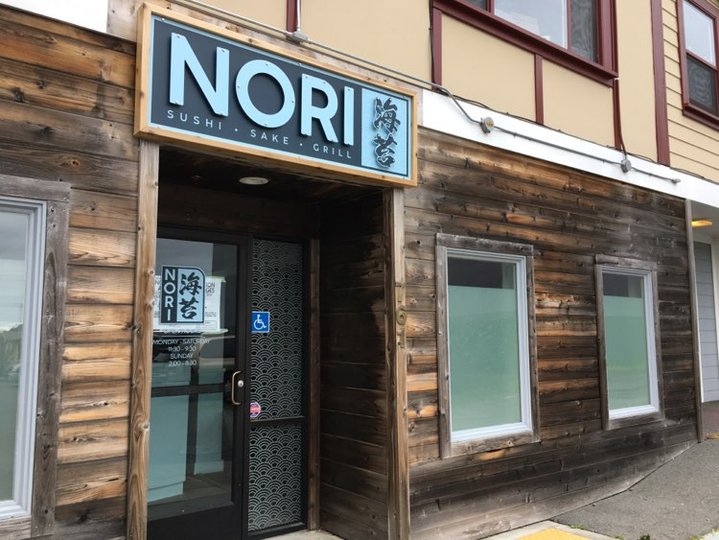
The rear entrance of Nori, off of 7th Street between G and H Streets in Arcata
Downtown Arcata will soon have a new dining option, with Nori — a sushi restaurant, grill and sake bar — opening toward the end of the month. And if you’re thinking Arcata already has enough sushi, manager Joe Tan says that Nori will offer something a little harder to find in Arcata: Taiwanese street food.
The restaurant is the latest business venture of Jack Wu, co-owner of both Bayfront Restaurant and Jack’s Seafood in Eureka. Tan — who manages the kitchen and sushi bar at Bayfront — is planning Nori’s sushi menu, and Bayfront chef Wen Yee will be running the kitchen, which will feature Taiwan street food style appetizers, grilled meats, seafood, noodles and more.
As for Nori’s sushi bar, Tan says it will be Izakaya style, with a small menu and small portions that people can snack on while enjoying the wide selection of sake the restaurant will offer. Tan said the menu will include dishes like poke and sashimi, and not a wide selection of the big “American style” rolls that are usually offered at other sushi restaurants. Although he will probably serve a couple big, spicy rolls, since that is what many people like, he said.
With two other sushi restaurants — Tomo and Sushi Spot — on the Arcata Plaza, Tan feels it is important to stand out. “I don’t want to compete against them,” Tan told the Outpost. “ I’m trying to do something different.”
At first, Tan added, he didn’t want to do a sushi menu at all. But the space, formerly occupied by seafood restaurant Salt, has such a beautiful bar that he felt was just begging to be utilized as a sushi bar.
In addition to opening Nori, Tan said that Wu has also purchased the Arcata Mazzotti’s — located almost right above the Nori space — and has plans to turn it into a nightclub and sports bar. The Outpost’s attempts to reach Wu about this project were unsuccessful.
Tan said that Nori is still trying to fill all the staff positions and is awaiting a health and safety inspection, but is otherwise pretty much ready to go and he is hoping the restaurant can open by March 26. Food and drinks will be available to-go and Nori will also offer limited indoor seating, as COVID guidelines permit.
Tan said more information will be posted on Nori’s website soon.
The Eureka Police Department today placed two of its officers — Sgt. Rodrigo Reyna-Sanchez and Officer Mark Meftah — on administrative leave, after a Sacramento Bee article detailed a string of hateful messages sent in a group chat among members of Sanchez’s squad chat over a period of months last year.
In an interview with the Outpost a few moments ago, Eureka Police Chief Steve Watson said that he will be looking for an investigator outside the department — and hopefully from outside the area — to conduct an internal fact-finding investigation into the group chat and the allegations raised by the story.
“I want a fresh, objective, impartial set of eyes on this,” Watson said.
Watson told the Outpost that while he had to wait for the outcome of that investigation to speak definitively about the matter, he said that what he knows so far is extremely disturbing — not only in itself, but because it undermines the work the department has been doing to reform its culture and build trust with the community.
“On the surface, this is deeply concerting, deeply upsetting to
me,” he said. “I am very angry.”
Only the two officers named in the article are on leave, Watson said, as they are the only ones who have been alleged to send the vile messages, which were misogynist, racist and violent. However, all department members — including other employees who were part of the chat — have been informed that this internal investigation is already underway.
If the investigation finds that officers in the chat acted contrary to the department’s policies, procedures or values, Watson said, then they will be subject to disciplinary measures, up to and including termination.
A few minutes after speaking with the Outpost, Watson sent out a letter to the community. It is reproduced below.
Dear Citizens,
Yesterday afternoon, the Eureka Police Department received a call from a reporter at
the Sacramento Bee newspaper who had questions about a text message exchange
between officers that reportedly occurred between January and August of 2020. At the
time of that call, neither I, nor my public affairs staff was aware of the material that he
referenced, so we asked for copies of the materials to be sent to our department and
the reporter obliged.
Upon learning the details of the content in these reported communications, I, like you,
was deeply saddened and disturbed. While the exchange that reportedly occurred
between officers was something that appears to have taken place on private devices, the
subject matter discussed professional duties and was profoundly upsetting.
As Chief of Police, I am deeply concerned with any allegation of behavior that calls into
question the professionalism of our officers, who are hired, trained, and trusted to serve
and protect the public interest. The kind of attitudes and behavior exhibited in the
transcript I saw did not and do not reflect the values and standards of the EPD.
As you may or may not know, this department has taken many steps over the last
several years to train and support our officers while strengthening our commitment to
the community we serve. What has been reported, unequivocally, does NOT meet the
professional standards to which we hold our public servants.
While the investigation into the veracity of these reports is still underway, and every
person is entitled to due process, the accusations are serious enough that this morning
my leadership team and I placed two officers who have been reported to have made
these statements on administrative leave. This leave is effective immediately and any
change of status will be evaluated pending deeper review of this critical matter. At my
direction, this investigation will be conducted by an independent, outside investigator.
We have worked hard together these past several years to create a community-service
oriented culture, and to build positive relationships with all members of our community
based on committed partnership, mutual understanding, trust and respect.
As Chief, I have also made it one of our department’s top priorities to focus on the high
standards our profession demands. Over the past four years, we prioritized providing
our officers training on implicit bias, procedural justice, racial and cultural diversity, de-
escalation techniques, and crisis intervention team training. We have also emphasized
outreach and services over enforcement to those experiencing homelessness — an
approach that stresses building relationships and collaboration within our homeless
community and service providers through our innovative Community Safety Engagement
Team (CSET) and Mobile Intervention and Services (MIST) programs.
Today, I feel compelled to state the obvious. The attitudes reflected in the text
messages that were shared with us yesterday, do not mirror this training. They do not
demonstrate the positive changes we have worked so hard to reach and they do not
meet my personal performance expectations for this department. Transparency and
accountability are required in the positions we fill, and you have my word that we won’t
rest as we keep working to achieve the standard our community expects.
On behalf of the many men and women of law enforcement who honorably protect and
serve their communities every day, in Humboldt County and across our nation, I seek
your support as we do everything in our power to earn and keep your trust.
While we leave room for the investigation to reveal more information, we also fully
denounce the content of the communications that have been reported. And, we
respectfully ask you to join us in doing the same. This is, in my opinion, the only right
way forward.
Just when you thought you’d watched all the junk TV your pandemic-oppressed brain could reasonably hope to withstand, here comes the latest fun/dumb docu-series Hulu is hoping you’ll get stoned and binge, this one featuring Humboldt’s two most enduring exports: Weed and Bigfoot.
If this sounds like your style of numbing agent, we invite you to check out the trailer for Sasquatch, above. Produced by the powerhouse Duplass brothers, the show deep dives into a story some guy heard almost 30 years ago about some NorCal cannabis farmers who were allegedly torn to pieces by the mythical creature. (I mean, who else would do that?!)
Here is Hulu’s synopsis:
While visiting a pot farm in Northern California in 1993, investigative journalist David Holthouse heard a story that still haunts him: On a nearby farm three men were torn limb from limb in a savage Bigfoot attack. Sasquatch follows David as he revisits the Redwoods 25 years later, in search of any evidence that might lead to the truth of what happened that night. As he pulls at the threads of this story he’ll be taken down a path that’s far more terrifying than anyone would have imagined.
Neat.
In a sign that Hulu knows what they have here, all three episodes of Sasquatch will be available to stream on April 20.
Press release from the Humboldt County Sheriff’s Office:
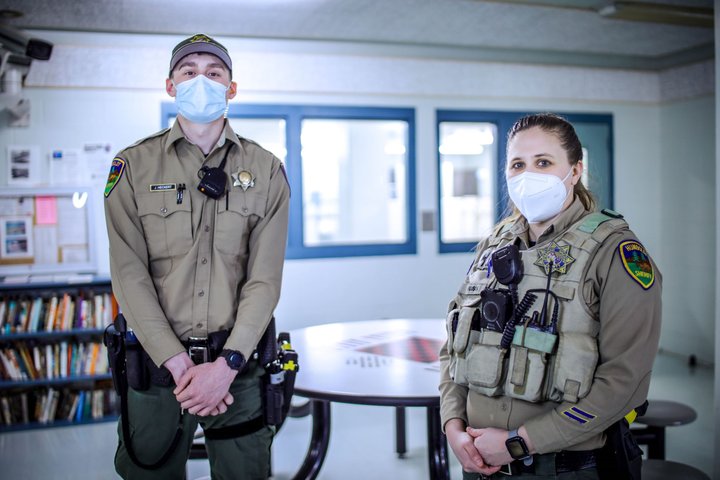
Two Humboldt County correctional deputies saved an inmate’s life last week after successfully performing the Heimlich Maneuver.
On March 8, 2021, during dinner service in the Humboldt County Correctional Facility, Correctional Deputy Jakob Heckert was working in a male housing unit and noticed an inmate who appeared to be choking. Deputy Heckert called for backup and immediately began administering the Heimlich Maneuver on the choking inmate. Correctional Deputy Jennifer Hudson responded to the call for backup and assisted Deputy Heckert with life-saving efforts. The deputies were able to successfully dislodge the obstruction from the inmate’s airway, saving the inmate’s life.
Humboldt County Sheriff William Honsal commends Deputies Heckert and Hudson for their quick actions and proper use of training to save a life.
The messages, sent over a period of several months, include multiple vulgar references to women, demeaning comments about homeless people, fantasies of employing deadly violence against suspects and jests about people who have contracted COVID-19.
At one point, an officer is told of an upcoming anti-war demonstration at the courthouse and replies “I’ll beat those f–– hippies down.”
The Bee reports that the text messages were confined to a group of six officers on the squad. The paper names only Sanchez and one other officer, Mark Meftah.
EPD Chief Steve Watson tells the Bee that an internal investigation has been opened into the matter.
There’ll be more on this story later today, and certainly more in the days and weeks to come. Read the Bee’s story here.
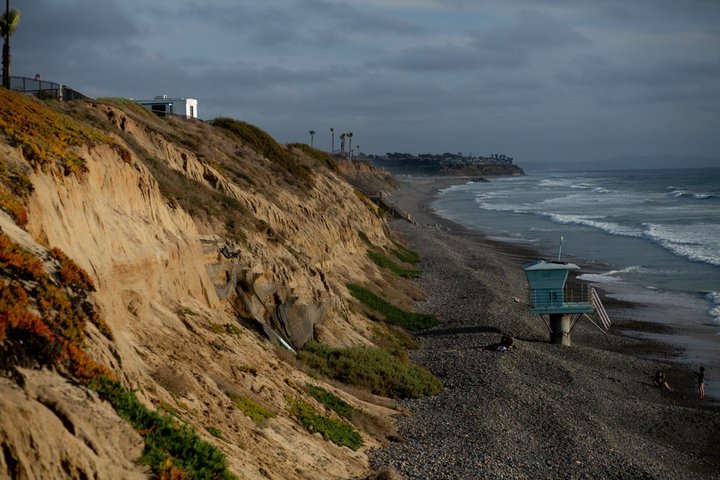
Despite decades-long attempts to prevent erosion, bluffs at South Carlsbad State Beach continue to fail, battered by rising seas. Photo by Shae Hammond for CalMatters
###
Of all the existential threats California parks face — dwindling budgets, more visitors and costly, long-deferred maintenance — now comes a climate-driven conundrum: When is a park no longer a park? When its namesake trees disappear in a barrage of lightning strikes? When its very land is washed away by ever-rising seas?
The California Department of Parks and Recreation is coming to terms with this dilemma after a climate-reckoning moment last August, when more than 97% of Big Basin Redwoods, California’s oldest state park, was charred by a lightning-sparked wildfire.
The shock of it was almost greater than the devastation: Coastal redwoods, the so-called asbestos forests of iconic, giant trees, hadn’t been hit by such ferocious blaze in living memory. The fire incinerated buildings and roads along with many trees; it was the most unexpected, indiscriminate and comprehensive destruction of a California state park, ever. Established 119 years ago, Big Basin remains closed.
Although all state agencies face the threat of climate change, state parks — with the depth and breadth of their 2,300 square miles of land — are singularly jeopardized. Caretaker of the nation’s largest state park system, the department is responsible for all of its historic structures, roads, bridges, land, beaches, forests, water, plants and animals.
“Every bit of California is going to be impacted by climate change. It’s going to affect every person in the state and every acre of land in the state,” said Jay Chamberlin, chief of the state parks’ natural resources division. “State parks are not only vulnerable, but some are uniquely vulnerable.”
Managing California’s nearly 300 parks will now require a top-to-bottom rethink: How to make public land more resilient to wildfires, rising seas, drought and extreme weather. The price tag for arming state beaches, thinning forests, moving restrooms and visitors’ centers, and other climate-resilience projects has not been calculated. But experts say if the money isn’t spent now to protect parks from rising seas and intensified fires, the damage and costs will multiply.
“There’s needs to be a climate resilience plan for every park unit,” said Rachel Norton, executive director of the nonprofit California State Parks Foundation. “This is what’s coming: Drought, fire, sea level rise, loss of habitat for species. There’s a lot more work to be done to understand the scope of the potential threat.”
In particular, making California’s state parks resilient to sea level rise and flooding is critical; the agency manages about a quarter of the state’s coastline. Although the state’s climate change response is ongoing and frequently updated, a comprehensive sea-level rise plan for parks is being finalized, officials said.
“Every bit of California is going to be impacted by climate change. State parks are not only vulnerable, but some are uniquely vulnerable.” — Jay Chamberlin, chief of the state parks’ natural resources division
Chamberlin said the agency is transitioning “to a stance where we consider climate in everything we do.”
“I’m talking about planning our capital investment, the vehicles we purchase or how we plan projects. When it comes to coastal issues, do not build in harm’s way. If a building needs roof repair, harden it if it’s in a wildfire zone. We are believers in building resilience into everything we do.”
The legislature is watching to see what the parks department comes up with.
“I tend to think, is there an engineering solution or a technology solution to this?” said Luz Rivas, a Democrat from Arleta who chairs the Assembly Natural Resources Committee.
Rivas, who has a degree in electrical engineering from the Massachusetts Institute of Technology and an advanced degree from Harvard, wonders if California can apply its ample brainpower to come up with solutions.
“We are very fortunate to have many research institutions and national labs working on this. California is a leader in climate change policy but also technology. I think we should meld the two.”
Forest fires of the future
Climate change will make forests more susceptible to extreme wildfires. By 2100, if greenhouse gas emissions continue to rise, one study found that the frequency of extreme wildfires burning over approximately 25,000 acres would increase by nearly 50 percent, and that average area burned statewide would increase by 77 percent by the end of the century. — California’s Fourth Climate Change Assessment (2018)
Even those deeply familiar with every woody acre of Big Basin Redwoods — home to ancient trees of such stature that many are named and curated — the aftermath was unsettling.
“Going back into the park for the first time, it was very hard to believe what I was seeing,” said Chris Spohrer, state parks superintendent for the Santa Cruz region. “To see what a fire of that intensity could do was disorienting. The landmarks were gone, the colors were monochromatic. It took several visits for it to sink in, to get your bearings. It was shocking.”
Even though the bulk of the contents of Big Basin was damaged or destroyed, the idea of the park, a celebration of the tallest living things on the planet, remains intact, officials say. While redwoods were burned, their bark is thick and fire-resistant, so park managers expect many of the big trees to survive, although other species, such as Douglas Firs, are not as hardy.
But things will be different. Managing a park to be resilient to fire is going to require change in a fundamental way in the decades to come: Visitors will have to alter their definition of a healthy park to include the sight of fewer trees and more prescribed burning. Managers may have to reduce the forest in order to save the park, and consider building future visitor centers and other facilities out of more fire-resistant materials like metal or concrete rather than charming but flammable wood.
Beginning in 1900, the Sempervirens Fund, a nonprofit conservation group, purchased about 17,000 acres of redwood forests and transferred them to the state, essentially creating Big Basin Redwoods. The organization also manages its own adjacent forests for climate resiliency by thinning and conducting controlled burns to reduce abnormal density of old-growth stands.
That work paid dividends during the blaze, resulting in low-intensity fire that cleared out overgrown vegetation but spared the giant trees on the group’s land, providing an object lesson for the adjacent park.
“There’s no one quick fix to any of this,” said Laura McLendon, the Sempervirens Fund’s director of land conservation.
To survive climate change, she said, California’s forested parklands must be aggressively managed for fire using an array of approaches. “There needs to be a suite of activities — fuels reduction, reintroducing fire to the landscape where it has historically occurred, rethinking where we develop and the materials we use.”
The complexities of extreme weather played a role in the Big Basin fire. Coastal redwoods are historically shrouded in cool, moist fog, providing a wet blanket that spared the region the catastrophic fires that plague the rest of the state. That fog has been significantly reduced and the region’s nighttime temperatures have risen.
Twenty-two state parks were hit by fire last year, according to the State Parks Foundation. Climate scientists say California can expect more frequent fires and more damaging megafires.
“There’s no one quick fix to any of this.” — Laura McLendon, sempervirens Fund’s director of land conservation
In Southern California, fires driven by late-summer winds regularly scorch state parks. More than half of parkland in the Santa Monica Mountains was damaged in the 2018 Woolsey Fire, with the popular beach retreats of Leo Carrillo and Malibu Creek State Parks bearing the brunt of the blaze. Historical sites were lost as well as employee residences and campgrounds. Will Rogers State Historic Park, a popular hiking retreat, has been hit by fire, and up the coast, Point Mugu State Park was nearly destroyed in 2013 by the Spring Fire, which burned more than 80 percent of the park and left it vulnerable to flooding.
Climate change’s impacts require adapting to a new and sometimes unfriendly climate, and building resilience — the buzzword of the moment — into the state parks’ nearly 1.5 million acres.
Sarah Newkirk, director of disaster resilience for The California Nature Conservancy, said it “used to be about bouncing back.” But now, “instead of bouncing back to the original configuration, we need to learn to bounce back better.”
Rising seas, rising threats
A new model estimates that, under mid to high sea-level rise scenarios, 31 to 67 percent of Southern California beaches may completely erode by 2100 without large-scale human interventions. Statewide damages could reach nearly $17.9 billion from inundation of residential and commercial buildings under (20 inches) of sea-level rise, which is close to the 95th percentile of potential sea-level rise by the middle of this century. A 100-year coastal flood, on top of this level of sea-level rise, would almost double the costs. — California’s Fourth Climate Change Assessment (2018)
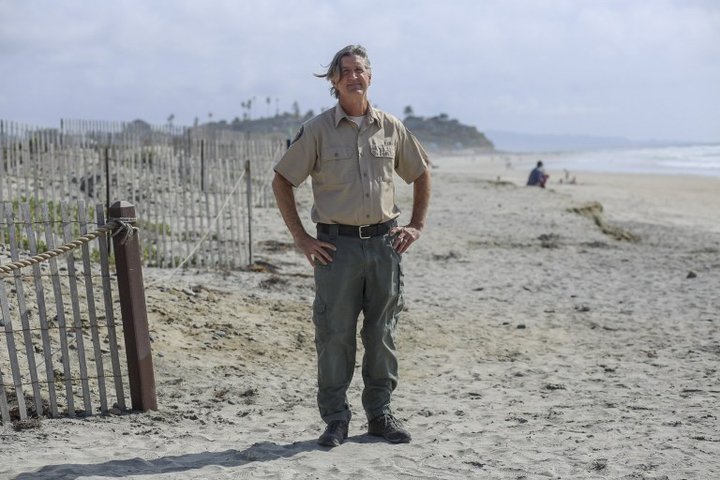
Darren Smith doesn’t need to read a report about climate change to understand the threats to state parks. He’s living it every day.
Smith, who is the natural resources manager for the park department’s San Diego Coast District, is fighting water — from all sides.
“We are being squeezed,” he said, gesturing to the ocean on a recent visit to South Carlsbad State Beach. The sea’s powerful wave action throws rocks and boulders up on the beach, cobbling it with smooth stones that crowd out sand.
Turning, Smith points to the cliffs behind him and the city of Carlsbad on the other side of a highway. El Nino-powered storms create runoff that gushes over bluffs or percolates into porous sandstone, carving fissures that pockmark and destabilize the cliff face. “We don’t have anywhere to go.”
As for a park campsite on a promontory affording a magnificent view of rugged coastline, “it’s a goner,” he said.
The Pacific Ocean is inexorably rising on the beaches he manages, slamming into bluffs and undermining parking lots, campsites and restroom facilities. On the ever-shrinking state beaches, Smith and his crews fight to preserve all-important “towel space” as well as public access. Staircases that lead down to the beach are in rusty decay and battered by waves.
The parks department is on a penny-pinching budget — $858 million for 2021-22, down 34% from the previous year because of one-time bond appropriations. Coronavirus closures cost the agency lost revenue from entrance fees and concessions.
The state is facing even worse sticker shock when considering the system-wide costs to respond to climate change. Smith said the agency can spend $3 million just replacing one beachfront staircase.
Experts say the state can no longer throw good money after bad and must plan for managed retreat — a wholesale push away from the sea. In Southern California, state park facilities are moved back from the shore in order to preserve them. Smith said a handful of beach-facing parking lots in his district have already been lost or moved.
In one case, not only does the public lose convenient access to a beach, but the state lost the parking lot’s annual $400,000 in revenue and spots for more than a million cars.
In some places, where the state beach is a narrow strip of land hemmed in by a road or highway, agency officials have to get creative, buying or swapping property from neighboring cities in order to move out of harm’s way.
Elsewhere, beach parks are being reconfigured by massive sand-moving projects. On a recent day, a parking lot served as a staging area for heavy equipment and excavators preparing to sculpt sand reclaimed from a nearby lagoon.
Darren Smith, manager of natural resources for the state parks department’s San Diego region, is keenly aware of the effects of climate change at California parks, including South Ponto Beach in Carlsbad. Photo by Shae Hammond for CalMatters
In Encinitas, an experiment in restoring a “living shoreline” is underway, an example of so-called soft armoring. Rather than piling up massive mountains of rock or pouring concrete to keep the sea at bay, the park built a dunes system anchored by native plants. The undulating sand dunes now provide an invaluable function, absorbing and slowing encroaching waves and providing habitat for an array of animals and plants.
The dunes are not only stabilizing the sand and preserving the beach, but on the landward side they prevent sand drifts from accumulating on the adjacent road. “If it wasn’t for this project, (it’s) guaranteed we would have lost some of the highway,” Smith said.
Smith said the parks agency is keenly aware of “what climate change is doing and will do in the future.” But he said, “we can’t keep up.”
Parks are threatened by other aspects of climate change, too: Extremes of heat and cold stress facilities and operations. Drought threatens animals’ habitat and makes trees more susceptible to disease and insect infestation.
Chamberlin, the parks’ resources chief, said future investments will be assessing whether a proposed facility is going to eventually be underwater or vulnerable to fire.
Whether its fire or water, climate change will continue to eat away at California’s parks — and the agency’s budget.
“The state parks system represents the most profound investment on the part of all Californians and reflects our collective passion to protect the natural environment,” said The Nature Conservancy’s Newkirk. “The state parks system has a real role in providing a good example of resiliency.”
###
CALmatters.org is a nonprofit, nonpartisan media venture explaining California policies and politics.
At the start of the pandemic, Brandon McCall’s two tenants ran into financial trouble. One had surgery, and went on disability, which tightened his purse strings. The other, who works in entertainment, was laid off almost immediately, and wasn’t eligible for unemployment as a contract worker. With a limited amount of cash coming in, McCall said the two of them stopped paying rent on his Van Nuys condo in Los Angeles.
McCall looked into mortgage forbearance, but decided to pass when he learned it would impact his credit. He would also have to pay in full after his deferral period was up. Unsure when the tenants would start paying again, McCall and his wife dipped into savings to cover the mortgage on their condo even as they rent elsewhere for work.
“Landlords rights and tenants rights are the same thing,” McCall said. “They’re often pitted against each other, but they’re the same thing. … I want to stay housed. I want to keep my tenants housed. We’re all in this together.”
I want to stay housed. I want to keep my tenants housed. We’re all in this together. — Brandon McCall, who is working with tenants
Throughout the past year, small landlords such as the McCalls have struggled to pay their mortgage when tenants became unable to pay. The state plans to provide some relief by using $2.6 billion in federal assistance as rent subsidies to pay landlords 80% of unpaid back rent of low-income tenants between April 2020 and March 2021. In exchange, landlords must agree to forgive the remaining 20% in back rent and agree not to pursue evictions.
The state rent relief program will not help McCall’s tenants, though; they make too much to qualify. Still, he said, he has been trying to help, connecting them to other relief programs and even putting them in touch with a local council person who might be able to offer assistance.
He is not contemplating eviction of his tenants, who have since gotten on a payment plan and are catching up on rent, citing his belief in the importance of affordable housing. But a number of small landlords are in the same boat as McCall: pinched from both ends, and wondering how much longer they are going to be able to float their own lives as well as their investment properties.
Small landlords struggle
Unlike the 2008 housing crisis when subprime lending triggered a wave of foreclosures, experts say property owners have fared surprisingly well during the pandemic. Homeowners, especially, have been assisted by low-interest rates and federally mandated mortgage forbearance. Edward S. Gordon Professor of Real Estate in the Finance Division at Columbia Business School Tomasz Piskorski estimated that some 60 million borrowers absorbed about $70 billion in debt during the pandemic.
However, not all small property owners have been able to take advantage of government relief even as they absorb the costs for renters.
“There are some landlords that will struggle to pay their bills because they aren’t receiving rent from tenants, or have units sitting vacant,” said Zillow economist Jeff Tucker. “It’s not like a larger property management company that can manage units and mostly muddle through. For a smaller-scale landlord with only a handful of rental units, they could easily be forced to sell their rental units or be foreclosed on if they have a mortgage on it.”
According to the 2015 American Housing Survey, nationally, about individual investors own 22.7 million units, accounting for a little under half the total number of rentals. Individual investors are more likely to own single-family homes or duplexes. About 70% of the rentals in LA are five units or less.
In large cities like San Francisco, rentals saw declines of 8% or 9% year over year. While low-income workers were more likely to be laid off and moved out to cut costs, wealthier renters, including a record number of millenials, ditched renting to become first-time homebuyers.
Desperate to get people in the door, landlords, many with mortgages on the properties they rent out, began offering months of free rent, free gym memberships and hundreds of dollars in gift cards to new renters.
Diane Robertson, a founding member of Coalition of Small Rental Property Owners, an LA-based grassroots organization that advocates for small landlords, worries about the future of rentals for small landlords. She founded the group after the state passed an eviction moratorium in 2020.
“There is a misconception about property owners in general,” Robertson said. “Small, independent owners, we are more like our tenants than not. If we have a duplex and one of those tenants is not paying rent, well, that’s half of your rental income. If you have more tenants, you can withstand a few of those tenants not paying rent, but that’s not the case for us.”
There is a misconception about property owners in general. Small, independent owners, we are more like our tenants than not. — Diane Robertson, founding member of Coalition of Small Rental Property Owners
Protecting landlords
Noni Richen is the board president of the Small Property Owners of San Francisco Institute, a nonprofit that aids small, local landlords. Most members are retired, and many live in a duplex, renting out the other apartment so they can make their mortgage payments or supplement their Social Security.
In December, a San Francisco landlord wrote to Richen, begging for assistance. She had received certified letters from her lender threatening foreclosure.
The woman, who had owned and managed two properties for 20 years, skipped three mortgage payments to save up for property taxes when a tenant stopped paying rent and she couldn’t evict them due to the pandemic, Richen said.
“Do you know if it’s legal for banks to foreclose during this pandemic,” she asked Richen. “Is there any relief that you know of for landlords?”
Other landlords have written to Richen with similar problems.
The threat of foreclosure isn’t just hurting landlords, it’s also hurting tenants, Richen said. Not only is the landlord facing a financial setback, her tenants may not have a place to live.
When the landlord is a renter
McCall is one of those landlords.
In December, he got an email from his landlords’ property manager that said their daughter would be taking over the management of their properties. It requested that McCall and his wife move out within 60 days.
McCall provided a copy of the email to CalMatters and The Salinas Californian. His landlord did not immediately return a request for comment.
With no cause of eviction listed, McCall initially refused to vacate the property, though he and his wife are considering moving out. Still, he said, it was uncomfortable being on both sides of this: potentially facing eviction while using his own savings to cover for tenants who still haven’t caught up on rental payments.
Robertson said problems like the ones McCall is facing are a result of lawmakers discounting the needs of landlords, who may go into foreclosure. Even though the powerful California Apartment Association backed the eviction moratorium deal covering 80% of back rent for low-income renters, Assemblymember Laurie Davies, a Laguna Niguel Republican, said landlords would still be on the hook for insurance, property taxes and maintenance costs. The deal also doesn’t cover many renters who made decent wages before the pandemic.
“I think, at the end of the day, landlords are not anti-renter,” Robertson said. “We want solutions that benefit both sides. I do think, though, that landlords want to be made whole.”
Slipping through the cracks
Under the CARES Act pandemic relief bill passed in April, federal lenders are required to provide 12 months of forbearance to homeowners unable to make their mortgage payments due to COVID-19. Since it would not count as delinquency, it helped keep people housed during the pandemic and kept foreclosures low.
Still, some property owners slipped through the cracks. Because the federal moratorium only applies to federal lenders, state or local lenders, such as local banks or credit unions, have continued to foreclose on landlords.
Under the Biden administration, California homeowners might see an extension of the forbearance provision, which could help some landlords who have lost out on rent. Economists say the share of homes in forbearance — about 2.5 million — hasn’t fallen much since October, indicating that those in forbearance have continued to renew out of necessity.
Meanwhile, landlords like the McCalls hope to avoid forbearance by waiting it out.
“At this point, we’re just a few months away from running out the clock on their 12 months,” Tucker, the Zillow economist, said. “That is going to loom large as a policy challenge this spring. Frankly, there’s a very good chance the simple solution is to kick the can down the road three or six months…but it’s a challenge.”
###
This article is part of the California Divide, a collaboration among newsrooms examining income inequality and economic survival in California.
CALmatters.org is a nonprofit, nonpartisan media venture explaining California policies and politics.