The proposed Fickle Hill Segment of the Arcata Ridge Trail, connecting the Arcata Community Forest and Sunny Brae Tract | Images from City of Arcata
After a decade of planning, the Arcata Ridge Trail — a five mile long trail planned to run all the way from Buttermilk Lane to West End Road — is one step closer to reality, after the Arcata City Council unanimously approved plans for the final trail segment needed to complete the project.
This final leg, called the Fickle Hill segment, will consist of about 1,600 feet of unpaved trail that will cross Fickle Hill Road, connecting existing trail networks in the Sunny Brae and Arcata Community Forest. Presented will three potential options, the council approved city staff’s “preferred crossing.”
The relatively small portion of trail will run near several private properties and some Fickle Hill residents have expressed concern over safety, privacy and environmental impacts, and a group of residents have even sued the City over the proposed trail route, saying it would would impact their water supply.
Uri Driscoll, one of the residents who filed the lawsuit, says the trail would run too close to a well shared by six families in the neighborhood. “We want to make sure that our system is protected,” Driscoll told the Outpost in a recent phone interview. “It will definitely affect the water system. It’s a steep slope and it’s a very dangerous road.”
During the council meeting on Wednesday night, Arcata Community Development Director David Loya said that the City has held multiple neighborhood meetings and came up with the alternative crossing designs to address some of these concerns. Though he did not comment specifically on the ongoing litigation, Loya said that the preferred design being presented to the council would have no impact on the water quality. The California Environmental Quality Act (CEQA) review also found no significant environmental impacts for the project.
Addressing some of the safety concerns, Loya said that the Fickle Hill Road crosswalk will include yield signs and arrows and a warning light 100 feet in front of the crossing. The County — which owns Fickle Hill Road —is also considering lowering the speed limit from 30 mph to 25 mph, Loya said.
Detailed design of the Fickle Hill crossing
Many community members commented during the meeting, most of them in support of the Fickle Hill segment and the long-due completion of the Arcata Ridge Trail. Some Fickle Hill residents felt that the project would improve safety, saying that many people already hike and bike on the skid trails in that area and there needs to be a way for them to safely cross the road.
“That literally is my backyard, so I just want to say YIMBY — yes in my backyard,” Melissa Hardy said to the council during the meeting. “Please do not delay in approving this project, which has been years in the making. People are not going to stop using this trail. They’re going to continue using the trial and instead walk on the road to make that connection.”
Some community members also expressed concern over increased traffic in the area, worried that people will treat the Fickle Hill crossing as a trailhead and park on the road to access the trail. Loya said that the City plans to do whatever it can to mitigate that activity and plans to install signs letting people know that this access point is not a trail head. The City will also place boulders in front of the nearby maintenance access area, to prevent people from parking there.
“I do want to address that and emphasize that this is not a trailhead,” Loya said during the meeting. “It is marked that it is not a trailhead. People should not be driving and parking up there. They should not be dropping off bikes. This is a trail access point and it should not be used any other way than for crossing and accessing directly on a bike.”
With council’s approval of the project, City staff will now work on identifying revenue sources for the project, which could come from the city’s Forest Fund, grants and donations and funding from the Measure A tax.
The project’s fate will also depend on the results of the ongoing litigation from the Fickle Hill residents surrounding the water source issue.
If all goes well, Loya told the Outpost, he is hopeful that construction on the trail segment could begin as early as this summer.
Are we confident that the new coronavirus variant linked to December’s outbreak in Eureka’s Granada assisted living facility has been contained? How was it discovered? Did the mutation that apparently developed there make that outbreak particularly large? Did it make people sicker?
Dr. Ian Hoffman, Humboldt’s public health officer, fielded these questions and more in an emergency media availability earlier this morning. Video above, rough transcript below.
###
Thank you for joining us for the February 18th media availability with County Health
Officer Dr. Ian Hoffman, who would like to begin by providing a brief statement
on the new COVID-19 variant that was recently identified in Humboldt County. Dr. Hoffman?
Thank you. This came out of an incredible partnership with many, many folks
who work both here within Public Health, at a research lab in San Francisco, the CZ Biohub,
folks from the CDPH - California Department of Public Health and our partners here at Granada.
The findings of this really highlight how well all of these different groups have worked together and
I think Humboldt County should be really proud of the work that’s been done to allow this finding.
So thank you to everyone who’s participated in this. We really feel that although the
outcome within Granada is devastating, the larger implications for how this turned out
for the community are really a wonderful story to tell, so, thank you.
From the Times-Standard: How many variants,
and how many cases of each, have been detected in Humboldt County to date?
So far the sequencing that we’ve done here for Humboldt County has identified only one of the
variants of concern or the variants that are being monitored, which is the L452r. That is
widely being called the ‘California variant’. So we found one of those back in November through
some of the sequencing that was done and the information that came a few weeks ago. In
this latest round there were another 13 of those that were found. So we’ve had 14 of those L452r
variants found to date in Humboldt County, which is not a surprising number considering
that statewide this is now becoming the dominant variant that they’re
finding in genetic sequencing. As many as 40% in some of the sampling to date.
This other - the N501y mutation that we found and identified that was specific only to the Granada
outbreak, is not a variant of concern. It is a single point mutation
that is also contained in some of the variants of concern from the U.K., South Africa and Brazil,
but in and of itself that single mutation is not considered a variant of concern. So
far these are the only major findings in our sequencing that have been found to date.
From the Times-Standard: Is the county going to invest more in
genomic sequencing to keep track of new variants?
We do a lot of genomic sequencing. Of our positive samples in the county,
we’ve sequenced nearly 22%, which is much higher than the recommended.
Within our lab, which are the ones that get sequenced, so the Humboldt County Public Health
lab has had about 50% of all of our positives have been sent to CZ Biohub for sequencing. Now, that’s
nearly all of this possible sequenceable specimens because not every single positive specimen can be
sequenced. There has to be enough of enough virus in there to sequence it. So, we really
are doing a lot more sequencing than most in both in California and in
the country. There is a new national initiative from the Biden administration to
increase funding for sequencing. So if there’s a possibility of doing more we’ll certainly
look into that, but we’re doing quite a bit already.
From the Times-Standard: With multiple variants on the rise,
can you explain how they would interact if they were spreading in the community
at the same time? Would the more virulent and vaccine-resistant strains become more dominant?
There’s a lot going into the factors that would determine if a variant became more dominant or
not. Things like the investigations and the tracing, the ability to stop strains
if they do enter our community or if mutations like this come up; the amount of testing goes
into it; additionally how the public is acting. If we’re following the guidance, if we’re masking
and distancing, we have less virus transmission in our community. We’re not traveling bringing in new
viruses from the outside - those are all things that will determine whether or not a variant of
concern comes into our county and spreads easily. Or, if we have something like this like a de novo
mutation, would it be able to take a hold and become more widespread.
From the Redwood News: Can you tell us everything that Public Health knows about the characteristics
of the new mutation identified in Humboldt County? Is it more transmissible? Does it
make people sicker? How is it different from other strains of the virus seen here locally?
This one particular mutation, the N501y, as I mentioned, is part of the three variants
of concern, but those have other mutations as well. So we don’t know whether this one would
behave exactly the same as those other ones, in terms of its transmissibility or infectiousness.
Given some of the laboratory studies that have been done around 501y mutations,
it is highly suggested that it is stickier and can bind more to the receptors that allow the virus
to enter the cells. So based on that and the fact of what we saw in Granada, it could be one of the
reasons that we saw such wide transmissibility and fast transmission in that setting.
From the Redwood News: The press release says that cases of the variant have been
linked to Granada Rehabilitation and Wellness Center and that it doesn’t
appear to have spread to the broader community. Can you explain how Public
Health came to this conclusion? Is this variant still present in our community?
Is there any chance it could potentially spread to the broader community in the future?
Through our investigations and contact tracing, we can really
feel confident that there were no lines of transmission from the case at Granada.
All of the contacts of anyone who was there were contacted, put on quarantine and
there is no evidence that any of those folks either transmitted to other
settings outside of Granada. Additionally, the sequencing that we’ve done to date has not shown
any spread of that particular - we haven’t seen the 501y mutation - in
any other samples. We’ll continue to monitor for that through ongoing genetic sequencing,
but I do think that given the time period that’s passed since Granada, that if this were something
that was going to be much more widespread we very likely would have seen it by now.
From the Redwood News: What does the presence of this new variant mean for
Humboldt County moving forward? How can residents best protect themselves against this new variant?
I don’t think there’s any concern for Humboldt with this new variant. I think it’s really
important for us to recognize that this is not a variant of concern and it’s different than
say the U.K. variant, the South African variant,
the Brazilian variants and other variants that we are monitoring. It’s a single mutation
and it very much seems to be contained to this one outbreak and did not spread from there.
As far as all variants go, the best thing we can do is to continue to do everything
that we’ve been doing. We have to wear masks, distance avoid gatherings, and wash our hands.
And those things will prevent the variants of concern and if this were circulating in our
community, that would be the same exact thing that would stop that from circulating broadly here.
From KMUD News: Can you describe how Covid variants occur in general
and how this local variant may have developed?
The coronavirus reproduces inside of our body and makes millions of new viruses
every time it makes a copy of itself, there’s a potential that it can make a mistake in that
replication of the genetic code. Those sorts of mistakes can sometimes confer advantages
to the genetics of the virus. This is not the first time this has been seen. This
mutation has come up in other places, obviously in those variants of concern, but also as a single
point mutation it has shown up in other places around the United States and around the world.
The way it can propagate is if it’s able to continue to spread beyond the original outbreak
and if it’s not contained. So I think that’s the important piece that we’re really focusing on
with this particular situation with Granada that it really based on all of our evidence today it
appears to be contained and did not spread and so was not able to become a variant of concern.
From KMUD News: Will this variant be added to the
CDC’s “Emerging Variant Cases in the United States” map?
No. The CDC map is only for variants of concern. So those are ones that again
have been identified as circulating broadly. This is a different kind of
situation with a single point mutation that seems to be contained to one local outbreak.
From KMUD News: Have other samples been sent to CZ Biohub since January?
Will there be continued genomic surveillance locally?
Absolutely. We continue to send samples as frequently as we possibly can.
From KMUD News: How does the genetic sequences from this variant
differ from others and why was it more contagious?
I believe we already addressed that.
From the North Coast Journal: How many samples from Humboldt County have been sent to CZ
Biohub for testing since the beginning of the Granada outbreak in November?
Do you believe it is a comprehensive enough sample to say with confidence
that this variant did not spread beyond the facility?
I don’t have exact numbers on for that, but we do send 100% really of what is sequenceable with the
regularity. So yes, there have been more sent since this time and we
continue to get that information back from CZ Biohub and we’ll continue to let anyone
know immediately if there’s a variant of concern. In this case with a mutation, we want to
really kind of study it and see and understand it before we make any determinations about
talking more broadly about it so that we can do it in a thoughtful way.
From the North Coast Journal: Is there evidence to suggest whether this new
variant is linked to a higher rate of critical outcomes from the disease?
I don’t believe there’s enough evidence to suggest that right now.
From the North Coast Journal: How is this variant similar/dissimilar to
others discovered in other parts of the state, country and world?
This shares only that one mutation at the in 501y. So that is with those three variants,
but also has been seen in other locations as single mutations that haven’t tended to spread.
From the North Coast Journal: Does discovery of this variant change
anything about how samples will be sent for genomic testing moving forward?
No. We continue to send samples on a regular basis and as many as we can, we’ll continue to do that.
From the North Coast Journal: What are the next steps to study this new variant and monitor for its spread?
We’ll continue to do our ongoing epidemiological and investigations
which could potentially link any cases to each other. We’ll continue to monitor through
genetic sequencing and I think really this just reinforces again the need for
more testing in our community, so that we can find these types of things if they are out there.
And for really following distancing, masking and gathering guidance.
From Reporter Daniel Mintz: A quote from today’s news release indicated that it
isn’t unexpected to see variants occasionally emerge from outbreaks. But this is one of many
variants around the world that have adopted mutations useful to the virus. What are the
implications of this level of viral diversity and how likely is it to be a continuing trend?
I think it really shows that this virus,
every chance it gets to reproduce it is a chance for it to show a mutation. Some mutations like
this one likely confer some sort of advantage to the virus. So, again going back to the basics of
the more we can stop the spread of this the less chance this virus has to mutate.
We will continue to do everything we can here at Humboldt County Public Health
and the Humboldt County Public Health lab to try to stop this disease from spreading and
we ask everyone to do our part with masking, distancing, avoiding gatherings, hand washing.
From the Times-Standard:
Should people be concerned about reinfection after they’ve been vaccinated?
There are rare cases that have been reported so far and it’s being very closely monitored.
I would just encourage everyone once you’re vaccinated, really important we gotta
continue to do all the same things: distancing, wearing a mask, avoiding gathering, keeping and
just keeping in your household and hopefully as there’s more data out there, we’ll know more and
can update folks on whether there is a risk for reinfection or what the risk is.
From the Times-Standard: Is it likely COVID-19 is here to stay and may require
a yearly booster shot like the flu once everyone is vaccinated?
Again, time will tell and studies will tell,
but I think that’s probably likely.
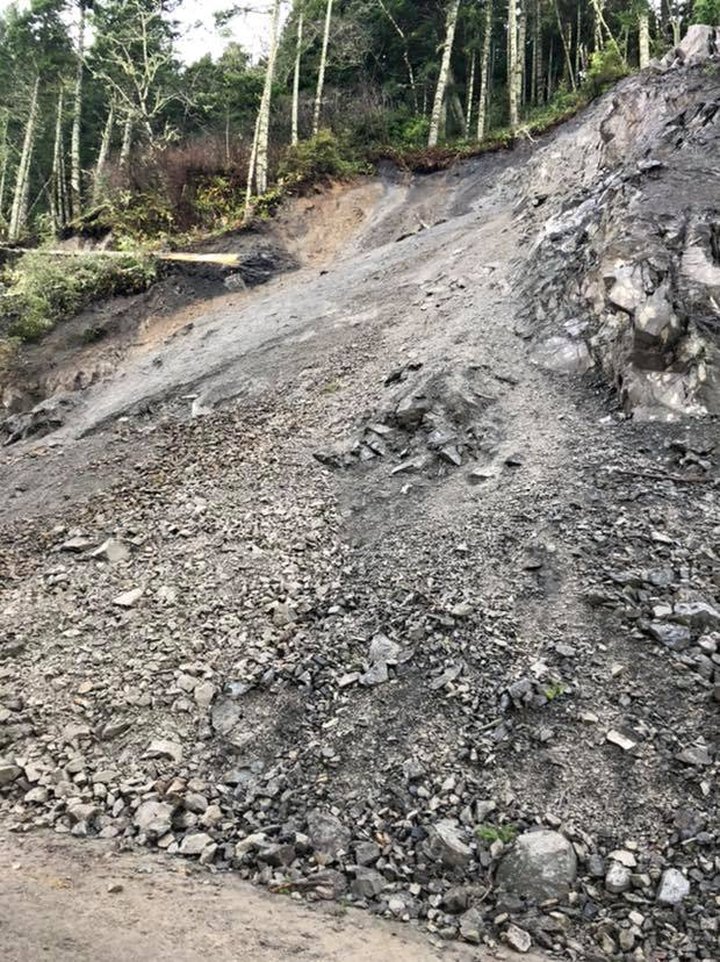
More weather, more slidin’. The latest from Caltrans on the most recent closure of Highway 101 at Last Chance Grade below:
TRAFFIC ALERT: U.S. Highway 101 is fully closed at Last Chance Grade, south of Crescent City, due to a slide. The highway is likely to reopen later today, but this estimate is subject to change if additional slide activity occurs. We continue 24/7 monitoring of the area to ensure safety and prompt reopening.
This beloved Humboldt fixture will soon whirl again!
For almost three decades, beginning way back in 1991, Harper Motors’ classic 1947 Allan Herchell carousel was a welcoming site on the stretch of Highway 101 between Eureka and Arcata where it long provided a useful distraction to Humboldt kids whose parents needed to direct their full focus to the tedious task of purchasing a new vehicle. Thanks to the colorful ride, many cars were sold and countless children’s “whee”s were extracted.
But it’s been a long time since those horsies have spun. ’Twas back in 2019, when the carousel had already sat idle for a couple years, that lot co-owner Trevor Harper told LoCO he was trying to unload the attraction due to associated insurance and maintenance costs.
“It’s time to move on,” Harper told the Outpost back then. “I’m just not in the amusement business.”
New potential carousel homes have been discussed. For a time, there was talk that Harper might donate it to the City of Eureka to anchor a reimagined Clarke Plaza in Old Town. City officials even went so far as to draw up design proposals, but the pricey plan never materialized.
Well, good news for fans of local nostalgia can be found in today’s North Coast Journal: Harper has found someone willing to accept his twirly donation. Humboldt County’s only carousel has found a new home at Bear River Rancheria in Loleta.
According to Darrell Sherman, a Bear River Rancheria tribal councilmember, the carousel will soon reside next to the Bear River Recreation Center on Keiser Road. Currently it’s being restored and new lights are being added so that someday, post-pandemic, parents will be able to treat their kids to an evening ride overlooking the Eel River Valley.
“I thought it was such a great opportunity, not only for the tribe but also for the community and for future generations,” Sherman told the NCJ. Later in the piece, he painted a picture of the possible future joys to come.
“At seven o’clock at night, you’re there and looking over the river, looking down on Ferndale and that’s something that no one has ever done before and now you’re enjoying a carousel ride with your loved ones at nighttime … it could potentially be a magical experience and that’s where this idea and thought came from, wanting to give back to the community and provide things you could enjoy with your loved ones.”
Press release from the Humboldt County Sheriff’s Office:
On Feb. 17, 2021, at about 10:48 a.m., Humboldt County Sheriff’s deputies were dispatched to the 1800 block of Pickett Road in McKinleyville for a suspicious vehicle investigation.
Deputies arrived on scene and contacted two occupants of the vehicle, 43-year-old Jeremy John Cringle and 24-year-old Kayla Ann Greenslit. Both Cringle and Greenslit were found to have outstanding warrants for their arrest.
During a search of both individuals and the vehicle, deputies located approximately .96 grams of heroin, approximately 1.5 grams of methamphetamine, drug paraphernalia and pepper spray.
Greenslit was arrested and booked into the Humboldt County Correctional Facility on fresh charges of possession of a narcotic controlled substance (HS 11350(a)) and possession of drug paraphernalia (HS 11364(a)), in addition to warrant charges of evading a peace officer (VC 2800.2), vehicle theft (VC 10851(a)), possession of stolen property (PC 496d(a)), false identification to a peace officer (PC 148.9(a)), petty theft (PC 488), grand theft (PC 487(d)(1)) and possession of a stolen vehicle (PC 496d(a)).
Cringle was arrested and booked into the Humboldt County Correctional Facility on fresh charges of felon in possession of tear gas (PC 22810(a)), possession of a controlled substance (HS 11377(a)) and possession of a narcotic controlled substance (HS 11350(a)), in addition to warrant charges of transport/sell controlled substance (HS 11379(a)), possession of a narcotic controlled substance (HS 11350(a)), possession of greater than 28.5 grams of marijuana (HS 11357(B)(2)), driving with a suspended license-prior conviction (VC 14601.2(a)), trespassing (PC 602(o)), failure to provide evidence of financial responsibility for vehicle (VC 16028(a)) and texting while driving (VC 23123.5(a)).
Anyone with information about this case or related criminal activity is encouraged to call the Humboldt County Sheriff’s Office at (707) 445-7251 or the Sheriff’s Office Crime Tip line at (707) 268-2539.
Press release from the Humboldt County Drug Task Force:
In early February of 2021 the Humboldt County Drug Task Force (HCDTF) were advised that Rodrigo Moreno Rios, AKA: “Shorty” (44 years old Fortuna) was again trafficking heroin in the Eel River Valley area of Humboldt County. Agents were able to obtain Rios’s new cell phone number that he was using to run his drug trafficking organization. An agent of the HCDTF, while working in an undercover capacity, called Rios posing as a new customer. Rios agreed to meet with the undercover agent at a local casino. Rios met with the agent, asked several questions, and agreed to start selling heroin to the agent.
Between Friday February 12th and Tuesday February 16th the undercover agent called Rios and ordered different quantities of heroin on three occasions. Rios negotiated weights, prices, and meeting locations with the agent and then Rios directed his runner, Alberto Evari Vielma Gonzalez (29 years old from Eureka) to meet the agent. HCDTF agents conducting surveillance watched Gonzalez take the money to his boss, Rios, after he sold heroin to the agent.
On Wednesday February 17th the undercover agent ordered a quantity of heroin to be delivered to a parking lot in the 700 block of South Fortuna Blvd. in Fortuna. When Gonzalez arrived in the parking lot a deputy from the Humboldt County Sheriff’s Department (HCSO) along with officers from the Eureka Police Department (EPD) POP Team made a traffic stop on Gonzalez and detained him without incident The heroin Gonzalez was delivering was located in the vehicle.
HCDTF agents then served a search warrant at Rios residence in the 3800 block of Rohnerville Rd. in Fortuna. Rios was detained inside the house. Agents recovered the phone being used to run the drug trafficking organization in Rios possession.
Agents requested a bail increase and source of bail hearing for Rios pursuant to 1270/1275 PC. The order was approved by a Humboldt County Superior Court Judge. Rios and Gonzalez were both booked at the Humboldt County Jail for the following charges:
H&S 11351 Possession/sales of controlled substances (4 counts)
H&S 11352 Transportation of controlled substances for sale (4 counts)
PC 182 Conspiracy by two or more people to distribute heroin
HCDTF would like to thank EPD & HCSO for their assistance with this investigation. Anyone with information related to this investigation or other narcotics related crimes are encouraged to call the Humboldt County Drug Task Force at 707-267-9976.
From the Humboldt County Joint Information Center:
A
never-before-seen COVID-19 variant has been identified in Humboldt
County, but Public Health officials say current evidence suggests it
was contained to a single outbreak and there is no indication it has
spread to the broader community.
In
late January, Humboldt County Public Health submitted dozens of
samples from individuals who tested positive for COVID-19 at the
Granada Rehabilitation and Wellness Facility, along with dozens of
random samples from the Humboldt County Public Health Lab (PHL), for
routine genomic surveillance. Genomic sequencing of the samples was
conducted by Chan Zuckerberg Biohub (CZ Biohub), a nonprofit medical
research organization that has been responsible for about 45% of the
genomic surveillance in California.
CZ
Biohub determined that 16 of those samples had the same mutation of
the virus’s spike protein at the N501Y position, which is common
among other COVID-19 variants, and Public Health linked all 16 back
to the Granada facility. Lab studies suggest that this mutation makes
the virus “sticky” or easier for the virus to attach to a cell’s
receptors, which could result in a higher rate of transmission.
Humboldt
County Health Officer Dr. Ian Hoffman said that it appears the
mutation occurred within the Granada facility as the virus spread
among staff and residents. “There is no evidence to suggest that
this variant was brought in from outside of Granada, and data
provided by CZ Biohub indicates that it has not been seen elsewhere
in Humboldt County,” he said. “The good news is there has been no
evidence either through genetic testing or contact investigations to
indicate the variant spread into the broader community.”
Senior
Biosecurity Fellow at CZ Biohub Dr. Patrick Ayscue said, “Mutation
is a natural feature of viruses, so it is not unexpected that we will
see variants occasionally arise in outbreaks.” Dr. Ayscue went on
to say, “What is pretty remarkable here is Humboldt County Public
Health was in a position to identify a new and potentially dangerous
variant, contain it and successfully stop it before it had the
opportunity to spread more broadly. It’s really a credit to the
hard work of local public health and their partners.”
The
Humboldt County PHL has been collaborating with CZ Biohub since June
2020, and the nonprofit has sequenced more than 650 samples from
Humboldt County, accounting for approximately 22% of total cases. PHL
Laboratory Manager Dr. Jeremy Corrigan said, “After we package and
send the samples, our teams work together to analyze the sequencing
data and identify any variants of concern. Sequencing also provides a
measure of quality control because we can monitor for mutations that
could impact the effectiveness of the PCR test we utilize,”
referring to the polymerase chain reaction test used by the PHL. Dr.
Corrigan noted that these kinds of partnerships are a great
opportunity to leverage expertise and resources to better understand
local COVID-19 conditions.
Dr.
Hoffman described the outbreak at Granada as heartbreaking for
residents, their families and caregivers as well as the community at
large. Identifying this variant, he said, offers a better
understanding of why the virus was able to spread through the
facility so quickly. “Genomic sequencing is a tool we’ll continue
to use to help us monitor for and contain variants before they become
a problem,” he said.
With
variants of concern on the rise around the world and here in
California, Dr. Hoffman said, prevention measures are vital to
keeping the spread of COVID-19 in check. “Please continue to wear a
mask when in public, maintain physical distance and wash your hands
regularly.”
Read
more about CZ Biohub’s genomic sequencing at czbiohub.org.