
Eureka City Schools Board Votes to Resume Optional In-Person Instruction for All Grade Levels Starting March 1
Ryan Burns / Friday, Feb. 19, 2021 @ 12:05 p.m. / Education
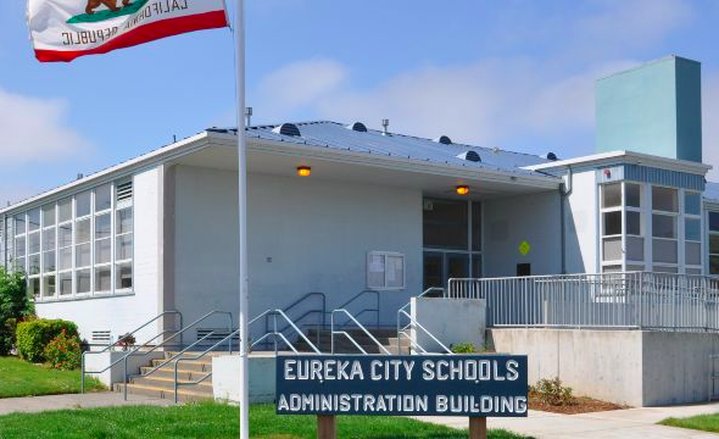
Eureka City Schools administration building. | Photo via ECS.
###
The Eureka City Schools Board on Thursday voted to make in-person instruction available as an option for all grade levels, preschool through high school, according to Superintendent Fred Van Vleck.
In a message posted to the district’s website and Facebook page Friday morning, Van Vleck said parents will have the option of sending their kids for in-person instruction or continuing with distance learning. Schools in the district offering instruction at the preschool level through eighth grade will reopen their doors on March 1, according to the post, though Eureka High and Zoe Barnum High may have to wait until Humboldt County has been in the Red Tier for 5 days.
Humboldt is currently in the Purple Tier in the state’s COVID-19 protocols, but Van Vleck writes, “We are optimistic that the County will move to the Red Tier on Tuesday, February 23rd, thus potentially allowing the high schools to provide the option for in-person learning on Monday, March 1st.”
Not everyone is pleased with the decision. An educator with the district who asked to remain anonymous, fearing for their job security, told the Outpost in an email, “I am extremely angry with last night’s school board decision to reopen schools before all teachers are vaccinated. In January, they agreed to wait until all teaching staff had cleared their second dose. This was a decision that demonstrated their support for us educators, who have been frankly abused in these distance learning months.”
Here’s Van Vleck’s message in its entirety:
Greetings Eureka City Schools Families,
Last night, on Thursday, February 18th, the Eureka City Schools Board met and determined that in-person instruction will be available as an option for all grade levels, preschool through high school. This means you will have an option for whether or not you would like your student to attend in-person instruction or continue on distance learning.
In-person learning will be available starting Monday, March 1st, for preschool through 8th grade. As of right now, the California Department of Public Health will not allow Eureka High School or Zoe Barnum High School to open for in-person instruction until Humboldt County has been in the Red Tier for 5 days. We are optimistic that the County will move to the Red Tier on Tuesday, February 23rd, thus potentially allowing the high schools to provide the option for in-person learning on Monday, March 1st.
As we transition to the option of in-person learning, there will be much work happening in preparation. Many of the details are not yet available. Your student’s school site will be in contact with you next week to determine whether or not you would like your student to stay on distance learning or attend in-person. Sites will also be reaching out with the schedule details, as there will likely be modifications to start and end times for both in-person and distance learning to accommodate bussing. If you have specific questions, please contact your student’s site.
We will not be able to transport students on our buses at the normal capacity, so if you have the means to get your student to school, please plan to do so. For those who rely on bussing, we will do our best to safely accommodate as many students as possible. More information will be available next week.
As we transition back to in-person learning, please be patient with your student’s teachers, their school site, and the District. We are starting a new way of learning, a combination of in-person and distance learning, that teachers have never done before. We are all but certain to have issues as we learn how to best serve students in two different learning modalities.
As students return to in-person instruction, please be advised, all students must wear a face covering and follow travel advisory and contact quarantines as directed by Humboldt County Public Health.
Please pause and consider your plans for safe interaction with others. Please follow the advice of Humboldt County Public Health to help keep your family and our community safe.
Stay healthy and stay strong.
BOOKED
Today: 6 felonies, 8 misdemeanors, 0 infractions
JUDGED
Humboldt County Superior Court Calendar: Yesterday
CHP REPORTS
No current incidents
ELSEWHERE
Governor’s Office: What they are saying: California leaders praise Governor Newsom’s democracy defending action ahead of November elections
Governor’s Office: Governor Newsom signs bill expanding fuel options to help Californians save at the pump, amid Donald Trump’s gas price crisis
Governor’s Office: Governor Newsom expands film and TV tax credits with new legislation, creates tax credit to support post-production jobs
Governor’s Office: Governor Newsom signs new laws to protect California elections from Trump interference
Eureka Sex Trafficker Pleads Guilty to Assault and Imprisonment of 16-Year-Old Girl; Takes Five-Year Sentence With Credit for Time Served
Rhonda Parker / Friday, Feb. 19, 2021 @ 11:48 a.m. / Courts
David Bernard Anderson II, charged with the sexual assault and false imprisonment of a 16-year-old Eureka girl in December 2018, pleaded guilty this morning to four felony charges and agreed to a five-year term behind bars.
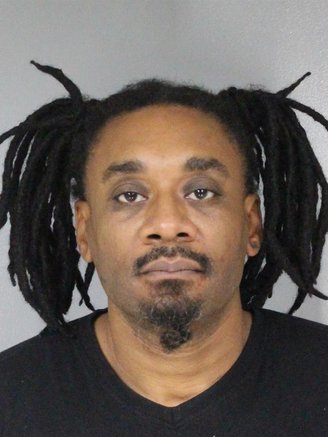
Anderson.
Anderson, 49, has already been in jail for two years, and with good-time credit will have more than three years of credit against the five-year term. He was previously convicted of sex-trafficking another young woman.
Today he admitted to two counts of unlawful sexual intercourse with a minor, one count of false imprisonment using force or fear and one count of attempted pandering, defined as procuring a person for the purposes of prostitution.
Anderson waived his right to appeal. He may have to register as a sex offender, but that issue will not be argued until his sentencing on March 16.
“I’m the one who has to make that call,” Judge Christopher Wilson told Anderson during the plea hearing. Anderson was on video from the jail, and his attorney, Michael Acosta, appeared via Zoom.
Anderson held the teenager captive in his Eureka apartment, taking away her clothing and cellphone. She escaped, wearing Anderson’s clothing, when he went to the store to buy her some cigarettes.
At one point Anderson reportedly told the girl “I could make a lot of money off you.”
As part of the plea agreement four charges were dismissed, including a count of rape.
“In reaching this resolution,” Deputy District Attorney Stacey Eads said, “a great deal of consideration has been given to the physical, mental and emotional well-being of Jane Doe. In no way am I suggesting that she was not strong or prepared to proceed through this trial. But nonetheless, I think this is in her best interest.”
Anderson’s trial had been scheduled to start today, with a panel of prospective jurors already summoned.
Anderson also admitted that in 2018 he violated the terms of his Post Release Community Supervision program. Eads said Anderson gave his program manager an address “where he kept a few belongings” rather than the address where he lived. It’s possible he could receive an additional 180-day term for that crime, though it has not been determined whether that will be added to the five-year term or served concurrently.
###
PREVIOUSLY:
- Eureka Police Arrest Man on Human Trafficking, Sexual Assault Charges
- Eureka Man Accused of Rape, Human Trafficking of a Minor Appears in Court; Preliminary Hearing in the Case Set for Day After Christmas
- COURT ROUNDUP: DA Alleges Fatal Humboldt Hill Collision Suspect Bailed Out With Illegal Weed Money
- TODAY in COURT: Latest on the Rio Dell, Manila, Hikshari Trail Murder Cases; Trial of Accused Eureka Sex Trafficker Delayed
- TODAY in COURT: Sex Trafficking Suspect Gets to Keep Lawyer, Who Faces His Own Criminal Charges; Eureka, Rio Dell Killings Also on Docket
- Virtual Preliminary Hearing Set Up for Eureka Man Accused of Sex Abuse, Trafficking; Proceedings Will Be Broadcast on YouTube
- TODAY in COURT: Preliminary Hearing for Eureka Sex Trafficking Suspect Underway
- Judge Drops Sex Trafficking Charges Against Accused Eureka Man; Suspect Will Still Stand Trial for Rape and Sodomy of a Minor
- TODAY in COURT: Date Set for Attorney’s Suit Against Judge for Alleged Abuse; Rio Dell Murder Suspect Heading to Trial Next Month
- TODAY in COURT: Accused West Del Norte Shooter Pleads Not Guilty; Sex Trafficking Suspect Hopes for Deal; Waterfront Murder Trial Delayed Again
The Squeeze Is On: Amid Recall Threat, Newsom Faces Single-Payer Dilemma
Ben Christopher / Friday, Feb. 19, 2021 @ 7:13 a.m. / Sacramento
Along with a pandemic, a recession, closed schools, ongoing budget negotiations and a likely recall campaign coming later this year, Gov. Gavin Newsom now has one more political problem to deal with: How to keep — or break — one of his biggest campaign promises.
When running for governor in 2018, Newsom vowed to replace an “inefficient and wasteful” patchwork of private insurance companies and programs with a single, state-funded health plan for everyone. “I don’t know how to do it, because it’s never been done. But I believe it can be done. And if any state can prove it, we can,” he told CalMatters then. “I’m willing to tackle this.” Progressive activists and the powerful California Nurses Association rallied to his candidacy.
Three years later, some of those supporters say it’s time for the governor to make good on that promise.
“Governor Newsom campaigned for single payer…These are things we are trying to hold him to,” said Eric Vance, an organizer with Healthy California Now, an umbrella organization of unions, health care activists and alums of Vermont Sen. Bernie Sanders’ presidential campaign, pushing for single payer.
Donald Trump has exited the White House. The pandemic has created an unprecedented public health crisis. And although President Joe Biden opposes a federal single-payer program, Xavier Becerra, the Californian he nominated to be his health secretary, is a single-payer proponent.
Said Vence: “Now more than ever is the time.”
The political pressure is due to ratchet up further today when Democratic Assemblymember Ash Kalra from San Jose is set to unveil legislation to push the state toward adopting a single-payer program.
These fresh demands arrive at a politically delicate moment for the governor. With a recall campaign increasingly seen as inevitable, he can ill-afford to tick off progressives. But earnestly campaigning to scrap the state’s entire health insurance system and replacing it with a government-run program that analysts say could cost more than the state’s entire budget remains a dicey political proposition.
The political pressure is due to ratchet up today when Democratic Assemblymember Ash Kalra from San Jose is set to unveil legislation to push the state toward adopting a single payer program.
Newsom already has plenty of those. Earlier this week, San Francisco state Sen. Scott Wiener introduced a state bill to ban hydraulic fracturing, forcing the governor to choose between honoring another campaign promise or providing more fodder to recall opponents who blame the governor for the state’s job losses.
Ditto, the school opening debate. Critics on the right condemn the governor for not doing enough to get kids back in school — Republican former San Diego mayor Kevin Faulconer has made this a focus of his bid to replace Newsom. Meanwhile, the California Teachers Association, one of Newsom’s largest backers in 2018, rolled out a statewide ad campaign warning lawmakers to “put safety first.”
The single-payer conflict amid a recall campaign presents an especially “vexing political problem” for the governor, said Thad Kousser, a University of California San Diego political science professor. There are two competing theories on the best way forward, he said.
Theory number 1: “The best way to defend yourself against a recall in a state the Democrats just won by 5 million votes is to lock down the left — and some movement toward single payer, some strong commitment, could do that.”
Theory number 2: “This is not the right time to take on a very controversial and very costly policy that may not even find a welcome audience in DC.”
Sal Rosselli, president of the National Union of Healthcare Workers and vice chair of Healthy California Now said there’s no real dilemma because the concept of a state-funded health insurance program is already popular.
“A super, super majority of Californians already support ‘Medicare for All,’” he said. “Am I concerned about (Newsom) alienating people? I’m not. I’m confident that he’s going to lead.”
That’s exactly what Newsom said he would do when he was a candidate.
Polling does regularly show that a wide swath of Californians support single payer — at least as a concept and in certain circumstances.
In 2017, the Public Policy Institute of California found that 56% of likely voters surveyed supported the creation of “guaranteed health insurance coverage” from a “single state government health plan.” But support fell to 43% if enacing such a plan meant higher taxes. Single-payer proponents argue that the higher taxes needed to finance a single-payer program could be at least partially offset through lower or eliminated premium and copay payments.
And last April the UC Berkeley Institute of Governmental Studies poll found that 55% of registered California voters surveyed either somewhat or strongly agreed that a single-payer program “would improve the nation’s ability to respond to disasters and pandemics such as COVID-19.”
Garry South, a Democratic political consultant who has worked with the California Nurses Association in the past, said those polling results might overstate the public’s support.
In surveys, if you ask Californians “‘Do you think that health care is a right and not a privilege and that every American or every Californian should have health insurance?” you’re going to get an overwhelmingly strong response, South said. But those ideals often come with another set of convictions, he said: “In achieving that, don’t ask me to give up anything. Don’t ask me to give up my private health insurance. Don’t ask me to pay more in taxes.”
South said Newsom’s priority should be on expanding health insurance coverage — both public and private. “It’s not about some other terminology you want to stick on it. It’s about universal coverage,” he said.
But for the single-payer-or-bust contingent of the Democratic Party, the debate is about more than terminology. They say the only way to provide cost-effective health insurance to everyone is through a universal, publicly funded program. According to the Kaiser Family Foundation, 7.8% of Californians went without health insurance in 2019, the last year for which there was reliable data. That’s down from 17.2% in 2013, a decline that California won through its eager embrace of the Affordable Care Act.
“People in general have a pretty jaundiced view of government’s ability to deliver.”
— Garry South, Democratic political consultant
Supporters of single payer say the current public health crisis only reiterates the need for sweeping change. “If there’s an argument for single payer it’s certainly the pandemic…the current system doesn’t work,” said Michael Lighty, a policy consultant working for the National Union of Healthcare. Critics say just the opposite: that the jittery vaccine rollout and the cascading series of failures at the state’s Employment Development Department should make Californians especially wary of entrusting their health insurance to a new state bureaucracy. “People in general have a pretty jaundiced view of government’s ability to deliver,” said South.
As governor, Newsom took symbolic, if minor, steps. In one of his first acts, he sent a letter to the Trump administration and congressional leaders asking for the federal waivers that would be required to bring all the health care funding that flows to the state through Medicare, Medicaid, the Veterans Administration and other programs under a single program. It was a nonstarter with the Trump administration.
In late 2019, Newsom also launched a statewide commission tasked with deciding what a single-payer system in California would look like and how it would work. Initially given a due date of this month, the commission — which some single-payer advocates saw as a stalling tactic to begin with — has been sidelined by the pandemic and hasn’t convened since August.
Kalra’s bill marks the first time Newsom will have to contend with single-payer legislation as governor. Of course if recent history is any guide, it may not reach his desk.
In 2017, a single-payer effort sponsored by the nurses’ union sailed through the state Senate but stalled in the Assembly. That proposal lacked a funding source, making it politically and procedurally easier to pass, but lacking vital details. Democratic Speaker Anthony Rendon shelved the bill, shielding his caucus from a contentious debate over how to pay for it. Healdsburg Democrat Jim Wood, chair of the Assembly Health Committee, has written an opinion piece that accuses the nurses of “boiling this very significant and complex issue into a chant.”
Four years later, Rendon is still the speaker and Wood still chairs the health committee.
David Townsend, a political consultant who often works for business-friendly Democrats, said he’d be “surprised” if a single-payer proposal gets out of the Legislature. “Even if Newsom wanted to, there’s just no way.”
Single-payer supporters are divided over the legislation too. Though the California nurses, who sponsored Kalra’s legislation, are part of Healthy California Now, the coalition itself is neutral on the bill. Instead, the organization’s goal is to ask Newsom to begin negotiations with the federal government over how to reroute federal health care spending toward a future single-payer program.
“The governor of California needs to lead this whole process,” said Rosselli of the National Union of Healthcare Workers.
###
CALmatters.org is a nonprofit, nonpartisan media venture explaining California policies and politics.
Lawmakers Blitz Governor on School Reopenings
Ricardo Cano / Thursday, Feb. 18, 2021 @ 6:45 p.m. / Sacramento
Disagreements between California’s Democratic-controlled Legislature and its Democratic governor over a plan to reopen schools came to a head Thursday as lawmakers introduced a bill they say would safely bring students back to campus this spring.
Senate Bill 86 would require California’s school districts to offer some sort of in-person instruction to students in kindergarten through sixth grade by April 15 if case rates in their county fall below 7 positive cases per 100,000 residents, known as the red tier.
Some parts of Gov. Gavin Newsom’s original plan remain, such as allocating $2 billion for reopening costs — if districts meet the reopening deadline — and $4.6 billion to address students’ learning loss. The new proposal still calls for negotiated agreements from local unions.
But it differs from Newsom’s position in a key way: Lawmakers said their plan mandates that local public health departments offer vaccines to school employees before they return to work in person, which Newsom has publicly said the state lacks the supply for and would delay reopening campuses.
“If the governor wants this (teacher vaccinations) to be a priority, it will be a priority,” said Patrick O’Donnell, chair of the Assembly Education Committee.
Key Assembly members said they planned to advance their proposal on Monday as a piece of the state budget, though their bill may be more of a negotiating tactic than a proposal that will be signed into law. It would be highly unusual for Democratic lawmakers to send Newsom a major budget item that they hadn’t previously agreed on. Negotiations — which Newsom described earlier this week as “stubborn” — are expected to continue in the coming days.
“This is a major step, but it is not cause for taking a victory lap,” Speaker Anthony Rendon said in a statement. “This legislation moves us closer to our common goal of getting each student safely into an optimal learning situation.”
Teacher vaccinations remain the central point of contention in negotiations between the governor, Legislature and labor unions.
“If the governor wants this (teacher vaccinations) to be a priority, it will be a priority.”
— Assemblymember Patrick O’Donnell, chair of the Education Committee
Newsom, public-health experts and guidance have said that schools can safely reopen without requiring teachers to be vaccinated so long as they implement strict measures such as widespread masking and distancing. Requiring all teachers to be vaccinated before reopening campuses would likely mean that most public schools would remain closed this spring, Newsom has said.
Teachers unions have listed vaccinations as part of their demands before physically reopening schools and agreements in some local districts that have yet to reopen, such as San Francisco, hinge on vaccinations. The new proposal by Democratic Assemblymembers Phil Ting, Patrick O’Donnell and Kevin McCarty more aligns with unions than Newsom’s stance.
Claudia Briggs, spokesperson for the California Teachers Association, said in an email Thursday that the union was reviewing the bill’s details.
“We appreciate the legislative proposal in prioritizing safety in opening schools for in-person instruction,” Briggs said. “The April 1 deadline for school districts to submit safety plans gives administrators time to put together their plans to ensure required safety measures are in place.”
In a Thursday call with reporters, legislators characterized their plan as realistic, arguing the state has the vaccine supply to make it happen. They put the onus on the governor, saying he has the power now to further prioritize educators, if he wants to.
“We think this is a plan that is implementable, that’s workable,” Ting said. “We think that the dates are achievable.”
The vaccine reality so far has been muddy.
Newsom last month reshuffled the state’s prioritization list to include teachers in the broad tier 1B Phase 1 group that also includes first responders, farm workers and Californians aged 65 and older. A chaotic rollout and dueling priority groups have translated to a wide variance in how quickly local public health departments have been able to give vaccines to teachers.
The city of Long Beach, which operates its own public-health department, will have offered all of its K-5 teachers the vaccine once the school district begins in-person instruction for elementary students March 29, according to Mayor Robert Garcia. Other counties, such as Santa Clara and Fresno, either have not said when they’ll offer vaccinations to teachers or said they wouldn’t be able to vaccinate teachers until April because of scarcity.
Newsom voiced optimism last week that a deal with the Legislature was imminent, but walked back hopes for a deal Tuesday when he said negotiations remained “stubborn.” The governor has said repeatedly that the state does not have the supply to offer all teachers vaccinations before reopening campuses.
Newsom’s office did not respond to a request for comment.
The legislative plan pushes the mile markers for full-scale elementary campus reopenings back two months — to April 15 — compared with Newsom’s initial plan. That would leave roughly six or so weeks of in-person instruction for California’s public schools, most of which end their school year in late May or early June.
Newsom had initially pushed for a Feb. 15 target date under a proposal that stalled after widespread criticism from superintendents, teachers unions and state lawmakers.
The governor had told superintendents that the date was intended to help prod districts toward reopening, and state officials expressed concerns last month of a limited window for reopening as the calendar days tick away.
Most of the state is experiencing declining coronavirus case rates after a brutal winter and are allowed by the state to reopen elementary schools, which the legislators said helped make their case for a feasible April 15 return.
Public pressure on state leaders to act has increased in recent weeks as most of the state’s 6.1 million students remain learning from home. Though many smaller districts in rural and inland parts of the state have physically reopened — some as early as August — most of California’s public-school students remain in online learning, and the state as a whole remains behind the rest of the country in offering in-person instruction.
###
Laurel Rosenhall contributed to this story. CALmatters.org is a nonprofit, nonpartisan media venture explaining California policies and politics.
(UPDATE) Surveillance Video Shows Critically Injured Eureka Pedestrian Was In Crosswalk When Vehicle Struck Them, Says EPD
Andrew Goff / Thursday, Feb. 18, 2021 @ 5:18 p.m. / Traffic
PREVIOUSLY: Pedestrian in Critical Condition After Being Struck by Vehicle on Fifth Street in Eureka
# # #
Eureka Police Department press release:
After interviewing additional witnesses and obtaining surveillance video from nearby businesses, the Eureka Police Department is issuing an investigative update to the vehicle versus pedestrian collision that occurred on February 16, 2021 at 5th and S Streets. Initial witness statements obtained at the scene had indicated the victim pedestrian suddenly stepped into the roadway and path of the oncoming vehicle. Surveillance video since obtained by EPD investigators has revealed these preliminary statements were inaccurate. The pedestrian was clearly in the marked crosswalk and almost fully across 5th Street when the 79-year-old driver of the involved vehicle struck him.
This incident will be forwarded to the District Attorney’s Office for review upon completion of the investigation and report. At the time of this release, the pedestrian remains hospitalized in critical condition.
Chief Steve Watson: “The City of Eureka and Eureka Police Department remain committed to improving traffic safety for our pedestrians, bicyclists, and motorists. We ask that all users of our roads slow down, pay attention, and stay alert.”
Anyone with additional information about this case is asked to contact the Eureka Police Department at (707) 441-4044.
TODAY in COURT: Recent Weitchpec, Eureka Shooting Suspects Make Their Appearances Before the Judge
Rhonda Parker / Thursday, Feb. 18, 2021 @ 5 p.m. / Courts
Bail was set at $750,000 today for a Hoopa man charged with attempting to murder a Weitchpec man who was shot during an altercation on Feb. 13.
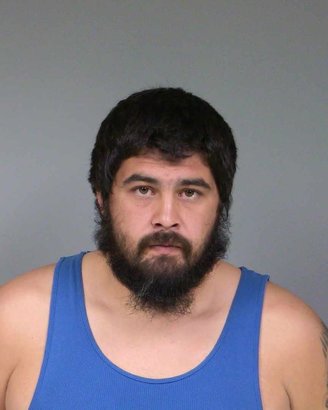
Lewis.
Judge Timothy Canning advised Derrick Anthony Lewis, 31, that he has been charged with attempted murder with the special allegation of personally and intentionally discharging a firearm. Deputy Public Defender Casey Russo entered not guilty pleas on his behalf.
Both Derrick Lewis and 51-year-old Frederick William Lewis were arrested after the 31-year-old victim, a relative of the Lewises, showed up at a business on state Highway 96 and said he had been shot. His wound was not life-threatening.
According to the Sheriff’s Office, witnesses said the Lewises followed the victim to property on Upper Cappell Road “and confronted him for reasons still under investigation.” The suspects reportedly fired numerous shots at the victim, striking him once.
Frederick Lewis posted bail and is out of custody. He has been charged with assault with a firearm and being a felon in possession of a firearm. The preliminary hearing for Derrick Lewis is scheduled for March 2.
PREVIOUSLY:
###
Also today in Judge Canning’s courtroom, arraignment was continued for Cory Nelson, suspected of shooting an acquaintance of his in the groin.
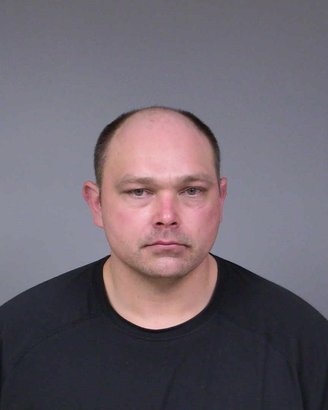
Nelson.
Attorney Russ Clanton made a special appearance for Nelson, saying he would like to speak with Nelson before hearing the charges and entering pleas. The arraignment was continued until Monday.
Nelson allegedly entered the victim’s home on Ninth Street in Eureka the afternoon of Feb. 15, assaulting him and demanding money before shooting him in the groin. A friend of the victim’s drove him to St. Joseph Hospital.
Officers from Eureka Police Department and the Humboldt County Drug Task Force arrested Nelson the following day at a residence on Ocean Avenue in McKinleyville. Nelson, 35, has two other criminal cases pending. Canning set bail in the latest case at $75,000. Although charges were not read in court because the arraignment was postponed, Nelson was booked into jail on suspicion of mayhem.
PREVIOUSLY:
Humboldt State Basketball Recruit Named as McDonald’s All-American Game Nominee
John Ross Ferrara / Thursday, Feb. 18, 2021 @ 3:25 p.m. / LoCO Sports!
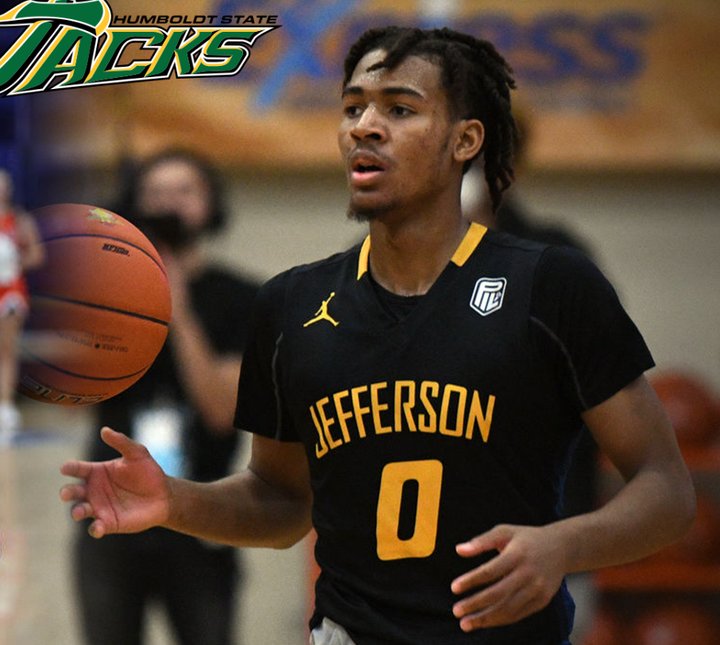
Keshawn Hall. | Photo provided by HSU.
One of Humboldt State University’s newest basketball recruits was announced as a nominee for the 2021 McDonald’s All American Game today.
HSU Freshman Keshawn Hall is one of more than 700 young men and women to receive the honor.
Hard work pays off ⛹️🍔
— McDonald’s All American Games (@McDAAG) February 18, 2021
Congratulations to the Class of 2021 Boys Nominees — tag the first player you see. pic.twitter.com/FUMajNfCGl
The McDonald’s All-American Game is an annual all-star basketball game that features some of the best high school graduates in the U.S. and Canada. While this year’s competition is canceled due to the ongoing COVID-19 pandemic, ESPN reports that 48 players from this list will still be selected for the final rosters and honored with a virtual celebration later this month.
Humboldt State Men’s Basketball Coach Tae Norwood recruited Hall from Lake Oswego High School in Oregon last month, where he was a member of the National Honor Society. Before playing for Lake Oswego High, the 6-foot-1-inch point guard played for Cheyenne High School in Nevada, where he was named a First-Team Nevada 3A All-State player, Co-Most Valuable Player of the Nevada 3A All-Southern Region, and the Nevada 3A Sunset League’s Most Valuable Player.
“KeShawn will provide added depth to the point guard position,” Coach Norwood was quoted as saying in a statement about Hall’s recruitment. “He is an exciting and fun player to watch. He is ultra-quick and fast with the ball and has the ability to make plays both in transition and in the half-court. KeShawn is selfless. He has a very good feel for the game and sees the floor extremely well. In its simplest form, he makes those around him better.”
Hall is one of 16 athletes from the state of Oregon to be nominated for this year’s All-American game.


