

TODAY in SUPES: COVID Hospitalizations at All-Time High, Cannabis Growers Blast County’s Marketing Efforts and a Permanent Hemp Ban is Passed
Ryan Burns / Tuesday, Feb. 9, 2021 @ 5:21 p.m. / Local Government
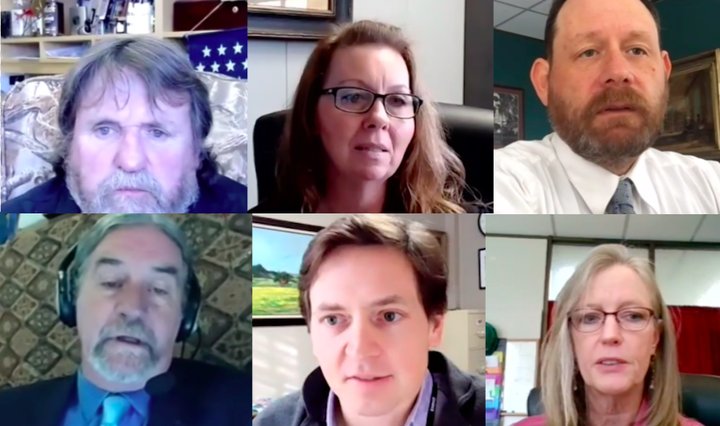
Screenshots from Tuesday’s meeting (clockwise from top left): Supervisor Rex Bohn, Supervisor Michelle Bushnell, Supervisor Mike Wilson, Supervisor Virginia Bass, Health Officer Ian Hoffman and Supervisor Steve Madrone.
###
Another big day for the Humboldt County Board of supervisors. Let’s get right to it, shall we?
COVID-19 Update
In his latest COVID-19 update, Humboldt County Health Officer Dr. Ian Hoffman said that while he expects the county to remain in the state’s purple tier, denoting widespread virus, for the coming weeks, he’s hopeful that we’re moving “over the top of that plateau” and can look forward to declining case counts. That’s what’s happening at the state level, and we tend to follow a bit behind statewide trends, he said. (Tuesday’s new-case count was just five.)
Still, the county is currently experiencing its highest rate of hospitalizations in the pandemic, though that’s not unexpected. “That’s sort of the last thing we see in a surge, so we’ll keep a close eye on that,” Hoffman said.
Spread of the disease “continues to be mostly from people you know,” such as multi-household gatherings, with a bit through travels and some outbreaks in congregate living facilities, according to Hoffman.
The county now has “an amazing capacity” for testing, in part because a lot fewer people are getting tested, he said, and he encouraged people to get tested frequently, saying it’s extremely important given the likelihood of COVID-19 variants popping up in the community. None have been detected in Humboldt thus far (only about four percent of samples get sent for the type of sequencing that would identify a variant), but Hoffman said widespread testing will reduce the likelihood that of new variants spreading rapidly.
As for vaccinations, through Monday a total of 18,208 doses have been administered countywide, with just over 15,000 being first doses and about 2,700 being second doses. That equates to just over 13 percent of the county that’s received at least one dose, including about half of those age 75 and older, Hoffman said. Well over 15 percent of the local native population has received at least one dose of vaccine, but the local Latinx community is lagging behind at around 6 percent.
The county is preparing to open vaccine availability more widely in the next few weeks, though Hoffman offered a word of warning. “With the variants coming [and the] potential for another surge, it’s extremely important we continue with … distancing, masking, avoiding gatherings [and] washing hands,” he said. “The next few months are a really fragile time … .”
Marketing Report
Later in the morning, the board and members of the public embarked on a robust discussion about how best to market Humboldt County to tourists. Julie Benbow, executive director of the Humboldt County Visitors Bureau, launched the conversation with a report on her organization’s latest efforts and plans for the future.
The HCVB has long held a contract with the county as the lead agency responsible for “advertising, promoting and marketing” our resources and assets. In recent years it has come under some scrutiny for failing to include cannabis in its marketing efforts.
In 2019, the City of Eureka — another longtime financial supporter of the HCVB — decided to pull its funding (to the tune of $370,000 annually), and the county has also considered looking at other suitors for its marketing dollars. Instead, in 2019, the board asked the HCVB to come back every six months with updates on its progress and marketing strategies.
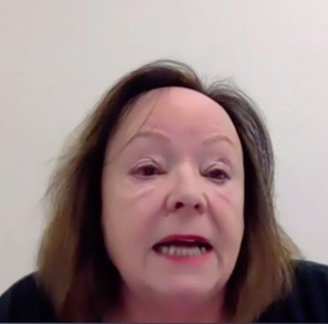
Benbow
Benbow’s presentation, which was delayed more than six months by the pandemic, focused on the economic power of tourism, and she said the bureau is “woefully underfunded.” She said cannabis hasn’t been included in the marketing efforts to date because it remains federally illegal, and 80 percent of the bureau’s advertising efforts were done nationally and internationally. A report submitted by the HCVB proposed two possible levels of county funding for the next year — $692,500 (level one) and $880,000 (level two).
“The key to tourism success over the next five years is increased investment,” Benbow said.
County staff plans to issue a request for proposals (RFP) for cannabis-specific marketing efforts sometime in or near April, according to Economic Development Director Scott Adair. But Second District Supervisor Michelle Bushnell encouraged the HCVB not to wait on marketing cannabis, and many public commenters agreed.
Amy Cirincione O’Connor, owner of the Humboldt Bay Social Club, blasted the county’s marketing plan as “outdated,” saying her business has never gotten any help from the HCVB. “We believe firmly in integrating cannabis, and we believe Humboldt County deserves a much more sophisticated marketing strategy,” she said.
Natalynne DeLapp, executive director of the Humboldt County Growers Alliance, a nonprofit cannabis industry trade group, presented to the board a 17-page comment letter calling for a more diversified, open and inclusive marketing strategy, one that’s not so entwined with the Humboldt Lodging Alliance (HLA), an organization of hotel owners that collects millions of dollars in transient occupancy taxes per year.
A succession of cannabis industry professionals proceeded to call in with public comments, urging the board to reassess its tourism strategy and incorporate cannabis and voicing concern about the HLA’s connections to multinational hotel chains.
The county’s current contract with the HCVB expires in June, and after today’s discussion the board agreed to receive the bureau’s report and return later to discuss how transient occupancy tax revenues are spent. Treasurer-Tax Collector John Bartholomew noted that the county could bring in hundreds of thousands of dollars more in revenue simply by applying those taxes to RV parks and campgrounds, a practice that was discontinued in 1993.
County staff was directed to return in 90 days with a detailed analysis of how transient-occupancy tax revenues are spent and recommendations for where increased revenues might go.
Hemp Moratorium
The county currently has a moratorium on industrial-scale hemp cultivation, which was instituted to give staff time to address concerns from local cannabis growers, including the potential for hemp pollen to drift and cross-pollinate with their crops and the possibility that hemp could introduce new pests and pathogens.
Last month, the Humboldt County Planning Commission advanced a “permanent” moratorium on industrial hemp cultivation, despite opposition from a small but vocal minority who want to grow the plant as a source of CBD. Today, the board was considering whether to pass that an ordinance instituting the ban, and also whether to allow an exemption for College of the Redwoods, which has expressed an interest in growing the plant for education and research purposes.
Public comment was largely a rehash (if you’ll pardon the expression) of previous debates on the topic of hemp. Outspoken hemp activist Benjamin Franklin Grant called the permanent moratorium “a job-abortion bill,” saying local businesses are currently forced to import hemp from Oregon to produce products with CBD.
But the majority of callers were from within the THC-heavy branch of the cannabis industry, and they encouraged the board to pass the ban. Some pointed out that if people really want to grow hemp, they can take advantage of the county’s streamlined application process for grows of less than 2,000 square feet (smaller than the threshold for industrial-scale) or grow within the “personal use” limits of 100 square feet on parcels smaller than an acre; up to 200 square feet on parcels of one to five acres; and up to 400 square feet on parcels larger than that.
By law, the county’s temporary moratorium can only last until May 10. If it expires, hemp cultivation would be allowed just like any other agricultural crop thanks to the 2018 federal Farm Bill. When the matter came back to the board, Third District Supervisor Mike Wilson said that if the county didn’t move forward with the ban today, “we’d see an explosion of concerns from all over the county.”
Fifth District Supervisor Steve Madrone said the medical benefits of CBD are important, but he agreed with commenters who said there’s a lot of room to grow under the “personal use” provisions.
The board wound up voting unanimously to pass the permanent ban — though as staff noted, it’s not technically “permanent.” The board has discretion to come back and alter it at any time. In the same motion, the board voted to come back at a future date to consider a special permit process for giving an exemption to College of the Redwoods — and possibly to other organizations, provided that they’d be growing it for non-commercial and/or educational purposes.
BOOKED
Yesterday: 6 felonies, 8 misdemeanors, 0 infractions
JUDGED
Humboldt County Superior Court Calendar: Friday, Sept. 18
CHP REPORTS
Holmes Flat Rd / Sr254 (HM office): Trfc Collision-1141 Enrt
0 Sr3 (RD office): Trfc Collision-No Inj
ELSEWHERE
Governor’s Office: Governor Newsom issues legislative update 9.20.2026
RHBB: Five Dead, One Seriously Injured in Fiery Head-On Crash on Highway 299 Near Whiskeytown
RHBB: Fire Burns Near Homeless Encampment Behind Lower Lake Walmart
Suspect in Arcata Arson Also Suspected in Campus Burglary Spree, Humboldt State Says
LoCO Staff / Tuesday, Feb. 9, 2021 @ 3:59 p.m. / Crime
PREVIOUSLY:
###
Press release from Humboldt State University:
A man arrested by Arcata Police on suspicion of arson on Saturday, Feb. 6, was also determined to be the suspect in several campus burglaries over the past few weeks.
Jesse Esteban Banuelos was arrested in connection with an off-campus residential structure fire on the 2700 block of Greenbriar Lane, according to APD. Upon further investigation by Humboldt State University Police, it was determined that Banuelos was the suspect in burglaries at the College Creek Marketplace, Jolly Giant Commons, and a campus apartment. HSU previously sent a timely warning message to campus about those incidents, which you can read more about here. Burglary charges will be added to the arson charge.
Food and a cart from campus were recovered in the investigation and HSU is working with APD to return the stolen goods.
If you need a safety escort at any time or need crime prevention tips, please contact UPD at 707-826-5555.
In case of emergency, contact University Police immediately by dialing or texting 911, calling (707) 826-5555 or extension 5555 from any campus blue light phone.
Low Kindergarten Attendance Creates First Grade Problem
Elizabeth Aguilera / Tuesday, Feb. 9, 2021 @ 2:18 p.m. / Sacramento
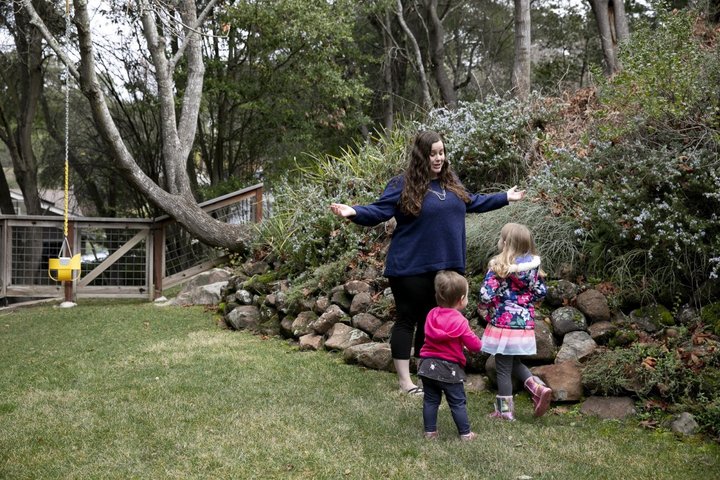
Gennie Gorback, President-Elect of the California Kindergarten Assocation, plays with her daughters, Cece, almost two, left, and Tilly, 4, right, at their Orinda home on Feb. 3, 2021. Photo by Anne Wernikoff, CalMatters
###
Thousands of California families chose to keep their children out of kindergarten this past year, opting instead for other in-person programs or no school at all.
That means thousands — or potentially tens of thousands — more children than usual will be hitting first grade next school year without having been through kindergarten, putting even more stress on an already strained system.
California is one of 32 states where kindergarten is optional. It’s an option that experts have increasingly come to disagree with. Children that skip kindergarten, they argue, arrive in first grade behind their peers in key areas like reading.
“Learning through play is so important for brain development and social emotional development,” said Gennie Gorback, president-elect of the California Kindergarten Association.
Kids who have never gone to preschool or been in an organized setting need that kindergarten time to learn how to “do school,” said Gorback, a former preschool and transitional kindergarten teacher whose own child will start kindergarten in the fall. “Things like how to sit criss-cross applesauce, raise hands to get called on or to form a line.
“You don’t naturally know that, it takes time.”
What happened to the children of California families who chose to skip “zoom school” for their 5-year olds largely depends on their family’s income. Experts worry the most affected are children from low-income families, whose parents had to decide between continuing to work or sitting with their children through virtual learning.
“Among those that didn’t go anywhere at all there will be variances among the experiences they have at home,” said Deborah Stipek, the Judy Koch Professor of Education at Stanford Graduate School of Education. “There will be parents who try to fill in the gap and those who may not know how to do that.”
The gap is expected to put pressure especially on first grade teachers, who will be required to differentiate students’ skills and try to get them caught up on basics they would have learned in kindergarten.
How many kids skipped kindergarten?
While an official number doesn’t exist yet — the California Department of Education is still compiling enrollment data and said it will not be ready until March — talking to school districts up and down the state suggests the number will be large.
The state’s largest school district — Los Angeles Unified — saw its overall enrollment decline 14%. The most significant decrease was in the kindergarten ranks, which lost 6,000 students. The San Diego Union School District showed a decline of 1,682 kindergarten and transitional kindergarten children. Sacramento City Schools also lost a crop of the youngest learners. As of December, the number of kindergartners was down by 600, a decrease of 18% from the prior year.
These districts are hardly alone.
Declining enrollment hit more than 60 percent of the state’s 1,000-plus districts and most of the drop happened in the earlier grades, Michael Fine, CEO of California’s Fiscal and Management Assistance Team told a legislative education committee last month.
Los Angeles Unified Superintendent Austin Beutner said the biggest drops were generally in neighborhoods with the lowest household incomes.
“We suspect some of this might be because families may lack the ability to provide full-time support for online learning which is necessary for very young learners,” he said in August. “This is yet another reminder that this crisis is having a disproportionate impact on low-income families.”
Where did they go?
Families with resources may have chosen to pay for private in-person schooling, small-group pods, or extended time in preschool programs, while low-income children, who stayed at home, may not be getting high quality enrichment experiences, said Anna Markowitz, assistant professor of education in the School of Education and Information Studies at UCLA.
Low-income families where parents work essential jobs may have had to choose between virtual school, where a parent has to sit with their child, and continuing to earn money to pay rent and buy food. Many may have also faced internet connectivity issues that frustrated the process and chose instead to keep the kids at home with family.
A McKinsey & Company study found that Black and Latino children are the most likely to experience learning loss because they have less access to quality remote learning or a conducive learning environment at home.
“Kindergarten and preschool programs help to equalize kids,” Markowitz said. “Without those experiences you are going to see a bigger stretch in their abilities. It will be academic but also experiences in a school-based setting, the practice of being in school.”
Why is kindergarten important?
Kindergarten has become more academic in the last couple of decades as standards like No Child Left Behind and Common Core State Standards became the norm.
“Kindergartners are expected to learn a fair amount and the good news is they can,” said Stipek, of the Stanford Graduate School of Education. “We grossly underestimated how much they could learn in literacy, early math before.”
The other piece of critical learning that takes place in kindergarten is social emotional learning, said Adria Taha-Resnick, president-elect of the California Association for the Education of Young Children and a professor of early childhood education at CSU Channel Islands.
This is the ability to relate to others, learn how to regulate oneself, build confidence in interacting with teachers and others, and to feel safe and secure enough to speak out, said Taha-Resnick. She said that while children can catch up academically it’s difficult to re-do that important time when children are learning how to interact with their peers and teacher and learning about themselves in the process.
Experts worry that the achievement and opportunity gaps that already existed among low-income students and students of color will deepen under current circumstances.
“This early learning window is so important for learning critical skills,” said Jenny Hontz, a parent and spokeswoman for Speak Up, a Los Angeles parent advocate group. “It could take years for the kids to catch up and some kids may be permanently harmed by this.”
The group is advocating for schools to resume in-person learning as soon as possible, especially for special needs students and English language learners who have an even harder time with virtual learning.
Hontz said the district is considering mandatory summer school and extending next school year by several days but it’s not enough.
“It’s going to take all hands on deck thinking, longer school days or longer school years, really intensive intervention to make sure the kids get what they need,” she said.
This is why there’s been ongoing efforts, including again this year, by legislators and advocates to make kindergarten mandatory in California.
Baldwin Park Democratic Sen. Susan Rubio is behind the current bill in Sacramento to require it. Rubio said there is a misconception about kindergarten that needs to be updated, especially among her peers in the legislature.
“That in years past kindergarten is where you got to get a nap and play with kids, that is not the reality,” she said. “Kindergarten is where you learn the essentials for writing. You have to know your numbers, your alphabet. These are substantive things they need to know to transition to 1st grade.”
How to prepare for the students return?
That kind of intensive work is going to need to include differentiating among students, learning about their experiences and figuring how to best help them, Stipek said. But much of it is going to need additional resources.
“There’s a lot of extra things that can be done to make up for some of the disadvantages but they are costly, they are not free,” Stipek said. “So there will be huge variability in what districts do. We need to be extra vigilant to ensure that the kids who need it get the help.”
Teachers, in particular, will face an extra burden this next year as students enter the classroom with greater variability in their skills than ever. Districts will need to help them by providing additional resources like summer school, tutoring and involving parents, she said.
Taha-Resnick recommends that districts mix children who skipped kindergarten into classrooms with kids of all levels because young children tend to also learn from one another.
Gorback, of the California Kindergarten Association, said the organization is going to focus its spring development series on what teachers will need and how to best differentiate students when there are wide gaps between them.
Schools may need to build a kindergarten-like curriculum for first grade teachers to use to cover some of the skills that were missed, Markowitz.“This is a problem that will be evident in other grades but will be amplified in 1st grade,” Markowitz said. “We are not going to hold back an entire year of kids.”
###
CALmatters.org is a nonprofit, nonpartisan media venture explaining California policies and politics.
Teacher Vaccines in California Determined by Location, Luck
Ricardo Cano / Tuesday, Feb. 9, 2021 @ 2:12 p.m. / Sacramento

Alameda County health workers prepare syringes with the Moderna COVID-19 vaccine during a distribution clinic at St. Rose hospital in Hayward on Jan. 27, 2021. Photo by Anne Wernikoff, CalMatters
###
How soon teachers can expect to get vaccinated depends largely on where they live and could determine whether the bulk of California’s students return to campuses this spring — or next fall.
Teacher vaccinations have emerged as a central point of contention in California’s charged debate over reopening schools as unions representing teachers and school employees have listed vaccine access as one of their demands before returning to campuses.
But, faced with a limited supply and dueling priority groups, many of California’s largest counties have not yet begun offering vaccines to teachers. And though some counties expect to begin vaccinating teachers within the next week or so, several others told CalMatters that their supply’s scarcity makes it difficult to project when their educators could expect a dose. Some counties don’t expect to offer vaccinations to teachers until a month from now or late March.
The county-by-county variance in teacher vaccinations runs the gamut:
- In Marin County, many campuses have been open for some time and educators started getting vaccines last month.
- Teachers in Ventura County can likely get vaccinated a month from now
- Santa Clara and San Mateo counties have no estimate for when that might happen.
Mixed messaging and a decentralized approach have resulted in a chaotic vaccine rollout roughly two months after the first doses prioritized for frontline health workers arrived in California in mid-December.
Gov. Gavin Newsom said during a press conference today that schools are unlikely to physically reopen this school year if vaccinations for every teacher are a prerequisite. “When you’re receiving less than 600,000 first doses a week, and you start to do the math… then we need to be honest with people, and let them know… that it’s very unlikely that we’ll be able to accomplish that very idealistic goal before the end of the school year because of the scarcity of supply in vaccinations,” he said.
Currently, many of the state’s largest counties are approaching or have begun distributing doses to those in the first tier of Phase 1B of the state’s vaccination priority list. That broad group encompasses 8.5 million Californians and includes teachers, farm workers and first responders as well as residents 65 and older.
Newsom acknowledged Monday that vaccine scarcity has hampered the ability of local public health departments to vaccinate teachers in large numbers. A recent plan by the governor to incentivize school districts to reopen campuses with extra per-pupil funding stalled after many school officials, unions and legislators said it was unworkable.
At his Monday press conference, Newsom said he hoped to announce a new school reopening deal with the Legislature “this week” that would include “a prioritization framework to get our teachers vaccinated.”
“The challenge is self-evident,” Newsom said. “In each and every county, they have different capacity issues, different demographics, different issues in terms of availability of the vaccine and the number of people that they have prioritized within those tiers.”
Several public-health experts as well as the governor, who’s under intense public pressure to reopen K-12 public schools this spring, have said in-person learning can be done safely without vaccinating educators if paired with strict preventative measures such as masking, ventilation and cohorting students.
Newsom, who recently told school superintendents that requiring teacher vaccinations for reopening schools would effectively keep them closed this spring, has cited “low” numbers of transmission within reopened schools as evidence that in-person instruction has not resulted in higher community spread. In January, 87 cases were linked to schools, a figure Newsom said was lower compared to November and December despite the state’s surge in cases and deaths.
The state, however, has yet to publish any data on cases in schools to affirm figures cited by Newsom. It remains one of the few states that is not publicly tracking which schools are open and whether they’ve experienced outbreaks. Under new state guidance, the California Department of Public Health began collecting this information from schools Jan. 25; the agency said in a statement Friday that it will provide the info on its new school website “in the near future.”
Counties race against time
In many of California’s largest counties, a dwindling clock has heightened the stakes in the complicated race to vaccinate educators. Most of the state’s public schools end the academic term in late May and early June, and full inoculation requires administering two vaccine doses spaced a month apart.
As of Friday, Santa Clara County was not vaccinating educators and health and education officials could not offer a timeline for when primarily because of limited vaccine supply, they said. Neighboring San Mateo County remains in Phase 1A and is prioritizing “those eligible at greatest risk of death.” Other large counties such as San Diego, San Joaquin and Kern are not yet vaccinating educators, citing vaccine scarcity.
Counties such as Marin and Napa, where many campuses have reopened, began vaccinating some of their educators last month. Several smaller, rural counties have made greater progress vaccinating their teachers compared with larger counties.
Sacramento County officials expect that, depending on supply, teachers will be able to sign up for vaccination appointments “in the next couple of weeks.”
Dr. Robert Levin, Ventura County’s health director, said he expects the vaccine will be available to teachers “in a month.”
Meanwhile, Shasta County, where all but two schools are offering in-person instruction, plans to host its first educator vaccine clinic Saturday. Placer County recently opened its clinic for educators.
Joe Prado, Fresno County’s public health division manager, said the county is “looking at late March to April” as the earliest vaccines would be offered to educators based on current supply and demand. The delay between doses would put in-person instruction beginning in April or May in that case. Prado said the limited week-to-week vaccine supply allocated to the county has made it “really difficult” to devise a quicker rollout to those eligible under Phase 1B.
Several Fresno County districts, including Clovis Unified, began offering in-person instruction last fall before the latest surge. This week, as case rates in the county fell below 25 positive cases per 100,000 residents, closed campuses will be allowed again to reopen for elementary students, according to Dr. Rais Vohra, Fresno County’s interim health officer.
“Our experience in Fresno County is that whenever all of those different layers of protection are implemented that the numbers of transmissions and outbreaks are really low, especially compared to what’s going on in the rest of our community,” Vohra said.
In Orange County, a spokesperson for the county education department said educators could become eligible for the vaccine in mid to late February, “assuming doses are available.” The county plans to roll out teacher vaccinations based on risk of exposure, meaning teachers working closely in person with special-needs children would be ahead of educators working remotely.
Alameda County, which entered Phase 1B this week, also plans to prioritize vaccinating educators teaching in person, according to county superintendent L.K. Monroe. About 325,000 residents are eligible under Phase 1B, according to county estimates, requiring 650,000 vaccine doses and at least a month’s time to complete vaccinations before moving down the state’s tiered system.
“If every educator came all at once to be vaccinated, it wouldn’t be possible under the current conditions,” Monroe said.
Alameda Unified, among the first districts in the county to set a reopening date, plans to bring back K-5 students March 8 without vaccinating teachers. Superintendent Pasquale Scudari at a recent board meeting cited public-health guidance and recent remarks from the director for the Centers for Disease Control as evidence “that elementary schools can safely be reopened prior to full vaccination.”
The county told superintendents that it expected to receive between 10,000 to 15,000 vaccine doses per week, Scutari said, far below demand. Because the district has set a firm return date, its teachers would likely be prioritized for vaccination.
Following mounting parent frustrations and a lawsuit from the city’s district attorney supported by the mayor, San Francisco Unified reached a tentative deal with its employee unions over the weekend that tie vaccine access to reopening.
Under the plan, the school would phase in a return to campuses if the city reaches the red tier under the state’s system for reopening schools and businesses — meaning, less than 7 positive cases per 100,000 residents — if teachers and staff receive access to the vaccine. Schools in San Francisco would physically reopen in the orange tier without the vaccination requirements under the plan.
Dr. Jeanne Noble, director of COVID response for UC San Francisco’s emergency department, said it’s unlikely the deal would result in students returning to campuses anytime soon. Realistically, Noble said, it could take “a minimum of 10 weeks” to vaccinate all of the city’s teachers given current supply.
Noble and other health professionals have called for schools to reopen this month without vaccination. Schools can safely operate with strict safety measures, she said, and 11 months away from schools has resulted in dire harm to students’ mental and physical well-being.
“It’s not a proposal or an agreement that would lead to in-person education this year just because of the scarcity of the vaccines and the logistics in rolling it out,” Noble said.
“I think it makes it potentially more likely that they would go back to school when San Francisco’s back in the orange tier.”
###
Barbara Feder Ostrov contributed to this story. CALmatters.org is a nonprofit, nonpartisan media venture explaining California policies and politics.
FAIR WARNING! Sewers Will Start Smoking Near Target Tomorrow Morning
Hank Sims / Tuesday, Feb. 9, 2021 @ 11:36 a.m. / Infrastructure
PREVIOUSLY:
###
Remember that time when all the sewers in Old Town started smoking, setting off a minor panic? The city of Eureka is trying to avoid that, nowadays — the panic, not the smoke — by giving everyone advance notice before their hellsmoke rises up from the bowels of the city.
Tomorrow morning, weather permitting, the smoke will envelop certain parts of the Bridge District. They pump the smoke in there to figure out where pipes are leaking. It’s a good thing! Though terrifying, the smoke, we are told, is non-toxic.
###
From the Eureka Public Works Department:
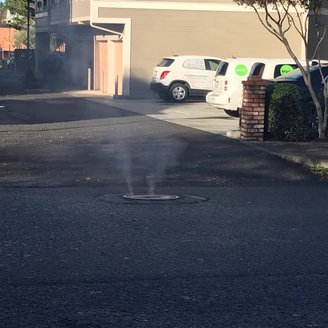
File photo: Shane Mizer.
Sanitary Sewer Smoke Testing near Target
- X Street, from 1st Street to 3rd Street
- Alley between 1st and 2nd Streets, from X Street to Y Street
- Y Street, from 1st Street to 3rd Street
The City of Eureka will be performing smoke testing of the sanitary sewer system at the above locations in Eureka beginning at 9:00 a.m., on Wednesday, February 10th. This testing involves pumping a non-toxic smoke into sewer manholes where it is forced through the sewer mains and laterals to locate defects in the system. Smoke will be visible in the area, and may travel to nearby sewer lines as well. There is no need to contact the Police or Fire Department, they have already been notified.
Traffic will remain open during testing; however, smoke may be visible exiting manholes. Please use caution while driving in the area. In addition to manholes, smoke will be visible coming from building vents and lateral cleanouts. This smoke is non-toxic, will not leave a residue, and will dissipate shortly after the test. This work will be performed between the hours of 9:00am and 10:00am, WEATHER PERMITTING.
There will be City of Eureka Personnel on site, with information, should there be any questions. The patience and cooperation of residents and business owners in the vicinity of the testing zone is greatly appreciated.
The City of Eureka realizes that this disruption may be an inconvenience, but repairing and maintaining our sewer collection systems is vital to the health and safety of our residents.
This Child’s Reaction to a Cruise Ship in Humboldt Bay Will Make You Smile
John Ross Ferrara / Tuesday, Feb. 9, 2021 @ 10:15 a.m. / Ocean

Boat! | Photo provided by Erin Martinez Sitterud.
You may have noticed the 300-foot cruise ship that was docked in Humboldt Bay over the weekend. One child sure did.
Local mom Erin Martinez Sitterud sent the Outpost this photo of her son Nathan reacting to the American Harmony entering Humboldt Bay on Friday while he was celebrating his 6th birthday. Happy birthday, Nathan!
Humboldt Bay Harbor District Executive Director Larry Oetker told the Outpost that the passenger-less riverboat stopped off in Humboldt Bay for some quick repairs.
“My understanding is that they had a minor hydraulic issue and they came into port unassisted, entirely on their own power,” Oetker said.
American Cruise Lines, which owns and operates the ship, told the Outpost that the American Harmony traveled all the way from Louisiana, passing through the Panama Canal before stopping in Humboldt County. The ship previously served as a cruise line on the Mississippi River and is on its way to Astoria, Oregon, where it will run cruises along the Columbia and Snake Rivers.
According to MarineTraffic.com, the ship left Humboldt Bay yesterday morning and is currently approaching Oregon’s Cannon Beach area.
While the cruise industry has suffered due to the pandemic, Oetker said that three occupied cruise ships are scheduled to visit Humboldt County next year.
“It’s been a tough year for cruise ships in Humboldt Bay and all over the world,” Oetker said. “We do have three cruise ships for 2022. We hope the pandemic ends soon so we can get back to normal life.”
OBITUARY: Vina Marie Simmons, 1925-2021
LoCO Staff / Tuesday, Feb. 9, 2021 @ 6:56 a.m. / Obits
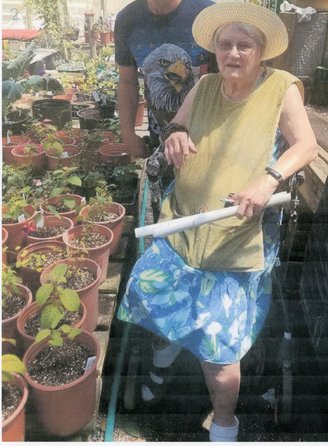
Vina
passed away on Jan. 30, 2021 at the age of 95. She had been married
to her husband, Paul Simmons for 65 years at his passing 14 years
ago. Vina is survived by her three children, James Simmons, Janet Boring
and Sue Smith and their families. Vina has many grandchildren and
great grandchildren.
Vina was born 1925 to Matilda and Leonard Bridges who had two other children, Margaret Zalud and Arthur Bridges.
After marring Paul Simmons in 1941 they lived in Texas where Paul served as Captain, Army Medical Battalion. In the mid-‘40s they operated a restaurant in Salinas. Vina, Paul and their three children moved to Eureka. While Paul worked for a mill Vina worked at Shaffer’s Hardware. They started Green Lot Nursery in 1961. Vina’s mother lived with them in her later years and liked to work in the nursery. Now their daughter, Sue manages the nursery which has been in business for 60 years.
Paul and Vina spent many happy years at their summer place in Trinity Center where Paul fished and Vina crochet. Vina was a wonderful at needle craft and could make crochet stuffed toys, doll clothes, embroidered pillowcases, braided rugs and when her children were little, she made their clothes our of flour sacks.
Vina was a Life Member of Soroptimist International of Eureka for 47 years.
In lieu of flowers donations Can be made to Soroptimist International of Eureka, P. O. Box 648, Eureka, CA 95502 or Hospice of Humboldt, 3327 Timber Fall Court, Eureka, Ca. 95503.
###
The obituary above was submitted on behalf of Vina Simmons’s loved ones. The Lost Coast Outpost runs obituaries of Humboldt County residents at no charge. See guidelines here.


