Today,
Rep. Jared Huffman (D-San Rafael) sent a letter to Cox Media Group
(CMG) urging them to restore access to nationwide channels following
CMG’s failed negotiations on retransmission consent agreements with
AT&T/DirectTV. This is the second time CMG has contributed to
blackouts impacting over 25,000 constituents in Rep. Huffman’s
district who rely on Eureka, California channels KIEM-NBC and
KVIQ-CBS. On January 8th, the same two CMG channels were dropped from
Suddenlink’s programming.
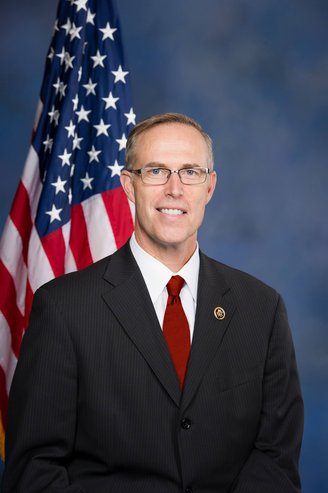
Photo via U.S. House of Representatives. Public Domain. Link
“My
constituents are tired of these finger pointing exercises where big
media conglomerates blame each other while consumers get screwed by
blackouts. I’m sure there’s some blame to go around, but CMG is
the common denominator in the two recent blackouts. At a minimum,
that suggests they’re not working proactively to protect consumers.
At worst, it suggests they’re using consumers as hostages by
letting blackouts happen to maximize their negotiating leverage.
Either way, it’s unacceptable,” said
Rep. Huffman.
In
the letter to Cox Media Group, Rep. Huffman stated:
“I
am disappointed to learn that Cox Media Group has, for the second
time this year, failed to negotiate retransmission consent
agreements, resulting in blackouts for my constituents and
communities across twenty markets nationwide […] As you know, [the
Communications Act of 1934] requires that should broadcasting
stations opt out of must carry status, the broadcaster along with
cable and satellite operators must negotiate retransmission in “good
faith.” Allowing consumers to experience blackouts to enhance your
negotiating leverage is not “good faith.”
“CMG’s
suggestion that customers switch to another cable, satellite, or
streaming provider in order to regain access is poorly informed and
entirely unreasonable; many of my affected constituents live in rural
areas with limited access to broadband and other distributors.
Furthermore, placing the burden on your customers to find alternative
solutions is not only a terrible business practice – it’s also a
grave failure to prioritize the public interest and the essential
value your services provide to local communities […] I strongly
urge you to restore access to these twenty nationwide channels
immediately and do everything in your power to avoid blackouts of
this kind in the future,” the
letter concludes.
As
an extra step to address this issue, Congressman Huffman will be
reintroducing the Local and Independent Television Protection Act,
a bill designed to address media consolidation by getting rid of the
UHF discount, an antiquated FCC loophole reinstated by the Trump
administration that facilitates mergers by allowing media companies
to “discount” UHF stations (channels 14-83) when calculating
whether they’re subject to the national TV ownership cap. The cap
states that no single company is allowed to own broadcast stations
that reach more than 39% percent of television-viewing households in
the country. For reintroduction this year, the measure will be
expanded to add protections for consumers whose access to local news
is unfairly jeopardized by failed retransmission consent
negotiations.
Specifically,
the bill will include a provision stating that should two parties
fail to negotiate, instead of cutting off access to local channels
for consumers, the cable or satellite provider would be required to
continue retransmitting local broadcast stations for a set period of
time while the parties resolve their differences. This protection
mechanism, known as interim carriage, would alleviate the burden on
the consumer of these unnecessary and unfair blackouts.
Whether it’s the commercials, halftime show or the game itself, the
Eureka Police Department is reminding everyone that we are all on the same team
when it comes to being safe on Super Bowl Sunday.
Super Bowl LV is Sunday, Feb. 7, and the Eureka Police Department will have
additional officers on patrol over the Super Bowl weekend looking for drivers
suspected of being under the influence of alcohol and/or drugs.
“If you are watching the game at home and plan to have a drink or two, stay at home
Sergeant Gary Whitmer said. “Have a family member who hasn’t been drinking go out
on your behalf or have your food delivered.”
Eureka Police reminds the public that alcohol is not the only thing that impairs and
may lead to a DUI. Prescription drugs, over-the-counter medications and marijuana
may affect your ability to drive safely. Do your research and understand how a drug
affects you before deciding whether or not you are OK to drive.
California’s public health guidance advises to limit mixing with people you don’t live
with as much as possible to limit the spread of COVID-19. Although many watch
parties will be virtual this year, it’s important to plan ahead, designate a sober driver or
simply stay at home for the night.
Funding for Super Bowl Sunday enforcement is provided by a grant from the California
Office of Traffic Safety, through the National Highway Traffic Safety Administration.
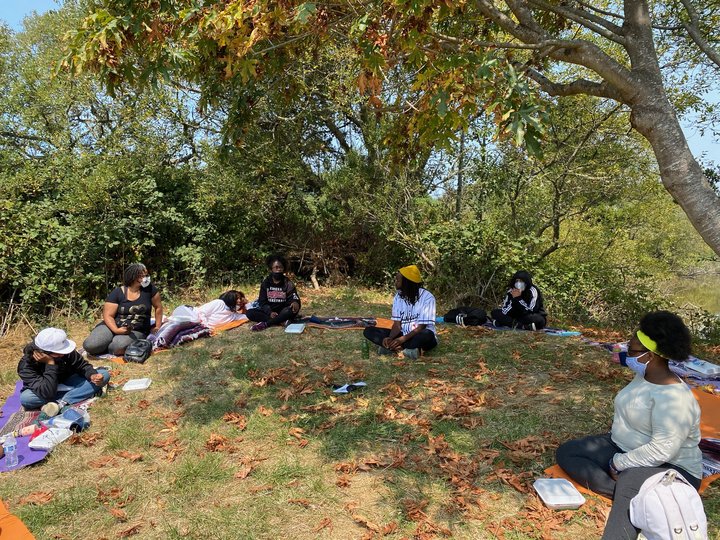
An HC Black Music and Arts Association class on pan-African culture at the Arcata Marsh. Photo by Valetta Molofsky
###
Sarah
Vevoda’s 7-year-old daughter Jaz used to say she had “up hair,”
her natural Black curls growing upward instead of hanging down like
nearly everyone else’s around her, including her family. Sarah, who
is white, says Jaz has commented on not seeing other people who look
like her. “It’s very hard for her to be in a sea of white people
everywhere she goes,” says Vevoda, noting Jaz is darker skinned
than her eldest child, who’s also bi-racial, and her hair and skin
are sometimes treated as curiosities by classmates. “As innocent as
they are, because they’re children and aren’t used to being
around someone who looks like Jaz … they can say things that make
her feel like she doesn’t fit in, that she stands out.”
It’s
with young people like Jaz that the HC Black Music and Arts
Association means to connect. The nonprofit organization, which
operates as a Dream Maker Project of the Ink People, is focused on
connecting young BIPOC people to their cultural roots and each other.
Starting as it did in 2020, the connections meant to foster
self-esteem and resilience have become even more vital amid the
COVID-19 pandemic and its attending isolation. Throughout February,
national Black History Month, HCBMAA is holding Harambee Liberation
Month, with Zoom workshops and classes, as well as distanced
in-person storytelling and a memorial march through Old Town.
President
and founding member of HCBMAA Valetta Molofsky, who teaches social
work at College of the Redwoods and serves as second vice president
of the Eureka NAACP, was hearing more and more through her work as a
social worker about BIPOC youth struggling with stress and even
suicidal ideation.
“I
had one child that told me [kids] called her dirt. That she was the
color of dirt,” says Molofsky. “She thought she was ugly. … No
child should be subjected to that.”
In
late 2019, Molofsky started looking for funding and helping hands to
create spaces of welcome and support for young BIPOC people in
Humboldt. Donations and sponsorships started coming in, and with
grant-writing help from Lorenza Simmons, the organization’s youth
coordinator, so did funding from Humboldt Area Foundation and Coast
Central Credit Union. With that funding, donated masks and hand
sanitizer — and help from local artists, educators and community
members — HCBMAA held a socially distanced Harambee Youth
Empowerment Workshop in August. The camp, which took its name from
the Swahili word for “pulling together,” focused on African
history, dance, music and art, as well as bonding with BIPOC peers
and mentors, all while applying African cultural principles.
For
Jaz, Vevoda says the experience was invaluable.
“The
first day of the camp, when she came home she was glowing,” she
says. “Just being in a group of people who looked like her was just
feeding her in a way that I didn’t realize.”
Simmons
will be running somatic movement and music classes for Harambee
Liberation Month. She incorporates African songs and movement from
Congo, Egypt and around the continent, as well as African American
traditions, to help participants connect to pan-African culture and
“feel comfortable in their skins … doing that through music and
art and all these different expressions to really build them up.”
She’s found that many BIPOC youth “don’t have connection to
African roots, or pieces are missing.” Through her classes, Simmons
tries to bridge the cultures of Africa, the global diaspora and
African American culture. Simmons says that connection — and just
getting up and moving — has proven even more important over the
last year.
COVID-19
has separated many students from vital support systems during a
stressful time, but Simmons sees young people of color in particular
suffering the loss after a tumultuous summer of local and national
news.
“The
movement and the protests were all amazing and needed, but I think
with George Floyd and Breonna Taylor and Ahmaud Arbery — I could go
on and on, just that constant flow — and with it coming to a head,
it’s just overload for the youth to be able to process it,” she
says. “Some of the normal places where they find connection were
being lost with the pandemic.”
Kory
Jones, who is teaching a three-part series this month called “Being
Yourself through Deconstruction,” will be trying to fill in some of
that support. The Marine Corps veteran says he’ll be sharing some
of the strategies that have helped him with PTSD brought on by
exposure to violence in his early years and his time in the military,
as well as the racism he’s experienced in varying forms. That means
breaking down some of the conflicting belief systems coming from
one’s family, religion, culture and country, evaluating those
beliefs and deciding what to let go.
“Deconstructing
and pulling some of that back,” Jones says, “that frees us.”
Jones,
who hails from Florida, understands the unwelcome feeling many BIPOC
youth and adults say they experience in Humboldt. “In the South,
you know where you can and can’t go as an African American person.
In California, it’s ‘Oh, OK.’ But you can’t.” Jones adds,
“On the East Coast it’s blatant; in California, it’s more
subtle.” He says he was recently struck by his third-grade son’s
admission that he sometimes worries whether his father will make it
home. Even without having had a direct conversation about how easily
a call to the police can escalate to violence against Black men,
Jones says, “My children on some level already know what they’re
dealing with. … We need to combat that on some level to keep their
self-esteem high.” For Jones, the goal is creating something like
the recreation center he grew up near, “a place where you can be
safe with your being as a whole … mentally, spiritually — you
have a place and you’re safe.”
HCBMAA
Vice President Doug Smith, who is the coordinator of Humboldt State
University’s African American Center for Academic Excellence, says
he will be connecting to participants through poetry.
“It
was a tool for me when I was younger going through challenges … it
was an outlet,” he says. And leaning into African oral tradition,
he’ll be encouraging reading poetry out loud and connecting the
work to what’s going on at school and in the community. “The
history we do get about ourselves is very negative and what that does
to a young child, growing up hearing only that they come from
slaves,” can be devastating, he says, as can disassociation from
ancestral ideals, values, tools and strategies. “Reaching into
history, reaching into cultures that are not given platforms”
through poetry, for example, can help reconnect kids to that well of
cultural resources.
“We’re
just trying to build back some cultural identity that’s been lost,”
says Molofsky. “We’re resilient, right? That’s how our
ancestors taught us to be.”
###
See
the full schedule of HCBMAA’s Black Liberation Month events below
and at www.northcoastjournal.com.Jennifer
Fumiko Cahill (she/her) is the Journal’s
arts and features editor. Reach her at 442-1400, extension 320, or
Jennifer@northcoastjournal.com. Follow her on Twitter @JFumikoCahill.
The
Community Voices Coalition is a project funded by Humboldt Area
Foundation and Wild Rivers Community Foundation to support local
journalism. This story was produced by the North
Coast Journal newsroom with full
editorial independence and control.
###
HCBMAA’s
2021 Harambee Liberation Month Schedule
In collaboration
with McKinleyville High School’s Black Student Union,
Benjamin
Mertz, activists and musical talent and community leaders engaging in
cultural and healing activities.
Classes
are open to all ages unless noted.
Please
check our Facebook
page for
any missing Zoom links and more information on other Liberation Month
events. Masks and social distancing required for all in-person
events.
Being
Yourself Through Deconstruction Wednesdays
4-5 p.m. Facilitator:
Kory Jones Meeting
ID: 786 8544 3630 Passcode:
FT7jtw
Teaching
BIPOC Youth (support
group for local school teachers/ mentors) Wednesdays
7-8 p.m. Facilitators:
Lorenza, Valetta and Flo Meeting
ID: 812 6888 7250
Black
Women Civil Rights Discussion Thursdays
4-5 p.m. Facilitator:
Nikki Valencia Meeting
ID: 823 2595 7803
Ujima
Parent Peer Support Circle Thursdays
6:30 p.m. Facilitators:
Valetta Register
at this link.
Family
Fit at Home Fridays
5-6 p.m. Facilitator:
Andrea Jones Meeting
ID: 899 7862 2861
Community
Class: Elderly Self-Care Fridays
6-7 p.m. Facilitator:
Ms. Alice Barbee Link
Poetry/Lyrics
Slam Night Fridays
7-8 p.m. Facilitator:
Aj Link Meeting
ID: 830 6035 6170 Passcode:
005214
Walk
in the TruthSeries Saturdays
9:30-11 a.m. This
is a four-week restorative circle series for women who have
experience generational trauma, domestic violence/sexual abuse and
unhealthy relationships. Facilitator:
Valetta Register
at this link.
Kuumba
Literacy Saturdays
on the Arcata Plaza 11:30 a.m.-12:30 p.m. Facilitator:
Andrea Jones
Redwoods
Meditation/Yoga Saturdays
at 14 Union St. in Arcata noon-1 p.m. Bring
your yoga mat, water bottle and mask Facilitator:
Aj
Family
Walk in the Park Saturdays First
hike location TBA
###
Four-week
series with Benjamin Mertz Sundays
at 4 p.m.
Feb.
7: The Underground Railroad, music of freedom and escape:
profiles on Harriet Tubman and Frederick Douglass. Feb.
14: The Harlem Renaissance, the Fisk Jubilee Singers, and the
poetry of James Weldon Johnson and Langston Hughes. Feb 21:
Jim Crow, Work Songs, and the Blues: profiles on Fannie Lou
Hamer and Bessie Smith. Feb. 28: The Civil Rights Movement
- freedom songs, profiles on Bernice Johnson Reagon and Harry
Belafonte. Zoom link.
Special
Event: Liberation March Feb.
20 at 10 a.m.-noon
In
honor of our Sistahs, Brothers and Youth that have died
Wear
white and black, bring your candles and instruments.
More
info will be provided on Facebook.
Arcata
Liberation March (no speakers) Feb.
20 at noon-1 p.m.
Meet
at D Street Community Park. Please wear white during this silent
demonstration to honor our ancestors. Asante.
Special CPR Youth
Certification Feb. 22 at 6-7 p.m. Ages 12-18; class
size:10
This class is made
possible by the COVID-19 Mental Health Grant from Humboldt Health
Foundation to support youth that identify as Black, Brown or African
American during the shelter-in-place ordinance. This is a first-come
registration. Sign your youth up by
emailing: hcblackmusicnarts@gmail.com.
An influential group of California health experts is holding fast for now to Gov. Gavid Newsom’s decision to make age the primary criteria for getting the COVID-19 vaccine. The decision announced today dismayed advocates who hoped the group would recommend moving disabled people and those with chronic medical conditions to the front of the line alongside those age 65 and older.
“My disability makes my immune system very weak. When I get a simple cold it goes to my lungs and I have a hard time breathing,” Dina Garcia of Chatsworth wrote in advance before Wednesday’s meeting of the state’s vaccine community advisory committee, where the decision was announced. “My doctor told me that if I get COVID, I may not survive. My worker (personal attendant) has already told me they would not take the vaccine. I am extremely worried that I will not survive this pandemic.”
The outside panel of experts convened by state officials to set California’s vaccine priorities made its decision after reviewing research showing that older people are far more likely to be hospitalized or die of COVID-19 than even people with significant disabilities or medical conditions, said Dr. Oliver Brooks, the group’s leader.
Disabled people and those with chronic conditions would be vaccinated after people 65+ and a few groups of essential workers such as teachers and farmworkers — but still before the general public — if state officials adopt the panel’s recommendations. Disability advocates are fiercely lobbying Newsom to move in the vaccine order, and he could override the group’s proposal.
Dr. Erica Pan, the state epidemiologist, said the group also recognized that while 8.5 million people are currently eligible for the vaccine, California has only received about 6.7 million doses.
“These are extremely challenging decisions we are making,” Pan said.
In mid-January, California abruptly pivoted to age as the primary eligibility criteria to simplify and speed up a widely criticized and chaotic vaccine rollout. The decision alarmed disability advocates, said Christina Mills, executive director of the California Foundation for Independent Living Centers.
They hoped state officials would this week announce a plan to move disabled people up the priority list, but that declaration never came.
Instead, Dr. Mark Ghaly, the state’s top health official, said Tuesday that he was aware of the community’s concerns and spoke about “beginning to galvanize around an opportunity that we will announce later.”
The comment didn’t sit well with Mills, who lives with a genetic bone disorder known as osteogenesis imperfecta and uses a wheelchair and help from personal assistants to live on her own.
“Honestly it just pisses me off even more,” Mills told CalMatters. “It’s like, what are we waiting for? The state has not figured out how to operationalize the vaccine for people like us.”
The federal Centers for Disease Control recommended that people with underlying medical conditions such as diabetes, cancer, cystic fibrosis and obesity receive the vaccine alongside those aged 65-74, after people 75 and up and frontline workers. But states are allowed to tweak those priorities.
For instance, Colorado will vaccinate people with two or more high-risk medical conditions alongside people 65-plus. Florida is currently vaccinating people considered by hospital providers to be “extremely vulnerable” to COVID-19 along with people 65 and older. In contrast, Kansas has placed people under 65 with high-risk conditions behind people 65 and older, prisoners and those living in other “congregate settings” that aren’t nursing homes.
But California changed its priority to 65+ based on studies that show age is a bigger predictor of death than disabilities. (Some research suggests that certain conditions, such as Down Syndrome, contribute to a higher risk of dying from COVID-19 than the average person, but the research is mixed.)
Even when vaccines become more widely available, Mills and other advocates say immunizing people with disabilities and chronic medical conditions will prove challenging. Paratransit services available to disabled people won’t wait for hours at a mass vaccination clinic. Some people are homebound. Some won’t be able to stand in long lines, or may need an accompanying caregiver.
To address concerns that people might try to jump the line claiming disabilities they don’t have, some advocates suggest that the state prioritize only certain groups, such as those who receive In-Home Supportive Services, a state program for aged, blind or disabled people that serves about 600,000 Californians. Other advocates, however, say people should be able to “self-identify” to speed up and simplify vaccinations. The state is setting up another committee to work out those details.
As California’s COVID-19 cases continue to fall after the holiday surge, nearly 3.8 million people have received their first or second vaccine dose, less than 10% of the population. After lagging behind most other states in vaccination rates, California now ranks 29th nationally, Pan said today.
Vaccinations of nursing home residents and staff should be completed by the end of February, and of those in assisted living facilities by the end of March, Pan said.
Vaccine supplies remain limited, however, and some counties report that they don’t even have enough to expand immunizations to teachers and essential workers who – in theory – could be immunized alongside Californians aged 65 and older.
As health officials continue making difficult decisions about which people will get the vaccine next amid so much need, Hector M. Ramirez, who attended the committee meeting virtually, commented in the meeting’s online chat:
“As a Native American who is also Latinx & Disabled I have no idea what equity means anymore. I do know what grief looks like now more than ever. I have lost four family members. And fear (I) will lose more.”
###
CALmatters.org is a nonprofit, nonpartisan media venture explaining California policies and politics.
This style of ticket proved lucky for tonight’s winner | CA Lottery
Not bad for a pandemic Wednesday night in Ferndale! The Ferndale Enterprise reports that a Bay Area man scratched himself into a $5 million lottery prize at Ferndale Liquors tonight.
Cameron Renner, the store’s owner, told the paper that the winner, who wished to remain anonymous, almost wasn’t handed the winning ticket.
“He wasn’t even going to buy that scratcher,” Renner told the Enterprise. “When the clerk went to pull the ticket, she pulled the wrong one. He said, ‘What the heck. I’ll play it anyways.’ He scratched it off and saw that he had won $5 million.”
While the winner may not be a local, some of that money will stay in Ferndale. Stores that offer California Lottery scratchers are entitled to one percent of the winnings — $50,000 in this instance.
Read more — and see the winning ticket! — on the Ferndale Enterprise’s site, here.
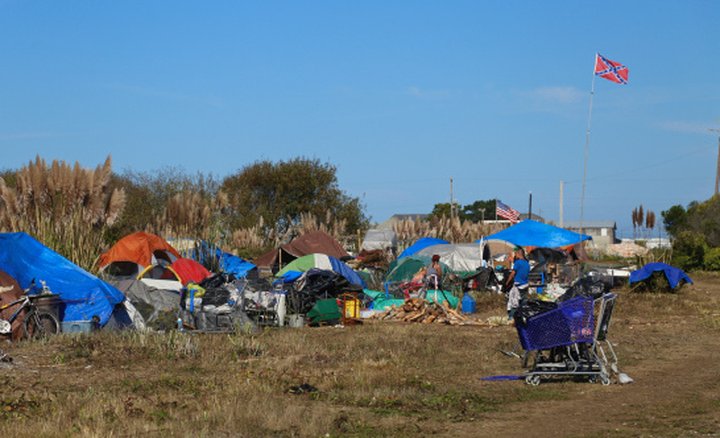
Homeless camp at the “Devil’s Playground” prior to the Palco Marsh eviction | File photo
###
After another long discussion during Tuesday night’s meeting, the Eureka City Council voted — 4-1, with Councilmember Leslie Castellano dissenting — to adopt an ordinance that restricts public camping in the city.
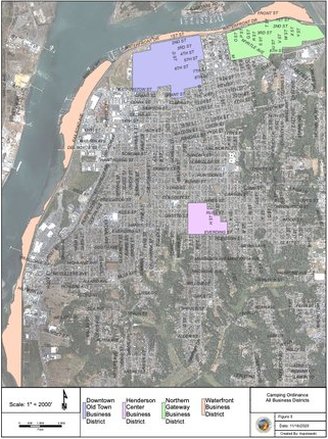
The ordinance has come before the council several times already, and been retooled a bit throughout the process. In its final version, the ordinance prohibits camping anytime in Old Town/ Downtown, Henderson Center, the Waterfront and the Northern Gateway districts, in city parks, the golf course and within 75 feet of public trails. It also bans camping anywhere in the city during daylight hours — starting 15 minutes after sunrise and ending 15 minutes before sunset — except for when it is raining, snowing or below 40 degrees.
The primary goal of the new ordinance was to replace the city’s existing anti-camping
ordinance with something more in-line with the Ninth Circuit’s Martin v. Boise decision, which held that local governments cannot punish someone for sleeping outside.
Several community members who spoke during the meeting, urged the council not to adopt this ordinance, saying that it still would effectively criminalize homeless people. Several people mentioned an issue with the fact that the ordinance makes clear where people can’t camp, but does not specify where people can camp in the city.
The business districts where camping is prohibited any time of day | from the City of Eureka
“One aspect that I find particularly frustrating and dehumanizing is that the council and other city staff have clearly stated EPD will not inform people on where they are allowed to camp,” Jasmine Guerra said to the council. “I hear the city’s concerns on having concentrated areas in the city that the city would then be liable for, but my point is that if we don’t want to condense people in specific areas, then we shouldn’t be forcing them out in the first place.”
The city has repeatedly said that there are many other city-owned properties where camping would be permitted, but City Attorney Bob Black explained that directing people to these properties could present liability issues for the city, and issues of responsibility for cleanup and sanitation.
City Manager Miles Slattery mentioned some of the previous issues the city has had when designating camping areas, specifically with the area of the Palco Marsh known to many as Devil’s Playground.
“We had an area that was designated as a lesser enforced area by the previous police chief,” Slattery said during the meeting. “It was, to be honest, a disaster. It ended up not only bad for the environment and the public, but even worse for the inhabitants.”
Violating the ordinance would be punishable by a fine — $25 for the first violation, $35 for the second violation and $50 for each additional violation — but the ordinance also states that it is not meant to be punitive, and that law enforcement should prioritize guidance to services over criminal punishment.
Several council members who were in favor of the ordinance said that they felt it is important for the Eureka Police to have this tool as a last resort for dealing with bad actors and to help address camping in the doorways of many local businesses.
“This is a pandemic and there are people right now in business who are hanging on by a thread,” said Councilmember Kim Bergel. “These are people who have been experiencing cleaning up people’s poop, cleaning up people’s trash, theft, broken windows — all of these things over a long period of time. And I’m not saying it’s only people who are experiencing homelesseness, but certainly it’s had a huge impact on our local businesses.”
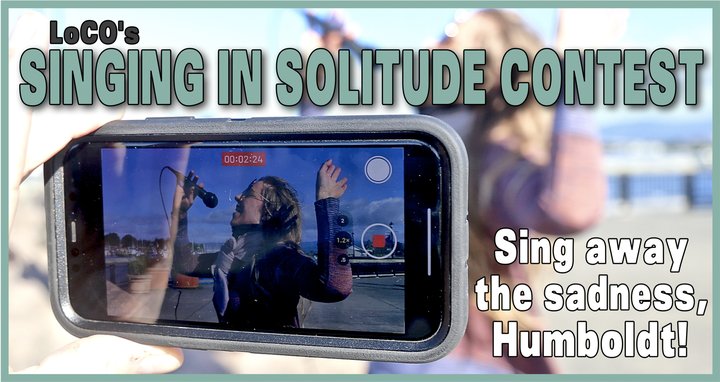
Gather round, Humboldt. Your Lost Coast Outpost has decided to battle our sheltered boredom by staging a little contest that is guaranteed to be loved and embraced by all and — exciting news! — the time has come to tell you about how this thing’s going to go down. Listen carefully, now!
First off, we’ll mention that LoCO has somehow managed to obtain a couple pretty sweet prizes: We’ve got one-night stays at both the Benbow Innand theInn at 2nd and C Streets that we are tasked with awarding to the general public. And what timing! We imagine you’re pretty sick of looking at your own walls, at this point. So let these fine, local, COVID-19-safety-precautions-complyin’ businesses lend you theirs for a night, amirite?
Now the important part: How do you win one of these coveted prizes? Well, you’re going to have to sing for ‘em, kids.
Introducing: LoCO’s Singing in Solitude Contest, where you, a bored and lonely Humboldt County resident, record yourself singing a love song of your choice in the hopes of securing fame, glory and a night somewhere else than your own damn house.
Here are the specifics you need to know to conquer all:
Record an under-three-minute video of yourself singing a love song, one you’re super sure will win over the hearts and minds of your fellow Humboldt shut-ins. You can sing acapella or with musical backing. We really don’t care! Just be entertaining.
At noon on Friday, Feb. 5, LoCO will launch the official Singing in Solitude Love Song Contest post on our Facebook page which we will link to on our site, here, to make it easy to find.
Upload your video to the comment section of that Facebook post. One entry per singer.
Wait for Humboldt’s judgmental social media users to discover your talent which they will then hopefully validate with a “like” or “heart” or whatever.
At noon on Thursday, Feb. 11 an imaginary buzzer will sound signifying that the fun is done and the contest is over. At that point, LoCO will declare the troubadour who garnered the most reactions on their video as the winner. (We will weigh “like”s, “heart”s, “wow”s, etc. equally, in this instance.) Then, we’ll reach out to that person to see if they’d like to claim the night’s stay at the Benbow Inn or the night’s stay at the Inn at 2nd and C Streets (which, we should note, also comes with a $50 gift certificate to Phatsy Kline’s Parlor Lounge). The first runner-up will be rewarded with whichever prize the winner does not select.
Does that all make sense? If not, read it again! If you still don’t get it, well, maybe that’s on us. Sorry.
And now a note to the people who will inevitably try to game the system: LoCO is watching you. Your attempts to pad your like count by logging into your various business/artist/political campaign pages will earn you LoCO’s scorn. Don’t. Rallying your crew is fine. Show us how popular you are.
And now a message to the voters: Can I like multiple video entries? Hey, there’s no way LoCO can stop you from doing that, but every extra vote you make dilutes your other votes. Do what thou wilt.
And finally, to the people who will find some aspect of this contest to complain about: Throw your own contest, you grump. We’re spreadin’ joy over here.
Now, you may have noticed that LoCO is throwing these fancy rooms around in the days leading up to Valentine’s Day. We want to make it clear that you are not obligated to redeem your potential winnings on V-Day, but you totally could do that. Or save it for later. You’re the winner! You do you.
Anyway, that’s it! Hopefully this does not end up a total disaster! You have a couple nights to work up the nerve to be awesome and endearing in front of your housebound community. Good luck to all! We’re excited to see your faces again! Sing like our collective sanity depends on it!
(P.S. For the love of all that is holy and good, horizontal video, please.)
Note: Entrants must be human to be eligible to win. For other legal contest rules, see here.