

Arcata City Council To Consider Placing Cap, Stricter Regulations on Vacation Rentals
Stephanie McGeary / Wednesday, Jan. 20, 2021 @ 1:24 p.m. / Local Government
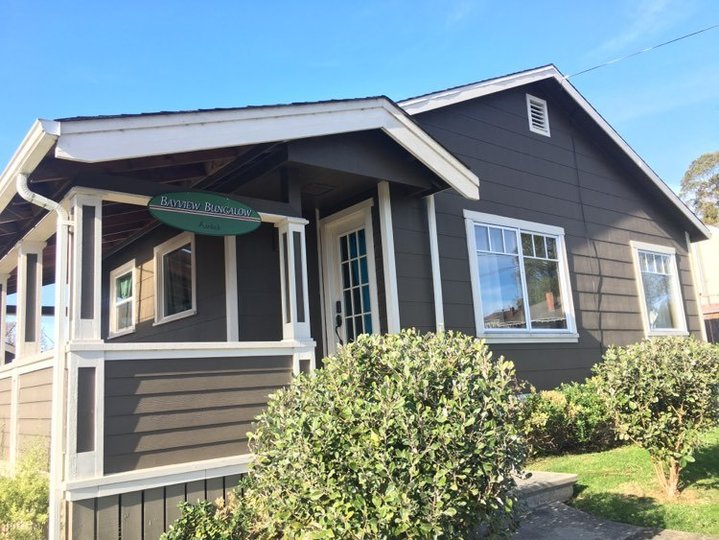
The ‘Bayview Bungalow’ vacation rental on H Street in Arcata
During tonight’s meeting, the Arcata City Council will consider imposing stricter regulations on vacation rentals, including placing a cap the number of short-term rentals allowed in the city.
City staff developed a vacation rental ordinance in 2018 and it was brought before the council for discussion last year, but the council took no action on the item due to a couple of council members having a potential conflict of interest. Now, with three new members, the council will again discuss the topic and see if it gains any traction.
Arcata currently requires vacation rental owners to obtain a business license — usually around $50 annually — and collect and pay Transient Occupancy Tax to the city. But the city doesn’t have a rigorous enforcement process, Arcata Community Development Director David Loya told the Outpost, and the city estimates that there are at least 25 vacation rental units not in compliance.
The proposed ordinance would require that, in addition to a business license, vacation rental owners obtain an operation permit, which would require applicants to pass a zoning clearance and a building inspection. The ordinance would also impose a 125-unit cap on vacation rentals in the city, though all of the specific requirements may be changed by the council.
Staff did some community outreach when drafting the ordinance and found that many local vacation rental owners were not supportive of the idea, some fearing that they would no longer be able to operate their rentals under the new regulations and many concerned about the potential costs of the inspections.
In an email to the city in 2018, Randy Klein — operator of who used to operate a vacation rental near downtown Arcata called the Bayview Bungalow — said that, as a retired couple, he and his wife rely on the income from their vacation rental and that converting it into a long-term rental “would be less than our mortgage payment.”
With vacation rentals becoming a very popular form of lodging in recent years, several California cities and counties have crafted ordinances regulating short term rentals. “In some areas, vacation rentals have changed the character of neighborhoods, created neighborhood concerns, and affected housing affordability,” Loya wrote in the staff report. “These ordinances are developed to limit the impact vacation rentals have on the availability and affordability of housing.”
Many cities have also established tighter restrictions or temporary bans on vacation rentals due to COVID-19, but Loya said that this is not the focus of tonight’s discussion. “If the state and or county closes vacation rentals or hotels, we’ll support those closures,” he told the Outpost.
If you have strong feelings about vacation rental regulation in Arcata, and are unable to attend tonight’s council meeting, Loya encourages you to email him at dloya@cityofarcata.org.
The Arcata City Council meets tonight at 6:00 p.m. You can view the full agenda and directions on how to participate here.
###
CORRECTION: Randy Klein informed the Outpost that he no longer owns the Bayview Bungalow. The article has been changed to reflect this information and to clarify that his email to the City was from 2018.
BOOKED
Today: 11 felonies, 19 misdemeanors, 0 infractions
JUDGED
Humboldt County Superior Court Calendar: Friday, Sept. 25
CHP REPORTS
Us101 S / Sprowl Creek Rd Ofr (HM office): Trfc Collision-No Inj
ELSEWHERE
RHBB: Heather S. Durand to be Sworn In as Superior Court Judge October 2
RHBB: Howard Forest Prescribed Burn Scheduled for September 29-October 22
Governor’s Office: Governor Newsom signs bills to strengthen accountability for cold storage facilities, following emergency in Boyle Heights
(VIDEO) Jason Segel Calls the Redwoods Beautiful, Indirectly Talks About Willow Creek on the ‘Late Show’ With Stephen Colbert
John Ross Ferrara / Wednesday, Jan. 20, 2021 @ 12:30 p.m. / Celebrity , MOVIED!
Hollywood celeb Jason Segel, who was spotted filming a movie in Eureka not four months ago, gave Humboldt County a brief shoutout on “The Late Show” with Stephen Colbert yesterday.
While promoting another non-Humboldt movie (boooring!), Segel mentions what he’s been up to during the pandemic (1:40).
“There was that lull in the middle where we though maybe things were calming down and I went and shot a movie in Humboldt County in Northern California in the redwoods,” he told Colbert. “It was very, very beautiful.”
That movie, an adaptation of the 2010 young adult novel The Sky is Everywhere, is still in post-production, according to IMDB. So maybe Segel will talk more about Humboldt closer to the movie’s release.
Later in the interview, though, Colbert brings up the redwoods again and asks Segel about Humboldt’s “Sasquatchies.” (2:48)
“There’s a whole town devoted to that by the way, up there,” Segel says, likely referring to Willow Creek. “Sasquatch is there, according to them.”
Colbert responded by referencing a Sasquatch report he did for the Daily Show in 1999. But that was filmed in King County, Washington. Nowhere near Humboldt, Stephen.
Watch the entire interview in the video embedded at the top of this story.
###
PREVIOUSLY: Movie Co-Starring Jason Segel Filming in Humboldt Through Thanksgiving
Probation Search in Shelter Cove Leads to Discovery of Illegal Weapons and Large Weed Grow, Sheriff’s Office Says
LoCO Staff / Wednesday, Jan. 20, 2021 @ 10:05 a.m. / Crime

Photos courtesy HCSO
Press release from the Humboldt County Sheriff’s Office:
On Jan. 19, 2021, at about 1:30 p.m., Humboldt County Sheriff’s deputies conducted a probation search at a residence on the 500 block of Nob Hill Court in Shelter Cove following community complaints regarding cannabis cultivation and increased traffic in the area.
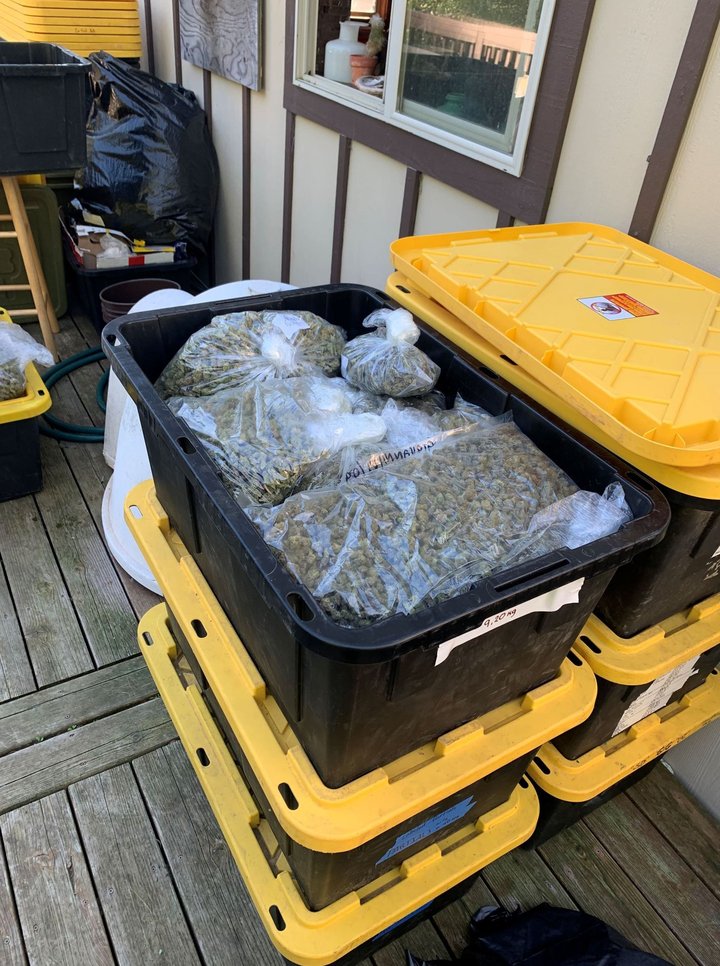
During the search of the residence, deputies located and seized over 830 pounds of processed cannabis packaged for sale, over 380 pounds of cannabis trim and approximately 558 growing cannabis plants. Additionally, deputies located and seized a sub-machine gun, a sawed-off short barreled shotgun, six high capacity magazines and six additional firearms.
Samuel Theodore McKee, age 28 of Shelter Cove, was cited on the following charges: unauthorized cultivation, harvesting or processing (H&S 11358(C)), possession of cannabis for sales (H&S 11359(B)), knowingly renting property for storing a controlled substance (H&S 11366), violation of probation (PC 1203.2(a)), possession of a firearm in commission of a felony (PC 12022(a)(1)), possession of short barreled shotgun (PC 33215), possession of an assault weapon (PC 30600) and possession of an illegal magazine (PC 32310).
This case has been forwarded to the District Attorney’s Office for review and prosecution.
Anyone with information about this case or related criminal activity is encouraged to call the Humboldt County Sheriff’s Office at (707) 445-7251 or the Sheriff’s Office Crime Tip line at (707) 268-2539.



Firefighters Dodge Exploding Propane Tanks as Flames Engulf Mobile Homes, RV on Spears Road Last Night
LoCO Staff / Wednesday, Jan. 20, 2021 @ 8:30 a.m. / Fire
Video: Submitted
###
Press release from Humboldt Bay Fire:
On 01/19/2021 at 10:43 P.M. Humboldt Bay Fire was dispatched to a reported structure fire in the 2700 block of Spears Road. The first arriving unit reported two fully involved single-wide manufactured homes with an additional partially involved recreational vehicle next to it. The occupants of the manufactured homes and recreational vehicle told fire personnel that all people and animals had been evacuated.
Humboldt Bay Fire units had extreme difficulty accessing the long, steep, muddy driveway. Personnel began extending several hundred feet of hose up the driveway by hand to fight the fire. Additional units had to hand-lay 350 feet of supply line to a hydrant as an unattended pickup obstructed the roadway that lead to the closest hydrant.
Fire personnel encountered multiple explosions from propane tanks during the incident. At one-point personnel were advised by the occupants that several propane tanks, including a 200-gallon tank, had recently been filled. Personnel saw several tanks venting with fire shooting in to the air. Personnel pulled back to a safer distance but continued to fight the fire. A large propane tank exploded causing a nearby Redwood tree to become involved in fire.
After approximately one hour of firefighting, personnel gained fire control. Even after the fire was controlled, several more explosions occurred causing firefighters to back out. Due to the large amount of burning materials on the property fire crews will be on scene to mop-up for several hours. Humboldt Bay Fire had four engines on scene. City Ambulance was also on scene as a precautionary measure. Cal Fire responded a duty officer at the request of Humboldt Bay Fire as this incident occurred on the joint response area between Humboldt Bay Fire and Cal Fire. Pacific Gas and Electric responded and secured the electrical to the property.
At the time of this news release, fire personnel were still mopping up and unable to investigate the cause of the fire. The estimated loss is $200,000.
(WATCH LIVE) The Inauguration of President Joe Biden
Andrew Goff / Wednesday, Jan. 20, 2021 @ 8:15 a.m. / News
Joseph Robinette Biden Jr. will be sworn in as the 46th president of the United States at 9 a.m. PST on Wednesday at a ceremony that will be dramatically different than any other inauguration in the nation’s 244 year history.
The socially distanced inauguration crowd will be among the smallest ever as officials consider the coronavirus pandemic and threats of domestic terrorism. In addition to Biden and Vice President Kamala Harris’s swearing-ins, the event is set to feature performances from Lady Gaga, Bruce Springsteen, Jennifer Lopez and Garth Brooks.
NBC News (and all major media entities) are providing online coverage of the proceedings. Join LoCO in gawking at history above.
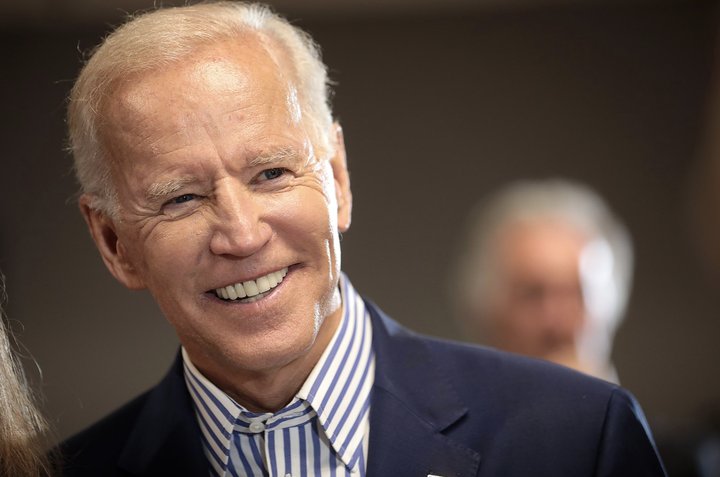
Joe. Photo: Gage Skidmore, Creative Commons license. Via Wikimedia.
Newsom’s $2 Billion School Reopening Fund Could Actually Cost Districts Money
Ricardo Cano / Wednesday, Jan. 20, 2021 @ 7:23 a.m. / Sacramento
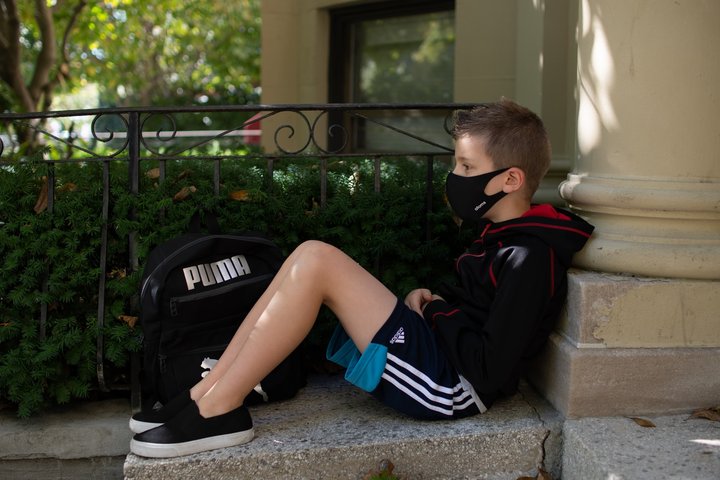
Photo by Kelly Sikkema on Unsplash.
###
In his bid to get California school campuses back open, Gov. Gavin Newsom proposed giving extra money to schools that managed to open by a certain date.
But the $2 billion in grant money would come with strings that some districts say would mean paying more than if they didn’t get the money in the first place. That’s because Newsom’s proposal — and new state guidance, the first since last summer — calls for vastly increased testing of school staff and students, which the schools would have to pay for.
The governor’s “Safe Schools for Plan,” first released Dec. 30, aims to incentivize schools to offer in-person learning by offering between $450 and $750 in per-pupil grant funding if the schools reopen for their youngest students by Feb. 16.
In order to receive extra state funding, districts would have to test staff and students for coronavirus periodically, according to trailer bill language. The frequency of the testing would depend on which of the state’s four color-coded reopening tiers the schools reside in.
For example, schools in the state’s purple and red tiers are now suggested to test their employees and students every two weeks. For schools in especially hard-hit counties with case rates higher than 14 positive cases per 100,000 — at this point, most schools — the guidance calls for testing staff and students on a weekly basis, per the California Department of Public Health. The guidance does not suggest specific testing timing for schools in the orange or yellow tiers.
Schools are not mandated to follow the state’s testing guidance if they don’t plan to seek financial support through Newsom’s proposed $2 billion fund for school reopenings. But the testing strings attached to state assistance have garnered criticism from school officials and advocates toward a reopening plan that had already attracted pushback from large, urban districts and teachers unions.
Critics of the governor’s reopening plan say that requiring more frequent testing — and that students be included — adds more to reopening costs than would be recuperated by the $2 billion fund. School officials have also raised concerns about the tight deadlines in order to qualify for the full per-pupil amounts, as well as the fact that the money is coming out of the Proposition 98 pot of funds already meant for K-12 schools and community colleges.
“I don’t know if that grant money was going to be enough for everything that would be required, including the testing schedule,” said Al Mijares, the Orange County district superintendent. “It’s made it difficult for people to immediately jump at this with enthusiasm and grab it with gusto and run.”
State advocacy groups representing school boards and district and county superintendents wrote a letter to the governor Tuesday asking him to make significant changes to his reopening proposal, including setting “more feasible” testing requirements to obtain funding.
The math doesn’t even pan out. So, districts would be stuck with this bill on the back end of something that nobody could afford.
— Marian Kim-Phelps, superintendent, Poway Unified School District
“The difficulty of implementing the proposed testing cadence prior to the proposed deadlines cannot be understated,” read the letter from school advocates, which included the California School Boards Association and California County School Superintendents Educational Services Association.
“Because COVID-19 testing for students and staff is central to the reopening plan, it is critical that schools actually have the capacity to operationalize and pay for the new testing requirements,” the letter said. “Currently, the vast majority of (school districts) do not believe such a path exists.”
Jesse Melgar, a spokesman for Newsom, said in a statement Tuesday that the governor planned to “continue working with legislators and stakeholders to advance this proposal in the coming weeks.”
“We appreciate that the letter acknowledges the importance of our Safe Schools for All Plan and the value of returning to in-person instruction in a manner that is safe for students and staff – even as they pose questions about the $2 billion budget proposal,” Melgar said.
Most public schools that reopened last fall did not include students in their surveillance testing strategies, and some reopened with minimal or no surveillance testing. The testing issue had vexed many local districts grappling with questions surrounding cost, availability and how often to test employees. Earlier state guidance on reopening schools suggested districts test their staff once every two months. It did not issue recommendations for testing students.
As part of the governor’s push to reopen schools, the state is allowing schools to piggyback on the state’s contract with Valencia Branch Laboratory for discounted testing. Also, the state has vowed to offer more technical support for schools by creating a new team dedicated to helping schools develop safety plans and launching a new website to troubleshoot their questions.
Still, for some school districts, the costs associated with required weekly or biweekly testing for employees and students outweigh the benefit of pursuing the $450 per-student grants.
Marian Kim-Phelps, superintendent of San Diego County’s Poway Unified, said Newsom’s reopening plan could actually cost the district of 36,000 students money if it decided to apply for the grants.
In a Thursday school board meeting hours after the state released its new guidance, Phelps explained to her board why it wouldn’t be worth the effort to pursue the grant funding for Poway, one of the largest districts in California to offer in-person instruction. Superintendents in San Diego County had estimated that it costs about $40 million to test all teachers in the county once. By that estimate, Phelps said, the grant funding they’d receive would pay for only eight rounds of testing for all teachers, not including students.
“The math doesn’t even pan out. So, districts would be stuck with this bill on the back end of something that nobody could afford,” Phelps said.
The state guidance, an update on recommendations first released in July, sets new rules for reopening schools.
All K-12 students attending school in person are now required to wear masks. While campuses are allowed to reopen for students in kindergarten through sixth grade so long as their county has less than 25 positive cases per 100,000, schools in California cannot physically reopen for grades 7-12 until their county moves out of the purple tier for five days.
The state will now track and publish data on school cases and reopened campuses, requiring school districts to report whether they are offering in-person instruction, and in what capacity, starting next week.
Sara Noguchi, superintendent of Modesto City Schools in the Central Valley, said she plans to pursue the state’s grant funding for reopening, though said she’s sought more clarification from public-health officials over how often staff and students would have to be tested.
Noguchi said the largest school system in Stanislaus County will be able to meet the Feb. 1 deadline for full grant funding because it began offering in-person learning for elementary students in November after applying for now-defunct reopening waivers. Many of the elementary waiver requirements overlap with those for acquiring grant funding.
“It took us weeks and weeks to work on an MOU that we negotiated to open up our elementary schools,” Noguchi said.
“If you weren’t in a district that applied for the waiver, it would be very difficult to put all of this together by February 1.”
###
CALmatters.org is a nonprofit, nonpartisan media venture explaining California policies and politics.
Day 1: New Sen. Alex Padilla Wants Trump’s ‘Enablers’ Out of U.S. Senate
Laurel Rosenhall / Wednesday, Jan. 20, 2021 @ 7:12 a.m. / D.C.
As he’s sworn in today by Vice President Kamala Harris to take her old seat, California’s newest senator says the outgoing president and some fellow senators must be held accountable for the deadly siege of the Capitol.
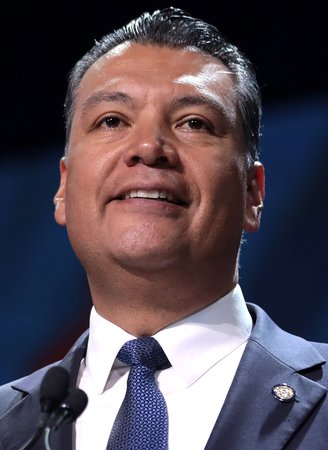
Photo: Gage Skidmore, Creative Commons license. Via Wikimedia.
Today’s presidential inauguration of Joe Biden sets off a spate of historic firsts that are reshaping Democratic politics in California. Kamala Harris, California’s former senator, will be sworn in as the first female vice president. Hours later, she’s scheduled to administer the oath of office to her replacement, Alex Padilla, the outgoing secretary of state who will become the first Latino to represent California in the United States Senate.
The changing of the guard comes as the nation is reeling from a deadly pandemic and the aftermath of the second impeachment of outgoing President Donald Trump. It’s a lot for a new senator to step into.
Amid heightened security, even plans for his swearing-in ceremony have been fluid, Padilla said:
“Here’s my game plan, to be honest. I’ll wake up in the morning, put on a suit. Have a cup of coffee in one hand, and a Bible in the other. And I’m just going to wait for the phone call.”
Conducting business in a conference room near the Democratic National Committee’s headquarters because his Capitol office isn’t yet available to him, Padilla talked to CalMatters about his new job. This interview has been lightly condensed for clarity.
Q: It’s been less than a month since Governor Newsom announced he would appoint you to replace Harris, but so much has changed in that short time. Democrats won two Senate races in Georgia, giving the party control of the Senate. And the House impeached President Trump for inciting the January 6 attack on the Capitol. How will these developments change your work as a senator?
A: I will try my best to stay focused. A lot of big issues to work on, but none more critical and urgent than the COVID-19 pandemic. A lot of what’s transpired since the announcement, you’re absolutely right, it just keeps adding to the workload. So as I am entering the United States Senate, there’s two oaths that I’ll be administered. One is being sworn in as a member of the Senate, and the other is being sworn in as a juror.
Q: When the Senate holds an impeachment trial, would you vote to convict President Trump? Would you vote to prevent him from ever holding office again?
A: I think it’s more than clear his actions, his statements in the public domain — he did just have a huge role in the rebellion and insurrection of January 6th. He’s been fanning those flames for four years.
Q: I didn’t hear you say yes.
A: I will respect the process of the hearing in the Senate, as a juror. But Donald Trump, and a lot of his enablers, must be held accountable.
Q: What about Senators Ted Cruz and Josh Hawley — would you vote to censure or expel them for objecting to the Electoral College votes?
A: Yes, I think they have to be held accountable. Every member of the Senate takes an oath to uphold and defend the Constitution of the United States, not to uphold conspiracy theories and baseless lies about election results. And they had fatal consequences on January 6. We can’t lose sight of it. Yes, we have a lot of official work to do but we can’t lose sight of the important accountability to defend our democracy.
Q: So, do you think censure or expulsion is the right answer for them?
A: I think the nation would be best served if they were no longer in the Senate. There are several procedures for that. You know, their hometown papers in their own respective states have called for their resignations, and that says a lot as well.
Q: Wow, that’s a lot to step into that you weren’t expecting a month ago.
A: Right. Just stepping into the United States Senate is a big enough milestone for anybody. It’s not lost on me that I’ve been appointed, not just to fill any vacancy, but the vacancy left by the next vice president of the United States. (Harris), the child of immigrants, the first woman vice president of the United States, administering the oath to me, a child of immigrants and the first Latino to represent California in the U.S. Senate — that’s a lot to reflect on. And frankly, a lot to be motivated by.
Q: What does the slim Democratic majority mean for your policy goals? And are there policies we have in California that you’d like to help pass for the whole nation?
A: Absolutely. It may be a razor-thin majority, but it’s a majority nonetheless. And the urgency by which a lot of these issues need to be addressed is absolutely there, starting with COVID. We can’t rest on our laurels just because there’s vaccines that have been approved. We clearly have manufacturing and production challenges to overcome. More distribution, better distribution plans to put in place across the country. … The other side of COVID response is economic. The $2,000 direct assistance to families across the country should have been done yesterday. The sooner we get that done, the better. And I want to be clear that it’s not a stimulus check in my opinion. It’s a survival check.
In addition to that, I think there’s many ways in which my California experience lends itself to the U.S. Senate. We talk about the imminent threat that is climate change. When I was in the state Senate for six years I chaired the committee that oversaw energy, so I was deeply involved in the crafting of California’s renewable energy goals. That directly translates to climate discussions in Congress. Look at my experience the last six years in the elections world. Election security is going to continue to be a hot topic for Congress. We can’t take our eye off the ball on the multiple threats — cyber and otherwise — to the integrity of our free and fair elections.
Q: What do you think about Biden’s proposal for immigration reform? Is eight years fast enough for a pathway to citizenship?
A: The proposal overall is very, very encouraging. Would I like to see five years as opposed to eight? Absolutely….And for that matter, a more affordable naturalization application fee. The fees have gone up too much, too soon in the last four years. But there’s other elements too. How to provide not just protections to Dreamers by reversing the Trump executive order for DACA, (but also) the parallel program that extends to the families of Dreamers. How to make sure we finish reuniting families that were separated at the border under the Trump administration? And how do we piece back together a humane asylum system that was decimated by Trump? So there’s a lot of elements in the comprehensive immigration reform plan that I’m eager to be a strong voice in. Because no state has more at stake in getting this done than the state of California.
Q: In the run-up to your appointment by Governor Newsom, so much of the public debate was about the ethnic and gender identities of those who might replace Senator Harris. (Some advocates said the seat should go to a Latino to represent the state’s largest ethnic group. Others said Newsom should appoint a Black woman because Harris was the only one in the Senate.) Did that surprise you?
A: Not completely. California’s rich diversity was among a number of considerations, and hopefully a key consideration, for Governor Newsom to take into account.
Q: But did the focus on the origin stories of the possible future senators take away from a discussion of what kind of qualifications voters might want in their senator? Or what their ideology and belief systems are, or what they could accomplish for the state?
A: I don’t think so. That’s one of the beautiful things about our democracy. We all bring our perspective, our life journey, to the process. I know the governor must have weighed a number of considerations, diversity being an important one, but just one. I’m honored and humbled by the selection. And I think in large part, it also is the result of my 20 years of public service, my experience, my track record at the municipal level, in the state Legislature and in the last six years as California’s chief elections officer.
Q: Can you give a sense of what the interview process with Newsom was like? What kinds of things did he ask about and want to explore with you?
A: It was multiple conversations by phone and by Zoom, talking about a wide range of policy issues. I’ve had a great working relationship with Governor Newsom now for many years. There was definitely a formal process here and a number of issues that we had lengthy conversations about, but it wasn’t to build a working relationship or rapport from scratch.
Q: Can you share what some of those policy issues were that he asked you about?
A: It really spanned from elections, to health care, to seismic safety sudden warning systems, to higher education. There was a lot.
Q: Your first job in government was as an aide to Senator Dianne Feinstein. Is there anything you learned from her that you’re reflecting on now that you’re that you’re beginning your own position as a senator?
A: Her effectiveness on issues like the assault weapons ban early in her tenure as a senator, and some of the major environmental protection deals that she’s shepherded through, from the desert to the redwoods and everywhere in between. Her courage in releasing the torture memo from the intelligence community. I thought that was bold and brave. So I learned a lot through observation. Looking forward to working alongside her. The narrative is not lost on me: I used to be a field representative for her once upon a time, and now we’re going to be colleagues. But I also look forward to bringing my own perspective and life experience to the deliberations of the United States Senate.
Q: Have you seen Senator Feinstein since you’ve been in Washington? (Feinstein told reporters Tuesday that she thought Sens. Cruz and Hawley had the right to object to Biden’s victory when the Senate certified Electoral College results following the Jan. 6 riot.)
A: I have not seen her since I arrived in Washington. We’ve talked by phone about weekly.
###
CALmatters.org is a nonprofit, nonpartisan media venture explaining California policies and politics.


.jpg)
_(cropped).jpg)