

Two Public Porta-Potties Torched Near Westhaven in Three Weeks
John Ross Ferrara / Tuesday, Jan. 12, 2021 @ 10:20 a.m. / Crime
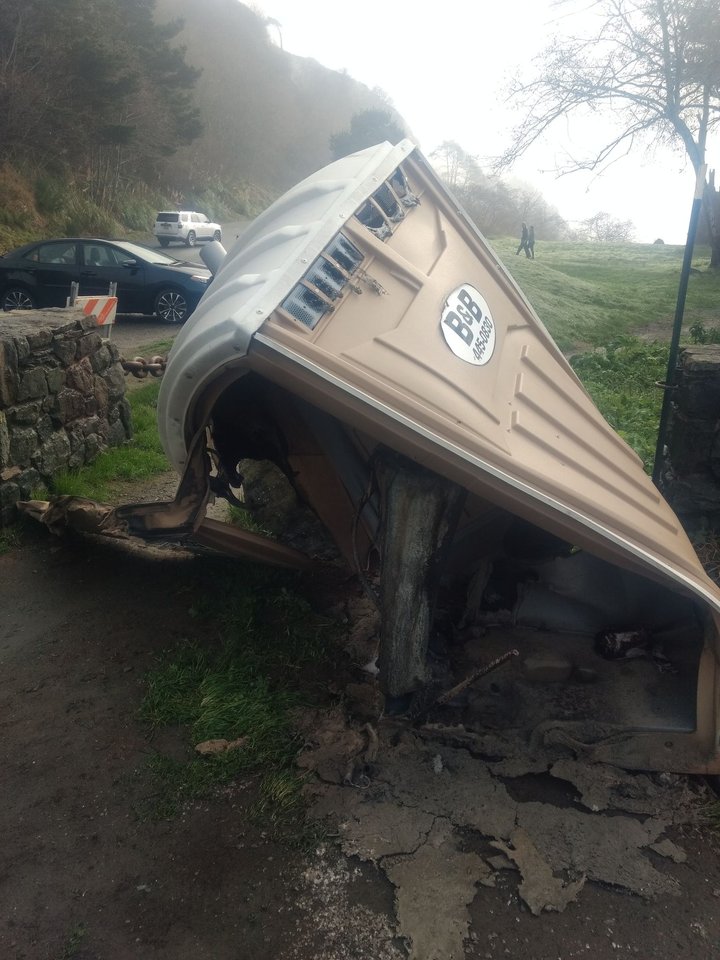
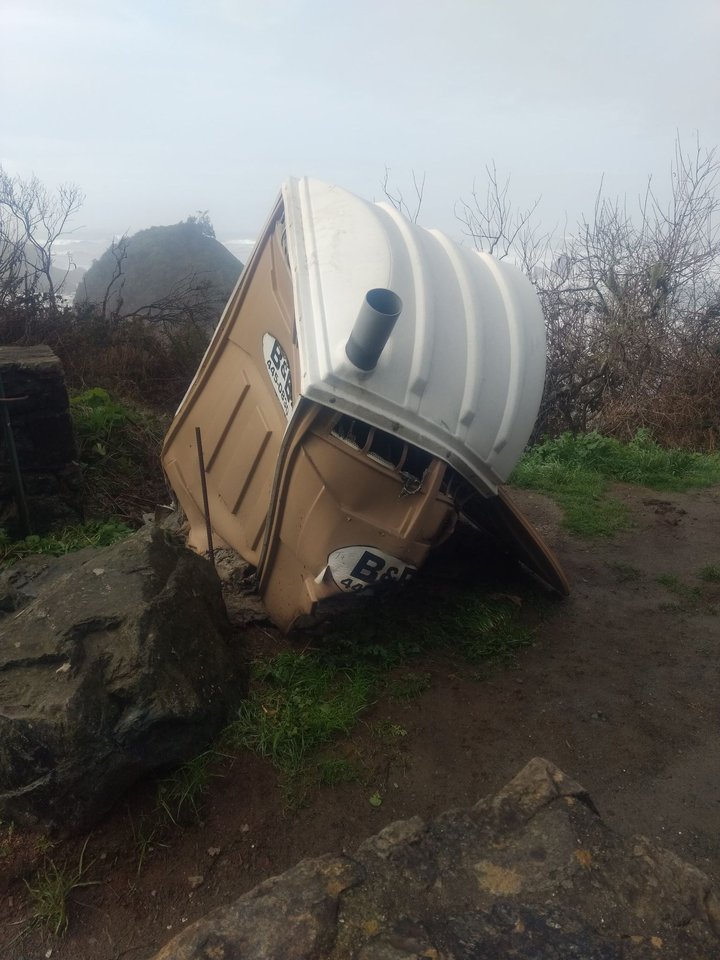
The porta-potty at Houda Point. | Photos by reader Tim Haywood.
Two ADA accessible porta-potties were burned to the ground in separate incidents along Scenic Drive in Westhaven within the last few weeks.
Westhaven Volunteer Fire Department Assistant Chief Neil Foreman told the Outpost that the first porta-potty was completely disintegrated near Luffenholtz beach on Dec. 23. On Saturday afternoon, firefighters responded to the most recent porta-potty fire down the road near Houda Point.
“It was definitely a hazmat situation,” Foreman said. “Obviously burning shit and burning plastic is really bad. We got the fire out pretty quickly but it was just really gross.”
Trinidad Coastal Land Trust Executive Director Carol Vander Meer told the Outpost that B&B Portable Toilets accepted the financial burden, but said that the nonprofit won’t replace the toilets anytime soon.
“We provided porta-potties at Luffenholtz and Houda Point,” Vander Meer said. ”It was our effort to reduce the impact of human waste on the beautiful environment.”
The suspicious fires, Vander Meer said, are part of an ongoing crime surge affecting Scenic Drive.
“With the pandemic, we’ve seen a dramatic increase in the use of Scenic Drive and there’s been, perhaps, more dumping and overnight camping, so it’s become more of an issue,” she said. “We’re looking into whether having security cameras might be helpful.”
While the Humboldt County Sheriff’s Office received nearly 100 more calls for service on Scenic Drive in 2020 than in the previous year, HCSO spokesperson Samantha Karges said that there hasn’t been a major uptick in crime in the area.
“We haven’t seen an alarming increase in crime, though we have had several vehicle burglaries along the road, which has prompted more proactive vehicle investigations, traffic stops and patrols of the area,” Karges said.
It’s unclear what caused the porta-potty fires and no suspects have been arrested in connection to the incidents.
“There didn’t appear to be any kind of accelerant,” Assistant Fire Chief Neil Foreman said. “Looking at it, maybe they just set the toilet paper on fire. It was burnt to a crisp.”
Vander Meer is encouraging anyone with information about the fires to contact the Humboldt County Sheriff’s Office Crime Tip Hotline at (707) 268-2539.
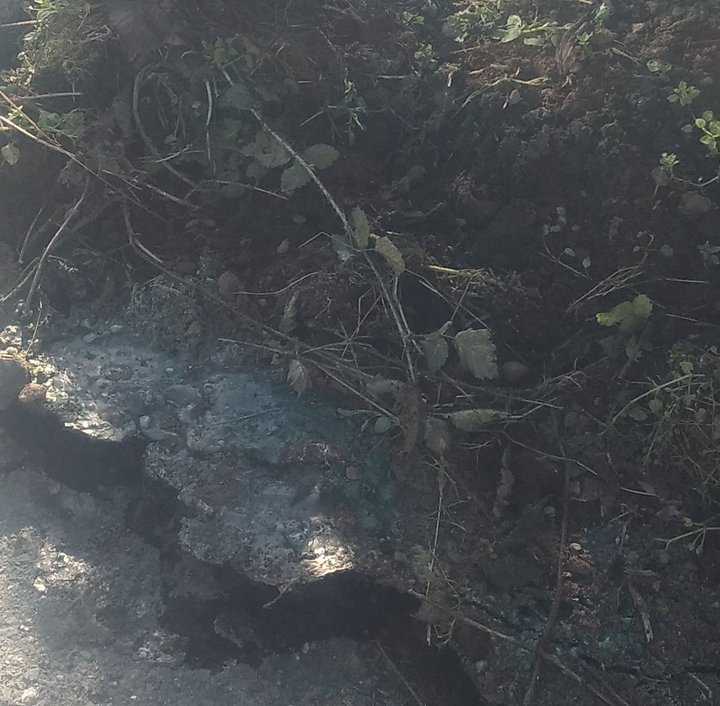
The disintegrated toilet at Luffenholtz Beach.
BOOKED
Today: 8 felonies, 13 misdemeanors, 0 infractions
JUDGED
Humboldt County Superior Court Calendar: Today
CHP REPORTS
Sr299 / Little Browns Creek Rd (RD office): Traffic Hazard
Us101 S / Tompkins Hill Rd Ofr (HM office): Trfc Collision-Unkn Inj
0 Grayback Rd (YK office): Car Fire
ELSEWHERE
Fishing the North Coast : Plenty of Fishing Options While We Wait for the Fall Rains
EcoNews: PR3 Creates New International Symbol for Reuse
EcoNews: Timber Sale Tracker: October 2026
Biden’s Debt Forgiveness Plan Would Help Millions of California Students
Mikhail Zinshteyn / Tuesday, Jan. 12, 2021 @ 7:09 a.m. / Sacramento
Millions of Californians could get one of the biggest transfers of money in this country’s history as lawmakers and the incoming president duel over competing plans to rid the nation of ten of billions of dollars in student debt.
If President-elect Joe Biden follows through with his campaign promise to forgive $10,000 in federal student debt, as many as 1.3 million Californians could see the balance on their federal college loans totally wiped out.
The plan, which would make good on a once fringe progressive goal of student forgiveness that’s gone mainstream in the past five years, would benefit a total of roughly 3.9 million Californians who combined owe $140 billion in federal loans used to pay for college.
But a chorus of Congressional Democrats, including Sens. Chuck Schumer, Elizabeth Warren and California U.S. Representative Maxine Waters, wants Biden to expunge up to $50,000 in federal student debt. Debt cancellation of $50,000 would clear the federal student debts of far more Californians — between 2.9 and 3.3 million people, according to a CalMatters analysis of U.S. Department of Education data.
What that could mean for California
Recent California college graduates with typical federal loan debt would see more than half of their undergraduate loans waived under the Biden plan, and lower-income students who qualified for the federal Pell grant would see a larger share of their debt forgiven.
Students with Pell grants graduating with bachelor’s from California’s public and private nonprofit universities typically have $18,000 in federal loans — slightly less than the $19,370 in federal loans borrowed by students who didn’t receive Pell grants, according to data crunched by The Institute for College Access & Success for CalMatters. This doesn’t include debt students can accrue as they continue their educations.
Nationally, college graduates generally owe more. The typical debt among graduates nationwide is about $27,000 for Pell recipients and 23,000 for those without Pell. That California funds the largest state aid program in the U.S., the Cal Grant, plus aid its colleges award, likely limits how much students need to borrow.
Experts are split on the potential economic impact of wiping out more than half of the typical California college graduate’s debt.
On the one hand, economists like Christopher Thornberg don’t think it would make much of a dent in the overall economy. “If you can’t pay back $10,000 in debt, you ain’t making a lot of money,” said Thornberg, a founding partner at Beacon Economics, a Los Angeles-based consulting firm. “And if you’re not making a lot of money, you’re not, what I would call, a macroeconomic driver.”
On the other hand, some experts think debt forgiveness could boost the economy by helping young people afford more goods, take business risks, and get closer to buying homes.
Then there’s the impact debt forgiveness can have on career choices. “Students with a lighter or no debt burden may feel free to pursue careers, especially in the public interest, that pay less –– but benefit everyone more,” said Jonathan Glater, a law professor at UCLA who studies debt relief.
Is debt forgiveness good policy?
Critics say any debt cancellation, especially as high as $50,000, is a middle- and upper-class giveaway. The argument goes that because college-debt holders tend to be more affluent, and already have federal repayment programs that reduce monthly payments to a portion of one’s income if they don’t earn a lot, wiping out some or all of their debts is a regressive move.
“We’re proposing to help only people who went to college, forget about those people who didn’t. I find that incredibly inequitable and not a progressive policy,” said Sandy Baum, a scholar on student debt, in an interview. Baum presented her research at a December meeting on student debt held by the California Student Aid Commission, which oversees the Cal Grant and helps to establish financial aid policy in the state.
She supports targeted debt relief, such as partial forgiveness for every year a borrower is unable to make any payments and for parents living below the poverty line who borrowed on behalf of their children.
“We’re proposing to help only people who went to college, forget about those people who didn’t. I find that incredibly inequitable and not a progressive policy.”
— Sandy Baum, scholar on student debt
Backers of comprehensive debt relief say debt forgiveness can close the racial wealth gap. While white borrowers largely pay off their student loans after 20 years, Black borrowers have barely made a dent in theirs, a recent study shows. Next, comprehensive debt forgiveness is much more meaningful to people with lower incomes because they get the largest relief relative to their economic situation, others have shown.
Current debt relief programs lag
Even with programs like income-driven repayment, which exist to reduce how much borrowers have to pay monthly if their incomes are low relative to their debt, Californians still struggle. Less than a quarter of California borrowers in repayment on a federal loan have incomes below $40,000, but those people account for more than half of borrowers who have fallen behind on a federal student loan in the state, according to the Student Borrower Protection Center, a group that supports debt forgiveness and crunched data from the Federal Reserve for CalMatters.
Debt forgiveness may also spare tens of thousands of Californians from going into default on their student loans, a problem that can plague communities of color in particular.
Part of the problem is that too few low-income borrowers struggling to repay their federal student loans either can’t access or don’t know about income-driven repayment, even though the loan relief programs have been in full force since 2009. Another criticism of debt forgiveness is that it may help past students, but incoming students will endure the same higher-education costs that plagued past borrowers. Biden has two solutions for that.
One is doubling the maximum award of the Pell Grant, which currently sits at around $6,300. Nearly a million California students receive a Pell Grant, according to the latest U.S. Department of Education data. Such a move could move the purchasing power of the grant closer to its glory days of 1975 when the maximum Pell Grant covered three-quarters of a student’s in-state tuition and housing costs at a public university. Today, it’s down to 28%.
The President-elect also campaigned to make public colleges tuition-free for students from families earning less than $125,000.
###
CALmatters.org is a nonprofit, nonpartisan media venture explaining California policies and politics.
OBITUARY: Timothy A. Willits, 1956-2020
LoCO Staff / Tuesday, Jan. 12, 2021 @ 6:56 a.m. / Obits
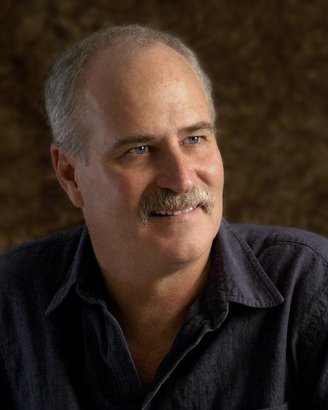
Timothy A. Willits
March 2, 1956 - Dec. 27, 2020
Tim was one of the most thoughtful, kind and gentle men one would likely meet. He was built of quiet strength. Words that have been used to describe him are that he was a man of integrity, honesty, loyalty, faithfulness, decency, generosity and wisdom. A statement he left with his wishes to be carried out when the time came was “About My Life: I didn’t always hit all the notes but I had a blast trying!” Despite him saying so, all who knew him know that he lived his life creating a symphony. That beautiful music is now quieted but his life’s song will always be remembered by the many, many people who loved him so very much.
Tim was born at the old General Hospital at Harris and H in Eureka, as a 4th-generation member of a Humboldt family. Other than when attending Brooks Institute of Photography in Santa Barbara, from which he received his B.A. in photographic sciences in 1980, Tim lived his entire life in Humboldt County. He made this choice in spite of an offer after graduation to travel the world as an assistant to one of the world’s greatest photographers at the time. The most inspiring senior each year was sought out for this distinction and honor. It is a testament to Tim’s love of and dedication to his family and Humboldt County that he chose to remain here for the rest of his life. In doing so, he positively touched many, many lives over the years. During his Brook’s years, Tim worked full-time at a service station, having learned the trade from working with his father at the family’s stations. His favorite anecdote of that time was the pleasure of pumping gas for Jane Fonda.
Tim attended South Bay Elementary School where he was Valedictorian of the graduating 6th grade class. He went on to attend Jacobs Junior High and Eureka High. As unassuming as Tim was, his mother had to find out from Mr. Moenke that a musical composition she heard at one of the high school performances had been composed by Tim. Tim could pick up and learn to play any musical instrument and became more than adept at some of them in short periods of time. He attended CR and HSU before getting his degree at Brooks Institute. He loved school and excelled therein, as he did in all of his endeavors throughout his life.
After graduating from college Tim spent some time in Eureka as a professional photographer working with Jack Anderson. He then went on to spend the rest of his working life at Pacific Gas and Electric Company. During his 30 years with the company Tim was respected for the work he accomplished in many of its divisions and turned down offers to be in management so that he could continue to work in the field. His favorite and final job was being a meter reader until, coincidently with retirement imminent, his services were no longer needed due to the introduction of smart meters.
In retirement Tim involved himself in many activities new to him which brought new and wonderful people into his life and him into theirs. He spent many weeks in 11 years traveling with his husband on 6 continents and to upwards of 40 countries. His delight in these adventures was apparent to all. For many years he was a valued board member of Humboldt Light Opera Company supporting its endeavors in every way he could, sometimes even when it took him out of his comfort zone.
Tim was predeceased by his father, Charlie Willits. He is survived by his partner (of 21 years)/husband Jim Willits, his mother Mary (Marilyn) Willits, his sister Connie Alvara, his brother Chris Willits, his 3 Hicks nephews, Steve, Scott and Stuart, as well as their wives, children, grandchildren, and, recently, great granddaughter, making Tim rejoice in being a great, great uncle. His nephews adored him and spoke of how much they learned from him (how to fish…), sometimes even moreso than from their own father.
Tim never desired to have many things. He was wise enough to know that the people in his life were what needed to be valued. He made sure those people knew their importance to him. He was loving, well-loved and will be missed by more of the community than he might ever have imagined. He is deserving of it all.
Tim died at home, the place in all the world where he most loved to be, of a previously undiagnosed health issue. Final arrangements were facilitated by Ayres Family Cremation. A celebration of Tim’s life will be held when everyone can freely gather together again.
The family requests that any donations in Tim’s name be made to Humboldt Light Opera Company, 92 Sunnybrae Center, Arcata, CA 95521.
###
The obituary above was submitted on behalf of Tim Willits’ loved ones. The Lost Coast Outpost runs obituaries of Humboldt County residents at no charge. See guidelines here.
OBITUARY: Harold (Hal) Eldon Harden, 1937-2020
LoCO Staff / Tuesday, Jan. 12, 2021 @ 6:56 a.m. / Obits
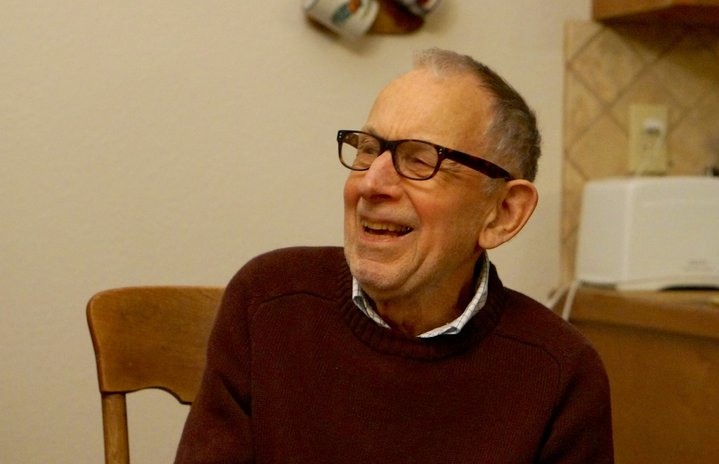
Harold (Hal) Eldon Harden died in McKinleyville on December 24, 2020. He was born on March 20, 1937 in Ottawa, Kansas. He spent most of his growing up years in Lincoln, Nebraska. In 1954 his family moved to Chevy Chase, Maryland and he graduated from high school there in 1955.
Hal attended the University of Maryland until he received an appointment to the Naval Academy. After graduating in 1961 he spent ten years in the Navy, most of the first six years at sea. In 1967, now a lieutenant, he began his studies in Electronic Engineering at the Naval Post Graduate School in Monterey. In 1968 he met his wife on a blind date and they were married not long after. After getting his B.S. degree he was transferred to Alameda. They bought a house in Orinda and lived there for 6 years. Hal left the Navy during that time and after working for Airco Temescal in Emeryville for several years they decided to realize a dream that they had of buying a place in the country and in May 1976, ended up on 100 acres in a beautiful valley east of Garberville.
For the next 39 years his woodworking talent was on full display as he created a new house interior, and in between drove a SHUSD bus to Island Mountain and back for nine years, built a small barn and chicken coop, milked several cows over the first 10 years, sheared a small flock of sheep, fenced most of the 100 acres, and fixed anything that needed it. He enjoyed listening to classical music and sketching their cows and various scenic places along the north coast. He traveled with his wife to different European countries and became a dedicated admirer of anything British after several trips there.
In 2015 they sold their one-of-a-kind house and property and moved to a neighborhood in McKinleyville to be closer to medical specialists. Hal leaves his wife of 52 years, Wendy, two loving daughters, Maggie and Cia, and two granddaughters.
###
The obituary above was submitted on behalf of Hal Harden’s loved ones. The Lost Coast Outpost runs obituaries of Humboldt County residents at no charge. See guidelines here.
County Planning Commission Forwards Permanent Industrial Hemp Ban to Board of Supervisors for Approval
Ryan Burns / Monday, Jan. 11, 2021 @ 5:09 p.m. / Cannabis
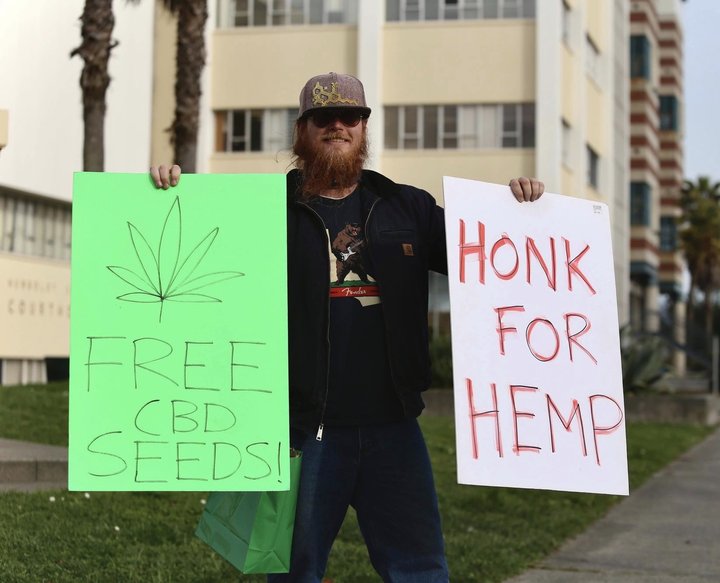
Hemp activist Benjamin Franklin Grant protests the county’s hemp moratorium outside the Humboldt County Courthouse on Monday. | Photo by Andrew Goff.
###
A time-traveling weed legalization activist from three or four decades ago would probably be confused to arrive in present-day Humboldt County and learn that marijuana is legal while cultivating hemp, weed’s fibrous, non-psychoactive sibling, remains banned throughout the unincorporated land. Yet here we are.
On Thursday, the Humboldt County Planning Commission unanimously voted to indefinitely extend the county’s industrial hemp moratorium, which has been in effect since May 2019, and to forward an ordinance to the Board of Supervisors that would make the prohibition permanent.
There are a couple of exceptions to the ban. First, College of the Redwoods will have permission to seek a special permit that, if approved, would allow hemp to be grown for educational and research purposes on the school’s main campus, just south of Eureka.
Secondly, as the word “industrial” suggests, the ban is meant to prevent commercial-scale operations, so the “personal use” size limits in the county’s Commercial Cannabis Land Use Ordinance (CCLUO) will apply to hemp as well. That means people can grow up to six hemp plants or maintain 100 square feet of cultivation on parcels smaller than an acre; up to 200 square feet on parcels of one to five acres; and up to 400 square feet on parcels larger than that.
Also, individual cities can make their own rules. They can implement their own bans on industrial hemp, as both Blue Lake and Fortuna have done, but if they don’t, hemp cultivation is permitted by default.
In 2020, the Humboldt County Agricultural Commissioner’s Office registered two industrial hemp growers — one growing in Arcata and the other in Rio Dell, according to Ag Commissioner Jeff Dolf. In an email on Monday Dolf said, “We also were contacted by a business in Arcata which expressed interest in producing industrial hemp nursery stock, but as yet have not received a completed application from the interested party.”
Why the ban in the rest of the county? Well, in a series of public hearings and workshops held in 2019, quite a few local cannabis growers came out and voiced concerns that industrial hemp could produce uncontrolled pollen drift along with pests and pathogens that might contaminate their own crops, potentially destroying large swaths of the region’s lucrative commercial cannabis.
This whole debate erupted in 2019 after the federal government — somewhat unexpectedly — lifted its longstanding ban on hemp cultivation with passage of the 2018 farm bill. While hemp has historically and most commonly been grown as a source of durable fiber, used to produce rope, textiles and paper, etc., it can also be cultivated as a source of cannabidiol, aka CBD, a compound that has blossomed into its own lucrative industry. CBD is now regularly infused into food, health and beauty products and marketed as a treatment for conditions such as anxiety, epilepsy, pain and even cancer, though the scientific evidence for those claims remains thin.
While commercial cannabis regulations in California include robust — some say oppressive — systems of permits, fees and taxes, federal legalization of hemp meant that it can be grown more or less like any other agricultural crop. In California that means little more than registering your grow site with your county’s agricultural commissioner and paying a $900 fee.
Some growers saw hemp cultivation as a back door that would allow them to produce a lucrative cash crop legally without being overburdened by regulations. Others maintained the libertarian argument that the government has no business telling people what crops they can and can’t grow on their own land.
At Thursday’s Planning Commission hearing, SoHum resident and regular hemp advocate Benjamin Jefferson Franklin Grant spoke against the moratorium.
“There are potential threats to the local cannabis industry from cross-pollination and pests,” he allowed, “but those aren’t problems that we can’t solve.”
The public workshops held last year informed the development of an eight-page draft ordinance aimed at establishing local rules for the industry, and Grant argued that the necessary protections — including allowing only female hemp plants as a means of preventing pollen drift — were baked in.
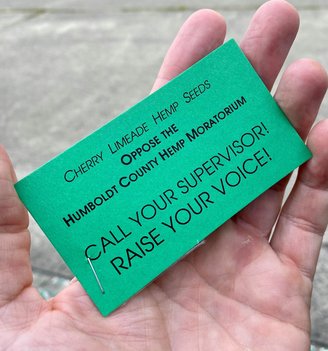
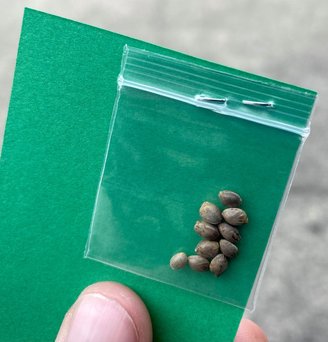
Frustrated with the Planning Commission’s decision, Grant took to the street in protest. On Monday he stood outside the Humboldt County Courthouse with picket signs — “Honk for Hemp,” one read — and handed out free packets containing six 10 feminized hemp seeds apiece. (Only males and the occasional hermaphroditic plant are capable of producing pollen.) Grant said he plans to go back and hand out seeds again on Tuesday as an act of civil disobedience.
Describing himself as a hemp grower and researcher with a degree in horticulture from the University of Southern Illinois, Grant said he grew 120 acres of CBD hemp in 2019 and has a seed labelers license in Wisconsin.
As for the Planning Commission’s recommendation to make the ban permanent, Grant said defiantly, “Nothing’s permanent in a democracy.”
But local cannabis industry insiders remain steadfastly opposed to industrial hemp. Ross Gordon, policy director for the Humboldt County Growers Alliance, said that the scale of industrial hemp operations can reach thousands of acres, making it virtually impossible for local officials to inspect each individual plant and ensure that they’re feminized. (The state defines industrial hemp as a cultivation area of at least one-tenth of an acre, or 4,325 square feet.)
Gordon also said the genetics of hemp plants are not as stabilized as plants with higher levels of THC, the psychoactive compound in cannabis. This creates a higher likelihood of male and hermaphroditic plants, he said. And while cannabis regulations include stringent restrictions on pesticide and water usage, those rules don’t apply to hemp cultivation. [CORRECTION: Dolf informed the Outpost, “The same pesticide laws that apply to high-THC cannabis also apply to industrial hemp.” Gordon acknowledged this, though he noted that cannabis products face more scrutiny and accountability because they must be tested for pesticides, herbicides, heavy metals and other contaminants.] Hence the concerns about pests and pathogens.
The HCGA sent the Board of Supervisors a six-page white paper in November outlining their arguments against allowing industrial hemp production in Humboldt County.
Asked if he had any objections to Grant handing out free seeds at the courthouse, Gordon said, “Not at all. Prop. 64 says everyone gets to grow six plants, so I think that’s awesome. People should get their personal use.”
The Board of Supervisors have yet to set a date to consider the industrial hemp moratorium.
###
PREVIOUSLY:
- Yurok Tribe Gives Thumbs-Up to Hemp: Tribal Council Moves to Legalize Non-Psychoactive Cannabis on Tribal Lands, Develop Regulations and Explore Business Opportunities Around Newly Legal Crop
- County Looks to Extend Moratorium on Industrial Hemp Cultivation While Developing New Rules and Regulations
- Will a Lapse in the County’s Hemp Moratorium Inadvertently Open the Floodgates for Industrial Cultivation?
- County Ag Commissioner Accepting Hemp Registration Forms Ahead of Moratorium Vote
- TODAY IN SUPES: Hemp Moratorium Reinstated
- (UPDATE: Letter Approved) Supes May Ask State Officials to Close ‘Loophole’ Allowing High-CBD Cannabis to be Grown as Hemp
- (MAPS) Here’s Where the County Might Allow You to Grow Industrial Hemp
- TODAY IN SUPES: A Protest Song, a Likely Hemp Moratorium Extension and the End of Columbus Day
Should Humboldt be Allowed to Manage the Pandemic on Its Own? Public Health Officer Takes Media Questions
LoCO Staff / Monday, Jan. 11, 2021 @ 4:45 p.m. / Coastal Currents
Dr. Ian Hoffman, Humboldt County Public Health Officer, took questions from local reporters today. Most of the questions had to do with Supervisor Rex Bohn’s request for his board to sign on to a letter asking the state to devolve pandemic-related economic decisions to the counties, but there were also a few questions about vaccination and the recently discovered variations of the virus.
Video above, rough transcript below.
###
From the North Coast Journal: “Based on Humboldt County’s epidemiological data, do you think any consideration should be given to loosening local COVID-19 restrictions at this time? Why or why not?”
I think I’ve said many times, and hopefully it’s been clear, that our data locally suggests we should be in the purple tier. That has not changed at all, in fact it’s only worsened, and so no, I do not think there should be any loosening of restrictions at this time.
From the North Coast Journal: “Is implementing COVID-19 guidance and restrictions by zip code a viable proposal? Why or why not?”
It’s certainly not one that Public Health is taking or has looked at, I think there are logistical concerns, you know the way that people move about in our community is not only within their ZIP code, ZIP codes are quite small areas, so that’s why we’ve gone with a county-wide approach.
From the North Coast Journal: “Do you see value in a statewide approach to COVID-19 restrictions? Why or why not?”
I think again I’ve been very clear on this, that we do think the statewide approach has value, and would continue to follow that approach.
From the North Coast Journal: “Do you feel it’s important for local officials to maintain a consistent, unified message regarding the efficacy and importance of local and state health orders and guidelines? Why or why not?”
I think it is helpful if we can all be on the same page t o put that out there. Obviously there are folks who don’t always agree, and we try to bring people to the table to have that discussion before we put policy out there, so we are always trying to work towards a unified message, but sometimes the communities we’re representing aren’t unified in that approach, so we’ll continue to work towards bringing people to the table and talking and trying to get everyone on the same page.
From the Redwood News: “You’ve mentioned in the past that our local data wasn’t in line with the State’s tier assignment for Humboldt County…i.e., us being in the red vs. purple tier. Some local leaders are talking about the Healthy Communities Resolution that essentially calls for freedom from the State’s covid regulations, and also objects to the tier assignment system. What does Public Health think about this resolution? Does the County have any plans to deviate from the State’s tier assignments and focus on more local regulations?”
So lots in that question, I’ll start with the local data not being in line. Whenever that’s happened, it’s that our data locally suggests that things are worse here, not better, so in those circumstances we’ve talked about being more restrictive than the state, not less restrictive. The recent red tier movement was mostly because of the state’s blueprint, was entirely because of the state’s blueprint and the equity metric gave us credit for taking care of disadvantaged populations, and having lower COVID rates in those parts of our society here in Humboldt County. So I think we will continue to follow that, and if we see a message locally that looks like it should be more restrictive, talk to our leaders and see if there’s an appetite for a stronger health order versus just recommendations, just like we did recently. I think that those would be the only plans to deviate from the tier system at this time.
From the Lost Coast Outpost: “The Board of Supervisors on Tuesday will consider a resolution brought forth by Supervisor Rex Bohn asking the state for more local control over COVID-19 regulations, including the ability to implement zip code-specific regulations and reopen schools. Would this resolution be helpful to Public Health? How would it change the county’s approach, if at all?”
So I think the ZIP code, we already addressed, and in terms of schools, schools have always been supported by Public Health to remain open when it is safe to do so. So from the beginning of this pandemic, in March, my predecessor Dr. Frankovich, Dr. Ennis, they worked with the schools to try to keep them open. There were many local decisions made by school boards, teachers, families who didn’t feel that that approach was what they wanted to do. The state approach has also encouraged opening of schools and trying to support it. And so it was not until recently that we moved to the purple tier that there were restrictions on reopening any schools. But from March until November, any school that wanted to open was encouraged to open, and we tried to support that as best as we could at Public Health.
From the North Coast News: “We are seeing that some vaccines aren’t being utilized across the U.S. despite the high demand. Is Humboldt using their full allotment? And, when will the county be getting their next allotment?”
Yeah, so as I’ve been saying, we get allotments each week, and that can vary from week to week. So we’ve had weeks of getting thousands of doses, some weeks of getting hundreds of doses. Not all of it has been used, but I think we are online to use up, all of what we have on hand in the next few weeks, and hopefully we are beginning the phases of looking into the next steps of Phase 1B as we wrap up Phase 1A. And you know, I think that we’ve been told by the state that, for at least the next probably month or two months, the amount we’re getting is likely to be fairly consistent of first doses, and that has been about one to 2,000 on average every week, and so I’m hopeful that we will continue to get that one to 2,000 doses each week in the coming months.
From the Two Rivers Tribune: “With all concerns regarding the efficacy of vaccines and mutated strains of the virus, and possible false-negatives caused by the variant strains, Please share your biggest concern of impacts of what the variant strains can cause the county, do we think they have arrived already?”
So with these new strains there’s always, this is a virus that has continued to mutate and always will mutate. One of the things about Coronavirus is that it’s fast moving and mutates very quickly. Most of those mutations die out, some of them catch on.
You know with regards to ones that have affected testing or vaccine, we have not seen any significant evidence to that, certainly we’ll keep people apprised if that is the case. In terms of whether that is circulating significantly here, I think it’s highly unlikely, we do know that there have been cases in the state of California, but we have no evidence to suggest that it’s here in Humboldt County at this time. The epidemiological data that’s being done, surveillance at a nationwide level, suggests that only one in 1,000 people who have been infected with the Coronavirus recently have these variants.
So it’s a pretty low likelihood, but again if we are not able to control the spread of the virus, just like it did in London and in England, it could take hold much more quickly, so there are a lot of efforts being done nationally and in the state of California and locally here in Humboldt to do surveillance for these variants and try to get ahead of it before it takes a strong hold.
From the Lost Coast Outpost: President-elect Joe Biden has signaled that his administration will pursue a policy of shipping vaccine as quickly as possible, rather than holding back second doses for booster shots. At the same time, the California Health Department says that it is making a strong push to ramp up vaccine delivery over the coming days. How is county staff adapting to the push to deliver vaccine into arms faster?
Yeah, as of right now we have no directive or evidence to start delaying second doses, so we have started this week with second doses as they come in and as they were planned. In terms of how we are trying to adapt, we sent Public Health staff into skilled nursing facilities to vaccinate over the last few weeks to try to speed things along. We opened up a public health clinic last week that has greatly increased the capacity and our staff and myself have been working with local health leaders to encourage increasing the number of appointments for giving vaccines in the coming weeks.
From the Redwood News: Has Public Health done any surveys or polls to gauge how the community feels about getting vaccinated for Covid-19? Does PH have a general idea of how much of the community is interested in getting the vaccine when it’s rolled out to the general public? What would you say to those people who may be hesitant about getting vaccinated?
So yes, we have been doing surveys. We did survey all of our healthcare partners early on to see what the interest was and how many folks they would need. We recently rolled out a community survey to get that sort of feedback on a broader population of Humboldt County. And that is just starting to come in. From the general uptake of the vaccine nationally, we’ve seen places where you get upwards of 90% of people taking it and sometimes less. It averages around in the 60-70% range for most places in terms of uptake of how many were offered versus how many people took it. I think that for anyone that is hesitant for this vaccine, I would start by saying it’s a safe vaccine. It has been through its trials. We’ve now given it to millions of people here, as well as around the world - many millions more. And we haven’t seen great changes in that concern for safety. So it continues to be a safe vaccine. It’s also a highly effective vaccine - one of the most highly effective vaccines we’ve ever seen at 94% efficacy which is much greater than we could have ever anticipated. So if we want this pandemic to end, this is really the tool that we need to have this pandemic end.
From the North Coast News: Do you think that incarcerated people should have higher priority for vaccination over other elderly or high-risk groups? With Del Norte County so close and Pelican Bay — is it wise to prioritize those populations given outbreaks that can potentially affect the outside community?
We have not reprioritized in Humboldt County, incarcerated or other groups who are in the tier 1B. These are extraordinarily difficult decisions that have to be made. If we look at the numbers of people who are affected by this, the group 75 and older, absolutely have the highest risk of being hospitalized, having bad outcomes, and certainly of death. So, from the standpoint of protecting those that are at the highest risk from bad disease, that’s why we will prioritize those who are 75 and older in phase 1B. As more information comes out, if this does really look like a tool that will reduce the spread of COVID-19, those conversations could change - that going into areas where there is higher likelihood for spread. But right now, the vaccine is really a tool to protect the individual, not to protect the society.
From the North Coast News: With hospitals so overwhelmed in other parts of the state, and the CDPH ordering facilities with room to accept patients from those at capacity, will Humboldt County accept patients from out of the county into our hospitals?
As I’ve answered this before, we are not at a place right now. This is a possibility as things worsen across the state. So I would stay tuned and we’ll see how things go in the coming weeks with surges worsening in areas that are closer to us.
From the Redheaded Blackbelt: At this point, does Humboldt County expect to receive transfer patients from other regions, such as from the Bay Area where ICU capacity is at 3%? If so, would these be non-Covid patients, or would there be a possibility that Humboldt could be receiving COVID-positive transfer patients? Please elaborate on how those decisions to transfer an individual are made, and what factors are considered in addition to available beds?
So, also like I’ve mentioned before, I think if we are going to get transfers, they’re going to be from areas that are much closer to us like the Bay Area or potentially even closer like Mendocino, or Del Norte. The current state of affairs from the state, the only request for transfers have been COVID patients. As far as I know, those have only come from counties in the far southern reach of the state, many hundreds of miles away. We don’t know what that could look like locally though, as this push of hospital cases comes closer to our county. The decision to transfer is made on a lot of things. It’s not just based on bed availability, it’s really based on concerns for the stability of a patient. There are factors of cost of transferring patients over longer distances and then local conditions that are allowing that accepting facility to have the ability to also care for the patients there locally.
From the Two Rivers Tribune: What information can you give us regarding the amount of variant stains of COVID-19 which have been detected in the State of California, and what factual information can you provide in those regards?
So I think we’ve pretty much answered this in the previous question. There is the U.K. variant that is slightly more contagious in terms of its spread that is circulating here in California, at extremely low levels, has not been picked up at high levels yet. There has been none found in Humboldt County to date. As far as we know, these strains are no more deadly, or making people more sick than the other strains. They just seem to be a little bit more contagious, and that number has changed dramatically over the course of the past few weeks. It’s hard to pinpoint exactly how much more contagious this variant really is, but as we learn more about it, it seems like that number has come down each week, in terms of how much more contagious it is than the widely circulating variant.
From the Redheaded Blackbelt: Can you please update the community on networking efforts to rally additional nurses for expanded hospital capacity?
We have, as public health, started to collect information from our health care volunteers who want to help in the vaccine effort. These are EMT’s, paramedics, nurses, other folks in health care who want to volunteer for the vaccine effort. In terms of the hospitals, I keep in touch with the hospitals about their surge planning capacity. They definitely are watching their staff very closely. I don’t know of any volunteers for that level, but I do know that there is a lot of look at what our local capacity is and how we could pull in and rearrange things to use some of our local resources if we had a surge here in Humboldt County.
Eureka Man Arrested for Suspected Heroin Sales After Officers Observe Him Making Multiple Trips to Drop Vehicle
LoCO Staff / Monday, Jan. 11, 2021 @ 4:30 p.m. / Crime
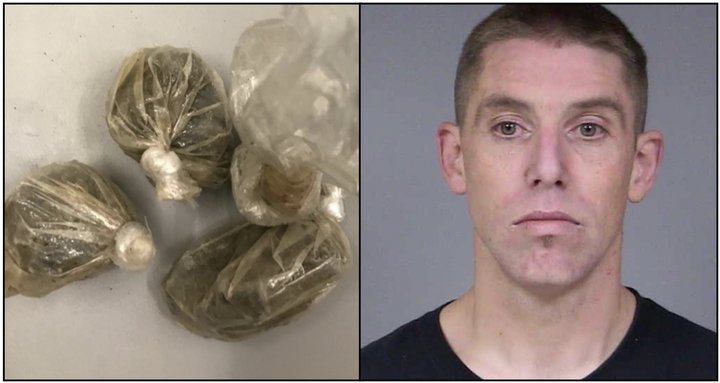
Jesse Hanson, 40, Eureka | HCDTF
Humboldt County Drug Task Force press release:
On December 28th, 2020 special agents with the Humboldt County Drug Task Force (HCDTF), with the assistance of the Humboldt County Sheriff’s Department, served a search warrant on Jesse Hanson (40 years old – Eureka). HCDTF agents had identified a drop vehicle that Hanson had left parked in the 3500 block of Broadway St. in Eureka. Hanson was observed multiple times riding a motorcycle to this vehicle, retrieving drugs from the vehicle, and then riding off to meet customers. HCSO Deputies detained Hanson as he arrived back at the drop vehicle.
Agents searched Hanson and located a small quantity of methamphetamine and $2700 in US currency. Inside the vehicle agents located ¼ pound of heroin and a digital scale. A records check revealed that Hanson had an active felony warrant for his arrest as well as multiple counts of probation in Humboldt County.
Hanson was booked at the Humboldt County Jail for the following charges:
- H&S 11352 Transportation of controlled substance for sale
- H&S 11351 Possession of controlled substance for sale
- H&S 11377 Possession of methamphetamine
Anyone with information related to this investigation or other narcotics related crimes are encouraged to call the Humboldt County Drug Task Force at 707-267-9976.


