

(PHOTOS) Local Artist Turns Humboldt Preschoolers’ Christmas Drawings Into Light-Up Displays to be Featured in Saturday’s Truckers’ Parade
Andrew Goff / Thursday, Dec. 10, 2020 @ 1:44 p.m. / :) , Art , Community
A familiar bit of Humboldt holiday normalcy will “HONK HONK HONK” its way through Eureka this Saturday, when the 32nd Truckers’ Christmas Parade does its best to bring smiles to community event-starved faces. To maintain appropriate pandemic safety, families are encouraged to watch, hear and endure this beloved tradition by practicing health official-recommended social distancing precautions or from the comfort of their parked, parade route-adjacent vehicles. Merry weird Christmas to you, one and all.
The Outpost wants to give you a heads up, though, and let you know to keep an eye out for one float that will likely out-adorable all the others. This year’s entry from the Eureka City Employees Association’s will feature lighted art displays that are based on drawings by students from the city’s Little Saplings preschool. The painstakingly thorough recreations are the effort of Robert “Robot” Adams. We now invite you to enjoy some side-by-side cuteness, comparing the local tykes’ artistic conceptions to Adams’ ultimate full-size realizations.
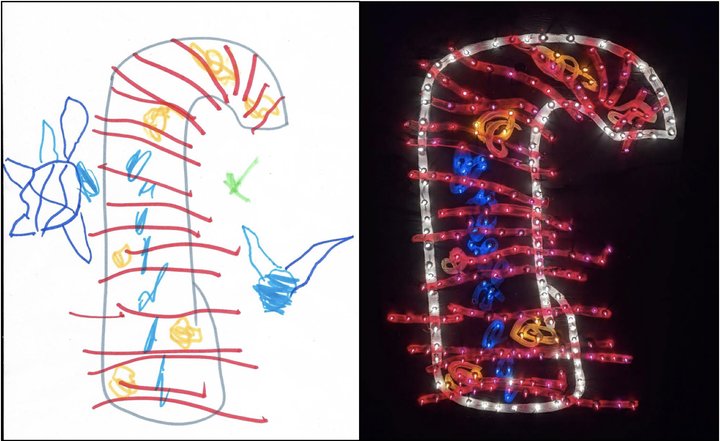
A candy cane!
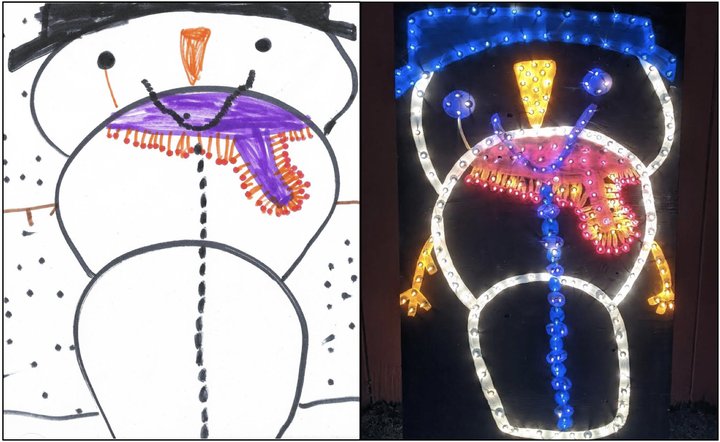
A snowman!
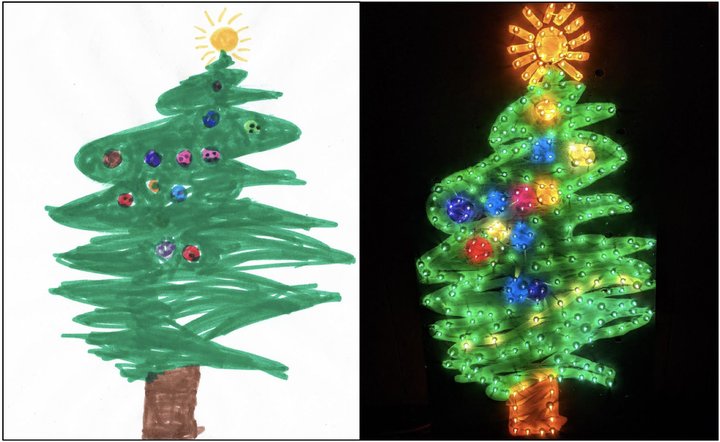
A Christmas tree!
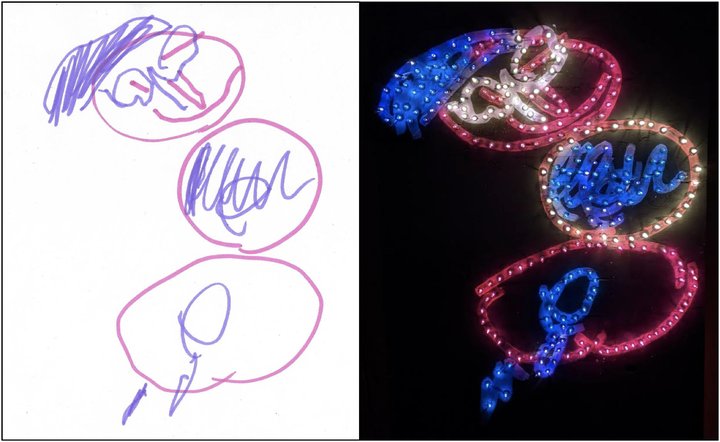
Another snowman, we think!
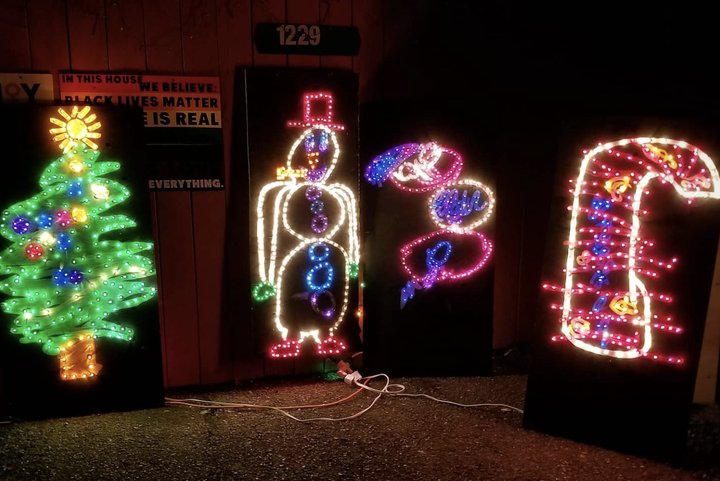
Ta-da! Adams, a longtime participant in the Kinetic Grand Championship and 2020 Rutabaga Queen, told the Outpost he hopes the works will inspire youngsters to pursue ideas combining art and engineering.
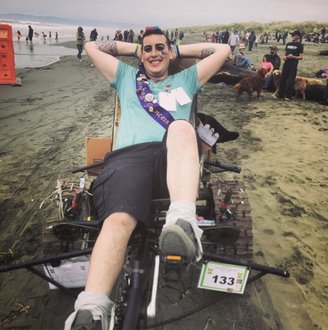
“robot”
“The draw to this project, for me, was using STEAM principles to make fun!” Adams said. “A large part of the work I do with Kinetic Universe and the Kinetic Museum is highlighting the fun sides of math and science, especially to children, I hope that more projects like this in the community will spark the curiosity of young engineers.”
Parents! Be sure to point these out to your kids and encourage them to keep scribbling! Who knows what might come of it?
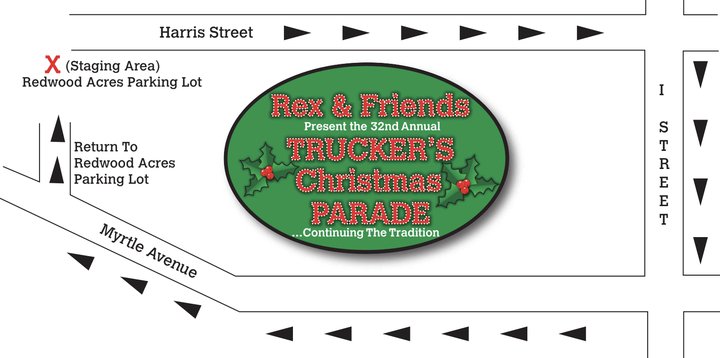
Find a thermos to fill with hot cocoa because the Truckers’ Christmas Parade starts at 6 p.m. this Saturday, Dec. 12. We’ve included a map of the route below. Be safe, be jolly and soak up some joy :)
BOOKED
Today: 4 felonies, 7 misdemeanors, 0 infractions
JUDGED
Humboldt County Superior Court Calendar: Today
CHP REPORTS
Painter St / Wildwood Ave (HM office): Trfc Collision-Unkn Inj
ELSEWHERE
RHBB: Wildfire Burning Near Highway 101 South of Laytonville
Governor’s Office: California reminds voters to check their mailboxes and return their ballot ASAP!
County of Humboldt Meetings: Oct. 8, 2026 - Humboldt Housing and Homelessness Coalition General meeting
RHBB: CHP Pursuit Ends With High-Risk Stop at Highway 299 and 101
Humboldt Bay Fire Recaps Flame-Filled Morning Along the South Eureka Shore
LoCO Staff / Thursday, Dec. 10, 2020 @ 11:46 a.m. / Fire
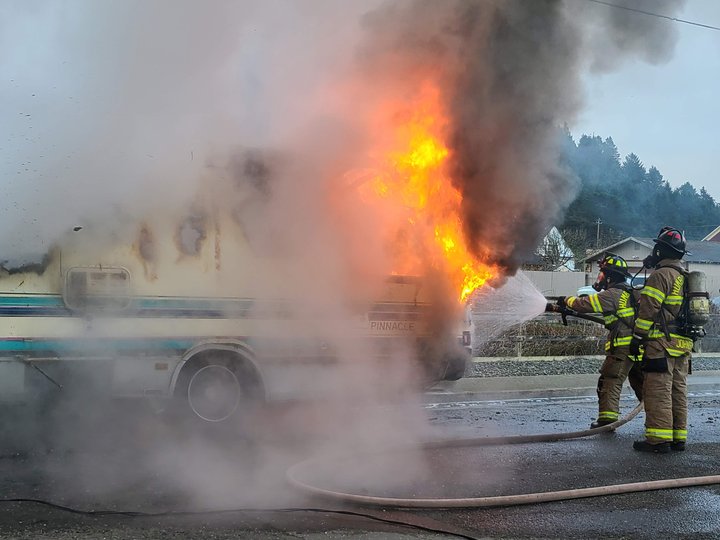
Photos: Humboldt Bay Fire.
###
Press release from Humboldt Bay Fire:
On the morning of December 10, 2020 around 8:21 a.m., Humboldt Bay Fire responded to the first of what would become two structure fires within 20 minutes.
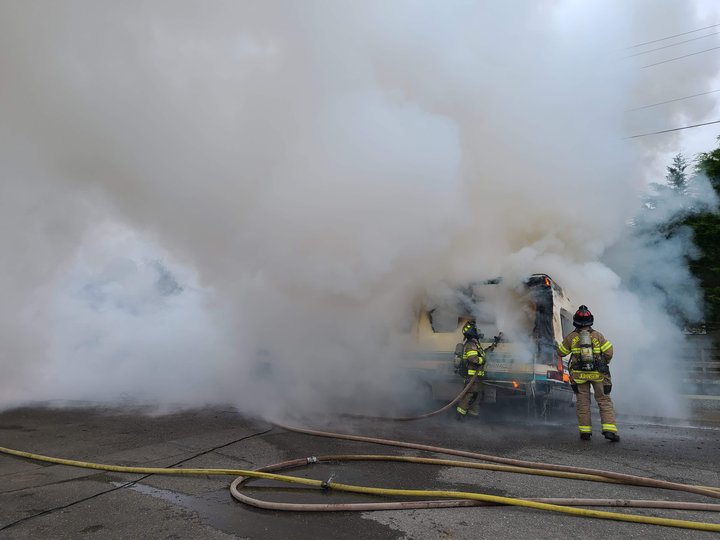
The first pulled crews to the 6600 block of Third Street in Fields Landing where a fully-engulfed R.V. posed a threat to a nearby utility pole and multiple residential homes. Bystanders watched as flames shot up from the vehicle and a large plume of grey smoke filled the air. Crews surrounded the vehicle and knocked down the fire, calling in aid from PG&E to assist with power lines down across the roadway. Deputies from the Humboldt County Sheriff’s Office and California Highway Patrol also responded to assist with crowd control and take witness reports.
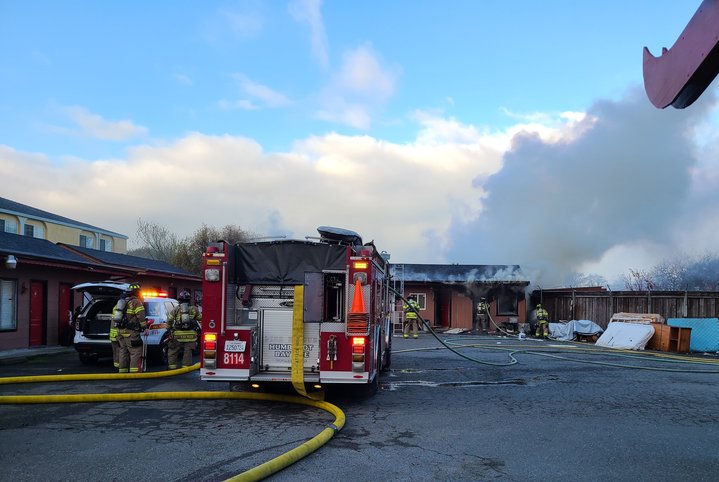
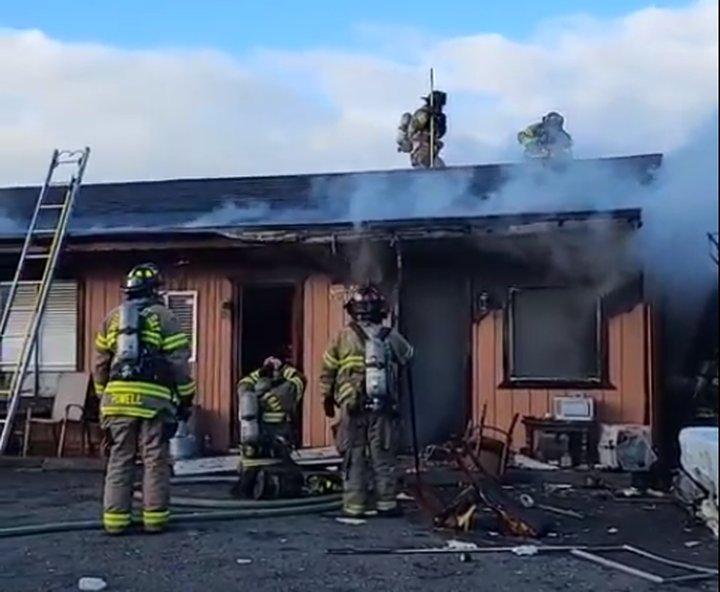
While on scene at about 8:40 a.m., HBF was dispatched to a second structure fire devouring a room in an apartment complex on the 4200 block of Broadway. As resources split off from the first fire, a secondary command officer arrived to find a working fire bursting out of a room in an attached apartment complex. Crews quickly confirmed all persons were out of the building and initiated fire attack. As smoke and superheated gases filled the apartment, crews took to the roof to create venting holes allowing for heat, gas, and smoke to escape from the apartment. This improved visibility and working conditions for crews inside who were extinguishing the fire and preventing further spread to the attached units and a nearby shed belonging to a commercial business next-door.
Although no firefighters were harmed in either incident, we are aware that one resident and one cat suffered from moderate injuries associated with the fire on Broadway. The resident suffered from unspecified burns and was transported to the hospital by friends prior to the arrival of public safety personnel. Humboldt Bay Fire assisted with the injured cat and transferred care of the animal to Animal Control. HBF was assisted on scene by Fire Support, PG&E, Eureka Police Department, City Ambulance, City of Eureka Public Works, and Animal Control.
The cause and origin as well as initial damage assessment on both fires are still unknown at this time. HBF would also like to thank Samoa Peninsula Fire District and Arcata Fire for providing call coverage while HBF resources were working on these incidents. Multiple multi-unit calls strains resources, making the need for mutual aid agreement with neighboring agencies ever more important. Thirty-five percent of the time HBF is dispatched to an emergency, a second unrelated emergency call is also dispatched. Our mutual aid agreements ensure sufficient resources can be provided to all emergency scenes.
Toys for Tots is Happening This Year, Despite COVID! Here’s What You Need to Know if Your Tot Needs a Toy, or If You Want to Give
Jacquelyn Opalach / Thursday, Dec. 10, 2020 @ 10:07 a.m. / Our Culture
From donations to distribution, the local Toys for Tots effort has had to be reimagined in all sorts of ways this year. The national nonprofit’s local group hasn’t been able to fundraise and has received fewer donations than usual, and toy pickups will be different with COVID safety protocols to follow. But it’s happening nonetheless! And it’s not too late to donate or register to receive a toy for your tot.
Schools usually register kids for the Toys for Tots program, but with distance learning less than half of Humboldt’s schools were able to do that this year. Children who were registered in previous years are automatically eligible for 2020, and parents or guardians can register new kids here. If you’re unable to register, you can attend a distribution event in person and still receive a toy. Toys for Tots won’t require proof of identification, and only need a phone number from those who appear without registering first.
Humboldt’s first wave of toy distribution is happening this weekend, at the former Ray’s in McKinleyville. Pickups are happening Friday the 11th through Sunday the 13th, from 9 a.m. to 3 p.m. each day. Folks in Willow Creek can pick up toys this weekend, too, on Saturday the 12th at the Veteran’s Hall from 9 a.m to 3 p.m.
There will be two more Humboldt distributions next week at different locations. In Garberville, toys will be distributed at New Hope Church from 10 am to 2 pm on Saturday, December 19th. Eureka’s only distribution is at the former Staples store next to CVS, which will be open 9 am to 3 pm, from Saturday the 19th through Monday the 21st. There will be one evening time slot at this location too, on Saturday from 6 pm to 8 pm.
If none of those pickup times or locations work for you, call the local Toys for Tots office at (707) 443 4480. Leave your phone number and the age and gender of your child, and Toys for Tots will call you back to arrange a time and pickup place that works for you.
Local Toys for Tots Coordinating Officer Gregg Gardiner told the Outpost that the organization will follow COVID safety measures for toy distributions, which will include temperature checks at the door, a mask requirement and social distancing. “It’s very unusual,” Gardiner said. “For safety, we have to do that.”
Toys for Tots accepts money donations as well as toys. Donate money here, or mail a check to their office at 2383 Myrtle Avenue, Eureka 95501. You can physically drop off toys at that address if you’d like, or drop them off at any of the locations on this list.
“I think the most important thing for people to know is if they make a donation, 100 percent of that donation stays local,” Gardiner said. All donations go entirely toward buying toys.
In terms of cash donations, the organization works directly with “toy manufacturers and vendors to buy toys at deeply discounted prices so they can stretch your cash donation as far as possible and allow them to serve more needy children at Christmas time,” Gardiner said.
That said, he greatly appreciates both toy and cash donations. “I gotta believe in my heart of hearts that those folks went out and bought with their family, and they thought about it and they gave it love. It adds an intrinsic value,” he said. “I like to encourage people to do that, because I think that’s a really meaningful way to enjoy Christmas, that spirit of giving.” In addition to toys, Toys for Tots distributes books, games and sporting goods.
Toys for Tots is a national nonprofit with over 800 coordinators throughout the country. Our local Toys for Tots organization distributes toys to families in Humboldt, Del Norte, Mendocino, Trinity and Curry counties. Between those few counties, local Toys for Tots has already sent out about two semi truckloads of toys to be distributed, Gardiner said. Last year the program supported 8,988 children and distributed 54,493 toys locally.
Early Morning Fire Breaks Out in Apartments Behind Chin’s Cafe
Hank Sims / Thursday, Dec. 10, 2020 @ 9:16 a.m. / Fire
Video: Submitted.
A fire broke out this morning in the motel/apartment units behind Chin’s Cafe on Broadway in Eureka, displacing several people and prompting a large emergency response.
Witnesses told the Outpost‘s Ryan Burns and Andrew Goff, both at the scene, that they heard a loud explosion in one of the units as the fire broke out. One said they saw debris fly into the air where a wall was blown out.
Amy Conlin of Humboldt Bay Fire told the Outpost that her agency could not yet confirm the cause of the fire. She did note that they came across a leaky propane tank outside the unit, and said that there may have been another inside.
The fire has been contained. One lane of southbound Broadway is closed. Police and firefighters are still on scene.
We’ll update when we know more.
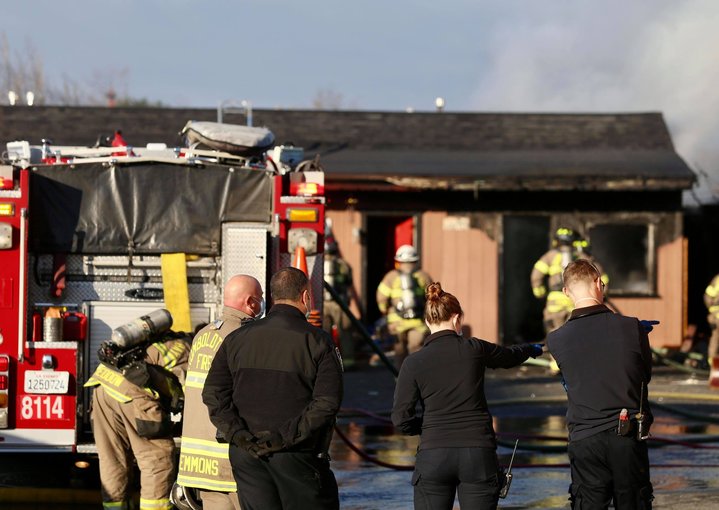
Photo: Andrew Goff.
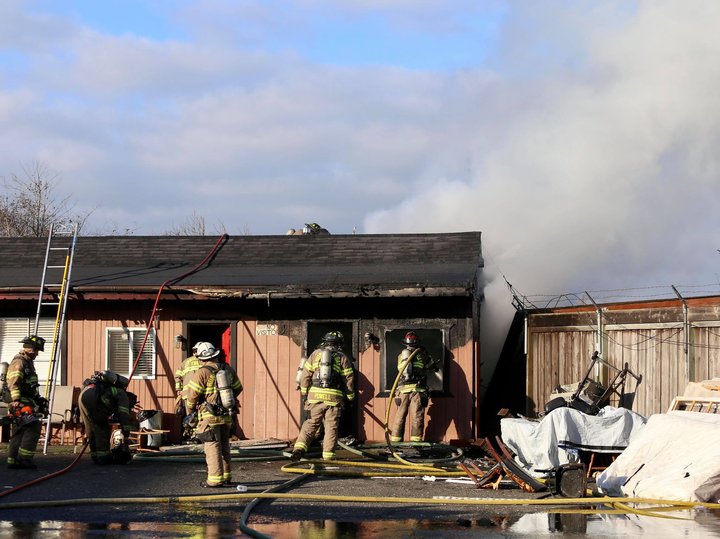
Photo: Andrew Goff.
OP-ED: Path to Reconciliation for Native People in California Begins With Truth and Healing
Frankie Myers / Thursday, Dec. 10, 2020 @ 7:05 a.m. / Guest Opinion
Almost one year into a global pandemic that is taxing health care systems and decimating communities, we are learning that Native people are 5.3 times more likely than white people to be hospitalized due to COVID-19. It’s the largest disparity for any racial or ethnic group in the U.S.
The devastation that this disease is causing in Indian Country is a by-product of deep-seated institutional failures and is not the first time Native Americans have been subject to the deadly impacts of widespread disease.
This outcome is the result of a system built by more than 500 years of violence, dispossession and destructive policies – a system that resulted in inadequate housing, limited availability of quality health care, and the general inaccessibility of the privilege to work remotely and quarantine safely at home.
For all of these reasons, our communities are more vulnerable to COVID-19. And because the disease disproportionately impacts our elders, COVID-19 threatens not only these beloved anchors of our communities, but also the vital cultural and linguistic knowledge that they hold. In losing them, we also risk losing key links to our values, traditions and who we are as a people.
Native peoples have fought long and hard to protect and provide for our communities despite the destructive systems that bear down on us – protecting our sovereign rights when they have been trampled on, providing services for our communities when they have been left behind and reinvigorating traditions that were almost lost to forced assimilation. Through our persistent resilience, we have survived genocide, and we have thrived.
But it is long past time for the rest of American society to stand alongside us. Together, we must tell the full, unsanitized history of how and why we got here. Until we break down the long-held assumptions, erasure and distorted history on equal terms, we can’t begin to work together to build a thriving future based on mutual honesty, respect and accountability.
Last week, the state of California took a crucial step in that direction by convening the first meeting of the California Truth and Healing Council. As a member of the council, I am charged with articulating one of the worst chapters of state-sponsored violence this country has ever known – the genocide perpetuated against tribal nations in the early days of California statehood.
This will be a five-year long process that will seek to bring to light the stories, documents and impacts of the dark saga that underpins the California Dream. This journey will require that the council and our communities delve into historical trauma after having experienced the collective ignorance of these histories for too long.
This will not be an easy task, but I believe the council can serve as a hub to connect the many rich histories of Native peoples and establish a fuller and truer history of California. My hope is that this work will serve as a more honest premise from which we can pursue restorative and reparative laws, policies and collective actions.
This progress will also require a culture shift. This council’s findings must find their way into museums, schoolbooks, legislative hearings and dinner table conservations. Californians should know whose stolen land they live on; wonder whose stolen water they are drinking and appreciate the rich cultures which could never be fully stolen from us.
Together we must ask the questions that link our past to our present, like why our state motto is “Eureka,” why California has such a high rate of missing and murdered Indigenous women and girls, and why Native students are still forced to build Spanish missions out of sugar cubes.
This Truth and Healing Council is historic in its scope and nature, and potential for impact, but it is really just the beginning. What this council finds will shape how we move as one state and many tribes that together deliver on a promise for all people.
Playgrounds Stay Open: State Backtracks on Outdoor Play Area Ban
Elizabeth Aguilera / Thursday, Dec. 10, 2020 @ 7 a.m. / Sacramento
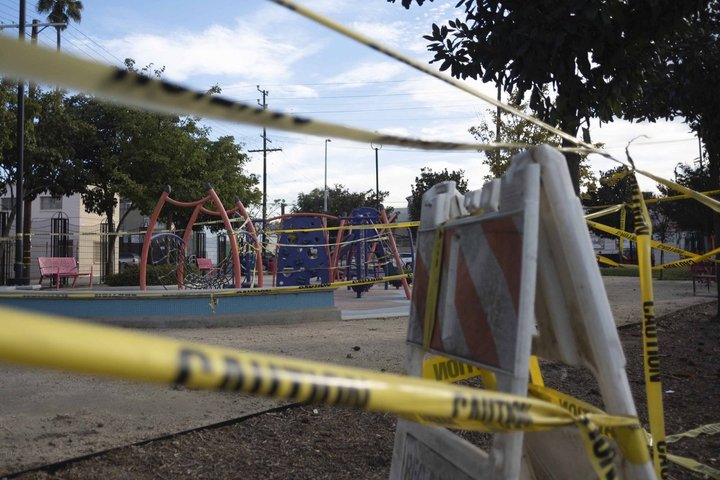
A cordoned off playground in South Central LA, on Dec. 8., 2020. Photo by Tash Kimmell for CalMatters.
###
California has backpedaled on closing playgrounds as part of its stay-at-home order after parents and legislators argued that children need outdoor play for their health.
The updated state guidance, posted yesterday, states that “playgrounds may remain open to facilitate physically distanced personal health and wellness through outdoor exercise.” The California Department of Public Health had been defending last week’s order closing outdoor playgrounds in hard-hit coronavirus regions, saying it was intended to keep families from mixing with those outside their households.
Some parents were ecstatic about the reversal and said they hoped their counties would also open play areas, as many have stricter rules and already had closed playgrounds.
“It is such a relief,” said Carmen Adler, who lives with her husband and two young sons in a Los Angeles apartment without a yard. “It will make winter break survivable.”
She took her children, 4 and 20 months, to the playground after work yesterday, calling the reversal “justice” for families.
Legislators who had pushed back also were pleased.
“Every parent knows how important playgrounds are for our youngest Californians,” said San Diego Democratic Assemblymember Lorena Gonzalez, who led the legislative effort on reopening playgrounds. She thanked Gov. Gavin Newsom “for hearing our collective concern and rethinking how we can open play structures for our kids.”
“Play is crucial for childhood development. But low-income communities of color living in dense housing often do not have access to a yard.”
— Hilda Solis, Los Angeles County Supervisor
After last week’s announcement, many parents were frustrated that playground closures were part of the new stay-at-home order, especially when certain retailers, indoor malls and outdoor tennis courts remained open, albeit with restrictions. They argued that children need to have access to playgrounds for their mental health and development, especially with schools closed.
They were not alone. A group of legislators, led by Gonzalez, sent a letter to Newsom on Friday, asking him to reconsider.
“Public playgrounds provide a shared outdoor resource for families without having to travel far, pay entrance fees, or need additional outdoor gear,” the letter stated.
It remains unclear if counties with closed playgrounds will follow the state’s new course. For instance, Los Angeles County issued its own stay-at-home order a week before the state’s — and its order included playground closures. Yesterday, county officials reversed its position and aligned with the state guidelines.
“Play is crucial for childhood development. But low-income communities of color living in dense housing often do not have access to a yard,” tweeted Los Angeles County Supervisor Hilda Solis. “With distance learning, having access to public playgrounds is more important now than ever.”
Regional stay-at-home orders went into effect across California this week, triggered by diminishing capacity in intensive care units. So far, most of California is under the order, including the Southern California and the San Joaquin Valley regions. Other areas, like San Francisco and surrounding counties, have elected to put the order in place ahead of the state requiring it.
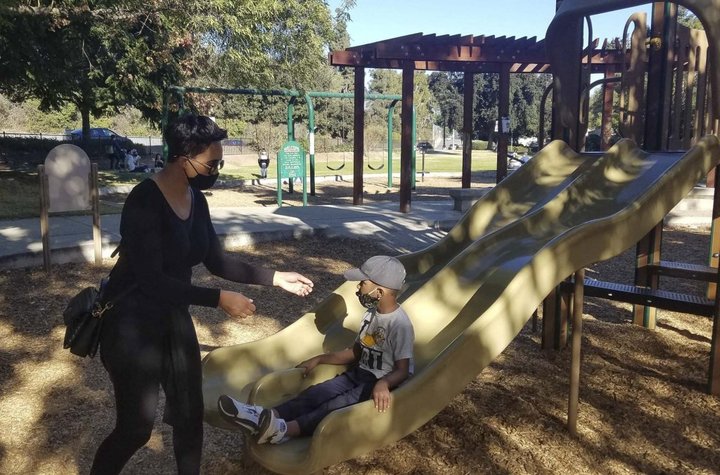
Ericka Dean of Los Angeles greets her son Miles, 4, at the slide at Pasadena Park last weekend, just before the state’s stay-at-home order was to go into effect and close playgrounds. The state reversed the order yesterday and will allow playgrounds to stay open. Photo by Elizabeth Aguilera for CalMatters
On Saturday, the day before the Southern California regional stay-at-home order was to go into effect, several families visited a small Pasadena park for last-minute playground adventures. Pasadena kept its parks open longer than other cities in the area because the city had opted not to follow the county closures. The city has its own public health department.
On a swing, 2-year-old Brady Lutzeier swung his feet in the air as his dad pushed, while also keeping an eye on his three older children on a nearby teeter-totter.
David Lutzeier, who lost his job managing a fitness center at the beginning of the pandemic and is now a stay-at-home dad, said the park is his children’s only outlet. He said he has been getting anonymous letters from neighbors complaining his kids were too loud while playing in their own driveway.
“We stay at home as much as possible, but for the mental health of the kids, we come here,” he said. “At the park they are free to be children and run and play and be loud.”
Ericka Dean, who lives in a Los Angeles apartment with her husband and 4-year-old son, drove 25 minutes over the weekend to Pasadena because her neighborhood parks shut down a week earlier under county regulations.
The family does not have a yard and Dean called parks their safe haven. Dean’s husband is high risk, so they have been careful to find parks with few children.
“I get it’s an economic crisis but it’s also a familial crisis too,” she said. Children “rely on park playgrounds to retain a sense of normalcy through this pandemic.”
Not all parents questioned the closure of playgrounds.
Public health nurse Leah Elias-Nelson, who has a 3-year-old son, said she has had to ask parents at her neighborhood playground to wear masks – and to mask up their kids since playgrounds reopened. Many of these parents “seem to struggle with the idea of keeping distance.”
Elias-Nelson, a school nurse for the Los Angeles Unified School District, suffered from COVID-19 in the spring. She wasn’t surprised when playgrounds were cordoned off again by the state this week but, even with the latest reversal, she doesn’t plan to return to play structures any time soon. That doesn’t mean they won’t go to the park, she said, but they plan to stay in open grassy areas.
“I still feel as though we all must act as custodians of public health and do our part to slow the spread,” she said. “We need to be home and away from others, not congregating at playgrounds.”
“I get it’s an economic crisis but it’s also a familial crisis too.”
— Ericka Dean, Los Angeles parent
Public health decisions are often at odds with individual and community decisions, said Rebecca Fielding-Miller, assistant professor of public health at University of California, San Diego.
But this time, Fielding-Miller said, the state got it wrong. The reversal is a win for families and for evidence-based policy, she said.
“There is little to no evidence that playgrounds are a major driver of risk, and rather a lot of evidence that playing outside in the fresh air is good for children,” she said. “This was going to disproportionately hurt low-income and racialized minority children, who have already borne the educational, economic, and health brunt of the pandemic.”
She said she believes the decision to close playgrounds was more detrimental than the slight risk of being infected while running across a foot bridge, captaining a ship’s wheel or sliding down a twister slide.
California’s first order in March to close playgrounds made sense, she said, because health officials thought COVID-19 could be spread by touching surfaces. Later, it was determined that transmission is mainly airborne. Playgrounds were reopened in October.
“Now we know the safest place to be is to be outside if you are going to be with other people,” Fielding-Miller said. “Parks and playgrounds are not what is overwhelming the ICU, people gathering with their family at the holiday or working out in a gym is the driver.”
As long as families follow the guidelines, playgrounds pose a minimal risk, said Fielding-Miller, who has her own 3-year-old playground aficionado.
###
CalMatters coverage of early childhood issues is supported by grants from First 5 Los Angeles and The Ralph M. Parsons Foundation. CALmatters.org is a nonprofit, nonpartisan media venture explaining California policies and politics.
Coronavirus Study: Lifting Eviction Moratoriums Leads to Higher COVID-19 Case Rates, Deaths
Laurence Du Sault / Thursday, Dec. 10, 2020 @ 7 a.m. / Sacramento
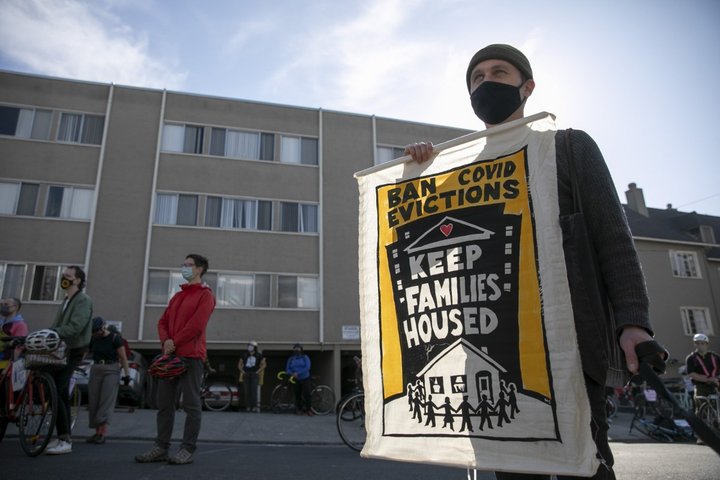
Oakland resident Andrew Rosenburg holds up a banner while protesting rent evictions during the pandemic on Dec. 5, 2020 in Oakland. Photo by Anne Wernikoff for CalMatters
###
As the state faces its most stringent business shutdowns since spring and as moratoriums protecting many from eviction threaten to sunset, California lawmakers have started debating more protections for vulnerable renters and landlords whose finances were affected by the pandemic’s deepening economic crisis.
Now, a new study of 44 states that enacted eviction moratoriums links evictions to an increase in coronavirus deaths and cases.
“We wanted to know whether these moratoriums could protect people from COVID,” said Kathryn Leifheit, lead author on the study and researcher at UCLA’s Fielding School of Public Health. And they do, the study found. “But the flip side of that is, when you get rid of them, people experience more COVID cases and deaths.”
Nationwide, the lifting of moratoriums resulted in an extra 365,200 to 502,200 coronavirus cases and between 8,900 and 12,500 more deaths, according to the study by researchers from UCLA’s Fielding School of Public Health and the John Hopkins University, Bloomberg School of Public Health, among others. “Any deaths would be upsetting, but these are large estimates,” Leifheit said. “You’re talking about big numbers.”
The study, pending peer review but published due to the urgency of the research, followed from March to September the 44 U.S. states that enacted eviction moratoriums. Researchers then compared data from the 27 states that lifted protections to the 17 states that kept them — including California, where existing protections are currently set to expire on Jan. 31. The federal moratorium ordered by the Centers for Disease Control expires on Dec. 31.
“The nature of the pandemic is temporary but the consequences for people’s lives can be lifelong, COVID can lead to death,” said Julia Raifman, co-author of the study and assistant public health professor at Boston University. “But also I think that children might never recover from the state of homelessness.”
After 16 weeks, states that had lifted their moratoriums had roughly twice as many cases than those that hadn’t, and their coronavirus mortality rates jumped: they were 5.4 times higher than those who had kept them, the study found. Texas, whose population is closest to California’s but which lifted its moratorium mid-May, would have had at least 120,650 less cases and 4,456 less deaths if moratoriums remained, the study found.
“We wanted to know whether these moratoriums could protect people from COVID. But the flip side of that is, when you get rid of them, people experience more COVID cases and deaths.”
— Kathryn Leifheit, researcher at ucla’s fielding school of public health
“Rates of COVID compared to now were relatively lower back then,” Leifheit said. “Now, thinking of January, we’re talking of a bunch of states losing those protections all at once and we’re talking of a phase of the pandemic where we’re getting 1 million cases a week.”
The researchers noted that not everyone who contracted the virus as a result of lifted moratoriums had necessarily been evicted. Rather, some of the additional cases and deaths were caused by what Madeline Howard, senior housing attorney at the Western Center on Law and Poverty, called a “ripple effect” of people moving in with friends and family, couch surfing, or crowding homeless encampments. “It’s not only about people affected by the evictions, it hurts the whole community,” said Howard.
“All of the additional exposure, it’s the opposite of shelter in place,” said Amie Fishman, executive director for Non-Profit Housing of Northern California.
While landlords — many of whom are also struggling to pay mortgages and bills — are asking for caution in extending renters’ protections, some lawmakers in California are pushing to extend protections for renters. Assemblymember David Chiu, D-San Francisco, this week introduced two bills proposing rental relief for those facing rent-related debt and extending the current statewide moratorium until December of next year. The state’s current moratorium protects renters from eviction if they provide a declaration that they were financially affected by the pandemic and pay a quarter of their rent.
“People have lost work because of the pandemic, and that is concentrated in low-income households who were already living paycheck to paycheck,” Raifman said. “I don’t think these people would be facing evictions otherwise.”
“And then the problem of the few becomes the problem of the many,” Leifheit said.
###
This article is part of the California Divide, a collaboration among newsrooms examining income inequality and economic survival in California.
CALmatters.org is a nonprofit, nonpartisan media venture explaining California policies and politics.


