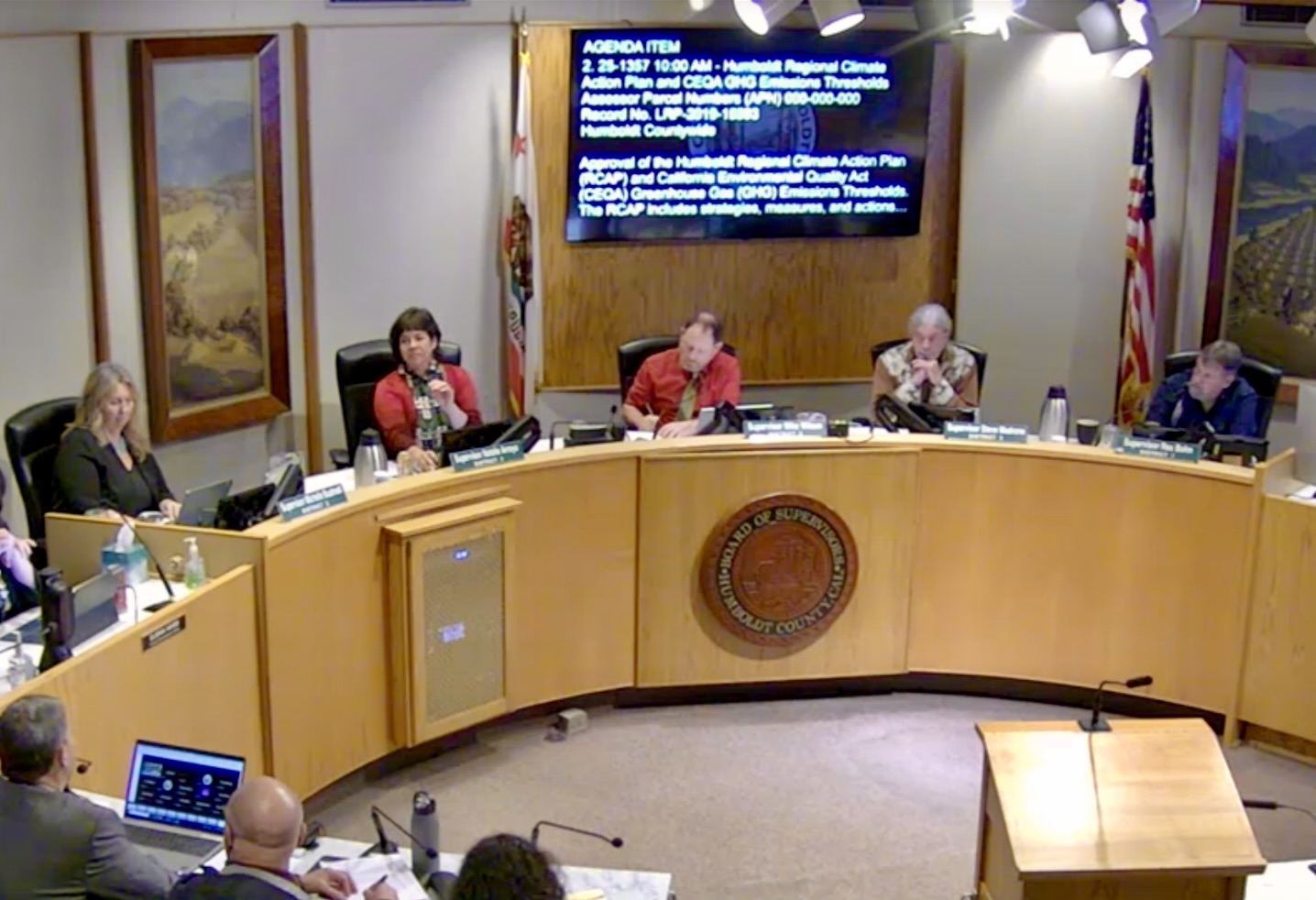
Humboldt County Board of Supervisors (from left): Michelle Bushnell, Natalie Arroyo, Mike Wilson, Steve Madrone and Rex Bohn. | Screenshot.
###
The Humboldt County Board of Supervisors today passed a sweeping environmental document aimed at reducing planet-warming greenhouse gas (GHG) emissions in the coming years.
Passed unanimously, the Regional Climate Action Plan (RCAP), which was developed in collaboration with local cities and other government agencies, includes an array of strategies and measures that, together, are designed to meet certain state and local goals. Specifically, they’re aimed at reducing the county’s GHG emissions to 40 percent below 1990 levels in the next four years and 85 percent below that mark by 2045 while achieving carbon neutrality.
The board also went a step further, setting an even more ambitious GHG threshold that will apply to new development projects requiring review under the California Environmental Quality Act (CEQA) — unless the project in question won’t come online until after 2030. After some deliberations (and confusion regarding percentages), the board agreed to set this threshold 35 percent lower than what’s spelled out in the RCAP.
Confusing? Certainly. Each board member got a bit lost, at one point or another, in what Fourth District Supervisor Natalie Arroyo dubbed the “acronym soup” of this discussion. But the RCAP is actually designed to streamline future development.
“Once the new regulations are adopted, it will better guide future development to locations that are encouraged by the county,” Planning and Building Director John Ford said during today’s meeting. The plan enshrines a tiered environmental review process, which staff said will reduce paperwork and delays by avoiding redundant analysis. In other words, projects that are consistent with the RCAP will have simpler regulatory procedures.

A forecast of the county’s future greenhouse gas emissions shows that transportation is the largest source of such pollutants. | Screenshot.
###
Humboldt County emitted roughly 1.5 million metric tons of carbon dioxide in 2022, according to Planner Megan Acevedo, with road transportation sources accounting for 73 percent of that. The second-highest contributor was building energy use from natural gas, she said.
The plan identifies 12 strategies for reducing emissions, largely focusing on transportation-related measures such as transitioning government fleets to cleaner-running vehicles/fuels while reducing the number of vehicle miles traveled. Land use planning will encourage growth in areas where services and transit already exist, and local governments will promote efficiency upgrades and electrification in homes and businesses.
The RCAP also aims to enhance carbon storage in forests and rangeland; improve energy efficiency in water and wastewater systems; reduce landfilled waste through recycling and organics diversion; and track all of these efforts via annual progress reports.
Ford noted that there has been a lot of confusion regarding the proposed GHG thresholds, as they pertain to new development. Many local residents conflated this with the RCAP. Ford explained that they’re related but distinct components of the county’s climate strategy, and the latter could be adopted without passing the former.
A hired consultant recommended that the county set a GHG threshold 50 percent below what’s spelled out in the RCAP, but when the matter came before the Humboldt County Planning Commission, that body wound up taking a slightly more conservative approach. With a narrow 3-2 vote, the commission suggested splitting the difference by setting a threshold of 25 percent below the RCAP level. Coming in to today’s meeting, staff sided with the Planning Commission, recommending that the board aim for that same 25 percent mark.
First District Supervisor Rex Bohn was skeptical about the whole process leading up to this point. He asked Ford whether staff had consulted with “people that build the houses” and suggested that stringent environmental regulations could prevent future development.
“They [local builders] should have had some input, because the best practices are going to be implemented by them,” Bohn said.
Ford replied by pointing out, “Sometimes people don’t like change, and this, unfortunately, is change.” He also said, “We’re not proposing anything right now that is revolutionary, related to building.”
Both Second District Supervisor Michelle Bushnell and Fifth District Supervisor Steve Madrone expressed concerns about restricting or prohibiting the use of wood stoves for heating rural homes. After doing some research, Ford assured them that wood stoves are still allowed under the RCAP, though they’re regulated through the EPA.
During the public comment period, an attorney representing SN Indianola, a subsidiary of Rob Arkley’s Security National, argued that the RCAP failed to include a planned housing development project along the Indianola Cutoff in its FEIR. Ford later told the board that it was omitted because the developers have yet to submit a permit application.
The majority of public comments came from local environmental activists, who encouraged the board to adopt the RCAP and adopt a lower GHG threshold.
After some more board discussion, Third District Supervisor and Board Chair Mike Wilson made a motion to adopt the RCAP, along with its related documents, and to set the GHG threshold at 50 percent of the RCAP level — a more stringent goal than what was passed by the Planning Commission and recommended by staff.
Bushnell said she wanted to vote in favor of the motion but couldn’t go that far. She requested the GHG goal be 25 percent below RCAP, and Bohn agreed, saying he’d like to defer to the expertise of the Planning Commission.
Percentage confusion ensued as some people did math from point A to B while others were measuring from B to A. Eventually, though, once everyone got on the same page, Wilson suggested a compromise: a GHG threshold of 35 percent below the RCAP.
This middle ground earned unanimous support for the motion.
CLICK TO MANAGE