
Screenshot of Tuesday’s Eureka Council meeting.
###
In an effort to close the gaps that prevent the city’s homeless community from accessing immediate shelter, the City of Eureka is pursuing new housing alternatives, including a city-sanctioned encampment.
At last night’s meeting, the council looked at several encampment setups in California and Oregon — ranging from strictly regulated city-run facilities to self-governed communities that more closely resemble a commune — to get a better sense of what would work here in Eureka. The council received the report, but did not take any formal action on the item.
The renewed push for emergency shelter options comes nearly one year after the city council rejected a controversial proposal that would have increased penalties for some people living in unauthorized homeless encampments. That proposal drew sharp criticism from homeless advocates who argued that it would cause undue harm to unhoused community members and create additional barriers to housing and supportive services. As a result, the council tossed the ordinance and instead formed an ad hoc committee to explore strategies to expand the city’s options for emergency shelter.
That ad-hoc committee includes council members Renee Contreras-DeLoach and G. Mario Fernandez, Eureka City Manager Miles Slattery, Managing Mental Health Clinician Jacob Rosen, CAPE Project Manager Jeff Davis and Chief Building Official Brendan Reilly.
During a presentation on that committee’s work at last night’s meeting, Contreras-DeLoach said city staff looked at two city-sanctioned “alternative shelters” in Portland, Oregon, including the Multnomah Safe Rest Village and Weidler Village, as well as Dignity Village, a membership-based community that calls itself “a radical experiment to end homelessness.” Staff also took online tours of a city-sanctioned encampment in San Rafael and The Grove in Sacramento, a 50-unit tiny cabin community for transitional-age youth.
Contreras-DeLoach acknowledged that there are “advantages and disadvantages” to each setup. Looking specifically at the Portland sites, she noted that the city-run Multnomah Village is made up of identical cube-like units (similar to the Betty Kwan Chinn Homeless Foundation’s Bayside Village) and is “very, very meticulously maintained” with tight security. Dignity Village, on the other hand, has more of an artsy, commune-type feel.
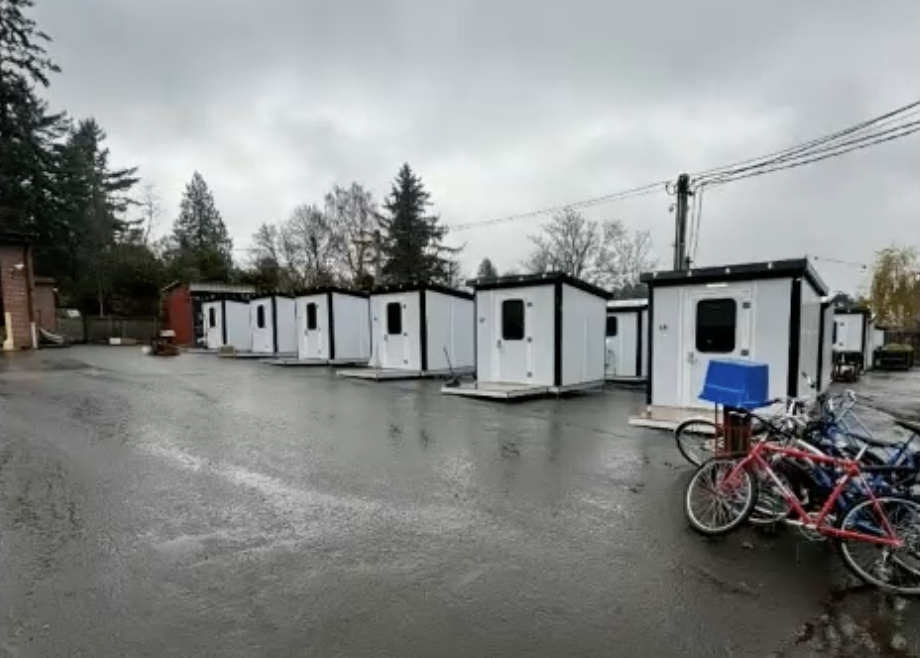
Portland’s Multnomah Safe Rest Village | Screenshot.
“It’s considered democratically self-administered, self-governed and self-operated,” Contreras-DeLoach said, referring to Dignity Village. Looking at an aerial view of the site, she pointed out piles of people’s belongings and garbage. “They did say to staff that … this community has had quite a few fire calls. …. You can see that there’s some safety concerns with how this one’s being operated.”

A tiny home located in Dignity Village. | Screenshot.
“I think there’s probably a happy medium between the two,” she added. “Studies have shown people do better and they heal better when there’s more of a sense of community, and we know that that’s often through environmental design and planning.”
Contreras-DeLoach also went over some of the different structure types that were used in each encampment, which range from fully-assembled one-room units to double units with a kitchenette and bathroom facilities, which exceed $20,000 per bedroom.
Contreras-DeLoach noted that a locally made and eco-friendly option could be sourced through Building Lives By Building Structure (BLBS), a Hoopa Valley-based hempcrete business. “They’re built like a home … and, price-wise, they come in at about the same price point,” she said, referring to the $20,000 per unit figure. However, she acknowledged that BLBS does not yet operate at the scale required for, say, a 25-unit tiny house village.

An example of a Conestoga Hut. | Screenshot.
The structures she was most interested in were Conestoga Huts, insulated, hard-shelled structures that are built kind of like a hoop house with a flat, plywood base that’s elevated off the ground. They’re used in tiny house villages and encampments throughout Oregon, but they’re not as common here in California because they’re considered tents and are subject to different zoning laws than other tiny house structures, Contreras-DeLoach said.
“One of the issues that we have in an encampment situation is that the tents have to be ADA accessible … which, in some ways, sounds almost counterintuitive because we’re talking about people that, right now, are stuck in bushes and potentially gutters and doorways. It seems like anything would be an improvement,” she said. “[These are] sturdy, non-flammable, insulated [and] safe, [with a] locking door and window, which solves a myriad issues.”
The biggest selling point for the Conestoga Hut is perhaps the price. A fully assembled unit costs around $4,500, and an unassembled unit is closer to $2,500.
“My takeaway from all of this [research] is that this is doable,” Contreras-DeLoach said at the end of her presentation. “After going through this and really looking at it, I’m like, ‘This is something that we can really do. This is an option for us to get people off the streets and in a more stable situation.’ These aren’t intended for long-term [use], but they could last for a really long time.”
Councilmember Leslie Castellano asked if the ad hoc committee had spoken with any specific entities or individuals willing to host an authorized encampment or tiny house village and, if so, where it would be located. She also asked about potential funding opportunities. Contreras-DeLoach said the ad hoc committee had spoken to a few faith-based organizations and private individuals about setting up Conestoga Huts, but couldn’t say who.
Slattery noted that staff applied for “a private donation from an entity south of here” and said the city is focusing its efforts on a 40-unit village at a property owned by the Betty Kwan Chinn Homeless Foundation at Second and A streets.
“We’ve looked into the PLHA [Permanent Local Housing Allocation] for funding to have that site prepped,” he continued. “We have a layout designed for that site, and that layout has been proposed to both the private donor as well as the organization that we’re seeking a donation from. We got really good news today: Our staff had spoken to that organization, and based on those conversations, we’re optimistic, but we won’t know until we hear back.”

Contreras-DeLoach | Screenshot
Contreras-DeLoach added that the faith-based organizations and private donors wouldn’t be able to host anything large-scale. “These would be much smaller,” she said, adding that the churches would have to expand their designation as an “institution” with the state to include welfare. “There’s multiple churches that are interested in having anywhere from two to five. So again, that’s not very many, but it’s what they feel like they can manage.”
Speaking to the design of some of the encampments in the presentation, Councilmember Kati Moulton emphasized that a colorful and even potentially cluttered space doesn’t mean it isn’t clean or poses liability risks. “There is room for both health and humanity.”
“I was at the Raven Project for many years, and if you’ve ever been inside that house, it is absolutely covered in artwork and memorabilia,” Moulton said. “It’s got a garden that’s thriving [and] it’s got a kitchen that’s really active. There’s lots of color, and the people who come in there to get services often end up employed there … and they all kind of leave their mark on the place.”
Mayor Kim Bergel expressed her appreciation for the in-depth report, but said she was disappointed that the ad hoc committee hadn’t done more to nail down a location for the encampment.

Bergel | Screenshot
“We’ve been having this conversation for 10 years,” she said. “When we shut down the camping ordinance, my understanding was … that [the committee] was going to bring back locations, people to manage the situation and how to keep people indoors. And I do appreciate that you did a lot of work on this, but it feels like we’re still in the same place. We still don’t have a location. … We don’t have any idea about how these things are going to be funded and who’s going to run it.”
Contreras-DeLoach said she didn’t feel it would be appropriate for her to make a recommendation to the council, given that many of the details hadn’t been worked out.
“I can say, here are the grants that they’re applying for, here are the sites that we’re looking at, here are potential investors,” she said. “I don’t know how far everybody got in the process before, but I think that some of it is just waiting on us.”
Bergel continued to voice her concerns, noting that she had to call the city’s non-emergency line twice last week because tourists were being yelled at in Old Town. On top of that, Bergel said she was tired of seeing people throw “all their stuff all over the place” at Madaket Plaza.
“You guys know me. It’s not that I don’t care about people, but I can understand how some people are afraid, and we’ve got to come up with some ideas,” she continued. “We are hitting the rock, but things aren’t changing. … The people that I see sitting out in front of Free Meal in all kinds of filth … I don’t see how we’re being compassionate by allowing those kinds of behaviors. … It’s been a problem, but it’s more of a problem now.”
Moulton took the opportunity to reiterate a statistic Contreras-Deloach had shared earlier in the presentation: Uplift Eureka has successfully rehoused 259 people since 2018, and its Homeless Prevention Program has assisted 87 others. Moulton asked Uplift’s manager, Jeff Davis, how many of the 259 people rehoused ended up back on the streets.
“In the ballpark of 80 [or] 85% success rate of folks that are still housed today, which is extremely high, and I think that goes to show our dedication,” Davis told the council. “When we work with folks in our Rapid Rehousing Program, we are working with folks who have the highest need and the highest level of vulnerability. If we had 100% success rate, we wouldn’t be helping the right people. We wouldn’t be helping the folks who need it the most.”
After some additional discussion, the council agreed to accept the report but didn’t take any further action on the item.
###
Want more city council coverage? Check back tomorrow!
CLICK TO MANAGE