
Residents crawled and crab walked across a massive map of Eureka at last night’s Housing Element workshop. | Photos by Isabella Vanderheiden.
###
About a hundred civic-minded residents spent Tuesday evening crouched over a gigantic map of Eureka spread across the floor of the Wharfinger Building’s main room, marking potential sites for the 1,740 new homes the city must plan for as part of its upcoming Housing Element update.
Every eight years, the California Department of Housing and Community Development (HCD) calculates how many new local jurisdictions must plan for to accommodate population growth and meet housing needs across all income levels. The HCD looks at the current number of dwelling units in cities and counties and compares it to population estimates and various other factors to determine the Regional Housing Needs Allocation (RHNA) for the next eight-year period.
Humboldt County’s total RHNA is 5,962 for the upcoming cycle. Following a series of meetings to determine how many dwellings each of the county’s seven cities must plan for between 2027 and 2035, the Humboldt County Association of Governments (HCAOG) presented Eureka with the ambitious goal of 1,740 new units — almost double the target set in the current planning cycle.
It’s important to note that the RHNA doesn’t require cities and counties to build all these units; they just need to plan for them.
“The city and the county, we’re not in the business of building housing, though we do build some,” Cristin Kenyon, the city’s development services director, told the Outpost at last night’s workshop. “We’re really looking at how [the city] can accommodate new housing. You know, are we zoned for more housing? Do we have sites with realistic and demonstrated potential for redevelopment? If we don’t, what city actions can we take to make it more likely that it’s going to happen?”

Kenyon points to a spot near Old Town.
Planning for 1,740 new units in a largely built-out city is no small feat. That’s why community input is critical.
“What we hear tonight will affect what city policies, programs and actions go into [the Housing Element], and then we’ll be implementing those for the next nine years,” Kenyon continued. “If you think about some of the biggest and most controversial planning efforts that have happened in recent years — building on city-owned parking lots, the Arcata Gateway Area Plan, the McKinleyville Town Center plan — all of those came out of Housing Element policies and actions from the current cycle. So now is the time … to get involved and give us input!”
Kelsey Fletterick, a senior planner for the city, underscored the importance of creativity.
“Looking at our landscape, where do we put these houses?” she asked. “Because we’re so built out, we don’t have a lot of room for the typical single-family house anymore, so we need to get creative. What about townhouses? What about multiplexes? And where can it go?”
Using small stickers (orange for renters and yellow for homeowners), workshop attendees marked dozens of potential locations for new housing units on the sprawling map, most of which were clustered in big, undeveloped or underutilized areas of the city. Several people marked the Balloon Track, the old rail yard between Broadway and Waterfront Drive, as a potential site. Others were more strategic, seeking out lesser-known parts of the city where a small apartment complex or an accessory dwelling unit (ADU) would fit.

The Balloon Track.

A view of the Broadway corridor and Eureka Mall. That area in the upper-middle with four yellow stickers in a row is the future site of “Sunset Heights.”
About a dozen stickers were placed around the Bayshore Mall, which was subject to a foreclosure auction on the steps of the Humboldt County Courthouse earlier this year, but there weren’t any bidders. The debt-laden mall is still open, but that hasn’t stopped locals and Cal Poly Humboldt students from dreaming up new uses for the property.
Reached for comment this morning, Kenyon said she also noticed the number of stickers on the Bayshore Mall. “[T]hat definitely seems to be on the community’s collective vision board, although redevelopment there would ultimately depend on a willing developer acquiring that site (and being able to demonstrate safety from coastal hazards through the coastal development permit process).”
Several other people thought the vacant storefronts at the Eureka Mall, located just up the hill, would be a good spot.
There were also a few stickers placed on a mostly vacant property overlooking Highway 101, where an affordable housing project is already planned. “Sunset Heights” will host 88 affordable housing units across four buildings, along with two indoor community centers. The project is being overseen by the Rural Communities Housing Development Corporation.

Another idea?
Everyone I chatted with while walking around the room agreed that the city needs more housing options, ideally around high-traffic areas like Old Town and Henderson Center.
A woman named Roxanne told me she’d like to see the city adopt a “European approach” to housing, with businesses and other commercial uses on the street level and apartments on the floors above. She said she’s seen Eureka “bloom” in recent years, and wants to see that trend continue, especially in Old Town. However, she worried that the lack of parking could present a problem for residents and tourists alike.

Prospective sites near Henderson Center.
During the mapping exercise, Kenyon noticed how difficult it was for attendees to identify undeveloped areas in the city that aren’t already slated for development or constrained by flood hazards or other environmental factors.
“I was hoping that someone from the public knew of some great piece of flat, undeveloped property with a willing property owner that I didn’t know about, but unfortunately, it’s as tough as I thought,” she wrote via email this morning. “That naturally led many people to focus on vacant buildings, underutilized commercial properties, and large parking lots as potential opportunities for housing.”
“There are very drastically different public opinions about parking,” she added. “Some attendees saw large parking lots as obvious redevelopment opportunities, while others felt we have a serious parking problem.”

Fourth District Supervisor Natalie Arroyo may have found a spot in Eureka’s West Side neighborhood.
City staff set up several other stations around the room to learn more about local housing priorities. One station had big sheets of paper for attendees to list their hopes and concerns about affordable housing, ADUs, neighborhood livability, homelessness and local economic development.
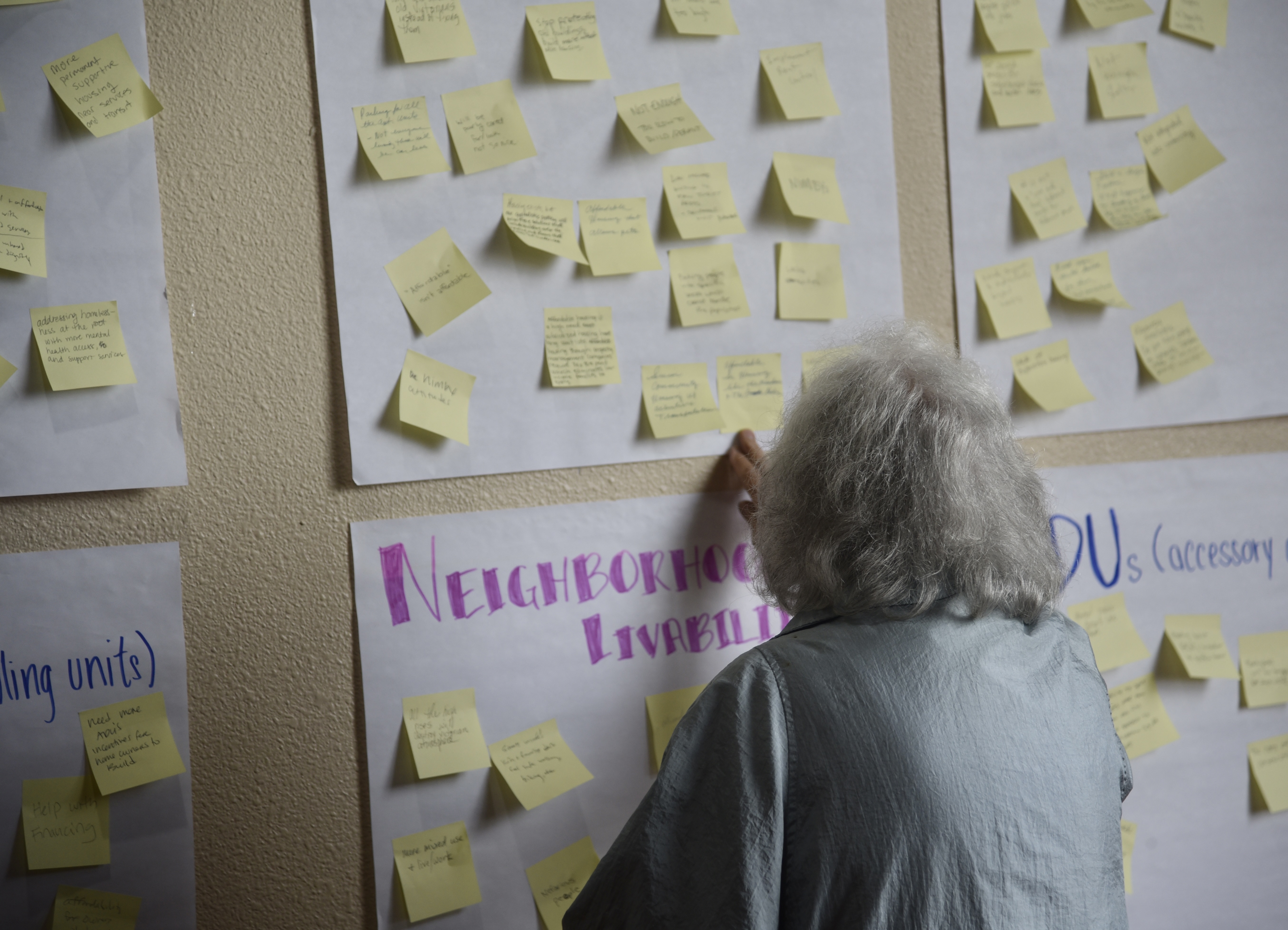

Residents write out their hopes and concerns on sticky notes.
There was also a little station set up for kids to draw their own neighborhood.
“Kids have the best ideas for housing,” Fletterick said. “It’s interesting when you get them out of the idea that a house is just a single-family house, they’re like, ‘I actually want to live in a live-work’ or ‘I like commercial mixed-use buildings’ and you see this shift into what creative housing development can look like.”

It’s never too early to get involved in local planning.

Last night’s workshop was the first of many community conversations about the Housing Element update. All of the input gathered during these meetings will be incorporated into the draft Housing Element that will be presented to the Eureka City Council in the coming months.
Want to share your thoughts? Fill out the city’s survey here.
CLICK TO MANAGE