
Members of the Citizens’ Advisory Committee on Measure Z Expenditures addresses the Humboldt County Board of Supervisors at Tuesday’s meeting. | Screenshot.
###
Following a tense debate at Tuesday’s meeting, the Humboldt County Board of Supervisors narrowly approved a three-year spending plan for projects and positions funded by Measure Z, the county’s half-cent sales tax dedicated to maintaining public safety and essential services.
The $13 million annual allocation will help fund fire and emergency medical services in remote areas of the county, as well as 70 staff positions across six county departments, including the Humboldt County Sheriff’s Office, the District Attorney’s Office, the Public Defender’s Office, the Department of Health and Human Services (DHHS), the Probation Department and Human Resources. The spending plan will also fund programming aimed at reducing crime in local schools.
The three-year plan, which covers fiscal years 2027-28 through 2029-30, was approved in a 3-1-1 vote, with Fourth District Supervisor Natalie Arroyo dissenting and Fifth District Supervisor Steve Madrone abstaining from the vote.
The board’s at-times contentious discussion largely focused on fairness across districts and how to balance the needs of one community with another while working within the confines of a dwindling pot of sales tax revenue.

Speaking at this week’s meeting, Deputy County Administrative Officer Sean Quincey acknowledged the challenging decision before the board, noting that Measure Z “is essentially flat” with “no growth expected” in the immediate future.
“Something has to give,” he said. “Either departments absorb the shortfall, which they’ve historically done through vacancies or trimming their services, or we reduce what’s available to community partners for [Measure Z] applications.”
The Citizens’ Advisory Committee on Measure Z Expenditures came up with four options for the three-year spending plan, as outlined in the tables below.


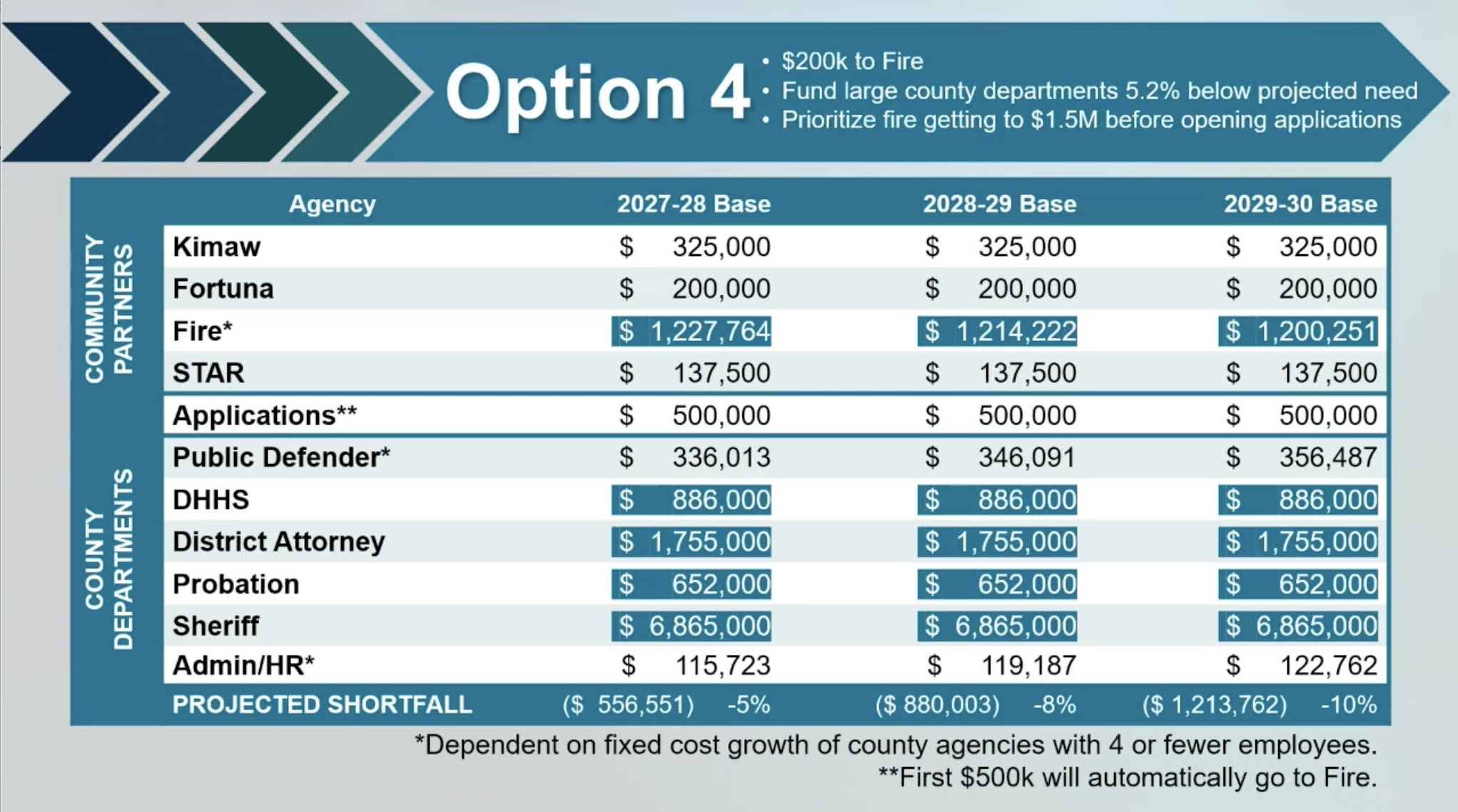
The two major sticking points involved funding requests from the City of Fortuna and Hoopa’s K’ima:w Medical Center, which the board debated earlier this year when deciding which Measure Z applications to fund for the 2026-27 fiscal year.
At that time, the board agreed to allocate nearly $246,000 to K’ima:w Medical Center for ambulance services on the condition that the agency seek funding elsewhere. (More on that below.) The board also agreed to allocate nearly $300,000 to the City of Fortuna for a full-time school resource officer for the Eel River Valley, a sworn position the county has funded eight of the last nine years. However, the board denied the Arcata Police Department’s $200,000 application to fund a juvenile diversion program that would serve the greater Arcata area.
Third District Supervisor and Board Chair Mike Wilson noted that Fortuna residents were given the option to raise their local sales tax from 0.75% to 1.5% in November 2024 to generate additional revenue, but the ballot measure was rejected. Arcata residents, on the other hand, voted to raise sales taxes to 10.25%, which includes three separate tax rates.
“The citizens [of Arcata] decided that these things are a value and they tax themselves,” Wilson said. “Fortuna has asked its citizens for higher sales tax, and [the ballot measure] was rejected by the citizens. … This is a little bit hard for me from that perspective. … I just want to reference that in terms of parity.”
Speaking during public comment, Fortuna Police Chief Matt Eberhart noted that Fortuna’s school resource officer works with 15 schools throughout the Eel River Valley.
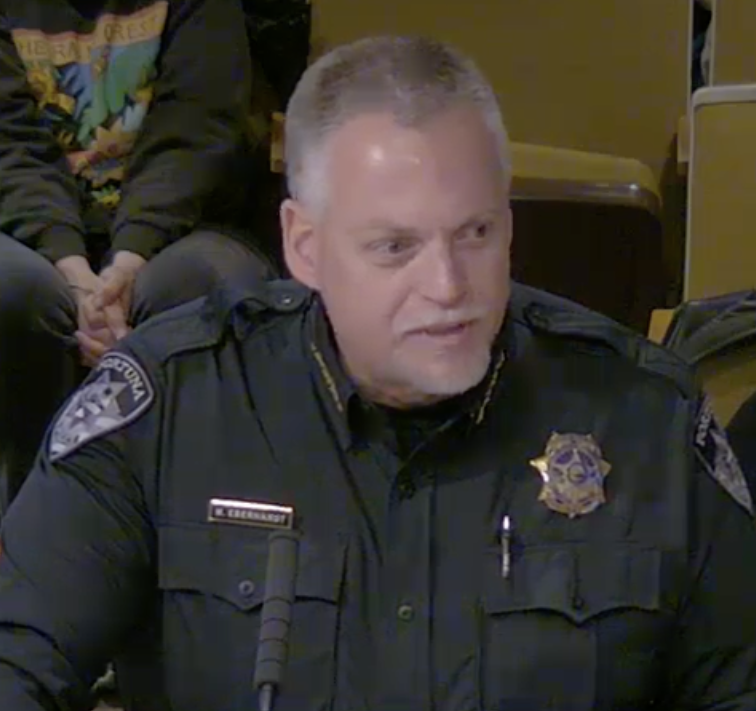
Eberhart | Screenshot
“The position serves as a resource for teachers and school staff, administrators and parents,” Eberhart said, noting that he served as a school resource officer earlier in his career. “I sat down with the school resource officer this last week, and … they said yes, they interact with the students, but they said they really help the school staff and the counselors on a regular basis [to] mitigate situations. … Just a couple examples: social media conflicts that spill over into campus, mental health crises, drugs and vaping.”
“We are grateful for the support that we have,” he added. “It does make an impact in the county, [and] it does make an impact in Fortuna.”
Humboldt Bay Fire Chief Tim Citro and Rus Brown, president of the Humboldt Fire Chiefs’ Association, also spoke during public comment to emphasize the importance of Measure Z funding and urged the board to continue investing in local fire departments.
First District Supervisor Rex Bohn spoke in favor of Option 1, the Measure Z Citizens Advisory Committee’s recommendation, given how much time and energy the group had spent on divvying up the funds. He questioned why the board would even have a committee if it didn’t want to take its advice.
“I’m really big on going with the committee’s recommendations,” he said.

Advisory committee members, Dylan Feierabend and Tammy Trent, address the board. | Screenshot.
Dylan Feierabend, the advisory committee’s vice chair, said the group had voted 7-2 to continue to fund the student resource officer position because “it’s always ranked one or two when we do our rankings.” To underscore his point, he noted that the county’s website describes Measure Z as “providing funding for rural ambulance, drug task force services, brush cutting along roadways to prevent wildfires and school resource officers in local public schools.”
“If that’s something that is shifting, we need to make sure we take a look at that,” Feierabend said. “[To] not consider funding [the school resource officer position going forward for three years — mind you, it’s not a lifetime — it signals an unwillingness or potential that that position may go away. As someone that has a young child … to not have that protection available, I think, is concerning.”
A little later in the discussion, Second District Supervisor Michelle Bushnell asked K’ima:w Medical Center CEO Ryan Zumalt if his organization had identified any additional revenue streams since the board’s last discussion on the matter. Zumalt said he and his team were “working more aggressively [to find] third-party revenue” through Trinity County and the Karuk and Yurok Tribes, but said nothing has been finalized as of yet.
The board quibbled over each of the four options on the table, with Arroyo and Wilson generally speaking in favor of Option 3, which would maintain the status quo, and Bohn and Bushnell expressing favor for Option 1, the committee’s recommendation.
Given that Fifth District Supervisor Steve Madrone was absent, Wilson said a split vote would be inevitable unless the board was willing to come to a compromise.
Arroyo said she appreciated Option 3 because “it kind of makes everybody a little tiny bit unhappy, which is perhaps the sign of a good divvying up of funds.” She made a motion to approve it, which was seconded by Wilson.
As the board continued to hash out the details of the motion, Madrone suddenly appeared at the dais, prompting staff to call a quick break. When the board came back, Madrone said he didn’t think it’d be appropriate to vote on the item since he wasn’t present for the discussion. The board ultimately voted 2-2-1, with Bohn and Bushnell dissenting and Madrone abstaining.
“You want to know why people hate government?” Bohn asked, “Because of crap like this. We can’t make a decision.”
In the interest of “compromise and parity,” Wilson asked if the board would be willing to amend either Option 1 or Option 2 and split the funding allocation for Fortuna’s school resource officer with APD to provide a diversion officer for the “Mad River area.”
Frustrated, Bohn suggested the board use some of Measure Z reserves to allocate $200,000 to Arcata and $200,000 to Fortuna, and made a motion to amend Option 2 to that effect, which was seconded by Bushnell.
County Administrative Officer Elishia Hayes warned against the action, noting that most of the $800,000 in reserves would be eaten up over the next three years. Instead, she suggested that the board could pull funds from the $500,000 allocation for applications. Bohn and Bushnell agreed.
The board ultimately voted 3-1-1, with Arroyo dissenting and Madrone abstaining, to approve Option 2 with amendments.
CLICK TO MANAGE