
Screenshot of Thursday’s Humboldt County Planning Commission meeting.
###
At last night’s meeting, the Humboldt County Planning Commission voted unanimously to deny a special permit for the removal of a 252-foot old-growth redwood in Lower Redway, citing insufficient evidence that the tree posed an “imminent” hazard to nearby structures.
The long-awaited decision came after an hour of fervent public comment in which more than two dozen community members criticized the county for allowing four old-growth redwoods to be removed from the residential lot at the corner of Briceland Road and Oakridge Drive without county approval. Many speakers argued that the trees, estimated to be more than 350 years old, should have been protected by the county-designated Q Zone, which provides specific protections for old-growth redwoods near the John B. DeWitt State Natural Reserve in Lower Redway.

The redwood in question is the tree on the right with the scar at its base. | Screenshot via Google Streetview.
Senior Planner Cliff Johnson provided an overview of the special permit request at the outset of last night’s meeting, detailing the history of the property and the surrounding Q Zone. Johnson explained that the property’s owner, Robert Scarlett, obtained a hazardous tree exemption from CalFire, which is also his employer, last year to cut down five old-growth trees on a property he had recently bought for his mother to live on.
The trees were inspected by a Lucas Titus, a CalFire professional forester, who identified “approximately five trees/clumps” that posed a “safety hazard” to the house below, and Scarlett went ahead with cutting down four of the five trees. (That assessment is linked here.)
But as the logging crew prepared to cut down the final tree slated for removal last month, county officials informed Scarlett that cutting the tree — even topping it — posed a safety risk to people traveling on Briceland Road and said he would need an encroachment permit to move forward. Days later, the county said he would actually need a special permit.
Why wasn’t a special permit required before the first four trees were removed? Planning and Building Director John Ford said Scarlett contacted the county last year to see if he needed a special permit, but was told he wouldn’t need one, since he had already secured a hazard tree exemption from CalFire.

Ford | Screenshot
“At the time, we had a different understanding of what the county could do with the Q Zone,” Ford explained, adding that staff was under the impression that CalFire’s jurisdiction superseded the county’s. “Those [four trees] were removed … with a process, but it wasn’t the appropriate process.”
Tonya Farmer, a local attorney representing Scarlett, emphasized that her client had gone through the process that was available to him and “acted reasonably in seeking permission” to remove the trees. She urged the commission to approve his permit.
“The evidence before the [commission] establishes that the tree is within striking distance of residences, roadways, utilities, infrastructure and public areas,” Farmer said. “Both the registered professional forester and the ISA [International Society of Arboriculture] certified arborist concluded the tree contains significant structural defects and presents a hazard under those circumstances. Mr. Scarlett faces potential civil liability if he fails to take reasonable steps to address the hazard condition on his property.”
“The question before the commission is not whether anyone values old-growth redwoods; it is whether the property owner, faced with professional opinions identifying a hazardous tree, acted reasonably in seeking permission to remove it, and he did,” she added.
Of the two dozen-plus residents who spoke during the public comment, all but one were opposed to tree removal. Many speakers sharply criticized the county for failing to enforce Q Zone protections, with one speaker calling the process a “complete embarrassment” and another accusing the planning commission of acting “in complete contempt for the Southern Humboldt community.”
Some speakers, including registered professional forester (RFP) Patrick Mulligan, claimed that Scarlett had “gone expert shopping” to find an arborist who would “give him a desired outcome.” He asserted that Titus’ initial assessment of the trees can’t be trusted because “he is a biased coworker of Scarlett.”
“These reports should not be trusted,” Mulligan said, noting that he used to live in the Briceland area and has seen the trees up close. “Steve Hohman’s report is not a separate assessment; it is a regurgitation of the arborist report, so it holds no value except by itself, except for his authority as an RPF, because the arborist could not meet the required level of authority.”
Mulligan also disputed Hohman’s claim that the tree “has a significant cavity with rot,” and said claims of root damage are “exaggerated.”
“Caltrans has repeatedly said during Richardson Grove litigation that moderate damage to redwood roots does not affect long-term stability, and the scar is not a threat either. Redwood trees heal,” he said. “There is no actual emergency. It is a lie for profit, and the county should not let itself be fooled again.”
Similarly, Tom Wheeler, executive director for the Environmental Protection Information Center (EPIC), noted that none of the inspection reports actually identified the trees as posing an “imminent” threat to nearby structures. He argued that the “supposed defects” to the tree, including the large scar at the base where a smaller tree was removed, were “created by the property owner himself or his agents.”

Wheeler | Screenshot
“That is supposedly a pathway to rot, again, that was caused by the property owner,” Wheeler said. “The arborist report also identifies changes to wind on the tree, and this notion that it could function as a sail and increase the risk of blowdown. That change in wind was caused by the removal of those four other trees. … There is no existing rot as a consequence of that cut. There may be rot in the future because of the property owner’s actions, [but] there is no rot at present.”
“This is an imminent hazard, and so we should not try to find that there is one when one does not exist,” he added.
Other speakers raised alarm over the precedent that would be set if the permit were approved.
“There’s plenty of trees out there with fire scars that are hundreds of years old … and they’re still living,” said Redway resident Kathy Glass. “It’s got cavities, it’s got scars, it’s got hazards; I mean, you could say it about every tree in the county.”
The only person who spoke in favor of the special permit was Thomas Mulder, the former Southern Humboldt representative on the Planning Commission. He warned commissioners that they would be liable if the tree “comes down and kills someone.”

Tonya Farmer and Robert Scarlett address the commission at last night’s meeting. | Screenshot
After public comment, Scarlett joined his attorney at the podium to answer questions from the commission. Before taking questions, Farmer called out several commenters by name to dispute their claims against her client. She refuted the assertion that Scarlett was granted the hazard tree exemption by CalFire because of his employment at the agency. She also disputed the claim that he had made a “substantial monetary windfall” from the logged trees.
“The total amount of money that he received for all the trees [was] not one million dollars, [it was] $70,000,” she said. “That’s it. And that’s not even net; he had to pay for the services to fell the trees, so this lie must stop today.”
Commissioner Todd Fulton asked Scarlett if he knew how the property was zoned when he bought it. “I’m unsure to this question,” Scarlett responded.
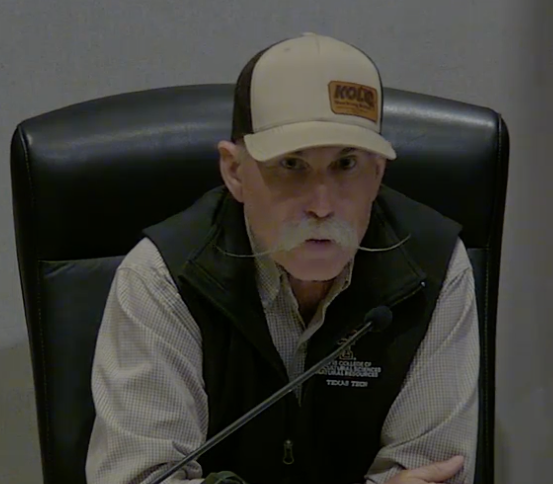
Fulton | Screenshot
“Was it ag exclusive?” Fulton asked. “Was it timber production zone? What was the zoning on the property when you purchased it?”
Scarlett’s attorney leaned over and said something in Scarlett’s ear. “Residential,” he replied.
Fulton said he had asked the question because he was trying to understand if Scarlett was aware of the Q Zone when he purchased the property.
“I’ve grown up across the street for 25 years, [and] I’ve been told about the Q Zone my whole life,” Scarlett said. “I think we’re getting into the weeds and everything like that with other individuals here. I acquired this property for my mother … because she is of aging and I live currently across the street.”
Scarlett emphasized his concern about limbs falling from the tree, noting that he had seen limbs fall from the tree in question and crush a vehicle.
Commission Chair Sarah West asked about drone footage of the crown of the tree and why it wasn’t submitted to the commission ahead of the meeting. Scarlett said he was led to believe that the forester he hired had sent the video to the county staff.
Ford said he had received the forester’s reports, but not the video. “I had discussed with Mr. Scarlett some things that he could do to make those reports stronger, including the video, and but none of that was done.”
Commissioner Noah Levy asked if Scarlett had girdled the four trees that were cut last year, referring to a logging practice where a complete ring is cut through the bark and cambium layer to kill a tree without cutting it down. “And if so, why would you have done that?”
“That was not me,” Scarlett said. “That was the company that I hired to do the job.”
“You should ask the company who did the job why they did that, not my client,” his attorney interjected.

Levy | Screenshot
“Well, did you ask them why they did that?” Levy asked. “I mean, you hired them.”
“They told me [they did it] so they can get a clean cut on the tree,” Scarlett said.
Levy said he could understand why Scarlett would want to remove hazardous limbs from the tree, but felt that people who “choose to live in the redwoods assume a certain risk.” Levy added he’s had to limb trees around his home before, but emphasized that he did so carefully “because living with the trees was the point of purchasing that property.”
“[W]ithout getting into your motivations or your character, I feel that the evidence that … your experts provided for why removal of these trees was the best or necessary course was very thin,” Levy continued. “I don’t find the evidence that you’ve submitted persuasive. At most, I think there might be a need to remove certain limbs, but that’s just where I stand on this.”
Farmer pushed back, reiterating that her client had followed the law. “Yeah, it needs to be improved, but … start with who was responsible for the Q Zone in the first damn place,” she said. “Then my client wouldn’t have had to go through any of this.”
Fulton emphasized that the commission’s role was not to judge the applicant’s motive for cutting down the trees — “the cat is out of the bag” — but to determine whether the remaining tree poses an “imminent” threat to nearby structures and infrastructure.
Commissioners Jerome Qiriazi and Peggy O’Neill both felt as though there wasn’t substantial evidence to prove the hazard was imminent. Commissioner Lorna McFarlane agreed, and made a motion to deny the special permit, which was seconded by O’Neill.
Commissioner Iver Skavdal expressed frustration at the commission having to deal with the issue in the first place. “This situation is a mess, which may be the understatement of the day,” he said. “I am disappointed in the steps taken — or not taken — that resulted in us being here tonight.”
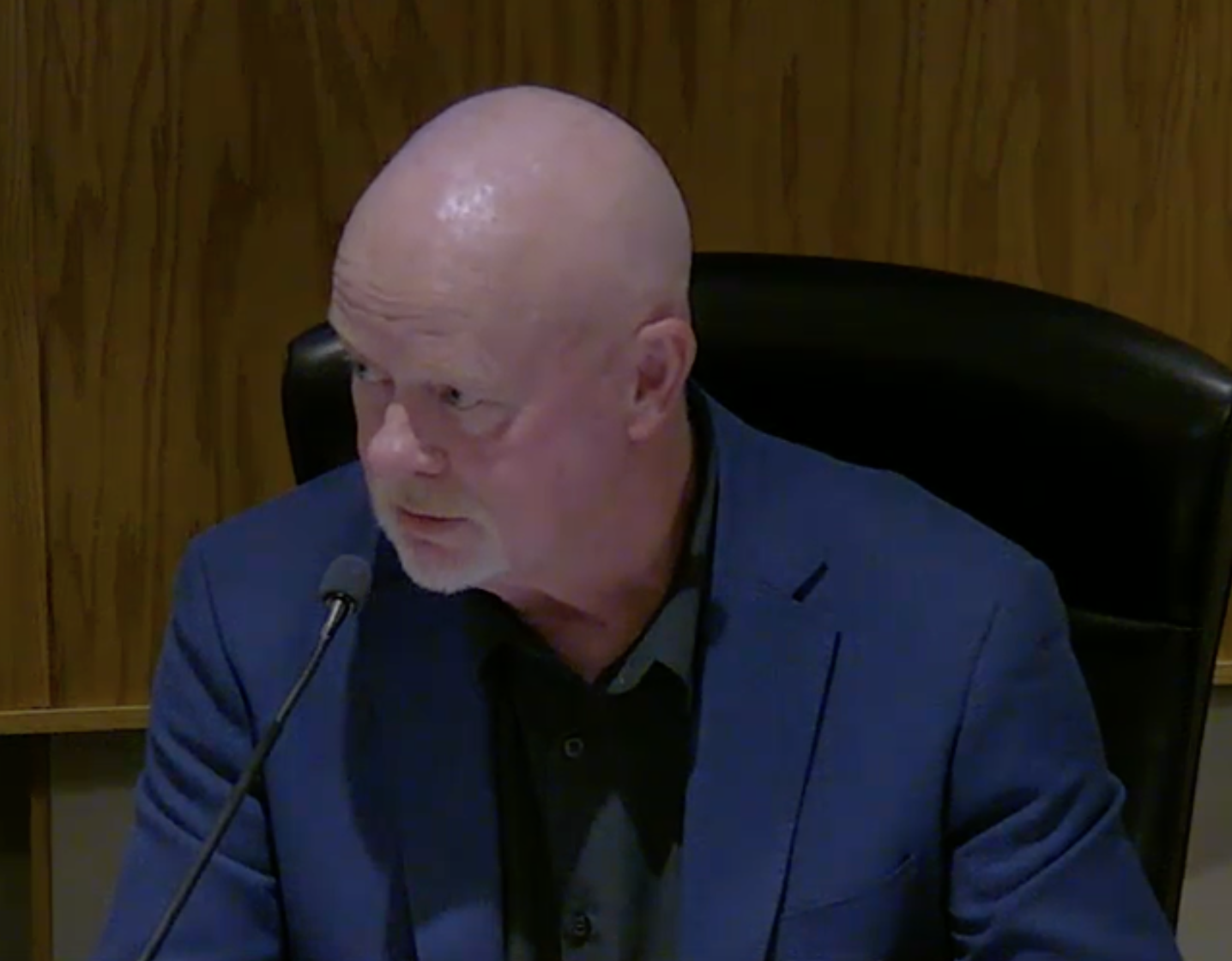
Skavdal | Screenshot
Skavdal said he was hesitant to support the motion, given the potential liability to the county if the tree were to fall and injure someone. However, he agreed with Levy that residents take on a certain level of risk when living among the redwoods.
“I don’t see that as any different from people who choose to have a house by the beach in a tsunami zone or next to the river in a flood zone,” he said. “Each of us weighs that risk with the opportunities and benefits that come from living in those areas. We’re talking about degrees of risk, and who participates in that risk, and that’s where I’m starting to be troubled. … If we decide the tree stays, who’s at risk if a limb falls on the applicant’s property or on the applicant’s mother?”
McFarlane said she would be happy to include an amendment to her motion that would allow Scarlett to limb the tree as he sees fit, but Ford noted that he can already do that.
O’Neill added that Scarlett could always resubmit his special permit request if the tree started showing signs of rot. This seemed to ease Skavdal’s concerns. Still, he urged staff to return to the commission or the Board of Supervisors with a report on the Q Zone to bolster it’s protections.
After some additional discussion, the commission denied the special permit request in a 7-0 vote.
CLICK TO MANAGE