
RCEA’s office in Oldtown Eureka.
PREVIOUSLY
###
The Redwood Coast Energy Authority’s board of directors approved at their meeting yesterday a new four-day workweek and salary step schedule for their employees that, years in the future, will allow many of them to earn more than 20% above what their current maximum salary allows for.
Like many governmental agencies, RCEA’s employees are paid on a salary-step schedule: employees are grouped by their titles and responsibilities, and each of these groups has their own pay ladder they work up, each employee’s salary increasing by 5% annually if their performance warrants it. The board approved new schedules for each of these groups of employees last night; each employee will be placed on the closest step up compared to what they’re currently earning. According to the staff report, a number of unfilled positions at RCEA gives it a $600,000 surplus, some of which they can use by adjusting their salary process. This year, the increased pay will cost roughly an extra $104,000.
The new schedules will be implemented April 5, and because their salaries are being adjusted up a tad, most of them will get a raise of less than 5%. The real gains will come later: the most Executive Director Beth Burks could make on the old schedule was $245,916 every year; in five years, on the new schedule, she stands to earn $271,714. (She currently makes a bit over $212,000). Everybody, all the way down to the lowest-paid position, will make more in the coming years than they would have on the old schedule. One standout, Deputy Executive Director Eileen Verbeck, made $151,309 in 2024, according to most recent publicly available salary data. Assuming she got a 5% raise last year, she’s currently making about $159,000; the most she could earn on the old schedule was about $170,000. Now, in a few years, she could earn over $217,000.
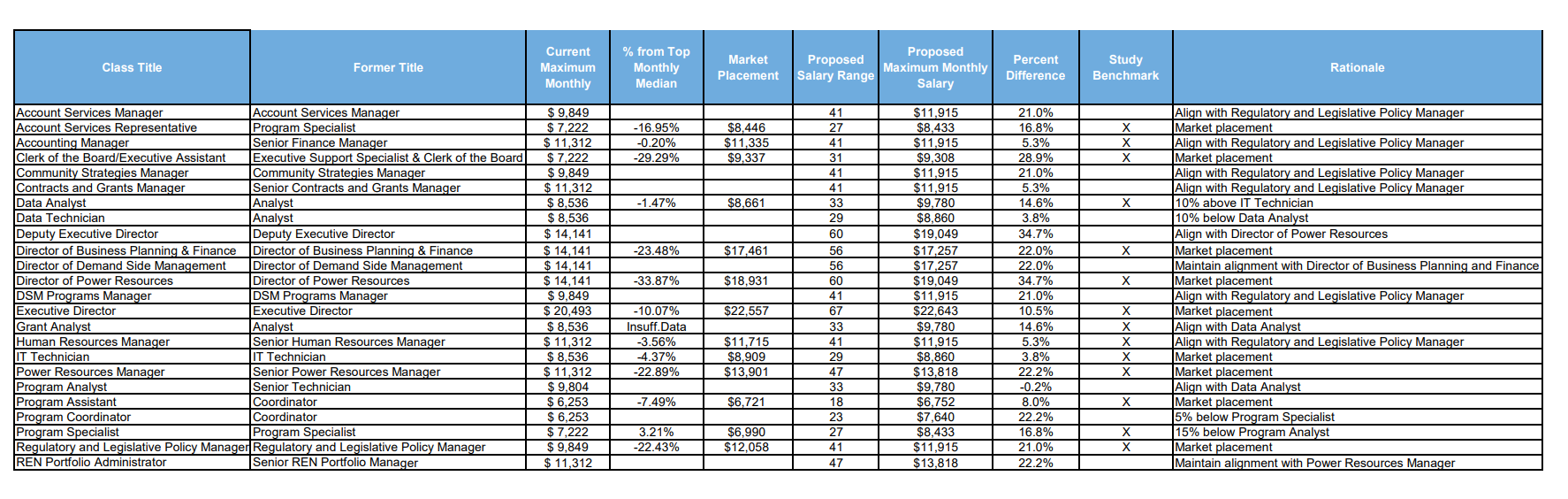
A comparison of RCEA’s old salaries at the top of the step schedule compared to the new steps. Screenshot.
RCEA’s board requested the salary reconfiguration in 2024; RCEA hired consulting firm Gallagher early in 2025 to work it out. RCEA gave them their pay scales and job descriptions for each position, and Gallagher also asked RCEA employees for their own descriptions of their duties and what they thought would be required of a new employee doing their job. Gallagher compared RCEA’s jobs to positions at 10 other agencies similar to RCEA. Some of them, in places such as the Bay Area or Orange County, pay their employees a lot more than RCEA does.
Top executives for some of the comparator agencies make over $300,000 annually (the CEO of the Sonoma Clean Power Authority was paid $496,000 in 2024). Gallagher computed the “cost of labor” differentials for each area based on data from the Economic Research Institute, and adjusted the pay for each equivalent position down from the other, higher-paying markets, some of them by as much as 30%. Gallagher’s report doesn’t dive into detail on how that was calculated. They found that almost all of RCEA’s employees are paid less than the market average, justifying the new step schedule.
For comparison, the median household in Humboldt County makes $58,124 every year.
The increased pay is necessary, RCEA staff and board members said yesterday, because they’re competing against agencies that offer more money and remote work opportunities. They’re also not enrolled in CalPERS and employees have to spend more on insurance than employees of other local agencies.
“I’ve heard we’re an incubator for good talent to go to other CCAs,” board member and Arcata city councilmember Sarah Schaefer said, referring to other Community Choice Aggregators like RCEA. “We want to be able to attract good people and keep them here to do good work in our community as well…It’s hard to — if we can — to not want to pay our employees more to do the work that they do.”
The vote to approve the pay changes was 5-0; Blue Lake City councilmember Elise Scafani and Heidi Moore-Guynup, a representative from the Blue Lake Rancheria, abstained.
The board also unanimously approved a 34-hour workweek for RCEA. They want to offer their employees “competitive and improved benefits,” said a staff presenter, hoping that a shorter workweek will reduce burnout, decrease absenteeism, and attract more prospective hires.
Over half of RCEA’s staff said they thought they could work through their loads in less than 40 hours a week, according to an internal poll.
To offset the lost hours, they’ll focus on efficiency, improving their communication and eliminating meetings when possible. “We’re really focusing on ‘How do we do it better?’” said one staff member, “so that we give people some time back and still have a similar level of productivity.”
The shorter workweek will also save RCEA money this year; many of their employees are on a bi-weekly salary, and every decade or so, there are 27 pay periods in a year instead of 26. Some employers pay for the extra two weeks, but that would cost RCEA $200,000. Leadership proposed a trade: keep working 40-hour weeks and also perhaps hold on to a Social Security Cost of Living Adjustment, or work 34-hour weeks and sacrifice the COLA. 96% of the staff wanted the deal.
They’ll work Monday-Thursday, 9 a.m. to 5:30 p.m. starting May 4.
Staff are, apparently, eagerly awaiting the change. They asked their staff to share one word that summed up how they felt about a shorter workweek and turned it into a word cloud. Right in the middle, in size 70-something font: “YAAAAS!”
CLICK TO MANAGE