In the spring of 1941, my sophomore year at Humboldt State College, I applied for a surveying job as a “stake artist,” a euphemism for Under Engineering Aide, the lowest of all civil servants. Division 1 of the California Division of Highways (now Caltrans) covers the North Coast from south of Hopland to the Oregon Border.
When I applied, there were seventeen names ahead of mine. However, my girlfriend, Eris Green, told me her Daddy, Bill Green, the big boss of Division 1, had moved me to the top of the list.
On the Friday college was out I received a phone call telling me to hop on the southbound Greyhound on Monday morning and join a survey party working somewhere along Highway 101 north of Garberville. I spotted the “Men and Equipment Working” sign near Myers Flat and asked to get off the bus.
Joining the Party

The author, circa 1941. Photos via the Humboldt Historian.
This wouldn’t be my first job away from home. The two previous summers, I had managed the YMCA’s Camp Ravencliff at Redway, but this job was different. It would introduce me to the real world of working with a diverse group of professionals. Our survey party consisted of the chief-of-party, Eddie Dessinger; transitman Norris Rawles; head chainman “Barney” Barnwell; rear chainman Verne Cooperrider, an upper division civil engineering student from UC Berkeley and a close friend, also hired for the summer; and the “virgin” stake artist.
The stake artist carries a bag of wooden stakes and a hatchet. He marks his stakes “artistically” with a blue crayon, showing such calculations as the amount of cut or fill required, then drives the stakes into the ground.
Along California’s Redwood Highway, however, a stake artist spends most of his time out in front of the rest of the party with a bolo knife whacking limbs, bushes, high ferns and occasionally even a notch out of the side of a redwood tree, which may be obstructing the transit’s line of-sight.
Although my hiring was based strictly on inside pull, I did bring certain advantages to the job. My dad was a licensed civil engineer and surveyor, and I had some experience helping him on survey parties, which Mr. Green may well have taken into consideration.
Dad told me that the man out front with the bolo could favorably impress the crew by clearing ground cover around the stake where the next transit setup would be. That advice served me well with Norris and Eddie and the chainmen — and no doubt with Mr. Green, when Eddie Dessinger made his first report.
Eddie Dessinger
Whenever Norris was ready to move from one transit setup to the next, Eddie, also usually out in front of the chainmen, would bellow back to Norris, “COME AHEAD AND BRING YOUR PLUMB BOB.”
I wondered about those outbursts from our otherwise quiet leader, and when I asked him, he explained, “Plumb bobs cost seven-fifty each, and whenever we lose one, I have to write a requisition for a replacement. You’d be surprised how many bobs chainmen and transitmen leave lying on the ground when they move ahead and how much time is wasted going back and hunting for them and sometimes not finding them.”
I soon learned that Eddie Dessinger was no ordinary highway engineer. Fast and accurate in his note taking, he never held up the advancement of the party while he completed a diagram or other complicated entry in his field book. He was always ahead of the action.
He also followed the rules by turning in his field notebooks to the Division headquarters without making neater copies at night, as some of the party chiefs did, though this was strictly forbidden. Instead, he spent his evenings studying for a promotional examination. As I later learned, Eddie’s notebooks were still the neatest and most detailed of any in District 1.

Knapp’s outstanding restaurant in Garberville, 1941.
Red Mountain
My baptism by fire was at Red Mountain in the notorious slide area south of Garberville and immediately north of the “Confusion Hill” tourist attraction. In the early days, this part of Highway 101 was a quarter-mile of two-lane road. Convict laborers took part in its construction, blasting rock from the near-vertical cliff that rises 900 feet from the South Fork Eel River.
The highway is about a third of the way up the cliff, so on average it was about 300 feet down to the riverbed and 600 feet up to the top. Our job was to survey cross-sections — horizontal and vertical profiles — at 50-foot intervals. An engineer in the Eureka office could then make a good estimate of the volume of rock and rubble higher up that would have to be removed to widen the highway by any specified amount. Today two bridges are being built on the west side of the river, completely bypassing the cliff at Red Mountain, but such a project was beyond serious consideration in 1941.
As the youngest, lowest-ranking, and lightest-weighing member of the party, it was my job to hold the front end of a cloth measuring tape as I was lowered down to the riverbed, and hoisted up the cliff above the road. I didn’t mention that I was deathly afraid of heights.
Norris, using a Rhodes arc to measure vertical angles, and Barney, who held the rear end of the tape, could see my hand holding the head end as big, strong Verne lowered me on a rope from one ledge to another.
Richardson Grove
After the Red Mountain job, we ran a quick survey through the giant redwoods of Richardson Grove where the campground held dances nightly on an open-air dance floor, and where Mrs. Green and the three Green daughters just happened to be camping. I took a little stuff from the rest of the crew about that, having already told them how I got the stake artist job so they wouldn’t learn about it from someone else.
One day a southbound semitrailer rig loaded with a single log perhaps seven feet in diameter lost its air brakes on the crooked downgrade approaching a combination soda fountain and souvenir shop. The driver saw some old folks crossing the two-lane highway ahead, and the quick-thinking hero aimed his tractor straight at a large redwood on the left side of the road. At the last moment he swerved the tractor to the right, barely missing the tree, and the momentum of the log carried it straight into the standing redwood. The rig was totaled, but the old folks were saved, and the driver survived.
Garberville Doings
While we were still working out of Garberville, another Under Engineering Aide, I’ll call him Pringle, joined the party as a second bushwhacker. At last I outranked someone.
Pringle was a bigot from Oklahoma who was continually volunteering his racist views and cracking racist jokes. This didn’t sit well with Barney, who was a licensed civil engineer and had held responsible assignments with the Division of Highways in earlier times. Barney’s defense of African Americans was as strong as Pringle’s castigation, and the verbal fur flew during lunch breaks.
Nor was Pringle above padding his expense account for his room and board after staying at Garberville’s Redwood Inn. By the time Eddie Dessinger heard of this, Pringle had already left the survey party because “the work was too hard and the pay not good enough.” None of us was sorry when Pringle departed. He hadn’t been much help with the bushwhacking either.
Working out of Ukiah, we softened and widened the tortuous, narrow curves up the long grade to Ridgewood Summit between Ukiah and Willits. Below was the Charles S. Howard ranch made famous by the Depression-era racehorse Seabiscuit.
On the way to work one morning we passed a one-car collision with an oak tree. Two young parents had dozed off and were killed instantly, but their infant sleeping in a padded wooden box behind the seat was uninjured.
Folly in Fort Bragg
From Ukiah we moved to the west over the Coast Range to Fort Bragg at the mouth of the Noyo River, where the action picked up again. Right away Norris started complaining of a toothache, so as soon as we all checked into the Windsor Hotel and had dinner, Verne and I rushed Norris to the bar to treat him to some painkiller. As Norris started feeling better, he suggested we move on to a nightclub where there was usually more action.
As we entered the more promising establishment, Norris said, “Hey guys, I’m in luck, there’s my dentist at the far end of the bar.”
Norris invited his friend to join us at an empty booth, ordered a round of drinks, and it was soon apparent that the dentist was already ahead of Norris. Even so, he readily agreed to relieve Norris of the troublesome tooth at his nearby office, and off they went.
Later, back at the Windsor, Norris came into our room and told Verne and me about his dental experience.
It seems that after his friendly dentist injected the Novocain and started to pull the tooth, Norris had said, “You’d better wait a bit, that Novocain hasn’t taken effect yet.”
The dentist had replied, “That’s strange, my hand is numb as a rock. I must have run the needle through your cheek into my thumb.”
He was more careful on the second try, and Norris told him when his jaw was sufficiently numb. The tooth was pulled, and as they were ready to leave the office Norris said, “Well, my jaw is almost awake now, but I still have a toothache.”
The dentist took a look and said, “Damn it, Norris, I pulled the wrong tooth. Now I’ll have to pull the one next to it.”
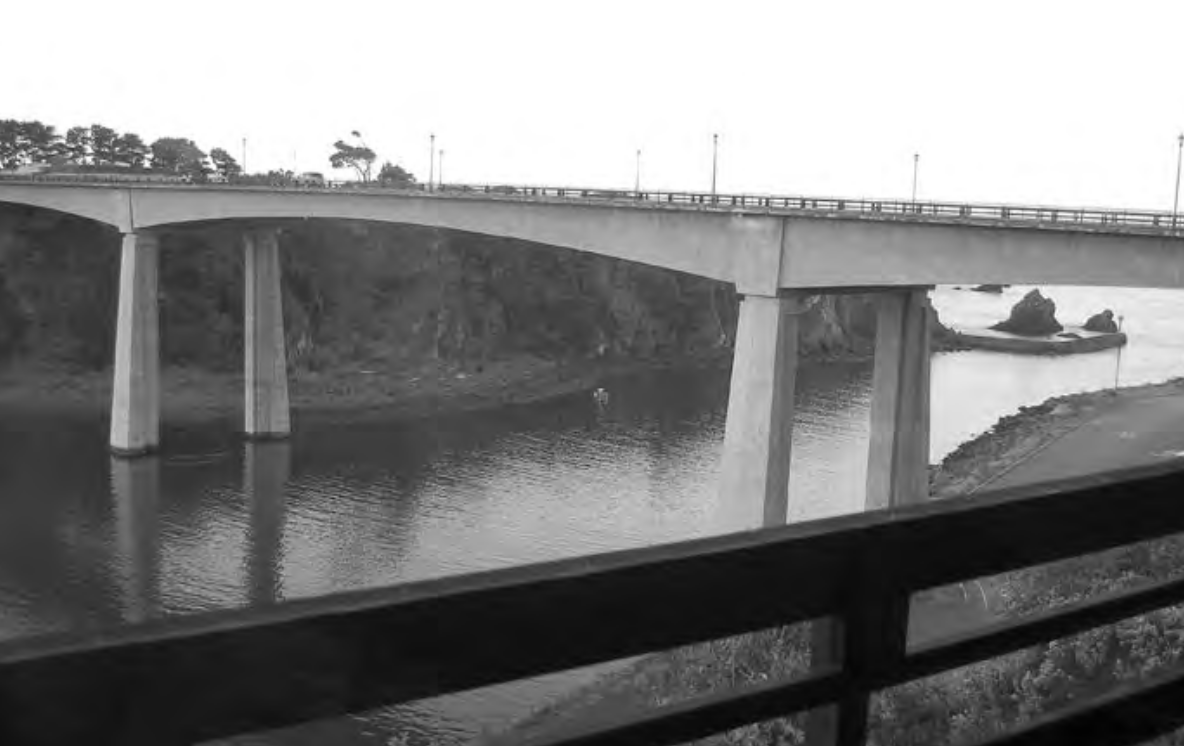
Noyo Harbor in Fort Bragg is one of several estuaries along the Mendocino coast that have been spanned by bridges since World War Two.
The Mendocino Coast
The coastline south of Fort Bragg is surely one of the most beautiful anywhere. Its most striking feature is the series of estuaries at the mouths of small streams flowing to the Pacific Ocean. These estuaries are carved into the coast bluffs for varying distances, and some are deep enough to accommodate small ocean-going craft.
The terrain is reasonably flat above the cliffs along the ocean, which had made for easy road building in the early days, except at the estuaries, where the highway was built to follow the existing trail around the head of each inlet.
In 1941 all America knew our entry in World War II was just a matter of time, and that the ability to move people and materials rapidly along the coast might be of critical military importance. The California Transportation Department now had ample reason to build the long, high bridges needed to speed traffic across the mouths of the estuaries.
The job of our survey party was to locate those bridges. They didn’t get built during the war but most of them did during the furious road building that followed the war nationwide.
Surveying the mouth of one of these inlets was in some ways more difficult than the Red Mountain job; it not only required climbing steep rocky bluffs, but also whacking our way through brush so dense that nothing larger than Br’er Rabbit could get through.
A Poor Exchange
When we finished surveying the estuary bridge sites and were starting a realignment job near Boonville, Eddie Dessinger was reassigned to lead another survey party that was having a personnel problem. An engineer named Burns was transferred from the troubled party to take over a party (ours) that was getting along fine. It didn’t take long to figure out why the other party was having a problem; the problem was Mr. Burns, as he insisted on being addressed.
Burns, who was sixty-five years old, had married a woman from Germany who was an outspoken Nazi sympathizer, and had converted her husband to her point of view. During lunch breaks, Burns regaled us with such opinions as, “If those Poles and Hungarians didn’t have the guts to stop Hitler, why shouldn’t he take over their countries and run them right. They will like butter on their tables, too.”

Bill Green, chief engineer of District 1 of the California Division of Highways in 1941.
We would listen to his Nazi wisdom without comment, but we figured Bill Green knew what was going on and had passed the word to the appropriate authorities. Later I learned from my mother, who was then the right hand to the Director of Civil Defense in Eureka, that they were keeping a sharp eye and a short leash on Burns’ wife throughout the war. Evidently Bill Green and the OSS had decided that the best way to handle the situation was to keep Burns working where his actions could be watched.
A Smooth Transition
As that wonderful summer came to an end, it was back-to-school time.
I had originally planned to transfer to the University of California for my upper division work, but the Friday before starting my summer job I had walked out of Founders Hall on one of those beautifully clear afternoons when you can actually see boats on the Pacific horizon, and decided to stay at Humboldt for another year. So when my summer of surveying was over, I was back in line for registration.
To follow up on the past summer’s enjoyment, I took Professor Homer Arnold’s wonderful surveying course, and it paid off big. The next spring the Army Corps of Engineers was starting to build the airport on Dows Prairie above McKinleyville. Captain Schultz, the project engineer, was hiring a civilian survey crew, and I applied for the transitman job. I was hired the next day, evidently on Professor Arnold’s recommendation.
Captain Schultz must have found my work satisfactory, because during that first month he offered me a job as a transitman on an airport survey in Juneau, Alaska, starting at the completion date of our airport in October 1942. At that time, Alaska was not yet a state. I was ready to go, but first I would have to get the approval of the draft board in Eureka. The draft board, however, said that if I accepted the offer they would have to draft me immediately, because if they let me leave the United States, they might never get me back.
I visualized the mud I would encounter in the Infantry and the salt spray in the Navy, and decided to enlist in the Army Air Corps, which I did on July 7, 1942. And that was before I had even seen the Air Corps pilot’s spiffy uniform of forest green blouse and “pink” cavalry twill slacks.
###
Neb Roscoe went on to a long and distinguished career in aviation. Renowned in his field, he wrote many books and articles on aviation psychology. A native Humboldter, he also wrote about Humboldt County history. The above piece is one of Neb’s last completed writings.
###
The piece above was printed in the Spring 2008 issue of the Humboldt Historian, a journal of the Humboldt County Historical Society. It is reprinted here with permission. The Humboldt County Historical Society is a nonprofit organization devoted to archiving, preserving and sharing Humboldt County’s rich history. You can become a member and receive a year’s worth of new issues of The Humboldt Historian at this link.
CLICK TO MANAGE