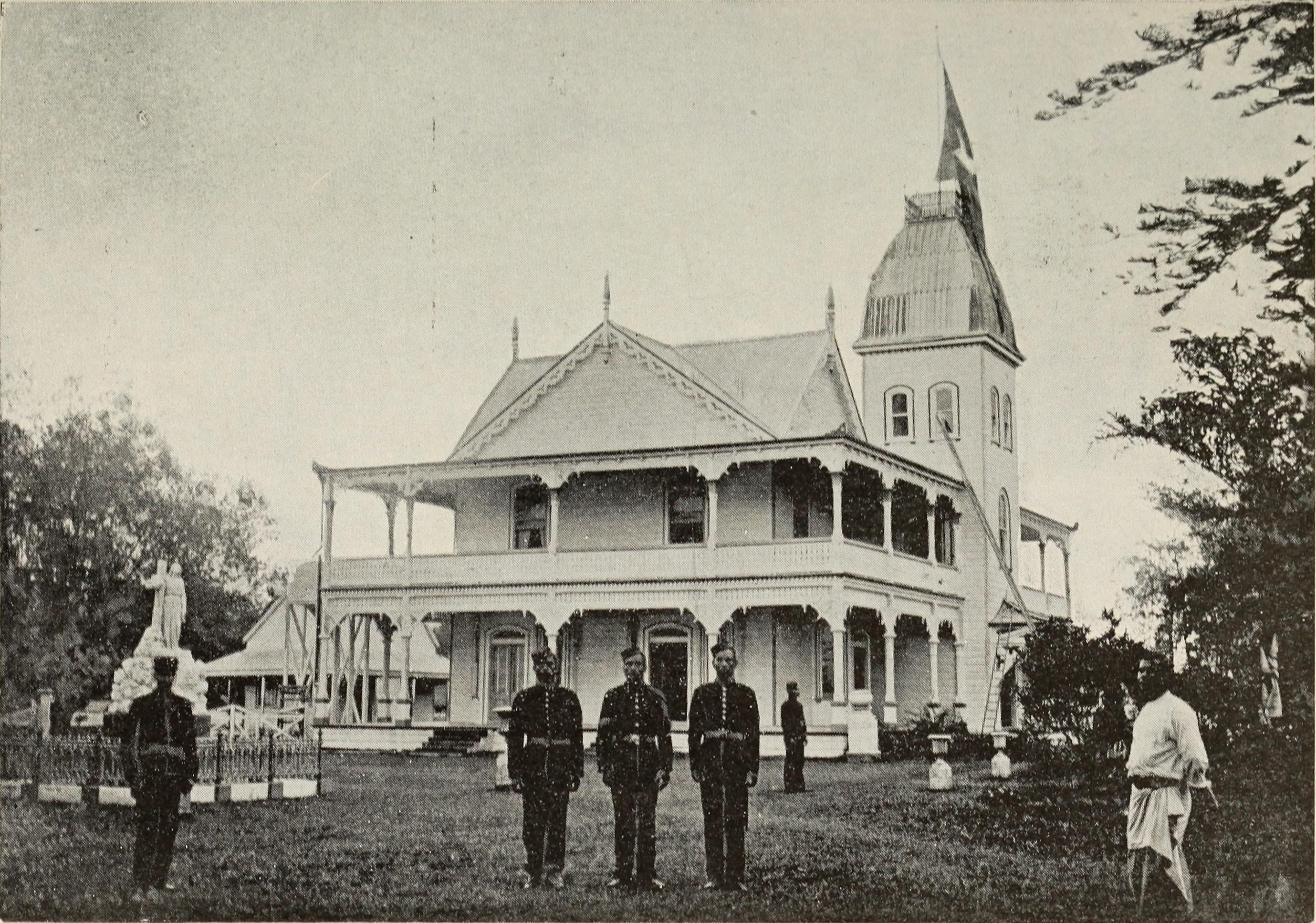
Tonga’s Royal Palace in 1990. Public domain, via Wikimedia Commons.
###
ED. NOTE FROM 2026: Between 1974 and 1976, Wallace E. Martin — a former sailor, Humboldt County treasurer-tax collector and president of the Humboldt County Historical Society — wrote a regular column called “Waterfront Yarns” in the Humboldt Historian. He eventually collected these stories and a few others in a book: Waterfront Yarns of Humboldt Bay: From the Era of Wooden Ships and Iron Men.
When Martin passed away in 1994, a couple of his colleagues in the Historical Society penned loving tributes to him, which you can find in PDF form at this link.
Here are four installments of “Waterfront Yarns,” all published in 1975.
###
The Parrot Massacre at Fields Landing
Usually, nothing short of a strike or a complete breakdown of loading facilities delays the loading of a 10,000-ton freighter.
But in January, 1953, a parrot, or in fact 13 parrots, brought about a halt to loading operations on the British freighter Tacoma Star at The Pacific Lumber Company’s wharf at Fields Landing.
The story started a month before when the vessel berthed at Cartagena, Columbia. While ashore, members of the crew purchased 14 parrots at $15 each, intending to give them to friends when the ship returned to her home port, London.
The day before the Tacoma Star arrived at Humboldt Bay and docked at Fields Landing, one of the parrots died. Coming from a foreign port, the vessel had to be inspected by local officials of the Public Health Service. When they learned of the bird’s demise, the remains were shipped to San Francisco for an autopsy.
Word came back that Polly had died of psittacosis (parrot fever). Since this is communicable to human beings, causing nausea and fever and sometimes bronchial pneumonia, the vessel was quarantined.
Death was decreed for the remaining parrots and fumigation for the ship. Dr. Myron Husband and an assistant from the Humboldt County Health Department boarded the vessel to conduct the last rites.
Buckets of water were secured and the unfortunate parrots, one by one, were drowned. And just to make sure, the dead birds were cremated in the ship’s boilers before the quarantine flag was lowered and the longshoremen allowed aboard to stow cargo.
Malcolm Martyn, a seaman aboard the Tacoma Star and the owner of one of the parrots, told me that in the month the crew had the birds they were taught to talk quite well.
“So well, in fact that the last bird to be drowned managed to blurt out a parting statement,” Martyn reflected.
“The bird chirped ‘Adois,’ a fond and appropriate farewell,” he said.
Head for the Timber
The men who manned the paddle-wheel ferryboats on Humboldt Bay were of a class which has nearly vanished. Their achievements and their records are legends of a distant past.
Captain H. H. Cousins, Master of the Arcata & Mad River Railroad Company’s bay ferry Alta was perhaps the best known of the bay navigators.
A good friend of my father, in the days when the Captain was Superintendent of the old Humboldt Stevedore Company, he often took the occasion to reminisce on the days when he piloted the Alta.
The Alta made two round-trips daily from the foot of G Street in Eureka to Arcata Wharf, carrying freight and passengers. Captain Cousins was often called upon to transport Arcata prisoners destined to the County Jail in Eureka. He had been deputized for this work by the late Sheriff “Mac” Brown.
One day a young boy was put in Captain Cousins’ custody at Arcata Wharf for delivery to the Sheriff at Eureka. Cousins was impressed with the neat appearance and good manners of the youth and questioned him for a few minutes before locking him in a stateroom.
He learned that the offense really wasn’t serious. It was the first time the prisoner had fallen into the “clutches of the law,” Cousins noted.
Forty-five minutes later the Alta docked at her wharf and when the vessel was secured, Captain Cousins went back to the stateroom where the prisoner was kept.
Opening the cabin door, he beckoned the youth to come out. As the culprit came outside the door, Cousins turned and gave him a swift kick in the seat of his pants and shouted: “Head for the timber and stay out of trouble, you son of a gun!”
No further conversation was necessary. The youth ran down the gangplank and disappeared into the lumber yard of the nearby Vance mill.
Captain Cousins seemed satisfied with this turn of events, and lighting his ever-present meerschaum pipe, he said that he slammed the cabin door shut and went ashore.
As far as he was concerned, justice had prevailed. And it hadn’t cost the Humboldt County taxpayers a cent!
Sea Trip Brings Neighborhood Excitement
Eureka’s waterfront of the 1920s held a fascination for many of the youth of the city. Most any day you could find the bay from the foot of Commercial Street on out to Carson’s Mill dock lined with steam schooners and a sprinkling of sailing vessels.
Down at the foot of Whipple Street, near the present site of the Union Oil Company’s pier, the Humboldt Stevedore Company’s bar tug Ranger was berthed.
During school vacation I often rode my bike out to “towboat wharf” just to see what was going on and, on occasion, arrived just as the Ranger was preparing to take a tramp steamer out to sea.
“Mind if I go with you, Cap?” was all that it was necessary to say to genial Capt. Gus Pettersen, and if he gave you the nod, it was usually with the warning: “Stay out of the way, kid!”
A friend of mine, James Simpson, and I climbed aboard the Ranger one Saturday morning in an unexpected opportunity to go to sea. We didn’t have time to phone our parents to inform them of our plans — in fact the anticipation of the voyage was such that we forgot all about it.
After leaving the dock we learned that the tug had orders to pick up the barge Griffson off Cape Mendocino and bring her into the bay. She was being towed up the coast by the steamer S. A. Perkins en route to Seattle.
Arriving at our station off the Cape, we could see that neither the Griffson nor the towing steamer was in sight. To while away the time, the crew got out some salmon gear and we proceeded to do some fishing.
About two hours later our tow showed up and after the transfer of lines was made the Ranger headed towards Humboldt Bar. Off Fairhaven a Cousins launch met us and advised Capt. Pettersen that orders had been received to take the vessel to Arcata Wharf.
By the time the Griffson was tied up it was late in the afternoon. My parents were searching the neighborhood for me. The same thing was going on at the Simpson home out on Third Street.
Finally, a neighbor of the Simpsons, Vince Rutledge, heard about it and decided that we might possibly have “gone out on the tug.” A quick trip to the wharf, noting our bikes parked there and the tug gone, confirmed his suspicions.
As darkness approached, the Ranger tied up at her dock. When Vince told us we were “on the missing person’s list,” our bikes were hastily placed in the trunk of his car and we sped for home.
My family met me with mixed emotions. I well remember that my Dad was quite angry but my mother was so happy to see her “sea-going” son that all was forgiven.
Yes, the waterfront had a powerful impact upon youth’s imagination. It was a magnet, a goal, a jumping-off place into new adventure. That’s why fellows of our generation, who could not resist those attractions fifty years ago, enjoy recalling them.
Potentate of Tonga Preferred Redwood
We have always had in mind that if we were ever to visit Nukualofa in the Tonga Islands, one of the first things we might do would be to search for the Royal Palace. This is our reason:
“Charter a schooner and send me a full cargo of clear redwood lumber as per specifications enclosed.”
That was the essence of a letter received just after the turn of the century by Williams, Dimond & Company, San Francisco Commission Merchants. It was signed “King of Tonga.”
Discreet inquiries through commercial circles revealed that the King had recently taken unto himself a bride and that the new Queen had prevailed upon him to refurbish the Palace and add a wing to it.
Although ruled by a native, Tonga was under British protectorate. Previously, all materials required there had been shipped from New Zealand or Australia. To order lumber from an American firm wasn’t accepted too well by the British, but the King had become disenchanted with the Kauri wood that had been shipped to the islands from New Zealand. He found that it did not stand the climate and since he had heard sung the praises of California Redwood many times, he decided that the addition to the Palace must be constructed of the best available lumber.
Williams, Dimond & Company placed the lumber order with the Dolbeer & Carson lumber mill at Eureka and, in looking around for a schooner, found that the Lillebonne, a Cousins-built vessel, was available for charter. She was sent to Humboldt Bay to load the 300,000 board feet of cargo.
John Andersen, an old-time friend of our family, and one of the finest deep-water sailors I ever knew, was Mate of the Lillebonne.
He recalled that when the vessel sailed into Nukualofa harbor several months later, the Captain and crew found that they were destined to have a longer stay there than anticipated. It seemed that the natives had a short work-week.
The early-day missionaries had taught the natives that Saturday was to be “the day of rest.” Afterward, the Government, backed by the British resident agent, changed their Sunday to the first day of the week against the wishes of the natives. In consequence, the natives went to church on Saturday and worked on Sunday, while the Government offices, including the Customs House which checked the Lillebonne’s cargo, were open on Saturday and closed on Sunday!
When the vessel was finally unloaded, the King showed his gratitude for receiving the cargo in good order by giving the ship a return cargo of copra and pearl shell, consigned to San Francisco.
Good weather prevailed on the voyage back to the California coast and thus ended the saga of the first introduction of redwood lumber to the Tonga Islands.
Could it be that after 75 years the Palace addition, made of Humboldt Redwood, would be there still?
We believe so.
###
The story above was printed in four 1975 issues of the Humboldt Historian, a journal of the Humboldt County Historical Society. It is reprinted here with permission. The Humboldt County Historical Society is a nonprofit organization devoted to archiving, preserving and sharing Humboldt County’s rich history. You can become a member and receive a year’s worth of new issues of The Humboldt Historian at this link.