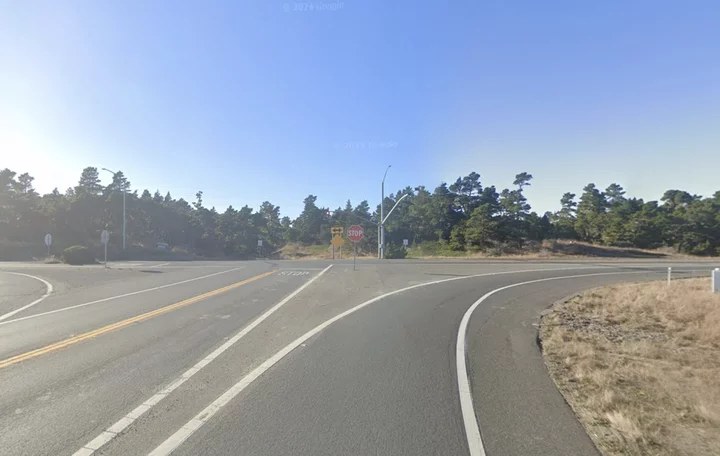
The intersection and future site of a roundabout. Image from Google Street View.
Roundabout.
Yesterday, the California Coastal Commission approved a Caltrans application to build one of them on Highway 255, where it intersects with New Navy Base Road near the Samoa Bridge.
It’s a strange intersection; the rules are different for everyone. Currently, drivers coming from Eureka don’t have to stop if they’re turning right, but do if they’re heading towards Samoa. Drivers going southbound don’t have to stop at all, but it’s a tight left towards Eureka to take at highway speeds. People heading up from Samoa only have to stop if they’re going straight. A roundabout will regulate all three directions.
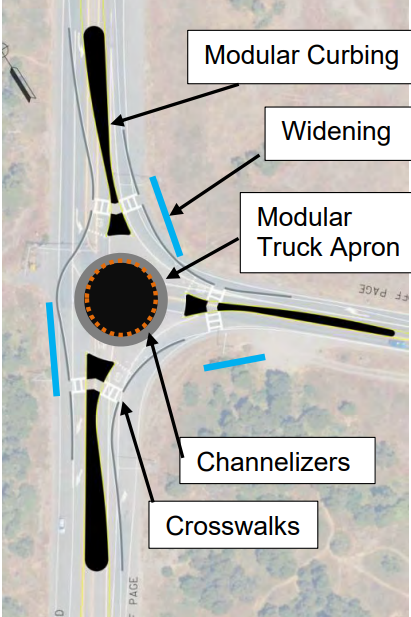
A schematic of the proposal. Screenshot from application.
It’ll be a fairly low-profile installation. Caltrans calls it a “modular” roundabout in its application, because instead of building a big concrete ring a couple feet high, they’ll simply grind down the asphalt in the middle of the intersection, pour some new pavement over it, add high-viz posts to make it stand out, and then bolt down plastic “components” around the edges. (The coastal commission asked that the roundabout fit in with the adjacent dune environs, so they’ll be sand-colored rather than black.)
Caltrans is calling the project a “quick-build” “pilot.” It’s a new type of roundabout for the agency — constructed cheaper and faster than a traditional roundabout, but, it hopes, just as safe. “If successful, it could serve as a design example for future locations to streamline installation of roundabouts on compressed timelines and budgets,” reads the staff report.
The agency is also going to add more signage, reduce the speed limit near the roundabout, and widen the highway shoulder and add some crosswalks for pedestrian and cycling use. It’ll also have to adhere to the commission’s stringent rules regulating environmental health and aesthetics for projects built near the coast.
They’ll begin construction next summer. It should be done in about 40 days.
The commission approved the application without discussion. There was no public comment on the subject.
“We appreciate the California Coastal Commission’s approval and collaboration on this project,” a Caltrans spokesman wrote in a statement sent to the Outpost. “This innovative, modular roundabout will use the existing roadway, with minor widening to better accommodate pedestrians and cyclists. It offers an opportunity to improve safety and reduce the risk of severe collisions at a fraction of the cost of a traditional roundabout. We’re excited to move this cost-effective improvement forward.”