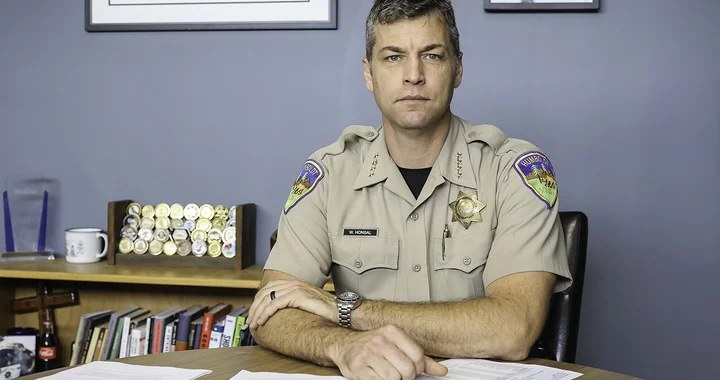
Honsal. File photo.
###
PREVIOUSLY:
###
From the Sheriff’s Office’s Facebook page:
I am disgusted with Governor Gavin Newsom’s decision to commute the death sentences of California’s condemned murderers to life without the possibility of parole.
As Sheriff, I have spent my career investigating violent crimes, working with victims and their families, and seeing firsthand the devastating consequences of murder. We are talking about 548 individuals on death row. I seriously question whether the Governor took the time to personally review each case, contact the victims’ families, and fully understand the devastating impact a decision of this magnitude would have on those who have already suffered unimaginable loss.
Behind every death sentence is a victim whose life was violently taken, a grieving family, an extensive criminal investigation, and a judicial process that included the presentation of evidence, jury deliberations, sentencing, and appellate review. These sentences were not handed down arbitrarily. They were imposed through a legal process designed to ensure that the most serious punishment was reserved for the most serious crimes.
One case that particularly stands out to me is Wayne Adam Ford, the serial killer with direct ties to Humboldt County who murdered four women. Another that personally impacted me is that of killer Richard Allen Davis, who kidnapped and murdered 12-year-old Polly Klaas. These are examples of horrific crimes that devastated families and entire communities. Their death sentences were imposed following extensive criminal proceedings in which juries heard the evidence and determined that the death penalty was warranted.
For those who may not understand the seriousness of these convictions, first-degree murder is the most serious classification of homicide under California law. It generally involves the intentional, deliberate, and premeditated killing of another human being. Premeditation means the killer made a conscious decision to take another person’s life rather than acting solely on impulse. In death penalty cases, the prosecution must also prove specific special circumstances beyond a reasonable doubt, and the jury must determine the appropriate punishment through a separate sentencing process. These are among the most serious crimes imaginable, and the sentences imposed reflect the gravity of the crimes and the evidence presented in court.
I recognize that Governor Newsom has the constitutional authority to grant clemency. However, having that authority does not mean every exercise of it is justified. Rather than approaching these cases individually and carefully considering the circumstances of each crime, he has chosen to make a sweeping decision affecting hundreds of convicted murderers. His decision replaces the individualized judgments of juries and courts with his personal opposition to the death penalty.
I am particularly concerned about the impact this decision has on victims’ families. They have endured unimaginable loss, participated in lengthy court proceedings, and waited decades for the justice system to carry out the sentences imposed. These families deserve to have their voices heard, their suffering acknowledged, and the decisions reached through our judicial system respected.
The timing of this announcement also raises serious questions about transparency and accountability. The Governor announced this sweeping decision just two days after a statewide election. A decision of this magnitude deserves full public scrutiny and an honest discussion about its consequences, not an announcement immediately following an election. I personally will not forget this decision, and I hope the citizens of California do not forget it either. Elections matter, and so does accountability.
Californians have repeatedly voted to preserve the death penalty. The Governor has made it clear that he fundamentally disagrees with capital punishment, but there is a significant difference between advocating to change the law and using executive clemency to replace hundreds of individual death sentences with a different punishment. The people of California have spoken on this issue, and their decisions deserve respect.
I recognize that life without the possibility of parole remains a serious sentence and that, at this time, these offenders are not being released into our communities. However, that does not diminish the significance of changing a punishment lawfully imposed by a jury. Our justice system must remain accountable to victims, their families, and the public. When hundreds of death sentences are changed through a broad executive decision rather than an individualized assessment of the evidence and circumstances, it undermines confidence in our judicial process.
I am disgusted by this decision. I believe the Governor has placed his personal opposition to the death penalty above the judgments of juries, the decisions of our courts, and the voices of victims’ families. I hope the people of California remember this decision and the impact it has on those who have already suffered so much.