
A visual simulation of what the project would look like, estimated to stop waves from hitting the roadway until 2050. A small parking lot, and access ramp for beach wheelchairs and emergency access, is also planned. | Rendering courtesy of Humboldt County
PREVIOUSLY
###
The road out to Centerville Beach will be fixed up, but its days of completely free-wheeling off-road vehicle access may be behind it.
The California Coastal Commission, the state regulatory agency for projects and laws that affect the shoreline of the Pacific shoreline, decided yesterday during a meeting in Eureka that they’d approve an application submitted by Humboldt County to repair and shore up the road. It’s in poor shape; fierce coastal winds choke it with sand every winter, and the ocean destroyed the parking lot at the end of it at Centerville Beach County Park. There’s also a high chance that rising sea levels and storm-powered erosion will totally overwhelm it within the next five years.
To delay that, the county’s Public Works department requested that the commission allow them to armor 880 feet of the road with rocks, and raise it (up to 10 feet in one section.) They’d also add a 12-space parking lot. These measures would be a Band-Aid and would only prevent the road from becoming completely inaccessible year-round until 2050. Moving the road further inland would be a more permanent solution, but Hank Seemann, the county’s deputy director of Humboldt County’s Public Works department, estimated that planning, obtaining permission from the various landowners, and securing funding could take at least 20 years to pull off.
The commission wasn’t thrilled about the armoring, noting that the idea was “inconsistent” with Coastal Act section 30235. (The ocean advocacy organization Surfrider also wrote in to proclaim their displeasure with the amoring because it can increase the rate of erosion.) It is, however, the only feasible method to keep the road usable and the beach accessible, it wrote, and denying the proposal also runs contrary to the Coastal Act. So the county can have its road, the commission agreed, but only if it exists for 20 years. By then, the commission said, it should hopefully have built a more eco-friendly alternative.
There are a few other terms of agreement the commission asked of the county, in return for its blessing: make the beach accessible to pedestrians and wheelchair users; add amenities, like picnic tables, overlook areas, bicycle racks, and trash cans; conduct a study on how to keep Centerville Beach accessible for the long-term.
But one other condition riled up far more controversy than the others: the county had to stop people from riding motor vehicles on the beach, to protect wetlands and wildlife habitat, by adding some gates and barriers. One Ferndale resident the Outpost interviewed last week told us she thought the provision was tantamount to extortion, and claimed it would damage Ferndale’s economy. Rex Bohn, the county’s First District Supervisor, agreed.
“They always want to get their pound of flesh,” he told us recently. “Or their pound of sand, in this case. They want a pound of sand, and I want them to pound sand.”
He also claimed at the meeting that motorized vehicles caused few problems on the beach.
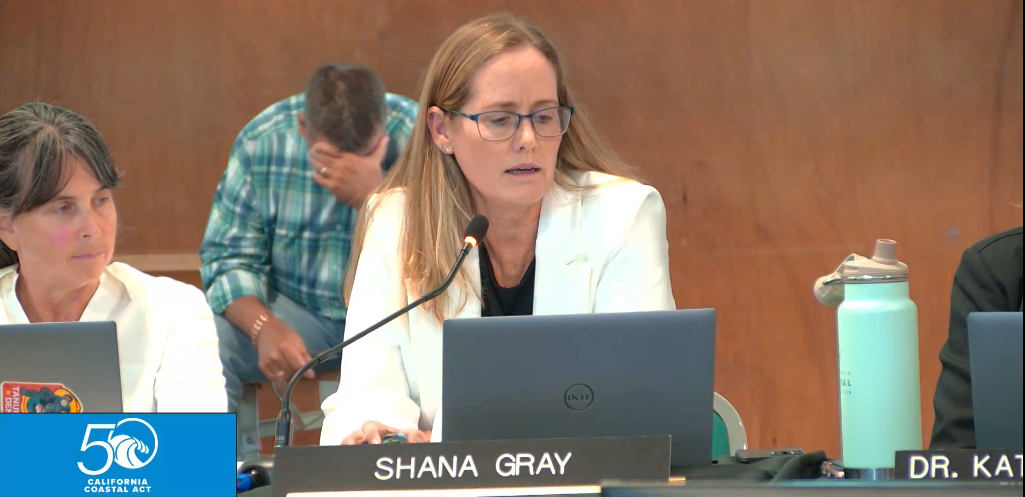
Supervisor Rex Bohn holds his head in his hands behind Commissioner Commission staffer Shana Gray.
Second District Supervisor Michelle Bushnell was also opposed to the plan, she said, and she enjoys heading down the beach with her family and all of their items.
Seemann said during the meeting that restricting vehicle access would be a significant policy shift, and that the county’s Board of Supervisors would have to debate the change sometime in October.
Every public commenter at the meeting — over a dozen — made their opposition clear, pointing out that it makes it easy for older people to enjoy the beach, allows fishermen to get up and down the beach easily, and lets them get far away from the other beachgoers. Only one person, who wrote a letter to the commission, was in favor of the idea. (Surfrider representatives didn’t mention the condition in a presentation or in their letter.)
“We are Ferndale residents and are terrorized [by] reckless drivers and four wheels drivers at this beach every time we visit,” the commenter wrote. “They think they are lawless. It will be better for the beach, wildlife, and plant life to stop vehicle access.”
Several people said denying them permission to drive on the beach would restrict their ability to access it. One man drew a comparison between off-road vehicles and beach wheelchairs, claiming that the wheelchair was plenty heavy enough to crush a snowy plover, a threatened species of shore bird native to the area.
“This overregulation is not necessary,” another said. He claimed he’d been waiting at the meeting for seven hours to share his opinion on the subject. “Please don’t do this to us…We don’t need to take this away.”
The coastal commissioners pointed out that the county park is only two acres, a drop in the bucket along a miles-long beach made up entirely of private property. Although it’s legal for people to travel up and down the “wave slope,” the area covered by the mean high tide, visitors aren’t supposed to be allowed to go beyond that, though many do.
Noting the commenters’ dedication, the commission eventually decided that it would ban motor vehicle access to the majority of the beach, though — at Commissioner Mike Wilson’s request — it let the county have an out, amending the provision to say that “managed” motor vehicle access could be allowed if the county developed a management plan that confines vehicles to the wave slope and wouldn’t harm wildlife habitat or the ocean. The county would have to determine how that’d be possible and how to enforce it, and it would have to apply to the commission at a later date to receive an OK.
The vote was unanimous, but the compromise wasn’t universally loved. Commissioner Meagan Harmon said she found it “impossible” to square allowing vehicle access with their Coastal Act mandate to “to protect, conserve, restore, and enhance the environment of the California coastline.”
Commissioner Ray Jackson spoke in favor of the compromise.
“It’s hard — really hard — putting the toothpaste back in the tube,” he said. “It’s hard to say, ‘For years’ — whether we think it’s right or wrong — ‘For years, an activity that has been done in this area, like that, it’s no longer permitted. That’s a hard pill to swallow.”
CLICK TO MANAGE