
Shannon Miranda, 55, stands in front of the barns behind his house on property that has been part of Miranda’s Rescue. | Photos by Ryan Burns except where noted.
###
Earlier this week, Shannon Miranda invited the Outpost to tour the Fortuna property where he lives and runs Miranda’s Rescue, the nonprofit animal sanctuary and adoption facility that he continues to describe as a “no-kill” operation.
As he led us around the grounds — past dog kennels and livestock enclosures and through the two large barns onsite — he said he hasn’t moved or altered anything since local, state and federal investigators conducted an extensive three-day search and excavation in June.
“You can tell I haven’t been in here,” he said as he led us into his “stall barn,” which includes 11 horse stalls and connects to a side building where his work office is located. “See all the cobwebs? I’ve done nothing since they did the raid in here,” he said. “I’ve been so depressed. I haven’t done anything.”
Throughout the tour and a subsequent interview in his garage, Miranda was keyed up, his voice pitched high as he refuted allegations that have been posted about him online, reported by law enforcement and published in news stories. As he walked across the property, he alternated between describing the facilities and listing grievances: He’s “super pissed” at a sheriff’s deputy and lieutenant involved in the investigation. He’s angry at the two women whose vigilante actions kickstarted this investigation. (His lawyer, Allison Jackson, is preparing to file trespassing and theft charges against them, he said.) He’s upset about receiving death threats and being “barbecued in the court of public opinion.”
Miranda said he has been unfairly vilified and misjudged. In our interview, he defended euthanizing dogs he deemed too dangerous to adopt out, as well as dogs that were adopted out only to be returned following violent incidents. He said that when investigators exhumed the remains of more than 100 dogs from his property in June, it wasn’t evidence of animal cruelty; rather, “They dug up my cemetery of pets,” desecrating the final resting place of animals he’d tried his best to help along with pets that belonged to local community members who had no place of their own to put the remains.
Miranda argued that the number of dogs exhumed in June — 123 dogs were, according to a revised count from the Humboldt County Sheriff’s Office — is not excessive when you consider how many dogs he managed to adopt out.
“Nobody’s focusing on the thousand-plus dogs that we have adopted, which is 90%,” he said.
The one mistake he’ll acknowledge is being a bad record-keeper. Records from public shelters reveal that approximately 1,030 dogs were surrendered to Miranda’s Rescue from the beginning of 2025 through the end of this past April, the Sheriff’s Office told the Outpost via email on Thursday. More than 750 of those dogs remain unaccounted for. Meanwhile, sheriff’s investigators have found adoption records for only about 150 dogs going back to 2023.
In this story we take a closer look at the statements Miranda provided on Monday and hear from some of the other people and organizations involved.

Aerial view of Miranda’s Rescue. | Google Earth.
More than four months have passed since the Humboldt County Sheriff’s Office executed the first search warrant at Miranda’s Rescue, launching what would become one of the largest criminal investigations in Humboldt County history. Law enforcement agencies including the FBI, the U.S. Department of Agriculture, the U.S. Attorney’s Office and the California Department of Justice continue to investigate Miranda over allegations of animal abuse, theft and fraud. He has yet to be arrested or charged with any crimes.
The investigation began in late April after two Fortuna animal rights activists, Jennifer Raymond and Jenna Moore, snuck onto a field at Miranda’s Rescue from Raymond’s neighboring property and, in the dead of night, dug up the freshly buried carcasses of eight dogs. In late June, teams of investigators, forensic scientists and veterinarians descended on the property, using ground-penetrating radar to locate buried animal remains and then exhuming the bones and carcasses as evidence.
The case has garnered nationwide and even international news coverage (Miranda, Raymond and Moore were interviewed by a crew from the tabloid TV news program Inside Edition last Friday) and the dog killings have earned condemnation from elected officials, animal rights organizations and public shelters that sent hundreds of dogs to Miranda’s Rescue via nonprofit partner organizations. One of those shelters, Oakland-based Rocket Dog, is suing Miranda for animal cruelty and fraud.
The Sheriff’s Office’s revised tally of 123 plus the eight recovered by Raymond and Moore comes to 131 dead dogs found buried in one field at Miranda’s Rescue. An anthropology team estimated the postmortem interval for a majority of those dogs at “a few weeks to a few months,” according to the Sheriff’s Office. By comparing information from recovered microchips to public shelter records, the Sheriff’s Office identified 57 matches for dogs that had been transferred to Miranda’s Rescue between Jan. 1 and April 19 of this year.

Forensic veterinarians perform inspections of exhumed dog carcasses during a multi-agency excavation and search of Miranda’s Rescue in June. | Photo via HCSO.
Miranda said the tally of unearthed dogs provided to him and his attorney by the Sheriff’s Office was 112.
“That’s not that many!” he insisted. “I mean, it’s a lot, but it’s not that many if you’re, when you’re taking in dogs and some are going back that are aggressive, and some can’t go back [to the shelters that sent them]. I mean, that’s not that many.”
In a statement released to several media outlets on July 31, Miranda said he notified the Sheriff’s Office every time he had to euthanize an animal. He reiterated that claim during our interview. “They knew dogs were put down because Humboldt Animal Control knew,” Miranda said, explaining that he always spoke with former Animal Control Manager Rob Patton, who retired last month.
Patton couldn’t be reached for this story, but Sheriff William Honsal disputed Miranda’s claims.
“There was only ONE occasion when Shannon called the shelter and spoke with one of my employees and said he had to put a dog down, and that was on May 1st, this year,” Honsal said in an emailed statement. “He has not called the shelter or advised us in any way when he planned on shooting and killing an animal on his property. We estimate the intact dogs we found during excavation were buried sometime between January and April of this year. He would have to have called us every week from January to April telling us he was killing more dogs.”

Two drawers and a basket with dog collars inside Miranda’s food shed.
The guided tour of Miranda’s Rescue began with the food shed, inside of which was pet food, medical supplies, blankets, muzzles, leashes and, atop a shelf, three containers of new and used dog collars.
One of the most incendiary bits of information released by law enforcement thus far is that investigators found more than 600 dog collars inside a barn where they believe dogs had been killed. Evidence inside the barn included a firearm, spent ammunition and apparent blood spatter. (Forensic testing has since confirmed the samples to be “blood of non-human origin,” Humboldt County Public Information Officer Erin Inskip told the Outpost this morning.)
Many in the public assumed that the empty collars had been removed from dogs just before or after they were shot dead. Miranda insisted that’s not the case, and he suggested that the Sheriff’s Office released that information in a deliberate attempt to mislead people.
He said hundreds of collars get donated via his organization’s four thrift store locations (two of which were recently closed). He stores most of the collars in his barn as backstock for the ones he keeps in the food shed for adoptees.
Here he is offering an explanation:
In the sworn affidavit that led to the second search warrant for Miranda’s Rescue, Humboldt County Sheriff’s Sergeant Shane Steele wrote that when investigators asked Miranda about walking dogs to “the ranch” side of his property where his barns are located, “[H]e admitted this is how he would operate when he had to shoot a dog.” Steele also testified that Miranda changed his story “numerous times” before eventually admitting to sending “fake adoption” texts — that is, informing shelter staff he’d found homes for dogs that, in reality, had already been shot dead.
Miranda told the Outpost he admitted no such thing.
“I never, absolutely 100% did not tell him that I walk dogs over here and send [texts] to adopters and shoot them in the head,” he said. “That never came out of my mouth.”
Those statements were made by a sheriff’s sergeant under oath, but Miranda protested, “I didn’t sign the affidavit. They wrote everything up. They gave me nothing when they left here.” (Court affidavits don’t require review or approval from suspects.)
As the tour continued, Miranda railed against Raymond and Moore. “Why’d she buy this property?” he said, gesturing at the parcel next to his, which Raymond bought last year. “A $400,000 piece of property to spy on somebody. How mental is that?”
Miranda alleged that Raymond is no longer allowed at the Humboldt Spay/Neuter Clinic she founded. “She’s just the money,” he said. “They kicked her out of there. She’s not allowed to have anything to even say with the clinic — because she’s impossible. She gets along with nobody.”
Reached by the Outpost, an employee at the Humboldt Spay/Neuter said Raymond is “more than welcome to come into the clinic” and remains on good terms with staff.
Later, Miranda gestured toward a patch of ground and said, “My camel’s over there.” The camel, named Tonka, once belonged to Moore, who told the North Coast Journal that she sold it to Miranda despite suspecting him of killing dogs because she knew Tonka would have more room on his property. But Miranda said this shows that Moore is either a hypocrite or a liar.
“If I’m an animal-abusing, dog-killing piece of shit, why would you send your camel here?” he asked.
The justifications
Regarding the dogs whose remains were unearthed by Raymond and Moore, Miranda said all eight had to be put down due to violent behavior. That included Zora, a black-and-brindle mastiff mix that had been transferred from Oakland Animal Services (OAS) less than a month earlier. According to Steele’s affidavit, Miranda lied to the OAS manager, telling her in a text that Zora had been adopted.
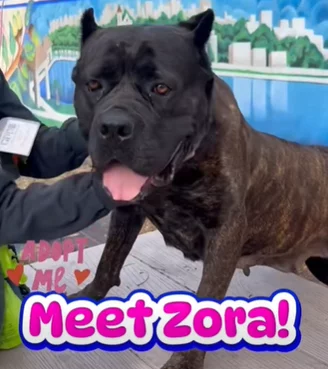
A social media image showing Zora before she was sent to Miranda’s Rescue.
In our interview, Miranda said he did manage to find adopters for Zora. He said he texted OAS with the good news while the new adopters were taking Zora for a walk by the levee near his property, but before even leaving the premises Zora went crazy.
“She killed a cat; she went after a dog. I got her. She pulled me down,” he said. Miranda described Zora as “very aggressive,” with “a high, high prey drive.” This conflicts with the description from Oakland staff members, who told Humboldt County sheriff’s investigators that she was “timid and non-aggressive.”
Miranda said the people who adopted Zora do not want to be identified due to fear of public blowback.
Also among the dogs exhumed by Raymond and Moore were two puppies, roughly six or seven months old. Miranda said the puppies had killed their own sister. “Ripped her to pieces,” he said. “And then we couldn’t get them off of her.”
Another recently transferred dog “became fixated on a stroller with a baby, lunged at it, and attacked it before staff intervened,” Miranda explained in a statement published to his website on June 18.
He didn’t explain the specific justifications for euthanizing all eight of the dogs that Raymond and Moore saw him bury, having captured footage of him on his tractor via motion-activated trail cameras. He simply said they had to be put down because they posed public safety risks, and he was forced to do it himself, rather than calling in a vet, because he had a sick family member and was in a hurry to get out of town.
For public shelters and nonprofits across California and beyond, Miranda’s Rescue has served as a convenient means of offloading hard-to-place dogs. From afar, it appeared an ideal rescue operation, one virtually unparalleled in its ability to find homes for large, sometimes difficult dogs, many of which were down to their last chance. Rescuers remarked on the idyllic grounds in the Eel River Valley. Nonprofits that partnered with government rescues regularly paid Miranda $450 to $1,500 or more per dog surrendered, trusting that he’d do his utmost to find them homes.
Public records indicate that more than 2,700 dogs have been transferred to Miranda’s Rescue from public shelters alone since 2020. We asked Miranda if that number sounded right.
“I don’t know,” he said. “I mean … that sounds really high.”
He suggested that the official numbers might be overstated, in part because reports from OAS sometimes listed dogs on invoices that hadn’t actually been delivered.
OAS Shelter Operations Manager Melinda Tierney said that’s false. Reached by phone on Thursday she said the shelter maintains computerized records that track every animal by name, breed, age and a unique ID number. She later forwarded the annual reports for transfers to Miranda’s Rescue, which show 786 dog transfers to Miranda’s Rescue since 2020.
By and large, those dogs were simply “bad,” according to Miranda.
“Some of those dogs are impossible to keep [confined],” he said. “They [staff at OAS] don’t tell me [how difficult the dogs are] when they’re sending them here. They want to get rid of them, and that’s part of why I think Oakland has kind of hushed up a little bit, because they know they were sending me dogs that were absolutely shitty and lying to me.”
In Sgt. Steele’s affidavit, he said a volunteer from Oakland described most of the animals sent to Miranda’s Rescue as “Old crepity senior dogs that we just knew would [be] the sweetest couch potatoes ever, not a bite or reaction in their body.”
Miranda vehemently disputed those descriptions.
“Well, that’s not true because they’re trying to cover up for what they did in sending [those dogs],” he said. He estimated that at least 85% of the dogs shipped to him by Friends of Oakland Animal Services, the shelter’s nonprofit partner, were sedated with gabapentin and trazodone and would only reveal their true nature hours after being dropped off.
One time, he said, he took a shipment of eight dogs from OAS and put them into four enclosures, two dogs in each space. “I got up the next morning, I had four dogs, total,” he said. “Each one of them had killed the dog they were with.”
We asked Miranda whether he considers it his own responsibility to ensure the safety of animals at his rescue operation.
“When they’re pulling through chain link fences and pulling into other [kennels], what are you gonna do?” he demanded. “I’ve got my dogs double kenneled. Some of those dogs I have with hog fencing; I’ve got kennels with hog fencing. Some of those dogs are impossible to keep in.”
If the dogs were that difficult, why did he continue to accept them?
“I shouldn’t have,” Miranda replied.
He also continued to charge money for those dogs.
“But I wasn’t paying them $500,” he said, referring to his standard rate. “I charged them $450 because I liked Martha,” he added, referring to Martha Cline, the former executive director of Friends of Oakland Animal Services, who was his regular contact person for transfers from OAS. “So it wasn’t like there [was no] communication that we had. … I’m not this big monster.”
Robin Wiedner, executive director of Friends of Oakland Animal Services, refuted Miranda’s characterization of the dogs they delivered. “They were lovely, lovely dogs that our volunteers loved, and we are all heartbroken,” she said.
Wiedner acknowledged that the dogs were often sedated for the drive north but said they were mostly not aggressive and had been sent to Miranda’s Rescue only because they needed space in Oakland. She recalled a “calm, lovely” dog named Weffy that she once took hiking. They saw cats on the hike and Weffy “couldn’t care less.” Weffy’s remains were among those recovered from Miranda’s Rescue in June. The OAS website lists 15 dogs that were exhumed from Miranda’s Rescue and later tracked back to OAS via microchip data. Miranda’s Rescue had informed the shelter that eight of those 15 had been adopted, according to the website.
“He lied to us repeatedly and told us the dogs were adopted,” Wiedner said. Some of the dogs they sent did have behavior issues, “but not so bad you have to shoot them in the head,” she said. A moment later she added, “He’s just a monster and a liar.”
Tierney, the shelter operations manager at OAS, said Miranda would charge extra to accept dogs with a documented bite history. Regarding the story about four newly arrived dogs that allegedly killed their kennel-mates overnight, Tierney said she heard about such an incident but thought only one dog had been killed. (She noted that she doesn’t handle transfers personally and was not a manager for much of the time in question.)
Asked about the adoption texts sent to OAS, Miranda again insisted that those dogs did get adopted but were later returned after violent incidents. He said they were then euthanized because OAS refused to take them back.
“Why would I call Oakland and say, ‘Hey, so and so was brought back’ when they weren’t going to take him back anyway?” Miranda said. “Why call and upset everybody? … I figured, why ruin someone’s week?”

Miranda in his office.
According to Steele’s affidavit, Miranda said he shoots dogs only on the rare occasions when a veterinarian isn’t available, but investigators found that he does not have a regular working relationship with any local vet.
Asked about this, Miranda said he used to take animals to Ferndale Veterinary, which is now part of Humboldt Veterinary Medical Group. A manager there, Grayson Hurt, told the Outpost that Miranda does not have a contract with the practice and has not given staff permission to discuss the services they’ve provided for him. Miranda told the Outpost that he’d call the office and grant that permission on Thursday but did not do so, Hurt said after checking the office’s call records.
“Unfortunately, despite hearing from other reporters that he gave us permission, we have yet to get it,” Hurt said. “I’ve texted [him], ‘Hey, can you just call me?’ That has yet to happen.”
Miranda mentioned another vet that has euthanized a couple of dogs for him. We reached her by phone on Tuesday. She asked not to be publicly identified but said that while she has known Miranda a long time, her practice closed in 2022, and she only resumed working with Miranda’s Rescue in June under the purview of the sheriff’s Animal Control. (She conducts the weekly wellness checks on the animals remaining at Miranda’s Rescue.)
Regardless, Miranda said that whenever he was unable to get a vet out, the dogs were “still humanely euthanized.”
We asked whether he generally killed the dogs himself. “No,” he replied.
Then who did? Miranda hesitated. “It was someone that helped me, that … ‘cause I.” He paused again. His voice was trembling. “Absolutely … it was awful. But I was so afraid if they got out and killed something or, I mean, they would go after livestock. They’d chase stuff through the fence. So yeah.”
But if he believes that all the euthanasia was legal and justified, why not tell us who did it?
“Because I’m not going to bring somebody else into it,” he said.
Was this person euthanizing dogs at his direction?
“Sometimes,” he replied. “It’s somebody from out of the area that, when they came to visit, if there was anything that had to be done, he stayed in my house. And if dogs came back … ” — that is, if they were returned by adoptees — “… that’s why some of the dogs that were out there [buried in the field], I didn’t know were out there, because they must have come back. And the rule is fighting, biting, killing, they’re put down.”
Does that mean dogs at Miranda’s Rescue were sometimes euthanized without Miranda’s knowledge?
Miranda didn’t answer that question directly, but he again referred to the unidentified person who sometimes put dogs down onsite. “He would tell me, ‘Hey, somebody brought back a dog that did this, or it killed goats, or someone’s here with the dog.”
He then changed the topic.

Filled three-ring binders on the bar in Miranda’s garage.
For most of our interview, Miranda stood behind the Western-style redwood bar in his garage, which is inlaid with horseshoes and metal tools sealed in resin. On top of it sat an office printer and two large three-ring binders. They were labeled “Social Media Posts” volumes one and two.
“This is just one month of all their lies,” he said in reference to the thick stacks of office paper inside the binders.
He has been collecting allegations levied against him online as well as death threats received in the mail. He read one of them aloud: “Your grandson should be turned into ground beef [and] served to you and his mother.” Then he picked up a zip-lock sandwich bag filled with a dark brown substance. “Did you know that you can mail dog shit to people?” Miranda said. “It’s fake dog shit,” he added. “There’s a website.”

Miranda holds open an envelope with an unidentified substance inside. He said it was part of the hate mail he has received.
Miranda still has friends and associates who will vouch for him.
Alice Millington, a local woman who operated a feral cat rescue for years and collaborated with Miranda frequently, said she has “nothing but positive” things to say about him. “And I’ve known him since he lived in the trailer park when I took my first puppy to him,” she said.
His nephew, who asked not to be identified by name, also vouched for him and called bullshit on a story recently reported by the San Francisco Chronicle about him and other kids dumping dog bodies into the Eel River at Miranda’s behest more than 20 years ago.
“There’s absolutely no truth to that,” the nephew said.
Humboldt County’s Planning and Building Department recently suspended Miranda’s Rescue’s conditional use permit due to several alleged violations. While the suspension remains in place, Miranda is not allowed to take in or adopt out any animals.
Twenty-one dogs remained onsite as of Thursday, according to the Sheriff’s Office, and Miranda said he still has “maybe 25 or 30 cats.” The rest of the animals on the property, including horses, goats, llamas, a donkey, exotic birds including a pair of emu, and “an African water buffalo that’s mean” are privately owned, mostly by Miranda himself, he said.
On Tuesday, the day after our interview, we spoke with Miranda again by phone and asked him how he can justify still referring to Miranda’s Rescue as a no-kill shelter.
“So the definition of no kill — and you can look it up — it’s [specific to] any animal that’s deemed adoptable or placeable,” he said. “So if a dog’s fighting, biting, attacking, that’s considered an animal that cannot be adopted. You put it down, you’re still a no-kill.”
There is no legal definition for no-kill sanctuaries, nor is there any governing body or organization ensuring accurate use of the term. According to the Animal Humane Society, there’s a generally agreed-upon definition of achieving at least a 90 percent adoption rate for all animals in their care and taking “proper measures to save all healthy and treatable pets from unnecessary euthanasia.”
###
PREVIOUSLY
- Search Warrant Served at Miranda’s Rescue Amid Allegations of Felony Animal Abuse, Fraud and Conspiracy
- Miranda’s Rescue Search Warrant Reveals Eight Dead Dogs Have Been Recovered; Sheriff’s Investigator Believes Miranda Killed Them for Financial Gain
- BREAKING: At Miranda’s Rescue, Multiple Agencies, Including the FBI, Execute Search Warrant Authorizing Excavation
- (VIDEO) More Than 700 Dogs From Miranda’s Rescue Remain Unaccounted For, Sheriff Honsal Says; Excavation of Grounds to Continue for Several Days
- ‘It’s Gruesome’: Investigators Dig Up More Than A Dozen Dog Carcasses at Miranda’s Rescue on Day Two of Excavations
- ‘This Investigation is Just Getting Started’: Sheriff’s Office Uncovers 117 Dog Carcasses, 21 Skulls and ‘Hundreds of Bones’ at Miranda’s Rescue
- (VIDEO) Humboldt County Sheriff Details Evidence From Barn ‘Kill Zone,’ Offers Updates on Miranda’s Rescue Criminal Investigation
- Shannon Miranda Admits Sending Fake Adoption Texts About Dogs He Shot Dead, Affidavit Says
- Oakland Nonprofit Dog Rescue Sues Shannon Miranda and ‘Co-Conspirators’ for Animal Cruelty and Fraud
- ‘I Will No Longer Stay Silent’: Shannon Miranda Issues Statement Decrying ‘Gestapo Tactics’ by Law Enforcement and ‘Lies’ From Critics
- Sheriff Honsal Responds to Shannon Miranda’s Accusations: ‘The Facts Will Ultimately Speak for Themselves’
- County Suspends Miranda’s Rescue’s Permit and Bans Use of the Parcel Where ‘Kill Zone’ Barn and Burial Sites are Located
- Jennifer Raymond Files Complaint With State Over Miranda’s Rescue, Asking Attorney General to Remove the Remaining Animals and Dissolve the Organization
CLICK TO MANAGE