

OBITUARY: Paul Martin Perrault, 1954-2025
LoCO Staff / Tuesday, Dec. 2, 2025 @ 6:56 a.m. / Obits

Paul Martin Perrault died on Nov. 2024. Paul had been living with the Yurok Tribe for past few years and was a great pool player, had a generous spirit, and believed in looking after nature. He could often be found hiking along the roadways picking up trash. Or in the local casinos at the beginning of every month.
He has lived in many places — Crescent City, Red Bluff, Sacramento, International Falls, Minn. He is survived by his brother Brad,and his three daughters (Paula, Josie, and Theresa), plus several grandchildren.
Paul made friends wherever he went and enjoyed helping others. Paul did not want anyone to mourn him but to celebrate. If you knew Paul or of him, please wish him well on his journey home.
###
The obituary above was submitted on behalf of Paul Perrault’s loved ones. The Lost Coast Outpost runs obituaries of Humboldt County residents at no charge. See guidelines here.
BOOKED
Today: 6 felonies, 10 misdemeanors, 0 infractions
JUDGED
Humboldt County Superior Court Calendar: Friday, Oct. 2
CHP REPORTS
Central Ave / Reasor Rd (HM office): Live or Dead Animal
Us101 / Shamrock Ln (HM office): Traffic Hazard
ELSEWHERE
RHBB: First Week of October is the Annual Week Without Driving
RHBB: Arcata’s Annual Pavement Maintenance Project Underway
RHBB: CDFW Seeks Public Comment on Draft Bobcat Conservation Plan
The Crumbling Ruin of Scotia’s Lumber Mill is in Escrow With an Unidentified Buyer
Ryan Burns / Monday, Dec. 1, 2025 @ 4:43 p.m. / Business

The roof of the Scotia lumber mill’s former sorter building started falling in earlier this year and collapsed even more over the past few weeks. | Photos by Ryan Burns.
###
It was once the largest redwood mill operation in the world, but Scotia’s “Mill A” and the adjacent sorter building have been steadily and visibly deteriorating in the 24 years since the Pacific Lumber Co. shut them down.
A testament to the financial power of the region’s once-booming logging industry, these towering industrial buildings and their underlying parcels are now in escrow with an undisclosed party, according to Town of Scotia Company President Steven T. Deike.
But don’t expect them to be restored to their former glory. Deike said that while it’ll be up to the new owners to decide the structures’ fate, a professional survey and analyses conducted some years back revealed their lack of potential.
“It was deemed to not even be close to economically feasible to rehabilitate [the buildings],” Deike told the Outpost earlier today. In fact, he said, the analysis concluded that even demolition would be a break-even proposition at best: The salvage value of raw materials, including virgin redwood timbers, would only maybe cover the cost of remediating hazardous waste onsite.
“Everything was steam heated [during the mill’s operations], and they wrapped all the pipes in asbestos,” Deike said. “Of course, that’s a no-no nowadays.”
He added that Pacific Lumber Co. conducted some environmental hazard assessments and addressed some soil contamination from petroleum products before going belly-up. “It’s not a toxic dump!” he stated emphatically.
The two parcels that host the mill and sorter building have been in escrow for close to a year, but ownership can’t be transferred to the mystery buyer until Phase Four of a prolonged subdivision project receives all necessary agency approvals.
In a phone interview, Deike said the Town of Scotia Co. had to complete a variety of infrastructure improvements along Williams Street — upgrading sewer and water lines, building new sidewalks, etc. — and the “as-built” diagrams are awaiting approval from a long list of entities, including the County of Humboldt, the Scotia Community Services District, PG&E and others. Deike said he’s hopeful that those approvals could come through as soon as February.
The Town of Scotia Company, LLC, assumed ownership of most assets in this former company town during PALCO’s 2008 bankruptcy proceedings. In recent years it rented space in Mill A to a variety of tenants, including Eel River Brewery, AquaDam and a sheet metal company. The sorter building was used as an RV storage facility for awhile.
But the structures are no longer suitable for occupation, as you can plainly see when you drive past on Hwy. 101.
“Nobody gave a rat’s ass about that property until the roof caved in,” Deike remarked in our phone conversation. He said public interest has skyrocketed since the roof collapse at the sorter building became visible this past spring. But this deterioration isn’t new.
“It’s been falling down from the inside out since, shoot, probably when PALCO had it,” Deike said.
He’s not at liberty to disclose the identity of the buyer or the purchase price, he said. A real estate deck from 2015 listed the parcels for $6,150,000, with the sales copy highlighting “ample power” from PG&E and water drawn from the adjacent Eel River.
Deike predicted that the new owners will likely dismantle Mill A and the sorter building.
“It’s not safe,” he said, noting that while the buildings may have some historical significance, preserving them simply isn’t pragmatic.
“All you’re doing is saving nostalgia, I guess,” Deike said.

The front of Mill A reads, “The Pacific Lumber Co., Since 1869.”
With Almost All the Prop. 50 Votes Counted, We See That Humboldt Was Happy to Assimilate Shasta County and Environs Into the Second Congressional District
Hank Sims / Monday, Dec. 1, 2025 @ 3:19 p.m. / Elections
Areas in blue were added to the Second Congressional district under Proposition 50; areas in red were subtracted from it.
Welcome, Redding! Welcome, Alturas! Welcome, Mt. Shasta and Yreka and Anderson and Burney Falls!
You have been assimilated into the Second District now. Or will soon be, come the next election.
You will be pleased to know that we Humboldters, your cousins on the coast, were happy to append you to our realm! The Humboldt County Elections Office has just released its fourth post-election tally, and with almost all the votes counted it appears that around 64 percent of us approved of your assimilation.
Congratulations! If you need any tips on adjusting to your new reality, we stand ready to assist you as best we can.
We are aware that some number of you were strongly anti-assimilation. Shasta County’s vote currently stands at a hurtful 70 percent against Proposition 50.
What you need to remember now is that we coast-dwellers are a forgiving people, so long as the offenders have offered penance. Send us a few truckloads of Fall River Numb Numb Juice and you will soon find all your sins wiped clean.
PREVIOUSLY:
- LOL! The Maps Have Been Leaked, So Check Out What Our New Congressional District Will Be if Texas Republicans and California Democrats Get Their Way
- These Rural Californians Want to Secede. Newsom’s Maps Would Pair Them With Bay Area Liberals
- Gavin Newsom ‘Light Years Ahead’ in 2028 Democratic Field After Prop. 50 Win
It’s Sad That the Fieldbrook Market Has Closed Again
Hank Sims / Monday, Dec. 1, 2025 @ 1:06 p.m. / Business

File photo: Andrew Goff.
It was just about exactly two years ago that the then-owners of the Fieldbrook Market posted a note to their Facebook page — they just weren’t able to make a go of it anymore.
It was a shame. Those owners, Clark and Lisa Springer — and the owners before them, Ross and Kelli Costa — had attempted something audacious with the out-of-the-way country market that had served the Fieldbrook community for decades. Their business proposition wasn’t just saving people a trip to town — it was luring people out of town and into Fieldbrook, where they could enjoy a nice dinner and choose from a big selection of tap beers and catch some music at the Market.
It was a fun scene. Your correspondent had some memorable evenings there.
But then, a year later, in stepped Ireland native and Blue Lake resident Paddy O’Dwyer to attempt to revive the place and rebrand it as the Fieldbrook Country Kitchen. After an absurd number of delays and setbacks, all chronicled on the Kitchen’s Facebook page, the place finally opened in June and immediately started hosting bands and trivia nights and karaoke contests and football watch parties — all the stuff.
But then, over the weekend, this brief note:
With a heavy heart we have to let everyone know due to financial hardships we unfortunately have had to close our doors here. Thanks to everyone who supported our business.
This is very sad, for Fieldbrook and the county and the nation. Every loss of a roadhouse juke joint makes America less than it was. RIP, Fieldbrook Market, at least until some poetical soul with deep pockets comes along to rekindle the flame.
###
CORRECTION: Since the original publication of this article a couple of hours ago, we’ve expanded and corrected the second paragraph to include a little bit more about the history of the market’s ownership, and to fix a name we flubbed. The Outpost regrets the error.
KING TIDES INCOMING! Coastal Humboldt Will See Some of the Highest Waves of the Year This Week, and You Can Help Science By Taking Cool Photos
Isabella Vanderheiden / Monday, Dec. 1, 2025 @ 10:35 a.m. / How ‘Bout That Weather , Ocean

Last year’s King Tides at Liscom Slough in the Arcata Bottoms. | Photo: California King Tides Project
###
Dig out your waders and grab your cameras — the king tides are coming!
This year’s king tides will roll in during high tide on Thursday morning — anywhere from 10:05 to 10:50 a.m. — and continue through Friday, though high-than-usual tides are still expected through Saturday morning.
If you’re new to the coast and/or you’ve no idea what these regal waves entail, king tides are the super-high tides that occur when the Earth, Moon and Sun align just so during a new or full moon, resulting in some of the biggest waves tides of the year. Estimates from the California King Tides Project indicate that this year’s king tides will exceed 9.85 feet in some areas — about 1.5 feet higher than average high tide — and bring flooding to low-lying areas around Humboldt Bay.
This is where you come in! Each year, the California Coastal Commission asks coastal dwellers to document the king tides to help the local and state officials get a clearer picture of what sea level rise is going to look like around the bay in the coming decades. If you feel compelled, head on out to one of the spots on the map below and snap a few pictures of the sea in the name of science. You’ll want to be a little extra cautious with extra high tides.
If you’d rather go with a group, Friends of the Arcata Marsh will host its annual king tides tour on Friday, Dec. 5, from 11 a.m. to noon. Meet the hosts on South I Street in the first gravel parking lot in from Samoa Boulevard. More information on documenting king tides can be found in the California Coastal Commission’s press release below.
###
We need your help to photograph the King Tides, the highest projected tides of the year. Your photos create a record of changes to our shoreline while helping us understand what’s vulnerable to flooding now and how sea level rise will impact California in the future. The next dates for the California King Tides Project are December 4 & 5, 2025, and December 6 in southern California and some northern California locations. The final King Tides of the season will be January 2 & 3, 2026.
Find your King Tide dates and times by looking at the pin on our tide map that’s closed to where you would like to photograph. Try to take your photos within a half hour of peak high tide, and above all else, make sure you’re safe when you do it.
Learn how to take and upload your photos.
Browse King Tide photos on our photo map and on the California King Tides Project website.
Tips:
- Have Location Services ON for your camera app so we can accurately map your photo. (If you never turned it off, it’s probably on.)
- Include something immobile in your photo, like access stairs, a bluff, a seawall, a pier, or something else that will help show the water level.
- Photos of roadways flooded by tidal water are helpful too.
- Shorebirds may be higher up than usual during king tides - try not to disturb wildlife while taking your photo.
- Post a King Tides Project flyer to help spread the word.
We’re hosting a webinar on Dec.2, from 12:00 p.m. -12:30 p.m., to learn about the King Tides Project and how to participate, including more tips on how to take a great king tides photo. Register here. (Attendance is not required to participate in the project.)
Fewer International Students Are Coming to the U.S. What This Means for California
Aliza Imran and Kahani Malhotra / Monday, Dec. 1, 2025 @ 7:35 a.m. / Sacramento
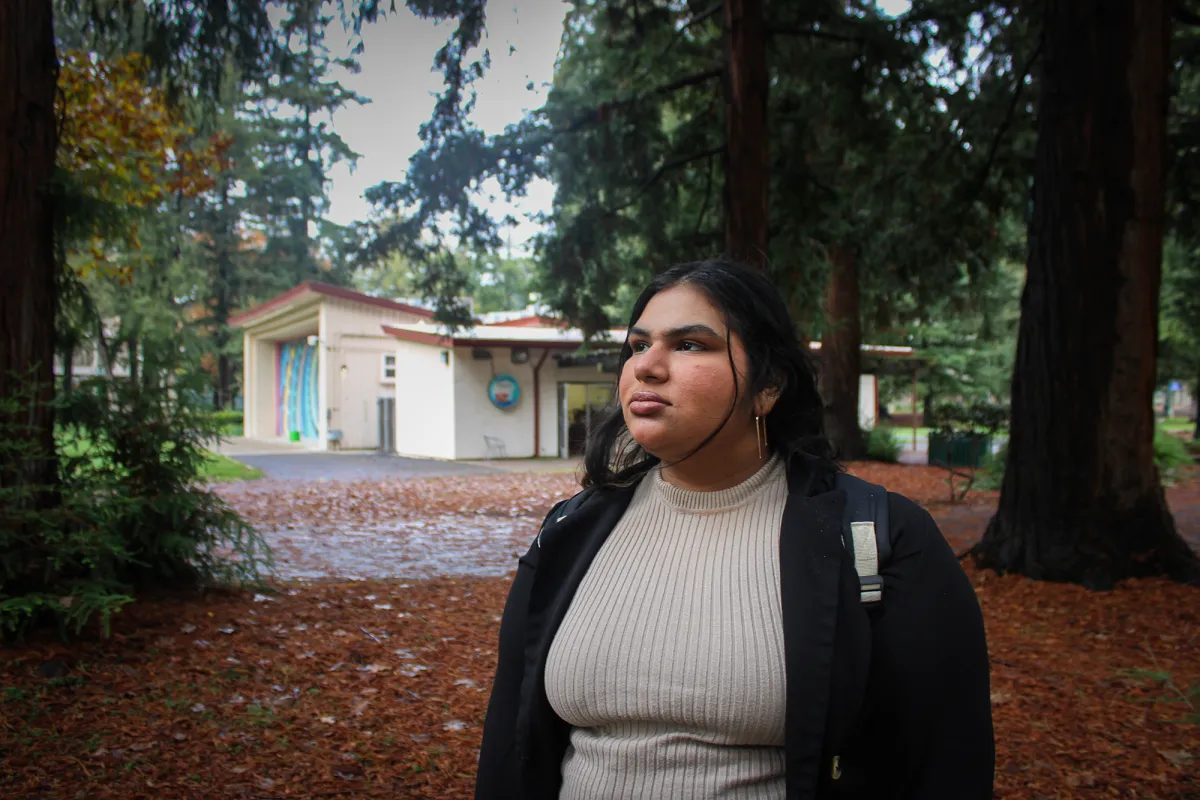
Namrata on the Sacramento State campus on Nov. 14, 2025. Namrata is an international student from India studying political science at Sacramento State. She uses the singular name Namrata as her legal name. Photo by Aliza Imran for CalMatters
###
This story was originally published by CalMatters. Sign up for their newsletters.
###
Until this year, UCLA senior Syed Tamim Ahmad considered staying in the U.S. after graduation to pursue his dream of becoming a doctor. But when the Trump administration revoked thousands of student visas last spring, he spent many sleepless nights supporting his peers as his school’s international student representative. The experience left him exhausted.
Ultimately, most student visas were reinstated following pressure from courts and judges nationwide. But the speed and intensity of the revocations — coupled with a lack of institutional support — caused distrust and anxiety for international students like Ahmad.
“After all that fiasco, I decided no, not anymore,” said Ahmad, who was born in India and raised in the United Arab Emirates.
Ahmad, an integrated biology and physiological sciences major, is now planning to go to medical school in Australia, where he said he can do research “in peace” without fearing changes to his visa status or funding.
A recent report by the Institute of International Education shows that the number of international college students in the U.S. is mostly stable for now, with just a 1% decrease in enrollment this fall. However, the report also found a 17% decline in new international students enrolling in American colleges and universities.
And from what students like Ahmad are saying, fewer are also likely to stay in the U.S. after graduation.
Tightening federal policies about who can live and work in the U.S. from abroad threaten further decreases in enrollment and losses of talent. International students bring diverse viewpoints and perspectives that enrich the classroom environment and lead to scientific and economic advancements, researchers and faculty alike told CalMatters.
The National Science Board found in a 2022 report that more temporary visa holders earn STEM doctorates than citizens and permanent residents combined, while international students earn a disproportionate amount of doctoral degrees in critical and emerging technologies. Foreign students in particular drive scientific research and advancement in the U.S.
Over 1.1 million international students studied in the U.S. during the last academic year. Of those students, 12.5% — over 140,000 — studied in California, making it the state with the largest international student population.
Last fall, international students made up 12% of the total student enrollment in the University of California system, with over 35,000 students from foreign countries. The California State University system enrolls nearly 14,000 international students, or about 3% of total enrollment.
This fall, the Cal State number has dropped to 12,122 students, according to the Cal State data dashboard. An official with the University of California Office of the President said the UC will not release enrollment data until later in December or January.
The Institute of International Education collected responses from 828 U.S. higher education institutions for its report. While it is unclear how many of these were California institutions, the report states that 22% of responses were from western states.
The UC system has faced pressure from the California Legislature in recent years to increase the number of students from California. In response, the UC’s 2030 Capacity Plan proposed decreasing the amount of nonresident students. UC Regents also increased tuition for incoming nonresident students by over $3,400 starting this fall.
Scenario modeling from the Association of International Educators showed California facing a projected 15% decline in overall international student enrollment this academic year. This would mean over 7,000 fewer international students for California’s two public university systems. The education nonprofit projects this drop could result in California losing more than $1 billion in revenue — based on the tuition and living expenses foreign students must pay — with similar enrollment trends across the country driving losses of nearly $7 billion nationwide.
Current realities for international students in California
Dorothy, an undergraduate student from China and opinion columnist for The Daily Cal at UC Berkeley, said anxiety has increased among her peers under Trump’s presidency. She asked that her full name not be published due to fear of retaliation from the federal government.
Recently, her reporting on the international student experience in California has been bleak.
“A lot of students are just debating whether they should focus their future on their home country or continue to seek employment here” after graduating, she said.
She also said no amount of support from her university would be enough to make her feel fully secure from federal policy.
“If I get my visa revoked, I [won’t] be able to just come back and continue my education here, because [the decision] can be overruled by a larger government,” she said.
The total number of foreign students pursuing higher education in the U.S. under the F-1 visa, which classifies holders as nonimmigrant full-time students, had steadily increased since 2020, surpassing pre-COVID numbers in 2024.
At the same time, the number of foreign students on temporary work authorizations, called Optional Practical Training, also increased. In the last academic year, nearly 300,000 foreign students were working with the authorization, a 21% increase from the prior year. Part of this accounted for graduate students entering the workforce.
But graduate student numbers are also declining. This fall, graduate enrollment decreased by 12%, according to the Institute of International Education report, which may also be a response to Trump’s research funding cuts.

Namrata on the Sacramento State campus on Nov. 14, 2025. Namrata is an international student from India studying political science at Sacramento State. She uses the singular name Namrata as her legal name. Photo by Aliza Imran for CalMatters
Sacramento State student Namrata, an international student from India who uses the singular name as her legal name, said her academic experience as a political science major has suffered due to her international student status.
She said faculty and peers have advised her to avoid writing about certain topics in her academic papers. Namrata referenced a recent English paper she wrote on freedom of speech, explaining that her professor cautioned her against making the piece overly political and discouraged her from addressing issues such as genocides or human rights violations. She said she feels restricted within her major and that her “degree doesn’t have value.”
“I don’t even have an equal chance to succeed as other students,” she said. “I wish I was them.”
Namrata is thinking about pursuing her master’s degree in another country or her home country.
Roma Singh, a freshman cinematic arts major from South Africa at Cal State Long Beach, said that while the immigration crackdown did “throw a wrench” in her plans, she ultimately decided that coming to California was the best decision for her aspirations. Singh hopes to pursue a career in Hollywood, and that being near Los Angeles will allow her to enter the industry.
Singh said that attaining her F-1 student visa was a difficult process. Embassy appointments were scarce, and she and her family scanned the embassy website for hours, several days in a row, to find an opening.
“I know some students who were hoping to attend Long Beach and they weren’t able to because they weren’t able to get an appointment,” Singh said.
International students are anxious about their futures
Many international students come to the U.S. with the goal of staying permanently. But with the Trump administration’s crackdown on immigrants, several told CalMatters the U.S. is becoming a less desirable destination for education and residency.
The path for international students to stay in the U.S. after graduation isn’t easy. Through the temporary work authorization, F-1 visa holders can work in the U.S. for up to 12 months. The institute report shows that 92% of higher education institutions believe that without that work authorization, international students would likely choose other countries for their education.

Syed Tamim Ahmad on the UCLA campus in April 2023. Ahmad is an international student from United Arab Emirates who will be leaving the U.S. for medical school in Australia. Photo by Kush Agarwal
Students may also pursue a work visa like the H-1B, which permits residency for an initial three-year period.
But a recent additional $100,000 fee for the H-1B visa — a common next step for international students wishing to stay in the U.S. after graduation — adds a roadblock for international students hoping to remain in the U.S.
One major challenge for thousands of students, both current and prospective, has been navigating Trump’s June travel ban to and from 12 countries, mostly in the Middle East and Africa. For seven more countries spread across the globe, he enacted a partial travel ban, including forbidding new student visas.
Students who already had visas were not subject to the ban, but many were advised by their universities to not leave the U.S., as re-entry was not guaranteed due to rapidly changing federal policy.
What international students bring to California
International students are a key source of revenue for tuition-driven universities, as they are not eligible for federal financial aid and often pay full tuition.
With 50% of students at the UC and Cal State paying zero tuition due to financial aid, the higher tuition paid by international and out-of-state students is advantageous, said Valerie Lundy-Wagner, associate director of the Public Policy Institute of California’s higher education center.
For the 2026-27 academic year, full-time nonresident students at the UCs will pay over $36,000 more in tuition than resident students. Assuming a normal credit load, nonresident students at Cal State will pay $14,000 more in tuition.
But while international students provide more tuition revenue than domestic ones, Lundy-Wagner said potential declines in enrollment are not dire, as institutions will have time to assess the intensity of enrollment declines and “what risk to tuition revenue they can expect,” allowing them to redistribute resources accordingly.
“No one expects that next year there are going to be no international students,” she said.
For institutions in California, particularly graduate programs, Lundy-Wagner said the presidential administration’s recent slashing of federal research funding is “more of an immediate issue” than declines in international enrollment.
And if enrollment declines are significant enough, the UC and Cal State systems can always supplement losses in tuition revenue with out-of-state students, as “there are still plenty of other states they could be recruiting from” where students would pay the same nonresident tuition.
But international students bring much more to California than simply additional tuition revenue, Lundy-Wagner said.
“The state has a diverse economy. Diverse economies require people who have diverse perspectives, and some of that will come in through folks who are coming from different countries,” she said. “It benefits California students and faculty to be interacting with folks who are from these different places and spaces.”
Sujatha Moni, a women’s and gender studies professor from India who teaches at Sacramento State, agrees.
She said that international students bring a unique perspective from their cultural backgrounds and interact with class content differently, providing domestic students with new viewpoints that they otherwise wouldn’t have been exposed to.
“International students enhance the value of education on our campus,” she said. “They bring that critical diversity that is much needed, that is so enriching, for any campus.”
Applying to study in California now
Despite the challenges, Dorothy said she has never regretted her decision to come to California for her university education, citing interesting classes, high-caliber professors and a vibrant, international community as draw factors.
She said if international families can afford to send their students to the U.S., and if they “value the experience and the education itself, it’s still worth it” to study here. She is encouraging her brother to also study in the U.S.
At UCLA, Ahmad said he is wary about recommending international students study in the U.S., citing how draining it has been for him to constantly worry about his visa status and potential cuts to research funding on top of being a student. He told his brother to “absolutely not” apply to the U.S. for law school.
“Given the current situation, I would say no,” he said. “But if it was like, a year back, … I would say yes.”
Ahmad looks forward to finally being in Australia, away from “the political drama” in the U.S. and the pressure to constantly advocate for himself and his international peers.
“I can also take a step back and, you know, be a student.”
###
Aliza Imran and Kahani Malhotra are contributors with the College Journalism Network, a collaboration between CalMatters and student journalists from across California. CalMatters higher education coverage is supported by a grant from the College Futures Foundation.
OBITUARY: Sonya Lynne Stringer, 1941-2025
LoCO Staff / Monday, Dec. 1, 2025 @ 7:15 a.m. / Obits

Sonya Lynne Stringer (Englis) passed away peacefully the morning of November 1, 2025. Born November 15, 1941 in Eureka, she lived in Humboldt County her entire life. She attended elementary and high school in Arcata.
Her freshman year of high school, she spotted Mike Stringer across the quad at lunchtime and told her girlfriend; I’m going to be going steady with him. They were married a week before she graduated from Arcata High School on June 06, 1959.
In 1961 they welcomed son Steve, followed by daughter Kris in 1963. They lived in Fortuna and Eureka. In 1981 they found their dream property on three acres out in Freshwater on the creek. Together they developed it into a paradise, spending every day off and vacation building fences, laying cement, landscaping and gardening. Both retiring from Safeway, in 1995 and 2000, they enjoyed a wonderful life there for the last 43 years.
Known by Sunny, she was nicknamed at a very early age because of her good nature and cheerful disposition; she always looked at the bright side of everything and could find something good in everyone. Her smile truly did light up a room, making everyone feel warm and welcome. She was kind, generous, fun, optimistic, selfless, accepting, resilient and forgiving. She had a spunky spirit, quiet strength and a true dedication to family. We all enjoyed her special way of storytelling. Sunny’s faith and belief in God were woven throughout her life in the way she lived and treated people. She was an extraordinary person who lived a remarkably humble and simple life. Sunny loved animals too, especially dogs. When she was five she took all her allowance, walked a few blocks to the pet store and brought home a puppy.
As a family, they enjoyed fishing, camping, cutting firewood up at the family property in Dinsmore, a historic trip to Disneyland in a motor home down the Monterey Coast and many family gatherings. She even tried golf once because Mike liked it so much ! She cherished every visit with her grandchildren and great-grandchildren, especially Christmas time. She loved all the pictures and videos her grandchildren would often send of the great grandchildren. She was very proud of her grandchildren and valued their relationships. She loved sharing their latest accomplishments, pictures and videos with other family members and her closest friends. Sunny and her best friend since kindergarten, Rita Madison, enjoyed getting away together every couple of years to Reno or Las Vegas for a Girl’s Getaway. Rita and her family were part of the family. They remained close like sisters until their passing; only a week apart.
Mike and Sunny’s 70-year love story continued until the day she passed. The caption under Mike’s senior picture in the yearbook read : One Woman Man. His love and adoration for her was unceasing. The life they had together was nurtured by mutual respect, hard work, fun, family and love. During her short illness, she remained gracious, selfless and ever optimistic. After her last radiation treatment, the radiologist asked her if she wanted to ring the bell. She said No, not until it’s gone. She accepted Jesus a couple months before she passed away. We have peace and joy knowing she’s with God. We know she’s ringing that bell in Heaven !
She is survived by her husband Mike, of 66 years. Her sisters Llana and Gary Thompson, Lee Ann Wonnacott and brother Leonard and Ellen Wonnacott. Brothers-in-law Bill Stringer, Brian and Sue Stringer, sister in law Kathy Stringer, Her son Steve and Teresa Stringer, daughter Kris Pastori, grandchildren Cari and Braulio Escareno, Michael and Angela Sanders, Cory and Alex Sanders, Joe Stringer, Jessica and Ben Coombs, Jill Kelly, James and Hayley Pastori, great-grandchildren Damien Escareno, Anakin Stringer, Nicholas Sanders, Jackson, Callum, Joanna and Clarissa Coombs, Tayler and Jaina Stephens, Ashlynne and Teegan Kelly, Dawsyn, Rye and Lucy Pastori, and Aunt Nancy MacGowan.
She is preceded in death by her parents, Richard and Lyrle Englis; father- and mother-in-law Ross and Marguerite Stringer; brother-in-law Patrick Stringer; and best friend of 78 years, Rita Madison.
Sunny’s family would like to thank her entire wonderful medical care team, who cared for her tirelessly with affection, respect and excellence. Special thanks to her entire palliative team at Madrone Care and everyone at Hospice of Humboldt.
No services will be held. You are welcome to donate to Hospice of Humboldt in her memory or serve at a local animal shelter.
###
The obituary above was submitted on behalf of Sonya Stringer’s loved ones. The Lost Coast Outpost runs obituaries of Humboldt County residents at no charge. See guidelines here.


