

Notorious Arcata Cattle Rancher Ray Christie Sues Humboldt County, Sheriff Honsal and Others, Alleging Civil Rights Violations
Ryan Burns / Tuesday, Dec. 2, 2025 @ 11:30 a.m. / Courts
UPDATE, 1:13 p.m.: After this post was published, Humboldt County Public Information Specialist Cati Gallardo provided the following response to a request for comment:
This an important matter for the county, however, this is a pending legal matter, and to preserve the integrity of the process, the County of Humboldt cannot provide further comment to the press at this time.
We also received a follow-up email from the PR firm representing Christie Larson LLP, asking us to replace the original press release (which contained a misspelled reference to Humboldt County) with a corrected version. We have done so. The firm also emailed a photo of Christie and his sons, below.

Photo courtesy Larson LLP.
###
Original post:

Ray Christie sits detained in a Bureau of Land Management vehicle during the 2018 raid on his ranch in the Arcata Bottoms. | File photo by Andrew Goff.
###
Attorneys representing Arcata cattle rancher Raymond Christie filed a federal civil rights lawsuit yesterday against the County of Humboldt, Sheriff William Honsal, former Sheriff’s Office Livestock Deputy Travis Mendes and former Deputy District Attorney Adrian Kamada, alleging multiple civil rights violations.
The 68-page complaint from L.A.-based law firm Larson LLP accuses the county and its officials of violating Christie’s Fourth Amendment protections against unreasonable searches and seizures and his Fourteenth Amendment rights to due process during a multi-agency, “SWAT-style” 2018 raid on his ranch in the Arcata Bottoms, his subsequent arrest for animal abuse and five years of criminal prosecution.
An L.A.-based public relations firm called Infinite Global emailed the Outpost a press release this morning. It outlines the lawsuit in broad strokes, saying Christie’s business involves purchasing sick, weak and injured cattle and attempting to nurse them back to health. It accuses Honsal, Mendes and Kamada of hypocrisy for pursuing Christie “while ignoring obvious violations at other operations in the area.”
The suit itself, which you can download via a link below, accuses Mendes of evidence tampering, including staging photos and moving evidence, and then lying under oath. It alleges that during the 2018 raid, officers ignored Christie’s requests to speak to an attorney. It accuses Kamada of secretly recording unconstitutional questioning and then hiding that recording for a year and a half. And it says this persecution and negative media coverage harmed Christie financially while damaging his reputation.
A 2019 court case against Christie for animal cruelty and illegal dumping of cattle carcasses near state waters ended in a mistrial after a single juror declined to convict him on four felony and 10 misdemeanor charges. His conviction on other misdemeanor charges was later set aside and dismissed.
Last year, the majority owners of Redwood Meat Company, the region’s only USDA-certified slaughterhouse and processing facility, sold their shares to Christie, though he has yet to reopen the business, which shut down in 2024 after more than 70 years in operation.
Christie’s lawsuit seeks compensatory damages for lost income and business opportunities, legal fees, reputational damage and emotional distress, plus unspecified punitive damages and injunctive relief.
Here’s the press release from Christie’s PR firm. Scroll down for a link to the lawsuit and links to just some of the many stories about Christie.
SAN FRANCISCO, December 2, 2025 – Law firm Larson LLP sued Humboldt County and three officials late Monday in San Francisco federal court on behalf of a northern California cattle rancher, alleging they violated his civil rights in raiding his home and properties, improperly tampered with evidence, and pursued criminal charges against him that were later dismissed but that continue to harm his reputation and ability to conduct business.
The case outlines how Humboldt County Deputy Sheriff Travis Mendes, serving as livestock deputy, unlawfully raided Ray Christie’s properties in 2018 under the pretext of searching for alleged animal abuse violations. Former Humboldt County Deputy District Attorney Adrian Kamada maliciously prosecuted Christie for years for alleged felonies following the raid, leading the District Attorney to fire him for improprieties in another matter and dismiss the charges in this case in 2023 following evidentiary challenges by Christie, according to the complaint. The complaint also names Sheriff William Honsal as a defendant for supporting Mendes’ and Kamada’s actions.
As the complaint states, Mendes, Kamada, and Honsal pursued Christie while ignoring obvious violations at other operations in the area.
“Mr. Mendes, Mr. Kamada, and Mr. Honsal showed unmistakable bias toward Mr. Christie for practicing and upholding industry standards but turned a blind eye to other operations that have admitted to clear violations,” said Rick Richmond, partner with Larson LLP and lead counsel for Mr. Christie. “This lawsuit is about vindicating Mr. Christie’s civil rights and highlighting the hypocrisy of Mr. Mendes, Mr. Kamada, and Mr. Honsal, while also allowing my client to assert the truth of what has so far been a one-sided story. We ask the court to right the wrongs Humboldt County and its officials have inflicted on Mr. Christie.”
Core to Christie’s business is purchasing cattle directly or at auction that other ranchers no longer want to care for—due to illness, injury, malnutrition or other issues—and rehabilitating them back into good health. These culled cattle come from a variety of operations, including beef ranchers and dairy farmers in the area who have declined to provide needed antibiotics or other care that disqualify an animal from being considered organic under the USDA’s National Organic Program. Products certified as organic under the USDA’s classification fetch far higher profits compared to non-organic products.
When culled cattle first arrive on Christie’s properties, they are often sick, injured or malnourished due to how they were cared for by their previous owners. Previous livestock deputies were familiar with Christie’s practices of taking these animals in and rehabilitating them and, in the years prior to the raid on his home and property, had investigated and dismissed complaints about the appearance of cattle in Christie’s herd.
Despite this, Mendes and Honsal singled Ray out in an investigation that began shortly after Honsal was elected as sheriff, and as soon as Mendes assumed the role of livestock deputy, and culminated in an early morning raid in March 2018 with officers in SWAT-style gear and carrying automatic assault rifles. During the raid, as noted in the complaint, Christie and his girlfriend were forced to stand outside in the frigid damp air, barefoot, and in the clothes in which they were sleeping. Mendes and Kamada interrogated Christie during the raid after Christie had asked to speak with his lawyer, and Mendes secretly recorded their improper questioning. It was later discovered that Mendes moved evidence before photographing it during the raid, and also used altered photographs as evidence, according to the complaint.
Kamada, who was among the raiding party and who participated in questioning Christie with no lawyer present, filed felony charges against Christie as a result of the raid. As outlined in the complaint, out of the 4,000 animals on Christie’s properties, fewer than 10 were identified as alleged victims of abuse in the felony charges that were later dismissed after Christie’s counsel uncovered fatal deficiencies in the evidence against him. Several of these cattle had arrived from an auction only hours earlier, in the middle of the night, and had not yet received the care and treatment Christie’s herd typically receive on arrival at his main ranch property. Others were cattle that had died prior to the raid but had yet to be buried due to particularly wet weather. As noted in the complaint, the industry-wide mortality rate for “open” cattle herds like Christie’s is around 20% annually, and cows that die must be buried on site due to a lack of a rendering plant in the area for more than 20 years.
Other farms in the area committing violations have escaped the county’s scrutiny. One prominent example mentioned in the complaint is Alexandre Dairy Farm, a well-known producer of A2 organic milk that Farm Forward and The Atlantic found in 2024 to have committed numerous instances of animal abuse following an extensive investigation. When confronted with this evidence, along with a mountain of corroborating evidence from other local ranchers, the Humboldt County Sheriff’s Office concluded the complaint by Farm Forward was “unfounded.” This was despite the USDA opening an investigation that forced the farm to admit to many instances of abuse and receive supervision from the USDA’s National Organic Program.
As a result of the ongoing harm caused by the county’s arbitrary enforcement, Christie has suffered financial and reputational damage. The charges, along with the negative media coverage and public attention, harmed Christie’s business partnerships and resulted in denied loans Christie had depended on to finance his operations. He has also had to spend hundreds of thousands of dollars on attorneys to defend against criminal charges. Christie developed cancer and a heart condition during the prosecution.
The complaint states that the defendants’ wanton disregard of Christie’s constitutional rights violates the United States Constitution and 42 U.S.C. § 1983, which provides an individual the right to sue local government officials for civil rights violations. The complaint seeks compensatory damages, punitive damages, attorneys’ fees and costs, pre-judgment interest, and all other relief provided by law.
The case is Raymond Frank Christie v. County of Humboldt et al., case number 3:25-cv-10328 in the US District Court for the Northern District of California.

Another photo of the 2018 raid on Christie’s property. | Andrew Goff.
###
DOCUMENT
###
PREVIOUSLY
- (VIDEO) Drone Flight Reveals Mass Open Grave of Cattle Carcasses in Arcata Bottoms
- Cops Raid Notorious Ranch in the Arcata Bottoms; Rancher Ray Christie Arrested at the Scene
- More Than 250 Dead Cows Found on Ray Christie’s Properties, Says HCSO; Numerous Other Alleged Violations Discovered
- Humboldt-Del Norte Cattlemen’s Association Calls Ray Christie’s Ranch ‘Horrific,’ Says Anyone Convicted of Animal Abuse Should be Punished to the ‘Greatest Extent Possible’
- Judge Says Ray Christie, Arcata Rancher Accused of Animal Cruelty, Can Still Own Livestock For Now
- Rancher Ray Christie Held to Answer for Three Felony Charges of Animal Abuse; Four Charges Dropped After Investigating Deputy’s Testimony Was Compromised
- Judge Reverses Own Decision in Christie Animal Cruelty Case; Arraignment Set For Next Month
- Calling State Law ‘Unconstitutional,’ Attorneys for Rancher Ray Christie Ask Judge to Throw Out Case Involving Hundreds of Cattle Carcasses Found on His Land
- CHRISTIE TRIAL: Misconduct or Mistrial? One Juror Refuses to Deliberate or Follow the Law, Other Members Tell Judge; Unknown Whether a Mistrial Will be Declared or Possible Rogue Juror Replaced
- CHRISTIE TRIAL: Hung Jury Declared After One Juror Out of 12 Declines to Convict Accused Rancher
- RETRIAL: Following Hung Jury, Rancher Ray Christie Will be Retried on Four Felony Counts in February, Prosecutor Says
- Judge Denies Motion to Dismiss Felony Animal Cruelty Charges Against Arcata Rancher Ray Christie
- Rancher Ray Christie’s Attorney Asks For Yet Another New Trial On Top of His Client’s Already Impending Retrial
- Arcata Rancher Ray Christie Set to Face Second Animal Cruelty Charges in January
- Jurors in Ray Christie’s Second Trial Will Get to Hear About the Hundreds of Carcasses Found on His Properties, Judge Rules
- CHRISTIE CASE: Rancher Battling Cancer as Second Trial Looms
- Trial of Arcata Rancher Ray Christie Delayed Yet Again, as the Accused’s Medical Problems Worsen
- Majority Owners of Shuttered Redwood Meat Co. Sell Their Shares to Accused Animal Abuser Ray Christie
- Judge Says the Sale of Redwood Meat Co. to Ray Christie Did Not Violate Restraining Order
BOOKED
Today: 6 felonies, 10 misdemeanors, 0 infractions
JUDGED
Humboldt County Superior Court Calendar: Friday, Oct. 2
CHP REPORTS
No current incidents
ELSEWHERE
RHBB: Humboldt County Road Construction Notice: Alderpoint Road in Blocksburg Tuesday
RHBB: First Week of October is the Annual Week Without Driving
Highway 36 Will Be Fully Closed This Weekend for Slide Repairs, Says Caltrans
LoCO Staff / Tuesday, Dec. 2, 2025 @ 9:57 a.m. / Traffic
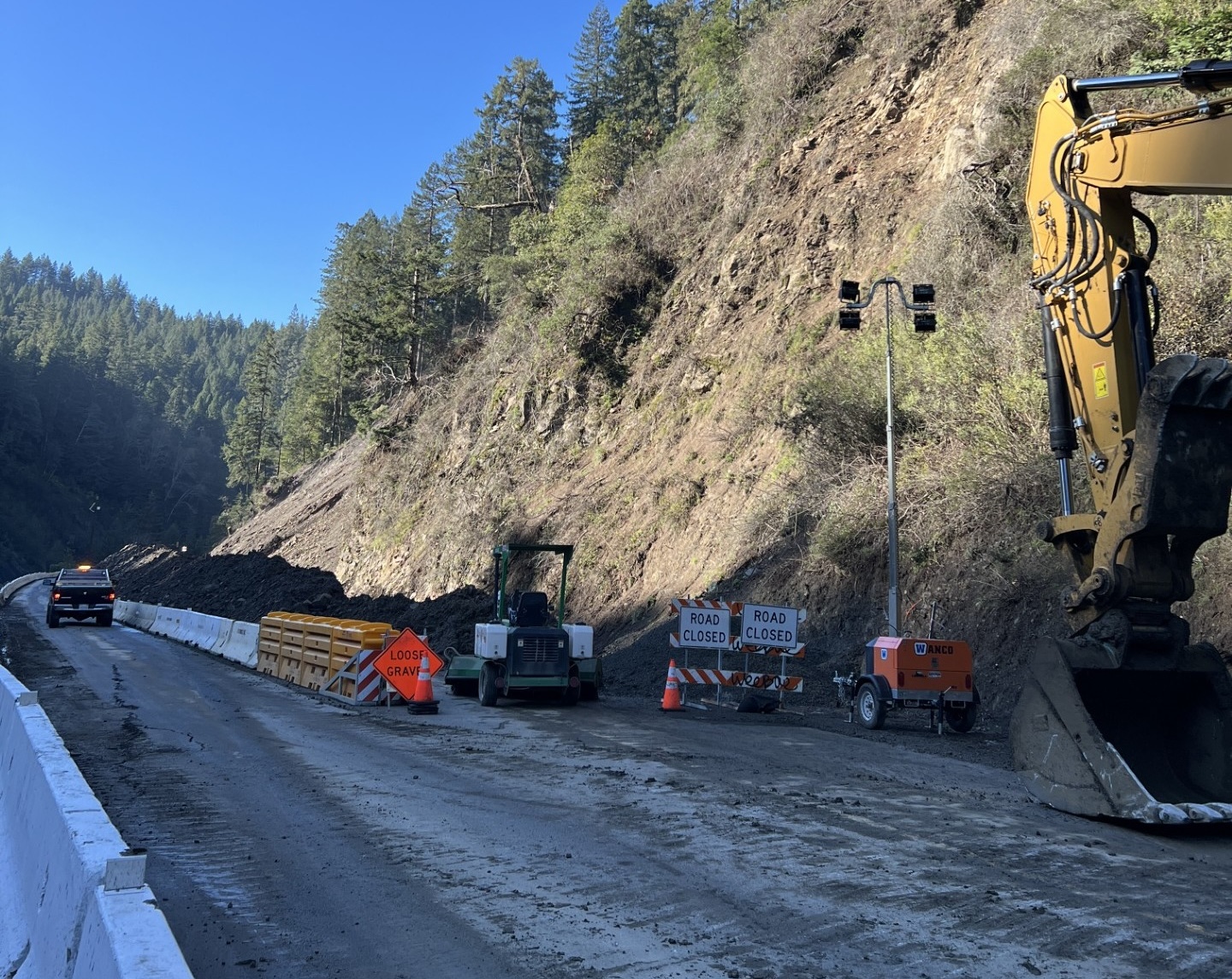
It’s coming along! | Photo: Caltrans District 1
###
From the California Department of Transportation District 1 Office:
A full closure of Route 36 is scheduled east of Swimmer’s Delight between postmiles 15.7 and 16.3 the weekend of December 6 and 7 to support slide-response work. The long detour requires using Routes 299 and 3.
The roadway is expected to close at 8 a.m. on Saturday, December 6, and reopen at 6 p.m. on Sunday, December 7. During this time, crews are planning helicopter operations to remove hazards from the slide area. These operations are weather and fog-dependent.
Emergency vehicles will be accommodated through the closure if necessary.
Outside of this planned closure, one-way traffic control continues with delays of up to 15 minutes. Please travel cautiously, and stay tuned for critical opening updates.
Go to quickmap.dot.ca.gov or the QuickMap app for the most up-to-date road conditions.
###
It’s OPEN ENROLLMENT Time in Humboldt County Schools! If Your Kid is Going to Attend a District Different Than the One You Live In Next Year, Now’s the Time to Get the Ball Rolling
LoCO Staff / Tuesday, Dec. 2, 2025 @ 9:31 a.m. / Education

File photo.
Press release from the Humboldt County Office of Education:
Enrollment for the 2026-27 school year has begun! For those interested in obtaining an interdistrict transfer, please contact your child’s district of residence to begin the process. This process is for both new and renewal requests. Check with the office of your district of residence for the deadline to submit forms. All forms will be submitted electronically.
“Families sometimes look beyond their district of residence to find the school setting that best supports their child’s learning and aspirations. Submitting an interdistrict request early helps schools plan thoughtfully and ensures a smooth enrollment process for everyone,” said Michael Davies-Hughes, Humboldt County Superintendent of Schools. “We are fortunate to have exceptional programs within schools across Humboldt County, and I encourage families to learn more about them as they make enrollment decisions for the 2026-2027 school year.”
For more information or to access the current forms, please visit this link.
Who’s Running for California Governor? Here’s a Look at the Current Field of Candidates
Jeanne Kuang / Tuesday, Dec. 2, 2025 @ 7 a.m. / Sacramento
This story was originally published by CalMatters. Sign up for their newsletters.
###
The game of musical chairs in the race to be California’s next governor lost another player last week.
After Democratic businessman Stephen Cloobeck — who was polling at below half a percent — dropped out of the race and endorsed Rep. Eric Swalwell on Monday, at least 10 candidates remain.
Voters are hardly to blame if the names don’t ring a bell. Though it’s wound on for more than a year now, the 2026 governor’s race remains unexpectedly wide open. In one poll released last month, 44% of surveyed voters did not have a preference for governor and no candidate polled above 15%.
The primary election is next June. Here’s a look at the field right now:
XAVIER BECERRA
If former Health and Human Services Secretary Xavier Becerra was looking for attention for his campaign, he found it in the form of negative headlines.
Last month, federal prosecutors indicted a Sacramento powerbroker in an alleged corruption scandal that rocked the state’s Democratic establishment. At its center? A dormant campaign account held by Becerra, from which prosecutors allege Gov. Gavin Newsom’s former chief of staff Dana Williamson conspired with other political consultants to steal $225,000. Williamson is charged with helping to divert the funds to the wife of Becerra’s longtime aide, Sean McCluskie, who has pleaded guilty in the alleged scheme.
Becerra was California’s first Latino attorney general before serving as a cabinet secretary for former President Joe Biden. He is running primarily on a platform of lowering health care costs.
He has not been accused of wrongdoing in the case and has said he was unaware of what was happening. But it’s still possible the association — and the implication he wasn’t paying attention — will taint his campaign, already polling at just 8%.
The controversy is one of a few moments of intrigue in an otherwise quiet race.
KATIE PORTER
In October, former Orange County Rep. Katie Porter, a Democrat, was caught on camera trying to walk out of a TV interview with a reporter who pressed her on whether she needed Republican support in the race. A second video followed, showing Porter berating a staff member during a Zoom call. At the time considered the front-runner, she rode out the news cycle and later said she “could have done better” about the behavior in the videos, but they appeared to have dropped her approval ratings. She is essentially tied with the top Republican candidate.
Porter made a name for herself as one of a “blue wave” of female, Democratic lawmakers elected to Congress during the first Trump administration in 2018. A law professor at UC Irvine who ran unsuccessfully for U.S. Senate last year, she gained attention for her tough questioning of corporate executives using her signature whiteboard.
TOM STEYER
Joining a wide field of other Democrats, billionaire investor and climate activist Tom Steyer announced last month he is jumping into the race.
Steyer, who made his fortune by founding a San Francisco hedge fund, has used his wealth to back liberal causes, including the environment. He’s never held public office before, but ran a short-lived campaign for president in 2020.
CHAD BIANCO
Pro-Trump Riverside County Sheriff Chad Bianco is neck-and-neck with Porter in the polls, though he is unlikely to last near the top of the pack in a state where Democrats outnumber Republicans nearly two-to-one and a GOP candidate hasn’t won a statewide seat in nearly 20 years.
The cowboy-hat-toting Bianco has heavily criticized Democratic governance. He argues for loosening regulations on businesses and says he wants to overturn California’s sanctuary law that restricts local police from cooperating with federal deportation officers.
ERIC SWALWELL
Other Democrats have focused on their biographies and experiences in government to try to distinguish themselves in a race where name recognition is low across the board. All have said they want to make California more affordable and push back on the Trump administration’s impact on the state.
Swalwell, a former prosecutor and Bay Area congressman, will likely lean heavily on his anti-Trump bonafides. He was one of several members of Congress appointed by former House Speaker Nancy Pelosi to help lead the second Trump impeachment after the attempted Jan. 6, 2021 insurrection and is now the latest Democrat under attack by the Trump administration over his mortgage.
ANTONIO VILLARAIGOSA
Former Los Angeles mayor and former Assembly Speaker Antonio Villaraigosa is among the more moderate of the Democratic field. He boasts of his time running the state’s largest city, during which he boosted the police force. He ran for governor unsuccessfully in 2018.
BETTY YEE
Former state Controller Betty Yee emphasizes her experience with the state budget and the tax system, having been a top finance office in ex-Gov. Gray Davis’ administration and having sat on the state Board of Equalization.
TONY THURMOND
State Superintendent of Public Instruction Tony Thurmond, a Democrat, is the only candidate currently in a statewide seat. He emphasizes his background as a social worker who grew up on public assistance programs in a low-income family. He has stated an ambitious goal of building two million housing units on surplus state land.
IAN CALDERON
Ian Calderon, a former Democratic Assembly majority leader, is emphasizing his relative youth. He was the first millennial member of the state Assembly, and is part of a Los Angeles County political dynasty. He has some ties to the cryptocurrency industry and has name-dropped it in ads and debates.
STEVE HILTON
Republican Steve Hilton, a Fox News contributor, was an adviser for British conservative Prime Minister David Cameron before pivoting to American politics. Before launching his campaign he released a book this year calling California “America’s worst-run state.”
OBITUARY: Corey ‘Bubba’ Tyler Shannon-Johnson, 1992-2025
LoCO Staff / Tuesday, Dec. 2, 2025 @ 6:56 a.m. / Obits

Corey “Bubba” Tyler Shannon-Johnson — beloved son, brother, uncle, buddy and friend — passed away on October 28, 2025, at 33 years old.
He was preceded in death by his grandparents, Carol and Charlie Johnson; his uncles, Emery Johnson and Skip Lawrence; aunt Laurie Howsman; niece Penelope Staley; cousins, Justin, Cameron, and Savannah Johnson.
Corey is survived by his mother, Kimberley O’Neal Johnson and her partner Corey’s best buddy Dan Yocom; his sisters Caitlyn Bell-Johnson ( Nick), Courtney O’Neal, and Casey Day ( Maliq); Brother Tony Shannon; nieces and nephews Austin and Hayden Ham, Avery Cortz, Zaylee Day and Emmett Staley. His aunts Lisa Lawrence, Jennifer Johnson, Sandy McKay, and Charlene Rosenstiel; uncle Darrin Johnson ( Emily), Cousins; Josh, Amanda, Chelsea, Anthony, Adam, Crystal, Nicholas, Elijah, Cheyenne, Kenny, Lena, Russ Jr, Tabitha, Lena May, and Syrina. Corey is also survived by numerous extended family members.
Corey was born March 19, 1992 and grew up in McKinleyville. Corey enjoyed playing baseball and basketball growing up, as he got older Corey enjoyed surfing, spending a lot of time at the local beaches. He loved being outdoors whether it was at the beach surfing the waves or in the trees being one with nature. Corey was a great artist. He loved drawing and writing poetry. He loved being around his family, and annoying his sisters was his job.
Corey could make anyone happy and always showed his beautiful smile. Corey never met a stranger everyone was his friend. His friendly nature impacted many.
At 15 years old Corey wanted to make some money. He went door to door in his neighborhood asking for work. He ended up at The Jonsteen Company, and from there his love and passion for trees and nature began. From that day on Corey could be found working at the Jonsteen Company — they became Corey’s second family, and we are forever grateful to the Company and crew for loving Corey and guiding him all those years.
We will be having a Celebration of Life for Corey on January 17, 2026 at Azalea Hall in McKinleyville from 1 to 4 p.m. Corey had a love for sneakers and long, bright, colorful socks. Please feel free to wear bright colors to honor Corey.
Please come join us as we celebrate our Bubba and your friend Corey.
###
The obituary above was submitted on behalf of Corey Shannon-Johnson’s loved ones. The Lost Coast Outpost runs obituaries of Humboldt County residents at no charge. See guidelines here.
OBITUARY: Jayme Elan Seehafer, 1975-2025
LoCO Staff / Tuesday, Dec. 2, 2025 @ 6:56 a.m. / Obits

Jayme Seehafer, of Arcata, died in October of cancer. She was raised outside of Sacramento, where she loved the green oasis her father built in their backyard in the grassy woodlands, with a pond, a small fruit orchard, a treehouse and chickens. She discovered the Grateful Dead and their followers as a teenager, and she and her sister adopted their tie-died festival wear as well as their rebellious vibe. She continued to love music and would often attend local and distant shows, and spent one summer on the road with one of her favorite bands.
Jayme moved to Humboldt to attend HSU. She loved the setting and the community and decided to stay, taking on various jobs while being a single mom and attending school. Once she earned her degree in biology, Jayme joined the U.S. Forest Service Redwood Sciences Lab in Arcata, first as a Watershed Steward with Americorps and later as a permanent employee. While there, she mastered a series of tasks including stream surveying, storm flow monitoring, data entry, and lab processing, which led to her niche as a data and lab manager for the Caspar Creek Experimental Watersheds and various other projects.
Jayme was smart, hardworking, kind, generous and creative. She was always interested in learning, including programming computers, how fungi fit in our world, carpentry and painting. She used her skills to create elegant data processing procedures, accurate and accessible data publications, fun toys in her office, and beautiful paintings on the walls of her home. Her family and friends miss her terribly, but we’re glad to have known her.
She’s survived by her son, Kinder Seehafer of Arcata, father Jon Seehafer and sister Nika Seehafer, her husband John, and their child Echo Valor in the Sacramento area, and sister Kia in Minnesota. If you would like to honor Jayme, please consider a donation to the ACLU of Northern California, Indivisible, a cancer or women’s health organization, or someone who needs your support.
###
The obituary above was submitted on behalf of Jayme Seehafer’s loved ones. The Lost Coast Outpost runs obituaries of Humboldt County residents at no charge. See guidelines here.
OBITUARY: Adrian Hass, 1968-2025
LoCO Staff / Tuesday, Dec. 2, 2025 @ 6:56 a.m. / Obits

A limb has fallen from our family tree but remains in our hearts forever.
Born Paul Adrian Hass to Paul Hass and Johanna Ross in London, England, on December 20, 1968; died September 9, 2025. Adrian was the eldest son and brother to seven siblings.
Adrian possessed a heart of gold and would give the shirt off his back to help his family and friends. A generous (to a fault), funny and intelligent man whose knowledge was as broad and eclectic as his colorful humor. A collector of all things, mechanical, historical and ironical, with an uncanny ability to rebuild or utilize them in a surprising variety of practical applications.
Adrian was nothing if not resourceful. A humble collector, recycler and a spiritual warrior, he was very proud of his Scottish heritage. A historian and storyteller who could bring a smile to your face with his humorous rendition of events. Adrian was fiercely loyal, he loved his family, friends, animals and he dearly loved the land. He loved to garden and mushroom hunt. He knew more about the Humboldt hills he lived in than anyone!
He had an amazing memory for quotes and lines from movies and books, actors and musicians, television shows, song lyrics and family events. He loved to rewrite the lyrics of popular songs and then sing them to you with his own revised lyrics (always hilarious and inappropriate).
Adrian loved motorcycles, cars, trucks and heavy equipment of all kinds but particularly what he considered “classics.” He was a true “junkyard man” and could create a mode of transport out of practically nothing except discarded parts and pieces. He towed, tinkered and collected for most of his life, which tragically ended far too soon.
Family, friends and neighbors relied on him regularly for maintenance and repair of generators, pumps, water systems etc. “A jack of all trades and master of none,” if he couldn’t fix it and make it work you could sometimes hear him say “they can’t all be winners” or “we can’t have everything, now, can we?” He never asked for much in return except maybe some beer, smokes and company. He loved a good hang and some social interaction and a Payday candy bar.
Adrian was preceded in death by his beloved wife Joanne. He is survived by his parents, aunts, uncles, sisters and respective spouses — Joey (Mike) Bommer, Amber (Kyle) Schlagenhauf, Tessa Hass, Tara Hass, Cailun (Justin) Lyon, and his brothers Jade Hass and Torrey Hass and many other friends and family members too numerous to list . May he rest among the stars, knowing he was deeply loved.
A celebration of life date and location to be determined at a future time.
###
The obituary above was submitted on behalf of Adrian Hass’s loved ones. The Lost Coast Outpost runs obituaries of Humboldt County residents at no charge. See guidelines here.


