
(VIDEO) Goodbye, Schatzi’s! Maybe the Real Hidden Treasures Were the Friends We Made Along the Way
Isabella Vanderheiden / Tuesday, Oct. 29, 2024 @ 7:05 a.m. / :)
It’s the end of Humboldt’s Schatzi’s era | Video/Photos: Andrew Goff
###
After more than 15 years of keeping Humboldt stocked in crystals, Bob Marley posters, duffel bags, bongs, tie-dye bellbottoms and swords, Schatzi’s Hidden Treasures is closing up shop, marking the end of an era at Eureka’s Bayshore Mall.

Timo, Schatzi’s curator
Schatzi’s first entered the Humboldt consciousness in 2009 when Christof Timotek Schneider-Reuter — “Timo,” to friends — began selling tapestries and incense at a kiosk inside the Bayshore Mall. Mall patrons enjoyed his eclectic wares so much that he decided to expand his business to a storefront. Schatzi’s has relocated a few times over the years, but its current (and final) home is situated near the entrance to Ross Dress for Less, across from the Department of Motor Vehicles.
Now, if you know me, you know I love the Bayshore Mall. I have spent many, many Sunday afternoons bopping around the mall, browsing the shops while munching on a pretzel dog and wondering how the hell F.Y.E. manages to stay in business. (Are Funko Pops!™ the glue that holds it all together?) During these mall outings, I almost always pop into Schatzi’s to admire the trinkets and bask in the Humboldt-flavored chaos of it all.
In my mind, Schatzi’s is a near-perfect microcosm of Humboldt County’s counterculture. Sure, it caters a bit more to festival-goers and New Age hippie types, but something about it captures the eccentric spirit of this quirky little place we call home. I mean, where else can you get a locally crocheted banana slug hat, handmade Yurok jewelry, a Bigfoot t-shirt, and an enormous duffel bag to transport your weed? Exactly.
I dropped by the Bayshore Mall last week, along with the Outpost’s Andrew Goff, to learn more about Schatzi’s impending closure and the store’s legacy here in Humboldt. As we made our way past the “lucky” bamboo and tiny fairy statues, we spotted the owner, Schneider-Reuter, chatting with one of his employees. He offered us a warm, German-accented welcome and took us on a tour of his store.


Looking up at the illuminated sign above the entrance to his store, Schneider-Reuter told us “schatzi” is a German term of endearment that roughly translates to “treasure,” or a sweet nickname you’d call a loved one.
“Treasure’s Hidden Treasure, it’s kind of like a double entendre,” he said. “It’s cute. We’re all schatzis, right? It could be you, it could be your grandfather, your grandmother, your dog, whoever. We’re all schatzis.”
Since Schatzi’s inception over a decade ago, Schneider-Reuter said he has always tried to facilitate a space that “makes everybody feel welcome.” That sentiment is reflected in the huge array of products he offers.
“If you tell us ‘I really want, hmm, hmm, hmm’ I will try to find it,” he said. “I let the customers tell us what we sell, you know? I mean, there are certain things we’re not going to sell, like a Confederate flag or something like that. We do have some values that are important to us, like inclusivity.”

Richard Kistler’s ‘Iron Giant’
The crown jewel of Schatzi’s – if I may be so bold – sits in the store’s front window. The “Iron Giant,” created by local sculpture artist Richard Kistler, is an 11-foot-tall bong made of 850 lbs of steel. The piece is currently listed for sale on Facebook Marketplace for $1,995.00.
“I’m trying to find a new home for it. I think it should go in the middle of the Arcata Plaza where McKinley used to be,” Schneider-Reuter joked, adding that he’s dropped the price by about $4,000 since he was originally listed. “I started with more because I paid more for it, but at this point, I’m open to whatever.”
Unfortunately, the behemoth bong is not operational. (Sorry, stoners!) However, Schneider-Reuter said a friend had told him it might be possible to make a smoker out of it.
“It’s a really fun piece,” he added. “I just want it to go somewhere where it will be appreciated.”
Another inexplicable feature of Schatzi’s Hidden Treasures is its collection of large and extra-large duffel bags. I have made my own assumptions about the duffel bags over the years, but I decided to ask anyway. “What’s all the luggage for?”
Surely anticipating my question, Schneider-Reuter’s face lit up and he told me he had taken over luggage sales from a man named Lee when he decided to close his business.
“He came to me and he said, ‘Hey, Timotek. I’m leaving but you need to sell duffel bags when I leave.’ Why do I need to sell duffel bags? I had no idea, but I trusted him,” Schneider-Reuter explained. “I bought his leftover inventory and oh my gosh, I think I sold 15 pallets of duffel bags that year, easily. Those are the really big bags. You can put 50 units in those bags.”
“Units?”
“50 pounds of weed,” he laughed. “And then people would take those [bags] and deliver them to wherever they sell their product. It’s a one-way use so they would always come back at the next harvest when they needed more bags.”
As you can imagine, duffel bag sales aren’t what they used to be. When the statewide cannabis industry collapsed a few years back, Schneider-Reuter saw a huge drop in business.
“That [was] a big part of my success,” he said. “With that missing, I mean, that’s the bottom line.”


To many, Schatzi’s impending closure will come as no surprise. American malls have steadily declined in the last 20 years – even more so since the COVID-19 pandemic – as brick-and-mortar retailers struggle to compete with online stores.
“We are down 50 percent in sales since COVID,” Schneider-Reuter said. “I think people [have opted] to purchase items online … understandably so. It’s easier for us to sit at home at night and order and choose and compare to get a decent price [for what we want].”
Three years ago, Brookfield Property Partners, the real estate management company that now owns and operates the Bayshore Mall, agreed to foreclose on the shopping center. At the time, it wasn’t really clear what the “friendly foreclosure” would mean for the future of the Bayshore Mall but it seems to be limping along. Several businesses have left the mall since the foreclosure was announced in May 2021, but several others have come aboard in the same time period.
Another big issue is shoplifting. Schneider-Reuter said the mall has seen a huge uptick in retail theft in the years following the pandemic. Mall security is “pretty hands off,” he said, which has put mall employees in the uncomfortable position of policing shoppers.
“Having to ask my employees to be on watch all the time, like, ‘Hey, what’s in your pocket?’ It kind of takes the fun out of retail,” he said. “I’ve seen so many people walk by with arms full of items … and nobody does anything. … I understand if you need a sandwich, no problem. I get it for certain things, but when it comes to a small shop like mine, it’s hard to measure [the impact] because I don’t really know all the things that get taken.”
However, that’s not why he’s closing Schatzi’s. After 15 years of selling trinkets, Schneider-Reuter says he’s ready to free up his time and move on to the next thing.
“It’s bittersweet,” he continued. “I’ve paid my dues, you know, serving the community and selling items in the mall. In my philosophy, there’s a beginning, a middle and an end to everything, and I’m choosing for this to be the end. I don’t want to end up being burned out on it or feeling bitter about it, you know? It’s good to choose your endings so you can start something new.”
Schatzi’s will officially close its doors in January 2025.
BOOKED
Today: 10 felonies, 12 misdemeanors, 0 infractions
JUDGED
Humboldt County Superior Court Calendar: Today
CHP REPORTS
Church Ave / Sutter Rd (HM office): Trfc Collision-Unkn Inj
Us101 S / Sr200 E Ofr (HM office): Trfc Collision-No Inj
Summer Ln / E Washington Blvd (HM office): Defective Traffic Signals
Poppy Dr / Sherwood Rd (HM office): Closure of a Road
ELSEWHERE
County of Humboldt Meetings: Behavioral Health Board - SUD/Dual Recovery Committee - Sept. 10, 2026
County of Humboldt Meetings: Behavioral Health Board Executive Committee Meeting - July 1, 2026
RHBB: Judge Overturns Search Warrant in Student Activist Case: Devices Ordered Returned
RHBB: Multi-Vehicle Crash Closes South Fortuna Boulevard Near Strongs Creek Plaza
OBITUARY: Gemma Jerene Marcelli-Martensen, 1947-2024
LoCO Staff / Tuesday, Oct. 29, 2024 @ 6:56 a.m. / Obits

Gemma Jerene Martensen, 77, passed away peacefully on October 23,
2024. Born in Eureka on September 1, 1947, Gemma was a
lifelong resident of Eureka and a devoted homemaker.
She graduated from Eureka Senior High in 1965 and, two years later, married her high school sweetheart and the love of her life, Stanley L. Martensen, in 1967. Together they built a life filled with love and family until Stanley’s passing in 2008.
Gemma was known for her incredible cooking, always preparing enough food to feed an army. She took great joy in canning, but her favorite pastime was spending time at the casino, where she enjoyed the excitement and fun.
Preceded in death by her beloved husband, Stanley L. Martensen (2008); her father, Daniel Marcelli (1987); her mother, Twyla Marcelli (2006); and her brother, Danny Marcelli (2006).
Gemma is survived by her siblings Kim Marcelli-Cunha (Calvin), Robert Marcelli (Shirley), and Lance Marcelli (Valerie). She leaves behind her loving children Janeen Baker (Paul), Stanley W. Martensen (Jessica), and Tracy Martensen (Jessica), as well as her grandchildren Kelley (Jimmy), Jamie, Jessica (Aj), Tashia, Keisha (Kent), Katina, Javonee (Marly), Tee’Ana, Trinity, Tanner, Elijah, Trinity, and Zyaire, and her 16 great-grandchildren. Gemma also had numerous nieces and nephews, all of whom she loved and adored.
Additionally, Gemma is survived by her brother-in-laws Robert B. Martensen, John Martensen (Andrea), and sister-in-law Jacque Hostler-Carmesin.
Gemma had a huge heart and was known for her generosity. She would give her last to anyone in need, and her kindness touched the lives of many. Her presence, warmth, and loving spirit will be deeply missed by all who knew her.
A viewing will be held on November 2, 2024 at 9:30 a.m. at Sanders Funeral Home (1835 E St. Eureka), followed by a graveside service at Ocean View Cemetery (3975 Broadway St., Eureka). A reception will be held afterwards at Lost Coast Brewery Taproom 1600 Sunset, Eureka, where family and friends are invited to gather and celebrate Gemma’s life.
###
The obituary above was submitted on behalf of Gemma Martensen’s loved ones. The Lost Coast Outpost runs obituaries of Humboldt County residents at no charge. See guidelines here. Email news@lostcoastoutpost.com.
BREAKING: St. Joseph Hospital Denies Allegations in State Abortion Care Lawsuit But Agrees to Follow State Health Care Laws as the Case Proceeds
Ryan Burns / Monday, Oct. 28, 2024 @ 5:30 p.m. / Courts , Health Care

St. Joseph Hospital in Eureka. | File photo.
###
PREVIOUSLY:
- Attorney General Sues St. Joseph Hospital for Denying a Woman Emergency Abortion Care
- Providence Offers ‘Profound Apologies’ to Woman Denied Emergency Abortion Care at St. Joseph Hospital
- A Local Doctor Urged St. Joseph Hospital to Change Its Anti-Abortion Policies Long Before State Lawsuit, According to Court Declaration
###
In response to a state lawsuit accusing St. Joseph Hospital of refusing to provide emergency abortion care, Providence Northern California is denying the allegations while promising to follow state law as the case proceeds.
Attorney General Rob Bonta’s office had filed a motion for a preliminary injunction to require St. Joseph Hospital to comply with California’s Emergency Services Law (ESL) with regard to pregnant patients experiencing medical emergencies. Today was the deadline for Providence to file its response.
A stipulated agreement and proposed order, received today by Humboldt County Superior Court, says both parties in this lawsuit seek to ensure “that pregnant patients receive adequate treatment for emergency medical conditions, based on the professional judgment of the treating physician.”
Furthermore, it says the two sides have “initiated discussions regarding a settlement of the case,” though Bonta’s office isn’t waiving any of its allegations and Providence isn’t admitting any liability at this stage.
The document, linked below, must be signed by a judge to take effect.
The state’s complaint, filed on Sept. 30, alleges that Providence violated California’s Emergency Services Law, the Unruh Civil Rights Act and the Unfair Competition Law. In one specific case, it accuses St. Joseph Hospital of denying emergency abortion care to Dr. Anna Nusslock, a Eureka chiropractor who was just 15 weeks pregnant with twins when she arrived to the hospital bleeding heavily and in severe pain.
“Despite the immediate threat to her life and health, and despite the fact her pregnancy was no longer viable, Providence refused to treat her,” Bonta’s office said in a press release. Care providers instead sent Nusslock up to Mad River Community Hospital. “On the way out the door, Providence handed Nusslock a bucket and towels ‘in case something happens in the car,’” the suit alleges.
The labor and delivery unit of Mad River Community Hospital is scheduled to permanently close on Thursday, leaving St. Joseph Hospital as the only labor and delivery unit in Humboldt County.
In the stipulated agreement, St. Joseph Hospital agrees, among other things, to:
Continue to allow its physicians to terminate a patient’s pregnancy … whenever the treating physician(s) determine in their professional judgment that failing to immediately terminate the pregnancy would reasonably be expected to
- Place the patient’s health in serious jeopardy;
- Result in serious impairment to the patient’s bodily functions; or
- Result in serious dysfunction of any bodily organ or part of the patient.
The hospital also agrees to provide a written notice of the order to all medical staff and every physician with privileges there within seven days of its issuance. Once the order is signed, the court will have authority to enforce it.
###
DOCUMENT: Stipulated Agreement and Proposed Order
Score Some of the City of Arcata’s Stuff On The Cheap at Auction This Week
Dezmond Remington / Monday, Oct. 28, 2024 @ 4:57 p.m. / Arcata

The 2017 McLaren 570s makes 562 horsepower and goes 204 miles an hour and you can buy one RIGHT NOW for a mere $102,000 on govdeals.com, a government auction website. Want a plane? They’ve got a few. Forklifts? Dozens to choose from. Trash compactors! Jewelry! GoPros!
Arcata’s government is putting some stuff on there this Wednesday, Oct. 28, but if you’re hoping to score a locally-sourced supercar, keep looking.
What’s up for grabs? If you need some computer towers, monitors, or channel mixers (plus some office chairs to sit around in while you admire your steals), then Arcata has you covered. The default bid for all items will be $1. Bidding ends Nov. 14. Winners have to pay for their items within five days and collect them within 10. Check the items out here.
LoCO Endorses Kamala Harris for President
LoCO Staff / Monday, Oct. 28, 2024 @ 4 p.m. / D.C.

It just seems like she’s better.
Like: Way, way obviously better. To the degree that, like: Man, how could anyone even think the other one is better? Seems very obvious!
I dunno.
Wow.
If you’re still figuring out who you should vote for, we think you should vote for her.
PREVIOUSLY:
A Bat-Killing Fungus Has Escaped Humboldt to Infect at Least Four Other California Counties
Ryan Burns / Monday, Oct. 28, 2024 @ 2:29 p.m. / Wildlife

Myotis yumanensis. Photo: (c) Don Loarie, some rights reserved (CC BY)
###
Just in time for Halloween, we’ve got scary bat news. Well, it’s scary news for bats … and anyone who cares about their welfare.
A fungus with a creepy name right out of a Harry Potter spell — Pseudogymnoascus destructans — has been confirmed in at least five California counties, including Humboldt. This fungus causes white-nose syndrome, a potentially fatal condition, in a wide variety of bat species.
The Outpost first wrote about the fungus’ arrival in California five years ago, before it had been positively identified here in Humboldt County. While the fungus has spread since then, a local biology professor and bat expert we spoke with at the time, Joe Szewczak, said white-nose syndrome may well prove less destructive here on the North Coast than it has been elsewhere in North America.
Here’s a press release from the California Department of Fish and Wildlife:
The fungus that causes white-nose syndrome in bats has been detected in several counties across California this year, although bats with visible signs of the disease have yet to be observed in the state.
White-nose syndrome has killed millions of bats across North America and decimated entire colonies. Hibernating bats like little brown myotis, Yuma myotis, and cave myotis are especially vulnerable. While white-nose syndrome is often fatal to hibernating bats, it does not infect humans, pets, livestock or other wildlife.
White-nose syndrome develops when the fungus Pseudogymnoascus destructans invades the skin cells of bats, resulting in damage to delicate wing membranes. The infection typically appears as white fuzz on the faces of infected bats, giving the syndrome its name. Bats with white-nose syndrome often end winter hibernation early, when water and insect prey resources are scarce, causing them to deplete their fat reserves and become dehydrated. As a result, infected bats often perish.
In 2023, the California Department of Fish and Wildlife (CDFW) first confirmed definitive presence of the fungus in a bat roost in Humboldt County. In 2024, the fungus was also confirmed present in Sutter, Placer, Amador, and Inyo counties. Inconclusive laboratory results suggest the fungus may also be present in Trinity, Siskiyou, Shasta, Plumas, Alpine, San Diego, and San Bernardino counties. Additional results are still pending for several other counties around the state.
The fungus has been detected on several bat species in California, including the little brown myotis, Yuma myotis, long-legged myotis, big brown bat, Mexican free-tailed bat, and Western red bat.
This is the first time a Western red bat has been reported with presence of the fungus. The positive sample was returned from a female bat captured on May 9, 2024, in Sutter County. Both Western and Eastern red bats occur in California and can be difficult to differentiate, so CDFW used genetic sequencing to confirm this individual as Western red bat (Lasiurus frantzii, previously recognized as L. blossevillii).While white-nose syndrome has not yet been observed in any bat in California, the presence of the fungal pathogen suggests the disease could manifest in California’s bats within the next few years. Such progression has been observed in other states, as the fungus and disease have been spreading across North America since discovery in 2006. The fungus was first detected on the West Coast in 2016 when it was discovered on a bat in King County, Wash.
While the fungus is primarily spread from contact between bats, humans can unintentionally spread it as well. People can carry fungal spores on clothing, shoes or recreation equipment that has come into contact with the fungus at bat roosts. To learn more about limiting the spread of white-nose syndrome, see the National White-nose Syndrome Decontamination Protocol (updated March 2024).
Biologists with CDFW, the National Park Service and U.S. Fish and Wildlife Service have been sampling California’s bats for the presence of the fungus and clinical signs of white-nose syndrome since 2016 in support of national surveillance efforts led by the U.S. Geological Survey National Wildlife Health Center. When bats at monitoring sites emerge from hibernation each spring, biologists swab their faces and wings to test for the fungus. Swabs are analyzed by the USGS National Wildlife Health Center and the Pathogen and Microbiome Institute at Northern Arizona University.
Sustained efforts to monitor bat populations will be critical to understanding and managing this devastating disease. CDFW and its partners will continue conducting white-nose syndrome surveillance and bat population monitoring across the state to assess potential impacts of the disease and inform research and management actions. The U.S. Fish and Wildlife Service leads the collaborative national response effort for white-nose syndrome through which scientists are continuing to develop and test innovative tools to manage the disease.
California is home to 25 species of bats. A single bat can eat thousands of insects each night. California’s bats keep insect populations in check, benefiting rural, suburban and urban communities as well as a wide variety of natural landscapes that range from forests to deserts to grasslands. The pest control services that bats provide also protect crops and benefit California’s agricultural economy – the largest in the nation. Across the country, bats contribute approximately $3.7 billion worth of insect pest control for farmers each year and their guano can be used as fertilizer to improve soil health. Robust bat populations are vital to a healthy environment and economy.
CDFW urges people to not handle wildlife, especially dead wildlife or individuals that appear sick. If you find sick or dead bats, or notice bats acting strangely, please report your sighting. Bats flying or roosting outside during the winter is an example of noteworthy behavior that can sometimes, but not always, be associated with white-nose syndrome.
You can help watch for white-nose syndrome in California by reporting bat sightings to CDFW: Report a Sick or Dead Bat Report a Bat Colony
For more information about white-nose syndrome, visit https://www.whitenosesyndrome.org/.
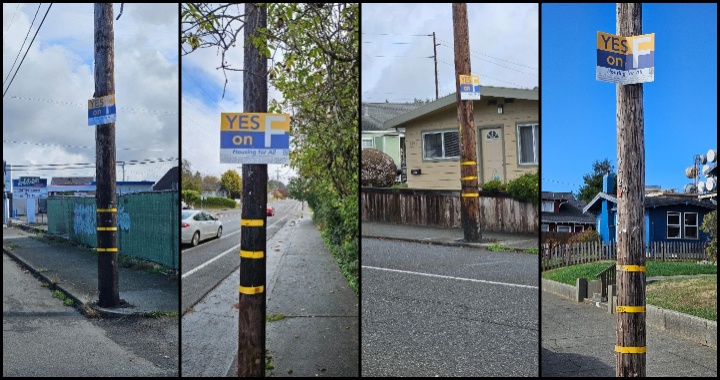
Several Dozen ‘Housing For All’ Signs Illegally Placed On Telephone Poles Around Town Over the Weekend
Hank Sims / Monday, Oct. 28, 2024 @ noon / Elections

Photos: City of Eureka.
Sometime over the last few days, dozens and dozens of signs supporting Measure F — the pro-parking “Housing For All” initiative that appears on current Eureka ballots — sprung up on telephone poles throughout the city and surrounding areas.
The problem? Those signs are, uh, illegal.
Eureka Municipal Code Section 155.340 specifically prohibits “[s]igns attached to or placed adjacent to any utility pole, parking meter, traffic signpost, traffic signal or any other traffic-control device, except when installed by a governmental agency.”
Eureka City Manager Miles Slattery, who personally removed many of the “Yes on F” signs over the weekend, says that city government has sent notices to Security National, its attorney and Measure F co-signers Mike Munson and Michelle Costantine, notifying them that the signs were placed illegally and inviting them to come pick them up at City Hall.
The yellow and blue signs were in the news last month, after a local resident altered the “Yes on F” slogan on the sign he had received to make it read “No on F.” This action prompted a citywide mailer from the well-funded, Security National-backed “Yes on F” campaign.
“Cheaters Always Lose,” the mailer read.
We’ve reached out to the Yes on F campaign for comment and will update when we hear back.