
OBITUARY: Carl Pellatz, 1945-2026
LoCO Staff / Sunday, July 5 @ 6:56 a.m. / Obits

Carl Eric Pellatz passed away peacefully in his sleep on June 25, 2026, with his wife by his side.
He was born on July 13, 1945, in Oregon City, Ore., to Helen and Rudolf Pellatz and moved to Arcata in 1959. He graduated from Arcata High School in 1963 and continued his education at Humboldt State University and the San Francisco College of Mortuary Science, graduating in 1967.
Carl’s professional journey began as a mortician before transitioning to a successful career as an insurance broker in 1974. Beyond his professional life, Carl was a dedicated pillar of the community. He served as a volunteer firefighter with the Arcata Fire Department from 1965, rising to the rank of captain. His commitment to public service resulted in an election to the Arcata City Council in 1992, serving as Mayor from 1995 to 1996.
His spirit of service extended throughout the region. Carl was a career-long Rotarian and past president, a founding member of the Humboldt Crabs nonprofit board of directors, and an active contributor to the Humboldt State University partnership campaign. He also served as a Governor’s Appointee to the Medical Quality Review Committee from 1984 to 1992 and was a familiar, respected presence on the basketball court as a referee.
Carl’s greatest joy was found in his family. After marrying in 1964 and raising three brilliant daughters, he married Charlene Janssen in 1996. They enjoyed 30 years of companionship, dedicated to community service, traveling, and the joy of grandparenting their five grandchildren. He leaves behind a legacy of service and devotion to the people and places he loved.
Carl is survived by his wife, Charlene Pellatz; his three daughters, Kristina Marquez (Manny), Amy Pellatz, and Juliana Wayman (Darrell); his five grandchildren, Anna Beck, Ava and Xander Jerry, and Mica and Grey Wayman; brothers Paul Pellatz (Pat) and Malcolm Blanchard (BJ); as well as nieces and nephews, Jeff Pellatz (Jeannie), Curt Pellatz (Coni), Todd Sobol (Sherrie), Eric Sobol (Shirley), Lisa Gorge and Sydney Blanchard.
A celebration of life will be held in late summer. Details to follow.
###
The obituary above was submitted on behalf of Carl Pellatz’s family. The Lost Coast Outpost runs obituaries of Humboldt County residents at no charge. See guidelines here. Email news@lostcoastoutpost.com.
BOOKED
Today: 7 felonies, 18 misdemeanors, 0 infractions
JUDGED
Humboldt County Superior Court Calendar: Today
CHP REPORTS
No current incidents
ELSEWHERE
KINS’s Talk Shop: Talkshop September 1st, 2026 – Aaron “Stu” Salles
EcoNews: “What’s in a Name?”: A Chilling Act of Censorship
EcoNews: The Fix Our Forest Act: Benefit or Bypass
RHBB: Debris Burning Suspension Remains in Effect Despite This Week’s Rain
THE ECONEWS REPORT: The Remarkable History and Uncertain Future of Abalone with Author Ann Vileisis
The EcoNews Report / Saturday, July 4 @ 10 a.m. / Environment

Photo: Wikimedia.
###
Explore the exciting world of abalone! Author, naturalist, and environmental historian Ann Vileisis talks to the Gang Green about the sad, strange and sometimes hopeful history of California’s abalone.
“The EcoNews Report,” July 4, 2026
###
LINKS:
HUMBOLDT HISTORY: Fourth of July Festivities in Humboldt County’s First Years, During Times of Peace and War
Ann Hunt / Saturday, July 4 @ 7:30 a.m. / History

Celebration on the Arcata Plaza, looking west, 1870, with the I.O.O.F. and the Eureka Brass Band. Photos via the Humboldt Historian.
A look at early Fourth of July celebrations in Humboldt County, 1855-1865, reveals a host of red-white-and-blue American traditions. We see an enthusiasm for the revolutionary spirit of America’s beginnings and its founding document, the Declaration of Independence, in both good times and bad.
According to the sometimes-sketchy newspaper accounts of the day from 1855 to 1865, such festivities were divided into two categories: those commemorating the signing of the Declaration of Independence and those that used the occasion as an excuse for social gatherings. Some activities were planned by local organizations or committees, while others, especially the dances, appear to have been put forth by enterprising businessmen.
Commemorations that focused on the nation’s independence included cannon salutes, the reading of the Declaration of Independence, speeches and toasts, editorials on the meaning of the day, and reprints of Fourth of July speeches given here and elsewhere.
Social events were no less important. Dances, picnics, horse races and fireworks strengthened community ties. They introduced people to one another. They reduced the social isolation of many families. They allowed for conversation around matters of personal and community importance. They also contributed to the economy. While geography or differences in social status, politics or religion often separated people, these functions provided connection. Yet by the Civil War-torn 1860s, many questioned whether these festivities should be held at all.
From 1855 to 1859, as the area’s pioneer settlements saw changes in populations, the economy and leadership, Independence Day events on the bay principally took place in Union (Arcata). Other locations held celebrations, but no place established and maintained the continuity and diversity of activities that Arcata did.
While these factors continued to play a role from 1860 to 1865, the effects of sectional politics and the Civil War made their mark on the county’s Fourth of July celebrations. This is particularly evident in the commemorative events, where an emphasis on loyalty to the Union and preservation of the Union replace America’s independence as the most important theme.
1855-1859
Newly arrived settlers found themselves in a very large county with a very small population. In the 1850 census, Union showed a population of 188 and Eureka, 55. By 1860, the population of Humboldt County increased to 2,698. Eureka, with a population of 478, had finally outgrown Arcata with its 316 citizens. Almost half of the county’s population, 1,166 people, resided in townships south of the bay: Table Bluff, Eel River, Pacific and Mattole.
It appears the early July 4th events were intended as countywide celebrations. An advertisement for a Fourth of July Ball at Murdock’s Hall in Union lists managers from Eureka, Bucksport, Hoopa Valley, Orleans Bar, Bates’ Ranch, Angel’s Ranch, South Fork and Trinidad. The steamer Glide advertised holiday excursions from Union to Eureka, Bucksport, Humboldt and North Beach, returning to Union in the evening. This let people visit friends in other parts of the county or travel to Union for the evening’s dance. During these years, Eureka hosted only one event, when three men named Moore, Pickard and Duyer hosted an Independence Ball in 1856.

Murdock’s Hall on the Plaza in Union (Arcata), c. 1850, from the Kuchel & Dresel 1857 lithograph.
In an article written about the Fourth of July celebrations of 1855, the editor of the Humboldt Times observed: “The day was celebrated by different parties in such a manner as was most agreeable to their respective tastes.” After detailing the commemorative events in Union, he then described other festivities of the day:
Some passed the day in yachting on the smooth waters of our bay; a large cavalcade of equestrians, both ladies and gentlemen, galloped “o’er the hills and far away,” others went to the races, … [others] sought out our shady brooks and were seen returning at eve handsomely rewarded with strings of fine trout. All united at night at Murdock’s Hall, where the ball of the season came off.
It is likely that these types of celebrations endured at least until the arrival of automobiles.
During the 1850s, the Methodists took the lead in planning commemorative events and community picnics. They began with speakers at the church and moved to picnics, sometimes returning to church for more speakers or activities. One exception occurred in 1857, when the Sons of Temperance from Union, Eureka and Bucksport joined to sponsor an event in a grove between the later two settlements. The oration of the day was given by Major Gabriel J. Rains of Fort Humboldt.
Common to all these early day celebrations were cannon salutes, recitations by Sunday school children, patriotic speeches, processions and picnics. The Declaration of Independence was read. In time, musical presentations were added.
During the day, people moved from one event site to another in procession, either by walking, horseback, carriage and/or wagon. In Union, for example, they often picnicked in a grove north of town; one year the picnic took place near the mouth of the Mad River. Travel to these locations was done “in procession.” Processions were not unique to the Fourth. Many events in this era involved processions. “Temperance,” or nonalcoholic, beverages, food and desserts were among the hallmarks of these early picnics. The ladies of the community prepared the food for the picnics. Food was also a part of the evening’s dances, which appear to have been sponsored by local businessmen. It is not clear whether these evening meals were sit-down dinners or buffets, but the food was prepared by a caterer, often the owner of a local hotel. Throughout the county, dances were the most regularly occurring event on the Fourth. The second most common activity was the reading of the Declaration of Independence.
Between 1855 and 1859, the people of Eel River gathered mostly for horse races, conversation and evening dances. The most elaborate event took place in Hydesville in 1858, when the Hon. H. W. Havens, the county’s assemblyman, Major Rains of Fort Humboldt, and the Eureka Brass Band were all part of a formal program.
1860-1865
By 1860, many things began to change in the county — and the country. Observances of the Fourth also changed in subtle ways. For the first time since 1856, Eureka hosted a dance in 1860. Held on July 3, it did not compete with the dance at Murdock’s Hall in Arcata.
Another first that year was that in Arcata a local committee, rather than the Methodist Church, planned and coordinated the events of the day. Throughout this five-year period events in Eureka and Arcata would be planned by a committee of citizens.
Though not on the program in 1860, the politics of the upcoming presidential election must have been a hot topic of conversation. It certainly was in the Humboldt Times. Local issues may have divided people before, but this was the first time, as the presidential race heated up around secession, that national politics entered local newspapers with such force.
The 1860 commemorative events in Arcata took place at a “grand picnic” at Jacoby Creek. The Humboldt Times editor wrote:
The place being selected was one of the most delightful spots in the county. It was cleared off on the bank of the stream underneath two large maple trees, the limbs of which were in contact about thirty feet from the ground and overgrown with a beautiful moss which protected it from the heat of the sun …The mountain trout are plentiful in the stream and many hundreds of fine ones had been caught in the morning by a fishing party.
These were … served up with the greatest variety of good things, which had been prepared by the ladies of Arcata.
After the meal, the Declaration of Independence was read, an oration given and national songs were sung by the Glee Club of Arcata. Fireworks on the Plaza and a ball in the evening concluded the day. Eureka planned a “Grand Union Celebration” for the county in 1861. The Humboldt Times editor reported:
As the morning advanced, people began to pour in to town from the different sections of the county. The new steamer Ida, sloops Flying Cloud, Live Yankee, and other craft arrived at the wharf about half past ten o’clock from Arcata, loaded to the water’s edge.
Though the Declaration of Independence was still read, the focus and emphasis of the day had shifted to the preservation of the Union and loyalty to it. Flags and bunting had been evident for several weeks, with flags flying on the fronts of public buildings. The Humboldt Times reported, “Soule, of the Phoenix Exchange, was first to raise the stars and stripes, but suit was quickly followed at the land office, post office, and Brett’s.” A 154-foot high Liberty Pole was erected on Eureka’s plaza and on the Fourth a 20’ x 30’ flag consisting of “the whole 34 stars” was raised.
The year 1861 was also the year of the county’s first big Fourth of July parade. Bearing an American flag and dressed in buckskins, Seth Kinman led a procession of townspeople to Union Square. It included a band, schoolchildren, ladies, other citizens, and a choir of forty singers. Following them were the Sons of Temperance; a star-shaped cart containing Nellie McGeorge as the Goddess of Liberty; the Odd Fellows in regalia; thirty-four young women dressed in red, white and blue and representing the thirty-four states; the Masonic fraternity; officers of the army and navy, and the speakers of the day.
According to the paper, there were “about one thousand persons all told, in the procession, and fully five hundred more persons who did not join it.” Given the population of the county, these figures may be an exaggeration. It was certainly the largest parade the county had ever experienced, and it reflected the strong Union sentiments of its organizers.
The parade ended at Eureka’s plaza, where the flag was raised, the band played the Star Spangled Banner, the Rev. W. L. Jones from the Congregational church prayed, and Walter Van Dyke read the Declaration. The choir sang “All Together Again,” “Who Shall Sever Freedom’s Shrine” and “My Country ‘Tis of Thee.” Judge A. J. Huestis delivered an oration, closing his speech with an appeal to all to work to maintain the Union.
After the feast which followed the program, a series of thirteen toasts were offered. Previously, these may have been offered at the dinners or dances. It is unlikely they would have been offered at the events planned by the Methodist Church, which advocated temperance. These were not casual toasts. They were planned in advance and published in local newspapers, with specific men assigned to make each toast and to respond to each toast. Some responses were musical in 1861, though it is unclear who provided the music. Did everyone join in the singing of these responses or was special music arranged? All we know are the song titles of the responses.
By 1861, eleven states had seceded from the Union. Four border states, while remaining in the Union, were deeply divided in their loyalties and remained so throughout the war. Within Humboldt County, many hearts were divided as well. Some sided with the south. Others had family and friends living within the seceded states. Even if they sided with the Union, they were concerned for the well-being of loved ones.
An estimated 620,000 soldiers died during the Civil War and many more were wounded. The number of dead is “equal to the total American fatalities in the Revolution, the War of 1812, the Mexican War, the Spanish-American War, World War I, World War II, and the Korean War combined.” The shadow this cast over the nation is hard to imagine.
###
By 1862, war news took an ever more prominent place in the pages of the Humboldt Times. But in the month of June local upheavals took center stage.
On June 14, the front page of the Humboldt Times followed up on an “extra” published on July 10, which reported on a series of four Indian attacks in less than forty-eight hours. Attacks occurred at Daby’s Ferry and at the Muhlburg home on the Mad River, within a few miles of Arcata; a third attack was on the Trinity trail, but because it was a heavily traveled commercial route, it was of no less importance. Then a Monday morning attack on Robert Neece within a mile of Rohner’s store brought the concerns of Arcata’s citizens to those of Hydesville and Eureka.
By month’s end, meetings in Eureka and Arcata resulted in the formation of two companies of militia, and Walter Van Dyke was appointed to communicate with General Wright about the situation and make an application for arms from the respective state authorities. Men were signing up to go to war — not for the Union — but for an ongoing local offensive against the region’s Native peoples.
On June 28, the editor of the Humboldt Times wrote: “The attention of our people is too much occupied with Indian matters to take pleasure in the usual festivities of Independence Day.”
The large, enthusiastic demonstrations of 1861 were not repeated. Still, the citizens of Humboldt County did not let Independence Day go completely unnoticed.
In Arcata, Charles A. Murdock read the Declaration of Independence and H. W. Havens, Esq., spoke with optimism about the Civil War’s end. This was followed by a meal prepared by the ladies of Arcata, at which patriotic toasts were again offered and responded to by various men in the community.
The Times reported:
In Eureka there was a general display of the national bunting, with salutes morning, noon and night, finishing off with a ball at Schmidt’s new store. In the southern portion of the county celebrations were ‘in order,’ but we have no space for particulars.
While the editor had no space for particulars, we know from one advertisement that Hydesville observed the day with horse races in the afternoon and a dance at Barnum’s Hotel in the evening.
###
As the War Between the States continued, tensions mounted locally on many fronts. Strains arose between those who wanted Fourth of July events to continue and those who questioned their appropriateness in light of the war and its attendant suffering. This tension can be noticed in editorials, in letters written to the paper, in smaller and fewer advertisements for events, in the absence of ads for flags and fireworks, and in less attention being paid to the work of planning committees.
The following year, 1863, July 4th observances became even simpler and, in some respects, more somber. On July 9, 1863, an unknown person writing as “Mysticus,” observed in the Times:
The fact that the rebel army was around our Capital and had met with nothing to resist their progress Northward could not be banished from our minds, but cast over us a feeling of sadness akin to despair.
Toned-down observances took place at Eureka, Arcata and Table Bluff. Storms on the previous day moved various events indoors. In Eureka, the program was moved to Brett’s Hall, and lunch was spread out at the Russ House. As usual, there was dancing in the evening. At the Presbyterian Church in Arcata there were recitations by the children and singing, along with the reading of the Declaration and a few remarks by Major Murdock. The traditional picnic was moved to Murdock’s Hall.
Fireworks and bonfires did liven up the day, as Mysticus observed:
The evening found Young America in a state of high enthusiasm which gave vent to itself in long-continued and most unearthly yells, as like young savages they danced around their huge tar barrel bonfire, or pelted one another with flaming camphene balls. A very pretty display of fireworks was made from the plaza as also from several private residences.
Writing years later in his biography, Charles Murdock, son of A. H. Major Murdock, described the events on the Plaza.
The grown-ups did well in the day-light hours, when the procession, the oration, and the reading of the Declaration were in order; but with the shades of night the fireworks would have been inadequate but for the activity of the boys. … On the highest point in the center a fine flagstaff one hundred and twenty feet high was proudly crowned by a liberty cap … On a spot not too near the flagstaff we planned for a spectacular center of flame. During the day we gathered material for an enormous bonfire. Huge casks formed the base and inflammable material of all kinds reached high in the air. At dusk we fired the pile. But the chief interest was centered in hundreds of balls of twine, soaked in camphene, which we lighted and threw rapidly from hand to hand all over the plaza.
###
By 1864, the mood was darker. Touching on the upcoming Fourth of July, an unidentified person writing only as “Eureka” wrote in the Humboldt Times:
In times like the present, of great national calamity, when the hand of brother is lifted against brother in deadly strife — when grief and mourning sit at so many hearth-stones in the land — when so many of our countrymen are exposed to death on the battle field and so many far from home sleep in unrecognized graves, hilarity would be unbecoming, and rejoicing uncalled for … Let the money that is usually spent in feasting and display be contributed in some way for the comfort of our soldiers or their families.
Thus, the tension between the festivities and the grim war was finally resolved. Most, if not all, events in the county became fundraisers for the U.S. Sanitary Commission. Fourth of July contributions for the Commission included $680.22 from Eureka, $51 from Arcata, and $128 from Mattole. The events of the day continued amid speculation the war might soon be over.
The events of 1864 marked the beginning of another important change in Humboldt County’s Fourth of July observances. Prior to this, they were planned and led by men. While only men continued to be named to the committees, women started to step outside their traditional roles as the anonymous preparers of food. Through their involvement in supporting the U.S. Sanitary Commission, they began to take a more visible role in shaping these and other community events.
###
The following year, 1865, was momentous: Lee surrendered to Grant on April 8, and President Lincoln was assassinated on April 14. On July 8, the editor of the Humboldt Times wrote:
The Fourth of July was observed pretty generally over the county in a manner which testified more clearly the appreciation of the exalted position occupied by our nation at the present moment as it issues from the fiery ordeal through which it has just passed, and the deep reverence in which the people hold the noble heroes who have made and preserved us that nation … The day was celebrated at Arcata, Eureka, Hydesville, Mattole, and by the garrison at Fort Humboldt. Patriotic music, reading of the Declaration of Independence, orations, feasting, festivals, and dancing were the marked features of the celebration.
In 1866, Independence Day celebrations spread further. Ferndale joined the list of those hosting an event. Advertisements for events in the county and for fireworks returned to the newspapers. An expanding number of events south of the bay reflected the growth and development of this part of the county and their need to come together in communities of their own. In the communities around the bay and those south of the bay, the focus of these events returned once again to our nation’s founding spirit and founding document.
###
The piece above was printed in the Summer 2012 issue of the Humboldt Historian, a journal of the Humboldt County Historical Society. It is reprinted here with permission. The Humboldt County Historical Society is a nonprofit organization devoted to archiving, preserving and sharing Humboldt County’s rich history. You can become a member and receive a year’s worth of new issues of The Humboldt Historian at this link.
(UPDATE) Dead Humpback Whale Found on Mad River Beach
Isabella Vanderheiden / Friday, July 3 @ 1:19 p.m. / Wildlife
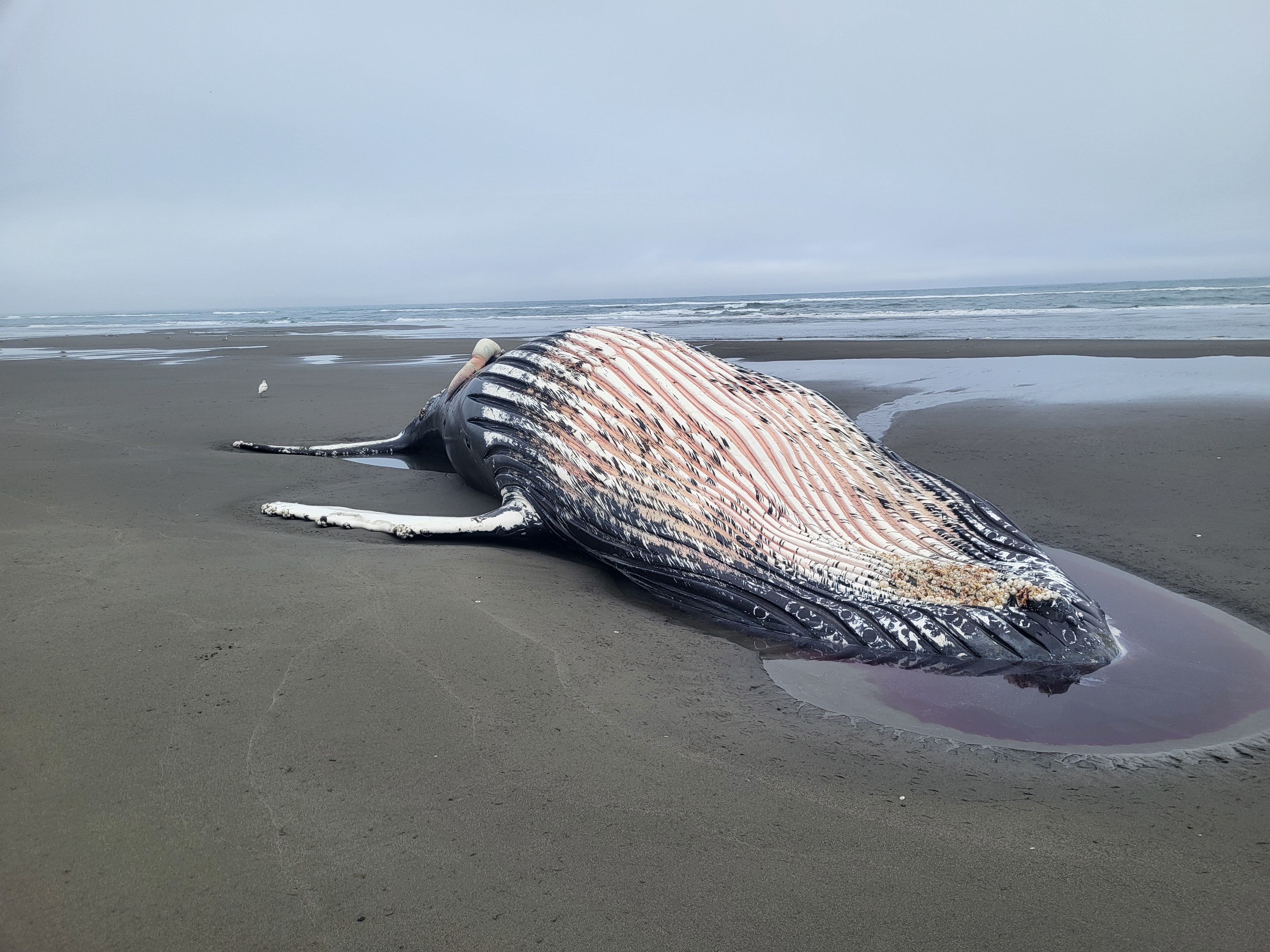
Photos provided by LoCO reader Tom Schallert.
###
UPDATE, 2:30 P.M.: While the cause of death remains unknown, Dawn Goley, director of the Marine Mammal Stranding Program at Cal Poly Humboldt, shared a few additional details about the 34-foot humpback whale that was found this morning on Mad River Beach, about a mile south of the mouth of the river.
The deceased whale was first seen floating offshore on Thursday, and it came ashore sometime last night, Goley told the Outpost.
“My team and I went out and took standardized measurements, collected some standardized samples of skin and blubber and did extensive observations to see if there was any obvious sign of the cause of death, or things that could indicate cause of death, but there was nothing definitive from what we saw externally,” she said in a phone interview this afternoon. “It looked to be in relatively good health and it had a thick blubber layer.”
As nature takes its course, beachgoers and pets should keep a “respectful distance” from the whale as it decomposes, Goley said. “It’s kind of in the tidal zone, and whales can get flipped in the waves and that could hurt someone,” she continued. “Also, there are juices coming out of the whale, so you want to keep pets and things away just for their safety and your safety.”
###
A deceased male humpback whale washed ashore on Mad River Beach this morning, according to staff with the North Coast Marine Mammal Center.
The cause of death is unknown at this time, but a staffer with the center told the Outpost via text message that researchers with Cal Poly Humboldt’s Marine Mammal Stranding Program are currently onsite conducting an assessment of the whale. We’ll update this post when we hear back.
This is the third humpback whale to wash ashore on the California coast since the beginning of June. The first was a deceased whale spotted on a beach near Pacific Grove in Monterey County on June 3, and a second juvenile humpback was found stranded at Sunset Beach near Watsonville in Santa Cruz County.
Staff with the UC Santa Cruz Marine Mammal Stranding Network conducted necropsies on the whales and identified domoic acid, a marine biotoxin associated with harmful algal blooms, in both samples. Exposure to domoic acid can cause neurological impairment, seizures and death in marine mammals, according to the report.
If you find a dead or stranded marine mammal on a local beach, contact Cal Poly Humboldt’s Marine Mammal Stranding Program at (707) 826-3650 or marinemammals@humboldt.edu. Injured or sick stranded marine mammals can also be reported to the North Coast Marine Mammal Center at (707) 951-4722.

The Pikeminnow Fishing Derby is Back! Get Out on the Eel River and Kill Invasive Fish for a Prize
LoCO Staff / Friday, July 3 @ 11:39 a.m. / Fish

Photo: TRIB Research.
###
Press release from TRIB Research and CalTrout:
The Eel River Pikeminnow Fishing Derby is back for its third year in its current format, and the numbers keep growing. In 2024, derby participants caught more than 500 fish. Last year, that effort more than doubled and anglers brought in 1,118 pikeminnow.
From July 1 through August 31, anyone with a valid California fishing license (or if under 16 years old, no license is necessary) can compete for a chance to win up to $800, with $5,000 in total cash and prizes available. There is no entry fee to participate.
Data collected from each catch helps researchers and managers better understand pikeminnow populations and their effects on native fish in the Eel River watershed, making this community event a win for anglers and for conservation efforts in California.
Background: Sacramento Pikeminnow in the Eel River
Sacramento Pikeminnow are not native to the Eel River. They were introduced via Pillsbury Reservoir in the late 1970s and have since spread to all forks of the river. Prolific and wide-ranging, they make seasonal freshwater migrations and have been found to prey on native salmonids and lamprey. On top of longstanding stressors such as historic overfishing, damaging logging practices, habitat loss, and the accelerating impacts of climate change, pikeminnow present an additional challenge to the recovery of native fish populations through both predation and competition.
In 2018, the Wiyot Tribe and Stillwater Sciences launched a focused effort to monitor pikeminnow in the South Fork Eel River and analyze their diet to better understand predation impacts. That collaboration has since grown to include CalTrout, UC Berkeley, the Bureau of Land Management, the California Department of Fish and Wildlife, and TRIB Research. Together, these partners are working to characterize pikeminnow distribution, behavior, and ecological impact, and to develop tools to reduce their presence in critical native fish habitat. One recent approach involves a channel-spanning weir designed to limit pikeminnow migration into the upper South Fork Eel.
For more on current pikeminnow research and management in the Eel, see the Wiyot Tribe’s Lhoulhaqh Pikeminnow Management Plan.
Derby Fishing Waters
Eligible waters include:
1. South Fork Eel River — downstream of the Humboldt County line to the confluence with the mainstem
2. Mainstem Eel River — from Dos Rios to the mouth of the Van Duzen
3. Van Duzen River — from Grizzly Creek to the mouth of the Van Duzen
Waters outside these boundaries are excluded from the derby to reduce fishing pressure on native fish in adjacent habitats.
Don’t Let the Y-Bones Fool You
Pikeminnow have an underserved reputation as inedible. When prepared properly (the key is managing the y-bones), they make for an excellent meal – fish balls in noodle soup, fried fish cakes, fish tacos, you can even try smoking them!
How to Enter
Full entry details, eligibility rules, and a guide to catching pikeminnow in the Eel River are available at tribresearch.org/pikeminnow.
###


Hoopa Firefighters Extinguish Late-Night Brush Fire Near Rodeo Grounds
LoCO Staff / Friday, July 3 @ 9:45 a.m. / Fire

Photo: Hoopa Fire Department
###
Facebook post from the Hoopa Fire Department and Office of Emergency Services:
Incident Name: Rodeo 1
Date: Last Night
Time Reported: Approximately 11 PMLast night at approximately 11:00 PM, Hoopa Wildland Fire responded to the Rodeo 1 Incident, located below the rodeo grounds near the Nixon Fishing Hole river bar.
The fire burned approximately 4 acres of river bar brush and began making an uphill run toward a nearby residential area. Due to the steep terrain and limited access, water tenders were unable to safely access the fire area and were staged nearby to support smaller 4x4 wildland engines, which delivered water directly to the incident.
Recognizing the threat to nearby homes, the Incident Commander requested assistance from the Hoopa Valley Volunteer Fire Department to provide structure protection for residences at risk while suppression efforts continued.
At approximately 12:00 AM, resources from the U.S. Forest Service Lower Trinity District were dispatched to assist with the Rodeo 1 Incident. However, at approximately 12:45 AM, those resources were diverted to respond to the Bluff Fire near Norton Field due to the emerging incident.
Through the coordinated efforts of Hoopa Wildland Fire and the Hoopa Valley Volunteer Fire Department, firefighters successfully contained the fire and prevented it from spreading into the residential area. No structures were lost, and no injuries have been reported.
We would like to thank all responding personnel and our partners for their rapid response, professionalism, and continued commitment to protecting the Hoopa Valley community.
As temperatures remain high and vegetation continues to dry, everyone is reminded to use extreme caution with any activity that could start a wildfire. If you see smoke or fire, report it immediately by calling 911.
We appreciate the continued support of our community as we work together to keep Hoopa Valley safe.
###

Photo: Hoopa Fire Department
New Fire Restrictions Take Effect Across Six Rivers National Forest
LoCO Staff / Friday, July 3 @ 8 a.m. / Fire , Safety

Photo: Six Rivers National Forest
###
Press release from Six Rivers National Forest:
Eureka, CA., July 2, 2026 — Due to dry conditions and increasing fire danger, the Six Rivers National Forest is implementing fire restrictions, beginning July 3, 2026. These restrictions apply to all of the Six Rivers National Forest (SRF) and land administered by the SRF which includes the Ukonom Ranger District of the Klamath National Forest. Forest visitors may still have a campfire within a designated fire safe site, developed recreation site, and in designated Wilderness areas. Restrictions are expected to be lifted on November 16, 2026, conditions permitting. The following is prohibited during fire restrictions:
- Building, maintaining, attending, or using a fire, campfire, or stove fire, except in Wilderness areas, Designated Fire Safe Sites, or within stoves, charcoal grills or fire rings provided in the Developed Recreation Sites. See Exhibit A for a list of sites.
- Smoking, except within an enclosed vehicle or building, or while stopped in an area at least three feet in diameter that is barren or cleared of all flammable material.
- Operating an internal combustion engine off National Forest System roads and trails
- Welding, or operating an acetylene or other torch with open flame.
View the complete forest order including a map and a complete list of developed recreation and designated fire safe sites visit the following link: www.fs.usda.gov/r05/sixrivers/alerts/forest-fire-restrictions
If visitors choose to have a campfire within a designated recreation site, follow these safety tips to prevent starting a wildfire:
- Clear all flammable materials from the ground for five feet in all directions from the edge of the fire and make sure it is located away from overhanging limbs. Only use developed fire rings.
- Have a shovel and water nearby.
- Keep your campfire small and only use dead and downed wood…don’t cut live trees for firewood.
- Make sure a responsible adult is always in attendance of your campfire. NEVER leave a campfire unattended!
- Always make sure your campfire is DEAD OUT before leaving it! Drown it with plenty of water, stir well with a shovel, feel to see if it is hot, REPEAT. If it is too hot to touch, then it is too hot to leave.
###


