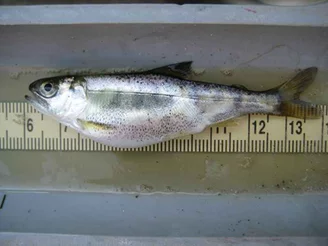
Juvenile Chinook salmon. | Photo: Roger Tabor/U.S. Fish and Wildlife Service, Public Domain.
###
Press release from the Karuk Tribe:
Orleans, CA — The Karuk Tribe today emphasized that Klamath River dam removal remains a historic and necessary step toward salmon recovery, while cautioning that recent detections of fish disease among juvenile salmon show that the river is still in the early stages of healing.
A juvenile Chinook salmon exhibits signs of C. shasta. | Photo: USFWS
Following dam removal, the Klamath has shown encouraging signs, including strong adult salmon returns and significant juvenile salmon outmigration from river reaches that had been devoid of salmon for a century. At the same time, monitoring has detected elevated levels of Ceratonova shasta (C. shasta), a fish parasite that can cause serious disease in juvenile salmon.
Tribal fisheries staff note that the disease detections are occurring during a difficult water year marked by low snowpack, early snowmelt, low flows, and high water temperatures. These conditions can increase stress on juvenile salmon and create more favorable conditions for disease transmission.
“Dam removal gave the Klamath River and our fish a fighting chance,” said Karuk Vice Chairman Kenneth Brink. “But no one should confuse dam removal with an instant cure. The river was damaged for more than a century. It will take time, strong winter flows, habitat restoration, and continued care to bring it back to health.”
The Tribe stressed that recent disease detections should not be interpreted as evidence that dam removal has failed. Rather, they demonstrate the complexity of river recovery after more than 100 years of altered flows, blocked habitat, degraded water quality, and disrupted ecological processes.
“The science is telling us two things at once,” said Karuk Senior Biologist Toz Soto. “First, salmon are now using their historic range, including areas with cold spring water. That is exactly why dam removal is important. Second, this year’s historic low flows and associated warm-water conditions are hard on young fish and can increase the risk of disease. The Klamath is recovering, but it is not yet recovered fully.”
Soto notes that large numbers of wild juvenile salmon migrated out to sea before the disease rates reached their height, and the bulk of dying fish appeared to be from the Fall Creek Hatchery.
C. shasta is not new to the Klamath River. It is a long-standing disease issue that is influenced by river conditions, including flow, temperature, habitat, and the parasite’s life cycle. Fisheries scientists have long understood that strong seasonal flows can help improve river conditions by moving sediment, disturbing disease-related habitat, and supporting healthier ecological processes.
“One good year or one bad year will not define the future of this river,” Soto said. “What we need now are several winters with strong flushing flows, continued habitat restoration, and careful monitoring so the river can rebuild the natural functions that salmon depend on.”
“How federal agencies manage water in the coming year is key,” said Brink. “We need a water strategy that doesn’t favor the needs of agriculture over fisheries. It’s difficult in years like this, which is one of the driest on record.”
The Karuk Tribe believes communications about the river must be honest about both progress and challenges. Dam removal reconnected the river and restored access to historic habitat, but full recovery will require sustained commitment from Tribal governments, federal and state agencies, restoration partners, water managers, and the public.
“The Klamath story is no longer only about removing dams,” Brink said. “It is about restoring the relationship between the river, the fish, and the people. That work is underway, but it is long-term work. We owe it to the salmon and to future generations to stay focused.”
The Tribe will continue working with federal, state, Tribal, and local partners to monitor juvenile salmon health, track disease conditions, support habitat restoration, and advocate for river flows that improve salmon survival.
TRINIDAD, CA — Humboldt County residents have filed a ballot initiative to permanently ban large-scale warehouse and distribution facilities from the county’s Coastal Zone — protecting the local businesses and coastal ecosystems that make this one of California’s most extraordinary places.
The measure, submitted by Indivisible Trinidad, would prohibit new warehouse or distribution facilities exceeding 20,000 square feet within the Coastal Zone. Marine-dependent uses are fully exempt. The prohibition applies to all pending applications for which a Coastal Development Permit has not yet been issued.
“We have something special here worth preserving,” said Dr. Tina Freeland, Indivisible Trinidad organizer. “Old-growth redwoods. A spectacular coastline. Working harbors and fishing families who’ve been here for generations. Small seaside communities with local shops. People come to Humboldt because it means something different. Industrial warehousing dismantles that.”
Businesses that thrive in Humboldt reflect the place itself — independent bookstores, galleries, art studios, nature outfitters, handcraft shops, farm stands and small inns tucked into the trees.
Their customers are visitors who drive hours to be somewhere that doesn’t look like everywhere else. That environment and the economy are fragile and irreplaceable, not compatible with industrial truck traffic, security lighting and concrete warehouse pads on the coastal bluffs.
Large warehousing can be located anywhere. There is no reason to put it here.
“Communities up and down this coast have watched industrial development hollow out the very thing that made them special,” said Dr. Freeland. “Humboldt still has what those places lost. This is how we keep it.”
As soon as their petition is approved, Trinidad Indivisible and other community organizers will be collecting 4,874 valid signatures from registered Humboldt County voters to place the measure on the November ballot.
To get involved, contact Debbie.Harrison.Rumberger@gmail.com
First partner Jennifer Siebel Newsom in Sacramento, on Feb. 11, 2026. Photo by Miguel Gutierrez Jr., CalMatters
###
This story — by reporters Maya C. Miller, Wendy Fry and Lynn La — was originally published by CalMatters. Sign up for their newsletters.
###
Gov. Gavin Newsom on Monday accused President Donald Trump of placing him and his wife on a political “hit list” and directing federal investigators to go on a “fishing expedition” for a crime it could use to indict him.
The Democratic governor declared that the president was targeting him because Newsom is considering a run for president in 2028.
“In recent days, federal agents have knocked on the doors of family friends and former employees,” Newsom said in the video. “Not because they found a crime, but because they simply are trying to find one.”
Newsom stated that he was “proud” to join Trump’s so-called “enemies list” that has also included former FBI Director James Comey, New York Attorney General Letitia James, U.S. Sen. Adam Schiff and Minnesota Governor Tim Walz, the former vice presidential candidate.
According to a person in the Department of Justice who is familiar with the investigation, there have been at least two criminal investigations into Newsom ongoing for a year in the Eastern District of California.
They originated from whistleblowers and people in Sacramento regarding the first partner Jennifer Siebel Newsom’s taxes and the separate investigation into Newsom’s former chief of staff Dana Williamson, who pleaded guilty in May in a corruption scandal that has not implicated the governor.
Newsom’s office characterized the investigative activity as an unfounded attack federal prosecutors undertook when they hit a dead end with the Williamson investigation. Investigators have been digging into private and “deeply personal matters” of the Newsom family, including the couple’s marriage, his office said.
The governor claimed that federal agents were demanding records and “abusing the grand jury process” by “digging through years and years of random documents.” Neither the governor nor Siebel Newsom have received subpoenas yet, Newsom’s office said, but he “looks forward” to receiving them.
Newsom’s office told reporters that given how specific some of the investigators’ questions were, they believe federal agents have issued subpoenas for the financial records for businesses associated with the Newsoms.
Newsom came to office with a successful hospitality company called PlumpJack, which he has placed in a blind trust. Siebel Newsom is a filmmaker who leads nonprofit groups called the California Partners Project and the Representation Project.
Newsom solicited at least $1.9 million in charitable payments known as ‘behested payments’ in 2024 and 2025 for Siebel Newsom’s California Partners Project, which champions gender equity, including $1 million from the Federated Indians of Graton Rancheria, according to disclosure reports filed with the Fair Political Practices Commission.
His office said federal agents have contacted more than a dozen friends, former employees, business associates, donors, and organizations connected to the Newsoms but did not specify further.
The accusations first came in a fiery video statement released Monday, but provided no concrete evidence that the president had orchestrated such a probe and did not identify any of the associated groups or people he said the Justice Department was looking into.
Newsom’s office insists that the department is hunting for a new crime to pin on the governor after coming up empty-handed following its arrest of Williamson. That initial probe was first opened by the Department of Justice during the Biden administration.
Williamson was indicted on wire fraud charges for funneling money from a dormant campaign account belonging to Xavier Becerra, the former Biden health secretary and the frontrunner to succeed Newsom as governor.
An attorney for Williamson, Matthew Rowan, did not immediately respond to a request for comment Monday.
The White House referred questions about Newsom’s comments to the Department of Justice. A Department of Justice spokesperson did not immediately respond.
“You can subpoena my records. You can investigate me. You can harass me. Put my name on any and every enemies list that you have,” Newsom said. “But leave my wife and family out of your personal vendetta!”
With
heavy hearts we need to inform everyone of the sudden passing of our
dear son, Tad Sarvinski, on June 2, 2026.
Tad
was born in Walnut Creek, on September 15, 1978, and moved back to
Humboldt County, settling in Hydesville. Growing up, Tad enjoyed the
outdoors, hiking on the family property, swimming in Yager Creek,
building tree forts, selling corn in a little roadside stand, and
raising 4-H and FFA animals. He also worked on the ranch tending
vegetable gardens and livestock.
He
attended Hydesville Elementary and Fortuna High where he played
multiple sports, football being his favorite. He was an avid 49ers,
Giants and Warriors fan. He attended a 49ers playoff game at the age
of three and was hooked for life.
He
attended Chico State and finished college at the University of
Phoenix with a B.A. degree in Business Administration. During college
he worked for a paint manufacturing plant in Chico and became one of
their salesmen upon graduation. He returned to Humboldt County and
worked as an advertisement salesman for radio and newspaper and an
assistant editor for Sensi Magazine. He then went back to the land
and raised a produce garden and enjoyed selling at the local Farmers
Markets.
He is survived by his parents, Julie and Buzz Sarvinski; his brother, Bo Sarvinski; aunts and uncles godfather Gary and aunt Linda Sarvinski, Leanne Ryan, Greg and Tammie Sarvinski, Gene and Ginger Sarvinski, Lisa and Vince Gamboa, Bill and Caligney Baldwin, Bev Baldwin, Cousin Lars and many more special cousins.
He was preceded in death by his brother, Ty Sarvinski; grandparents Spike and Millie Sarvinski and Helen and Hal Baldwin; uncles Galen Sarvinski, Hal Baldwin II, Frank Cardoza, and Ron Doebel; aunt Lottie Luke; godmother Linda Doebel; and cousin Disney Gamboa.
He
also leaves his furry companions, Boogie, Maggie, Dusty and Buddy
Black.
A
service will be held on Saturday, June 20, at St. Joseph Catholic
Church in Fortuna, 810 14th Street, at 10 a.m. A reception will
follow at Bear River Casino Ballroom.
Tad
will be forever in our hearts — until we meet again.
###
The obituary above was submitted on behalf of Tad Sarvinski’s family. The Lost Coast Outpost runs obituaries of Humboldt County residents at no charge. See guidelines here. Email news@lostcoastoutpost.com.
I imagine I always knew this day would come but I had a piece of me that thought — or maybe hoped — it wouldn’t. I don’t even know where to begin.
How do you put on paper the love you have, how do you capture her sense of humor, her love of music and singing, for black and white classic movies, all things Elvis, or her laugh — oh lord how we have laughed — but most of all the love she gave us all. My God, how she loved. I can go into detail about this event or that event in her life, but really what I want to say is that our mom was a fighter and survivor from the moment she took her first breath on August 12,1954 until she took her last breath on June 7, 2026.
She made a conscious decision to make the lives of her children nothing like the life she grew up in. She chose love over continued generational trauma, and for that we will always be grateful.
There will never be a way to capture who our mom was or how much we love her in this message, so yet again I find myself not knowing where to go with this. So I will list the love in her life.
Our mom is survived by her three children — Virginia Smith, Joshua Miraglia, Tiffany Baldwin — and their significant others; her six beloved grandchildren, Kendall Smith, Hunter Smith, Loerlei Martinez-Miraglia, Dominic Baldwin, Landon Smith, Tarah Baldwin and thier significant others (her bonus grandkids); as well as her two great-grandchildren, Autumn “Bella Girl” Owens and Braelynn “Brea Brea” Smith.
While the beautiful humans listed above were her whole world, she had a very big world of people she loved through out her life, starting with her siblings, our amazing aunts and uncle — Laurie Sachs (Terry), nephew Lindsey and niece Katie; Patrick Wollitz (Tamara), nephew Travis and niece Ashley; Mandy Fox (Gary), nephews Grey and Liam, niece Ryan and their significant others.
Mom was blessed with life-long friendships spanning 60 years. Pam “Nana” Mattot has been by our mom’s side through every happy, beautiful, amazing, rough, tragic and worst moments of her life, and gave our mom support and love. She is her true soul sister. Aunt Darlene and Aunt Debbie Jones, all I can say is that we dont have many memories that dont include you. Those ‘80s were really something! Your friendship with our mom will always be something I look back on and know what real love is between friends who are family.
She is preceded in death by her mother, Judy Perkins, and husband, Ernest Miraglia.
There are so many people who she loved and shared her life with and while you may not be listed here please dont think your part was any less special to her. Like I said in the beginning, I could never put it all into words on paper.
Cynthia Ann Miraglia (White) had many titles — Sister, Aunt, Cousin, Granny Hunny, Gran, GiGi — and they all meant the world to her, but her favorite one was Mama. Our lives will forever be changed but what won’t change is our love for her and her love for us. She loved us from our first breath and we will love her until our last.
Until we see you again, Mama.
Our family would like to extend our heartfelt gratitude to Hospice of Humboldt and Mom’s care team. Their compassion, support and dedication helped make a very difficult time a little easier for all of us. If you would like to honor our mother’s memory, we ask that you consider making a donation in her name to our local Hospice, whose care and kindness meant so much to her and our family.
This message was shared and approved by Cyndy :) HA!
###
The obituary above was submitted on behalf of Cynthia Miraglia’s family. The Lost Coast Outpost runs obituaries of Humboldt County residents at no charge. See guidelines here. Email news@lostcoastoutpost.com.
Ray Christie. | Detail of image provided by Larson LLP, the firm representing Christie in his federal civil rights suit.
Nearly two years after the abrupt closure of Humboldt County’s only USDA-certified slaughterhouse and meat processing facility, local beef producers say Redwood Meat Co. will soon reopen under new majority owner Raymond Frank Christie, an Arcata rancher who has been accused and prosecuted for multiple counts of animal cruelty, though never convicted.
The Outpost has been unable to reach Christie for this story. (He didn’t respond to multiple voicemails and texts, and just today he told courts blogger John Chiv that he won’t comment until Redwood Meat is “close to opening.”)
But several local beef producers say Christie has declared his intention to reopen the facility in the coming weeks or months.
Megan Kenney, director of the Harvest Hub program for the North Coast Growers’ Association, said Christie was among the attendees of a June 2 gathering of the North Coast Meat Processing Collaborative, a group that includes meat producers, buyers and support entities. Participants discussed a recently published industry analysis and worked to identify the region’s most urgent needs and next steps.
Kenney said Christie attended the first half of the meeting and discussed his plans for Redwood Meat.
“He said it should be up and running sometime over the summer, like in the next couple months,” Kenney said.
“Ray’s been telling me two to three weeks,” Victorine said when reached by phone on Friday. “He said he’d give me a tour.”
Christie also told attendees at the June 2 meeting that he’s been able to retain many of the trained staff members who worked for the Nylander family, which operated Redwood Meat for roughly seven decades, and that he’s purchased a lot of new equipment for the facility, Kenney said.
“Redwood Meat had been grandfathered in,” she added, referring to outdated equipment that was nevertheless given a pass by USDA inspectors since the facility had been operating continuously for so long. “After being closed down for a period, [Redwood Meat] was required to get new equipment,” Kenney said.
Humboldt County Planning and Building Director John Ford said Redwood Meat is going through a building plan check and will not need to obtain a permit to reopen.
“There is no Conditional Use Permit on the use of the property,” Ford said via email. “It has been there long enough to be considered a Legal Non-conforming use. It can be maintained and modified but not expanded and maintain that legal non-conforming status.”
Historically, Redwood Meat has primarily slaughtered and processed beef, lamb and hogs. Kenney said her understanding is that when the facility reopens, it will be licensed to process and retain the full carcasses of all animals under 30 months old. (When animals older than 30 months are slaughtered, the facility must retain the skull and spinal cord due to USDA food safety regulations.) Retaining the offal and other parts of younger livestock will reduce food waste and allow local farmers to retain more of their animals than before, Kenney said.
“[Christie] said that was something he’s very proud of,” she added.
However, it remains unclear how Christie will attract enough business to make a profit. When the Nylanders shut the place down in 2024, owner/operators Ryan and John “Punk” Nylander said the operation had long been financially “marginal” and finally buckled under rising costs for essentials such as insurance, water and utilities.
Furthermore, many local ranchers and their customers are wary of Christie and his reputation, given his history of animal neglect and abuse allegations. In 2009 he stood trial on charges pertaining to organized cockfighting after animal control officers who searched his McKinleyville farm discovered nearly 1,400 roosters and 90 gaffs and knives, the kinds of weapons attached to birds’ legs during a fight.
The jury in that case failed to reach a verdict, resulting in a mistrial. Christie was subsequently charged with threatening to assault his brother, who was scheduled to testify against him in court.
Nine years later, a multi-agency law enforcement task force raided Christie’s ranch in the Arcata Bottoms. He was arrested and later tried in court for four felony counts of animal cruelty and 10 misdemeanor counts of dumping cattle carcasses within 150 feet of state waters. Once again, a mistrial was declared after a single juror refused to convict, though he was convicted of numerous misdemeanor counts for dumping carcasses near state waters.
A retrial was ordered on the four felony counts. That trial endured numerous delays as Christie dealt with a series of medical problems, including a heart condition and a basal cell carcinoma diagnosis that required multiple surgeries. Charges in this second trial were dropped in December 2023 after Christie’s attorney alleged various improprieties in the case, accusing prosecutors of evidence tampering and unconstitutional interrogation.
Christie later filed a federal civil rights suit accusing the County of Humboldt, Sheriff William Honsal, prosecutor Adrian Kamada and other county personnel of violating his constitutional rights. The county has filed a motion to dismiss the case. The next hearing is scheduled for Aug. 5.
While Christie has yet to be convicted of anything beyond misdemeanors, some local ranchers say they have no intention of doing business with him. When Redwood Meat closed down two years ago, local ranchers were forced to find alternatives, with most opting to work with meat processing facilities hundreds of miles away — businesses such as Yosemite Valley Beef in Merced, Star Harvest in Yreka and Certified Meats in Fresno.
Thomas Nicholson Stratton, co-owner of the regenerative ranching, dairy-farming and ice-cream-making Foggy Bottoms Boys, said he’s working with other local producers to collectively send beef products to and from Star Harvest in Yreka twice a month and currently has no intention of changing.
Liz Klopper, who owns and operates Bear River Valley Beef with her husband Hugo, said they also plan on staying with Star Harvest. (She declined to offer a reason for the decision.)
Another meat local producer, who the Outpost spoke with on condition of anonymity, said they didn’t know of anybody at this point who would do business with Christie. Another noted that Christie could choose to import lower-quality animals to produce “commodity beef” but said it would be tough to compete with large-scale operations doing the same elsewhere in the state.
Still, Kenney suggested that the reopening of Redwood Meat could easily wind up benefiting the region.
“I know there’s a lot of hesitation,” she said. “But I can imagine if Redwood Meat Co. reopens, it’s not like [Christie] will be on the floor. It will be the same people maintaining humane slaughtering [that did so for the Nylanders]. So I think a lot of people are waiting to see what happens.”
When Redwood Meat closed down two years ago, several industry leaders described it as a loss of critical infrastructure, and they said small, family-owned farms had the most to lose.
Kenney said she understands why perspectives differ but predicted that if Christie winds up working more behind the scenes and proves that he can maintain humane treatment for the animals, some local ranchers will have a strong financial incentive to choose the Eureka operation.
“I know some people are like, ‘Absolutely no, no way in hell,’ while others are like, ‘Will it make my beef two dollars cheaper?’ We’ll see how it shakes out in six months to a year.”
A digital rendering of a floating offshore wind farm. | Image: U.S. Department of Energy.
###
A quick heads-up for people interested in offshore wind development on the North Coast — the Humboldt Bay Harbor District is hosting a public meeting in Arcata next week to discuss next steps for the Offshore Wind Heavy Lift Marine Terminal slated for the Samoa Peninsula.
If you haven’t been following the project up to this point, now is a good time to tune in.
Why now? The Harbor District is preparing environmental documents for the heavy lift marine terminal, and the agency needs community input to ensure the draft environmental impact report (DEIR) thoroughly addresses concerns surrounding the project. The June 24 meeting will be one of several opportunities the public will have to share their thoughts on the proposed project before the district recirculates the notice of preparation later this summer.
But before we dig into those environmental documents, a little refresher on the six-year history of the project:
The Harbor District began planning for the heavy lift marine terminal project back in 2020, just a couple of years after the Humboldt Wind Energy Area (WEA), located about 20 miles west of Eureka, was first identified as a possible location for a floating offshore wind farm.
The Humboldt Wind Energy Area (WEA)| Map: Bureau of Ocean Energy Management (BOEM)
In 2022, the Harbor District entered into a partnership with Crowley Wind Services to build and operate a full-service marine terminal on the Samoa Peninsula that would have the potential to produce and ship the gigantic components needed for floating offshore wind turbines — everything from the blades and nacelles (the generator house) to mooring lines, towers and transmission cables. In 2024, the Harbor District secured a massive $426 million grant from the Department of Transportation to build the project.
But despite all of this, the district has held out hope for Humboldt’s offshore wind future.
“Absolutely, we are moving ahead with port development,” Harbor District Executive Director Chris Mikkelson told the Outpost via email. “Markets change, and players change too; however, our drive for economic development and the construction of a multi-purpose heavy-lift marine terminal does not. We remain focused on driving economic development while cleaning up neglected brownfield lands in our community, restoring the health of the land and water, and we will remain so until we complete the goal we set a few years ago.”
“As for the Federal Administration’s actions, as we have shared many times, No Hard Feelings,” he added. “We will work with all to find a path that will bring a quality project forward for the consideration of our community.”
Conceptual rendering of the Humboldt Bay Offshore Wind Heavy Lift Marine Terminal | Photo: Harbor District.
The district is on target to have the project’s draft EIR ready for public review by next spring, Mikkelson said, with the final EIR and “a construction-ready project” ready to go by the end of 2027.
But before the draft EIR goes out for public review next year, the district will recirculate the notice of preparation (NOP) — the first step in the California Environmental Quality Act (CEQA) review process — for a 30-day public comment period. The NOP was first released in August 2023, but the district felt it should be updated to include new information, though nothing about the actual project has changed. That document will be released for public review in August.
“We are voluntarily revising and recirculating the NOP since quite a bit of time has passed,” Harbor District Development Director Rob Holmlund told the Outpost. “There have also been persistent rumors that the project ‘has been cancelled,’ which is not accurate. The project was temporarily paused following the loss of Federal funding, but the project proceeds as originally planned through the utilization of State funding. So, we decided that it would be helpful to the community to release an updated NOP to help clarify that the project is proceeding.”
At the end of last year, the district secured an $18.25 million waterfront facilities improvement grant from the California Energy Commission — a drop in the bucket compared to the $435 million in federal funding that was rescinded last year. Still, Mikkelson said the CEC grant will “further our technical studies and substantially grow our community engagement initiatives.”
“We will apply for additional funds through the CEC under an award made available from Proposition 4 funds, with more details to come as that program is currently under development,” he said, referring to the state’s $10 billion climate bond, which earmarked $475 million in funds for port upgrades to support offshore wind development in California.
Mikkelson could not say what portion of those funds, if any, the Harbor District is slated to receive.
A digital rendering of the fully built-out Humboldt Bay Offshore Wind Heavy Lift Marine Terminal. | Image: Harbor District.
After the public review period for the NOP wraps, the Harbor District will use those comments — and others submitted during community meetings, like the one coming up on June 24 — to set priorities for the draft EIR, which will analyze a wide-range of potential environmental impacts associated with the project.
In an effort to “go far above and beyond what is typical or required” to get the public involved, Holmlund said the district assembled a community advisory committee to improve local engagement and “ensure the project is informed by a broad community perspective.”
The 40-person community advisory committee includes delegates from North Coast tribes and the Northern California Indian Development Council, elected officials from the county and its seven incorporated cities, residents of the Samoa Peninsula, environmental advocates, business leaders and representatives from various industries, including commercial fisheries, aquaculture and the local building sector.
Wilfred “Wil” Franklin, director of the North Coast Small Business Development Center (SBDC), emphasized that the intent of the committee is not to advocate for offshore wind, but to ensure community members have access to accurate information about the proposed development.
“We aren’t necessarily advocates or proponents; we are just there as liaisons [for] communication and education,” Franklin told the Outpost. “There are [members who] aren’t really excited about offshore wind, but the communications have been very respectful, and everybody’s really trying to help the community. That feels really good, even if we sit on different sides of whether we want it or support it or not.”
Similarly, Heidi Moore-Guynup, the Blue Lake Rancheria’s director of tribal and governmental affairs, said it is essential to combat misinformation surrounding the port development project.
She pointed to a survey conducted by Oregon State University, in partnership with the Schatz Energy Research Center at Cal Poly Humboldt and several other universities, that sought to understand community perspectives on offshore wind development in Humboldt, Coos Bay, Ore. and Westport, Wash.
“What we learned is that very few people are actually aware of the proposed projects, both at the hyper-localized level and at the state level,” Moore-Guynup said. “So we want there to be active community education … and accurate information that’s distributed and made available so that individuals can make their own assumptions about offshore wind as an ecosystem.”
“When I say ‘offshore wind as an ecosystem,’ what we’re talking about are the actual floating wind turbines that will be in the ocean, about 20 miles off the coast,” she continued. “We’re talking about the heavy lift terminal that needs to be constructed to be able to assemble and tow out those turbines. We’re talking about transmission upgrades that need to happen to bring the power on the shore to provide more reliable electrification across the county, as well as to bring that electrification … to larger municipalities outside of the county. There’s supply chain needs, workforce development and training. When I say ‘offshore wind ecosystem,’ it’s all of those things.”
[DISCLOSURE: The Blue Lake Rancheria is a minority owner of the Outpost’s parent company, Lost Coast Communications, Inc.]
Moore-Guynup noted that the Blue Lake Rancheria is “currently in support” of local offshore wind development, given the Tribe’s “deep concern of climate change.” However, that support is hinged on several conditions, including the district’s commitment to a green port strategy, an Missing and Murdered Indigenous People (MMIP) prevention plan, tribal participation in workforce development and training, as well as ample mitigation measures to protect native plants and animals.
“It’s vitally important for there to be widespread community support for projects like this. Otherwise, it can feel very extractive,” she said. “The Harbor District also can tremendously benefit from those perspectives and community voices.”
Matt Simmons, an attorney with the Environmental Protection Information Center (EPIC), hopes the upcoming community meeting will encourage people from all sectors to get involved with the NOP/EIR process.
“The [NOP] basically says, ‘We’re thinking about doing this, what do you as the public and all the state agencies that regulate natural resources think? What concerns do you have? What should we be studying?’” Simmons said. “I think it’s important for people to know that the Harbor District is planning and … now is actually the time for the community to weigh in.”
The community meeting will be held at the Arcata Community Center (321 Dr. MLK Jr. Parkway) on Wednesday, June 24 from 5:30 to 7:30 p.m. Unlike previous meetings where staff provide lengthy powerpoint presentations to an audience, this meeting will be more interactive and attendees can wander around the room to view displays and ask questions about various aspects of the port development project.
“[A]ny project we propose must pass the test of the people,” Mikkelson said. “We invite all to engage, to provide personal testimony, and to have your voices heard.”