In times when fear and division are used to silence us, we choose to gather, to remember, and to celebrate. We will keep practicing our culture, which lives, grows, and flourishes in the community. Now more than ever, we need to walk together, because our strength comes from our roots and from the solidarity that binds us. El Dia de Muertos - The Day of the Dead celebration continues as an act of love, memory, and resistance. We invite everyone to join us, because together we defend our freedom and our joy to live fully with Peace and Dignity.
Centro del Pueblo is proud to invite the Humboldt County community to its 8th Annual Día de Muertos celebration on Saturday Sunday, November 2, from 4 to 6 PM at The Eureka Theater, 612 F Street, Eureka. This free, family-friendly event will honor the vibrant Mexican tradition of remembering and celebrating loved ones who have passed away.
The celebration will feature Mercadito, community altars, Danz###a Azteca, Catrinas, Mariachi Mar Pacifico and Mariachi de Centro del Pueblo, Teatro del Pueblo performances, Bailes Folklórico from Fortuna, Eureka, and Arcata, with special guests from our Youth council from CDP and Latinx Clubs from Mckinleyville and Eureka. Attendees are encouraged to bring offerings, photos, or small items to place on the community altar in remembrance of their loved ones.
“Día de Muertos is a time to honor our ancestors, celebrate their lives, and keep their memory alive through music, art, and community,” said Brenda Pérez, Executive Director of Centro del Pueblo. “This is a cultural celebration that welcomes everyone, whether they are familiar with the tradition or experiencing it for the first time.”
This event is part of Centro del Pueblo’s ongoing efforts to celebrate Indigenous heritage and the cultural revitalization of our communities in Humboldt County and to create inclusive spaces for intercultural dialogue, healing, and community building. To conclude these celebrations, we invite you to join our annual Procession for Immigrants Rights From Fortuna to Eureka on November 8th, details in flyer attached.
Event Details:
What: Día de Muertos Celebration
When: November 2, 2025 | 4:00–6:00 PM
Where: The Eureka Theater, 612 F Street, Eureka, CA
Jodeah Wilson, 22, on his laptop at his off-campus apartment near Sacramento State University on Oct. 17, 2025. Wilson, a former Sac State student, left school this semester after being unable to afford tuition. Photo by Felix Uribe for CalMatters/Catchlight Photography.
###
This story was originally published by CalMatters. Sign up for their newsletters.
###
If you ask Jodeah Wilson how his life got off track, he’ll say it’s all about money.
He needs money for November rent. He also needs money to pay back the tuition he owes for the spring semester at Sacramento State University, which would allow him to re-enroll. Until then, he’s stuck in limbo.
“All I need is a goddamn job so I can pay this off myself,” he said. But it’s been months and so far, he’s still unemployed.
To state leaders and researchers, though, it’s more than just money. California has nearly 500,000 young people ages 16 to 24 who are in the same predicament, neither working nor in school. Finding them a job is part of the solution, but it goes much deeper than that. Many are struggling socially and emotionally, too, making it even harder to move forward.
Men are particularly at risk. In July, Gov. Gavin Newsom issued an executive order to address “the alarming rise in suicides and disconnection among California’s young men and boys.”
It’s a “crisis,” Newsom told former President Bill Clinton in an interview at the Clinton Global Initiative last month. “Look at the dropout rates. Look at the depths of despair. Look at the issues around loneliness. Look at every critical category. It’s just blinking red lights for young men.”
Newsom pointed to Charlie Kirk as a model for how to make young men feel heard and get them re-engaged politically, albeit for Trump. Then he slammed Democrats for ignoring these young men and their needs.
Wilson is convinced he’s an exception to these trends and that his unemployment is temporary. He talks fast, speaking in short sentences, repeating himself when needed, like a coach hyping up a team. When he gets excited or gestures for emphasis, a dreadlock falls from his bun and shakes with his words.
“I’ve been persistent,” he said. “You can check Indeed. You can check Glassdoor. You can check my network. You can check how many career fairs I attended, how many internships I’ve acquired.”
His checking account has $76, and his savings account has 8 cents, he said during an interview earlier this month. Despite his persistence, he’s worried about becoming homeless in November if a job doesn’t materialize soon.
Jodeah Wilson stands for a portrait outside his apartment building near Sac State on Oct. 17, 2025. Photo by Felix Uribe for CalMatters/Catchlight
Of the roughly 4.6 million Californians between the ages of 16 and 24, more than 10% are considered disconnected, meaning they’re neither working nor in school, according to Kristen Lewis, the director of the research organization Measure of America. The majority are men, and Black and Native American men have higher rates.
The reasons so many young men drop out of school and work are varied. Economists point to rising automation or the loss of male-dominated manufacturing jobs in the U.S. Some of these men have disabilities or are struggling with addiction or mental health challenges. Many are incarcerated — California’s prisons are 96% male. Most of California’s homeless population is male too.
For Newsom, though, it’s not just about men’s role in the economy or education. In the executive order, he points to a slew of other disturbing statistics:
Nearly 1 in 4 men under the age of 30 say they have no close friends, a “five-fold increase since 1990” and “with higher rates of disconnection for Black males.”
Men are four times more likely than women to die by suicide — a disparity that has grown over the past few decades.
Men also have higher rates of cardiovascular diseases and cancer.
Wilson, who is both Black and Native American, said his issues are just a product of the job market. He has been rejected by restaurants, call centers and delivery services over the past two years, representing more than 50 different online job applications on Indeed alone. He’s done some seasonal or temporary work, he said, such as a four-hour catering shift about once a month, but other than that, he’s had little professional luck.
Regardless of the reason, the sole fact that he is neither working nor in school right now could have an impact on his future quality of life, even if he does find a job soon. Lewis, the Measure of America director, pointed to a longitudinal study of young people in similar situations. It found they’re likely to make less money and have worse health outcomes by the time they reach their 30s. The longer a person is unemployed and out of school, she said, the greater the likelihood of long-term consequences.
No car and no financial aid
In one of Wilson’s communications classes at Sac State, a professor compared adulthood to the experience of climbing a rope, where every responsibility or misfortune is a knife, cutting off those who are too weak to climb any higher.
Wilson said he feels like he’s at the bottom of the rope and about to get cut off.
He started Sac State in the spring of 2024 with $20,000 in his bank account, money that he’d saved by working at Red Robin while attending community college. But one year later, he had spent most of it.
Jodeah Wilson waits at a red light while driving his new car through Sacramento on Oct. 17, 2025. When his previous car broke down, he kept it a secret from his father for months because he was determined to figure out the situation on his own. Photo by Felix Uribe for CalMatters/Catchlight
In January, Wilson was driving southbound on I-5 from his hometown of Redding toward Sac State, ready to start the spring semester. Near Arbuckle, he noticed the temperature gauge on his 2002 Honda Accord suddenly swung right. The car was slowing down, even though his foot was still on the gas. He pulled over to the breakdown lane and watched steam pour from the hood. By the time he had towed the car to a mechanic, it was too late, he said — part of the engine had melted.
Without a car, he struggled to find a job, he said. His grades started to slip, too. “I needed to stop focusing on school and focus instead on how the hell I’m going to get this rent and tuition paid.”
For Lewis, who has long studied the struggles that young people face, it’s everyday setbacks — a broken car, failing grades — that often set someone on the path to dropping out of school or abandoning the workforce. “Young people who are out of school and out of work basically need what all young people need,” she said. “They need guidance. They need help. They need understanding. They need a chance to try and fail and try again.”
California offers generous financial aid for the majority of students enrolled at California State University campuses, covering tuition and daily living costs such as food and housing, but Wilson doesn’t qualify. Although he’s 22, he’s still considered a child for the purposes of financial aid, and his father, who owns a construction company, and his father’s new wife, a paralegal, collectively make too much money for him to qualify for state or federal aid, he said.
First: Jodeah Wilson sits on his bed while using his laptop in his off-campus apartment on Oct. 17, 2025. Last: Academic degrees from community college hang on the bedroom wall of Wilson’s off-campus apartment. Photos by Felix Uribe for CalMatters/Catchlight
Wilson’s father helped out a little over the spring semester, sending a few hundred dollars to his bank account when funds were low, but the major costs, such as rent and tuition, have always been Wilson’s sole responsibility. He’s proud of that.
“(My father) supports me where it’s necessary, but in other aspects of my life, he shouldn’t, because I’m a man. I’m supposed to kind of do what I got to do,” said Wilson. Though he finished the spring semester, he owes over $4,000 in missed tuition payments, which he has to pay before he can re-enroll.
Ten years of depression, never seeking help
If you ask Will Rose how his life got off track, he’ll say it’s all about mental health.
After dropping out of college 10 years ago, Rose, now 29, always thought he might return, though he never did. He worked retail jobs, mostly for Target, while living at his father’s house in Hermosa Beach. In retrospect, he said he was often depressed, though he wasn’t conscious of it at the time.
At night after working a shift or in the middle of the day, during one of his stints of unemployment, Rose would drive around the corner to the 7-Eleven and return home with a Big Gulp, Cheetos or Takis. “Anything that would overload my senses,” he said.
Over the course of 10 years, he gained more than 60 pounds. When he felt stuck, he would buzz off all his hair as a way to regain control over his body and his life.
Will Rose takes a long walk around his neighborhood to support his mental health in San Pedro on Oct. 16, 2025. The 29-year-old has been struggling to find a sense of community, which has left him feeling lonely. Photo by Zaydee Sanchez for CalMatters/Catchlight
As a follow-up to Newsom’s executive order, state agencies submitted a 75-page document outlining the work they’re doing to support young men. The mental health team at California Health and Human Services highlighted a federally funded project run by the state, which helped set up nearly 250 billboards in all of California’s major cities featuring the faces of young men, looking hopeful or determined. Next to each face is the 9-8-8 suicide and crisis number. The goal is to help men see that “it’s OK to not feel OK, and it’s OK to ask for help,” said Ahn Bui, a project director at the California Health and Human Services Agency.
Her colleague at the agency, Stephanie Welch, added that most mental health professionals are female, which makes it even harder for some men to feel welcome in a therapist’s office. Nationally, suicide is a leading cause of death among men ages 15 to 44 — with more men dying by suicide than cancer, heart disease or homicide. Yet men are less likely to seek treatment for mental health issues than women, Bui said.
Men are also more likely to use drugs and to overdose.
Last year, Rose was working as a contractor, delivering packages for Amazon part time. When he wasn’t working, he was using meth. When the high was good, he felt invincible, infallible, he said, even if he was just sitting on his couch. But when it was bad, he would watch hours of porn.
Once, he spent two full days so high that he couldn’t sleep. He was alone in his room, he said — his thoughts were racing so fast that he couldn’t recognize who he was or that he was even human. His dad was still in the house, though Rose said he felt so “dystopian” that he didn’t even know he needed help. “I was seriously suicidal. I was seriously going to end it.”
In May 2024, Rose admitted himself to a psychiatric ward near downtown Los Angeles.
What’s happening to ‘prime-age’ men?
As a child, Rose was in foster care and lived in roughly 25 different homes, including some where he said he was sexually abused, repeatedly. He only remembers a few of the homes, he said; the rest are a blur. Mostly, he remembers getting adopted at age 10 and moving to his first permanent home in Hermosa Beach.
Sitting in the silence of his hospital room in the psychiatric ward last year, and in the months that followed, Rose said he began to reflect on the impact of his childhood trauma. Bui, a psychiatrist by training, prefers to use the clinical term, “adverse childhood experiences,” to describe what Rose has gone through. Sexual abuse, for instance, is linked to mental health challenges and substance use issues later in life, she said.
This summer, with help from his father, Rose got a new car and finally moved into his own apartment in San Pedro, just a few blocks from the Los Angeles Harbor, as he continued working for Amazon. In his spare time, he began going on short meditative walks.
First: Will Rose is wrestling with loneliness, a feeling many men across the country are increasingly experiencing. Last: He said the palm trees and flowers remind him of the beauty that still exists. Oct. 16, 2025. Photos by Zaydee Sanchez for CalMatters/Catchlight
But soon after moving, he lost his job. “I was cutting corners,” he acknowledged, marking packages as delivered so he could leave work a few minutes early. “With everything being AI-based, they just keep track of everything you do. They’re just so strict.”
At 29, Rose is what economists consider a “prime-age man,” meaning that he’s in the peak age for employment. Since the 1960s, the number of prime age men opting out of the labor force has grown, especially among those without college degrees, according to a recent study by the Federal Reserve Bank of San Francisco. It’s unprecedented, Newsom said in his executive order.
Beyond the usual labor market explanations, such as automation, researchers have analyzed other potential trends. Some point to family dynamics, such as the rising number of men who are living with a parent or serving as caretakers.
One 2017 study found a link between the advent of new and improved video games and the decline in men’s working hours. Today, the average non-working man spends 520 hours a year on “recreational computer time,” most of it video games. For comparison, the average employee works about 2,000 hours a year.
State agency officials say they’re leading a series of education, health and career initiatives aimed at men, including using money from Proposition 1, a state mental health bond that passed last year, to increase the pipeline of male therapists. Last month, Newsom said his office is starting a $5 million grant program to create more mentorship opportunities for young men.
What causes a person to leave school or work varies, and so do the solutions for bringing them back, said Lewis, with Measure of America. “There tends to be a desire for some sort of silver bullet,” she said, such as summer jobs programs or employment assistance.
“I mean, it’s great to get someone a job, but if someone has a traumatic upbringing, and is dealing with a substance use disorder and has mental health challenges, they need other kinds of support.”
‘I feel like I can pick myself up back on my feet’
Now unemployed again, Rose walks several times a day, at all hours. On good days, he wakes up at 6 a.m., puts his phone in a drawer and starts his morning walk. A few blocks from his house is a greenway lined with palm trees that stretches along the water, where he walks for about 10 minutes, ambling slowly, passing markers along the way: a Swedish church, a homeless shelter, a rehabilitation center.
Seeing the rehabilitation center is a relief, he said. “If shit ever hits the fan, I have something to fall back on.”
Will Rose finds moments of stillness by the waterfront in San Pedro on Oct. 16, 2025. He said he has been struggling with a constant noise in his mind about who he should be, and it’s in these moments by the water that he tries to find peace. Photo by Zaydee Sanchez for CalMatters/Catchlight
There are bad days too, hours that he lies in bed, scrolling TikTok, where the app’s algorithm shows him videos about conspiracy theories, motivational speakers or existential questions about the universe. In July, while on his usual walking route late at night, a man approached Rose, asked him where he’s from and punched him, fracturing his nose, before he could even respond. Rose said he suspects the man was high on meth, but stumbling home that night, he remembers worrying that others might see him and assume he was the one on drugs. “I just felt so defeated in that moment.”
Because the problems facing men and boys are so complex — spanning employment, health, and education — there is no “quick and easy answer,” said Brooks Allen, an education policy advisor to the governor and the executive director of the State Board of Education. He said Newsom’s initiative and other efforts by state agencies are an attempt to show these men that resources do exist and are tailored to their needs.
Will Rose walks to a park near his home in San Pedro, which has become a place of refuge for him, surrounded by greenery and nature, on Oct. 16, 2025. Photo by Zaydee Sanchez for CalMatters/Catchlight
One of the organizations highlighted by Newsom is Improve Your Tomorrow, a Sacramento-based national nonprofit that supports young men of color. The organization referred Wilson to a job this past summer and helped him submit a petition to Sac State, asking the university to exclude his father’s income in its financial aid calculations. Wilson got the summer job, though it was only temporary. The university denied the petition.
Earlier this year, when his car broke down, Wilson kept the news secret from his father, who only found out through a grandparent. His father was mad Wilson didn’t tell him but purchased him another car nonetheless.
Wilson said his father would likely want to help with rent this November, but he isn’t sure he would accept. “There’s a high chance that I would sleep in my car before he knows I’m homeless,” he said. “I feel like I can pick myself up back on my feet.”
###
This project story was produced jointly by CalMatters & CatchLight as part of our mental health initiative.
Anthony
Oliver Knox (“Olie”) May
9, 1965 – October 7, 2025
Anthony
Oliver Knox, affectionately known as “Olie,” passed away
peacefully on October 7, 2025, at the Hospice House in Eureka,
surrounded by love — with his devoted sister, Kathryne Koch, and
his loyal companion, Toots, by his side.
Born
on Mother’s Day, May 9, 1965, in Stockton, California, to John Knox
and Gloria Cardoza-Knox Stephan, Anthony was third of four
children, including his late sister Lisa Knox, sister Kathryne
Koch, and half-sister Jessica Scott (Little sister).
In
1977, the family moved to Humboldt County, where they sold
their airplane for a commercial fishing boat, the Billie
Jean. At just 12 years old Ollie began a lifelong career as a fisherman. He
worked aboard vessels such as the Active
II,
fishing and crabbing along the coasts of California, Bay Area,
Humboldt County, Oregon and Alaska.
As
a boy, Olie was an avid baseball fan and played pitcher. He also
loved football, baseball, fishing, motorcycle riding, hunting, and
gardening. He was an avid fan of the Atlanta Braves and the Denver
Broncos. Olie attended Jacobs Junior High, Zane Jr High and Eureka
High School, Olie was known for his infectious sense of humor —
something everyone who knew him would never forget. Once he became
your friend, he was a friend for life and cherished his friendships
with every drop of his soul. He loved to party.
Though
life brought its share of struggles, Olie found joy and peace in the
simple things — especially the company of his beloved dog, Toots
(“Tootsie Roll”). Often seen riding his electric scooter
with Toots faithfully at his side, while drinking a beer listening to
his radio, Olie made his home in Fortuna, California, where he
enjoyed visits from his sister Kathy and phone calls from lifelong
friends.
Olie
is survived by his sister Kathryne Koch and her husband Roger, his
“little sister” Jessica Scott, his nieces and nephews
Phelix, JR, Samantha, Kori-Lee, Jeremy, Melody, and Lyndsey, his many
Great-Nieces and Nephews and his cherished companion, Toots.
He
is preceded in death by his parents Gloria and Henry Stephan, his
sister Lisa Knox, his nephew Terry Moore, Biological father John Knox
and his beloved dogs Missy and Chopper.
A memorial to celebrate Olie’s life will be held on Saturday,
December 6 at 2:30 p.m.
at
the Moose Lodge 4328 Campton Rd., Eureka. Friends and family are
encouraged to bring their funniest stories to share, in honor of the
humor and heart that made Olie unforgettable.
###
The obituary above was submitted on behalf of Olie Knox’s loved ones. The Lost Coast Outpost runs obituaries of Humboldt County residents at no charge. See guidelines here.
Nancy Mary “Noni” Kurtz (née DePucci)
March 26, 1928 – October 20, 2025
Nancy Mary “Noni” Kurtz passed away peacefully on October 20, 2025, in Eureka at
the age of 97. Born on March 26, 1928, in Eureka, she remained deeply rooted in her hometown
throughout her life.
Noni was a devoted homemaker and the heart of her family. She was a beloved wife to her late
husband, Albert Kurtz, and together they built a life centered around love, family, and
community. Her home was always open — a place where family and friends could find comfort,
advice, or simply a warm hug and a smile. Known for her sweet nature, caring spirit, and a
touch of stubbornness that made her all the more lovable. Noni touched countless lives with her
generosity and warmth. Noni helped care for many nieces, nephews, grandchildren, great-grandchildren and many friends. Noni was always so generous. She will be truly missed by
everyone.
She was the cherished mother of Albert (Cathy) Kurtz, Cindy (Albert) Morgan, and Cathy (Ray)
Schulz. Her legacy continues through her grandchildren: Heather (Steve) Bryan, ShannonFoster (Rich Bettis), Ryan (Traci) Ober, Jeremy (Trista) Kurtz, and Kurt (Heidi) Ober;
great-grandchildren: Ashley (Cody) Elam, Tessa (Phil) Ellebrecht, Jake Overholt, McKenzie
(Jorden) Franks, Skyler Ober (Caylee Shannon), Parker (Gracie) Bryan, Breanna
Foster-Vaughan (Terry Vaughan) (Logan Miranda), and Kamrin Ober; and
great-great-grandchildren: Caidence and Phillip Ellebrecht; Braxton and Bryson Elam; Ariella
and Deluca Ober; Kyra and Aerith Overholt; and Axell Franks.
She was preceded in death by her parents Alfredo and Emilia DePucci; her husband Albert
Kurtz; sister and brother-in-law Rena and Gene Miller; brother Fred DePucci; granddaughter
Shauna Foster; nephew John Miller; and niece Vicky Machado.
Noni’s faith was an important part of her life. She was deeply involved with Christ Lutheran
Church in Fortuna where she found spiritual strength and community.
A talented seamstress with nimble hands and a creative heart, Noni enjoyed crocheting intricate
doilies as well as making blankets and dolls for loved ones. Her handiwork became treasured
keepsakes for generations. Beyond crafting, she created lasting memories through travel — one
especially memorable trip being a road adventure to Disneyland with five of her grandchildren.
Despite one child getting lost more than once during the trip, it remained a joyful highlight for all
involved. She also had the opportunity to travel to Toronto with her husband to visit their son
Albert — another cherished memory.
Noni held a special place in her heart for Rio Dell. She loved the town dearly and became a
pillar of its community through years of kindness and involvement.
The family extends heartfelt gratitude to Debra Garnes for always being there for Noni and the
entire family. Special thanks also go to IHSS caregivers Michelle, Janet, Claudia; the Hospice
nurses and aides; and the compassionate staff at Ida Emmerson Hospice House who cared so
lovingly for Noni in her final days.
A celebration of life is pending.
Memorial donations may be made to Hospice in honor of Noni’s memory.
May Nancy “Noni” Kurtz’s legacy of love continue to bring comfort to all who knew her.
###
The obituary above was submitted on behalf of Noni Kurtz’s loved ones. The Lost Coast Outpost runs obituaries of Humboldt County residents at no charge. See guidelines here.
Longtime Humboldt County cannabis farmers Tom and Karen Hessler, who were once featured on CNBC, address the Humboldt County Board of Supervisors. | Screenshot.
###
Humboldt’s commercial cannabis farmers will never again have to complain about the county’s cultivation tax: It’s gone.
Nine years after local voters approved Measure S— establishing a tiered cultivation tax of $1 to $3 per square foot, depending on grow type — the Board of Supervisors today agreed to eliminate the tax altogether. They did so after noting that the market has “completely crashed” amid rampant overproduction statewide.
The unanimous vote — which excluded Second District Supervisor Michelle Bushnell, who is active in the industry and therefore recused herself — following a public comment period in which nearly two dozen growers, consultants and advocates unanimously urged the board to repeal Measure S.
Third District Supervisor Mike Wilson initially indicated that he’d be voting the other way on the matter. While acknowledging that the industry is in the toilet, so to speak, he said he was “a little uncomfortable” repealing a taxation measure that voters had approved, especially when the only people who spoke up today were those with financial incentives to urge repeal.
Wilson also noted that local taxation isn’t the only factor in the industry’s struggles.
“The thing that made this work to begin with, under prohibition, was because you could hide it in the hills …and now that’s basically what’s making it not work,” he said.
But before the board could vote, there was some confusion about whether a vote to repeal Measure S would be permanent. Deputy County Counsel Joel Campbell-Blair stepped up to explain that it would not. The language of Measure S gives the board the authority to repeal or modify the voter-approved tax (as it did in recent years, suspending it for 2022 and 2023 and then reinstating it at a drastically reduced rate for 2024), but also the authority to bring it back.
“The only thing that could take away a future board’s authority to reinstate [Measure S] would be the voters again,” Campbell-Blair explained.
Following the explanation, Wilson said that, in that case, he’d be voting in favor of the motion.
In introducing the matter to the board, Deputy County Administrative Officer Sean Quincey set the stage with an overview of what’s happened since 2016, when everyone seemed to have dollar signs in their eyes and growers themselves helped draft the county’s land use ordinance, saying they were excited to come out of the shadows. (Marvel at the sunny optimism on display a decade ago, when a growers organization rejoiced that “the future of Humboldt is bright because the farmers and the people are organized.”)
Today, in the somber board chamber, Quincey recounted the obvious.
“The cultivation sector has become oversaturated,” he said. “Licensed growers statewide have the capacity to produce more than eight times what Californians can actually consume, and illegal supply from out of state — namely Oregon — has significantly added to the flooding of supply in the state. This oversupply has driven wholesale prices down significantly.”
Worst of all, predictions that our region would become the Napa County of cannabis proved false.
“Contrary to expectations,” Quincey continued, “sun-grown cannabis from Humboldt’s legacy growers has not commanded premium pricing. The market actually pays far less for outdoor cannabis compared to indoor and mix light.”
The county’s Measure S tax revenues map the downward spiral:
Measure S revenue trend. | Screenshot from county presentation.
###
The board had two options today when it came to Measure S, Quincey said: Repeal the measure altogether or embark on a study to explore possible alternatives, with a goal of putting one on the November 2026 ballot. Wilson noted that there was a third option: Keeping Measure S and modifying it however the board sees fit, as it has been doing.
Meanwhile, the board was also charged with deciding what to do about the $11.45 million that local cultivators owe in back taxes and the $1 million-plus owed in current-year taxes.
The parade of public speakers sang an extended song of sorrow.
“Our local cannabis industry has been desecrated by agency overreach and unfair financial regulatory burden — so much so that I could write a compelling book of agency injustices [that] our farmers have been subjected to in this era of implementing California cannabis,” one consultant said.
Lia Nelson of NorthPoint Consulting said, “We used to have upwards of 100 clients and now we just have a couple handful, most of whom are really, really struggling financially.”
Natalynne DeLapp, who spoke as one of the founders of the Humboldt County Growers Alliance (HCGA), recounted some history, saying “legacy growers” across the state were effectively kneecapped by the removal of a proposed one-acre cultivation cap in Prop. 64, the initiative that legalized commercial cannabis statewide.
Still, the market thrived for awhile, with local growers bringing more than $55 million in tax revenue to the county. But the market crashed in 2021 and never recovered.
“So many of the farmers that are in that room have given their all for this last decade to be part of this community, to normalize, to be trusted community partners,” DeLapp said. “And they have done everything. … [But] more and more and more people are dropping out. We are losing the very culture that makes this place unique.”
Bridgeville grower Nick Glass said he and his wife recently realized that this year could mark their last harvest.
“We looked at each other and we said, ‘Oh, we need to get jobs,’” Glass said. “We spent the weekend building résumés, and hopefully Humboldt’s economy is good enough to support us as we have to move to town, if our farm closes. Which is sad, right? I’ve been doing it for 20 years, and I cannot afford to make a living doing this anymore.”
Several speakers said eliminating the cultivation tax would be a meaningful step in “normalizing” cannabis as an agricultural crop.
When the matter came back to the board for discussion, First District Supervisor Rex Bohn cut right to the chase, making a motion to repeal Measure S. Fifth District Supervisor Steve Madrone immediately seconded the motion.
Wilson said the board still needed to consider the matter of 2026 taxes but was reminded that the motion at hand would eliminate those.
Bohn offered up a summation of Measure S: “This has been an experiment gone to hell,” he said.
Fourth District Supervisor Natalie Arroyo said it’s still important to collect the $11.45 million owed in back taxes for the sake of fairness to those who’ve already paid their bills. Madrone said the county should hold firm on the established December 31, 2025, deadline for paying past-due taxes.
Once the confusion about the permanence of the vote was cleared up, the board unanimously approved zeroing out the Measure S tax rate indefinitely. Staff will need to bring the item back to the board before the end of the year to formalize the change.
The
California Highway Patrol (CHP) will launch a 12-hour Maximum
Enforcement Period (MEP) from 6 p.m. Friday, October 31, through 6
a.m. Saturday, November 1, to protect motorists and prevent
impaired driving. During the operation, all available CHP officers
will be on patrol statewide, focusing on identifying and arresting
impaired drivers before they cause harm.
Driving
under the influence of alcohol, drugs or a combination of both can
have deadly consequences. On average, more than 800 fatal crashes
involving impaired drivers claim over 900 lives each year in
California, reinforcing the CHP’s commitment to removing
impaired drivers from the road.
Impairment
is not limited to alcohol. Prescription medications,
over-the-counter drugs and cannabis products can all affect a
driver’s ability to operate a vehicle safely.
Penalties
for Impaired Driving
Drivers
arrested for driving under the influence face serious penalties,
including:
Driver’s
license suspension
Fines
Mandatory
DUI education programs
Jail
time
During
last year’s 12-hour Halloween MEP, officers investigated nearly
500 crashes statewide. About 90 of those involved impaired
drivers, resulting in two deaths and more than 60 injuries. CHP
officers also made nearly 120 DUI arrests during that period.
To
help ensure everyone reaches their destination safely, the CHP
urges motorists to:
Designate
a sober driver.
Use
ride-sharing services, taxis or public transit.
Never
drive impaired or ride with someone who is.
If
you see someone who appears to be driving impaired, call 9-1-1
immediately.
“Whether
it’s Halloween or any night of the year, the decision to drive
sober can save a life,” Commissioner Duryee added. “Together,
we can make our roads safer and prevent tragedies before they
happen.”
The
CHP reminds all drivers to make responsible choices behind the
wheel — never drive under the influence, always wear your seat
belt and follow the speed limit.
The
mission of the CHP is to provide the highest level of Safety,
Service,and
Security.
Heavy machinery was utilized at Jenny Creek to place boulders and trees to slow the water and add habitat complexity for fish and insects.
Press release from Resource Environmental Solutions:
Hornbrook, CA – The end of construction activity on four priority tributaries to the
Klamath River was marked with a “restoration celebration” hosted by Resource
Environmental Solutions (RES) and attended last week by tribal leaders, contractors
and others.
As restoration contractor for the Klamath River Renewal project, RES led the effort to
rehabilitate these key tributaries using a large playbook of stream restoration designs
and practices. Collectively, these four tributaries historically had provided over 25 miles
of high-quality habitat for salmon and steelhead. Each one was rendered inaccessible to
these species by four dams constructed in the first half of the 1900s.
The dams were removed in January 2024 as phase one of the largest dam removal and
river restoration in the world. In the second phase, stream restoration designs were
finalized as reservoir waters receded and historical stream channels became
accessible. During the decades these sections of the tributaries were inundated, their
natural structures were deeply impaired. Flow patterns, the deposition of sediment, and
a healthy riparian zone were all altered, inhibiting key habitat features that returning
salmon and steelhead require to spawn and thrive.
“The surgery is over, and the healing of this key salmon habitat can begin,” said Dave
Coffman, Director of Northern California and Oregon Operations and leader of the
overall restoration effort for RES. “From the dam removal work in 2024 to the stream
reconstruction effort led by RES, the major structural interventions needed to restore the
river and these key tributaries is complete.”
Primary RES contractors for the stream restoration include the Yurok Tribe Construction
Corporation and Stantec. RES led an “adaptive design” process that tied permitting and
agency approval to the realities that terrain would only be exposed after the reservoirs
were drained. RES and Stantec developed 60% designs before dam removal and
adapted them to actual conditions post dam removal.
The Yurok Tribe Construction Corporation, in coordination with the Yurok Tribe Fisheries
Department, was the primary implementer of the stream reconstruction on Scotch,
Camp, and Jenny Creeks, including re-grading streambank slopes to reconnect
floodplains. RES’ in-house team performed restoration construction work at Beaver
Creek. Large wood placement, boulder habitat structures, and beaver dam analogs
were features of the restoration of nearly 3.5 miles of creeks.
“We brought an intense effort to bear on these four creeks, all in far northern California,”
said Coffman. “If you think of the Klamath River as a highway, tributaries are ‘exits’ that
salmon can take to get home. These are places salmon historically selected as
spawning and rearing habitat, and we want to welcome them back.”
Coffman noted that if the area had not received major rehabilitation, the creeks would
have featured steep banks disconnected from the floodplain and would have no large
wood in the streams to slow the water down and provide cover and insect habitat.
Ongoing erosion would have impaired water quality for years to come, he said.
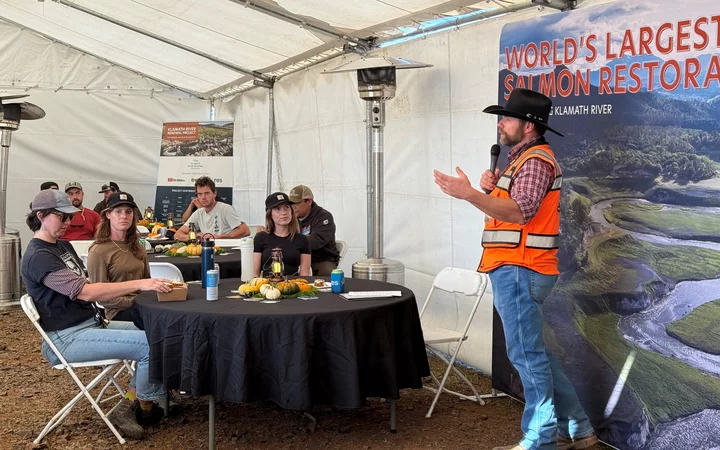
Dave Coffman of RES congratulates Yurok Tribal members and others involved in restoring key Klamath River tributaries as part the largest dam removal and river restoration in the world.
RES and the Yurok Tribe worked over the past several months to implement stream
design and restoration efforts, reconfiguring stream channels to ensure upstream fish
passage and restoring habitat for fish spawning and rearing of young.
“This was a dedicated crew,” said Coffman. “A lot of our team essentially lived on the
site, putting in 14-to-16-hour days before the window for ‘in-water’ work closed. The
entire team was aligned on the importance of this work, and seeing salmon reoccupy
the habitat so quickly reinforced the critical nature of completing this massive effort
ahead of schedule. I’m proud of the team that came together to make the vision a
reality.”
In addition to reconfiguring and restoring stream channels, restoration teams removed
hundreds of thousands of cubic yards of excess sediment, relocating it within the former
reservoir footprints.
The restoration work took place on land that was home to the Shasta Indian Nation until
the Tribe was forcibly removed a century ago to make way for the construction of Copco
Dam. Tribal leaders were on hand to celebrate the restoration work.
“Restoration ensures a healthy river for fish, and it also restores the landscape as
Shasta people return to Kikaceki,” said Sami Jo Difuntorum, Cultural Preservation
Officer for the Tribe. “It is very humbling to see the salmon return in the restored
tributaries. It gives us so much hope for the future health of the river and the people as
we heal together.”
Phillip Williams, a Yurok Tribe Council member who also serves as President of the
Yurok Tribe Construction Corporation, was visibly moved as he discussed the role of the
Tribe in healing the Klamath River.
“We are watching a lasting legacy unfold before our very eyes. The Creator is blessing
us, and the restoration crews are the tools used to heal the Klamath Basin. Hundreds of
salmon are returning home to Jenny Creek. Every fish that spawns represents the hope
of a better future for the Klamath River communities,” he said.
Dan Chase, the Director of Fisheries, Aquatics & Design for RES, noted that the
restoration work will vastly improve habitat conditions for salmon, steelhead, lamprey,
and other native species in areas that were previously inundated with stagnant water
seasonally choked with toxic algae.
“Reshaping channels and rebuilding floodplain function creates the foundation for
resilient, shaded, and dynamic stream corridors that support diverse aquatic life,” said
Chase. “Dam removal made the entire river once again accessible to fish, but
restoration makes the previously damaged streams hospitable to them.”
Chase said the entire project team was keenly aware of the sensitivity of working in
these newly emerged creeks where young, endangered fish were rearing.
“We captured and relocated juvenile salmon and steelhead ahead of construction,
protected turtles and nesting birds, monitored water quality, and safeguarded cultural
resources with tribal oversight,” said Chase. “Our tribal partners have often said that we
are not only restoring the river, but also a way of life vital to Native American
communities who have depended on the river since time immemorial. Everyone
involved in this epic project has felt the enormity of the task.”
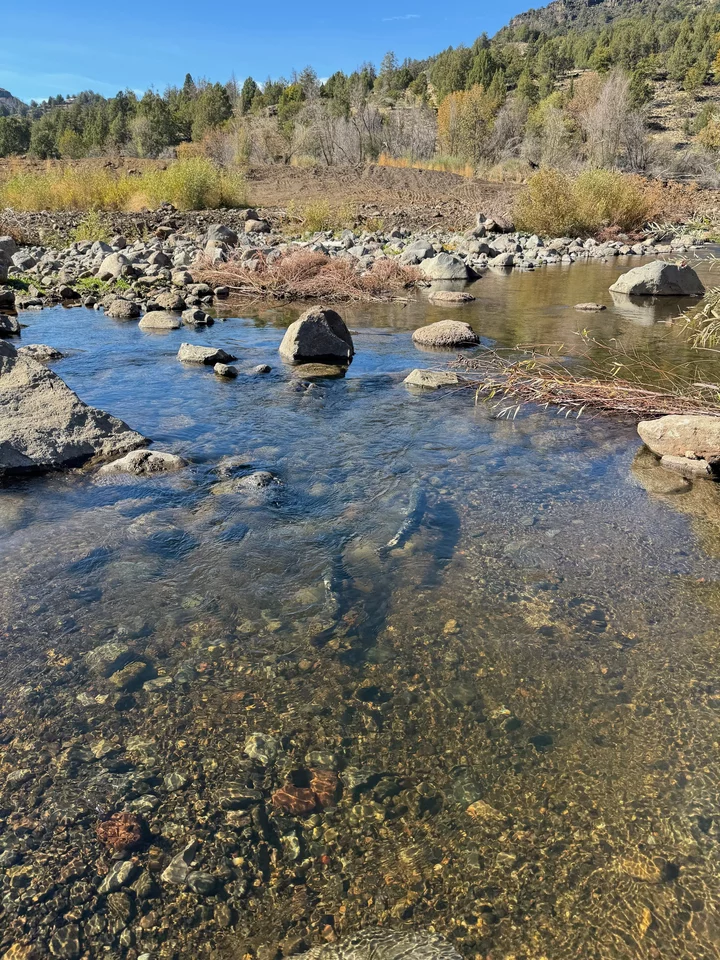
Salmon have recently returned to spawn in Jenny Creek, one of four high-priority tributaries restored under a plan crafted by RES. A portion of Jenny Creek was covered in up to 40 feet of algae choked reservoir water until Klamath River dams were removed.