
Mike McGuire Will be the Next Leader of the California Senate, Under New Deal Announced Today
LoCO Staff / Monday, Aug. 28, 2023 @ 7:36 p.m. / Sacramento
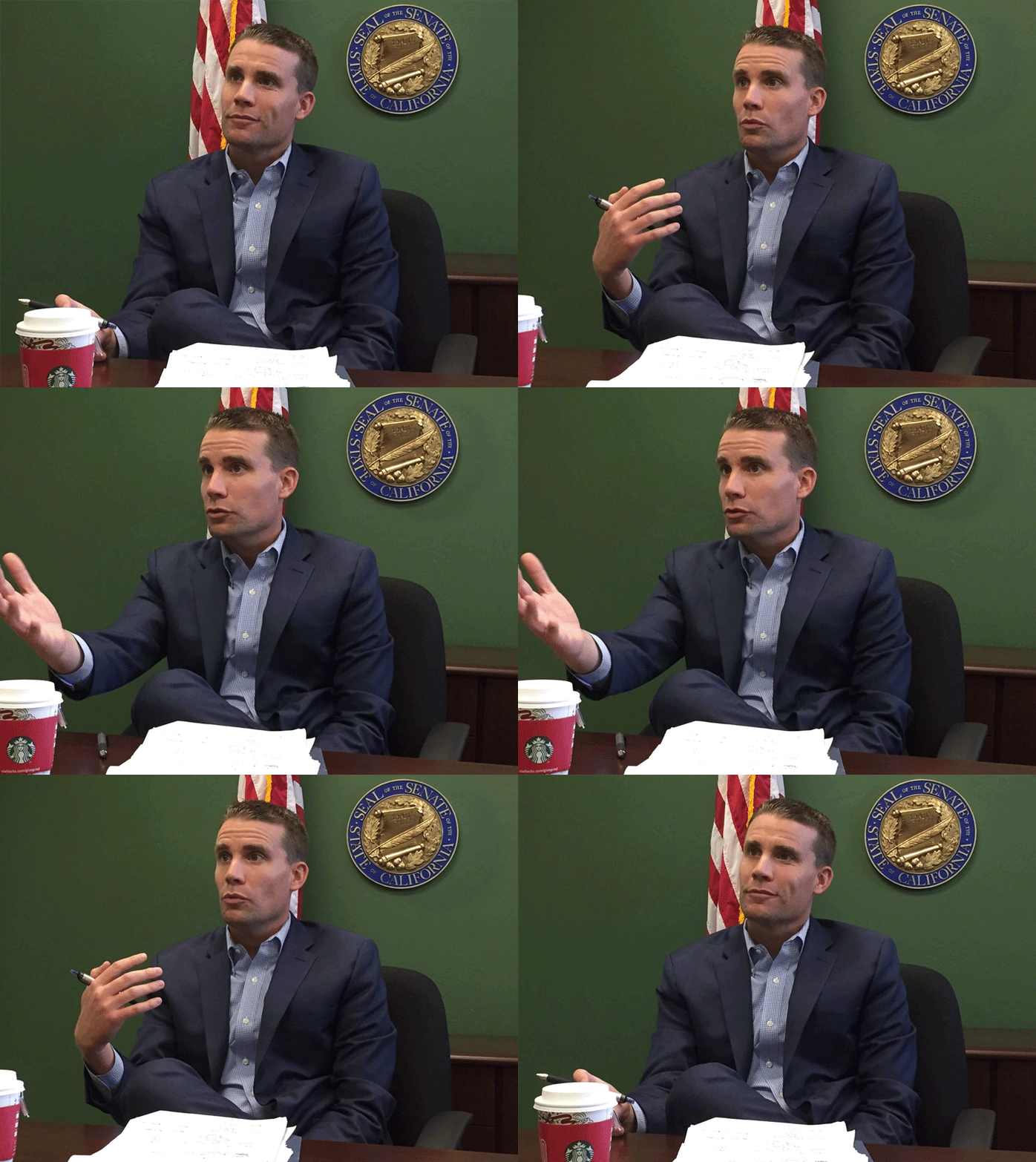
File photo: Ryan Burns.
Press release from the office of State Sen. Mike McGuire:
Today, Senate President pro Tempore Toni G. Atkins (D-San Diego) announced that the Senate Democratic Caucus convened and determined that Senator Mike McGuire (D-Healdsburg) will be the Pro Tem Designee, with a transition to be announced next year.
Senate Leader Atkins has served as Pro Tem since 2018, and was the first woman to hold the position and the first person in 150 years to serve as both Pro Tem and Assembly Speaker.
“It is a privilege to be the Senate Leader. Now, the time has come to plan for the next leader, and the Senate Democratic Caucus is unified in its decision to name Senator Mike McGuire as the Pro Tem Designee. I am confident that this will be a seamless transition, and that Senator McGuire will continue to guide the Senate and California down a path of success. Senator McGuire has been a key member of my leadership team, a trusted confidant, and time after time, the convener who sets the table to get things done. The Senate and the people of California will be in good hands with Senator McGuire as their future leader of the Senate.”
Senator McGuire, who was elected to the Senate in 2014, has served as Majority Leader since 2022, and has been integral to several legislative victories, including the 2022 climate package and the infrastructure streamlining package negotiated alongside this year’s state budget.
“Pro Tem Atkins is one of the most effective and thoughtful leaders of our time. She’s a California trailblazer, a role model for millions, and a dear friend. We will work hand-in-glove to finish out the important work that we have all fought so hard for all year – and to ensure a seamless transition into the next chapter of this great institution,” Senator McGuire said. “Words are not enough to express the extent of my gratitude, honor, and humility for being chosen by our united Caucus to lead the California Senate. Together, we will meet the challenges ahead with grace, courage, and determination. We will never stop fighting to make the promise of the Golden State real for every Californian.”
LEADERSHIP: McGuire lobbies on behalf of Calfire firefighters in 2022.
BOOKED
Today: 6 felonies, 12 misdemeanors, 0 infractions
JUDGED
Humboldt County Superior Court Calendar: Today
CHP REPORTS
Poppy Dr / Sherwood Rd (HM office): Closure of a Road
ELSEWHERE
County of Humboldt Meetings: CAT (Committee for Active Transportation) Meeting Agenda
Governor’s Office: California and the Australian state of Queensland ink new partnership to accelerate climate resilience, agricultural technology, and innovation
County of Humboldt Meetings: Human Rights Commission Agenda- Hybrid Meeting
Fishing the North Coast : Cool Water, Rain Spark Klamath Salmon Push
Backers of Eureka’s Pro-Parking ‘Housing for All’ Initiative Say They’ve Gathered and Submitted Enough Signatures to Get It On the Ballot
LoCO Staff / Monday, Aug. 28, 2023 @ 4:45 p.m. / Local Government
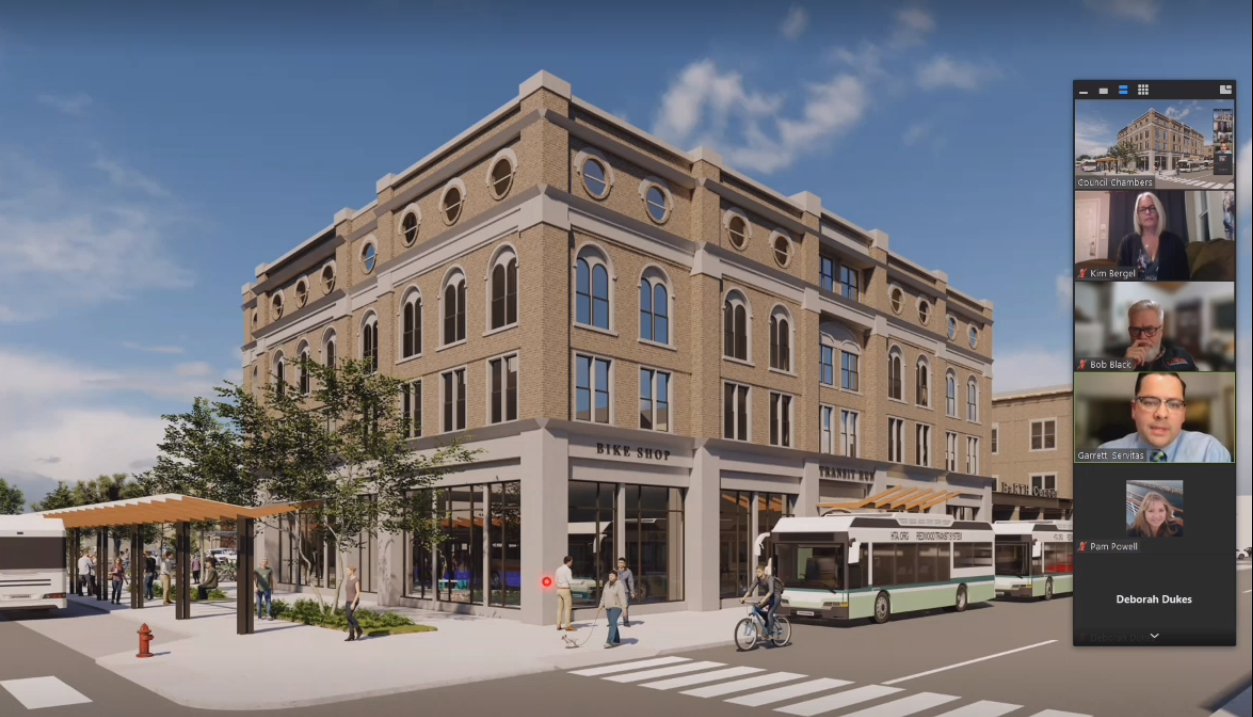
Despite its name, the ‘Housing For All’ initiative seeks to stop in-progress Eureka developments like the downtown EaRTH Center.
Press release from “Housing For All” proponents:
Mike Munson, one of the two proponents of the City of Eureka Housing for All and Downtown Vitality Initiative, today turned in initiative petitions containing 2,811 signatures to the City of Eureka Clerk’s office. Ten percent, or 1,600, of the city’s registered voters’ validated signatures are needed for an initiative to qualify for the ballot.
“We are confident we have obtained the required number of signatures,” said Munson. “Once the City Clerk and County Registrar count and validate the signatures, voters will have an opportunity to pass our Initiative and enable Eureka to provide housing while preserving the economic vitality of our Historic Downtown.”
Added Munson, “We are very encouraged by the broad support we found in every neighborhood in the city.”
Once the registrar validates the needed number of signatures, the City Council can select from several options, including (1) choose to adopt the Initiative directly and forego the cost of putting it on the ballot in a city election; (2) decide to place the Initiative on the next ballot (March 2024); or ask for more information in a report from planning staff, which must be completed within 30 days, before deciding to either adopt the Initiative directly or to place the Initiative on the ballot. Eureka business owners Munson and Michelle Costantine co-signed the petition which, if ratified by a majority of the voters, will amend the City of Eureka’s General Plan by:
1. Designating the site of the publicly owned former Jacobs Middle School (which is now vacant) for housing for all income levels,
2. Improving the city’s plans to provide housing downtown by requiring the preservation of existing parking,
3. Providing adequate parking for new downtown housing.
“We believe the City of Eureka needs to provide more housing to address the unprecedented housing crisis,” said Munson. “The city has a badly flawed plan. It will eliminate hundreds of downtown parking spaces to make way for very low-income housing. The loss of parking will devastate downtown business and do nothing to relieve the housing crisis experienced by working- and middle-income families.”
If passed by the voters, the Housing for All Initiative will give Eureka the ability to provide hundreds of units of housing at both the Jacobs site and downtown. It will also help downtown grow into an attractive place to live, work, and play by preserving the parking needed for tourists, visitors, and workers while providing the parking many families need to thrive. More information, including a copy of the City of Eureka Housing for All and Downtown Vitality Initiative, can be found at eurekahousingforall2024.org.
###
PREVIOUSLY:
- Open Letter Urging Eureka Voters Not to Sign the ‘Housing For All’ Petition Endorsed by 100+ Humboldt County Residents, Including Local Leaders in Politics, Business and Culture
- Group Circulating Eureka Housing Petition Says the Wiyot Tribe’s Projects Are OK, Clarifies That Parking Lot Conversions Will Be Allowed So Long as Developers Build Even More Parking Than Before
- Local Group Announces Intent to Stop the City of Eureka’s Conversion of Downtown Parking Lots Into Housing With New Ballot Measure
- Arkley-Affiliated Group ‘Citizens for a Better Eureka’ Files Second Lawsuit Against the City Over Development Plans
- Local Environmental Groups Call ‘Bullshit’ on Lawsuit Seeking to Stop Development on Eureka Parking Lots
- Here is the Housing Development/Parking Lot Lawsuit Served on the City of Eureka Today
- Eureka City Council Approves Surplus Designation for Vacant Lots by the Boardwalk Despite Lawsuit Threats, Paving the Way for Affordable Housing and Mixed-Use Development Along the Waterfront
- New Group — ‘Citizens for a Better Eureka’ — Says It Will Sue Eureka Over Downtown Housing Development
- Eureka Planning Commission Declares ‘Surplus’ Designation for Big Gravel Lots by the Boardwalk to Further Mixed-Use Development Efforts
- ‘People Are Dying’: Eureka Residents Urge City Officials to Act Quickly to Address Ongoing Shelter Crisis
- In the Wake of Jestine Green’s Tragic Death, Eureka Grapples With Mental Health and Housing Challenges Among the Homeless Community
- GUEST OPINION: Rob Arkley’s Love of Parking Lots Reflects a Bias Embedded in Our Car-Centric Culture
- ‘Furious’ Rob Arkley Says He’s Moving Security National HQ Out of Eureka After Clashing With City Staff About Development Priorities
- Two Former Eureka Mayors Come Out in Support of Pro-Parking Initiative
- Eureka Council Requests Informational Report on ‘Housing for All’ Initiative to Clear Up Confusion for Voters, Discusses Guidelines for ADUs, and More
Car Smashes Into Power Box in Arcata, Knocking Out Electricity to Mad River Hospital
Ryan Burns / Monday, Aug. 28, 2023 @ 11:55 a.m. / News
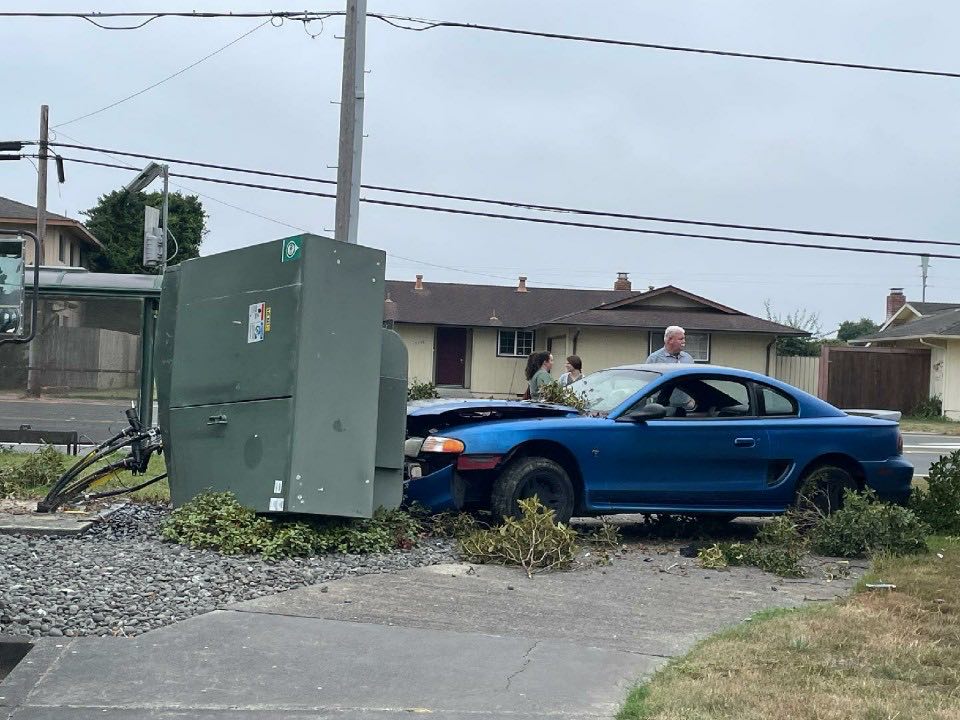
Photo submitted by Becky Jensen.
###
A car traveling south northbound on Janes Road in Arcata smashed head-on into an electrical box around 8 a.m. this morning, cutting off power to several buildings at Mad River Hospital.
Reached by phone, CEO David Neal said the driver appeared to be intoxicated and was taken into custody by the Arcata Police Department. “It’s really fortunate there were no kids on the sidewalk,” Neal said. “It’s really scary when you think about it.”
The hospital is next to Pacific Union School, and at the time of the collision parents were arriving to drop off their children.
According to Neal, the hospital’s main buildings are operating on generator power but other facilities, including the MRI lab, the pain clinic and the business office, are without electricity indefinitely.
[UPDATE, 2:25 p.m.: Neal called a few hours after this post was published to say that, upon further inspection, hospital staffers discovered that power to the main hospital building was never knocked out, despite the violence of teh collision. “We’re back, totally operational,” Neal said. He added that PG&E hopes to have power to the clinic buildings restored by 6 a.m. Tuesday.]
The two-story Shaw Pavilion is served by a separate PG&E hookup, and some business services have been moved into that building for the time being, Neal said.
Elective surgeries will be canceled until power is restored, which could take days, according to Neal. He said a PG&E representative will arrive this afternoon to further assess the situation. In the meantime, he expects the hospital to continue with “business as usual.”
Ferndale’s Foggy Bottoms Boys Say Local Business Owner Lobbed Anti-Gay Slurs at Their Employees, Destroyed Property During Chili Cook-Off at Humboldt County Fair
Ryan Burns / Monday, Aug. 28, 2023 @ 11:09 a.m. / News
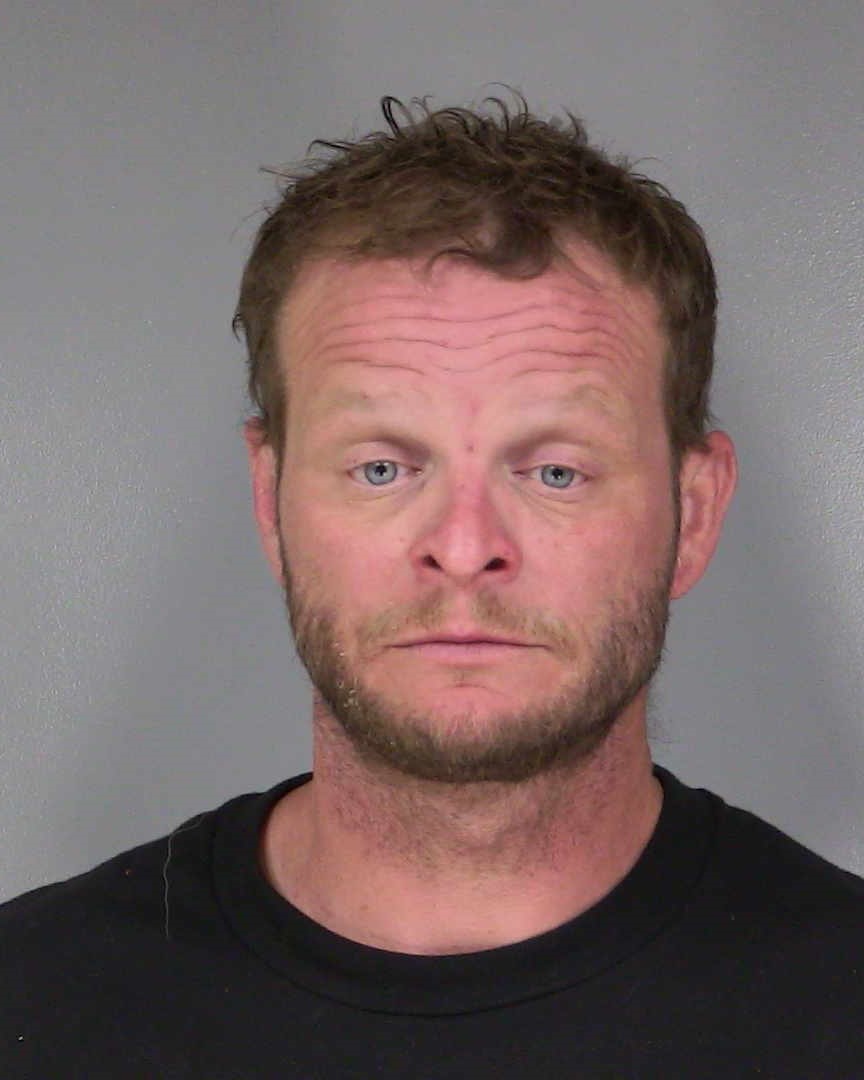
Knight’s booking photo
UPDATE, 4:53 p.m.: After this post was published, the Times-Standard published a story by reporter Sage Alexander, who quotes Thomas Nicholson Stratton.
According to the story, Nicholson Stratton says that the homophobic comments made by LoCo Fish Co. owner Jayme Knight included, “Oh, that’s so gay. You should be over there. With the F-ggy bottoms boys.” We assume that omitted vowel was an “a” and not an “o.”
Later in the afternoon, the North Coast Journal‘s Jennifer Fumiko Cahill published a story that quotes Knight, who denies that he intentionally ran over anyone’s belongings but does not deny getting drunk and using gay slurs.
The following quotes are attributed to Knight:
God, I regret my actions so much. I don’t know what to say; I don’t have any excuses. I had too much to drink and my judgement got the better of me. … I really don’t have any hatred at all toward the LGBTQ community at all. I’m just trying to wrap my mind around how it got so out of control. I need to really work on myself; I needa go to rehab and therapy.
###
Original post:
Local dairy farming couple Cody and Thomas Nicholson Stratton, known by their business name The Foggy Bottoms Boys, have alleged on social media that their employees were subjected to hurtful and offensive gay slurs during the annual chili cook-off event at the Humboldt County Fair last week.
“To make matters worse,” the Nicholson Strattons said on Facebook and Instagram, “after the event concluded, the owner of this company damaged our supplies by running over several boxes of supplies while moving forward and then backing into our new tent and burner. This reckless action could have resulted in harm to individuals present including our son.”
While the Nicholson Strattons did not identify the business owner, Ferndale Police Chief Ron Sligh told the Outpost that Jayme Knight, owner of the popular food truck business LoCo Fish Co., was arrested at the scene of the chili cook-off on Thursday evening after allegedly driving while intoxicated and backing his vehicle into boxes belonging to another participant at the event.
Sligh said allegations of hate speech came in to the Ferndale Police Department after Knight had been arrested and booked into the Humboldt County Corrections Facility. “That part is still under investigation,” he said. “Initially, [Knight] was intoxicated, so he was arrested for DUI because you can’t drive under influence anywhere, even [at the fairgrounds].”
As for the alleged anti-gay hate speech, Sligh said, “There have been a number of people who’ve called up [to report that]. We did talk to one of the subjects involved, and we’re still looking into that aspect.”
The Outpost tried to contact Knight via the two listed phone numbers for LoCo Fish Co. Both numbers delivered an automated reply saying the voicemail box could not accept messages. We also sent a Facebook message to Knight, to which he did not immediately respond.
On Instagram, LoCo Fish Co. posted a comment under the Nicholson Strattons’ post, saying, “I’m extremely sorry for our actions.”
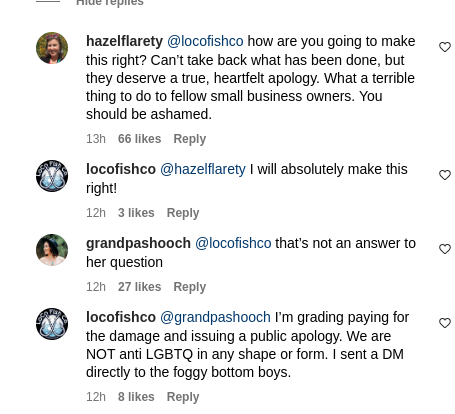
A commenter on the Instagram post also tagged LoCO Fish Co. and asked, “How are you going to make this right? Can’t take back what has been done, but they deserve a true, heartfelt apology. What a terrible thing to do to local business owners. You should be ashamed.”
LoCO Fish Co. replied to that comment, saying, “I will absolutely make this right!” When another commenter suggested that this response was insufficient, LoCO Fish Co. commented again, saying, “I’m … paying for the damage and issuing a public apology. We are NOT anti-LGBTQ in any form.”
Jill Duffy, the interim director of the Humboldt County Fair, told the Outpost that she hadn’t heard about the alleged hate speech until last night, though she was aware of Knight’s arrest. Someone called her on Thursday to say Knight was being arrested after backing into a tent and that he was “in the back of a [police] vehicle looking very unhappy.”
Duffy added that it’s important for people to take such matters directly to management as soon as they happen, whether it’s at the fair or anywhere else. “A lot of things could be reined in and addressed faster” that way, Duffy said.
We will update this post if we hear back from Knight.
Here’s the full Facebook post from the Foggy Bottoms Boys:
And here’s the text of the post, copied and pasted for those who don’t have Facebook:
Many of you have reached out to us about this and we want to be honest about the unfortunate experience that our team recently encountered by another contestant at the Humboldt County Fair Chili Cook Off. During the participation of the event, our employees were subjected to hurtful and offensive gay slurs throughout by another contestant company. It was disheartening to see such behavior being tolerated in a community event that should celebrate diversity and inclusivity.
To make matters worse, after the event concluded, the owner of this company destroyed our supplies by driving over several boxes of supplies and equipment while moving forward and then backing into our new tent and burner. This reckless action could have resulted in harm to individuals present including our son. Subsequently, we believe he was detained and questioned by police. While this was disheartening and shocking we continue to believe it’s important for us to stand together against such behavior in our community. Let’s continue to champion respect, inclusivity, and safety for all.
Thank you for the support you continue to show our business and family.
*Please keep comments respectful and supportive, and feel free to share this post.
If you or someone you know is experiencing hate or bullying based on your sexual orientation, or you’d like to learn how you can advocate and be an ally for our community - here are a few vetted resource links we highly recommend exploring and sharing - and of course, we are personally here for members of our community who need support.
The Fortuna Teenager Who Accidentally Shot Himself Last Night is Doing OK, Police Say
LoCO Staff / Monday, Aug. 28, 2023 @ 10:01 a.m. / Non-Crime
Press release from the Fortuna Police Department:

On Sunday, August 27th 2023 at about 8:30 PM, Fortuna Police Officers were dispatched to the 3000 block of Smith Lane for a report of a 17-year old male with a gunshot wound. Officers and emergency medical services arrived on scene and located the 17-year old lying on the ground accompanied by family members. The juvenile suffered what was later determined to be a self-inflicted gunshot wound and he was transported to a local area hospital for treatment.
Fortuna Detectives spoke with the juvenile at the hospital and obtained verification that he had in fact, accidently shot himself.
As of this morning, Monday, August 28th 2023 at 9 a.m., the juvenile was reported to be in stable condition by medical personnel. The name of the victim is being withheld due to his status as a minor. The 9mm handgun was later located under the juvenile’s mattress with a spent casing jammed in the slide and was seized by investigators. Any questions related to this release of information can be directed to Casey Day, Chief of Police at (707) 725- 7550.
Families Have High Hopes for Gavin Newsom’s CARE Courts. Providers Want to Lower Expectations
Jeanne Kuang / Monday, Aug. 28, 2023 @ 7:25 a.m. / Sacramento

Stacey Berardino, assistant deputy director over the forensics and justice involved division of mental health, speaks to community members about CARE Court, a new program that will be implemented in October of 2023, at the St. Irenaeus Catholic Church in Cypress on Aug. 17, 2023. Photo by Lauren Justice for CalMatters.
Under the low hum of cold fluorescent lights in a nondescript office park in Orange County, dozens of Californians gathered to find out if they could get help for their loved ones under the state’s new CARE Court system.
Unless that loved one has a medical diagnosis specific to schizophrenia or some other psychotic disorders, the answer was probably not.
The mid-August meeting was one of a series held by a mental health advocacy group in Orange County with the officials in charge of implementing CARE Court starting in October, about what the new system can and cannot do.
“What we’re here to do is share the facts to help manage expectations,” said Veronica Kelley, Orange County’s chief of Mental Health and Recovery Services.
Community Assistance, Recovery, and Empowerment (CARE) Court was Gov. Gavin Newsom’s biggest legislative priority last year — what state lawmakers and local politicians hoped would be one answer to California’s dual, overlapping homelessness and mental health crises.
The new program allows family members and others to petition someone with untreated mental illness into civil courts, where a judge would order a treatment plan and require county mental health departments to provide it.
Backed by millions in new state funds, it’s a mandate for those departments at a time Californians have become increasingly frustrated with one of the most visible consequences of the state’s trenchant homelessness crisis — people with the most severe mental illnesses languishing on the streets.
Counties will be judged on how well they’re able to get people who may be resistant to help inside and into treatment, even though CARE Court is not exclusively a program targeting homelessness. Local mental health officials are warning it won’t be a panacea.
“There’s been a presumption — and this is, to be clear, driven by how the administration talked about CARE Court at the outset — a broad presumption that CARE Court is going to fix homelessness or have a broad impact on the nexus of homelessness and behavioral health,” said Luke Bergmann, director of the San Diego County Behavioral Health Services department.
In reality, he said, it’s “actually going to be a pretty small program. It’s not going to be this thing that dramatically changes homelessness.”
The program aims to walk the line between forced treatment and completely voluntary treatment for those with the gravest needs. Disability rights groups decry it as a violation of a person’s civil liberties, and a potential path toward conservatorship and the loss of legal rights for those who repeatedly decline care.

Annette Mugrditchian, deputy director, speaks to community members about CARE Court, a new program that will be implemented in October of 2023, at the Behavioral Health Training Center in Orange County on Aug. 17, 2023. Photo by Lauren Justice for CalMatters
CARE Court survived a legal challenge from Disability Rights California and other civil rights groups earlier this year. The group sat on a state working group for the program’s implementation and will monitor its rollout.
The program was welcomed by some family members of those with severe mental illness, who have complained the state’s privacy and patients’ rights laws only allow their loved ones to be compelled into treatment when in crisis, trapping them in a revolving door of short-term hospital stays and homelessness.
The first courts will open across the state in about a month. Seven counties, urban and rural, have been deep in preparation to be the first to roll out the program in October.
Los Angeles County, whose roughly 75,000-person unhoused population is the state’s largest, will start the program in December; the rest of the state will follow next year.
Those in the first group — San Francisco, Orange, San Diego, Riverside, Stanislaus, Glenn and Tuolumne counties — have had numerous questions to address, such as:
- Who will find and serve respondents with their CARE Court petition if the respondent is unhoused?
- How can county courts make the paperwork-heavy petition process easy for family members?
- How many mental health treatment beds will counties need to add?
- Where will people live after completing the court-ordered plans?
The state estimates between 7,000 and 12,000 people will qualify. They needn’t be homeless to receive the services, though many who qualify are likely to be unhoused. The state’s homeless population on any given night last year topped 171,000.
A UC San Francisco study of homelessness statewide this year found that more than a quarter of unhoused people had been hospitalized at any point in their lives for a mental health problem; the homeless services authority in Los Angeles has estimated a quarter of the city’s homeless adults has a severe mental illness. But CARE Court is targeted at an even narrower set of diagnoses and circumstances.
So counties are also playing a careful game of “level-setting,” Bergman said, “about what this thing will actually be.”
Still, local officials see the program as an opportunity to get more people into mental health care who haven’t been treated, before their condition deteriorates to the point of being put in conservatorships.
And the state’s Department of Health Care Services says it will be looking out for whether the program reduces emergency room visits, police encounters, short-term hospital stays and involuntary psychiatric holds — and whether it helps people find stable housing.
Managing expectations
One major uncertainty counties face, officials say, is even knowing how many cases they’ll get.
That’s in part because the law allows a wide range of people to petition for someone to be in CARE Court, including family members, roommates, health care providers, paramedics, hospital officials or homeless outreach workers.
But the list of actual conditions the program targets is narrow, limited to schizophrenia and related illnesses.
That could disappoint those whose loved ones have other diagnoses — and create an unknown amount of work for counties if a flood of those family members file petitions. Behavioral health departments must evaluate each person if it’s not clear whether they qualify for the program.
San Diego County estimates it will get 1,000 petitions in the first year and establish court-ordered treatment plans for 250 people; the remainder likely will either not qualify or agree to services voluntarily, Bergmann said. Orange County expects about 1,400 petitions and anywhere from 400 to 600 treatment plans.
“(CARE Court’s) not going to be this thing that dramatically changes homelessness.”
— Luke Bergmann, director, San Diego County Behavioral Health Services
Officials in Riverside County don’t even have an estimate, citing varying data there on the prevalence of schizophrenia in the unhoused population.
“We really think it’s unknowable,” said Marcus Cannon, the county’s deputy behavioral health director.
Counties want the state to help them manage public expectations. Both Kelley and Cannon said they’ve heard from local leaders who have floated having city workers file petitions for a wide swath of unhoused residents, to get them indoors.
“What the public thinks CARE Court is and what it is are definitely two very different things,” said Michelle Doty Cabrera, director of the County Behavioral Health Directors Association.
In an emailed statement, state Department of Health Care Services spokesperson Sami Gallegos said that counties “are managing public relations among local elected officials and others” to spread the message about who the program is and isn’t for.
After learning of the narrow eligibility criteria at a community meeting in August, Nancy Beltran considered her options.
Beltran, of Anaheim, said she lives with a family member whose psychotic condition caused him to hit another relative in 2020, landing him in the hospital against his will. She said he’s refused treatment and doesn’t believe he’s sick. Another psychotic episode earlier this year didn’t qualify him for hospitalization, she said, because the symptoms weren’t as severe.
“I didn’t want it to get to that point,” she said. “I don’t want him to be incarcerated. I want it to be the least restrictive, least traumatic experience.”
She’s still not sure whether the program is for her family member, because they haven’t gotten a clear diagnosis, she said.
Beltran said she also wishes the program could help a friend, who is already enrolled in therapy sessions for diagnosed schizophrenia, find a place to live. Her friend’s condition, she said, deteriorates because he is unhoused, but he remains on waiting lists for housing. But CARE Court, she was disappointed to learn at the meetings, is only for those with untreated schizophrenia.
Threading a needle
Everyone involved in CARE Court in Orange County — from the judge who would ultimately order treatment to the public defender who will represent respondents to the behavioral health officials responsible for finding, diagnosing and treating them — had the same message for the public: The program will be voluntary.
Critics, however, contend that there’s no way a court process can be voluntary since at some point there is a judge’s order. By law, counties must try at least twice to persuade a respondent to accept treatment before a judge orders it. Even then, the treatment plan, which can include therapy, medication and housing, doesn’t come with much enforcement. Medication can be ordered, but not forcibly administered.

Judge Ebrahim Baytieh speaks to community members about CARE Court, a new program that will be implemented in October of 2023, at the Behavioral Health Training Center in Orange County on Aug. 17, 2023. Photo by Lauren Justice for CalMatters
Over the course of a year, respondents will attend court hearings to see whether they’re adhering to the treatment, and whether the county is providing it. Counties can be fined as much as $1,000 a day for not providing the care; if the person fails to complete treatment they could be considered for conservatorship.
But county officials stressed that’s not the goal.
“We have tried for 40 years in this wonderful country of ours to force people with mental illness” to be treated, Orange County Superior Court Judge Ebrahim Baytieh told family members at another community meeting, in a church in Cypress. “Study after study has found it doesn’t work. We all know there’s no magical answer. But we will be patient, and we will be persistent.”
Kelley’s department is training its workers and peer supporters — people who also have mental illness or have recovered who can help guide a respondent through CARE Court — in a well-regarded communication method called LEAP to persuade respondents to accept care. It will offer services to those in CARE Court under a “whatever it takes” approach, whether it’s a ride to the doctor’s office, help enrolling in food stamps, addiction treatment or temporary housing.
The task will take time.
At the community meetings, Kelley and her colleagues repeatedly described a pilot program she ran as behavioral health director in San Bernardino County. The program took referrals from family, police or other community members who wanted to prod those who were resistant into mental health treatment.
The time it took for county workers using the LEAP method to persuade respondents to enter treatment varied, Kelley said. But on average, she said it took 20 visits if a respondent was housed — and 40 visits if they were unhoused. Visit times varied, from a few minutes to a whole day, so the whole process could take weeks or months, Kelley said.
The timetables set by law for CARE Court are much tighter.
If counties initially determine a client won’t agree to treatment, they get 14 days to try again before the next court hearing. Kelley said the judges in her county are sympathetic toward those concerns, but not all counties will get such flexibility.
“I can’t do 40 face-to-face visits in 14 days,” she said.
Civil rights advocates balked at the counties’ suggestion that any program involving the pressure of the judicial system, even a non-criminal court, could be voluntary.
“If you’re trying to engage somebody, and there’s a petition that involves a court,” there’s less hope of building genuine trust, said Keris Myrick, a mental health advocate who lives with schizophrenia and a board member of Disability Rights California.
The group is particularly concerned the court process could be ineffective or harmful among Black residents, who are overrepresented both in California’s homeless population and among people diagnosed with schizophrenia.
Myrick, who is Black, said she has been subject to involuntary treatment, and described harrowing experiences during which she was handcuffed in the back of a police car or strapped down to a gurney for hours before a doctor visited. She said one thing that actually helped her recover was having a peer supporter who was also African American and related to her experiences, eventually persuading her to get treatment on her own terms.
“What the public thinks CARE Court is and what it is are definitely two very different things.”
— Michelle Doty Cabrera, director, County Behavioral Health Directors Association
She later ran a peer support program in Los Angeles County and trained workers in the county mental health department. Myrick says the state needs to expand those services, as well as housing and social supports to help people live stable lives, without the threat of a judicial order.
Alex Barnard, a sociologist at New York University who has studied involuntary mental health treatment in California, is skeptical about whether the state can appease both civil libertarians and those who want more aggressive treatment. But he said the program’s mandate of a year of persistent engagement is promising.
“If CARE Courts works, it will probably be because of that,” he said. “It creates some accountability on the provider to keep trying to work with somebody who might be very challenging, and elsewhere in the system would just have their file closed out.”
Long-term resources
Those implementation questions are among a list of other practical hurdles counties face for the program to be successful.
There’s long-term funding. The first seven counties were given $26 million in one-time state grants to start the programs; some have estimated annual costs of the services themselves will far exceed those allotments.
The state says most services will be covered by Medi-Cal or private insurance, and expects counties to submit reimbursement requests, including the costs of going to court or finding respondents.
But the nationwide shortage of behavioral health workers has made it a challenge for some departments to hire. In San Diego County, Bergmann’s department plans to add 55 new staff, including 10 clinicians, for CARE Court. Only 35% have been hired so far, a spokesperson said.
And there’s housing and beds, which all agree is crucial to making treatment a success.
Health officials believe most people who qualify for CARE Court will need a more intensive treatment placement in the beginning, while some may be able to be placed in residential facilities or their own apartments after being stabilized.
But there are shortages across that spectrum. A 2021 Rand analysis found the state is short more than 4,700 psychiatric inpatient treatment beds and nearly 3,000 residential facility beds such as board-and-cares — long-term housing for people with severe mental illness and one option for respondents to live after they complete CARE Court.
Included in last year’s state budget was nearly $1 billion in new funding for counties to expand temporary housing placements for those with mental illness, with priority given to people in CARE Court.
Orange County and some others are using the grants to open new treatment beds. In San Diego, Bergmann’s department will use the money to pay for board-and-care placements. But significant new infrastructure will take years to complete. Over the past five years, Bergmann said, the county has lost a fifth of those residential facilities.
“In the near term, those funds will help us help people with the fewest resources to compete more” for placements, he said. “It’s not going to all of a sudden create a net increase in infrastructure.”
Marisa Kendall contributed to this reporting.
###
CalMatters.org is a nonprofit, nonpartisan media venture explaining California policies and politics.
GROWING OLD UNGRACEFULLY: Jesus’ Second Coming and DJT
Barry Evans / Sunday, Aug. 27, 2023 @ 7 a.m. / Growing Old Ungracefully
“It’s
less work, it’s
less effort, it’s
less painful,
to
reject reality than to reject a belief you’re
emotionally invested in.”
— Franklin Veaux on Quora, h/t Dave Fitzgerald
###
I see where our last ex-president says that, next news conference, he’ll provide irrefutable proof that he was cheated out of a second term. Again. The proof is always just around the corner, any day now, yet somehow it never quite materializes. So how his followers take this? Do they say, “Hey, the guy’s obviously lying, I’ll never vote for him again”? Nope, quite the opposite: they double down. According to CBS last week, “Trump far and away leads the GOP field among voters who place top importance on a candidate being ‘honest and trustworthy.’” So: why do people, something approaching 80 million Americans, believe him? It’s called cognitive dissonance.
The phrase seems to have originated in a 1956 book, When Prophecy Fails: A Social and Psychological Study of a Modern Group That Predicted the Destruction of the World, by Leon Festinger and others. They studied a small religious group in Chicago, “The Seekers,” whose guru, housewife and automatic writing practitioner Dorothy Martin, predicted a huge flood for the night of December 21, 1954, which would wipe out much of North America. (She based her knowledge on messages received from the planet Clarion.) When nothing happened, many of the group members dug in, coming up with (implausible) rationales for the non-event. Somehow they were able to keep two contradictory events in their minds simultaneously, that (a) the flood was definitely coming and (b) it didn’t come.
Festinger wrote later, in an article for Scientific American, “…cognitive dissonance…centers around the idea that if a person knows various things that are not psychologically consistent with one another, he will, in a variety of ways, try to make them more consistent.” Wikipedia’s entry on cognitive dissonance sums up Festinger’s idea: “Coping with the nuances of contradictory ideas or experiences is mentally stressful. It requires energy and effort to sit with those seemingly opposite things that all seem true. Festinger argued that some people would inevitably resolve the dissonance by blindly believing whatever they wanted to believe.”
Trump’s true believers have plenty of predecessors, going way beyond that small Chicago group. Today’s Seventh Day Adventists and Jehovah’s Witnesses have roots in the “Millerites” of the 1840s. William Miller, a Baptist lay preacher, predicted Jesus’ Second Coming would occur “sometime between March 21, 1843 and March 21, 1844.” (He based his prophecy on the Book of Daniel.) Following the latter date, he announced Jesus’ return would take place, definitely, on October 22, 1844. When that date came and went, the majority of Millerites — we’re talking tens of thousands of believers all across the United States, and in the U.K. and Australia, many of whom had sold their property in anticipation of The End — stuck to their guns! New dates for the Second Coming were proposed, or perhaps Jesus had returned, but was keeping quiet about it, or it’s going to happen any second now. Miller himself wrote, “The time, as I have calculated it, is now filled up; and I expect every moment to see the Savior descend from heaven. I have now nothing to look for but this glorious hope.” (Seventh Day Adventists claim that October 22, 1844 was only the start of the process of atonement/cleansing, which is ongoing.)
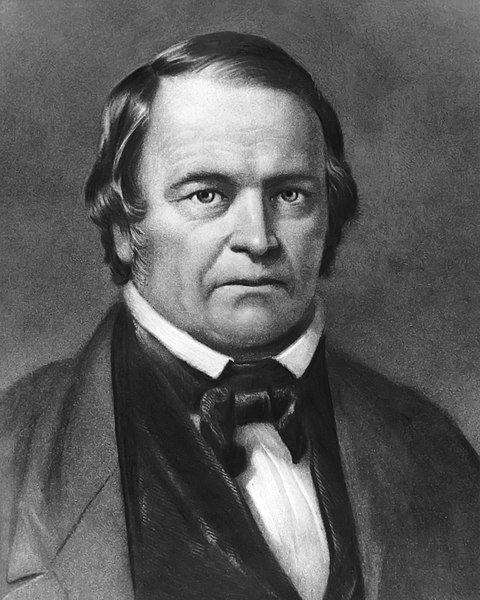
William Miller, 1982-1849. (Unknown artist, Wikimedia, public domain)
For Millerites, Seekers and Trumpists, it’s easier and less stressful to continue to believe what part of you knows to be false than to face reality: cognitive dissonance in action. They can take heart from Charlie Brown. Okay, so when Charlie went to kick the football, Lucy snatched it away, every time. But next time, it’ll be different. Only believe.


