

OBITUARY: Galen Duane Willfong, 1963-2022
LoCO Staff / Tuesday, Nov. 29, 2022 @ 6:56 a.m. / Obits

On
November 19. 2022, we lost our beloved best friend, husband, father,
father-in-law and grandfather, Galen Duane Willfong, after a short
and courageous battle with Stage IV Glioblastoma. Although this
aggressive brain cancer took him from us to soon and at such a young
age it does not define the person who Galen was in life. With the
devastating progression of his cancer over the past 6 months we found
it crucial that we keep our BLESSINGS in check along the way. We were
given cherished time, although short, to share our most precious
memories with each other, our family and our friends.
Galen and I met and soon after became best friends when I was 15 and he was 20. After I graduated from high school, on September 12, 1987 I became Mrs. Galen Willfong. This day would prove to be just the beginning of many, many of the happiest days we will share in our life together. We slid into our new roles naturally and Galen quickly adapted to his new nickname, “Baby.” He didn’t think twice when others referred to him by that name as well. We would always laugh when someone called him Baby without even knowing his real name. Since we have spent more years together then we have apart my definition of who he is, is hard to minimize for all of you but I will do my best.
Galen (Baby) was born on October 9, 1963 in Arcata to Patricia and Duane Willfong. He grew up in Westhaven, going through the Trinidad School District and on to McKinleyville High School, from which he graduated in 1981. He starting working for his dad’s logging business, Willfong Logging, at the age of 15 and at the age of 23 (the year we married) he was hired to pull green chain at Schmidbauer Lumber Co. in Eureka. Baby had a great passion for the outdoors so working in the timber industry was all he knew and loved. He always enjoyed sharing his knowledge of timber with me. We would be on our Sunday afternoon drives through the mountains, deer hunting, or while out cutting wood and he would say he wished he could bottle the sap and make a perfume for me and then proceed to tell me what kind of wood it was and any additional characteristics he knew about it.
In 2015, he started working for Efficiency Delivery, where he was employed up until this May when he received his heartbreaking diagnosis. He enjoyed his early morning starts and the many friendships he made along his delivery route around town and in Crescent City. His work schedule with Efficiency gave him the freedom and flexibility to be a domestic God for me and to help care for our then six-month-old grandson Mason in the afternoons. Both brought him joy and contentment, it was a win win for all.
Baby was a dedicated 49er fan with hopes to take his grandkids to a game as we enjoyed doing.
Through the years, the school functions, sports events, family vacations, traditions and holidays these were always high lighted memories for Baby that we will continue and honor. About 15 yrs ago prior to becoming empty nesters, one of Baby’s new found hobbies was prospecting. We would often spend our weekends camping and/or taking road trips to the river with his sluice, gold pans, ice chest filled with his favorite beer and my palapa/ beach bag in hand all with hopes that “EUREKA” would be the word of the day and could be heard from him miles away. Needless to say the “EUREKA” part never happened, but you would never have known as he showed his excitement with filling his glass vials with what gold he did find. He said his love for gold panning is what makes him so fond of the Gold Rush cheerleaders … ok baby (wink, wink).
Baby and I made a FABO team and did everything together. Gardening was another joint pleasure we called our “dirt therapy”. Getting his (our) hands dirty planting a big beautiful vegetable, herb and flower garden in the backyard every spring was a delight we both looked forward to every year. In keeping it real, I will say he did all of the hard labor and prep that would provide the foundation for our farm to table and he did it with such a sense of satisfaction and pride. Sharing our excess bounty with others always put a smile on his face. He also took on being the family grill master and would grill (BBQ) our breakfast, lunch and dinner when given any opportunity. He liked getting creative. Baby was a hard worker no matter what the task and set that example for his family.
Along with all of the precious milestones that come with parenting over the years having his kids all together and filling the room with laughter and music were some of his fondest moments of being a parent. The night before he passed we believe he was at peace hearing the kids together in the kitchen doing just that.
He is survived by the luckiest wife he has ever known, Christine Willfong, his daughter Mackenzie Helms, and sons Colton (Ashley) and Garrett (Amanda) Willfong along with his beautiful grandchildren Penny and Oliver (Mackenzie) and Mason (Garrett and Amanda). In addition, 10 yrs ago after a evening babysitting job, Galen took on the privilege of being Unk to a very special young man “Monkey” (Dominic), who was just 6 weeks old at the time. The two shared a very special bond that will be held close to all of our hearts forever.
As the saying goes “not all blood is family and not all family is blood.”
He is also survived by his father Duane Willfong and his sister Shanell (Simon) Beyzade and their three daughters Jayda, Tibel and Ashkim.
He is proceeded in death by his grandparents Einar and Norma Olson, my grandparents Frank and Sara Ashby and most recenty his mother, Patricia Willfong, with whom I’m sure he’s enjoying a long overdue cup of coffee with without interruption.
We have been beyond blessed with having so many amazing people on this journey with us, my heart is so full and I will never forget any of you. My family and myself will never be able to express our complete GRATITUDE for the amount of love and support we have received from, but not limited too, his neurologist , Dr Z and medical team at CPMC in San Francisco (both Davies and Van Ness campuses) they were our home away from home for 21 days. Dr MacDonald and his radiology team. Dr Ng and his Oncology team, his acute therapy team at CPMC and Providence in Eureka. Dr Fratkin and his Palliative/Resolution Care team…you ALL amaze me daily with the care you provide.
All of these people that I have mentioned were our biggest cheerleaders and encouragement in rooting us on in meeting one final goal that Baby and I prayed we would get to share….celebrating our 35th wedding anniversary on September 12th and….WE DID IT BABY…WE MADE IT!! We shared this priceless achievement with a precious weekend in Gold Beach just as planned. Although priceless, It was bitter sweet knowing this would be our last vacation, but…WE MADE IT BABY!!
Baby’s time on Hospice was short, however the guidance, confidence comfort, strength and support we were given by his nurses, Sadie and Pam, (DeAnne, Katie, Kristen and Travis) helped us to embrace what was ahead. EVERYONE has shown me such care and sensitivity during my emotional struggles with being a daily caregiver as I watched my soulmate decline.
To our loving family and dear friends, God Bless you all for being by our side with anything and everything like a rock!! A heartfelt thank you for your thoughtful texts, calls, visits, cards, flowers, monetary donations and the yummy meals that fed and continue to feed our family on the days when we need it the most.
My dearest friends Rachel and Rene, you two will never know the impact you have made on Baby, myself and our family since the moment I called you on May 14th with the news from CPMC. I know your work isn’t done as I enter this new chapter and for that I am forever grateful. We all love and appreciate you both more then you will ever know.
Baby,
I love you every second, of every minute of every hour of every day. The Willfong name lives on and though you might be gone you will never be forgotten.
Please come celebrate Galen’s life with his family and friends this Saturday December 3, 2022 at 1 p.m. located at a private residence, 2522 Dragonfly Place, McKinleyville.
A sentimental thank you to Hannah at Arcata Florist for becoming a customer turned friend to Baby. As you share your kindness, beautiful floral work and fond memories we appreciate you.
###
The obituary above was submitted on behalf of Galen Willfong’s loved ones. The Lost Coast Outpost runs obituaries of Humboldt County residents at no charge. See guidelines here. Email news@lostcoastoutpost.com.
BOOKED
Today: 7 felonies, 13 misdemeanors, 0 infractions
JUDGED
Humboldt County Superior Court Calendar: Yesterday
CHP REPORTS
No current incidents
ELSEWHERE
RHBB: MP18 Fire Grows to 5,202 Acres as Unhealthy Smoke Settles Over Hoopa
RHBB: 780-Foot Cruise Ship Scheduled to Dock in Humboldt Bay Next Friday
RHBB: Trinity County Fair Association to Host Community Meeting on Fair’s Future
RHBB: Humboldt County Planning & Building Department to Host Public Meetings to Discuss Housing Element
OBITUARY: Elaine Carol Gray, 1947-2022
LoCO Staff / Tuesday, Nov. 29, 2022 @ 6:56 a.m. / Obits
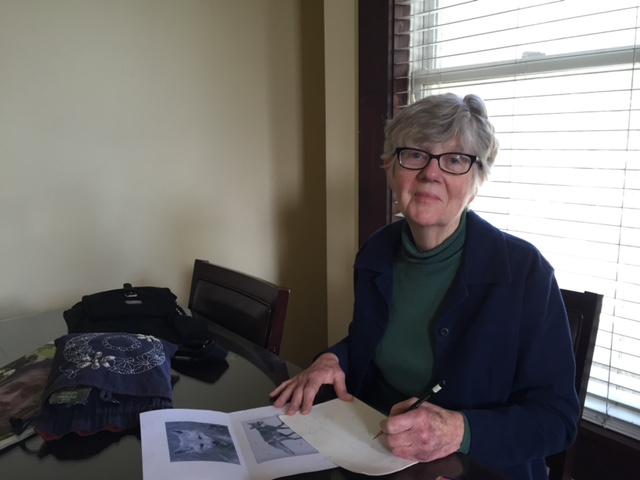
Elaine Carol Gray passed away on November 18, 2022 in her home surrounded by family. Elaine (75) died of heart failure after suffering with Alzheimers.
Born in Phoenix, Arizona on February 3, 1947, parents Harold and Helen Brown. Elaine moved to California in 1965. Elaine received both her Bachelors and Masters Degrees in Education Administration from Chico State University. Throughout her career she was passionate about public education and promoting learning.
Elaine spent her career in education beginning as a teacher in 1972. She worked in several California cities both in the classroom and administration in East Nicolaus, West Sacramento and Dos Palos. Elaine spent 1978 abroad teaching in Wales. She adored her time and took pride in her accomplishments as Principal/Superintendent of Freshwater Elementary School (1994-2005).
As a lifelong learner, during her retirement Elaine enjoyed taking courses at Cal Poly Humboldt. Throughout her life Elaine loved travel, especially visiting museums both nationally and internationally. She enjoyed painting and believed in reusing goods as an avid thrift store shopper. Elaine was a member of the Rotary, active in the Democratic party and the Humboldt Handweavers and Spinners Guild.
She is survived by daughter Rainbow Greer and son-in-law Adam Sullivan of Santa Rosa, California, Son Todd and daughter-in-law Dorothy Johnsgard of Aransa Pass, Texas and son John O’Brien of Fair Oaks, California.
The family is holding a celebration of life for immediate family and friends. This is a private event. Elaine wanted most for her friends and family to visit with her before her death and luckily this wish came true.
###
The obituary above was submitted on behalf of Elaine Gray’s loved ones. The Lost Coast Outpost runs obituaries of Humboldt County residents at no charge. See guidelines here. Email news@lostcoastoutpost.com.
OBITUARY: Grace Ernestine Lindsley 1930-2022
LoCO Staff / Tuesday, Nov. 29, 2022 @ 6:56 a.m. / Obits
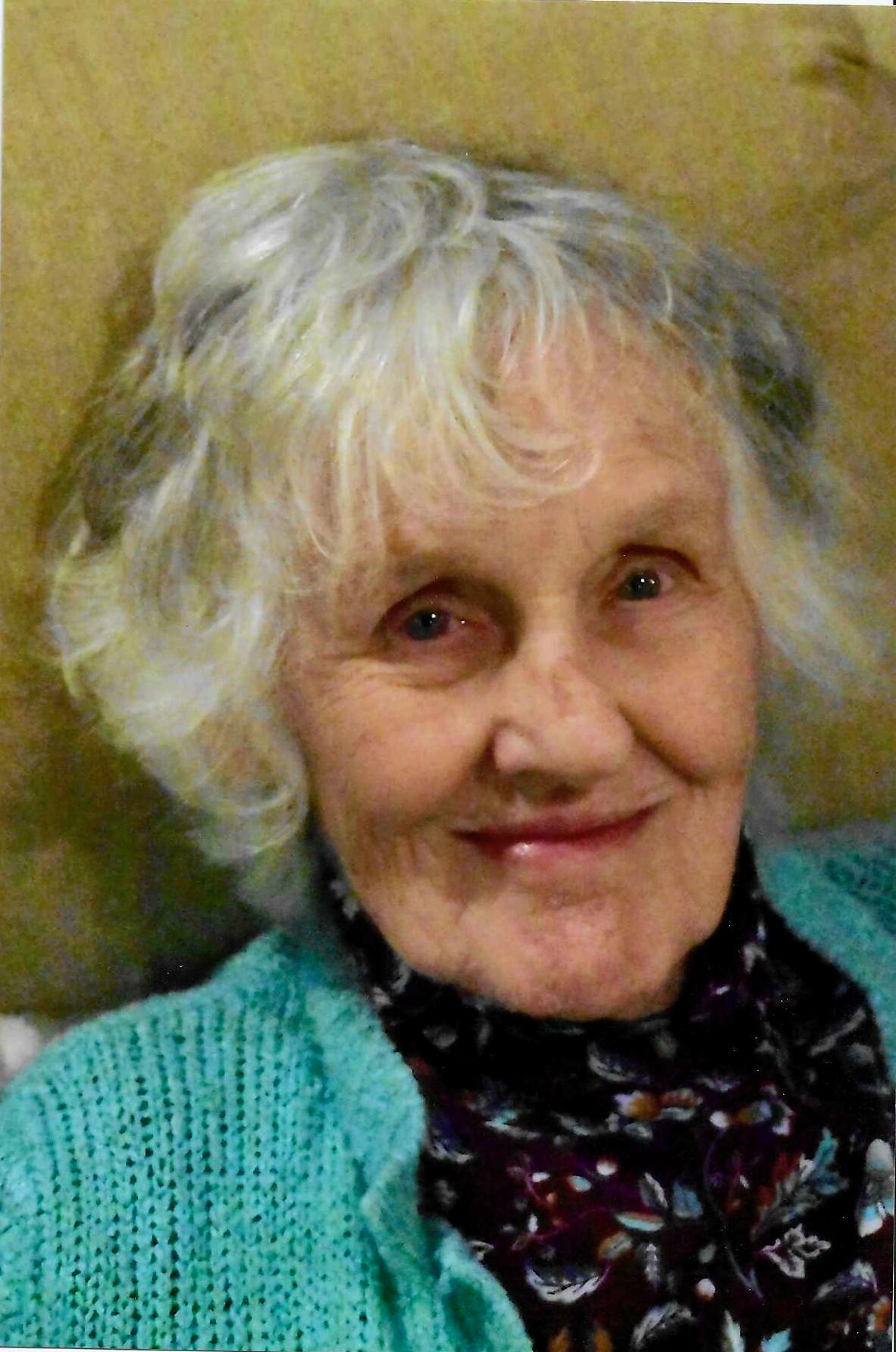
Grace Ernestine Lindsley
February 7, 1930 –
October 13, 2022
Grace was born on February 7, 1930 in Scio, Oregon to Frank and Iva Freitag, and passed away at the age 92 in Eureka.
As a young girl along with her cousins, growing up in meager circumstances, she picked beans in the local fields for 2 cents a pound.
When Grace was fourteen, she lived with her aunt Alice and uncle Dorsey in order to take care of her two cousins. She also was attending Lebanon High School and working in the produce department of a grocery store.
She met a Navy sailor named Allen Robert (Bob to family) Lindsley when he came to see his Aunt Alice. Alice was Allen’s aunt and Dorsey was Grace’s uncle.
On December 4, 1946 Allen and Grace were married in Lebanon, Oregon. They were married for 66 years until his death in 2013. Shortly after they were married, they moved to Brookings, Oregon. They then moved to Arcata.
They built a house in McKinleyville and in1956 moved to sunny Garberville as Allen (Al) was hired by PG&E as a line truck driver. In 1966, Grace was hired by the Southern Humboldt Unified School District to work as a cook’s assistant at Redway Elementary School. She eventually would become head cook. Grace retired in 1992 after 26 years of service. After her retirement, children she had cooked for would come up to her and express how much they had loved the food she had cooked as everything was homemade — especially her yeast rolls and apple crisp.
After she retired our dad and mom volunteered at the Healy Senior Center. Grace volunteered for 28 years. Grace would sell raffle tickets during their annual yard sale. She would also sell tickets and volunteered at the annual Redway Volunteer Fire Department BBQ for 41 years. After dad’s death, her good friend and neighbor Candi Brady took her to the Jerold Phelps Community Hospital to listen to the weekly live music. She attended the sessions for the next seven years and enjoyed the pie and ice cream they served.
Grace is survived by her two daughters, Patricia Wormington, (Dan) and Nancy Jurrens (Greg); granddaughter Amy Winslow; grandsons Jason Jurrens (Sara) and Jeffrey Jurrens; great-granddaughters Nikki Winslow, Anna and Grace Jurrens and great-grandson Caelan Winslow; sister Doris Rakow of Salem, Oregon and brother Robert Freitag of Lebanon, Oregon.
On November 2, 2022, Grace was laid to rest next to Allen at the Liberty-Nye Cemetery in Sweet Home, Oregon to her favorite songs, “Amazing Grace” and “You Are My Sunshine.”
Mom would say “everybody loves me.” This was so true.
We would like to thank the staff of Frye’s Care Home for their compassion and kindness and Hospice of Humboldt for their care and guidance during her final days.
A celebration of her life will be held in the spring.
###
The obituary above was submitted on behalf of Grace Lindsley’s loved ones. The Lost Coast Outpost runs obituaries of Humboldt County residents at no charge. See guidelines here. Email news@lostcoastoutpost.com.
OBITUARY: Alvina ‘Lee’ Perkins, 1932-2022
LoCO Staff / Tuesday, Nov. 29, 2022 @ 6:56 a.m. / Obits
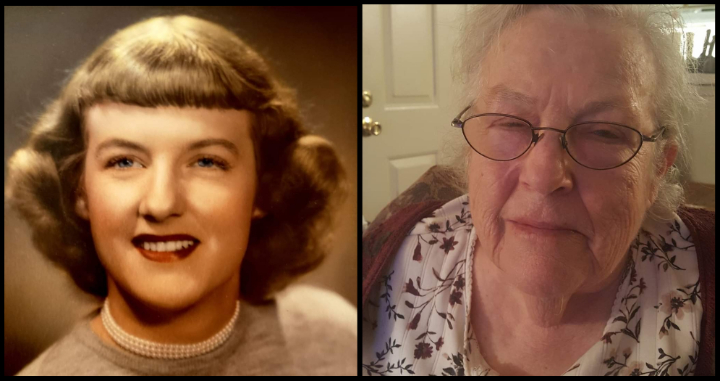
Alvina “Lee” Perkins died peacefully on October 20, 2022 at the age of 90 in her home in Los Angeles with her daughter holding her hand.
Lee was born in Chicago, Illinois on July 2, 1932 to Carl and Erna Guettler. Carl moved the family to Ferndale around 1937 to be close to Erna’s adopted mother from her years in Germany. After Erna died in 1939 following a short battle with leukemia, Lee was sent back to Chicago to live with her Grandma Guettler while her dad tried to recover from his beloved wife’s death. Lee would later return to Humboldt County to go to various schools. She finished high school at Concordia High School in Oakland, California with her younger sister Carla.
Upon the request of her mom, Carl made sure that Lee and Carla finished their college education at Concordia University in Chicago before they got married. Lee graduated from Concordia in 1954 with a degree in Music Education where she mastered playing the pipe organ under the tutelage of some of the best in the business. She began her teaching career in Joliet, Illinois. She met Thomas Perkins while in Chicago and they married on June 25, 1955 in a double wedding with her sister Carla and her husband Dr. Leonard Schoepp. Both couples moved back to Eureka to help Lee’s dad Carl run the Fireside Motel which Carl built. Lee taught primary and special education classes at several Eureka City Schools including Lafayette, Worthington and Jefferson Elementary schools as well as Rio Dell Elementary and South Bay Elementary during the late 1950s into the 1970s.
Lee’s passion, however, was playing the pipe organ for the Lutheran Church, especially Bach and Buxtehude. She began playing at Trinity Lutheran Church in Eureka and moved to Lutheran Church of Arcata when she found out they bought a Schlicker pipe organ for the new church sanctuary. Lee played for the Lutheran Church of Arcata for 30 years and loved every minute of it. Lee also played for dozens of weddings and funerals in Northern California and Chicago over her lifetime.
Lee also taught piano to many students in Humboldt County and put on many recitals. She became a dear friend to many of her students keeping in touch after they moved on in life. She also gave the gift of music to her son and daughter at an early age placing them in music lessons for as many instruments as they wanted to learn. This gift of music carried on and has enriched their lives throughout the years.
Lee moved down to live with her daughter Andrea in Los Angeles in her last 10 years to receive top medical care. Her daughter took the best care of Lee making sure her life was happy, peaceful and as comfortable as possible.
Lee is preceded in death by her dad and mom, Carl and Erna Guettler, her stepmother Dagmar Constance Guettler, her husband Thomas E Perkins, and her son Steve Perkins. Lee is survived by her sister Carla Schoepp, her daughter Dr. Andrea Perkins, and her granddaughter Samantha Perkins.
Lee was interred at Greenwood Cemetery in Arcata. A celebration of life service will be held for Lee at Lutheran Church of Arcata on December 10, 2022 at 2 p.m. with a reception to follow. The church is located at 151 E. 16th St in Arcata. All who knew and loved Lee are more than welcome to come and celebrate the life of such a sweet, gentle, loving soul that Lee was while living here on earth.
###
The obituary above was submitted on behalf of Lee Perkins’ loved ones. The Lost Coast Outpost runs obituaries of Humboldt County residents at no charge. See guidelines here. Email news@lostcoastoutpost.com.
150 Humboldt County Residents Will Get $1,000 a Month Through Guaranteed Basic Income Pilot Program
Ryan Burns / Monday, Nov. 28, 2022 @ 4:19 p.m. / Community Services
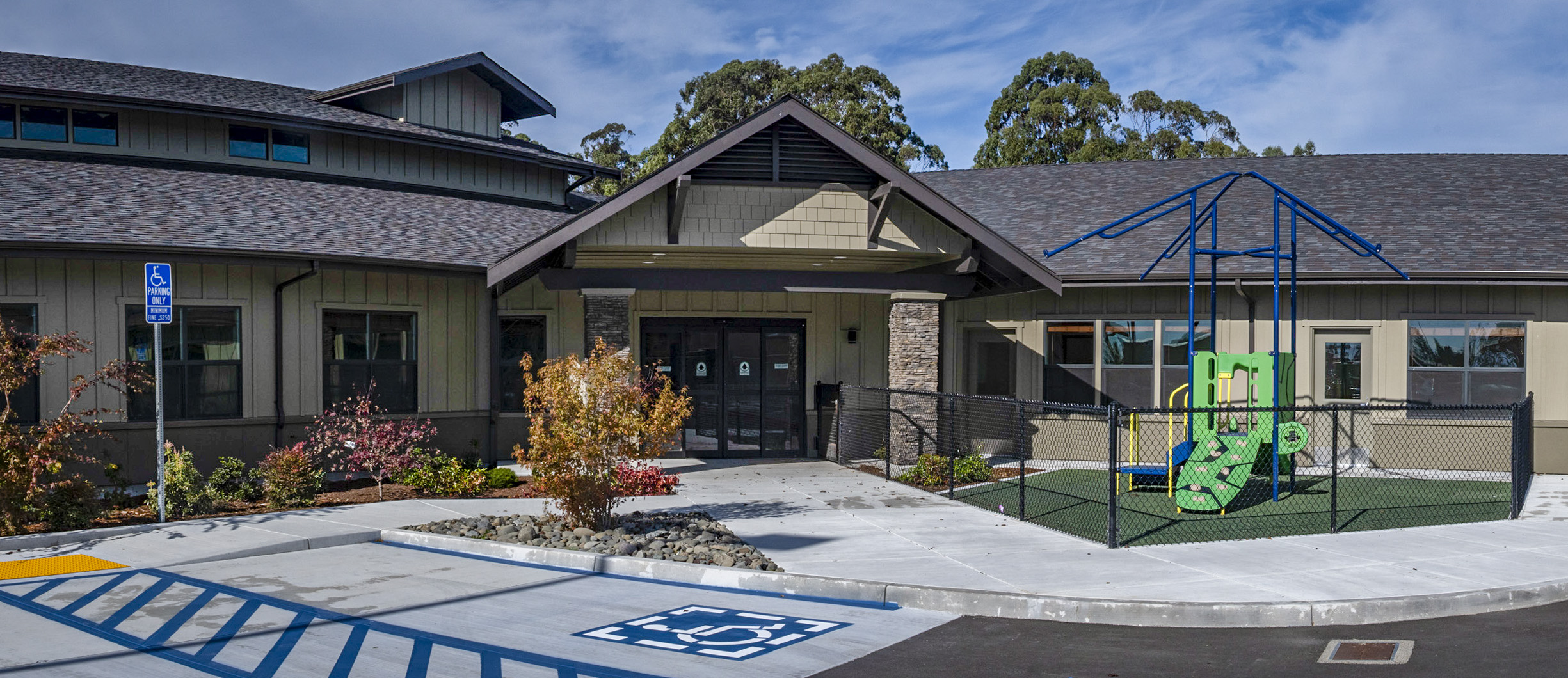
The Center, a multi-agency facility led by the nonprofit McKinleyville Family Resource Center, opened its doors in April. The McKFRC will soon administer a guaranteed basic income program for local residents. | Submitted
A hundred and fifty Humboldt County residents will soon receive monthly payments of $1,000 cash for a year and a half, no strings attached, as part of a state-funded guaranteed basic income pilot program, the first of its kind in California.
Last Monday, the California Department of Social Services announced its intention to award more than $25.5 million in grant funding to seven pilot programs, six of which will be managed by nonprofits in major metropolitan areas. The seventh will be run by the McKinleyville Family Resource Center, whose program manager and interim co-executive director, Robin Baker, was ecstatic to learn that her organization had been selected to receive an award of $2,354,841.
“I was blown away,” she said in a phone interview this morning. “I cried tears of joy for the first time in my life.”
The McKFRC, whose mission is to support, enrich and sustain healthy community life, has yet to iron out the program’s eligibility details, but broadly speaking they plan to give out 18 monthly payments of $1,000 apiece to 150 local Medi-Cal recipients who are in their first or second trimester of pregnancy at the time of qualification.
Baker said the McKFRC will work with various partner organizations over a six-month period to design the enrollment and disbursement processes. Those groups include Open Door Community Health Centers, the Humboldt County Department of Health and Human Services, North Coast Regional Department of Child Support Services, United Indian Health Services and the Trinidad Rancheria, among others.
This kind of collaborative effort played a key role in the development of The Center at McKinleyville, which opened its doors in April after a decade of planning, Baker said. Led by the McKFRC, The Center allows northern Humboldt residents to access services from a variety of partner organizations, including most of those mentioned above.
Local service groups, government and tribal agencies also helped the McKFRC in its bid for the guaranteed income grant award, submitting enthusiastic letters of support that vouched for the organization’s track record of helping rural families.
While Baker was happily surprised by the grant award, she also sees how impactful the program can be in addressing some of our region’s specific challenges. In applying for the grant, the McKFRC noted that Humboldt County’s rates for nearly all leading causes of death are two-to-three times the state average. Native Americans here die an average of 12 years sooner than Caucasians, in part due to disproportionately high rates of serious health conditions, drug related deaths and trauma.
The concept of guaranteed income payments has gained traction in California and beyond following a 2019 pilot program led by former Stockton Mayor Michael D. Tubbs. In that city, 125 randomly selected residents received payments of $500 per month for 24 months.
Researchers analyzing the results found that participants were healthier, happier and less susceptible to the kinds of month-to-month income fluctuations many households face. What’s more, the program actually boosted employment rates among recipients, alleviating their financial scarcity and allowing them greater self-determination.
Sacramento adopted a similar program in January, and in July 2021 California lawmakers unanimously approved the first state-funded guaranteed income plan in the U.S. The program is designed to help qualifying expectant mothers as well as young adults who recently left foster care.
“Our original proposal was to serve 275 people,” including locals who are aging out of foster care, Baker said. But after submitting the application, McFRC was contacted by state officials who asked if they’d consider limiting the program to pregnant applicants.
“We said, ‘Yes, absolutely,’” Baker recalled.
There’s still a lot of work to be done before the payments can begin.
“We’ll have a six-month planning time, and we need to secure a $1.2 million philanthropic match,” Baker said. A group of organizations has already expressed interest in supporting a guaranteed income program, including The California Endowment, Sierra Health Foundation, The James Irvine Foundation and Blue Shield of California. The McKFRC is also partnering the Humboldt Area Foundation to identify potential local sources of funding. (Baker said the McKFRC will welcome donations, too. People can specify that it should go to the guaranteed income pilot program.)
“We feel confident that we will be able to do [raise the $1.2 million], and it’s a big lift,” Baker said. She explained that the direct $1,000 payments need to come from a combination of state and philanthropic funding so recipients don’t lose eligibility for their state benefits. The McKFRC also wants to ensure that the money gets delivered in a way that’s accessible to people who may not have bank accounts — so potentially via prepaid cards or checks.
The six-month planning period will be followed by a six-month enrollment phase, and Baker said the McKFRC plans to prioritize applicants who are Black, Indigenous and people of color (BIPOC).
“Because we’re the only rural [recipient of] funding, I think a lot of people will be watching to see what the impact is,” Baker said.
The results could wind up informing policymakers across the country and potentially expand the proliferation of guaranteed basic income programs, which garnered a lot of attention and support when proposed by 2020 presidential candidate Andrew Yang. Baker’s excited about the potential.
“It’s a wonderful opportunity for Humboldt County to tell our story on a large scale and to impact people nationwide,” she said.
WINTER IS HERE: Cold, Wet Weather Ahead For Humboldt
Andrew Goff / Monday, Nov. 28, 2022 @ 2:19 p.m. / How ‘Bout That Weather
NWS
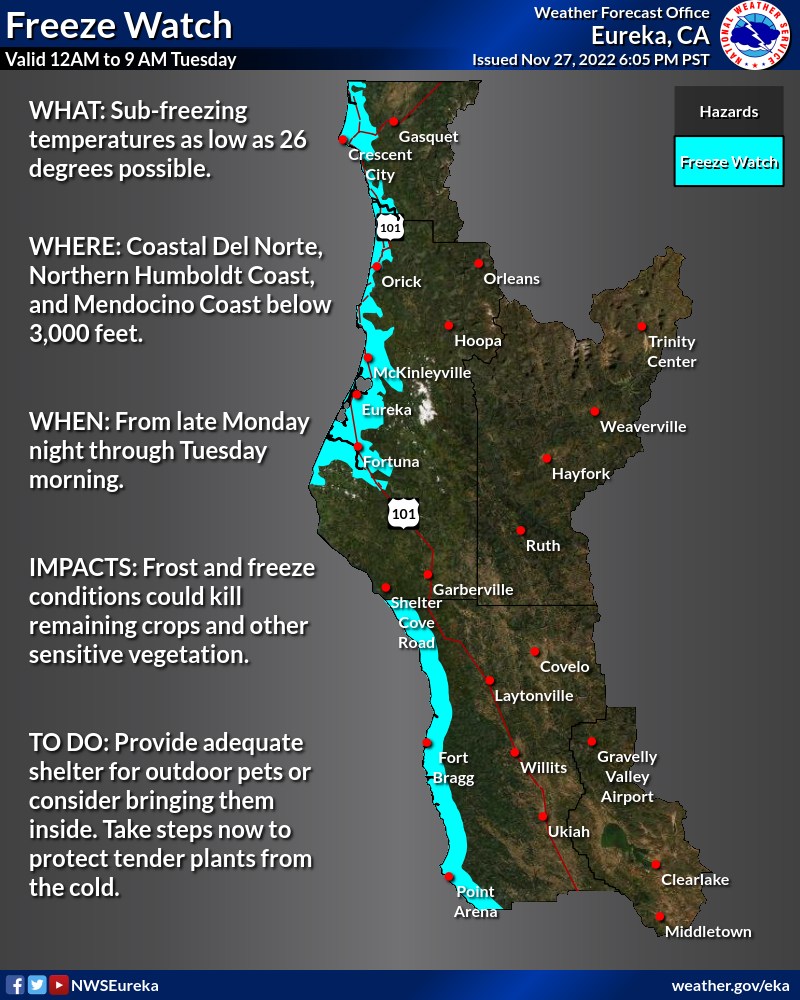
With rain and freezing temperatures expected, winter is likely to kick it up a notch this week here in Humboldt. Time to bring in the goats, people.
First up on the schedule, the National Weather Service here in Eureka warns that Monday night is going to be a cold one with freezing temperatures possible countywide.
“A cold airmass will settle over Northwest California Monday night and freezing conditions will be possible across the area, even at the coast,” the NWS said Monday while issuing a Freeze Watch.
As the week progresses, Humboldt is probably in store for an above-average sky dumping. The NWS warns that a “significant winter storm is expected to come our way Wednesday night and into Thursday, bringing heavy rainfall and the potential for low elevation snow.”
Get to hunkerin’, HumCo.

Man Who Helped Bear River Triple Murderer Go on the Lam Sentenced to Three Years, Eight Months but Will Likely Only Serve a Year in Prison
Rhonda Parker / Monday, Nov. 28, 2022 @ 12:33 p.m. / Courts
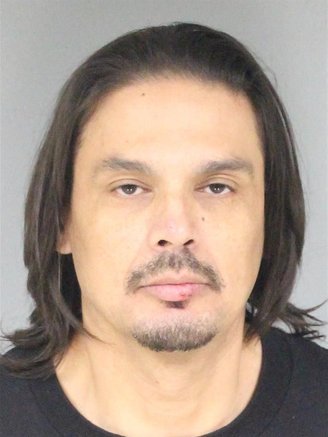
A prison parolee who was arrested in Utah with triple-murderer Mauricio Johnson was sentenced this morning to three years and eight months in state prison.
Keener.
Judge Kaleb Cockrum sentenced 48-year-old Von Eric Keener to the maximum three years for being an accessory after the fact. He also received eight months for failing to register as a sex offender and 180 days for parole violation. The 180 days will run concurrently.
Keener has so much credit for actual time served, along with “good time” credit, that he will likely spend about a year in prison.
Keener and Johnson were arrested in Utah on Feb. 11, 2021, the day after the 18-year-old Johnson gunned down Margarett Lee Moon and her fiance Nikki Metcalf, both 40, and Moon’s 16-year-old daughter Shelly Moon. All three were shot in the head at their home on the Bear River Rancheria.
At the time Keener was the boyfriend of Johnson’s mother, Melissa Johnson-Sanchez, who also pleaded guilty to being an accessory to the killings. Johnson-Sanchez, 43, was sentenced in October to 364 days in Humboldt County Correctional Facility. She remains in custody.
Today family members of the victims requested — as they did at Johnson-Sanchez’s sentencing — that Keener also be charged with child abuse for the trauma he caused Margarett Moon’s younger children. The kids awoke that morning to find Metcalf and Shelly Moon dead and Margarett Moon fatally injured. She died an estimated four hours after she was shot.
“I’ll never forgive him for what he did to those little Indian children,” said family friend Jewel Frank this morning. She glared at Keener, standing next to his attorney Joe Judge, and said “She (Margarett) was alive while you aided and abetted.”
It has been stated that after the killings Johnson got a car and headed east, accompanied by Keener. Johnson’s mother followed them in another vehicle until they were all arrested by the Utah Highway Patrol.
But Keener said in court this morning he was not in the car with Johnson until they reached Redding.
Deputy District Attorney Roger Rees said Keener could have reported the shootings but chose not to.
“Mr. Keener didn’t notify law enforcement that there were victims of a shooting that might need medical attention,” Rees said.
He said some family members believe Keener should be charged with not only child abuse but murder.
“We do not believe there is sufficient evidence,” the prosecutor said.
The judge told Frank and Sandra Keisner, Metcalf’s mother, that he couldn’t grant their wishes.
“The charges you are asking for can’t be charged and can’t be proven,” Cockrum said.
There was some confusion today about how much jail credit Keener has earned. Cockrum said during sentencing that Keener would receive 688 days against the three-year sentence. Defense attorney Joe Judge said outside court that the amount was 768 days.
Keener himself was perturbed with the number of credits awarded, complaining it wasn’t what he was promised. But Cockrum told him the sentencing was done and on the record. Keener is free to file an appeal.
Keener was on parole for a sex offense that occurred years ago.
###
PREVIOUSLY
- Names/Photos of Suspects in Loleta Robbery/Assault Released
- Loleta Shotgun Robbery Suspects All In Custody
- EPD Arrests Uncooperative, Shotgun-Toting Wanted Man
- ARRESTED: 18-Year-Old Bear River Homicide Suspect, Two Associates Taken Into Custody in Utah, Sheriff’s Office Says
- TODAY in COURT: Alleged Accomplice of Bear River Triple Homicide Suspect Arraigned in Utah Court; Updates on ‘Manila Five,’ Anderson Cases
- Suspect in Bear River Triple Homicide Appears in Utah Court, Gets Public Defender Assigned
- DA Files Charges in Bear River Triple Murder; If Convicted, Teen Suspect Could Face Life Without Parole or the Death Penalty
- Bear River Murder Suspect Still Fighting Extradition From Utah, but One Person Arrested With Him Has Been Returned to County Jail
- Affidavit From Utah Cop Offers Details of Police Investigation Into Last Month’s Triple Homicide at the Bear River Rancheria
- To Get Bear River Triple-Murder Suspect Back to Humboldt, Governor Newsom Must Agree to Sign a Warrant
- Alleged Bear River Homicide Accomplice Sentenced for Violating Parole, Charged With Failure to Register as a Sex Offender
- Fortuna Man Accused of Accessory to a Homicide Arrested
- Mom of Bear River Murderer and Her Boyfriend Charged With Being Accessories After the Fact


