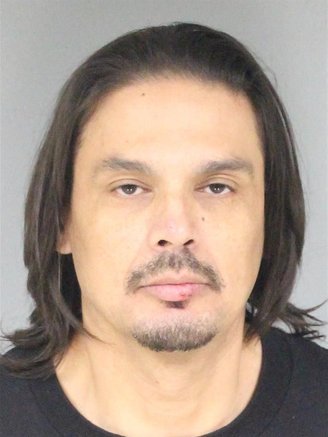
A prison parolee who was arrested in Utah with triple-murderer Mauricio Johnson was sentenced this morning to three years and eight months in state prison.
Keener.
Judge Kaleb Cockrum sentenced 48-year-old Von Eric Keener to the maximum three years for being an accessory after the fact. He also received eight months for failing to register as a sex offender and 180 days for parole violation. The 180 days will run concurrently.
Keener has so much credit for actual time served, along with “good time” credit, that he will likely spend about a year in prison.
Keener and Johnson were arrested in Utah on Feb. 11, 2021, the day after the 18-year-old Johnson gunned down Margarett Lee Moon and her fiance Nikki Metcalf, both 40, and Moon’s 16-year-old daughter Shelly Moon. All three were shot in the head at their home on the Bear River Rancheria.
At the time Keener was the boyfriend of Johnson’s mother, Melissa Johnson-Sanchez, who also pleaded guilty to being an accessory to the killings. Johnson-Sanchez, 43, was sentenced in October to 364 days in Humboldt County Correctional Facility. She remains in custody.
Today family members of the victims requested — as they did at Johnson-Sanchez’s sentencing — that Keener also be charged with child abuse for the trauma he caused Margarett Moon’s younger children. The kids awoke that morning to find Metcalf and Shelly Moon dead and Margarett Moon fatally injured. She died an estimated four hours after she was shot.
“I’ll never forgive him for what he did to those little Indian children,” said family friend Jewel Frank this morning. She glared at Keener, standing next to his attorney Joe Judge, and said “She (Margarett) was alive while you aided and abetted.”
It has been stated that after the killings Johnson got a car and headed east, accompanied by Keener. Johnson’s mother followed them in another vehicle until they were all arrested by the Utah Highway Patrol.
But Keener said in court this morning he was not in the car with Johnson until they reached Redding.
Deputy District Attorney Roger Rees said Keener could have reported the shootings but chose not to.
“Mr. Keener didn’t notify law enforcement that there were victims of a shooting that might need medical attention,” Rees said.
He said some family members believe Keener should be charged with not only child abuse but murder.
“We do not believe there is sufficient evidence,” the prosecutor said.
The judge told Frank and Sandra Keisner, Metcalf’s mother, that he couldn’t grant their wishes.
“The charges you are asking for can’t be charged and can’t be proven,” Cockrum said.
There was some confusion today about how much jail credit Keener has earned. Cockrum said during sentencing that Keener would receive 688 days against the three-year sentence. Defense attorney Joe Judge said outside court that the amount was 768 days.
Keener himself was perturbed with the number of credits awarded, complaining it wasn’t what he was promised. But Cockrum told him the sentencing was done and on the record. Keener is free to file an appeal.
Keener was on parole for a sex offense that occurred years ago.
Press release from the Humboldt County Sheriff’s Office:
On Nov. 26, 2022, at about 4:26 p.m., Humboldt County Sheriff’s deputies were dispatched to the 1000 block of North Westhaven Drive near Trinidad for the report of a neighbor dispute resulting in an assault.
Deputies arrived in the area and contacted an adult male victim who had multiple injuries consistent with being assaulted with a shovel. According to the victim, a property dispute had occurred between the victim and the suspect, 55-year-old Tyrone Vincent McDonald. During this dispute, McDonald reportedly assaulted the victim with the shovel.
Deputies located McDonald still in possession of the shovel. He was taken into custody without incident.
McDonald was booked into the Humboldt County Correctional Facility on charges of assault with a deadly weapon other than a firearm (PC 245(a)(1)).
Anyone with information about this case or related criminal activity is encouraged to call the Humboldt County Sheriff’s Office at (707) 445-7251 or the Sheriff’s Office Crime Tip line at (707) 268-2539.
Press release from the Humboldt County Sheriff’s Office:
On Nov. 23, 2022, at about 7:45 a.m., Humboldt County Sheriff’s deputies were dispatched to a business on the 1400 block of Glendale Drive near Blue Lake for the report of an assault.
During their investigation, deputies learned that the suspect, 33-year-old William Meders, physically assaulted an adult male victim outside the business unprovoked. Following the attack, Meders fled the area and the victim sought medical treatment at a local hospital.
Deputies located Meders in the area of Highway 299 and he was taken into custody without incident.
Meders was booked into the Humboldt County Correctional Facility on charges of battery with serious bodily injury (PC 243(d)).
Anyone with information about this case or related criminal activity is encouraged to call the Humboldt County Sheriff’s Office at (707) 445-7251 or the Sheriff’s Office Crime Tip line at (707) 268-2539.
The Black Academic Excellence Center at Cal Poly in San Luis Obispo on Nov. 2, 2022. Photo by Julie Leopo for CalMatters
The most selective university in the California State University system enrolled a miniscule 146 undergraduate Black students this fall.
Pick a common benchmark for racial or social inclusion and California Polytechnic State University, San Luis Obispo is likely to trail all California public universities.
No Cal State or University of California campus, 32 undergraduate-serving institutions in total, enrolls a smaller percentage of Black undergraduate students than Cal Poly — just under 0.7% this fall. Across both systems, the campus has enrolled the smallest share of Black undergraduate students annually between 2003 and 2021 — and below 1% for most of those years.
Cal Poly is among the toughest public universities in California to enter and graduates students who go on to earn strong wages — an amazing value given the relatively low cost to attend a university in a system that’s proud of its reputation for access and inclusion. And yet Cal Poly is an anomaly, lacking much of the diversity of all the other UCs and Cal State campuses, even when compared to highly selective institutions such as UCLA, UC Berkeley and San Diego State.
Cal Poly attracts the smallest percentage of Black freshman applicants of any Cal State or UC campus and also enrolls few Black students who transfer from community colleges. Black students who spoke with CalMatters described both explicit and subtle acts of racism they experienced on campus, and the minimal trust they have in campus authorities to intervene.
All those factors are related in complex ways. Black students said they’d likely experience less direct racism and feel less isolated as the only Black person in a classroom if Cal Poly just had more Black students. But the paucity of Black students on campus is a key impediment toward attracting more of them — an almost self-fulfilling prophecy in which Black student applicants seeking a larger community of students who look like them go elsewhere. It’s a classic “chicken-and-egg” problem.
Eddie Comeaux called Cal Poly’s low Black enrollment and admissions figures “gross.” The UC Riverside professor of higher education studies has researched why some talented Black students don’t attend UC campuses. Even those schools, which attract far more Black students than Cal Poly, are hit with perception problems that compel Black students to enroll at private universities or historically black colleges and universities. “When you don’t have that representation, it sends the signal that your communities are not valued — you’re not welcome,” he said.
Cal Poly is the only California public university where more than half of the undergraduate students are white, according to fall 2021 and 2022 enrollment data, though a few other Cal State campuses come close.
Another distinction: It’s educated the smallest percentage of low-income students of any UC or Cal State annually since 2008.
Nor is it a new phenomenon that Cal Poly attracts so few Black students. Despite its in-state reputation as an academic powerhouse, Cal Poly has had the lowest share of Black freshman applicants of any Cal State and UC each year since at least 2011.
Black students who spoke with CalMatters say the dearth of Black students at Cal Poly has diminished their education and has left them feeling isolated. They also reported being called the N-word. Were it not for the independent efforts of the small, tightly knit community of Black students on campus, some say, they would have left already.
“The Black students that (Cal Poly) has kept on campus is because of the work of other Black students,” said Gracie Babatola, a third-year Black student who’s president of Associated Students Inc., the campus’s student government.
Their stories add to the recent history of prejudicial incidents on campus. Those included a white student who wore Blackface and others dressed in stereotypical street gang attire at a fraternity party that gained national attention in 2018. The campus president suspended the fraternity and then halted all Greek life for the rest of the year. A short time later, the campus leadership learned of another Blackface incident among fraternity members in a private Snapchat group, which prompted the university president to ask then-state Attorney General Xavier Becerra to investigate that and other incidents. Months later, the attorney general’s office concluded that the students violated no state or Cal State system policies. A week after the Blackface incident, a professor found racist fliers pinned to his classroom door on campus.
“Those kinds of public spectacles can certainly get students to shy away from attending that campus,” Comeaux said.
CalMatters reached out to the administration at Cal Poly five times for an interview and was rebuffed each time.
“Cal Poly recognizes the gap in its enrollment of Black students,” wrote Matt Lazier, a Cal Poly spokesperson, in a 1,300-word email, which CalMatters is sharing in full. Cal Poly “is eager to identify and implement additional measures” to expand diversity. “Pointedly, this includes attracting and enrolling more Black applicants,” he wrote.
Lazier noted several recent programs that may attract more Black students. The campus increased mandatory fees students pay to attend, setting aside a portion for financial aid for low-income students, which disproportionately include Black students in the United States. There’s also the Cal Poly Scholars program, which offers financial aid and academic support to low-income students. That program is expected to grow with new revenue coming from recent fee increases for out-of-state students. Separately, anonymous donors independent of the university provide financial aid to 32 Black students through scholarship programs meant specifically for Black students, with awards ranging from $3,000 a year to a full ride for a wine and viticulture major. Cal Poly officials advise that donors partner with outside groups, such as the California Community Foundation, to administer the scholarships.
Still, those efforts aren’t translating into any uptick in Black student enrollment.
The leadership of the Cal State system also turned down an interview, explaining that “there is not any direct guidance from the Chancellor’s Office to Cal Poly on the subject,” wrote system spokesperson Michael Uhlenkamp. “We are in full support of their efforts to improve diversity and confident that the strategies they have identified are appropriate to helping them reach their goals.”
Called the N-word for the first time
With 21,000 undergrads and only 146 Black students, a campus body composed of one Black student for every 144 non-Black students creates what some Black students describe as a harsh, at times scary, environment.
CalMatters spoke with about a dozen Black Cal Poly students, six on the record, about their experiences with racism. Most of the interviews took place across two days in early November at Cal Poly’s Black Academic Excellence Center, a 609-square-foot student lounge. It’s a tight space regularly filled with 15 students who squeeze in to study, nap, plan their course schedules and socialize. The stories of overt racism some students shared with CalMatters were familiar to those relayed by other Black students in the room.
After grudgingly joining her friends to attend a fraternity party at an off-campus apartment building in February, Jasmine Phipps felt like an outcast and stepped away from the main throng of students. She sat down on a bench in the building courtyard and got on the phone with her dad, with whom she speaks often, when she recalls hearing someone say, “Get out of here,” followed by the N-word. The slur was hurled at her by three white males who appeared to be students, she said.
Jasmine Phipps, 19, a sophomore communications student at Cal Poly in San Luis Obispo on Nov. 2, 2022. Photo by Julie Leopo for CalMatters
The verbal assault Phipps described underscored a trying year for her.
“Last year, if it wasn’t for (Black Academic Excellence Center) and (Black Student Union), I would have transferred out because the staring was a lot. Those little whispers, you hear whispers all the time,” said Phipps, who’s now a sophomore. “And then it gets to a point where you can look at somebody when they’re walking by, but you don’t have to break your neck to look at them. … there’s not that many Black students on campus but I’m pretty sure you’ve seen Black people before.”Freshman Nehemiah Tshishimbi avoids campus parties. In part because he’s not the partying type. But the construction management major also wants to avoid a racist experience — and he’s heard enough stories to stay clear.
Tshishimbi, who identifies as African American, expressed his struggles with befriending white students. Unlike with his Black friends on campus, he hides the full dynamism of his personality around white students, in part because he fears that being Black and male is viewed as a threat — “more aggressive and more dangerous,” he said.
He gets along with white students, chiefly through Christian clubs at Cal Poly. But without common hobbies, Black students may struggle “feeling connected with the white students on campus,” he said.
Nehemiah Tshishimbi, 18, a first-year student at Cal Poly in San Luis Obispo on Nov. 2, 2022. Photo by Julie Leopo for CalMatters
Kianah Corey, who identifies as Black and Filipino, also said she was called the N-word. She entered Cal Poly in 2018 and played for the university’s softball team. She was a freshman on her third day on campus, she recalled, when a white female athlete from another Cal Poly team uttered the pejorative twice during a drinking game.
Corey was the only person of color there and felt powerless to speak up. “No one said anything” in her defense, she said, adding that it was her first time being called the N-word.
“That day literally changed the trajectory of my entire life,” Corey said. She switched her major from liberal studies to child development, with an interest in how students cope with trauma. Now she’s earning a master’s in psychology at Cal Poly. She’s also a paid assistant coordinator for the Black Academic Excellence Center.If other Black students were in the room with her that day, being called the N-word “would have never happened,” Corey said.
Other times, “I was the Black token,” she said. In one example, she questioned why she was in the center of a softball team marketing image “when I played the least innings out of all field players,” she wrote in an Instagram story this year.
Kianah Corey, 20, a psychology grad student at Cal Poly in San Luis Obispo on Nov. 2, 2022. Photo by Julie Leopo for CalMatters
Unlike the other Black students interviewed for this story, Eyasu Betwos spent most of his life in Ethiopia, where Black people by far are the majority. “Living back home for all those years prepared me to just be confident,” the fourth-year computer science major said. “I act like I belong everywhere I go,” something he said many of his Black peers at Cal Poly feel they can’t do.
But when two seemingly drunk white men followed him as he was walking home after a football game in September, Betwos noticed.
“‘Hey, look, there’s a Black kid,’” he remembers them saying. “‘Let’s scare him.’” Betwos said the two men, who appeared to be in their 50s, crossed the road to his side of the street. He was nervous, he said, but joked with them. Eventually they peeled off at an intersection and left Betwos alone.
Because he’s a sports photographer for campus teams, he’s often leaving work at night. Before, he’d walk back home. Now he rides the shuttle. Like Phipps and Corey, he never reported any racist incidents to campus authorities.
“Cal Poly kind of markets itself as having this sort of safe, non-urban college environment,” said Thanayi M. Jackson, a Black Cal Poly history professor who focuses on politics and race. But referring to past incidents of racial animus on campus, she said “This doesn’t seem safe for a Black family.”
Phipps and others previously expressed doubt campus authorities would do much with their testimonials. “When it comes to white males, it’s … their word against mine,” she said. “The Black community in here, they supported me.”
Cal Poly administrators also turned down CalMatters’ request for a separate interview to discuss the campus response to racist acts on campus. Lazier, the campus spokesperson, provided another 600-word written response to specifically address the campus climate, which CalMatters is sharing.
“We unequivocally abhor and denounce racist speech and actions,” he wrote, noting the campus hired a consultant to evaluate the campus cultural climate before the COVID-19 pandemic. Among the conclusions in the 2019 report was a feeling among students and staff that the university is a “good old-boy school” and known as “a White, wealthy school, where your diversity is not welcome,” as one respondent quoted in the report put it. The report authors proposed numerous recommendations, including a diversity training program and investing more in programs that support diversity efforts.
“That follow-up work is ongoing through the university’s Office of Diversity, Equity and Inclusion,” Lazier wrote.
Even before the report, the campus was seemingly aware it had a bias problem. In 2014, Cal Poly created the Bias Incident Response Team. According to Lazier, the bias team meets “as needed” to “evaluate incidents for policy violations, resource provisions, and appropriate resolutions.” The nature and frequency of those reported incidents are unclear. “The team doesn’t maintain statistics on its reports,” Lazier wrote in a November 2022 email.
In the 600-word email, Lazier wrote that students should report any racist incident to campus officials. However, “it is important to note the limitations the university faces in disciplining any campus community member for racist speech.” As a public institution, Cal Poly is “bound by law to uphold the First Amendment rights of those who study, work, visit, or live on our campus,” Lazier wrote — sentiments similar to what the campus told the public in 2018 after the outcry over a student wearing Blackface.A senior lawyer for the American Civil Liberties Union agrees public campuses are limited in what they can do about racist speech on campus, but in some cases, a university can take action. “If the use of the N-word is targeted and repeated, a public university may be able to discipline a student for harassment,” wrote Peter Eliasberg, chief counsel at the ACLU of Southern California, in an email. “In some circumstances, the use of the word could be part of a pattern of speech that constituted unprotected threats.”
Cal Poly isn’t on Black students’ lists
Several counselors at nonprofits who advise high school students on attending college told CalMatters that Cal Poly isn’t on the radar of Black students because the campus has few Black students to begin with.
“I think that that demographic of 1% African American students dissuades our African American students from applying,” said Mimi Bolton, lead advisor at Neighborhood Academic Initiative, run by the University of Southern California. The Black students she’s mentored who are interested in engineering — Cal Poly’s most popular type of degree — can find campuses where engineering is strong and where there is more diversity. “All of those factors make that school further down a lot of our students’ list, if it’s on the list at all,” Bolton said. Cal Poly may also be less attractive to students who don’t want to pursue the sciences and business — among the school’s most popular majors, Bolton added.
“Cal Poly kind of markets itself as having this sort of safe, non-urban college environment. This doesn’t seem safe for a Black family.” — Thanayi M. Jackson, a Black Cal Poly history professor who focuses on politics and race
Ashley Williams advises 30 to 40 Black high school students and she doesn’t hear them bring up Cal Poly as a destination. She is assistant director of a UCLA program where students eye many schools.
Williams thinks students with the grades to enter Cal Poly would rather attend a UC for the name recognition and the larger Black student population, or go out-of-state to historically Black colleges and universities.
“If it’s a competitive Cal State, they may be thinking, ‘Why do that? I’ll go to a UC,’” Williams said.
One scholar thinks Cal Poly’s low number of enrolled Black students alone paints a picture of a racist climate that can dissuade other Black students from applying. “Racism, especially at an institutional level, doesn’t require any form of intent and doesn’t even require individual actors,” said Whitney N. L. Pirtle, a sociologist at UC Merced who studies race and ethnicity. “I think the numbers (at Cal Poly) are evidence enough.”
Whether Cal Poly’s reputation for racist incidents is another impediment to attracting Black students is an open question. Among the Black students at the Neighborhood Academic Initiative, “the answer is no — students are not intentionally avoiding Cal Poly because of any incidents they’ve heard about,” emailed Kim Thomas-Barrios, who runs the initiative, among other duties. Racist experiences can occur anywhere, on or off campus, she wrote.
But Jackson, the Cal Poly professor, recounted a conversation with a Black high school student that suggests Black students pay attention to campus climate. After she took part in a series of lectures for visiting Black high school students in March, Jackson recalls one student telling her that “this was a really nice event, you brought out all your Black folks, but you know, Cal Poly, y’all don’t do anything when people are in Blackface and have racial incidents on campus, and so you’re gonna have to do a lot more than that if you want us to come to Cal Poly.” Jackson stressed this wasn’t a direct quote, but it was a “pretty darn close paraphrase.”
“If it’s a competitive Cal State, they may be thinking, ‘Why do that? I’ll go to a UC.’” — Ashley Williams, high school student advisor
Cal Poly’s reputation can travel along a “whisper network,” Pirtle said. People talk, whether the data captures it or not. And though her sons aren’t yet in high school, Cal Poly “would not be a place I would want them to go” given its enrollment and applications data, said Pirtle, who’s Black.
In his first email, Lazier, the Cal Poly spokesperson, didn’t attribute the campus’s struggles to attract Black students to campus climate, but rather to its cost. He noted that Cal Poly ends up being more expensive because the UCs “have been able to offer more financial aid to students with lower incomes,” he wrote, which he argues attracts a larger share of Black and other students of color.
But part of the reason is that Cal Poly charges nearly $3,000 more in student fees than the Cal State system average. Those higher costs eat into the state and federal financial aid students get. To better compete with the UCs on affordability, this year Cal Poly rolled out a new student fee plan that raises costs for wealthier students and then uses some of those revenues to give lower-income students more financial aid.
Cal Poly’s markedly low percentage of Black students is even more startling when focusing on transfer students. Only two times in the past 15 years has this campus of 21,000 undergraduate students enrolled 10 or more new Black transfer students from California’s community colleges, according to fall enrollment data. Students from community colleges contribute a large share of the diversity at UC and Cal State campuses. But just 11% of all of Cal Poly’s undergraduate students hail from community colleges — far below the rate at all other Cal State campuses and all but one UC campus (UC Merced, which is among the most diverse public universities in the state).
When they were submitting college applications, some Cal Poly Black students didn’t know about the university until the last minute. Babatola didn’t decide to apply until two hours before the application deadline and had learned of the school’s existence just a few weeks prior.
Only after being admitted did Babatola learn of the campus’s tiny Black population and its past history of racist incidents. That unnerved her, but after liking an Instagram post from the campus’s Black Student Union, Babatola was quickly folded into the Black student community. She was invited to one event, but couldn’t make it. Still, her point person at Black Student Union continued to text her regularly.“Knowing at least I already had found the community,” plus Cal Poly’s relative affordability and good academic reputation, compelled Babatola to enroll, she said.
Cal Poly isn’t the only non-urban CSU or UC
Some explanations Lazier gave for the dearth of Black students at Cal Poly unravel upon closer scrutiny. For instance, he wrote that a state ban on affirmative action prevents Cal Poly from considering race as a factor in admissions. But that ban applies to all public universities in California as well, all of which attract more Black students. And yes, the campus is in a heavily white area of the state that’s removed from major metro centers, as he noted. UCLA and San Diego State, for example, attract many students who are local. So does Cal Poly Pomona.
But other public universities such as UC Santa Barbara, UC Santa Cruz, and California State Polytechnic University, Humboldt have similar local diversity constraints and still manage to attract a greater share of Black students — as applicants and as students. And unlike other Cal State campuses that enroll students who typically grew up near campus, Cal Poly attracts interest statewide and beyond. In fact, about 18% of Cal Poly’s undergraduates are out-of-state students, quadruple the average for the entire Cal State system. The UC systemwide average is also 18%, but, again, the system’s individual campuses attract and enroll more Black students.
Cal Poly’s location “is not a satisfying” answer for why it attracts so few Black students, said Hans Johnson, a senior fellow focused on higher education issues at the Public Policy Institute of California.
As a prestigious institution, “it serves not just a local population, but a widespread population in the state and yet, Black students are significantly underrepresented at Cal Poly,” Johnson said.
The only Black student in the class
That there are few Black students on campus also hurts their education, limiting the caliber of class discussions and creating extra social pressures.
The Black students CalMatters interviewed say they often are the only ones in their classes who are Black. That puts pressure on them to carry an outsized load in group discussions. “You’re the person to explain the whole story for all the Blacks,” Phipps said.
Third-year student Mikayla Santiago, who’s African American and Puerto Rican, counts four times she’s been in a class with another Black student — and never in any of her major classes tied to animal science or psychology. Without a Black person in class with her, she feels a dual burden.
“Is everyone looking at me, trying to gauge how I’m feeling?” said Santiago, who’s also the Black Student Union co-president. At the same time, “I’m also trying to gauge how I’m feeling.”
Santiago, who, like Phipps, works part-time at the excellence center, is certain that more Black students in the same class would push the conversation about race in politics and society beyond a surface-level understanding. It’d be less “I’m shocked that Black people have gone through this,” she said. More Black students would also motivate her academically, likening the responsibility to a “family tie.”
Mikayla Santiago is a junior psychology student at Cal Poly in San Luis Obispo. Nov. 2, 2022. Photo by Julie Leopo for CalMatters
Babatola felt diminished in a political science class when a professor dismissed her point that Black students from Africa and African Americans, many who trace their history to U.S. slavery, have different social experiences.
“There’s trauma that comes with being African American that I will never understand,” said Babatola, who was born in Nigeria. She remembers the professor saying, “Well, you look the same.” She expected a political science professor to be more attuned to the nuances of cultural identity.
That the students feel this weight makes sense from a research perspective, said Comeaux, the UC Riverside scholar. “When you have a critical mass of Black students in a classroom, the Black student doesn’t have to be the representative for all things black, right?” he said.“They don’t have to be that token student.”
For Jackson, the Cal Poly history professor, the subject of race becomes an abstraction without Black students in the class. That can lead to some white students feeling guilty about the caustic U.S. history of race relations rather than dealing with the experiences of Black people who endured the systemic racism, Jackson said. She offers what she admits is a counter-intuitive argument: rather than creating friction in the classroom, with Black students participating in class discussions, there’s a “de-centering of the white response,” Jackson said.
The absence of Black students is “jarring,” Jackson said. “Sometimes (that) absence is just super loud.”
How these experiences translate into students’ graduation rates is unclear. As CalMatters has previously reported, Cal Poly joined almost all other Cal State campuses with long-lingering and wide gaps in graduation rates between Black students and students from other demographic groups. But that trend swung the other way this most recent year: Black students at Cal Poly posted the highest six-year graduation rates of any racial or ethnic group in 2022, according to new system data. About 93% of Black students graduated after six years this year — higher than the campus average of 86%.
Such swings are common at Cal Poly: Because the campus has so few Black students, graduating a few more students in one year dramatically increases its six-year graduation rate for those students. Last year it graduated 28 Black students. This year it graduated 24. That pales in comparison to the roughly 4,000 students the school graduates annually.
A ‘small’ but ‘mighty’ support system for Black students
An obvious solution to ending the isolation Black students experience on campus is to attract more Black students. But it’s not that easy.
“Do I want more Black students to come here and face the racism that we have all faced as Black human beings on this campus, and so our Black population grows?” asked Corey. “Or do I tell them to not come and then have the ones that are here still suffer from the racism?”
Without a doubt, she wants more Black students to come.
One approach to attract more Black students? “We lie,” said Babatola. “We just skirt around what a lot of us are thinking and what a lot of us have experienced.”
But arguably Cal Poly is also “lying” about the level of diversity among its students by using marketing images that critics say give the impression the university enrolls far more Black students than it actually does.
“We lie. We just skirt around what a lot of us are thinking and what a lot of us have experienced.” Gracie Babatola, a third-year Black student at cal poly and president of Associated Students Inc.
In past years, Babatola and her peers would tell prospective students of the campus’s strong academics, the closely formed friendships — while papering over the day-to-day frustrations of being Black at Cal Poly.
However, this year, “I’ve been really trying to work on being more honest about the realities of campus,” she said.
Cal Poly has a lot to offer, students said: ample internship opportunities, a learn-by-doing method of teaching, high average salaries for students who graduate, to name a few.Lazier, the Cal Poly spokesperson, also suggested that more Black students on campus would improve the experiences for Black students. “This truly is a work in progress,” he wrote. “And campus culture and the diversity of our student body and work force go hand in hand. As we improve in one area, we will see positive effects in the other, and vice versa.”
Phipps has cried at times and questioned why she came to Cal Poly, but she isn’t leaving. Instead, she feels an obligation to make Cal Poly a more welcoming place for Black students.
Already she has a great group of friends: “Small, but we’re very mighty,” Phipps said. “They’ll help me get through this.”
###
CalMatters.org is a nonprofit, nonpartisan media venture explaining California policies and politics.
A few years ago, the US
government quietly went from UFOs to UAPs: Unidentified Flying
Objects to Unidentified Aerial Phenomena. It was a calculated move,
designed to fool nobody: UFOs are firmly in the “Aliens are here,
checking us out” meme to “it’s OK folks, it’s not aliens,
it’s just balloons, or Chinese-Russian drones, or Venus, or
something we don’t understand, not aliens, trust us, we’re the
government” label.
In a report
issued a year ago by the Office of the Director of National
Intelligence, “Preliminary Assessment: Unidentified Aerial
Phenomena,” the word “alien” is conspicuously absent. Instead
we have: airborne clutter (balloons, birds, drones, etc.); natural
atmospheric phenomena (ice crystals and the like that show up as
radar blips); US government or US industry developmental programs;
foreign adversary (specifically, Chinese and Russian) systems; and a
catchall “other” bin (“…pending scientific advances that
allowed us to better understand them”). Not an alien in sight.
Not that the name-swap
has done any good with true-believers. Those fuzzy infra-red fighter
jet clips, released by the Pentagon in 2020 (explained
to death by Mick West)? Aliens. The
Roswell weather balloon? Aliens. Crop circles created by
pranksters? Aliens. Abduction stories, usually involving an
instrument shoved up the abductee’s ass? Aliens. Virtually
anything you can’t explain? Aliens. Thanks, Hollywood!
The infamous 2004 GOFAST video.
Commander David Fravor, flying a jet off the USS Nimitz, claimed that
the object (shaped like a Tic Tac) was about 40 feet long, despite
having no way of knowing how far away it was and therefore subject to
parallax error. (It was probably a weather balloon much closer than
he thought.) (US Navy, Public Release)
Back in the 1950s, 1960s
and 1970s, a cottage industry was built around photographs of flying
saucers and, sometimes, of their extraterrestrial occupants. Yep,
we — some folks (mostly, for some reason, in Red States!) got great
photos, proof positive of their alien encounters. Except, wouldn’t
you know it, when they went to get the film processed (per-digital
cameras), those sneaky ETs had erased the images, or caused them to
be blurry beyond recognition.
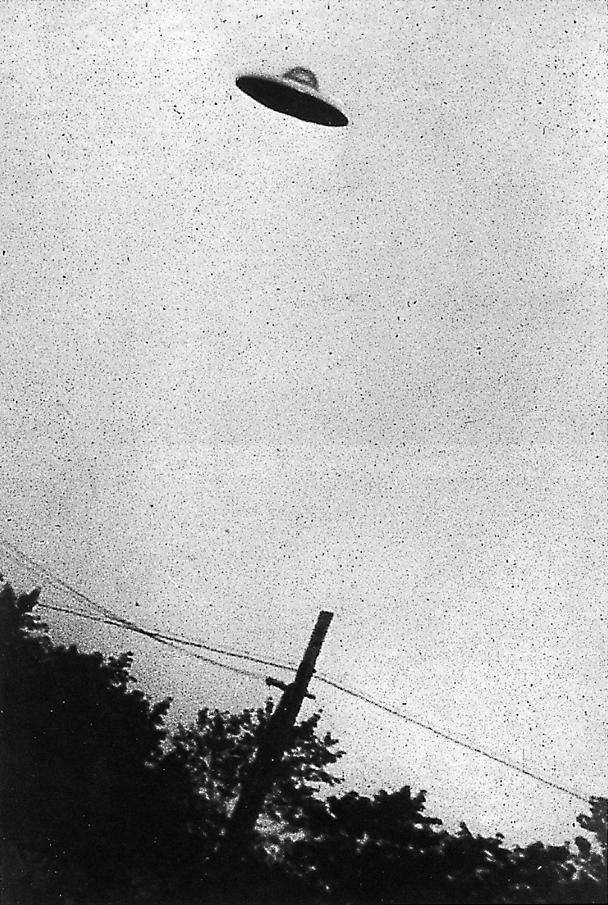
They’re here! UFO over Passaic, New Jersey in 1952. (Public domain, via Wikimedia.)
But that’s no problem
today! On a planet with eight billion people (exactly, per the United
Nations, last November 15) and around six billion smartphones — most
of which can stream images as they’re taken, that shouldn’t be a
problem. Now we can readily obtain proof of what we see, be it
details of their spacecraft or the aliens themselves, and prove to
the world that we weren’t stoned or hypnotized or just (gasp)
making up stories to sell to the papers! Should be easy, right?
Except, since the
advent of digital cameras, and especially the ability to stream in
real time, there’s been a positive dearth of such images. I guess
the aliens, shy by nature, figured out our technology just in time to
stop making appearances.
By the way, a side
note: why are aliens, in movies, books and National Inquirer stories,
almost always depicted as evil, Earth invading bad guys? (“The Day
the Earth Stood Still” and Spielberg’s “ET” were rare
exceptions.) I think you can make a good case that an intelligent
species that is also aggressive and prone to taking sides, like our
own, is unlikely to survive more than a few generations after
inventing weapons of mass destruction. As evidence, I offer: the
Cuban missile crisis, the 1983
Soviet false alarm incident,
Putin’s current nuclear threats, and our apparent inability to
reduce our (January 2022) 12,705 nuclear warheads, despite have more
than enough to “keep raising the dust” on cities we’ve already
destroyed. That is, any alien species that’s survived long enough
to figure out long-distance (really long!) interstellar travel
is likely to be peaceful. As Neil deGrasse Tyson put it in one
of his StarTalk videos, “Our knowledge of
aliens is derived not from how they would behave, but how we would
behave.”
I’ll let Neil close
out this rant. “The fact that you don’t know what it is, is not
evidence that you know what it is.”
Anna
disembarked from the metrobus at Soğutluceşme
in Kadıköy. Since it was the last stop, the remaining passengers
also filed out onto the sidewalk in front of the municipal building
and began flowing to catch the nearby buses or to walk into the
neighborhood. It was always busy here, crowded, reflected Anna, much
more so than her native Rostov.
With
distaste, she recalled an incident on the metrobus a few minutes
earlier. The bus had been overfilled as usual, everyone crammed like
anchovies, pressed against the doors. At one of the stops, a few
passengers were trying to get off, and they pushed anxiously against
Anna, but she had been unable to let them pass because a
broad-shouldered man in front of her either refused to move or was
oblivious of the custom of temporarily getting off the bus to let
others get off. A covered woman had shouted something rudely at Anna.
Anna didn’t know more than a few phrases of Turkish, but the
context and tone were enough. Somehow, after much pressing and more
shouts from other passengers, the bodies had made their way past Anna
and the broad-shouldered man and out into the street, the doors were
closed and the bus continued to Kadıköy.
As
she walked along, Anna still bristled at the thought of those
unintelligible curses. She took her anger out on the man blocking the
way. Some people, she thought! Why couldn’t he have simply got off
the bus for a moment to clear the way? Did he really think the bus
would leave without him? Some people – they behave as if … as if
– they are the only people in the world. As if there were nobody
else.
Anyway,
she was tired. She had been up since six, and had taken a very long
trip across the city to the distant neighborhood of Zeytinburnu. It
was an industrial district, full of factories. She had gone there for
a job interview, a customer service position. It was advertised as
minimum wage, but being a foreigner, she had felt sure that the
amount stated in the interview was lower than that. The interviewer,
a Turkish manager, had obviously liked her (Turkish men had a thing
for Russian women, she knew that), and had complimented her on her
English and asked if she spoke any Turkish, which of course she did
not, having been in the city for only a month. The interview had
concluded with the manager indicating that he would be in touch
“soon.” Soon! What does that word even mean?
She
was thirty six, still with the attractive slimness of her youth. Her
long red hair was like that of a fresh apple, and her pale complexion
still rosy (in her youth, her friends had teasingly referred to her
as “a Russian Kate Winslet,” ha! The film “Titanic” had been
very popular in her hometown). Indeed, lots of men looked at her,
noting her foreign-ness and pleasing features. Anna crossed the busy
main street and walked up the hill to the neighborhood where she and
her husband Alexei were staying. The trees were golden and
red-colored, the streets beginning to flow with dry leaves. The
autumn was warm and dry, pleasant. Out of habit she still checked the
weather in Rostov – today it was about 6 degrees (Celsius), cloudy,
so the winter had not really set in back home yet.
Home?
It was still hard to process – the fact that she and Alexei were …
refugees? She couldn’t accept this word, this condition. Yes, it
was true that they had left Russia. And yes, because of the war.
Alexei had feared conscription, so they had taken a bus to Istanbul.
Anna shuddered at the memory of that horrible overnight journey. The
trip itself wasn’t so long, only about ten hours, but it had been
packed just like her recent metrobus, and everyone had been tired,
anxious and rude. Again, everyone acting as if their situation alone
was the only one that existed, the only one that mattered.
Since
their arrival in Istanbul, everything had been a blur. She and
Alexei, who was a train driver, had traveled to Istanbul a few years
before on holiday. They had spent a pleasant week seeing the sights,
the mosques, the underground network of cisterns, and taking the
ferryboat rides along the Bosphorus. It was summer then, and tourists
were everywhere – including lots of Russians and Ukrainians, she
remembered. Not without some irony, she recalled how she and Alexei
had entertained the idea of moving there. Why not? With its sea air,
cosmopolitan vibe, ancient rhythms, would not Istanbul be a nice
place to live?
And
now here they were, under drastically different circumstances. With
something between fear and sadness, Anna thought about how much their
expectations were altered. The city, with its endless sprawling
streaked grey horizons, scarcely registered. Now, visions like those
of that vanished holiday were as thin and gone as ghosts, and their
existence had shrunk to something pale and fragile. Only some savings
and the generosity of Hakan was keeping them from the streets.
Hakan
was their landlord. He was a stocky, hot-tempered kid in his early
twenties. Generally he housed Erasmus students in the block of flats
he either owned or managed, it wasn’t clear. By chance, a room was
available. Due to hyperinflation, even such little rooms could be
costly nowadays. But Hakan had taken a liking to them – to her,
especially, and given the desperate couple something of a discount.
“You are my friends!” he said, evincing the warm hospitality that
Turks are well known for. “Don’t worry about anything, I will
help you. I love Russian peoples!”
To
be fair, they had encountered other evidences of such kindness since
their arrival. Lots of her countrymen and women had purchased
property in the south of the country, a spike had occurred in recent
months. And Russians for years had made Turkey their summer vacation
destination, so Turks in general were warmly disposed towards them,
even nowadays. For instance, the other night they had been invited by
a virtual stranger – a talkative, bearded man who spoke halting
English – for fish and rakı at a restaurant near the iskele,
and the man had insisted on paying for everything. Due to their
limited funds, they had reluctantly accepted the man’s offer, but
at the cost of having to give him their mobile number. He now called
and left half a dozen messages a day, wanting to meet and hang out –
especially with Anna. It got to the point where Anna had to turn her
phone off for certain periods – which was a matter fraught with
tension, since a phone call with a job offer could also come at any
minute.
Anna
arrived at their building. Their room was on the third floor, no
lift, so she walked up the stairs and let herself in with a key.
Alexei was sitting on the sofa, his face buried in a laptop (he was
binging “Prison Break,” his favorite series, for the thousandth
time, she thought with a sigh). He was still wearing the clothes he’d
been sleeping in when she left early that morning. An empty pack of
Camels sat on the coffee table, which meant he couldn’t be bothered
to even go downstairs to the market. His face was unshaved, soft and
sallow, as he had not been out much. Anna fought the urge to be
annoyed – they really didn’t need arguments. Back in Rostov, he
liked his job, and getting up and going to work. He was one of those
who needs the regularity of work. Here in Istanbul, he was
intimidated by the city, crushed by the crowds, and preferred to stay
at home while his wife went out. Well, she could try to look after
them both, at least for awhile. Maybe later he would start getting
used to everything. After all, it was a lot to get used to.
The
rest of the apartment was quiet. The other tenants, two young Erasmus
students, were hardly ever there. Anna went to the common bathroom,
undressed and showered, washing the smells of the city and the
metrobus off. Wrapping her hair in a towel, and donning a worn, blue
robe, she went back to the living room.
“I
got a message from Pavel,” Alexei said. “He says he thinks he can
help us.”
Not
Pavel again, she thought wearily. They’d had this discussion. Pavel
was a Russian living in Prague. They had met him at the train station
in Rostov the day of their departure a month before, and over vodka
and cigarettes commiserated together about the war, their situation.
Pavel was a young man, early twenties, rather arrogant, Anna thought.
No, just full of himself, young. She had a mature distrust of such
young men. Pavel was heading to Prague, where he claimed to have some
friends who would get him a job in one of the nightclubs. “You must
come to Prague!” he insisted. “I have friends there, they can
help you. Forget Istanbul! Czechia is much better.”
Alexei
was keen on the idea, she knew that. She also was fond of Prague. In
fact, they had spent their honeymoon in the Golden City ten years
before, and made wonderful excursions to Cesky Krumlov and the
vineyards of Moravia. She still smiled at a memory of walking hand in
hand with her new husband across the Charles Bridge near dawn, and
seeing a pair of swans dozing in the placid waters of the Vltava.
“Look, they are like us,” she had said, tenderly.
The
thing was, Pavel evidently had found a job at someplace called Club
Paradise. He sent them the link to the club’s website. It was a
strip club in the city’s red-light district. “Lots of Russian
girls work here,” he messaged. “They make really good money! Easy
money!” He even promised to get a job for Alexei as a doorman or at
the bar.
Yes,
they’d been over this before. To Alexei, it was an inspired plan.
He reasoned with Anna: lots of women do it, he said. He even gave
vague personal examples, acquaintances of so-and-so, stories of vague
struggle, of sacrifices in the night, but ultimately of satisfaction
and even triumph, financial of course. Anna resisted. It seemed that
she was the one who would be doing the work, making the sacrifices,
enduring the struggles. That was if they were even able to get to
Prague. With the war, and the many people jamming the borders, the
restrictions were getting tighter. How do they know that they
wouldn’t be turned away? And then what would they do? Where would
they go?
Alexei
had already dreamed though all of these eventualities, and arrived at
the notion that without risk there is no reward, and that anyway, it
was a very little risk. They were coming from Istanbul, not from
Russia. If asked, they could simply present themselves as tourists,
hoping to pass a few days in Prague. With tourist visas in hand, they
would then be free to take their chances in the city.
When
it came to the Paradise Club, her husband was willing to concede her
reservations. “Of course my love, I am not crazy about the idea of
you dancing either,” he had said. “But from what Pavel says, it
really is easy money, good money. You could just do it for a little
while, and I could be there to look after you at the door, keep an
eye out. And then once we get enough money, we can try our luck at
something else. Maybe you could even get back into design!”
He
knew that was a selling point. Back home, Anna had a good career as a
graphic designer. She worked for a tourist magazine and usually from
home. She missed her job, missed using her talents. After they had
left Russia, her employer had tried to give her some online work, but
this had fallen though for some vague reasons related to sanctions
and restrictions on credit. At any rate, she had not heard from her
former employer since they left.
“Anyway,
the dancing would be just to buy us some time,” Alexei insisted.
“Come on, you dance a bit, flirt with the customers – Pavel says
they are not bad, mostly British, Americans, stag parties. Pick up
some nice money, and next thing you know –”
Anna
had heard all this before. They had been over it. Now, Alexei wanted
to talk about it again because of the message from Pavel. He was full
of renewed enthusiasm for the project – he who had scarcely been
out of doors in a week, while she had been getting up at dawn,
cramming herself onto the metrobus and heading to godforsaken places
like Zeytinburnu, reduced to applying for jobs that she would never
even glance at back home in Rostov.
Some
people – they act as if they are the only people in the world.
She
was tired, still tired from the trip. She needed a rest. She would go
to the bed, lay down for a while and stare at the walls. Then she
would nap, and later get up and make some soup for dinner. Alexei
would need some cigarettes, and probably some beer at least. She
could use a drink herself. She would do all those things, and then
maybe later, after she was rested, she would allow herself to relax
and listen to her husband’s Prague proposal once more. After all,
wasn’t he also trying, in his own way? She would try too. What else
was there to do? It was a small apartment, too small for arguments,
and their situation did not need any more complications.
And
so, feeling very much alone, Anna laid down and for a long while,
stared up at the walls.
###
James
Tressler, a former Lost Coast resident, is a writer and teacher
living in Istanbul.
Do
we have a fundamental human right to a healthy climate? If so, how do
we know when our rights have been violated?
Global climate
agreements are structured to keep warming below 1.5C (or 2.7F, for
our American friends). But this number reflects a political
compromise — what global leaders believe is politically
achievable, not a scientific understanding of climatic risks. Below
this threshold, science predicts dire consequences. (Think Biblical:
floods, fires, pestilence, and the like.) Yet, in informal and legal
discussions of climate change, 1.5C is treated as some kind of legal
litmus test.
Professors Jen
Marlow (CalPoly Humboldt), Lauren Sanckin (U. of Washington School of
Law) and attorney Andrea Rodgers join Gang Green to talk about their
most recent scholarship and break down the state of national and
international litigation to recognize the right to a healthy climate.