Press release from the Humboldt County Public Health Division:
The Humboldt County Public Health Branch responded last week to a COVID-19 outbreak at Fortuna Rehabilitation & Wellness Center where 26 residents and 10 staff members have now tested positive for the virus. One resident is currently hospitalized.
Due to the vulnerability of the long-term care facility’s senior and medically fragile residents, Public Health staff are providing a heightened level of response.
The branch’s Communicable Disease team is testing residents and staff three times a week and coordinating with the California Department of Public Health’s Healthcare-Associated Infections group. The teams are meeting on an expedited schedule with facility management to slow the spread of the virus.
Fortuna Rehabilitation & Wellness Center is a 104-bed facility with 56 residents and 70 staff members. According to facility management, they are working to backfill staff who have tested positive.
For the most recent COVID-19 information, visit cdc.gov or cdph.ca.gov Local information is available at humboldtgov.org.
Press release from the Humboldt County Superior Court:
WE NEED MORE CIVIL GRAND JURY CANDIDATES PLEASE!!
The Humboldt County civil grand jury is seeking more applicants for fiscal year 2021/22 –
the next term begins JULY 1, 2022 and ends June 30, 2023. We currently do not have
enough applicants to empanel a Civil Grand Jury unless we need to receive at least 25 more
applicants!! Are you or someone you know interested in serving your community??
We understand that the current pandemic guidelines in place encourages people not to
travel, and as a result the Civil Grand Jury will be conducting via online Zoom meetings
instead of in-person. In-person meetings will not resume until which time the Public Health
Department has lifted the current social-distancing orders. Currently, the Civil Grand Jury meets
on Tuesdays and Wednesdays each week in the mornings for approximately 3 – 3.5 hrs. per day,
although later in the term the weekly time commitment may increase as needed.
The Court also encourages interested persons to apply and be considered to serve as alternates, if
and when vacancies occur during the term of service.
The primary work of the civil grand jury
is to investigate and review citizen complaints concerning the operations of city and county
government as well as other tax supported and non-profit agencies and districts. Based on these
reviews, the grand jury publishes its findings and may recommend constructive action to improve
the quality and effectiveness of local government. The civil grand jury does NOT consider
criminal indictments.
For more information and eligibility requirements regarding grand jury service, please see the
Grand Jury Questionnaire located on the Court’s web site: www.humboldt.courts.ca.gov. You
may also complete, download, and email an application to: GrandJuryApps@humboldtcourt.ca.gov. If you have any questions regarding the process, please
call 269-1245 or send an email to the above-referenced email address.
Your assistance and interest are greatly appreciated!
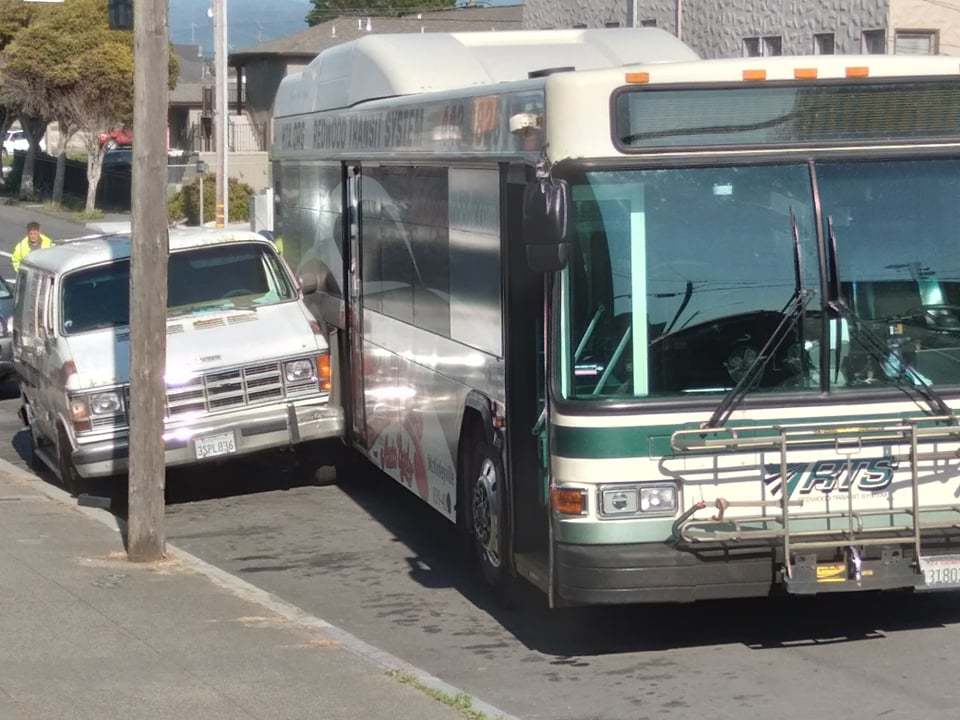
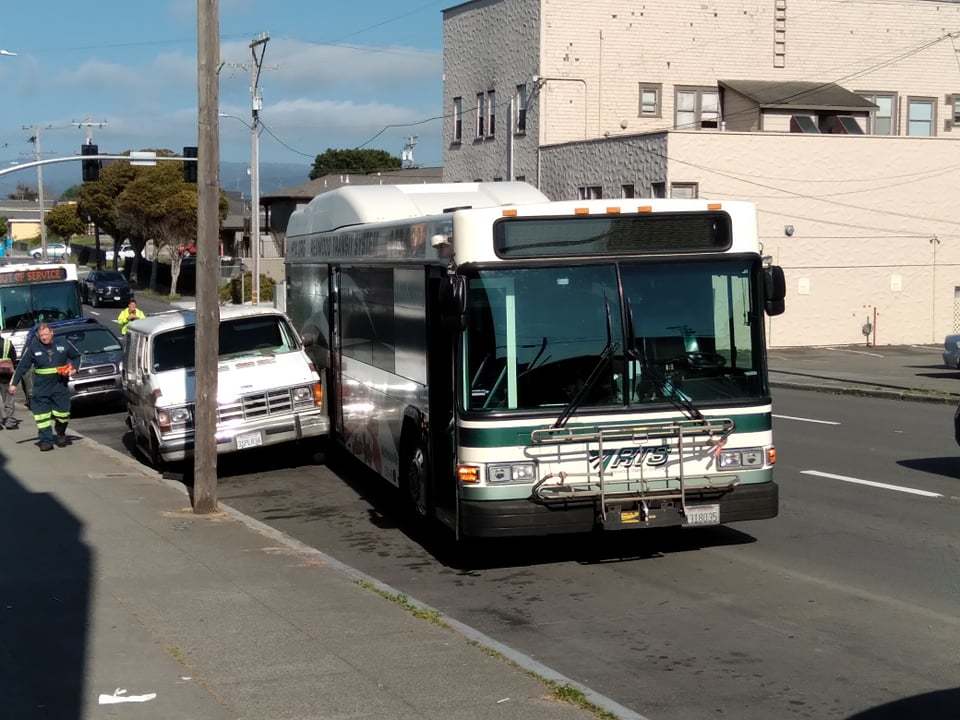
The scene of the crash invovling an HTA bus and a parked van. | Backroads Humboldt and Beyond
The Humboldt Transit Authority is investigating the actions of one of its drivers after a Redwood Transit System bus sideswiped a parked van while attempting to make a scheduled stop near the intersection of 4th and L Streets in Eureka yesterday at approximately 5:15 p.m. with passengers on board.
HTA General Manager Greg Pratt told the Outpost that no injuries were reported as a result of the crash and that the bus received minor damages.
Eureka Police Department spokesperson Brittany Powell told the Outpost the crash was not reported to police by any involved parties.
“Non-injury collisions are civil issues and don’t need police response,” Powell said. “But usually, businesses request them — especially if they are transporting people.”
Pratt confirmed that officers were not called to the scene and that HTA policy does not require employees to alert police in instances of minor crashes with no reported injuries.
“[Authorities are called] any time there is any kind of injury,” Pratt said of the ongoing investigation. “It sounds like we already talked to the vehicle owner and exchanged info.”
The cause of the crash is still under investigation by the HTA — a joint agency governed by a board of officials representing the County of Humboldt and the Cities of Arcata, Eureka, Fortuna, Rio Dell and Trinidad.
The involved driver, who has worked for the HTA for less than a year, is reportedly undergoing a standard drug and alcohol test as part of the investigation.
“There are thresholds we follow under the [Federal Transit Administration],” Pratt said. “Anytime there is a certain type of accident or injury, employees are to be drug and alcohol tested.”
Involved passengers were picked up by a replacement HTA bus to complete their trip.
As murder suspect Gearold Sotolongo’s attorney builds a case for self-defense, witnesses testified yesterday that victim Roger Yale had threatened to kill Sotolongo and had once beaten one witness into a coma.
Witness Robert Blake, Sotolongo’s uncle, testified he woke up in the hospital, not knowing what happened, but the people who called the ambulance told him later that Yale and another man came up behind him and hit him over the head.
Defense attorney Zack Curtis called Blake and two other witnesses after the prosecution rested its case this morning. Blake not only testified that Yale left him in a coma, but that Yale told Sotolongo he was going to kill him during a separate altercation at a Hoopa home.
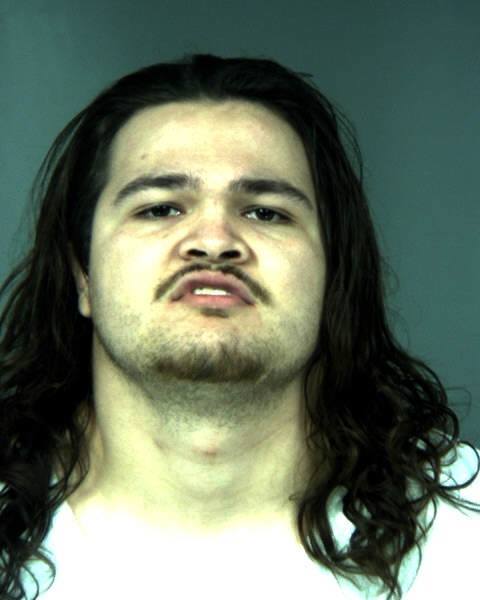
Sotolongo.
Both incidents occurred in the weeks before Sotolongo allegedly stabbed Yale in the heart outside the Hoopa Mini-mart on Feb. 13, 2016.
Blake, Misgilo Moon and Moon’s partner Shelby Surber all testified they were there when Yale pointed at Sotolongo and said either “I’m going to kill you too, motherfucker,” or “Fuck you, I’m going to kill you too.”
Neither Moon nor Surber could recall whose home they were at, but Blake said they were at a party at the home of Sylvia Moon.
Curtis presented an opening statement to the jury this morning before he began calling his witnesses. He said Sotolongo was just hanging out the morning of the killing, hoping to collect enough money to buy a bottle of liquor. During an episode across the street from the mini-mart, Curtis said, Yale pulled out a knife and brandished it at Sotolongo, because “for some reason” Yale had a grudge against Sotolongo.
Also, Curtis told the jury, Sotolongo was upset that Yale attacked Blake, as in “I don’t think it’s very cool that you beat up my uncle.”
Video surveillance shows Yale interacting with Sotolongo and a group of people, with the group dispersing and Yale, in seeming relief, sitting down on the curb in front of the mini-mart. Sotolongo walks toward Yale. According to Curtis, Sotolongo just wanted to buy a bottle. But then he turns toward Yale because, Curtis said, Yale was “yelling threats and insults as he sat there.”
Curtis said Yale took a couple of steps toward Sotolongo, with Sotolongo aware that Yale “had a knife in his pocket and a stick in his hand.”
“He tried to grab Mr. Yale’s hand and control it,” Curtis told the jury. When he couldn’t, “he did what he had to do.”
What Sotolongo did was stab Yale between the ribs, with the blade puncturing his heart.
“Keep in mind Mr. Sotolongo didn’t know Roger Yale had a fatal wound,” Curtis said. “Roger Yale didn’t know. He thought he was going to shake it off.”
After he was stabbed, Yale went into the mini-mart and asked for a paper towel.
All three witnesses faced a withering cross-examination by Deputy District Attorney Roger Rees, who is the trial prosecutor along with Deputy District Attorney Jessica Watson.
Blake, for example, admitted he has a slew of felony convictions, including arson. He is a registered sex offender and has spent time in prisons at San Quentin, Susanville and Vacaville.
Moon has one felony conviction for assault with serious bodily injury, with his mother a co-defendant. When Rees asked him about that, he couldn’t remember what he was convicted of or when.
“You remember with exacting detail what happened 30 days before Mr. Sotolongo killed Mr. Yale,” Rees said, referring to the incident in which Yale allegedly threatened Sotolongo with death. But, Rees said, Moon couldn’t remember what he was convicted of and when.
Moon and Surber said they didn’t tell authorities about Yale’s threat to Sotolongo until just a few weeks ago. Sotolongo has been behind bars for more than six years.
“I didn’t know who to tell,” Moon said. He has visited Sotolongo numerous times in jail and also has talked to him on the phone a number of times.
Both Yale and Sotolongo, back in their high school days, were renowned wrestlers. Was Sotolongo afraid of Yale because of his wrestling reputation, or was Sotolongo superior?
“He was the pitbull of our family,” Blake told an investigator. “Roger was scared of him.”
Rees brought up that Moon attended an April hearing at which attorneys were talking about the witness list. At the end of the hearing, Moon told Sotolongo “Get me that list.”
Testimony was expected to continue this morning before Judge Larry Killoran.
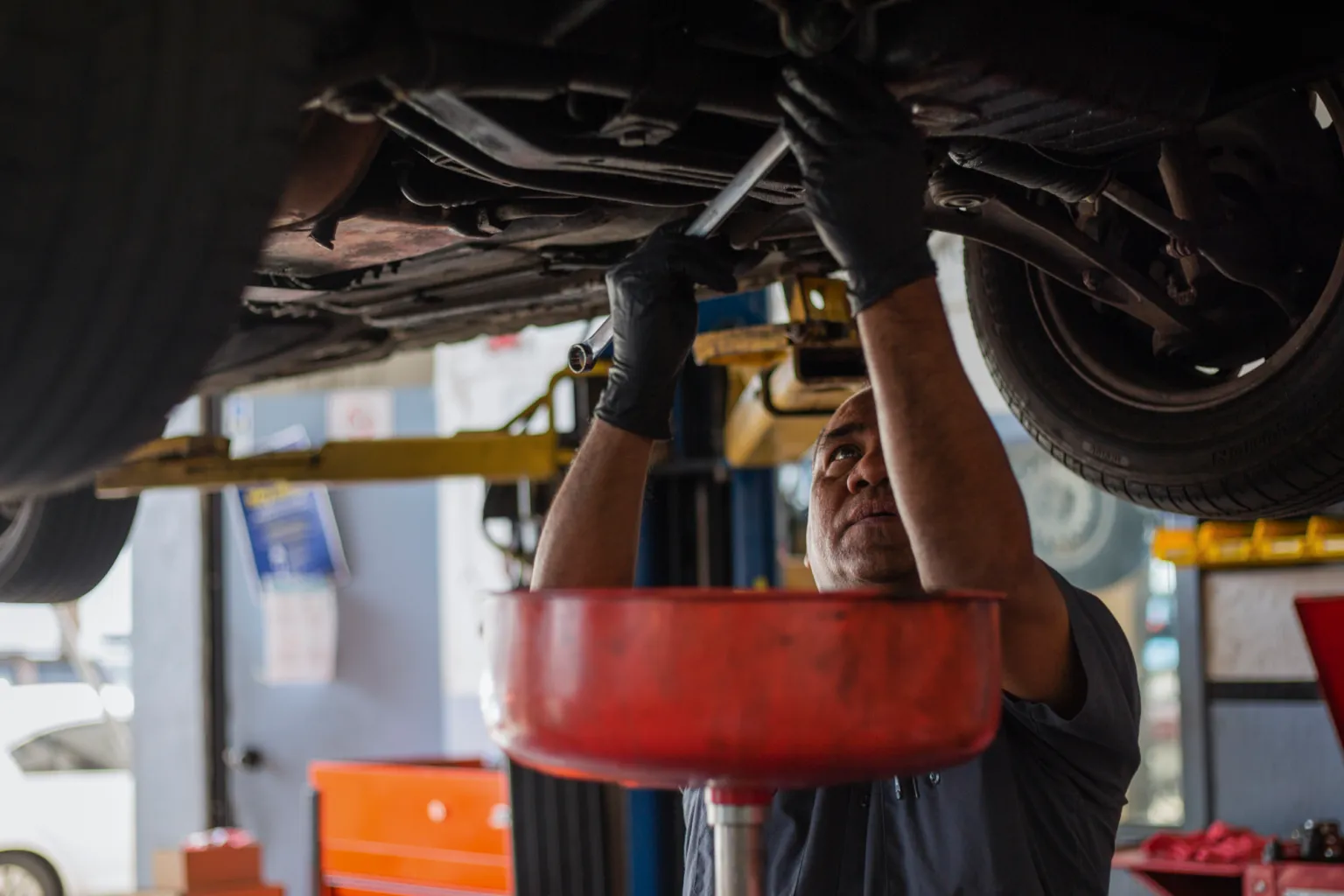
Walter Preza works on a car at J & R Auto Repair shop mechanic in San Francisco. Photo by Nina Riggio for CalMatters
###
The pungent odor of motor oil and grease wafts through the air at JR Automotive in San Francisco as Jesus Rojas lifts the hood of a 2014 Honda Civic to inspect its engine.
Gasoline-powered vehicles like this one have hundreds of moving parts and other components that keep mechanics like Rojas busy. Rojas, 42, has spent much of his life refining the specialized skills needed to inspect and repair them.
But as California switches to electric vehicles in its battle against climate change and air pollution, these skills will be needed less and less over the next decade. By 2040, the state projects that nearly 32,000 auto mechanics jobs will be lost in California, since electric vehicles need far less maintenance and repair than conventional combustion engines.
“I’m not against electric vehicles,” said Rojas, who immigrated to the Bay Area from Mexico as a teenager and opened his own shop 11 years ago. “I’ve always loved cars and I’ll work on them until I can’t anymore. So we have to adjust. We have to get out of our comfort zones.”
In an effort to transform to a carbon-neutral, climate-friendly state, California’s proposal to phase out all new gas-powered cars by 2035 will drive a wide-ranging transition of the workforce.
Throughout the economy, an estimated 64,700 jobs will be lost because of the mandate, according to the California Air Resources Board’s calculations. On the other hand, an estimated 24,900 jobs would be gained in other sectors, so the estimated net loss is 39,800 jobs, a minimal amount across the state’s entire economy, by 2040.
But no single workforce in the state would be hurt more than auto mechanics: California has about 60,910 auto service technicians and mechanics, and more than half of those jobs would be lost over the next two decades if the mandate goes into effect, the air board calculates.
The transition would be phased in over a decade: Beginning with 2026 models, 35% of new cars and light-duty trucks sold in California would be zero-emission, reaching 51% in 2028, 68% in 2030 and 100% in 2035. The board will hold a hearing on June 9 before voting on the proposal in August.
Alex Dirige, 67, an immigrant from Guam who has worked as a mechanic in San Francisco for more than 30 years, worries that the transition to electric cars will threaten the livelihoods of vulnerable groups like undocumented immigrants and cause many auto repair workers to leave the industry altogether.
The trade provides a steady and reliable income in California for many workers with no college degree. On average, mechanics across the state earn about $26 an hour or $54,190 a year, according to the U.S. Bureau of Labor Statistics.
“Many mechanics who have started working see that there’s not a long-term future in the auto repair business, with hybrids and electric cars coming out,” Dirige said. “The electric vehicle repair market is just about nonexistent. A lot of them would love to be in the field but they might choose to go into other types of employment.”
Who loses and who gains jobs
California is already suffering the ill effects of climate change — which damages its economy, not just its public health and its environment. About 40% of its greenhouse gas emissions come from transportation, the largest of any sector, so state leaders say reducing reliance on gasoline and moving towards electric cars is crucial to averting even more disastrous effects.
Some industries gain jobs while others lose them as the state shifts to zero-emission vehicles.
The retail trade sector, which includes gas station workers and automobile and parts dealers, would lose 38,669 jobs by 2040 or about 2% of the retail workforce. Most of the losses would be at gasoline stations. As the electric vehicle fleet grows, air board officials project gas stations could provide charging to offset the losses.
“The electric vehicle repair market is just about nonexistent.” — Alex Dirige, auto mechanic in San Francisco
Some of the loss in the retail sector is due to less expendable income. Electric cars now cost more to purchase, although prices will drop and maintenance will cost far less, saving about $3,200 for the life of a 2026 car and $7,500 for a 2035 car, according to the air board.
Another 20,831 jobs in state and local government would be eliminated because of the decrease in gas tax revenue.
But the transition to electric cars also will create thousands of jobs. Southern California Edison, Pacific Gas & Electric and other power industry companies would benefit most, with the creation of about 5,600 jobs by 2040 as car owners spend more on electricity to power their vehicles. Insurance carriers will benefit from about 1,700 new jobs, while the construction industry is expected to gain about 3,600.
Since few vehicles are manufactured in California, the state is unlikely to see a surge in manufacturing in response to the mandate. Of the 44 major auto assembly plants in the U.S., most are located in the Midwest and the South, according to a 2021 report from the International Council on Clean Transportation, a nonprofit research organization.
A ‘slow-moving’ change
Mechanics who work on internal combustion engines would still have plenty of work: The rule would not ban sales of used cars, and it wouldn’t force the state’s residents to stop driving the roughly 29 million gas-powered cars that are already on the road. Californians also could keep importing new or used vehicles from out of state.
That means Californians will still own a lot of gas-powered cars past 2035, softening the blow for car mechanics and industries dependent on fossil fuels, said James Sallee, an economist and research associate at the Energy Institute at University of California, Berkeley’s Haas School of Business.
Sallee said the changes wouldn’t occur fast enough to trigger a sharp economic slowdown within the auto repair industry.
“It’s when there’s quick and rapid changes that we think the most harm is done to workers because they can’t relocate freely and quickly,” Sallee said. “So it’s important people have in perspective that it is a slow-moving process, not a dramatic and super-fast shift away from demand for gasoline stations or oil changes. It’s going to be something that takes place over a longer time period.”
Electric cars have fewer fluids, such as engine oil, and fewer moving parts than a conventional car. Brake systems also last longer because of regenerative braking, which converts energy from the brake pads into electricity to recharge the battery, according to the U.S. Department of Energy. They also don’t have mufflers, radiators and exhaust systems.
“It is a slow-moving process, not a dramatic and super-fast shift away from demand for gasoline stations or oil changes.” — James Sallee, Energy Institute, UC Berkeley
But auto mechanics warned that while most operating and maintenance costs are lower for electric vehicles, some parts can be more expensive to replace. Rojas also said electric car owners could experience problems down the line they haven’t yet thought about.
Electric vehicles tend to weigh more than conventional cars, which means they need special tires that can support a heavier load. Those can cost between $200 and $300 per tire, compared to the $50 to $150 average for a gas-powered car, Rojas said.
In addition, other services like replacing a windshield on a car like a Tesla, which has sensors and computerized features, could cost anywhere from $1,100 to $2,000, he said, compared to $200 and $500 for the windshield of a conventional car.
“Because the car is still under warranty from the dealership, nothing right now comes out of pocket,” said Rojas. “But as soon as the vehicle becomes older, they’re going to become more expensive.”
While zero-emission vehicle sales have been steadily increasing in recent years, Californians continue to primarily drive gas-powered cars. Electric cars in 2021 made up about 3% of all cars on the road but 12.4% of auto sales.
Some mechanics doubt that consumer behavior can change as quickly as the air board thinks it will. The proposal would require a massive overhaul of new charging stations and building codes.
“It’s nearly impossible to make all these changes by 2035,” Dirige said. “We don’t have the infrastructure to go to all electric vehicles. We barely have it now. And if you ask people, they’re afraid they’re going to end up with a car that is going to run out of electricity and they’ll be stuck somewhere.”
Mechanics will need new skills or new jobs
Rojas and his business partner, Raul Perez, employ two other mechanics, also Latino immigrants, who perform routine services such as oil changes and tuneups.
Rojas said mechanics have to invest thousands of dollars of their own money to buy special equipment and tools. Some could use their existing tools and skills to service electric cars, since the cars would still require cosmetic repairs, tire rotations and battery inspections.
But many won’t be able to afford retraining for a new career or learning new skills in complex areas like electrical engineering needed to repair hybrid and electric models.
“If the government is interested in helping us economically to get retrained, it could really help the people who might be struggling but want to learn,” he said.
Shane Gusman, a lobbyist for the International Brotherhood of Teamsters, said state leaders should help fund the retraining of workers who lose their jobs due to the state’s efforts to battle climate change.
“Unions are not standing in the way of responsible policies to protect the climate and try to slow down climate change,” he said. “But all of us need to think about the impact on workers. We need to try to come up with policies that protect the workforce, which ultimately protects our economy.”
To reduce job losses from its zero-emission vehicle mandate, the air board in its report says “policy options could be considered for job retraining and transfer support, particularly for lower income individuals.”
State Sen. Josh Becker, a Democrat from San Mateo, agreed. He said the “path of getting to zero needs to foster new well-paying, secure, middle class jobs, and work to transition those from fossil fuels industries.”
“It is true that it is easier to talk about the energy transition when it is not our own jobs that are threatened by it,” he said.
Assemblymember Al Muratsuchi, who chairs the Joint Legislative Committee on Climate Change Policies, introduced AB 1966, which would create a state fund to help retrain and transition workers from the fossil fuel industry to other non-polluting sectors. He said the funds would also offer wage replacement and insurance, pension guarantees, health care options and peer counseling.
The bill, however, would not help auto mechanics.
“We all know that change can be difficult for anyone,” he said. “We need to make the transition to a clean energy economy in a way that doesn’t leave anyone behind.”
The Governor’s Office of Planning and Research is also developing a “just transition” roadmap to guide state policies.
For now, Rojas said he’s focused on the day-to-day operations of his business. The shop is busy, servicing about 40 to 50 cars a week, and Rojas and his team are seeing more hybrid vehicles. He said he supports the state’s plan, and hopes other workers in his industry will also get on board.
“This industry, it’s always changing,” Rojas said. “But a lot of mechanics, they don’t want to change, they just want to do what they’re good at and that’s a problem. We need people that are willing to learn because we have to adapt.”
###
CalMatters.org is a nonprofit, nonpartisan media venture explaining California policies and politics.
George Leslie Hurlburt succumbed to Alzheimer’s disease on May 11, 2022, at the age of 84, even as he affirmed each day what a lucky guy he was. Indeed, George got to travel the world, have four beautiful children and several grands, and marry the one he wanted to spend his mature years with.
George was born in Michigan on December 22, 1937, but the family soon left by train for California, and he was never to return to snow country. He grew up in southern California, married and had children. He also served in the US Army National Guard and in the US Air Force. But when divorce came and separated his family, he moved to the Caribbean, learned to dive, and began his career in underwater construction and demolition.
He spent thirteen years in the waters around the US Virgin Islands, sometimes with his boys in a shack on Virgin Gorda, then living on and rebuilding an ex-British racing yacht. While he built seawalls and marinas, the boys learned to sail, dive, and explore wrecks. One memory shared of that time is of Dad telling stories about the stars and of getting scared by black holes that could swallow the planet. Another fond memory is of ending an exciting day with everyone relaxing on deck with mochas.
Working for Raymond, Brown and Root as a diver sent George to Diego Garcia in the Indian Ocean. From there he visited China, Thailand, Hong Kong, Korea, Palau, Phuket and Australia. When son Scott was stationed in Germany, George flew him to Nairobi, where the two went on photo safari through Kenya.
Later, on a car trip through northern California on the way to Oregon to visit old sailing buddies, George became enamored with Humboldt County and all the waterfowl he saw in the wetlands. He vowed he’d live here some day. He bought properties and eventually did end up here after retiring from diving. He built houses, cut firewood, and one day met a woman looking for pasture for her horse, which he happened to have. They became close friends, later sweethearts, then he and Ruth were married in 1997. He asked her what kind of architecture she liked, and they set about building their craftsman/timber-frame home in Carlotta, using timber and lumber they milled themselves.
George loved all people and all animals. He always spoke to strangers and waved at dogs in cars. He loved Ruth’s horses, though he didn’t ride himself.
A son shared life lessons he learned from his dad: Find your niche and be the best at it that you can, don’t limit yourself, pursue knowledge, work hard and play hard, take care of friends and family, mind your health.
Only daughter Kerry echoes these sentiments, recalling that special father-daughter relationship and the influence the first man in her life has on his girl.
Granddaughter Jennifer recalls: His stories had you at the edge of your seat and always ended with a laugh. The noise of a chain saw, the crack of a redwood before it drops, and the booming sound of Grandpas voice will remain in my memory forever. Grandpa’s house is where I learned to climb, get truly dirty, explore, and hit a nail with a hammer. It’s the place my cousin became my brother and my sister my best friend. I was so lucky to have him for a grandpa and I will cherish the memories.
Granddaughter Brianna remembers: My Grandpa George was larger than life! When people say live life to the fullest, they’re talking about how my Grandpa lived. So full of adventure and a serious thirst for learning through real life experiences! Man, the stories he had to tell! He always taught us everything he could…he even taught me to parallel park.
A grandson remembers his Grampa this way: long hair, big hands, deep voice, big smile. He drove a little MG and a big dump truck. Grampa wearing driving gloves and hat, they’d make trips up and down Kneeland Road to and from school, sharing laughs and conversation. Grampa taught him to work hard, be tough, use his mind, appreciate art and jazz, read road signs, shoot a gun, run a chainsaw, make a fire, cook, and look up at the stars!
George is survived by his wife of twenty-four years, Ruth Hoke, who nurtures a vision of him on his sailboat with his black lab Diver; by his four children Kerry Berg of North Carolina, twins Philip and Paul Hurlburt of Texas and California, and Scott Hulburt of California; by his grandchildren Alexander Hurlburt, Nicholas Eanni, Jennifer Morales, Brianna Ory, and Marleah and Garrett Hurlburt, as well as several great-grandchildren.
He is loved and missed by all.
###
The obituary above was submitted by George Hurlburt’s loved ones. The Lost Coast Outpost runs obituaries of Humboldt County residents at no charge. See guidelines here. Email news@lostcoastoutpost.com.
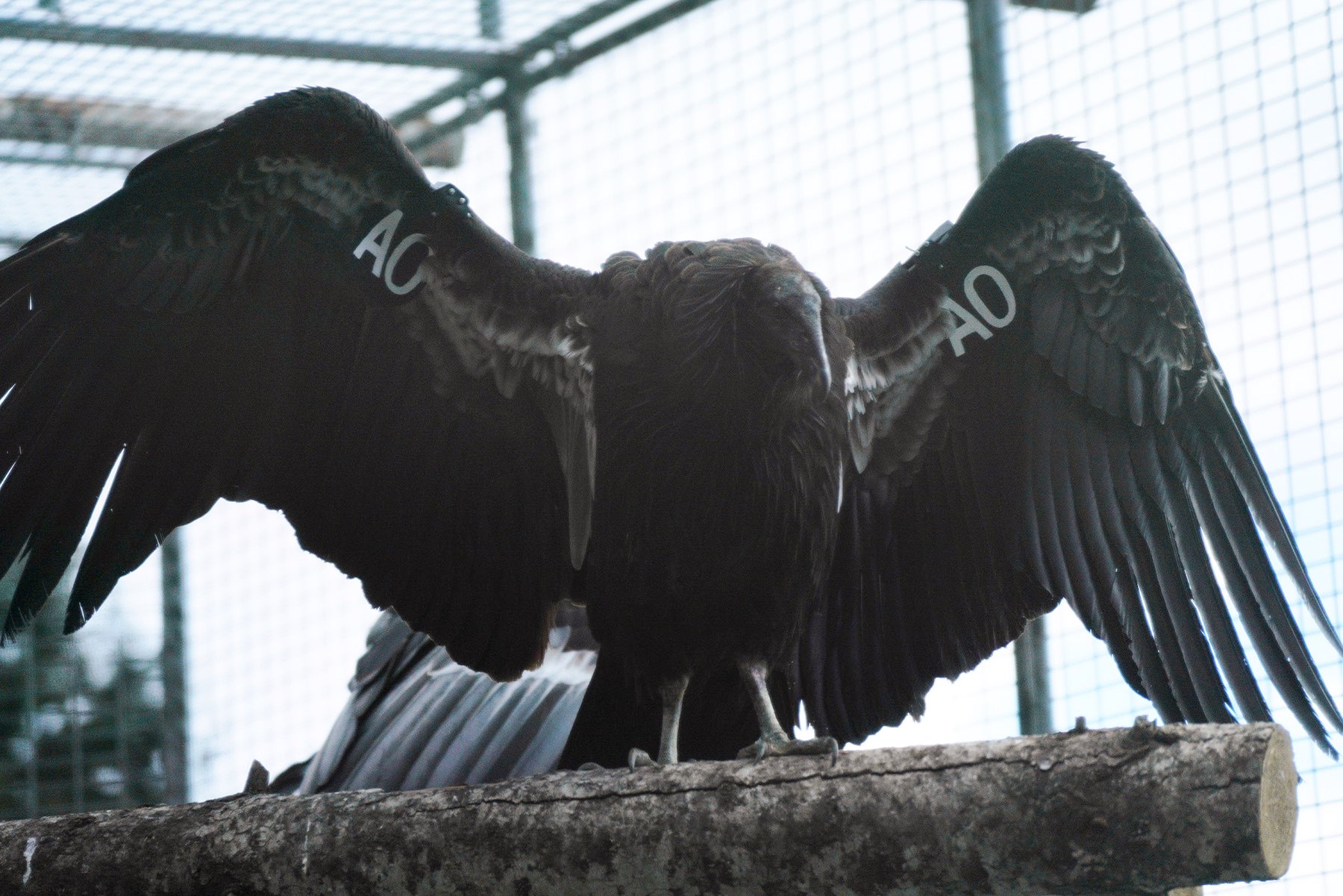
Condor A0 is ready for its big moment | Yurok Tribe
UPDATE: The Yurok Tribe has announced they are pushing back A0’s date with destiny:
The release has been postponed to Wednesday due to a change in the weather forecast. REVISED: At around 8:30am Wednesday, May 25, 2022, the Northern California Condor Restoration Program will facilitate the release of the third condor to soar over Yurok skies in more than a century. The release of condor A0 can be viewed live on the Yurok Condor Cam.
# # #
Yurok Tribe release:
At around 8:30am tomorrow (Tuesday, May 24, 2022), the Northern California Condor Restoration Program will facilitate the release of the third condor to soar over Yurok skies in more than a century. The release of condor A0 can be viewed live on the Yurok Condor Cam - https://www.yuroktribe.org/yurok-condor-live-feed
Prior to its reintroduction, condor A0 must voluntarily enter and exit a release structure, which is attached to the main flight pen. If the bird does not depart from the staging area, a second release attempt will be made in the near future. This deliberate procedure was successfully employed in the release of the first two condors earlier this month. On May 3, 2022, the NCCRP, a partnership between the Yurok Tribe and Redwood National and State Parks (NPS) reintroduced the first two condors to fly free in the redwood region since 1892. Both birds are healthy and adapting well to their new environment.
A fourth condor will be released at a later date. The staggered release process seeks to provide the best conditions for the birds. Staggering condor releases, whereby biologists release one or two condors at a time, rather than the entire group at once, is a management strategy that allows close observation and management of individual birds. Following releases, biologists must monitor condors to see that they display appropriate behavior. Additionally, keeping one or more birds in the pen after initial releases maintains a social draw to the release site, which encourages the released condors to remain near to the release facility where they may interact with remaining captive condors. For more information about the staggered release strategy, please watch the following video with Yurok Condor Restoration Program Manager Chris West, who also oversees the NCCRP: https://bit.ly/3NBienT
For at least the next two decades, the Northern California Condor Restoration Program will release two condor cohorts per year. The Yurok Tribe started working on condor reintroduction in 2008. With support from Redwood National Park, the US Fish and Wildlife Service and Bureau of Indian Affairs as well as the Administration for Native Americans, Pacific Gas and Electric and many other contributors, such as the Global Conservation Fund and the Redwood National Park Foundation, the Yurok Wildlife Department completed the tremendous amount of work required to reintroduce this critically endangered species. The following tasks represent a small fraction of what they had to accomplish in order to make condor reintroduction a reality: extensive environmental assessments, contaminant analyses, constant fundraising, planning, designing and constructing facilities, performing intensive community outreach and coordinating with numerous stakeholders and collaborators.
For more information about the Northern California condor recovery effort - https://bit.ly/3Nx9C1u