

‘Everyone Loses’: Sacramento Valley Struggles to Survive Unprecedented Water Cuts
Rachel Becker / Monday, May 23, 2022 @ 7:38 a.m. / Sacramento
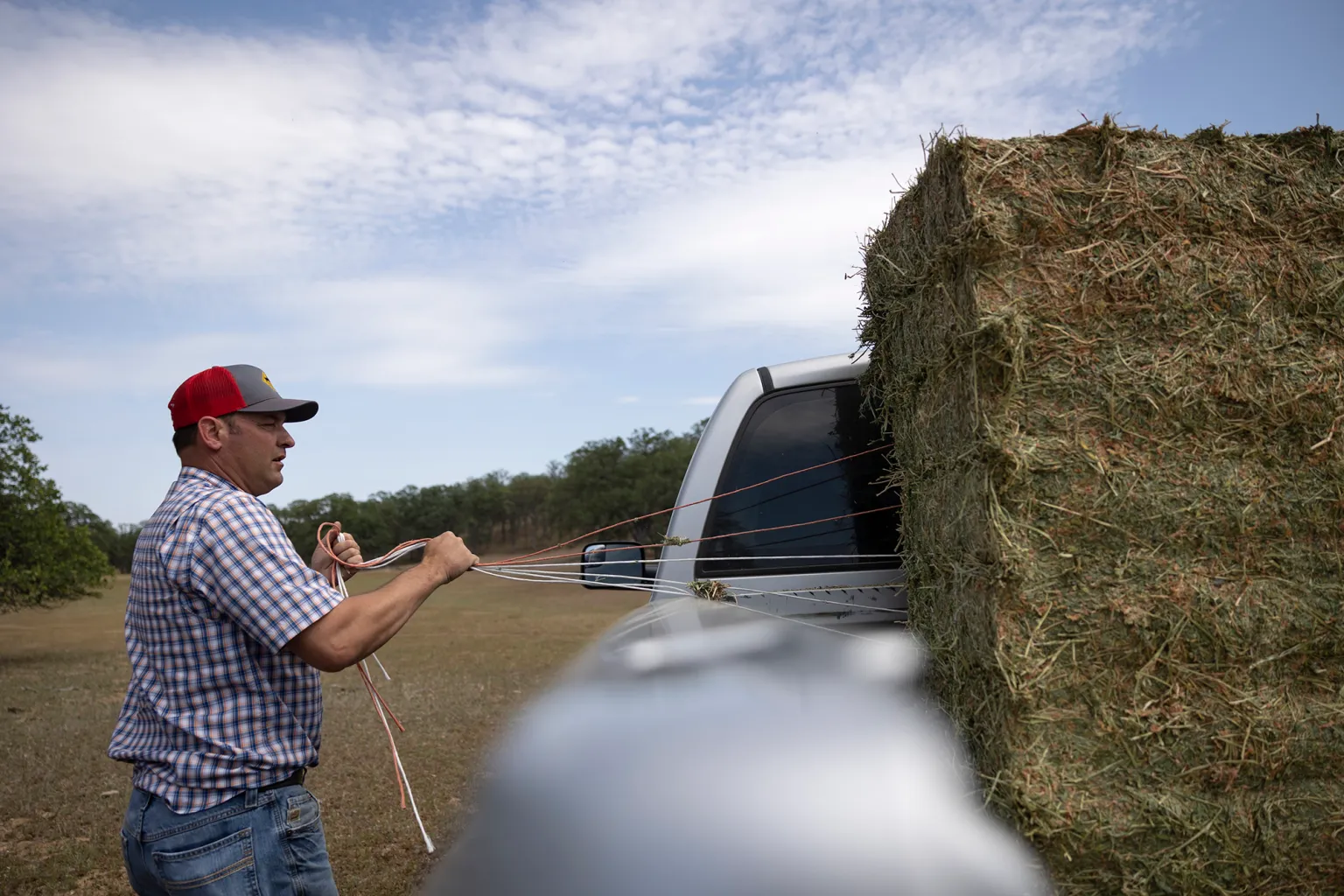
The drought has stunted grasses that Josh Davy’s cattle usually feed on so he prepares hay for them at his ranch near Red Bluff. Photo by Miguel Gutierrez Jr., CalMatters
###
Standing on the grassy plateau where water is piped onto his property, Josh Davy wished his feet were wet and his irrigation ditch full.
Three years ago, when he sank everything he had into 66 acres of irrigated pasture in Shasta County, Davy thought he’d drought-proofed his cattle operation.
He’d been banking on the Sacramento Valley’s water supply, which was guaranteed even during the deepest of droughts almost 60 years ago, when irrigation districts up and down the valley cut a deal with the federal government. Buying this land was his insurance against droughts expected to intensify with climate change.
But this spring, for the first time ever, no water is flowing through his pipes and canals or those of his neighbors: The district won’t be delivering any water to Davy or any of its roughly 800 other customers.
Without rain for rangeland grass where his cows forage in the winter, or water to irrigate his pasture, he will probably have to sell at least half the cows he’s raised for breeding and sell all of his calves a season early. Davy expects to lose money this year — more than $120,000 dollars, he guesses, and if it happens again next year, he won’t be able to pay his bills.
“I would never have bought (this land) if I had known it wasn’t going to get water. Not when you pay the price you pay for it,” he said. “If this is a one-time fluke, I’ll suck it up and be fine. But I don’t have another year in me.”
Since 1964, the water supply of the Western Sacramento Valley has been virtually guaranteed, even during critically dry years, the result of an arcane water rights system and legal agreements underlying operations of the Central Valley Project, the federal government’s massive water management system.
But as California weathers a third year of drought, conditions have grown so dry and reservoirs so low that the valley’s landowners and irrigation districts are being forced to give up more water than ever before. Now, this region, which has relied on the largest portion of federally-managed water flowing from Lake Shasta, is wrestling with what to do as its deal with the federal government no longer protects them.
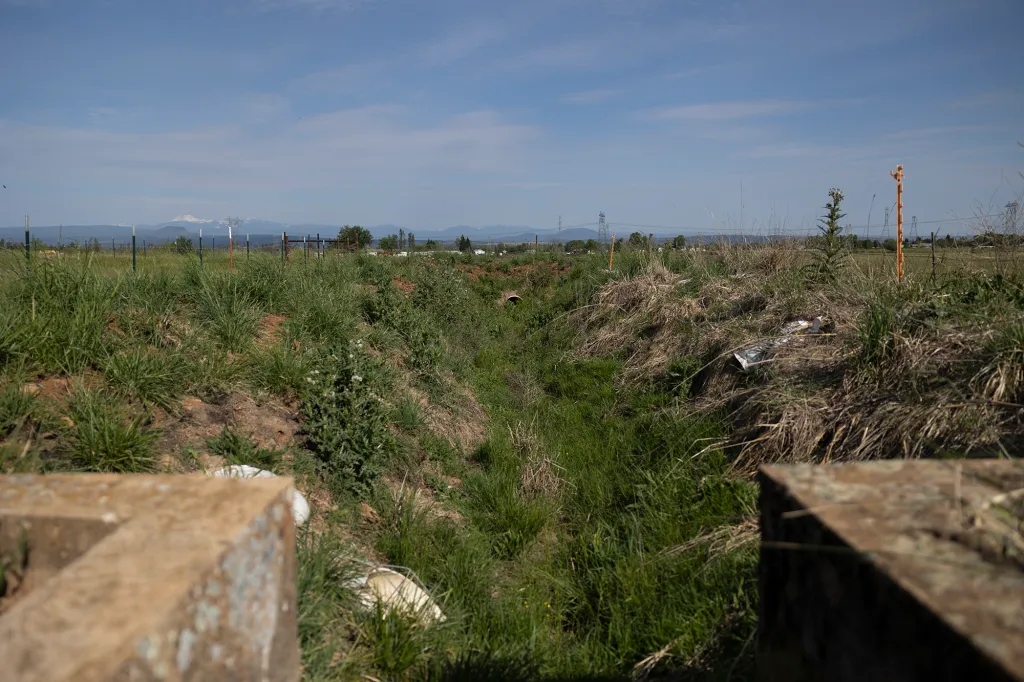
An irrigation canal on Davy’s pasture in Shasta County is bone-dry on April 27, 2022. Photo by Miguel Gutierrez Jr., CalMatters
All relying on the lake’s supplies will make sacrifices: Many are struggling to keep their cattle and crops. Refuges for wildlife also will have to cope with less water from Lake Shasta, endangering migratory birds. And the eggs of endangered salmon that depend on cold water released from Shasta Dam are expected to die by the millions.
For decades, water wars have pitted growers and ranchers against nature, north against south. But in this new California, where everyone is suffering, no one is guaranteed anything.
“In the end, when one person wins, everybody loses,” Davy said. “And we don’t actually solve the problem.”
Portioning out the river’s precious water
This parched valley was once a land of floods, regularly inundated when the Sacramento River overflowed to turn grasslands and riverbank forests into a vast, seasonal lake.
Settlers that flooded into California on the tide of the Gold Rush of 1849 staked their claims to the river’s flow with notices posted to trees in a system of “first in time, first in right.”
The river was corralled by levees, the region replumbed with drainage ditches and irrigation canals. Grasslands and swamps lush with tules turned to ranches and wheat fields, then to orchards, irrigated pasture and rice.
The federal government took over in the 1930s, when it began building the Central Valley Project.’s Shasta Dam, which displaced the Winnemem Wintu people. A 20-year negotiation between water rights holders and the US Bureau of Reclamation culminated in a deal in 1964.
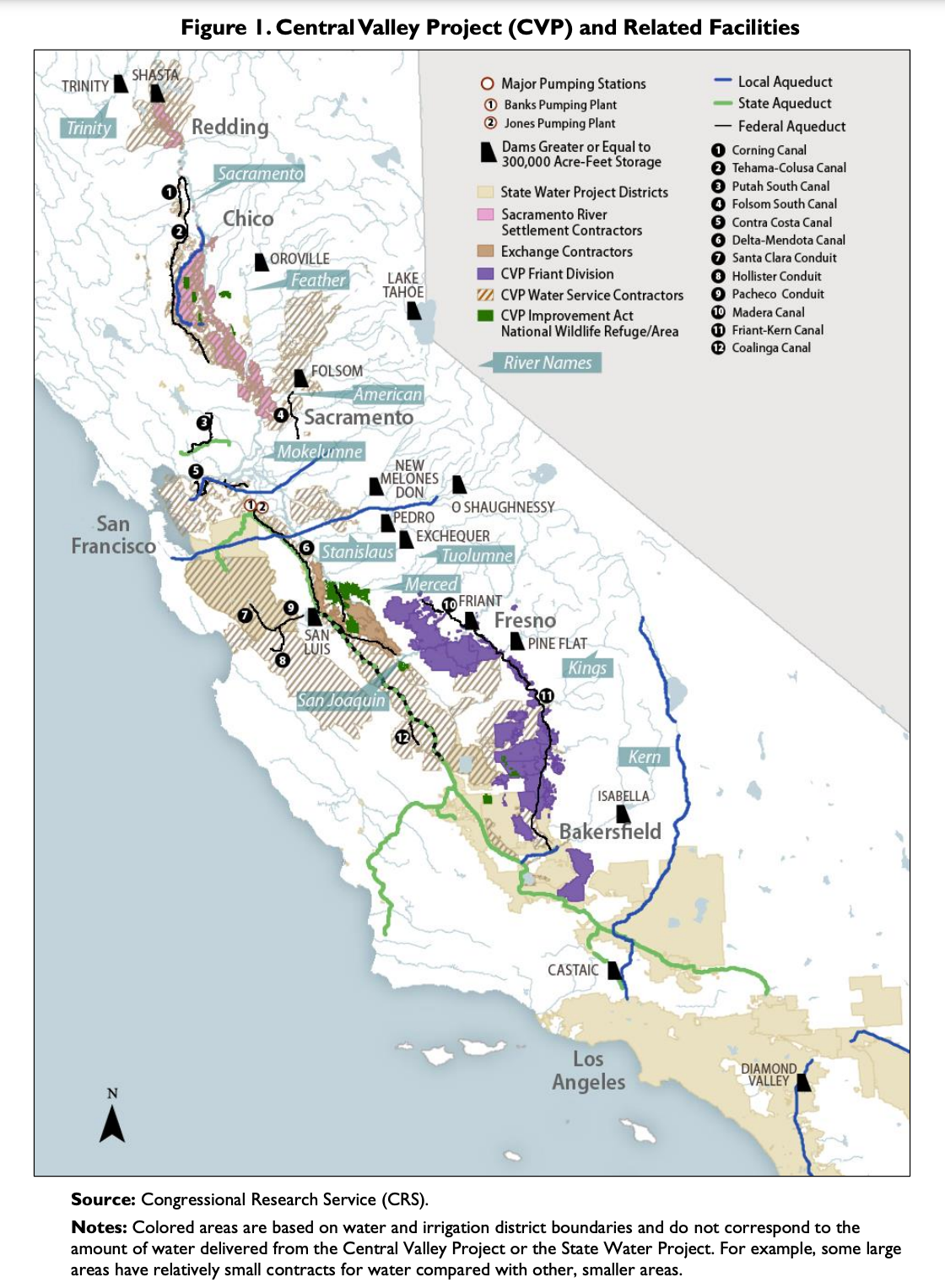
Today, under the agreements, which were renewed in 2005, nearly 150 landowners and irrigation districts that supply almost half a million acres of agriculture in the western Sacramento Valley are entitled to receive about three times more water than Los Angeles and San Francisco use in a year.
It’s a controversial amount in the parched state. Before this year, the Sacramento River Settlement Contractors, as they’re called, received the largest portion of the federally-managed supply of water that flows from Shasta Lake. It’s more than cities receive, more than wildlife refuges, more even than other powerful agricultural suppliers like the Westlands Water District farther south.
Their contract bars the irrigation districts’ supply from being cut by more than a quarter in critically dry years. During the last drought in 2014, federal efforts to cut it to 40% of the contracted amount were met with resistance, and deliveries ultimately increased to the full 75% allocation for the dry year.
But this year, facing exceptionally dry conditions, the irrigation districts negotiated with state and federal agencies, and agreed in March to reduce their water deliveries to 18%. Other agricultural suppliers with less senior rights are set to get nothing.
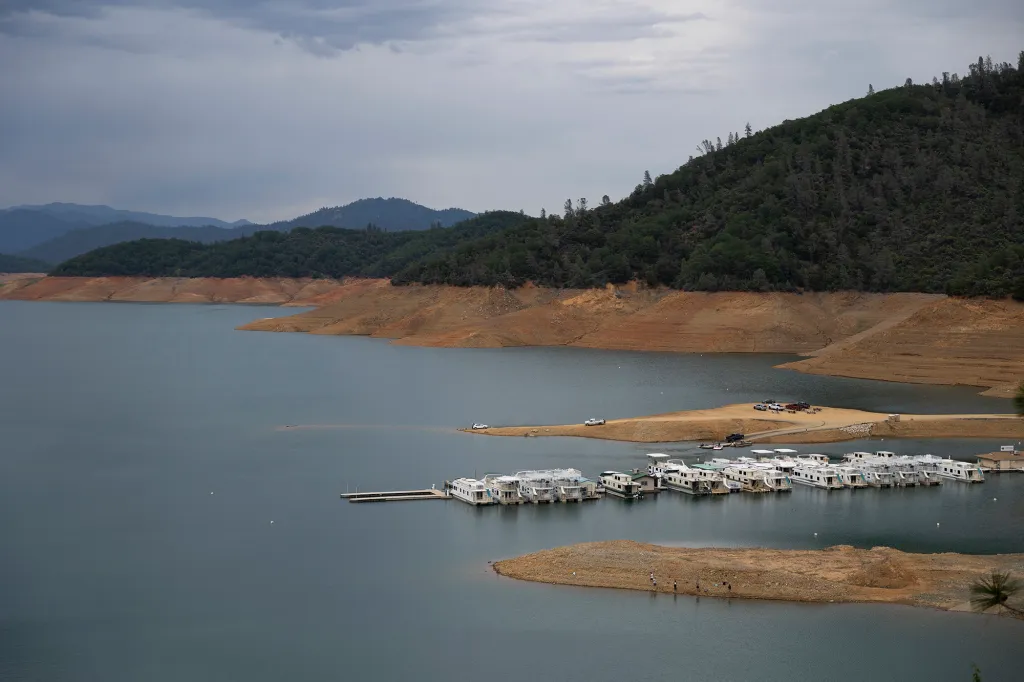
Low water levels at Shasta Lake on April 25, 2022. Photo by Miguel Gutierrez Jr., CalMatters
Growers understand that they have to sacrifice some water this year, said Thaddeus Bettner, general manager for Glenn-Colusa Irrigation District, the largest of the Sacramento River Settlement Contractors and one of the largest irrigation districts in the state. But he wondered why irrigation districts in the Western Sacramento Valley draw so much of the blame.
“I understand we’re bigger than everybody so we catch the focus,” Bettner said. “We’re just trying to survive this year. Frankly, it’s just complete devastation up here. And it’s unfortunate that the view seems to be that we should get hurt even more to save fish.”
Cutting deliveries to growers means that more water can flow through the rivers, which slightly raises the chances for more endangered winter-run Chinook salmon to survive this year.
“They had the water rights to take 75% of their allocation instead of 18%, and we were anticipating another total bust,” said Howard Brown, senior policy advisor with NOAA Fisheries’ West Coast Region. “One hundred percent temperature dependent mortality (of salmon eggs) would not have been something out of reason to imagine.”
Yet more than half of the eggs of endangered winter-run Chinook salmon are expected to still die this year, according to the National Marine Fisheries Service.
State and federal biologists are racing to move some of the adult salmon to a cooler tributary of the Sacramento River and a hatchery.
“We’re spreading the risk around, and putting our eggs in different baskets,” Brown said. “The animal that’s on the flag of California is extinct. How many can we afford to lose before we lose our identity as people and as citizens of California?”
‘Nothing like I thought I’d ever see’ in the Sacramento Valley
In any other year, Davy would run his cattle on rain-fed rangeland he leases in Tehama County until late spring before moving the herd to his home pasture, kept green and lush with spring and summer irrigation.
Davy, who grew up roping and running cattle, supports his career as a full-time rancher with his other full-time job as a farm advisor with the University of California Cooperative Extension, specializing in livestock, rangelands and natural resources.
Three years ago, he sold his home in Cottonwood, on the Shasta-Tehama county line, for a fixer-upper nearby with holes in the floor, a shoddy electrical system and windows that wouldn’t close. This fixer-upper had two inarguable selling points: a view of Mount Shasta and water from the Anderson-Cottonwood Irrigation District, a settlement contractor.
This year, without rain, the grass where his cows forage through the winter crunches underfoot.
“This grass should be up to my waist right now,” Davy said, readying a chute he would soon use to transport his cattle. He unloaded hay from his pickup to feed the cows and calves until he could move them — unheard of, he said, in April.
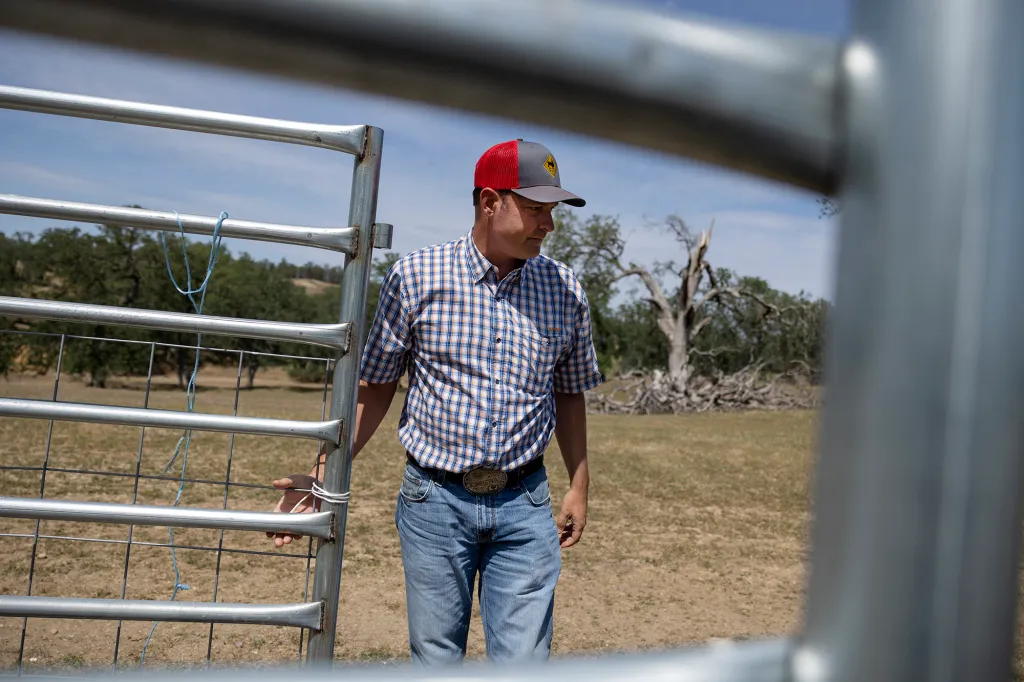
Davy prepares to feed his cattle near Red Bluff on April 25, 2022. Photo by Miguel Gutierrez Jr., CalMatters
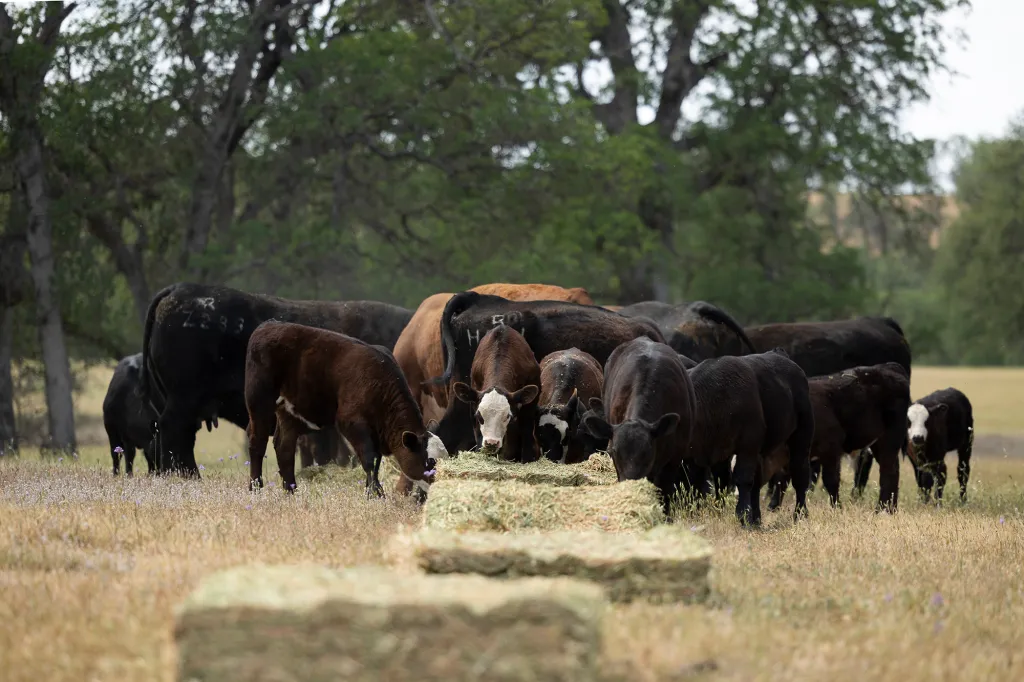
Cattle feed on hay in Tehama County. Photo by MIguel Gutierrez Jr., CalMatters
Forty miles away, his pasture, green from the April rains, is faring a little better — but the green can’t last without irrigation. Thinking about it too hard makes Davy feel sick.
“I try to stick to what I can get done today, and then assume next year I’ll be okay. I think that’s the mantra for agriculture,” he said: “Next year will be better.”
About 75 miles south of Davy’s ranch, rangeland and irrigated pastures open up to orchards and thousands of acres of empty rice fields.
“Nothing like I thought I’d ever see,” said Mathew Garcia, gazing at one of his dry rice fields in Glenn, about an hour and a half north of Sacramento.
In any other year, he would have been preparing to seed and flood the crumbled clay. This year, he had to abandon even the one field he’d planned to irrigate from a well. The ground was too thirsty to hold the water.
Garcia’s water comes from two different irrigation districts with settlement contracts. This year, the roughly 420 acres he farms will see water deliveries either eliminated or too diminished to plant rice. He’ll funnel the water instead to his tenant’s irrigated pasture where cattle graze.
“Without the water, we have dirt. It’s basically worthless,” Garcia said. “It’s very depressing.”
“Without the water, we have dirt. It’s basically worthless.”
— Mathew Garcia, rice farmer
California is one of the main rice producers in the United States, and almost all is grown in the Sacramento Valley. It’s an especially water-demanding crop: The plants and evaporation drink up about two-thirds of the flows; the rest dribbles through the earth to refill groundwater stores or flows back into irrigation ditches that supply other crops, rivers and wetlands.
Garcia places some of the blame on the weather. But he also blames federal regulators, who allow water to flow from the reservoirs year-round for fish, wildlife and water quality.
“Everybody says well, you shouldn’t farm in the desert. Does this look like a desert to you? No. It looks like fertile, beautiful farmland with the most amazing irrigation system that’s ever been put in. And they’re just taking the water from it. They’re creating a desert.”
In the depths of California’s last historic drought from 2012 through 2016, Garcia could still plant his fields. Even with last year’s reduced water deliveries, he planted — filling the gaps in water supply by pumping from his groundwater wells.
Garcia will survive this year: He credits his wife’s foresight to purchase crop insurance years ago. Without it, he said, he’d be done — he’d have to sell land, maybe find another job.

Mathew Garcia, standing in one of his fallowed rice fields in Glenn, says he can’t plant anything this year because of reduced water deliveries. Miguel Gutierrez Jr., CalMatters
“If this drought sustains, I don’t know how long insurance is going to last. And then at what point do you throw in the towel?” said Garcia. “There’s a teetering point somewhere. Everybody’s is different. I don’t know where mine is yet.”
Local water suppliers anticipate about 370,000 acres of cropland will go fallow in the western Sacramento Valley, the result of diminished deliveries to the settlement contractors. Most lie in Colusa and Glenn counties, where agriculture is the epicenter of the economy. Money and jobs radiate from the fields to the crop dusters and chemical suppliers, rice driers and warehouses.
And, like the water, jobs for farm workers have dried up.
For nine years, Sergio Cortez has been traveling from Jalisco, Mexico to work in Sacramento Valley fields. This is the driest he’s ever seen it, and he knows that next year could be worse.
“Aqui el agua es todo, pues,” he said. “Al no haber agua, pues no hay trabajo.” Water is everything, he said. If there’s no water, there’s no work.
The parking lot at the migrant farmworker housing in Colusa County where Cortez and his family live for part of the year was full of cars and pickups that would normally be parked at the fields. Cortez hadn’t worked in two days.
For Adolfo Morales Martinez, 74, it had been a month since he worked. And, at the end of April, his unemployment benefits were about to end.
“Desesperados. Estamos desesperados,” he said. “Pues en el campo gana uno poquito, no? Y sin nada? No mas.” We’re desperate, he said. In the fields, he can earn a little. But now, nothing.
Normally Morales Martinez drives a tractor, readying rice fields for planting. Now it’s like a desert, his wife, Alma Galavez, said.
“Eso esta desértico, vea. Todo. Nada, Nada. Esta feo y triste,” she said. There’s nothing. It’s ugly and sad.
Extreme effects on salmon and birds, too
Environmental advocates and California tribes have been fighting the growers’ and irrigation districts’ claim to California’s finite water supply for years, citing inadequate water to maintain water quality and temperatures for endangered fish and the Delta.
“People who have built their farms in the desert, or in areas where their water has to be exported to them, need to think about changing. Because that’s what’s killing the state,” said Caleen Sisk, chief and spiritual leader of the Winnemem Wintu, whose lands were flooded with the damming of Lake Shasta.
To Sisk, the salmon that once spawned in the tributaries above the Central Valley signal the region’s health. “If there are no salmon, there will be no people soon.”
Federal scientists estimate that last year about three-quarters of endangered winter-run Chinook salmon eggs died because the water downstream of a depleted Lake Shasta was too warm. Only about 3% of the salmon ultimately survived to migrate downriver.
“It’s been clear for decades that there was a need to reduce diversions,” said Doug Obegi, senior attorney with the Natural Resources Defense Council. “The consequences are just becoming more and more extreme.”
In 2020, California sued the Trump administration over what it said were flawed federal assessments for how the Central Valley Project’s operations harm endangered species.
The judge sent the federal plans back for more work and approved what he called a “reasonable interim approach“ that called for prioritizing fish and public safety over irrigation districts. He called the contracts an “800 pound gorilla” that “make it exceedingly and increasingly difficult” for the federal government to be “sufficiently protective of winter-run (salmon).”
US Bureau of Reclamation spokesperson Gary Pitzer said the agency worked with the districts to reach an agreement on how much water to deliver because “it’s the right thing to do, particularly during drought — one of the worst on record.”
“There’s not a lot of places for these birds to go. The Sacramento Valley has always been the bankable piece.”
— Curtis McCasland, Sacramento National Wildlife Refuge Complex
Environmental advocacy groups applauded the reduced allocations to the Sacramento Valley irrigation districts. But they also raised concerns that other irrigation districts with similar contracts elsewhere in the state would still see their full dry year allocations, and cautioned that the temperatures will still kill salmon by the scores this year.
Wildlife refuges where birds can rest and eat during their 4,000-mile winter journeys along the Pacific Flyway also are receiving significantly less water this year.
Curtis McCasland, manager of the Sacramento National Wildlife Refuge Complex, expects less than half a typical year’s water supply to be delivered to the refuges this year — cobbled together from purchased water supplies, federal deliveries and, he hopes, storm flows this winter.
North of Sacramento, the five refuges in the complex are painstakingly tended wilderness in a sea of agriculture. More than a century ago, wetlands fanned out for miles to either side of the flood-prone Sacramento River. Now, more than 90% of the state’s wetlands are gone, drained for fields, homes, and businesses. Those remaining in these refuges now depend on water flowing from Shasta Dam and shunted through irrigation canals.
At the end of April, the Colusa National Wildlife Refuge offered an oasis among the barren rice fields, which normally provide about two-thirds of the migrating bird’s calories. Dark green bulrushes rose from shallow ponds where shorebirds jackhammered their bills in and out of the muck.
McCasland knows all this lush green can’t last. As he steered an SUV past black-necked stilts picking their way through the water and ducklings paddling ferociously, he braced for another dry year.
“Instead of being those postage stamps in a sea of rice, we’re going to be postage stamps in a sea of fallow fields,” McCasland said.
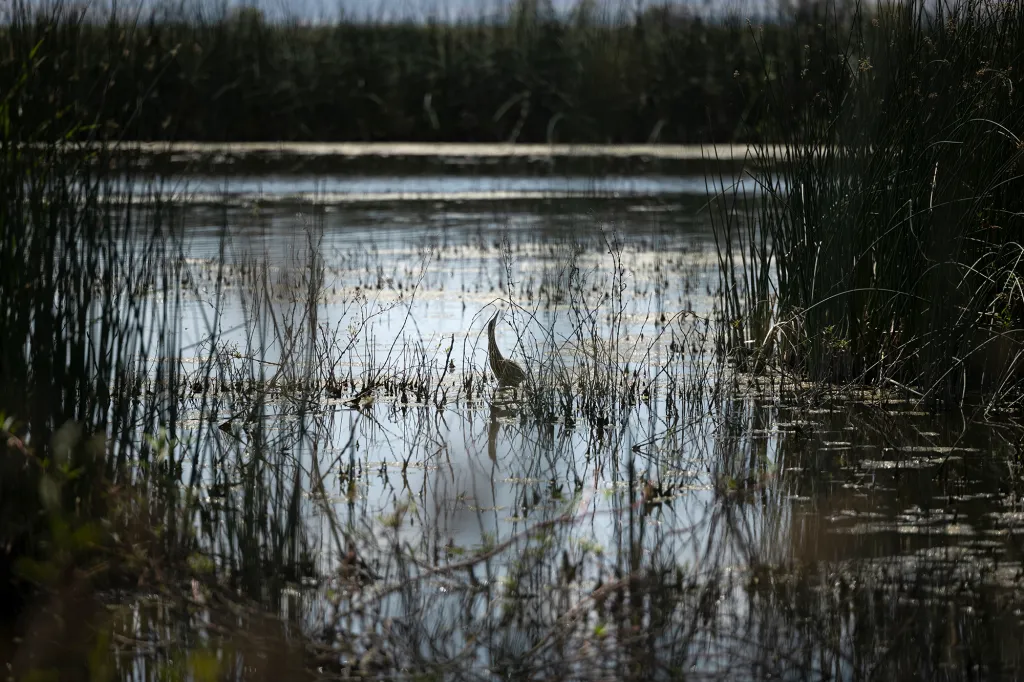
An American bittern feeds at the Colusa National Wildlife Refuge on April 28, 2022. Photo by Miguel Gutierrez Jr., CalMatters
In a typical year, the refuge wetlands that depend on federal water get much less water than the settlement contractors are entitled to — about 4% of the total, McCasland estimates. And he worries that this year, whatever water they do receive won’t be enough to keep all these birds fed and healthy.
More than a million birds descend on the refuges every winter to rest and find food. More stop in the surrounding rice fields, which are largely dry this year.
“In years where Shasta is at a normal or average level, it should be no problem to get us the water,” he said. “In years like this, certainly it’s going to be terribly difficult.”
The drought may already have taken a toll. Last November, only 745,000 birds landed in the refuge, a decrease of more than 700,000 from November of 2019, although some may have remained farther north because of unseasonably balmy weather there.
The refuges are like a farm, where McCasland and his colleagues carefully cultivate tule, shrubs and grasses with pulses of summertime irrigations. With less water this summer, these wintertime food sources for birds will dry and shrivel. And with less water during the peak of fall and winter migrations, hungry birds will be packed together in the few remaining marshes — raising the risk of outbreaks from diseases like avian botulism or cholera.
“There’s not a lot of places for these birds to go,” he said. “The Sacramento Valley has always been the bankable piece….They do have wings, they may be able to move through.” But, he added, “the question is, what happens next?”
###
CalMatters Photo Editor Miguel Gutierrez contributed to this story. CalMatters.org is a nonprofit, nonpartisan media venture explaining California policies and politics.
BOOKED
Today: 7 felonies, 6 misdemeanors, 0 infractions
JUDGED
Humboldt County Superior Court Calendar: Today
CHP REPORTS
13570 Mm101 N Hum R135.70 (HM office): Trfc Collision-Unkn Inj
ELSEWHERE
Humboldt Last Week: 394: Dorm sex-assault arrest twice, Hoopa homicide teens, trafficking bust, 6-victim abuse case, Miranda suspended, more
Governor’s Office: Six years after Creek Fire, Governor Newsom recognizes historic nighttime CalGuard rescue that saved 242 lives
RHBB: ‘Check In With Your People’: Humboldt’s Suicide Rate More Than Twice the State Average
MONDAYS WITH MICHAELE: Kinetics is Back!
LoCO Staff / Monday, May 23, 2022 @ 7:30 a.m. / Mondays With Michaele
Photos: Matt Filar
The glory has returned. After two years in COVID limbo, the Kinetic Grand Championship is back for three days of silly/serious art racing over pavement, sand and water. To celebrate, your President of Positivity stopped by Arcata’s Kinetic Lab, a kavernous den of kreativity where numerous kinetic teams tinker away on their krafty kreations. Take a peek inside in the clip above and konsider taking in portions of the race this koming weekend!
# # #
Perhaps You’d Like to Explore Previous Mondays With Michaele For Some Reason!

Also…
Sex Abuse Suits Pouring in as State’s Catholic Leaders Seek Relief From Highest Court
Nigel Duara / Monday, May 23, 2022 @ 7 a.m. / Sacramento
In California, the lawsuits are mounting — middle-aged men, saying they were sexually assaulted as children by a Boy Scout leader or a priest. A woman, now in her late 30s, detailing how she was allegedly assaulted in a center for foster children. A man who said he was abused while volunteering with the Salvation Army.
At least 750 of those lawsuits filed since January 2020 are against Catholic dioceses, and more than 800 people are in the process of filing to beat a Dec. 31 deadline, according to lawyers involved in the cases.
The year-end date marks the close of the state’s three-year “lookback window,” which allows plaintiffs to file civil suits for childhood sexual abuse no matter how long ago the alleged events took place.
Now, facing hundreds of lawsuits, a group of Catholic bishops is taking those challenges to the nation’s highest court. Saying they faced “potentially ruinous liability,” the bishops last month asked the U.S. Supreme Court to declare the California lookback window unconstitutional.
“Review is critical now, before the Catholic Church in the largest state in the union is forced to litigate hundreds or thousands of cases seeking potentially billions of dollars in retroactive punitive damages,” according to the petition, which was first reported by the Catholic News Agency.
“There are few institutions that serve youth that do not have a history of having perpetrators in them who harm children.”
— Paul Mones, Los Angeles plaintiff’s attorney
California created its new lookback window in 2019 under Assembly Bill 218, authored by then-Assemblymember Lorena Gonzalez, a San Diego Democrat.
The bill opened a three-year period, from 2020 to 2022, that permitted complainants to file sexual abuse claims that exceeded the statute of limitations.
The law allows people younger than 40 to file complaints without any extra steps. Complainants older than 40 must obtain, through an attorney, a mental health evaluation that finds “there is a reasonable basis to believe that the plaintiff had been subject to childhood sexual abuse.”
In 2002, the state passed a similar law creating a year-long window for people to file such claims. More than 850 people sued the Catholic Church the following year, and another 150 sued other religious institutions and the Boy Scouts of America. The Catholic Church paid out more than $1 billion to settle claims, according to the bishops’ petition to the U.S. Supreme Court.
Multiple dioceses sold “vast swaths” of church property in the 2000s, the petition states. Some exhausted or relinquished their lawsuit insurance, and the church believed at the time that the matter was over.
“That assurance proved to be false,” the bishops wrote.
Across the country, such lookback windows have faced and survived multiple legal challenges at the state level. Actor Bill Cosby, accused of more than 50 sexual assaults over decades, has challenged them in California and New Jersey. Prince Andrew’s initial challenge to New York’s “lookback window” failed to persuade a judge in January to throw out his case.
Los Angeles attorney Paul Mones, who is representing at least 75 people suing the Catholic Church and dozens more suing other institutions, said he expects “a flurry of filings” in the last 60 days of the year before the lookback window expires.
Among his cases, Mones said, were people suing the Boy Scouts of America, private schools, public schools, the Salvation Army, Big Brothers Big Sisters and the Boys & Girls Clubs of America.
“There are few institutions that serve youth that do not have a history of having perpetrators in them who harm children,” Mones said.
The U.S. Supreme Court has struck down a previous California lookback window, but that was specific to criminal prosecution.
In that 2003 case, Stogner vs. California, the high court ruled 5-4 that allowing California to charge someone criminally with child sex abuse after the statute of limitations had expired “inflicted punishment for past criminal conduct that … did not trigger any such liability.”
In 2013 and 2018, then-Gov. Jerry Brown vetoed similar proposals to create lookback windows in California.
The lawsuits during the current window have been targeted at both religious and secular institutions. In California, more than 200 women and men have sued an El Monte children’s center, alleging abuse between 1988 and 2001.
In Sacramento, two brothers have sued the Capital Christian Center, alleging that they and three other former students were abused sexually in the early 1980s.
Rick Simons, a plaintiff’s attorney managing the cases against the Catholic Church in Northern California, said his oldest case dates to the early 1960s. That litigant and others like him didn’t sue during California’s 2003 lookback window because “he wasn’t ready,” Simons said.
“One year is just not enough time for some folks to process stuff,” Simons said. “This time, maybe the parents are mostly gone. Many more people are sober.”
“This was news in 2002 and 2003, that Catholic priests were engaged in systematic abuse. People hadn’t heard it on that scale,” he added.
The abuse cases against the Catholic Church during the current lookback window have been divided into three consolidated cases across the state: Northern California, San Diego and Los Angeles. In Northern California, plaintiff’s attorneys said more than 200 people have already filed suit, and another 800 are in the process of filing.
“The (bishops’) petition is an attempt to invalidate the law and a disingenuous slap in the face to victims who have yet to come forward.”
— Mike McDonnell, Survivors Network for those Abused by Priests
In San Diego, 80 people have filed suit, and in Los Angeles, 473 people have sued.
“The (bishops’) petition is an attempt to invalidate the law and a disingenuous slap in the face to victims who have yet to come forward,” said Mike McDonnell, spokesperson for the group Survivors Network for those Abused by Priests, or SNAP.
“It’s concerning to us because it’s not a thing of the past, it is a thing of the present and it is absolutely a thing of the future.”
McDonnell said the sexual abuse claims test not just the financial resources of the Catholic Church and its dioceses, but the insurers that cover them.
Insurers have expressed concern over the reopened statute of limitations and their financial exposure to costs far higher than they anticipated when they originally issued policies for an organization, whether it’s a church or a Boy Scout troop.
In 2019 alone, 14 states amended their laws to allow more time for claims of child sexual abuse, and at least eight states reopened the window for abuse claims that had exceeded the statute of limitations.
Nationwide, lookback windows have typically led to thousands of lawsuits. In New Jersey, for instance, more than 1,200 sexual abuse lawsuits were filed between December 2019, when the state’s lookback window opened, and October 2021, when it closed, according to the Associated Press.
About two-thirds of those New Jersey lawsuits named religious institutions. Lawsuits against schools represented about 14% and about 9% named the Boy Scouts.
Bill Donohue, president of the New York-based Catholic League, said in a statement that a focus on the Catholic Church in child sex abuse legislation and litigation is “anti-Catholic bigotry.”
“It is a myth to maintain that the Catholic Church has a monopoly on the sexual abuse of minors: it exists in every institution where adults interact with youngsters,” Donohue said.
“The Catholic Church in California has twice dealt with this issue. It should not be subjected to another round of lawsuits.”
California Catholic churches have paid among the highest dollar amounts for sex abuse settlements of any state, according to a list of settlements compiled by the website Bishop Accountability.
“The Catholic Church in California has twice dealt with this issue. It should not be subjected to another round of lawsuits.”
— Bill Donohue, president, New York-based Catholic League
The Los Angeles diocese paid $660 million to settle hundreds of abuse claims in 2007, and that same year, the San Diego diocese filed for bankruptcy and paid 144 people a total of $198 million. Those are the two highest settlements made by the Catholic Church in the U.S.
Bankruptcy is a real fear for the churches involved in this litigation, said Jeff Anderson, a Minneapolis-based attorney with an office in Los Angeles who represents child sex abuse claimants suing the Catholic Church.
“They are among the most frequent offenders, so yes, they are the most exposed [financially],” Anderson said.
Anderson said the church is banking on the 6-3 conservative majority on the Supreme Court, as well as the justices’ own religious affiliations — six justices are Catholic, though one, Sonya Sotomayor, is part of the court’s liberal minority.
“I think that’s the only thing they can bank after,” Anderson said. “This writ is really the Hail Mary pass to the Catholic court.”
###
CalMatters.org is a nonprofit, nonpartisan media venture explaining California policies and politics.
Klamath Basin Dam Removal Needs a Science-Driven Oversight Plan
Jeffrey Mount and Peter Moyle / Monday, May 23, 2022 @ 7 a.m. / Sacramento
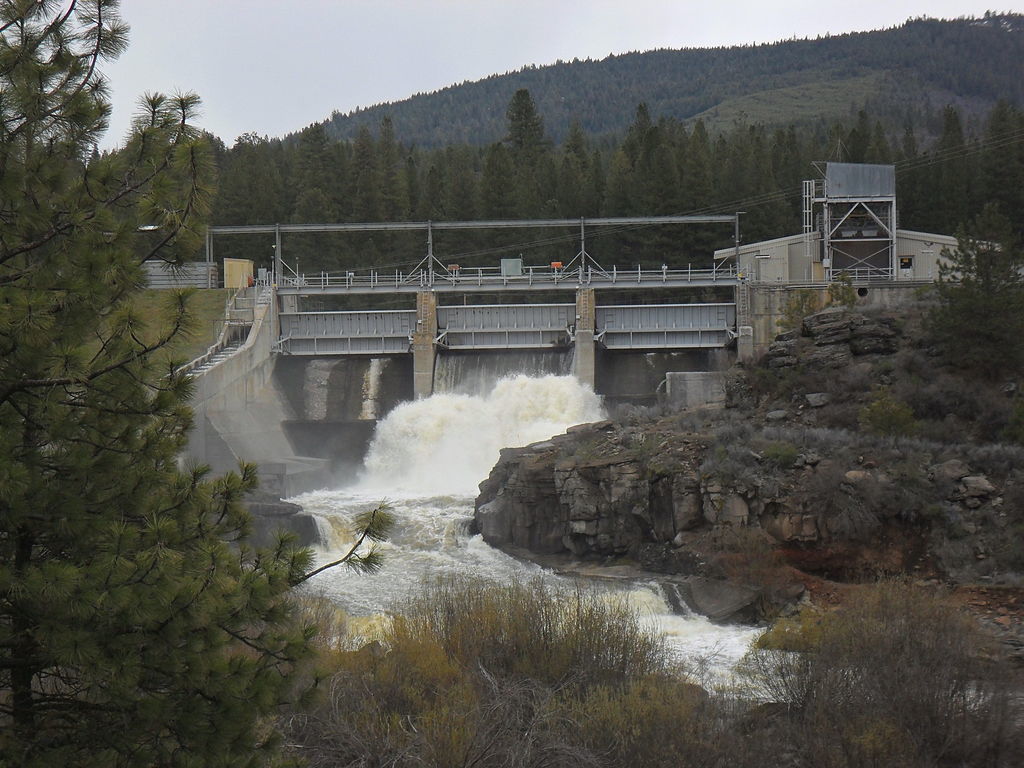
JC Boyle Dam. Bobjgalindo, CC BY-SA 3.0
The Klamath Basin is on the cusp of the most ambitious dam removal effort ever attempted. If all goes to plan, efforts will get underway by next year to bring down the four aging hydropower dams that divide the basin in half. Are we ready for this?
The ramifications of this dam removal effort are vast, affecting not only the river’s mainstem but ultimately all the tributaries where so much biodiversity resides. Removal of the dams will be an important first step — albeit with many steps to go — in improving salmon and steelhead stocks in the basin.
A robust science and monitoring program is essential to ensuring the success of the project — and will help guide future similar dam removal projects around the world. Although more than $450 million has been allocated for the dam removal, to our knowledge, little has been allocated to fund the science needed to evaluate it. This is a mistake.
Science in the basin has come a very long way in the past 20 years, thanks to efforts by the federal government, Oregon, California, the tribes, universities, consultants and various nonprofits. Efforts such as the Klamath Basin Monitoring Program and the Klamath Basin Integrated Fisheries Restoration and Monitoring Plan show great potential. But both efforts are a work in progress, and neither is focused on meeting the science and monitoring needs of dam removal.
If we’re going to have a science program ready for when the drawing down of the reservoirs begins, we have to get started on it now. Putting such a program together typically takes a year or more.
We encourage all interests in the basin to support the urgent development and funding of a science program devoted to evaluating the effects of dam removal and guiding management responses. Based on our long experience with various science programs, we offer four criteria needed for success. The program must be:
Hypothesis-driven: The foundation of adaptive management is that all management actions are hypotheses to be tested by modeling and monitoring. The key to success is to avoid the temptation to measure everything, but instead to focus narrowly on the handful of hypotheses that justified dam removal in the first place.
Inclusive: All parties need a seat at the table, especially the tribes that have the highest stake in the outcome and have developed increasingly sophisticated science and monitoring programs of their own.
Well-led: Strong leadership is essential. Even though the program is inclusive, it needs someone vested with decision-making authority and resources who will allow the program to be nimble.
Reliably funded: Too often, these programs are cobbled together by reducing funds for existing programs. In the long run, this approach is inefficient and creates confusion and conflict.
Based on other programs, we estimate that about $5 million a year for 10 years is needed. A combination of state and federal funding is the most likely source for this funding, although private philanthropy can help.
There are many models for this kind of program, both within and outside of government. The Grand Canyon Monitoring and Research Center is an example of a federally run program that addresses management hypotheses.
Another would be the Southern California Coastal Water Research Project, a joint-powers authority that has strong leadership and is well-known for its inclusivity and consensus-based program planning.
A third option would involve developing a nonprofit modeled after the Klamath River Renewal Corporation, the organization tasked with removing the Klamath dams.
All of these are viable options.
The whole world is watching the Klamath Dam removal project. This is an opportunity not just to get dam removal right, but to guide future management of the Klamath Basin and all other large dam removal projects throughout the West and, for that matter, the world.
All parties need to get on board with a focused science program, and they need to do it soon.
###
Jeffrey Mount has written previously about management of the Delta watershed, the Endangered Species Act and restoring California’s ecosystems. He is a senior fellow at the Public Policy Institute of California’s Water Policy Center.
Peter Moyle is distinguished professor emeritus in the Department of Wildlife, Fish, and Conservation Biology and associate director of the Center for Watershed Sciences at the University of California, Davis.
CalMatters.org is a nonprofit, nonpartisan media venture explaining California policies and politics.
(AUDIO) HUMBOLDT HOLDING UP: Craig and Holly are Brad and Janet in Ferndale Rep’s Rocky Horror Show Which FINALLY Opens This Week
LoCO Staff / Sunday, May 22, 2022 @ 10 a.m. / Humboldt Holding Up

Holly Portman and Craig Woods would like to use the phone if that’s OK
(AUDIO) Holly and Craig Jump to the Left, Step to the Right, Etc.
Wait a minute. Aren’t all productions of The Rocky Horror Show required by Transylvanian law to be staged around Halloween for some reason? Well, listen. Sometimes a global pandemic prevents public displays of the “Time Warp” from delighting audiences. Things got pushed back. And so, after much antic…
…ipation Ferndale Repertory Theatre is going to push ahead with its Rocky Horror Show now, OK? Opening night is this coming Friday, May 27 and the show runs Fridays, Saturdays and Sundays through June 19.

On today’s edition of Humboldt Holding Up we speak with two members of the show’s cast, Holly Portman and Craig Woods, who tackle the roles of Brad and Janet in the upcoming musical. We discuss the resilience of Humboldt theater community and the trials of COVID, but most importantly we subject the stars to a Rocky Horror Show trivia pop quiz to see how prepared they are for the roles ahead of them. How will they fare?! Tune in!
Click the audio player above or click over to Apple Podcasts to hear Holly and Craig’s chat with LoCO’s Andrew Goff and Stephanie McGeary (who just might also have a part in this show herself. Uh huh.) Also, remember to scroll our list of past guests below.
PREVIOUS HUMBOLDT HOLDING UP GUESTS:
- #93 Nurse Lauren Van Vlear
- #92 Planned Parenthood Northern California CEO Gilda Gonzales
- #91 Arcata Main Street Bellydancer Shoshanna
- #90 Antarctic Voyager Darren Weiss
- #89 Bounskee Creator Justin Schwartzman
- #88 Arcata Senior Planner Delo Freitas
- #87 Humboldt County Supervisor Virginia Bass
- #86 Annie’s Cambodian’s Laura Chau-Yang
- #85 Comedian Josh Barnes
- #84 Cal Poly Humboldt’s Jenn Capps, Connie Stewart & Mike Fisher
- #83 Eureka Artist Jesse Wiedel
- #82 Keyboard Veteran Brian Swislow
- #81 Lost Lewis Treasure Hunter Corey Lewis
- #80 “The Cannabis Conversation” Writer Jesse Duncan
- #79 Humboldt COAD’s Alison Sterling Nichols
- #78 Miranda’s Rescue Founder Shannon Miranda
- #77 Eureka Police Department Chief Steve Watson
- #76 ‘The Bartow Project’ Michelle Hernandez and Zuzka Sabata
- #75 Foggy Bottoms Boys Thomas and Cody Nicholson Stratton
- #74 North Coast News’ Nazy Javid
- #73 Pumpkin Carver Mike Craghead
- #72 Eureka Police Department Sergeant Leonard LaFrance
- #71 Eureka Artist Duane Flatmo
- #70 Arcata City Councilmember Sarah Schaefer
- #69 Humboldt Hot Air Director Neroli Devaney
- #68 St. Joe’s James Ladika and Austin Allison
- #67 Eureka Artist Richard Evans
- #66 NCRT’s Calder Johnson
- #65 TV Newsman Dave Silverbrand
- #63 Housing Policy Specialist Brian Heaton
- #62 Muralists Blake Reagan and Lucas Thornton
- #61 Arcata City Councilmember Emily Goldstein
- #60 Kayak Guide Eric Stockwell
- #59 Eureka City Councilmember Natalie Arroyo
- #58 Wiyot Cultural Center Manager Marnie Atkins
- #57 Humboldt County Growers’ Alliance’s Natalynne DeLapp
- #56 RREDC Executive Director Gregg Foster
- #55 Dell’Arte’s Michael Fields
- #54 Llama Wrangler Keagan Trischum
- #53 Crabs President David Sharp
- #52 Organic Dairy Farmers Kristina Radelfinger and Dorice Miranda
- #51 Former Arcata Mayor Alex Stillman
- #50 Cooperation Humboldt’s David Cobb
- #49 Ink People Center for the Arts’ Libby Maynard
- #48 Humboldt Bay Social Co-Owner Amy Cirincione O’Connor
- #47 Musician Lyndsey Battle
- #46 Mad River Brewing CEO Linda Cooley
- #45 LoCO Editor Hank Sims
- #44 Humboldt Republic’s Jason Brandi
- #43 Table Bluff Farmer Hannah Eisloeffel
- #42 Logger Bar Owner Kate Martin
- #41 Teacher/Rapper Zach “Zigzilla” Lehner
- #40 Madaket Captain “Zippo” Libby Tonning
- #39 Event Planner Alegria Sita
- #38 Food For People’s Anne Holcomb
- #37 AHHA President Nezzie Wade
- #36 Performance Artist Noël August/Tucker Noir
- #35 Eureka Mayor Susan Seaman
- #34 Eagle House Owner Jennifer Metz
- #33 Absynth Quartet Drummer Mike “Tofu” Schwartz
- #32 HACHR Executive Director Lasara Firefox Allen
- #31 Alchemy Distillery Owner Amy Bohner
- #30 Eureka City Councilmember Kati Moulton
- #29 Eureka City Councilmember Scott Bauer
- #28 Ungraceful Ager Barry Evans
- #27 Arcata City Councilmember Sofia Pereira
- #26 HumBrews Music Booker Laurel Weston
- #25 Eureka City Councilmember Kim Bergel
- #24 Film Commission’s Cassandra Hesseltine and Nate Adams
- #23 Marble Maker Topher Reynolds
- #22 Arcata Playhouse Director Jacqueline Dandeneau
- #21 Humboldt Political Junkie Eric Kirk
- #20 Rio Dell Mayor Debra Garnes
- #19 Second District Supervisor Estelle Fennell
- #18 Arcata Food Aficionado Jada Calypso Brotman
- #17 Body Piercer Jackie Silva
- #16 Dick Taylor Chocolate’s Adam Dick
- #15 FUHS Teachers Mark Thom and Inma Thompson
- #14 Eureka City Manager Miles Slattery
- #13 Savage Henry Co-Founder Chris Durant
- #12 Eureka Street Art Festival Organizer Jenna Catsos
- #11 SCRAP Humboldt Founder Tibora Bea
- #10 Gym Owner Tyler Parr
- #9 Six Rivers Brewery Co-Owner Meredith Maier
- #8 Multicultural Skincare Therapist Levia Love
- #7 Annie’s Cambodian Server and Social Worker Joshua Coppock
- #6 Eureka City Councilmember Austin Allison
- #5 HSU Professor Deidre Pike
- #4 Pastor Bethany Cseh
- #3 Singer/Songwriter Chris Parreira
- #2 Eureka City Councilmember Leslie Castellano
- #1 Arcata City Councilmember Paul Pitino
GROWING OLD UNGRACEFULLY: Turtles All the Way Down
Barry Evans / Sunday, May 22, 2022 @ 7 a.m. / Growing Old Ungracefully
Quite possibly the greatest book ever written on the subject of turtle stacking.
— Lisa Simpson on Yertle the Turtle by Dr. Seuss
###
You may have heard the story about the Western astronomer who was visiting India, giving talks around the country on the state of cosmological science. At the close of one of his lectures, an old lady stood up and said, “Actually, the earth is supported on the back of a giant turtle.” The astronomer was taken aback, but stepping up to the plate, responded, “I understand, madam, but can you tell me what the turtle is standing on?” to which the lady said, “Another turtle, of course.” Taking a deep breath, he replied, “Well yes, but…” “It’s no good, sonny,” she interrupted. “It’s turtles all the way down!”
The story has been repeated so often by, or with reference to, so many famous people — Bertrand Russell, Linus Pauling, Carl Sagan, Justice Antonin Scalia, Stephen Hawking — that it’s acquired a life of its own. The Turtle Problem is now routinely used as shorthand for the philosophical notion of infinite regression. I’ve seen it cited in reference to such issues as “the policing problem” (Who polices the police…and who them?…) and Intelligent Design (If the world is so complicated that it took God to create it, who created God?…and etc.)
I was reminded of this trope watching an old sci-fi neo-noir movie last week (my wife was out of town, what’s a guy going to do to amuse himself?). The Thirteenth Floor is so clunky, I don’t think I’ll be giving much away if I say that the protagonist, who helped create a simulation of LA in the 1930s (think mayhem and murder) believes that he’s living in the present (i.e. 1999, when the movie was made) before discovering that his 1999 self is a simulation. He — his consciousness — dies in that world, and “he” reawakens in a Technicolor 2024, to be greeted by the actual flesh-and-blood folks who created his sim.

Now where have I seen that green sheen before? (Lo-res movie poster, fair use.)
Sound familiar? It’s The Matrix, only cheesier. Oddly, both movies were up for the Saturn Award for Best Science Fiction in 2000, but The Matrix, deservedly, won. (If The Matrix hadn’t won, maybe the Wachowski brothers/sisters wouldn’t have ruined it all by making the two inferior sequels.) Both movies invite — practically scream at you with — The Question: If you discover that you’re in a simulation, how do your creators know if they’re ”real” or whether they’re in a simulation themselves? And on and on, turtles all the way up.
Can The Turtle Problem also be applied to consciousness? I’ll be sitting quietly, thinking, “Hmm, here I am, sitting here, staring at a wall.” Then comes, “Who is having this thought?” ( — a standard technique in some forms of meditation). Followed, instantly it seems, by, “Who is having the thought, ‘Who is having this thought?’ ?” And before you can say infinite regression, my mind’s off and running down mirrored corridors, bouncing the question (as I imagine) between the twin hemispheres of my brain.
Suppose we allow that when we notice that we’re thinking, we’re having a ‘meta-thought’, and that this meta-thought is somehow more ‘real’ than the original thought. So the next thought, the thought about the meta-thought (the ‘meta-meta-thought’) is presumably closer yet to reality. At what point do we get to reality itself?
Can we ever experience the world (including ourselves in it) as it really is? As the memsaab might have said, “It’s no good, sonny. You’re deluded every which-what way. You’re better off with turtles.”
OBITUARY: Robert Francis Carmesin, 1947-2022
LoCO Staff / Sunday, May 22, 2022 @ 6:56 a.m. / Obits
Robert Francis Carmesin
April 13, 1947 – May 16, 2022
Robert Francis Carmesin, AKA Carm/Buddy went to be with the Lord on May 16, 2022 at 8:30 a.m. He fought a valiant battle against Amyotrophic Lateral Sclerosis (ALS), commonly known as Lou Gehrig’s, a progressive neuromuscular disease. He passed away peacefully in his sleep at home in Mckinleyville, and gave love to each and every person as he said farewell in the weeks prior.
He was born April 13, 1947, in Los Angeles, and moved with his parents to McKinleyville in 1952 where he began life as the son of a chicken rancher. He deeply loved his Mom, Dad and family and helped to build their ranch known as the “Carmesin Compound.” He was preceded in death by his parents John and Lois Carmesin, his first wife Christine Grace-Carmesin, second wife Catherine Blake-Carmesin.
He was the beloved husband of Jacqueline Hostler-Carmesin, loving father of Damian Carmesin (Kristie Burns), and Tina King (Terry). He was step-father of Richard England Sr. (Jennifer), Christina Nelson (Chris), Michael Hostler (Sarah Burns), Heather Hostler, Don Hostler (Mark Alsbury), and Robin Hostler. He was Grandpa to Derek Carmesin (son Landon), Ayashie Carmesin, Kaleb Carmesin, Melanie Carmesin, Taylor-Jay King (Rikki), Tanner King (Taylor Van Antwerp), Madyson Nelson, Richard England Jr., Jessalyn England, Hilton Hostler III (Heather), Kameiko Hostler, Kamaria Charlo, Aneekah Hostler, John Silver Hostler, Coco Hostler, Michael Hostler, Jr.
He was an amazing brother to Rita McAtee (Dale), John Carmesin (Vickie), and uncle to Jamie Dobrec (Mike), Annie Meagher (James), Travis Carmesin (Danielle), Heidi Olson (Pete), and brother-in-law to Bob Martensen, sister-in-law, Sherrie England (Bob), Debbie McBride (Curt). Great uncle to Branson Dobrec, Daytona Dobrec, Riley Meagher, Clint Meagher, Cole Carmesin, Carlee Carmesin and Josie Olson.
He made a life time of memories with best friends Stevie Jones, Ron Martin, Teddy and Jack Biondini, Stevie Noble, Garth and Linda Sundberg, Gary “Pepe” Johnson, Keith and Erica Ervin, and Erick Ammon. He was loved greatly by the Hoopa family Grandma Mush, Auntie Dick, Auntie Doolie, Uncle Loggie and so many others.
Robert attended McKinleyville High School and was part of the first four-year graduating class of 1965. He was inducted into the McKinleyville High School Hall of Fame in 2011. He earned six varsity letters – three each in football and track – set an H-DN football record in 1963 with 43 pass receptions, and was the H-DN pole vault champion in 1965.
He attended Humboldt State University and worked as a butcher at E & O Meat Market, moving on to Miller Farms Nursery around 1968 for many years. He later went to Prudhoe Bay, Alaska to work on the Cat Trains, across frozen tundra’s and snow fields. They made living quarters to live in while working on the oil fields. He saved lives numerous times in these treacherous conditions and his friends look forward to sharing these stories at his Celebration of Life.
He became an Operating Engineer and worked at Redwood Empire Aggregates in Arcata beginning in 1978 and retiring in 2009 and had been a foreman for most of those years. He told stories of every highway and road he had paved in three counties and would tell us, “I paved that road!” He was a fisherman extraordinaire and was known for the best smoked salmon and albacore tuna that he generously gave to family and friends. He packed into the Trinity Alps with the Martensens, Kings and Ammons for decades of hunting and wonderful memories. His best times were hunting, fishing and enjoying the outdoors. He certainly never let anyone out fish him!
He was a member of the Humboldt County Sheriff’s Marine Posse from 1970-1980. In 1971, he was one of the dive team that searched for the DC-3 airplane that plunged into the ocean at Shelter Cove, recovering numerous bodies. He also did several searches with the HCSO in the Trinity River. One of his favorite hobbies was diving for abalone and bringing home trophy shells.
He was a contractor who could build anything he attempted, helping his family and friends without hesitation. He built an amazing cabin on the Klamath River that will be forever cherished by his loved ones. He meticulously cared for the land he had bought from his dear friend, Bunny Vanpelt. He had a great respect for the land and Native American people, learning a lot of from the elders he was honored to know.
He married his wife Jacque Carmesin on Dec. 12, 2012 at the Bayside Country Club and they had a fairy tale romance for almost ten years, hunting and fishing, playing at Trinity Lake and loving all of their families. Most of all Robert Carmesin was a wonderful, kind person who touched everyone that knew him. He was a gentle soul and the most loving human being that we have ever met. He was an incredibly loving husband, father, brother, uncle, friend, grandpa, and his beautiful spirit will live on forever!! We miss him terribly already but take his wisdom and laughter with us until we see him in heaven some day.
Please join us in celebrating his life on Tuesday, May 24, 2022, 1:30 p.m. at Azalea Hall in McKinleyville.
###
The obituary above was submitted by Robert Carmesin’s loved ones. The Lost Coast Outpost runs obituaries of Humboldt County residents at no charge. See guidelines here. Email news@lostcoastoutpost.com.


