

‘No Single Greater Action We Can Take Than Removing These Dams’: FERC Releases Environmental Document for Review
Isabella Vanderheiden / Saturday, Feb. 26, 2022 @ 2:28 p.m. / Klamath

Iron Gate Dam, one of four hydroelectric dams slated for removal on the Klamath River. | Michael Wier, CalTrout.
###
North Coast tribes are one step closer to their decades-long goal of dam removal following the Federal Energy Regulatory Commission’s (FERC) release of its draft Environmental Impact Statement on Friday for removal of the lower four Klamath River dams.
Removal of the four dams will open 420 miles of salmon spawning habitat as well as improve water quality and reduce critical temperature conditions that cause disease in threatened salmon species.
“This really affirms what we’ve been saying for years,” Craig Tucker, a natural resources consultant for the Karuk Tribe, told the Outpost. “Removing the dams is good for fish, it’s good for water quality, and it’s good for PacifiCorp customers. We think that the information contained in the [DEIS] reaffirms that dam removal is the correct decision.”
The 990-page document contains FERC’s evaluation of the environmental, cultural, and economic impacts associated with dam removal, as well the potential consequences of a “no-action alternative.”
“Under the no-action alternative, the Lower Klamath Project would continue to operate as it does today,” the DEIS says. “…The no-action alternative would not address the water quality and disease issues which, when combined with the ongoing trend of increased temperatures, poses a substantial risk to the survival of one of the few remaining Chinook salmon populations in California that still sustain important commercial, recreational, and Tribal fisheries.”
Tucker acknowledged that there are short-term impacts associated with dam removal, such as sediment impacts to the Klamath River, but emphasized “the long-term benefits far outweigh the short-term risks.”
“Our native fish runs are slipping into extinction and we have to do something dramatic to reverse this trend,” he said. “There is no single greater action we can take than removing these dams. It opens up hundreds of miles of historical spawning habitat, dramatically improves water quality and the benefits will be seen immediately.”
“Dam removal won’t fix it all, but we can’t fix the Klamath without dam removal,” he added.
Comments on the DEIS may be submitted through April 18, 2022. Following public review, FERC will put together the final EIS and issue a permit for dam removal.
“If everything goes according to plan, they’ll make that decision later this year and as soon as they do dam removal activities will begin,” Tucker said.
Dam removal is slated to begin in early 2023.
The DEIS can be found here.
Here’s the press release:
Washington, DC – Today the Federal Energy Regulatory Commission (FERC) released its draft Environmental Impact Statement (DEIS) on the proposed removal of the lower four Klamath River dams. The public is now invited to comment on the DEIS which describes the impacts and benefits of the project.
“Once again, a thorough analysis by experts reveals dam removal as key for restoring Klamath fisheries and improving water quality” notes Yurok Vice Chairman Frankie Myers. “Our culture and our fisheries are hanging in the balance. We are ready to start work on dam removal this year.”
In comparing the impacts of dam removal to current conditions, the DEIS concludes that dam removal provides significant economic, environmental, and cultural benefits to northern California and southern Oregon. This conclusion is consistent with the findings of two other Environmental Impact Studies that evaluated dam removal over the past two decades.
For California and Oregon commercial salmon fishermen, dam removal is key to revitalizing their industry. “Dams have decimated salmon returns on the Klamath River which means fewer harvest opportunities for family-owned commercial fishing vessels. Dam removal has the potential to save our industry and thousands of jobs in California and Oregon ports,” explains Glen Spain with Pacific Coast Federation of Fishermen’s Associations.
In recent years, as many as 90 percent of juvenile salmon sampled tested positive for a disease called Ceratomyxa shasta. The disease flourishes in the areas where water quality and flows are most affected by the dams. “The dams are a key factor in the diseases that are wiping out entire generations of salmon,” says Spain.
Brian Johnson, California Director of Trout Unlimited, acknowledges that dam removal is but one significant component of the environmental restoration work that is needed throughout the Klamath Basin to support the recovery of fish like salmon and steelhead trout. “We still need to balance water use and restore wetlands in the Upper Basin,” said Johnson. “But dam removal remains the single biggest thing we can do to restore Klamath fisheries and water quality right now.”
Benefits of dam removal include reintroducing salmon to over 400 miles of historical habitat, eliminating reservoirs that host toxic algae blooms each summer, and eliminating poor water quality conditions that allow fish disease-causing parasites to flourish. Because the cost of relicensing the dams would exceed the cost of removal under the plan, removal is also the best outcome for PacifiCorp customers.
“This is the biggest salmon restoration project in history,” notes Russell ‘Buster’ Attebery, Chairman of the Karuk Tribe. “And it’s desperately needed. Fewer and fewer salmon return each year. If we don’t act now, we may lose them all. Dam removal gives me hope that my grandchildren will be able to fish for the family dinner the way I did when I was a kid.”
“Dam removal works. We have only to look at the Elwha River restoration to see just how quickly an entire ecosystem can recover,” said Brian Graber, senior director of river restoration for American Rivers. “The Klamath is significant not only because it will be the biggest dam removal and river restoration effort in history, but also because it is a story of righting historic wrongs, illustrating how the futures of rivers and communities are inextricably linked.”
Some in the agricultural community see dam removal as a way to improve fish populations, making resolution of water disputes easier. “What it comes down to is what’s good for fish is good for farms. Taking dams out will benefit fish, people and agriculture. Dam removal is a huge step towards bringing the Klamath Basin back into balance,” Kelley Delpit, third generation farmer in the Klamath Basin.
FERC will accept public comments on the DEIS until April 18, 2022. Before dam removal can commence, FERC will need to issue a final EIS and approval. Dam removal advocates hope FERC will issue a final approval this summer will dam removal activities to begin soon after.
BOOKED
Yesterday: 7 felonies, 17 misdemeanors, 0 infractions
JUDGED
Humboldt County Superior Court Calendar: Friday, Sept. 4
CHP REPORTS
No current incidents
ELSEWHERE
RHBB: CDPH Issues Immunization Recommendations for 2026-27 Respiratory Virus Season
RHBB: Redway Transfer Station to Close an Extra Day for Construction
RHBB: Dows Prairie Road to Close for Two Months for Culvert Repair
(UPDATING) 1/4-Acre Vegetation Fire Reported on Titlow Hill
LoCO Staff / Saturday, Feb. 26, 2022 @ noon / Fire
Update, 12:30 p.m.:
Forward progress has been “totally contained” by private resources in the area, according to scanner traffic. Willow Creek Fire is at the scene.
Original post:
There is a 1/4 acre vegetation fire currently burning west of Willow Creek, approximately three miles up Titlow Hill Road from State Route 299, according to scanner traffic. The small fire was reported shortly after 11:30 a.m. as an escaped controlled burn. Blue Lake Volunteer Fire Department and Cal Fire are responding.
We will update when more information is available.
Testimony Wraps in Case of Arcata Man Accused of Biting Off Cop’s Thumb; Defense Attorney Reprimanded For Mocking Officers
Rhonda Parker / Saturday, Feb. 26, 2022 @ 10:27 a.m. / Courts
In an anti-climatic end to testimony in the jury trial of mayhem suspect Delano Blayze Malang, the defendant took the witness stand Friday and admitted he lunged toward Arcata police Sgt. Heidi Groszmann, bit off her thumb and spit it out.
Malang, 22, is accused of mayhem for biting off the top half of Groszmann’s thumb while she and other officers were struggling to place him in a police van on Aug. 1, 2021, during the Arcata Arts Festival. Malang was screaming, thrashing and kicking, at one point knocking off the body-worn camera of Officer Jamal Jones.
Police suspected Malang was under the influence of methamphetamine. But by the time he was finally restrained and taken away, his possible meth use was a relatively minor issue.
The ordeal started on an Arcata Plaza corner while Jones, Groszmann and Officer Joseph Rodes were questioning Timothy Cox about squirting people with a water gun. They also learned Cox had been in a fight with Malang, whose name officers didn’t know at the time.
Malang walked over and perched on top of a bench behind Cox and the officers. He said during testimony that “I wanted to see what was going on.” He said Cox had “assaulted me repeatedly” in the past.
Jones told Malang five times to leave the area, even saying “Please.” Malang ignored the orders, finally leaving when the officer walked toward him and asked if he wanted to be arrested.
Once Cox had been lectured and agreed to leave the Plaza, officers turned their attention to Malang. They had already taken note of his strange behavior, and several people on the Plaza reported Malang smoked meth all day and bugged people. Also, one man showed officers his arm and said “the little fucker bit me.”
Groszmann, under cross-examination by Deputy Conflict Counsel R. J. Loehner, described Malang as yelling to himself, with his hands and body twitching.
“He didn’t seem to have control of his body movements,” she said.
After the incident at the bench, Jones and Rodes began following Malang, who was walking away. Jones ordered him to stop. He kept walking.
All of this was captured on the officers’ body-worn cameras. The jury watched video footage multiple times.
Malang entered Cafe Brio, where a number of people were having lunch, with Rodes and Jones behind him. He ignored orders to “come here,” instead positioning himself behind a table. Rodes grabbed him by one arm, Jones by the other, and they took him outside the cafe.
Then began a wild, exceptionally loud struggle that didn’t end until Groszmann had lost half her thumb and Malang was finally in custody.
Malang was bellowing “No! No! I didn’t do anything! I didn’t do anything! Please don’t hurt me!”
Officers attempted to place him in the back of a patrol car. Screaming constantly, Malang began banging his head on the patrol car and then the sidewalk. Jones grabbed him by the hair to stop him.
Police then allowed Malang to sit on a curb for at least 15 minutes, while Groszmann went to get a police van. They figured they would have less trouble getting him into a van, and they didn’t want to use more force.
“We didn’t want to hurt him,” Groszmann testified.
Also, HSU police Sgt. John Packer was summoned to help. Packer, now retired, was known for his skill at dealing with rowdy suspects.
Packer testified it became clear quickly that with Malang, “words wouldn’t work.”
He stayed to help place the wildly thrashing Malang in the back of the van, and he saw Malang lunge toward Groszmann and bite her thumb. The bitten-off portion landed on the van’s back steps.
Groszmann said she had put her hand on Malang’s forehead to stop him from banging his head, “forward and backward and side to side.”
In the process, her thumb went into his mouth. Groszmann yelped “OW!” but continued to help, going to grab a “wrap” device to restrain Malang.
“She continued to assist,” Jones testified. “I kept telling her to go to the hospital but she continued to assist.”
Groszmann’s body camera filmed the moment when she removed her right glove and saw what remained of her thumb. There was a small gasp. Then she drove herself to Mad River Community Hospital.
Later, after doctors at the hospital “jammed” the top of her thumb back on, Groszmann was treated by Dr. Mark Pardoe, a reconstructive surgeon. Pardoe testified “it takes a pretty strong bite” to go through a fingernail.
When Malang testified Friday under questioning by Deputy District Attorney Trent Timm, the only thing he denied was being under the influence of methamphetamine. He said he hadn’t used it for a month or more.
Yes, he ignored police commands. Yes, he resisted, but it wasn’t because he was afraid of being arrested. It was because he didn’t want to be “grabbed” or “taken.”
Malang claimed he didn’t know he was being arrested and he didn’t understand what was happening or why. That seems unlikely, as he has been arrested a number of times and has convictions for robbery, larceny and assault, among other crimes.
Pointing to a portion of video footage, Timm said “That’s your head lunging forward,” isn’t it?”
“Yes.”
“That’s because you lunged forward and bit off Sgt. Groszmann’s thumb.”
“Yes.”
“When you got a chance to really hurt someone you did.”
“Yes.”
Under direct examination by his own attorney, Malang said he ignored police commands “because I didn’t want to be around the police.” He didn’t understand why he was being grabbed.
As to the bite, “I bit off Officer Groszmann’s thumb and spit it out. I’d been put in the back of a police van … she stuck her thumb in my mouth.”
Malang said he didn’t know whether he “made a cognitive decision” to bite the officer. “I don’t know.”
Many of Loehner’s questions focused on what Malang was feeling at particular moments in time. Judge Gregory Elvine-Kreis ruled those questions irrelevant and they weren’t answered.
Loehner, who has been at odds with the judge during the trial, told Malang:
“Johnny, I’d like to ask you a lot more questions, but I don’t think this court would find them relevant. So nothing further.”
That drew an admonishment from Elvine-Kreis, who admonished Loehner so many times throughout the trial that this reporter lost count.
“You force me to do this,” the judge told Loehner.
It was unclear whether Loehner called Malang “Johnny’’ because he goes by that name, or if Loehner was making fun of Groszmann, who had been told the name was Johnny and used that name while speaking with Malang.
Loehner also mimicked Officer Jones’ pronunciation of “kids” when the officer was talking about his concern for children on the Plaza.
Prosecutor Timm responded with “Officer Jones has an accent. He should not be mocked.”
Another admonishment.
Closing arguments are scheduled for Monday afternoon. The Outpost will publish another article after the verdict is reached, with more information on Loehner’s antics and the fate of Sgt. Groszmann’s thumb.
THE ECONEWS REPORT: Build Broadway Better
The EcoNews Report / Saturday, Feb. 26, 2022 @ 7 a.m. / Environment

This week, Gang Green sits down with Caltrans’ Jeff Pimentel to discuss Caltrans’ work to improve Broadway for all road users (and not just motorists). Through fixing sidewalks, adding pedestrian crossings, and other changes to the road, we can influence individuals to make safer decisions.
Caltrans’ work on Broadway is also a reflection of larger cultural changes within the agency. Once almost solely focused on traffic speed, the agency has made great progress towards broadening its horizons to prioritize traffic safety and incorporate the interests of non-car road users. Progress!
AUDIO:
“The EcoNews Report,” Feb. 26, 2022
THE CANNABIS CONVERSATION: Cannabis Addiction
Jesse Duncan / Saturday, Feb. 26, 2022 @ 7 a.m. / Cannabis
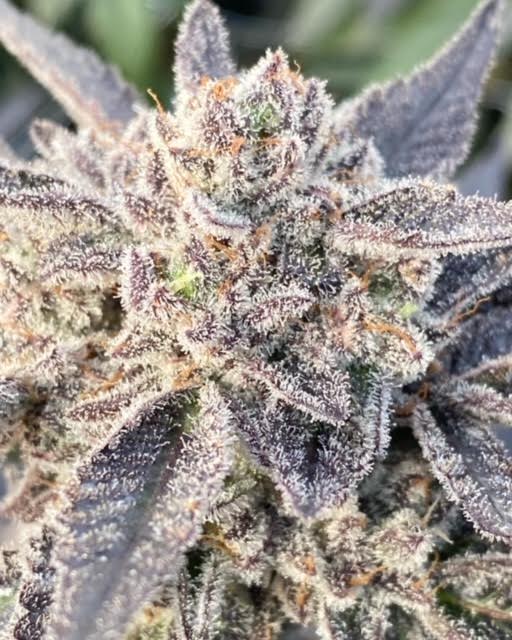
One of the least popular topics in my industry is that of cannabis addiction. As a historically demonized industry attempts to redefine itself along the lines of health and wellness, the topic can be a real buzzkill and is often ignored, denied, or given minimal significance. While everyone knows that I grow professionally and advocate for safe, barrier-free medicinal cannabis access for all people worldwide, I like approximately ten percent of habitual users, develop a physical addiction to cannabis with excessive use.
In the context of mind-altering substances, addiction or “substance use disorder (SUD) is a complex condition in which there is uncontrolled use of a substance despite harmful consequences. People with SUD have an intense focus on using a certain substance(s) such as alcohol, tobacco, or illicit drugs, to the point where the person’s ability to function in day-to-day life becomes impaired. People keep using the substance even when they know it is causing or will cause problems.” Repeated substance use causes changes to the brain and impacts judgment, decision making, learning, memory, and behavioral control.
My history with pot is a storied one. When I began smoking at age 15, I was fascinated with it. An older buddy on the golf team sold trim joints for a buck apiece and I started smoking on the weekends with my two best friends. We would laugh hysterically and I remember food tasting so delicious when high! The first time we got baked we ate Stouffer’s pepperoni pizza and I thought I’d gone to heaven.
We soon graduated to smoking bud, the bubonic chronic out of Garberville, and some indoor trainwreck. Cannabis flowers were among the most beautiful things I’d ever seen. The color, the crystals, and the aroma really drew me in and a largely covetous long-term relationship was born.
My folks, children of the sixties and seventies found out we were smoking early on and offered me two pieces of advice – don’t get high at school and don’t drive stoned. In one ear and out the other. I was soon smoking every day and, because we had found a source for really killer stuff, I was tragically lit most of the time. I was generally so blazed that I couldn’t focus on schoolwork anymore. I had a hard time even reading a page out of a book without getting lost and my energy level fell apart.
I remember waking up trashed after a hard day of smoking. We called it being run down. Walking a round of golf took everything I had and teachers started asking me why I had become so inward. Known as a social extrovert, others were noticing a change in my behavior and were concerned. My solution to the developing problem was simple, power through and start smoking more so as to build a tolerance and better mask my altered state of mind. The process took about two years. My grades tanked after being a straight-A student, and I limped through senior year, adding copious amounts of alcohol and LSD to my cannabis regime. Not highly recommended for the developing brain or emotional stability!
I took two years off school to work and entered college at age 20, just after my marriage. By then my tolerance had improved and I excelled academically and socially once again. I was high all the time but participated in class, got all A’s, gave regular oral presentations, and was a leader on group projects. All was well until I stopped smoking for the first time in years.
We were taking a trip to my sister’s wedding and my wife pleaded with me not to take any weed as she didn’t want me stinking at the ceremony. I was nervous when we left town and smoked heavily before leaving. When we arrived in Davis about five hours later, I was starting to feel off. Anxiety was building and I was beginning to feel nauseous. I couldn’t sleep that night and felt really caged up. The next day got really gnarly. My nausea and anxiety continued to build and I looked like hell. I survived the wedding, but couldn’t eat at the reception or tolerate the crowd.
I didn’t sleep for a second night and demanded we head home a day early. Social stimulation was overwhelming and I vomited several times on the way home. I limped into town and ran out to the shed and smoked heavily. I was shaky and had hot and cold flashes. I showered, smoked again, and was able to start sipping water after another hour. I had shed nearly ten pounds in three days, was awake for nearly the whole time, and had circles under my eyes. Back on the smoke, I “normalized” quickly and went about life as before – high all the time and excelling outwardly.
Fast forward another five years and I experienced a similar episode. I had just received my MBA and was entering my profession as a financial advisor. I decided to stop smoking for fear of stigma, so I set down my pipe and saddled up for the next chapter of my life. I experienced the same outcome. I didn’t sleep for the first 48 hours, was overwhelmed by nausea and anxiety, and dropped ten pounds in several days. It took me about a week to feel normal and I struggled with nightmares for several months after quitting.
I was cannabis-free for three years and began smoking again at age 30. Given my prior experiences, I treaded lightly. Rather than smoking all the time, I began using casually – once a day versus 8-10 heavy sessions like in years past. Interestingly, with more moderate intake my body didn’t develop the same physical response. I could decide not to use on weekends when around the family and things were well. I could eat and sleep and not experience any other side effects.
After mom’s death five years later and a serious hip injury, I started smoking constantly – perhaps trying to hide from the sadness and pain, or perhaps so I could work through those emotions. After a few years of heavy use, I decided to quit again. I experienced another very challenging withdrawal with the same symptoms. Perhaps due to age, it took approximately two weeks to leave the anxiety behind and feel normal again.
As a result of these experiences, I make a conscious effort to consume minimally nowadays. I’ll occasionally take one puff of my favorite live resin cartridges or one ten milligram ice hash gummy and enjoy the experience. Rather than using out of necessity or as an escape or survival mechanism, I now use cannabis for enhanced sensory experiences, to center myself spiritually and emotionally, or to alter my perspective around a challenging situation or decision. An occasional mind and body-altering experience is rewarding and something I quite enjoy.
The literature on cannabis addiction is growing. It’s estimated that approximately 10% of habitual users become dependent on cannabis. For those who start consuming in adolescence or youth, the number increases to 17%. Cannabis addiction is associated with heavy use, some citing daily intake of four to five joints. Addiction, or cannabis use disorder is exemplified by using more cannabis than intended, failed attempts to quit using, using even though it causes problems at home, school or work, or using despite social or relationship problems. Other signs of addiction include cravings, increasing dosage to achieve the same high, and experiencing withdrawal symptoms when stopping use.
If you are struggling with perceived cannabis addiction, stopping cold turkey is one method, but can be challenging and highly disruptive. I recommend backing down your use for a period of two weeks before quitting altogether. For example, if you are orally ingesting 300 mg of THC per day as I used to, dropping that to 200, then 100, then 50 will be easier on your system. If you find yourself unable to successfully ween yourself off, then biting the bullet, quitting at once, and experiencing several days of discomfort is the path.
If you are a heavy smoker, transitioning to edibles for a week or two can help break your habitual/ritualistic smoking habit and improve the chances of your success. I find taking Golden Slumber tea from Humboldt Herbals coupled with melatonin gummies for a few days can soften the anxiety and help you get some needed rest as your body transitions to a new normal.
While most cannabis users can smoke as much as they want as often as they want and never experience any ill effects, others simply don’t have that luxury. And while cannabis addiction is obviously much less serious than being addicted to alcohol, opiates, or hard drugs, it is real nonetheless. As we seek to professionalize our industry and normalize use, conversations around cannabis addiction must be part of the process. By openly acknowledging this reality and helping consumers address the issue without fear or judgment, we show compassion and strengthen our hand as a loving industry dedicated to saving and improving lives.
Despite having a somewhat challenging relationship with cannabis at times, I’m proud of what I do for a living and I love smoking weed…I honestly wish I could do it all the time, yet now understand this isn’t the best option for me. I believe cannabis is a path to personal enlightenment and improved interpersonal relationships. I believe it enhances our love for people and for the natural world. I find that cannabis makes people nicer and allows us to live with less stress and more appreciation and thankfulness. I wouldn’t change my path for anything and instead, believe that my personal experience allows me to be an even greater advocate for the plant we love.
###
Jesse Duncan is a lifelong Humboldt County resident, a father of six, a retired financial advisor, and a full-time commercial cannabis grower. He is also the creator of NorCal Financial and Cannabis Consulting, a no-cost platform that helps small farmers improve their cultivation, business, and financial skills. Please check out his blog at, his Instagram at jesse_duncann, and connect with him on Linkedin.
Will Annie’s Cambodian Be Replaced by a Fast Food Drive-Through? Project Submitted to the City Includes Plans to Demolish the Beloved Local Restaurant
Stephanie McGeary / Friday, Feb. 25, 2022 @ 4:48 p.m. / Business , Our Culture
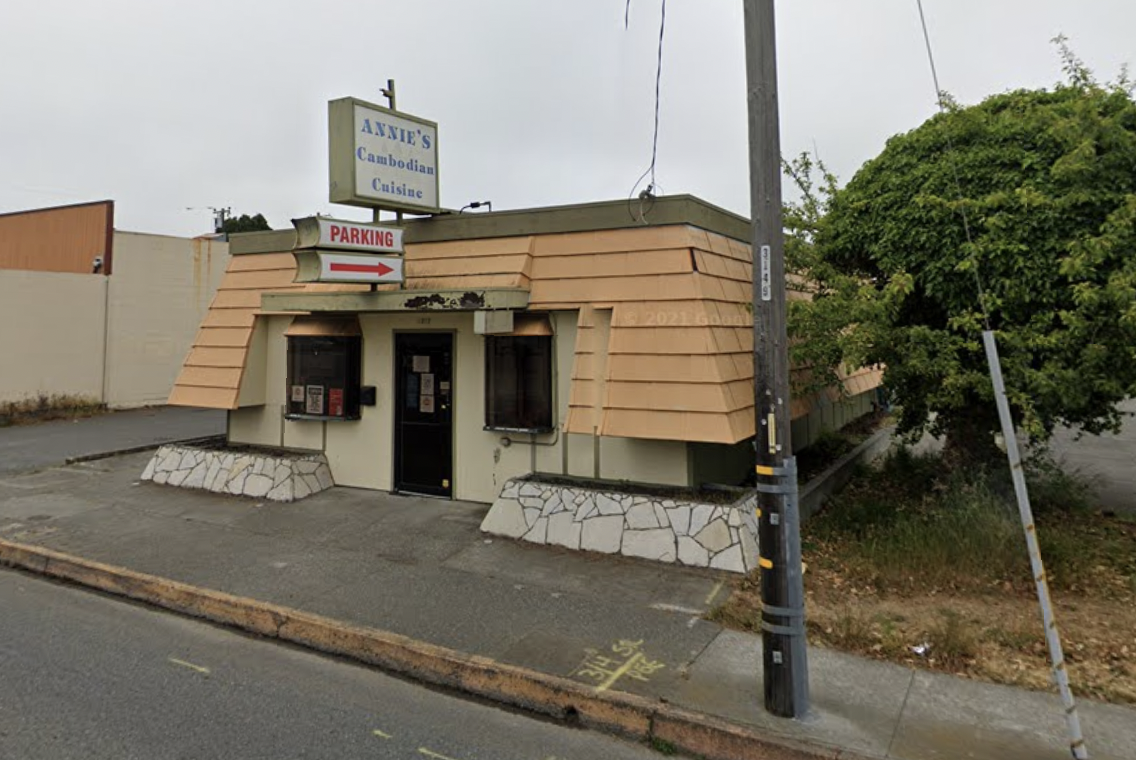
Annie’s Cambodian on Fifth Street in Eureka. | Google Street View.
###
For more than 11 years the small, unassuming restaurant Annie’s Cambodian Cuisine – located on 101 North (Fifth Street) between U and T Streets in Eureka – has been a favorite of locals, who flock there for the delicious grub and friendly service. Now this beloved business may be in trouble after plans were submitted to the City to demolish the Annie’s building to make way for a drive-through restaurant.
A Development Project Referral – sent to the Outpost earlier this week by Eureka City Manger Miles Slattery – includes development plans for the three adjoining parcels at 1906 Fourth Street, which holds a now-closed Subway Sandwiches, and 1905 Fifth Street, which holds Annie’s and a now closed Sizzler.
The project proposal – submitted by applicant Humboldt QOZ Fund, LLC on Feb. 14 – includes plans to demolish the three existing restaurant buildings and build a Starbucks, plus an as-yet-unnamed restaurant in their place. The two parcels holding Annie’s and Sizzler would be combined into one parcel and a 1,805 foot restaurant would be built on the site. A 1,000 square foot Starbucks would be built on the site that currently holds Subway. Both restaurants would include a parking lot and drive-through.
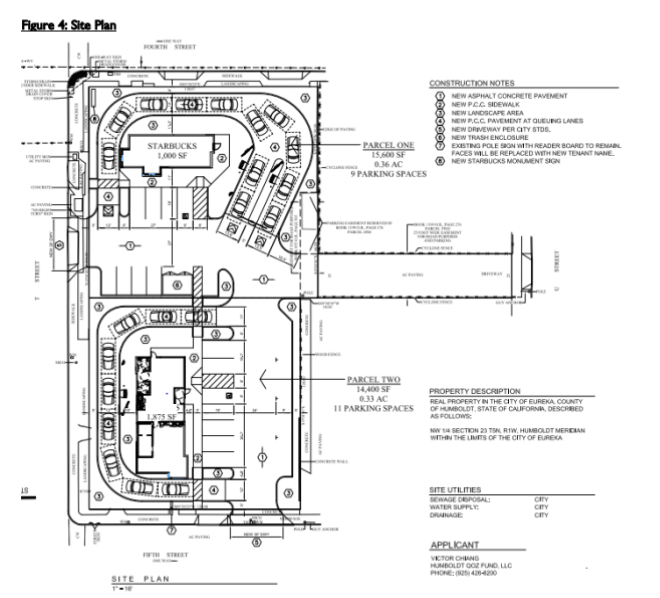
Site plans for a drive-through Starbucks in place of the Subway and another drive-through restuarant in place of Annie’s and Sizzler | Images from the City of Eureka
Reached by phone on Friday afternoon, Annie’s co-owner Laura Chau-Yang said she did not wish to comment at this time. But it did seem like any plans to demolish the building came as an unpleasant surprise to Chau-Yang.
It’s also not totally clear how long it will be before demolition or building would take place, but it will likely take a while. Slattery told the Outpost that the project referral was sent to the local regulatory agencies, which will have until March 1 to bring up any issues with the project. If there are no issues, the applicant will then need to submit all the necessary permits, including a demolition and building permit, and will need to submit building and design plans for approval before construction can begin.
Slattery did not know yet what the drive-through restaurant might be that would replace Annie’s. But he did say that the City would be more than willing to help the owners to find a new space, so that Annie’s Cambodian Cuisine can continue to serve the community.
View the Development Project Referral here.
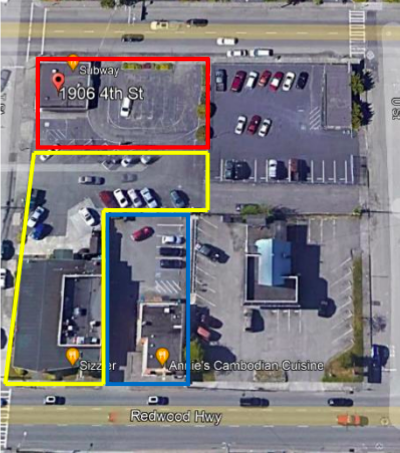
The three restaurant parcels at 1906 4th Street and 1905 5th Street
Eureka City Council to Discuss Future EaRTH Center Project Site
Isabella Vanderheiden / Friday, Feb. 25, 2022 @ 2:56 p.m. / Eureka Rising

The EaRTH Center gateway, pictured in a slide presented at the Feb. 9 Eureka City Council meeting.
###
The Eureka City Council will return to the contentious topic of parking lots next week and consider the reduction or removal of two city-owned parking lots on Third Street between G and H streets, behind Lost Coast Brewery, from the city’s Parking Assessment District (PAD) to make way for the recently approved EaRTH Center.
As detailed in the agenda summary, the PAD was created in 1954 and encompassed most of the city’s central business district. “During that time, the city council approved issuance of bonds for the acquisition and construction of off-street parking facilities, and in 1955, a bond was formally issued and the City began to acquire and develop parking lots.”
Several parking lots were constructed with the bond funds and in 1964, after eight lots were developed, the bonds were retired.
The PAD is no longer collecting assessments. However, any lot funded by the PAD must go through a public hearing process to allow for the lot to be reduced or removed by a developer.
Many downtown business owners have spoken against the development of the lot over concerns about downtown parking capacity. However, data developed in the city’s recent parking study didn’t indicate that parking is at crisis levels. As previously reported by the Outpost, in 2019 — before COVID — 13 public lots in the Old Town and downtown areas, none of which are proposed for development, had about 50 percent of their spaces available throughout the day.
The EaRTH Center – a near-acronym for Eureka Regional Transit & Housing Center – will contain an intermodal transit center and at least 31 dwelling units, with 27 of them designated for low-, very-low- and moderate-income tenants. It will have an interior courtyard, rooftop greenspace, a space for food trucks and room for new retail establishments. It is slated for completion in the fall of 2024.
The Eureka City Council meeting will take place on Tuesday, March 1 at 6 p.m. The agenda can be found here.


