UPDATE: After this story was published, Auditor-Controller Karen Paz Dominguez suggested that the Attorney General’s letter may have been sent in error, or perhaps as a result of an automatic, calendar-based notification process that ignored the specifics of the local situation.
The reasoning behind this theory, offered by Paz Dominguez, was that the letter was sent on behalf of the State Controller’s Office, an agency that recently sent an audit team to Humboldt County to conduct an investigation into the county’s financial reporting practices. That team has yet to issue its report, and Paz Dominguez said she was under the impression that the report will include instructions on how to proceed with filing the delinquent report.
On March 2, we got some clarification from Jennifer Hanson, press secretary for the State Controller’s Office. She told the Outpost via email:
The State Controller’s audits team is conducting a review to determine whether the county’s inability to submit timely financial reports is due to a lack of internal controls. This review does not excuse the county from its responsibility for timely filing of required reports. The letter from the Attorney General was not sent in error. It was sent at the request of the State Controller.
###
Original post:
Humboldt County Auditor-Controller Karen Paz Dominguez. | Screenshot from a September meeting.
###
The California Attorney General’s Office on Thursday issued a final demand letter to Humboldt County Auditor-Controller Karen Paz Dominguez, threatening legal action for her failure to submit the county’s 2019/20 Financial Transactions Report (FTR), which is now more than a year overdue.
The demand letter, signed by Deputy Attorney General Julianne Mossler and addressed to Paz Dominguez personally, says the A.G.’s Office was called in by the State Controller’s Office, which launched an investigation in December into the county’s financial practices and reporting. That investigation was initiated because of this same overdue financial report.
It’s not clear whether the State Controller’s Office has completed its investigation. Paz Dominguez told the Outpost earlier today, coincidentally, that she and her staff haven’t heard from the investigation team in a few weeks, “but they may be working with other departments. Can’t say for sure,” she said in a text.
According to the demand letter, the State Controller’s Office made several attempts over the past year to compel Paz Dominguez to submit the report, which is a state-mandated audit of the county’s financial transactions from the preceding fiscal year.
The first attempt came via a letter sent February 26, 2021, in which the State Controller’s Office advised Paz Dominguez that the report was delinquent and gave her an additional 20 days to reply. The county did not respond and failed to meet the March 18 deadline, according to Mossler’s letter.
The State Controller’s Office followed up with an email on June 1, and Mossler tells Paz Dominguez, “You responded on June 14, 2021, stating that the County’s audit for FY 2019/2020 was
underway, but not yet complete.”
She continues:
You offered to complete the report using unaudited
information, and indicated it would take two weeks. The SCO [State Controller’s Office] agreed that you could use
unaudited information and SCO would still accept the report in the agreed upon two week
timeframe. On June 21, 2021, you informed the SCO that the data was collected and being
processed, and completion of the report was an “urgent priority.” You have never submitted the
report.
It’s now eight months later, and Mossler says the county is now delinquent in submitting its 2020/21 financial transaction report, too. It was due on January 31.
“At this point,” Mossler tells Paz Dominguez, “the SCO is prepared to exercise all of its authority under Government Code
53895 to request the Attorney General to prosecute an action for forfeiture, and any other
remedies afforded under the law.”
That code section says the state can charge Paz Dominguez $5,000 for failing to submit the financial transactions report within 20 days of receiving written notice that it’s overdue.
Earlier this month, Caltrans sanctioned the county and froze all federal and state reimbursement for new transportation-related projects as a result of the county’s delinquent financial reporting. Just this week, the state’s Employment Development Department placed about $3.5 million in Workforce Innovation and Opportunity Act (WIOA) funding on hold until the county submits its 2019/20 single audit, according to Economic Development Director Scott Adair.
First 5 Humboldt, an independent local government agency providing early childhood development services, is in the process of withdrawing its finances from county management. First 5 Executive Director Mary Ann Hansen told the Board of Supervisors in December that, for the first time ever, she’d been forced to request an extension from the State Controller’s Office for submitting First 5’s year-end audit. The delay was caused by the Auditor-Controller’s Office’s failure to perform its mandated accounting and oversight services, according to First 5’s independent auditor.
After obtaining a copy of the Attorney General’s Office letter this afternoon we reached out for comment from Paz Dominguez. She responded via text, saying she was in a meeting. We’ll update this post if we hear back from her before day’s end.
UPDATE: After this post was published, Paz Dominguez emailed the following press release:
Dear Taxpayers of Humboldt County,
The role of an elected official is easy to understand: to fulfill the duties they have been assigned in a manner which serves the best interests of the public. In the case of the Elected Auditor-Controller, the successful fulfillment of those duties is not up to the Auditor-Controller alone but relies on the good governance of the collective Board of Supervisors, the just administration of the County Administrative Office, the wise judgment of its County Counsel, and the responsible performance of County Department Heads. More importantly, it relies on all of these bodies working together toward a clear and shared goal of serving the best interests of the public it governs.
When a County does not have a clear and shared goal that is agreed upon by its Board of Supervisors and leadership body (and when the fear of responsibility and accountability is made legitimate by irresponsible reporting and sensationalism), confusion and dysfunction can quickly devolve into power struggles, political hits, and scapegoating of responsibility – all at the expense of taxpayers. When the conflict involves the management of public funds and the reporting of that management, the attacks can become personal, coordinated, and reckless – again, all at the expense of taxpayers.
The County of Humboldt, as an organization, has not completed timely or accurately, several of its various centralized and decentralized financial reports. The long-term decentralization of financial and accounting operations has resulted in decades-long patterns of misfilings, misinformation, and misreporting which have throughout the years resulted in penalties, returned funding, and have paved the way for confirmed cases of errors and fraud. The inter-personal relationships of County officials have yielded both great, innovative ideas that have benefited the County and they have also led to inhumane conditions for County employees and coverups under the guise of confidentiality.
Today, the buck stops here. The County of Humboldt, as a government organization, is not okay. The now decades-long power struggles, unethical exploitation of “friendships”, in-fighting, and scapegoating are coming to a head and action must be taken. It has become painfully clear to me that “working within the system” and shielded from the public’s view will not yield the desired results of transparency, accountability, or integrity. The County’s failure to take seriously the function and authority of its Elected Office of the Auditor-Controller is now raising the stakes for me to take direct action.
A letter from the State Attorney General has been delivered to the County addressed to me demanding that action be taken. It is no longer prudent for me to wait for the results of nonexistent investigations or publicly announced audit reports that have yet to be issued to convince this County to respect the authority of the public that elected an independent Auditor-Controller or to inform the public of what is happening in its county government. And while this County has grown accustomed to being sued or threatened by State Agencies for the actions (or lack of action) by its County Departments, I will not be as complacent.
The only way out of this long-term dysfunction is to responsibly inform the public of the inadequate financial operations of the County and take ownership and responsibility for the active efforts toward resolution. In the absence of leadership, one must become the leader.
On Tuesday, March 1, 2022, at the regularly-scheduled 9 am meeting of the Humboldt County Board of Supervisors, I will be presenting a report of my findings on the financial transactions, operations, and reporting practices of the County of Humboldt from my perspective as its Chief Accounting Officer and independently elected Auditor-Controller. I will also be discussing with the Board the status of the County’s audits. The meeting will be in person, live-streamed, and recorded. Please attend.
I write this to you today as a humbled public servant free from undue influence with no request of you other than to participate in Tuesday’s board meeting. Should you believe that the dysfunction of which I speak is new and/or unheard of in this County’s past, I invite you to read this 1997 North Coast Journal article titled “The New Majority” which can be found online at this link: https://www.northcoastjournal.com/may97/5-97.cvrstry.html
1st District Supervisor, Rex Bohn: rbohn@co.humboldt.ca.us 2nd District Supervisor, Michelle Bushnell: mbushnell@co.humboldt.ca.us 3rd District Supervisor, Mike Wilson: mike.wilson@co.humboldt.ca.us 4th District Supervisor, Virginia Bass: vbass@co.humboldt.ca.us 5th District Supervisor, Steve Madrone: smadrone@co.humboldt.ca.us
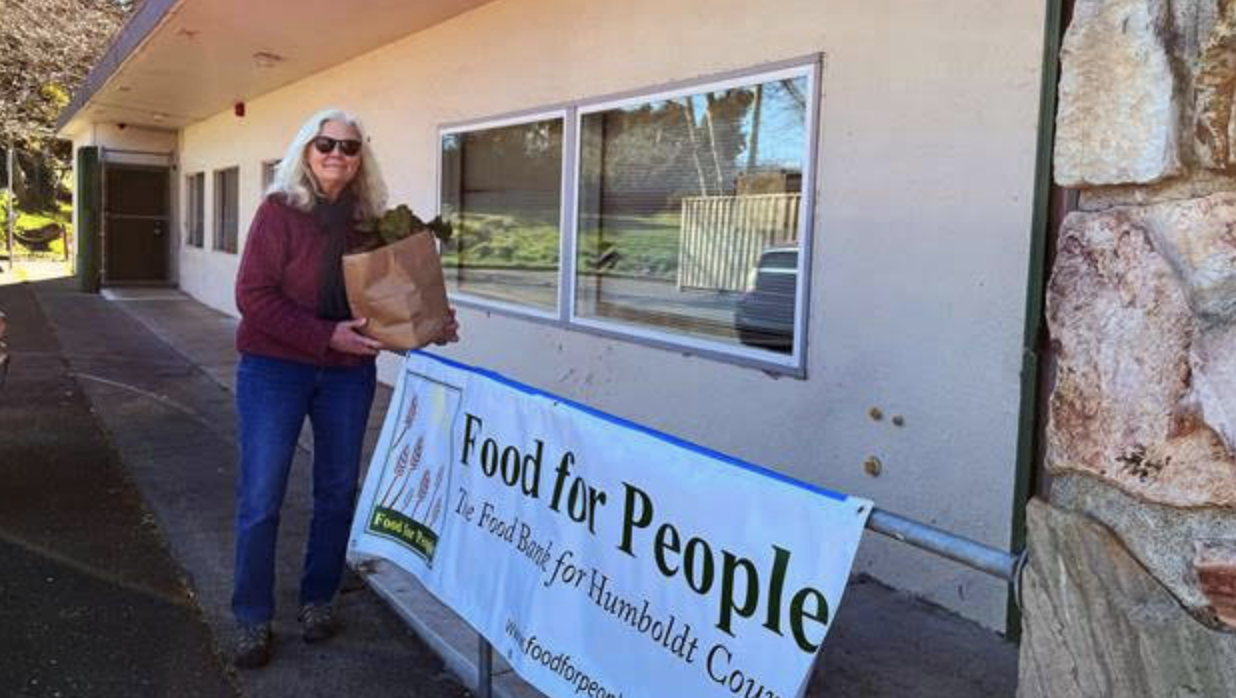
Food for People’s Executive Director Anne Holcomb stands outside of the new Eureka Choice Pantry Location at 1720 10th Street, Eureka.
Food for People release:
Food for People’s Eureka Choice Pantry is relocating to 1720 10th St, located directly adjacent to the
Cooper Gulch Fields and the Eureka skate park. The existing location at 2112 Broadway will close as of
Friday March 25th and no food pantry services will be available that day. The food pantry will reopen in
its new location on Tuesday March 29th . The hours of operation will be Tuesday, Wednesday, and Friday
of each week from 11am to 3pm (closed 12:30-1pm for lunch). In the new location, Food for People will
implement an order-ahead model as a new benefit to pantry users. Please contact pantry staff at
(707)407-0447 for details or to make an appointment. For those traveling by bus, the Eureka Transit
System’s Purple Route stops at the Burre Center located a quarter mile from the new pantry location.
Here there be food… for people!
The relocation of the Eureka Food Pantry has been necessitated by the delay in construction of Food for
People’s main site. Food for People is in the process of rebuilding their facility following the sewer
inundation that occurred in February of 2020. Due to delays in construction caused by the pandemic and
supply shortages, a more stable and long term option is needed to house Food for People’s Eureka food
pantry that serves more than 1,000 community members each month.
After long delays, construction
materials have been secured and construction of the new food bank is slated to begin in the next
month, which should provide the pantry a permanent location by 2023. You can help Food for People
rebuild a facility that will ensure every person experiencing hunger in Humboldt County can access
nutritious foods into the future by making a donation at www.rebuildfoodforpeople.org.
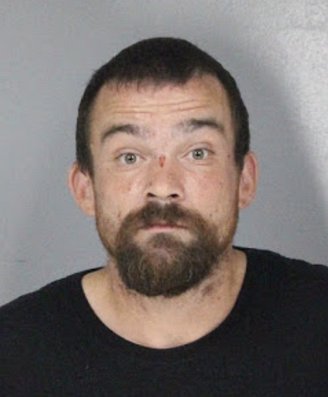
On February 24, 2022 a Humboldt County jury reached verdicts in the David Lee Dues trial. The
jury found 34 year old Dues guilty of felony false imprisonment and indecent exposure and found
him not guilty of assault with intent to commit sexual assault.
Evidence presented at trial showed that on November 1, 2020 at about 10:15 p.m., the defendant
entered the Fortuna Launderland as the lone occupant of the business, an employee in her 50s,
was closing up. The defendant proceeded to lunge for her feet and chased her into a back office.
There the defendant exposed himself and continued his assault until the employee successfully
fought him off. The defendant fled the scene, but Fortuna Police officers located him at the bus
stop near Launderland the following morning. The jury also heard evidence of Dues’ prior conduct,
including a similar assault from 2008 where the defendant threatened to rape another woman and
testimony about voicemails the defendant left for his mother, also threatening to rape her. Both
the Launderland employee and the survivor of the 2008 assault testified at trial.
Deputy District Attorney Carolyn Schaffer prosecuted the case with the assistance of District
Attorney Investigator Ryan Hill and Victim Witness Advocate Caitlyn LaHaie. Deputy Public
Defenders Ben McLaughlin and Kylie Boyd represented Mr. Dues. Judge Christopher G. Wilson
presided over the case.
Mr. Dues is scheduled to be sentenced on March 22, 2022.
Humboldt County Department of Health and Human Services:
Public and Environmental Health officials are working to contain local cases of the gastrointestinal illness Shigella bacteria, after three lab-confirmed cases and two more suspected cases infected Eureka residents during the past month.
The cases span multiple households, infecting school-age children and adults, including a person experiencing homelessness.
Officials believe the virus bacterial infection may have been spread through one or more Eureka laundromats, after an infected person washed contaminated clothing at the facility.
Environmental Health officials are working closely with the operators of the two laundromats, the Self-Serve Laundromat on Summer Street and Eureka Laundromat on Little Fairfield Street, to make sure their facilities are cleaned and disinfected properly.
Shigella germs are found in stool, and infection is spread by eating food or drinking liquids contaminated by an infected person, or when a person touches a contaminated surface or object and then touches their mouth or puts the object into their mouth. People infected with shigellosis typically experience a fever, abdominal cramps and diarrhea which may be bloody.
Onset of shigellosis symptoms usually occurs one to two days after exposure—but may take longer—and lasts around a week. Infected people can remain contagious up to six weeks after symptoms resolve.
Most people with shigellosis recover completely without severe complications. In rare cases Shigella may cause bloodstream infections, seizures, kidney failure or arthritis.
The best way to prevent the spread of shigellosis is to wash hands:
Before, during and after preparing food
Before eating
Before and after caring for someone who is sick
After using the toilet
After blowing your nose, coughing or sneezing
After touching garbage
After changing diapers or cleaning up a child who has used the toilet
After touching an animal, animal feed or animal waste
After handling pet food or pet treats.
People with shigellosis should:
Stay home from school or from health care, food service or childcare jobs while sick
Abstain from sharing food
Abstain from swimming and hot tubs
Abstain from having sex for at least two weeks after symptoms resolve.
If you are experiencing symptoms, contact your primary care provider or call Public Health at 707-445-6200.
Young people masked | Photo: Xingyue Huang, Unsplash
Anthony Pritchett, a senior at Nevada Union High, sat nervously at a school board meeting on Tuesday night as angry crowds yelled at each other over a vote to violate state law and lift the mask mandate for its students.
“There was just a lot of yelling,” he said. “It was very hostile. When the resolution was passed at the end, there was a roar of applause and yelling that lasted for at least a minute.”
As debates over mask and vaccine mandates heat up, the polarization is extending into student life in California. Students on both sides are being harassed for their beliefs, while education officials caught in the crossfire have to reconcile how to enforce COVID-19 protocols and provide an education to all students. Meanwhile, a Feb. 28 update from state officials about school masking policy looms.
“Friend groups have fractured over this,” said 18-year-old Pritchett, who serves as a student member on the board at Nevada Joint Union High School District, about 60 miles northeast of Sacramento.
“There’s a lot of tension on campus,” he said. “There are frequent protests and walkouts mainly in opposition to vaccines and masks.”
On Thursday, the 2,600-student district shut down schools because so many teachers called in sick in response to the vote. Making masks optional violated an agreement between the district and the teachers union, which states that any changes to safety protocols must be negotiated.
“The overwhelming message is that teachers don’t feel supported,” said teachers’ union president Eric Mayer. “They’re given an impossible decision to defy the board or defy state law.”
Nevada Joint Union High School District isn’t the first in California to make masking indoors at school optional. Leaders at severalotherdistricts made the decision in recent weeks in response to growing anger from parents and community members, especially as the state lifted other mask mandates for vaccinated individuals.
Research has been clear that face coverings reduce the risk of spread and vaccines reduce transmission and help prevent serious illness. And, according to a new poll, most California voters support mask and vaccine mandates for schools.
Students and educators say their school communities are already beyond the breaking point.
“The state said we’re going to keep masks on in schools, but we have no effective mechanisms to enforce it,” said Brett McFadden, superintendent of Nevada Joint Union High, before Tuesday’s vote. “If we have any disruption right now, we can’t call the police. We have no one to call.”
Students enter the fray
One day a week, 16-year-old Kinsey Hage refuses to wear a mask to school. She calls it “Freedom Fridays.” Hage, a junior at Bella Vista High School in the San Juan Unified School District near Sacramento, started the protest alone in January. Now, over 100 of her peers participate.
“It’s really frustrating to know that celebrities and adults can go to the Super Bowl unmasked,” she said. “I honestly think it’s so ridiculous and unfair.”
While some friends and teachers support her, Hage said her beliefs and activism has ended friendships and hurt relationships with other teachers.
“All these friends I’ve known since middle school won’t acknowledge me any more,” she said. “I started eating with some new friends.”
Then there’s the more unpleasant encounters both at school and on social media.
“I’ve had kids at school literally tell me to kill myself,” she said. “They’ll say ‘wear your mask,’ or they’ll just cuss me out.”
Jaxson Barrett, a 17-year-old at Carlsbad High School near San Diego, says he’s been denied entry into his classroom for two weeks for refusing to wear a mask.
“I was just tired of wearing them,” he said. “I wanted to see what happened. I went into class, and I got kicked out immediately.”
He said he’s been sitting outside for the entire school day trying to keep up with his assignments, despite the cold and rainy weather. About 10 students eventually joined him.
Students and supporters protest school mask mandates in front of Bella Vista High School in Fair Oaks on Feb. 18, 2022. Photo courtesy of Kinsey Hage
Other students across California have been calling for stricter enforcement of masking and more access to vaccinations and high-quality masks.
Michael Lee-Chang, a senior at Redondo Union High School in Los Angeles County, has been vocal on social media about maintaining safety protocols on campuses. He joined hundreds of students in a January walkout to urge school leaders to reinforce masking and physical distancing in classrooms.
Lee-Chang’s activism has led others to bully him, he says. The 18-year-old has become a target of harassment from conservative parents on social media. Students have dropped cartons of milk on his head, he said, adding that he now walks a different path to his classes to avoid certain groups of students.
“Every time I pass them, they yell, ‘unmask the kids!’” he said. “In a perfect world, everyone would be vaccinated, and we would be testing on a daily basis, but we don’t live in that world.”
Educators have their hands tied
Teachers and school district officials are trapped in a bind between public health and education laws.
If a student refuses to wear a mask, teachers have to remove that student from the classroom or risk losing their credentials for violating state law. But at the same time, school districts are required to provide instruction to all students.
And while at-home, independent study is an option for these students, parents must opt in. When parents refuse, state education laws require that the student be placed in a classroom. Education officials like Gayle Garbolino-Mojica, superintendent at the Placer County Office of Education, feel there’s no way out of this loop.
“We’re caught in a Catch-22,” Garbolino-Mojica said. “In reality, nobody wants to physically remove children.”
Ultimately, some teachers are keeping students outside, while others are just letting them into class. Apart from the legal and logistical challenges, the damage to relationships between educators and their students might be irreparable. Educators statewide worry about whether public education can recover.
“I will say that the fabric of our schools are deteriorating minute by minute,” Garbolino-Mojica said. “I’m personally worried and concerned about what our communities will look like once this is over.”
Parents across the state are sharing online instructions about how students can defy masking rules. Let Them Breathe, an anti-mask mandate advocacy group, posted some of these resources on its website. Younger students are memorizing scripts at Saugus Union School District, a K-6 district in Los Angeles County, according to Superintendent Colleen Hawkins.
“Today, across the district there’s probably about 85 students who refused to wear masks,” Hawkins said on Tuesday. “They say, ‘it’s my First Amendment right.’”
Because her district serves mostly younger children, Hawkins said teachers and administrators are careful not to scold or punish these students.
“We just can’t have them in the room with their peers,” she said.
Hawkins and several other district leaders across California say they’ve written to the governor and other lawmakers to ask that they lift the indoor mask mandate for schools and to keep a personal belief exemption for the COVID-19 vaccination requirement.
Two years into the pandemic, local education officials are more willing to risk sacrificing safety protocols to maintain order in their communities.
“I’m worried about the frustration that everybody’s feeling, and what that will mean for public education,” said Hawkins. “I don’t know how communities will continue to trust their local school districts.”
Local leaders defying the state
A handful of school districts haven’t waited for state officials to loosen regulations.
“For me, it started with the governor’s press conference, when he said that he’s going to lift the mandate for everyone, except for school children and teachers,” said Jee Manghani, board president at Rancho Santa Fe School District in San Diego County.
His school board voted Monday to make masks optional for students. Manghani and other district leaders said the benefits outweigh the risks.
“I already felt confident that even if the state didn’t agree, we were making the right decision,” said board vice president Annette Ross.
At Nevada Joint Union High School, it remains unclear when teachers will start returning to school. Teachers union president Mayer said the teacher absences are not an organized effort.
For some board members, giving into the anti-mask crowd not only breaks state law but also sets a precedent for the looming vaccine mandate. The California Department of Public Health will require students to be vaccinated once the FDA fully approves the vaccine for their age groups. Students may need to be immunized by as early as July 1.
Jamie Reeves, a board member at Nevada Joint Union, voted to keep the masking requirement to honor the district’s agreement with its teachers. She said it’s an unfortunate precedent to set, but she concedes that trying to enforce statewide COVID-19 mandates is taking too much time and energy away from educators.
“I left that meeting feeling heartbroken,” she said. “But how much time do we spend dealing with this, and how much time do we spend getting kids educated?”
Pritchett, who’s had more than half of his high school career disrupted by the pandemic, said that compromising safety might be the only way to have peace.
“I do wish this culture war could have been fought somewhere else,” he said. “It’s a huge distraction to education.”
###
CALmatters.org is a nonprofit, nonpartisan media venture explaining California policies and politics.
George Dowell, 40, receives the COVID-19 vaccine at Umoja Health pop-up clinic in Oakland last week. He waited a year to watch for any side-effects or problems in his vaccinated friends. Photo by Marissa Leshnov for CalMatters
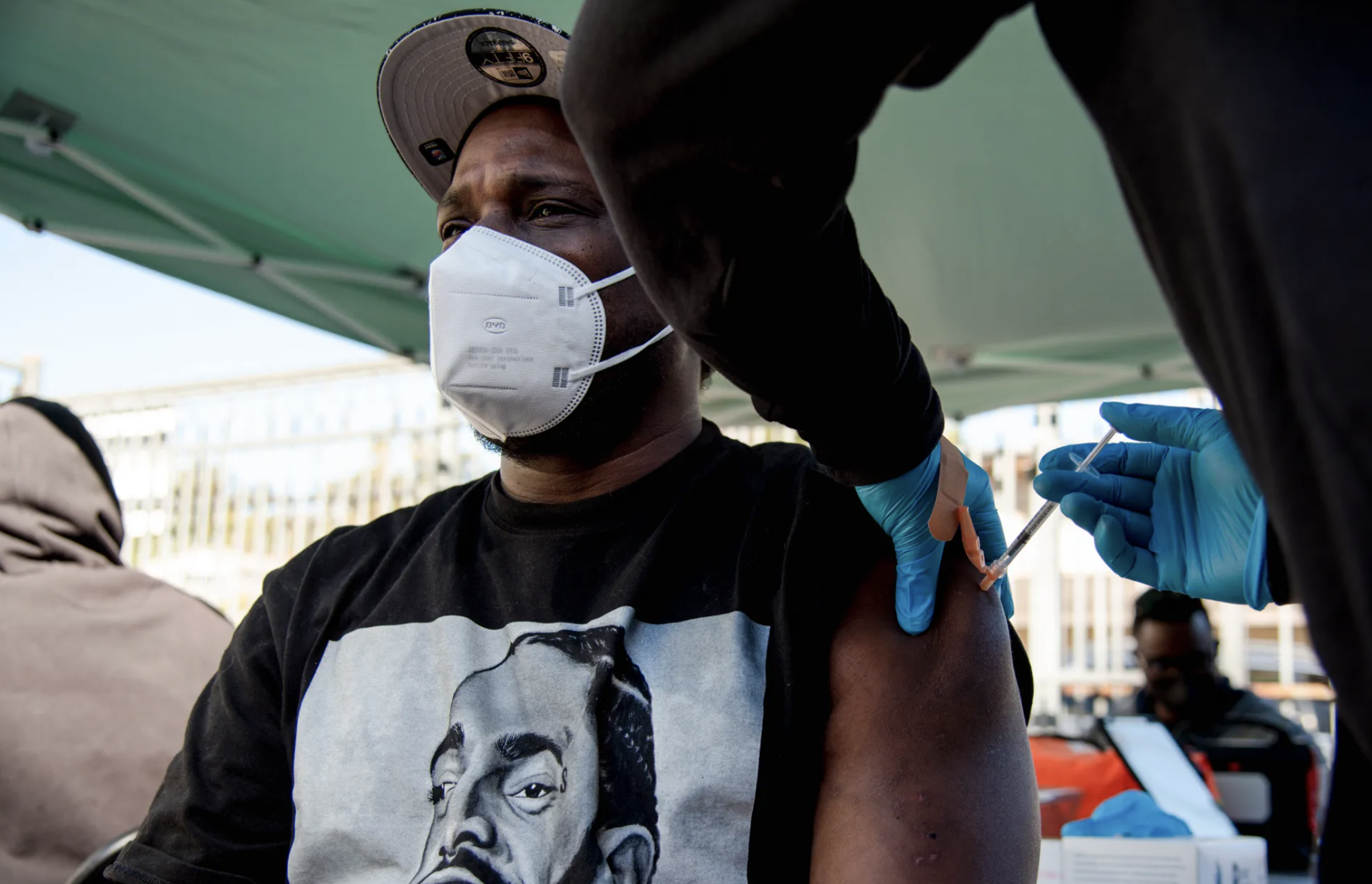
Deondray Moore sat in a plastic folding chair, rolled up his sleeve and got his first COVID-19 shot in the parking lot of Center of Hope Community Church in Oakland a week ago. He was the last in his family to get vaccinated after putting it off for more than a year, and only acquiesced because he wants to be in the delivery room when his son is born this summer.
“My mom has been trying to get me vaccinated forever, since the (vaccines) came out,” Moore said. “My partner got it quick, and her kids got it as fast as they could. She wasn’t playing around. She was like ‘Don’t miss out on the baby.’”
The 35-year-old Oakland native, an African American, knows multiple people who have contracted COVID-19 and died. Moore wears a mask and doesn’t go out much. But he’s suspicious of the vaccine and the way it was developed. “I just don’t trust the government,” he said.
African Americans, who have a litany of historical reasons to mistrust public health officials and doctors, have the lowest vaccination rate in the state, at 55%.
COVID-19 has become deadlier for Black Californians since the widespread availability of vaccinations, and vaccine hesitancy could be among the reasons why. Other races, which have higher vaccination rates, have seen death rates rise, but not as dramatically.
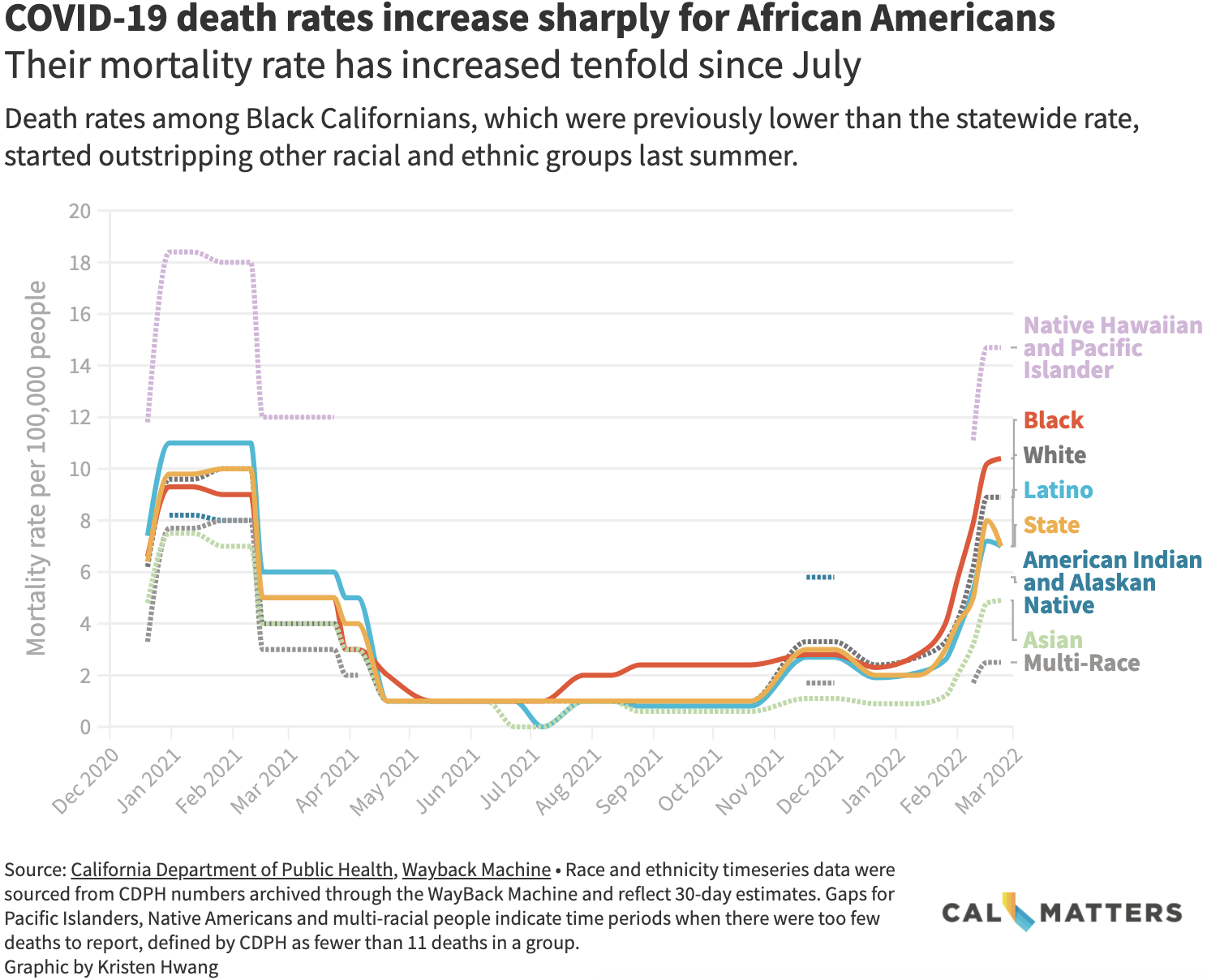
A CalMatters analysis shows since last summer, the rate of Black Californians dying from COVID-19 has increased tenfold — from one death per 100,000 people last July to 10.4 deaths this week. That surpasses Latinos and all races except Pacific Islanders, who are dying at the rate of 14.7 per 100,000, according to state data.
And while statewide deaths from COVID have declined in the past week, they have continued to rise for African Americans.
So far, 5,544 Black people have died from the virus in California.
Click to enlarge
Dr. Kim Rhoads, an associate professor of epidemiology at University of California, San Francisco, said she isn’t surprised by the growing death rate among African Americans. “Disparities aren’t new. They aren’t new to COVID,” said Rhoads, who helped organize the community clinic where Moore got his shot.
For some Black residents, the disparity grew worse after vaccines became widely available last summer, according to a study from UC Santa Cruz and UC San Francisco researchers.
Middle-aged Blacks make up a growing, disproportionate share of the Californians who died, while the proportion shrank for Latinos and others: In March 2021, Black people aged 40-64, who make up roughly 5% of all middle-aged Californians, accounted for 6% of COVID-19 deaths in that age group. But a few months later, their numbers skyrocketed, accounting for 21% by last July, according to the study.
In contrast, middle-aged Latinos accounted for 66% of all COVID-19 deaths at the beginning of March 2021, but then last July shrank to 30%, mirroring their proportion of all middle-aged Californians.
Lead researcher Alicia Riley said preliminary data through November shows continuing disparities.
So why did the vaccines apparently help Latinos but not Black Californians? It’s possible that those who are most at risk of dying from the disease aren’t getting vaccinated. Younger African Americans also may not have been included in early vaccination campaigns or may have felt they weren’t at risk of severe illness or death.
“What’s puzzling to me is that they have a really different story in terms of who’s dying,” said Riley, a UCSC assistant professor of global and community health. “Are the people who were at risk of dying in the Latino community actually being reached with vaccination, whereas somehow that’s not happening for Black Californians as effectively?”
Experts say myriad other factors could also be driving the trend, including poverty, lack of insurance, distrust of the health care system and higher rates of health complications like diabetes or heart disease.
The increased share of deaths for Black Californians is a powerful sign of “who was left behind when everyone else was kind of moving on out of the pandemic,” Riley said.
The study did not find significant differences for other age groups, although state data suggests Black children fare worse than other races, too.
Black children in California are the second most likely to die from the virus among Californians younger than 18, with 1.2 deaths per 100,000 Black children. Pacific Islanders are twice as likely to die from COVID as Black children, while all other races have less than one COVID-19 death per 100,000 children.
The drivers for African American deaths are likely deeper than vaccination disparities.
Dr. Kim Rhoads has helped set up the Umoja Health pop-up clinic in Oakland to vaccinate Black residents. Photo by Marissa Leshnov for CalMatters
Rhoads, who studies death disparities in Black cancer patients, said pre-existing health complications also aren’t entirely to blame. Structural factors like poor quality health care also likely contribute to higher death rates, she said. For instance, medical devices like the pulse oximeter, which is used to determine whether a patient needs supplemental oxygen, don’t work well on dark skin.
“If we just say comorbidities, then we’re blaming the victim number one and we’re washing our hands of any responsibility,” Rhoads said.
Vaccine campaigns successful for some
Substantial gains have been made among Latinos, according to Riley’s study. After bearing the brunt in the early stages, Latinos’ death rate dropped from nearly 25 deaths per 100,000 people in January 2021 to 1 death per 100,000 in July. Over the last month, the California Department of Public Health estimates 7.2 Latinos died of COVID per 100,000 people, lower than the statewide rate of 8 per 100,000.
Around June 2021 the percentage of fully vaccinated Latinos outstripped Blacks and Native Americans, leaving Blacks in last place. Only 57% of Latinos are fully vaccinated, but some hard hit agricultural areas like Imperial County were quick to accept the vaccine — and it has made a difference.
Eduardo Garcia, senior policy manager for the Latino Community Foundation, said high death rates among Latinos early in the pandemic galvanized local groups and clinics to dole out vaccines and combat misinformation.
“Over 34,000 California Latinos have died since the beginning of the pandemic,” Garcia said. “It touched people close to home. I think that also created an impulse for people to get information from reliable sources and get the vaccine.”
COVID-19 “touched people close to home. I think that also created an impulse for people to get information from reliable sources and get the vaccine.”
Eduardo Garcia, Latino Community Foundation
Rhoads said refocusing COVID-19 vaccination messaging on preventing deaths rather than infections is important for equity, particularly since getting her community to trust the vaccine has been harder.
“It’s about a historical relationship between Black people and public health and health care,” Rhoads said. “Instead of saying lack of trust, I’m saying there’s no relationship there, so there should be no expectation of trust.”
That trust was further shaken last spring when the Food and Drug Administration warned of rare but severe side effects associated with the Johnson and Johnson vaccine. Rhoads said the number of people seeking vaccinations at her clinic dropped precipitously.
To help bridge the gap, Rhoads founded Umoja Health, a collective of community and faith-based organizations in the Bay Area, to make COVID-19 testing and vaccination easy and accessible for African Americans. They bring pop-up clinic supplies to churches, schools and neighborhoods where they know vaccination rates are low. It takes patience and continued effort, Rhoads said.
With mask restrictions loosening, the Umoja Health clinic in Oakland has seen less demand for vaccines and COVID-19 testing. Photo by Marissa Leshnov for CalMatters
At Castlemont High School in Oakland, where the clinic frequently sets up shop, it was several weeks before many Black students trusted them enough to get the vaccine.
“The Latino students came immediately,” she said. “But as we’ve been there over time, we’re starting to see more and more of the African American students come through, and then we started to see people bringing their parents.”
‘Back to normal’ threatens Blacks and Pacific Islanders
Gov. Gavin Newsom’s recent announcement that California would be moving into a new phase of the pandemic worries advocates and community health organizers like Rhoads.
The new state action plan acknowledges continuing disparities when it comes to COVID-19 deaths and highlights money in Newsom’s budget that includes $819 million to expand Medi-Cal to undocumented individuals next year, $1.7 billion to invest in a more diverse health care workforce over five years and $65 million to fund the creation of an office of community partnerships and strategic communication.
But the plan offers little in terms of immediate action to fix disparities, and includes no specific programs to help Black communities.
The state health department on Thursday announced new $27 million contracts would be awarded to more than 100 community-based health organizations to shore up vaccination efforts in underserved communities, including African American ones.
However, community advocates worry that rhetoric used by Newsom like “turning the page” on the pandemic will ultimately prevent groups that have never caught up from moving forward.
Throughout the pandemic, Pacific Islanders have been hit the hardest by COVID-19. Their mortality rate is nearly twice that of the statewide rate and nearly six times higher than the lowest rate of 2.5 deaths per 100,000 people among those who identify as multi-racial.
While data suggests that Pacific Islanders are nearly 100% vaccinated, Thomas said there is reason to believe that the state’s numbers are inaccurate. At times that number has creeped above 100%. From a personal experience, Thomas said she is one of only two people in her 50-person Samoan church in San Bernardino that she knows is vaccinated. It’s not uncommon for there to be more than two funerals a month in her community.
“I’m really concerned that we’re not taking an equitable approach to mitigate the pandemic among (Native Hawaiian and Pacific Islander) communities and other communities of color,” Thomas said. She criticized the lifting of the state’s mask mandate on Feb. 15 and the governor’s endemic plan.
Rhoads echoed Thomas’ sentiments.
The pandemic “is not over. It’s not for people who aren’t vaccinated, who don’t have regular health care,” she said.
Last week Rhoads and more than 35 organizations sent a letter to the state health department in part criticizing the state’s inconsistent and confusing messaging on masking. The health department’s initial criteria for lifting the indoor mask mandate included vaccination and infection rates that were unmet when the mandate expired.
Rhoads said instances like this erode public trust in government and scientific organizations, particularly among groups that placed little faith in the institutions to begin with.
In response, the department agreed to schedule a meeting between Rhoads and State Public Health Officer Dr. Tomas Aragon.
In a separate response to CalMatters, the state health department said vaccine equity was the “north star” of its efforts to reach marginalized communities, and that it would continue to partner with community organizations, ethnic media, translators and faith-based groups.
“This work is ongoing, and closing the equity gap across all California communities remains a priority to the state’s vaccination efforts,” the department said in a statement.
‘Nothing to be afraid of’
In Oakland at the Umoja clinic last week, George Dowell, a 40-year-old African American, said he was getting his second vaccination dose because he didn’t “want to be left behind” as more and more businesses require proof of vaccination for entry.
Dowell is among the age group experiencing higher death rates in Riley’s study. He spent the past year watching vaccinated friends and family carefully for side effects before deciding to get the shot himself.
Deondray Moore, 35, receives the COVID-19 vaccine at Umoja Health pop-up clinic in Oakland. Moore said he decided to get vaccinated so that he could join his partner in the delivery room when their first child is born in June. He takes the virus seriously — “it’s serious man. People do need to take precautions” — but he waited to be vaccinated because he was skeptical about the safety of the vaccines. Photo by Marissa Leshnov for CalMatters
Social media and misinformation played a role in Dowell’s hesitation. “I was listening to certain people, social media, instead of listening to myself and doing what’s right,” Dowell said.
Three weeks ago, he decided it was time. He found the Umoja clinic while driving around the neighborhood and got his first Pfizer shot. Dowell wanted to show his school-aged nieces and nephews that “there was nothing to be afraid of” as they became eligible for the vaccine.
Dowell’s 27-year-old son is also unvaccinated, and Dowell said he promised he would call to let him know how he feels after this second shot.
###
CALmatters.org is a nonprofit, nonpartisan media venture explaining California policies and politics.
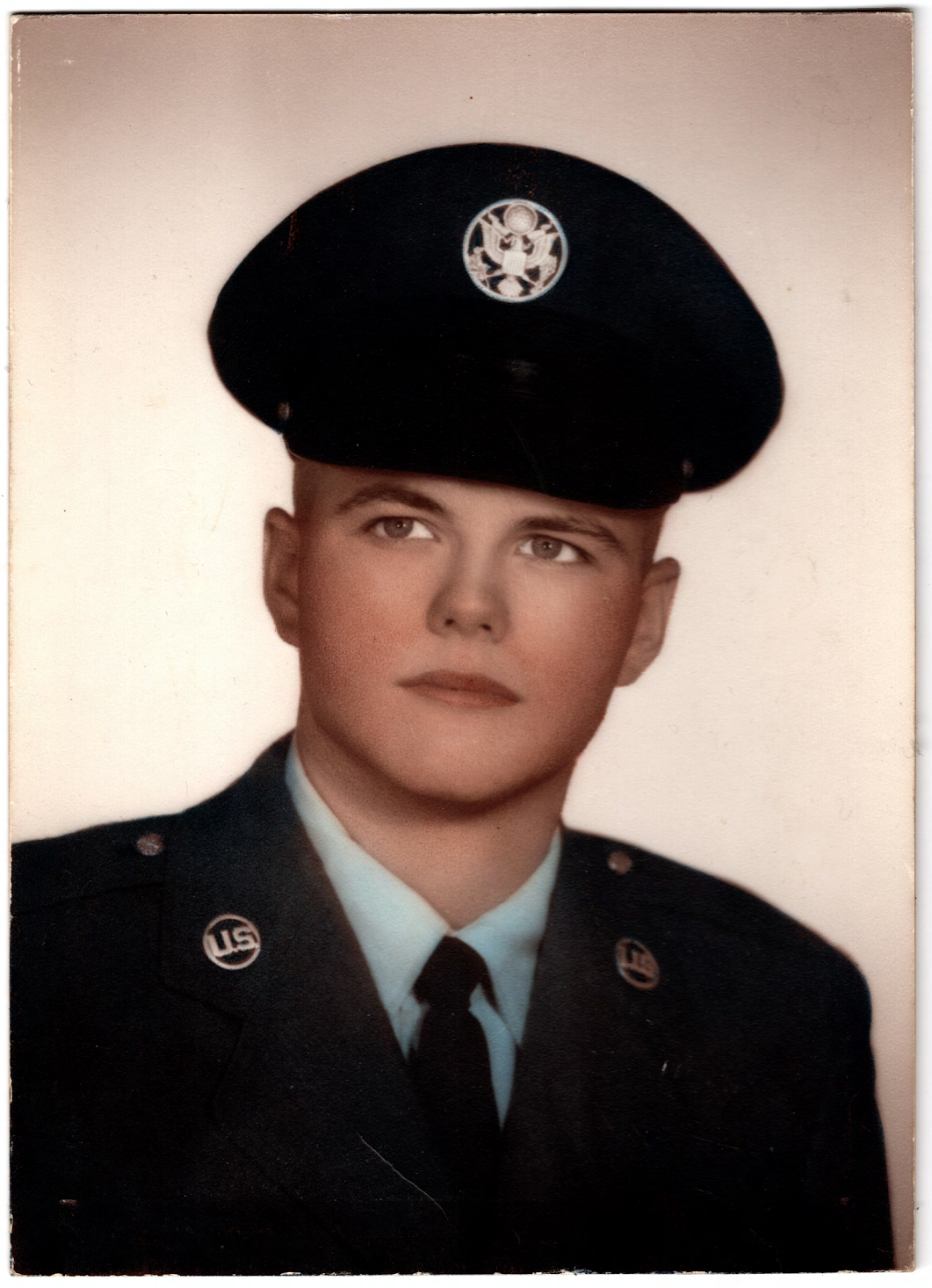
Tom Gerald Evans was born in the Methodist Hospital in Los Angeles on March 19, 1940 to
Murrell and Lilyan Evans. He died on Jan. 2, 2022
Tom was born adventurous. When he was 10 years old, he was written in the
Reseda newspaper on August 10, 1950…“He found a rifle shell in a motion picture
lot nearby…He took the shell home and attempted to hammer it into his toy gun…it
exploded. He was treated for powder burns.” His mom told me that she heard the
explosion, her knees went out from under her, so she kept on, crawling to the
back door. Tom was coming in, saw her and asked “Why are you crawling on the
floor?”
Tom was a member of the Sea Explorers in 1955, along with two of his good
friends, Kim Pepperell and Jon Tribur. He graduated from Reseda High School on
January 30, 1958. After graduation, he worked at Rocketdyne with another two of
his good friends, Wayne Woodhall and Alvin Farless.
Tom’s dad was a firefighter in the Los Angeles City Fire Department. His dad
loved the fire service and it inspired Tom to apply. On June 18, 1961, Tom
graduated from an eight-week intensive training at the Los Angeles City Fire
Department Drill Tower in North Hollywood and received his appointment as a
fireman. He became an Inspector three years later, working from Headquarters in
Los Angeles.
Tom was in the Air Force Reserve during the same period of time, working as
an airplane mechanic. He was also an expert car mechanic; he could fix anything
with an engine.
After marrying in September 4, 1965, having three children and having moved
seven times in 10 years to different cities in Southern California – from Canoga
Park to Sylmar to Pasadena where we lived in 2 different rental homes before
buying one in Altadena. Tom worked for the Pasadena Fire Department as an
Inspector. Then he applied for a job with the State Fire Marshals office as a
Deputy State Fire Marshal. We moved to Hemet for a year, then Livermore for six
months, then bought a house on an acre in Brentwood.
Tom liked to do everything himself in all the places we lived. In Brentwood, he
fenced and cross-fenced our one-acre farm. He milked the cow, rode our angus
bull and horse, fed the animals (goats, sheep, chickens, turkeys), planted and
picked the vegetables from our garden, kept the acre, house and animals in top
condition all the while he was a full-time fire inspector.
In 1985, we bought a house in Eureka, where we settled permanently. Tom
tore up the carpet, installed wood flooring, took out windows and glass doors to
put in double-pane, painted the house-inside and out, fenced the yard and outdoor
deck, and built a tree-house. He put in an electric garage door opener; got a
concrete mixer to put a concrete floor outside to house an outdoor generator
which he installed. The kids gave him a shed from Costco; he made a concrete
floor and put the shed together. Whatever needed doing, he would do. The only
thing he didn’t do but wanted to - was put a new roof on the house - overruled on
that dangerous venture!
He was amazingly adept and a perfectionist at everything he did. If he had not
done a particular task before, he would read up on how to do it, and did it! He
continually amazed all of us at the knowledge he had.
Tom was a well-rounded individual; he was a hiker, a runner, water skiier, cave
explorer, mountain/rock climber, 4-wheeler enthusiast, motorcyclist. He liked zip-
lining, camping, and enjoyed driving to vacations in California, Oregon, Nevada,
Arizona, New Mexico, Washington State, Kentucky… He was a family man,
enjoyed life and made it fun and exciting for us all.
Family comments below:
My dad was the strong silent type but we always knew he loved us. There
wasn’t a thing he couldn’t do, not a car he couldn’t fix, a house he couldn’t repair,
a deck he couldn’t build, a person he wouldn’t love. He was a wonderful example
of a loving and loyal husband, a doting and caring father, a fun and adventurous
friend. We are thankful for him having lived a long and full life and for him fighting
so hard to continue to be with his family in this physical life. Dad was one of a
kind.
Dad passed away from end-stage congestive heart failure. We mourn the loss
of such an outstanding husband, father, grandfather, uncle and friend. Such a
great legacy he left. He was always one of the first people to be there for those
around him in need. Over the 57 years of my parent’s marriage, their house was
always full because it was a welcoming & loving place of refuge for many in need -
from family members & friends, to foster children. He was a man of faith and truly
lived his faith actively which made such a positive impact on so many lives. I was
blessed to have had the honor of being his ‘Lightning’. (He used to call me & my
sister, “Lightning & Thunder”.)
Tom was a saint: loving, forgiving, patient, kind, generous, helpful to all who
asked. He was the best husband a woman could ever dream of, or ask for; the
best example of a Christian to his children & grandchildren & all who knew him.
When he made friends, they were friends forever. He was the love of my life –
Almighty God brought us together and kept us together. I will forever be thankful
for having had Tom in my life, for his peaceful death and that our family was
together when his spirit went back to the God who gave it (Eccl 12:7).
There will be a Celebration of Life at the Wharfinger, 1 Marina Way, Eureka on Sunday March 20 at
11 a.m. to 2 p.m.
###
The obituary above was submitted on behalf of Tom’s loved ones. The Lost Coast Outpost runs obituaries of Humboldt County residents at no charge. See guidelines here.








 Students and supporters protest school mask mandates in front of Bella Vista High School in Fair Oaks on Feb. 18, 2022. Photo courtesy of Kinsey Hage
 Dr. Kim Rhoads has helped set up the Umoja Health pop-up clinic in Oakland to vaccinate Black residents. Photo by Marissa Leshnov for CalMatters
 With mask restrictions loosening, the Umoja Health clinic in Oakland has seen less demand for vaccines and COVID-19 testing. Photo by Marissa Leshnov for CalMatters
 Deondray Moore, 35, receives the COVID-19 vaccine at Umoja Health pop-up clinic in Oakland. Moore said he decided to get vaccinated so that he could join his partner in the delivery room when their first child is born in June. He takes the virus seriously — “it’s serious man. People do need to take precautions” — but he waited to be vaccinated because he was skeptical about the safety of the vaccines. Photo by Marissa Leshnov for CalMatters