

TODAY in SUPES: Board Talks Drought, Weed Irrigation Curtailment; Madrone Confronts a Geologist
Ryan Burns / Tuesday, Feb. 15, 2022 @ 5:12 p.m. / Local Government
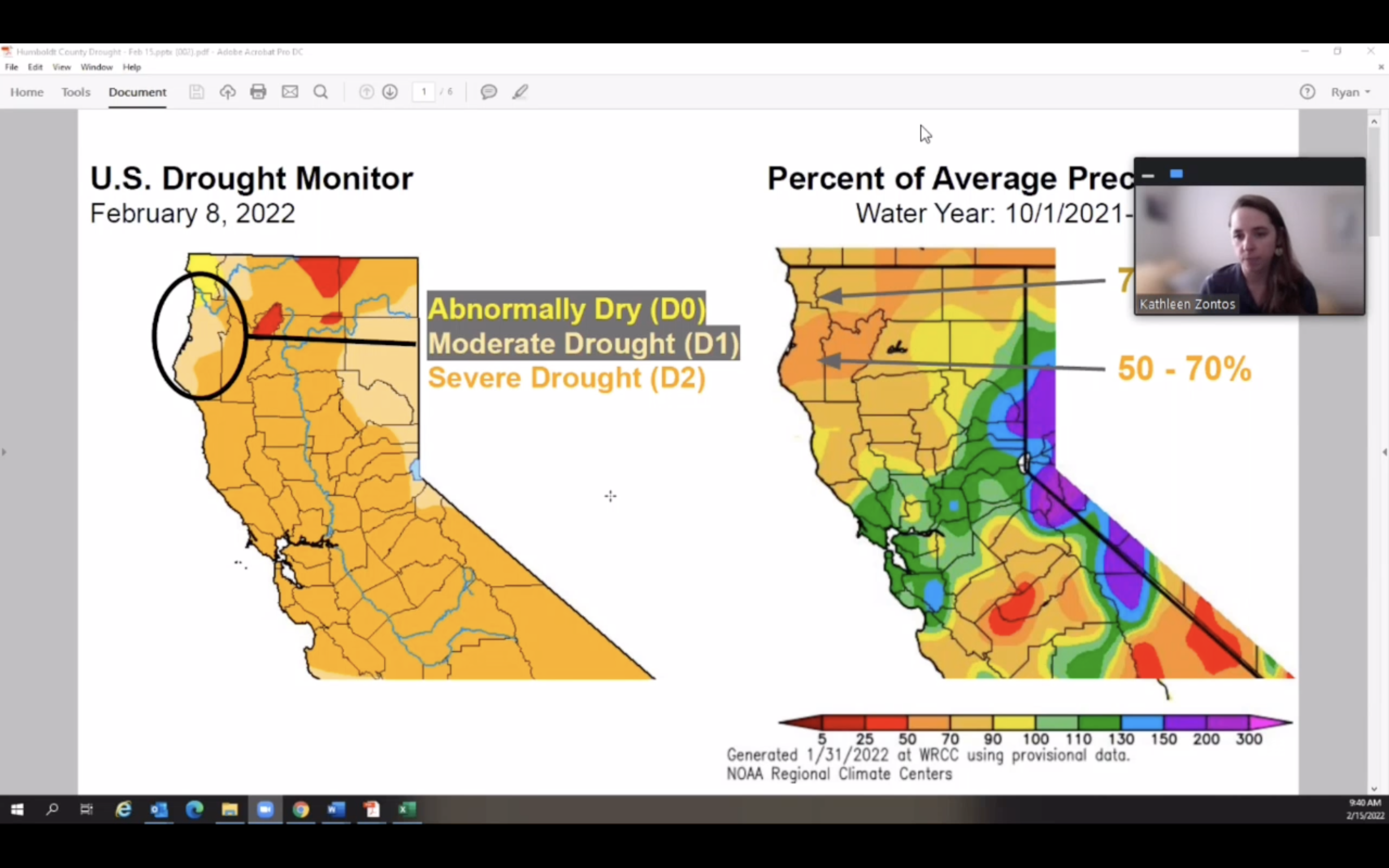
Kathleen Zontos, a hydrologist with the National Weather Service’s Eureka office, delivers a presentation on current drought conditions at Tuesday’s meeting of the Humboldt County Board of Supervisors. | Screenshot.
###
Humboldt County hasn’t seen any significant rainfall since early January, and according to Kathleen Zontos, a National Weather Service hydrologist who addressed the ongoing drought at Tuesday’s Board of Supervisors meeting, if the next two and a half months remain dry, Northern California may wind up having the driest three-year period on record.
“So we’re kind of coming into the 11th hour as far as reaching where we want to be,” Zontos told the board.
The board voted to continue the ongoing state of local emergency at Tuesday’s meeting, following the advice of staff with the Office of Emergency Services and the Humboldt County Drought Task Force.
Yana Valachovic, a forest scientist with the University of California Cooperative Extension, said animal agriculture operations across the western United States are seeing high demand and limited supply of hay, alfalfa and other products. Many local and regional producers have reduced the size of their herds due to such drought-related challenges, she said, noting that last year’s relatively cold spring also slowed grass growth.
As you can see from the chart below, Eureka experienced a strong start to the water year, which runs from October 1 to the end of September, but precipitation flatlined shortly after the New Year.
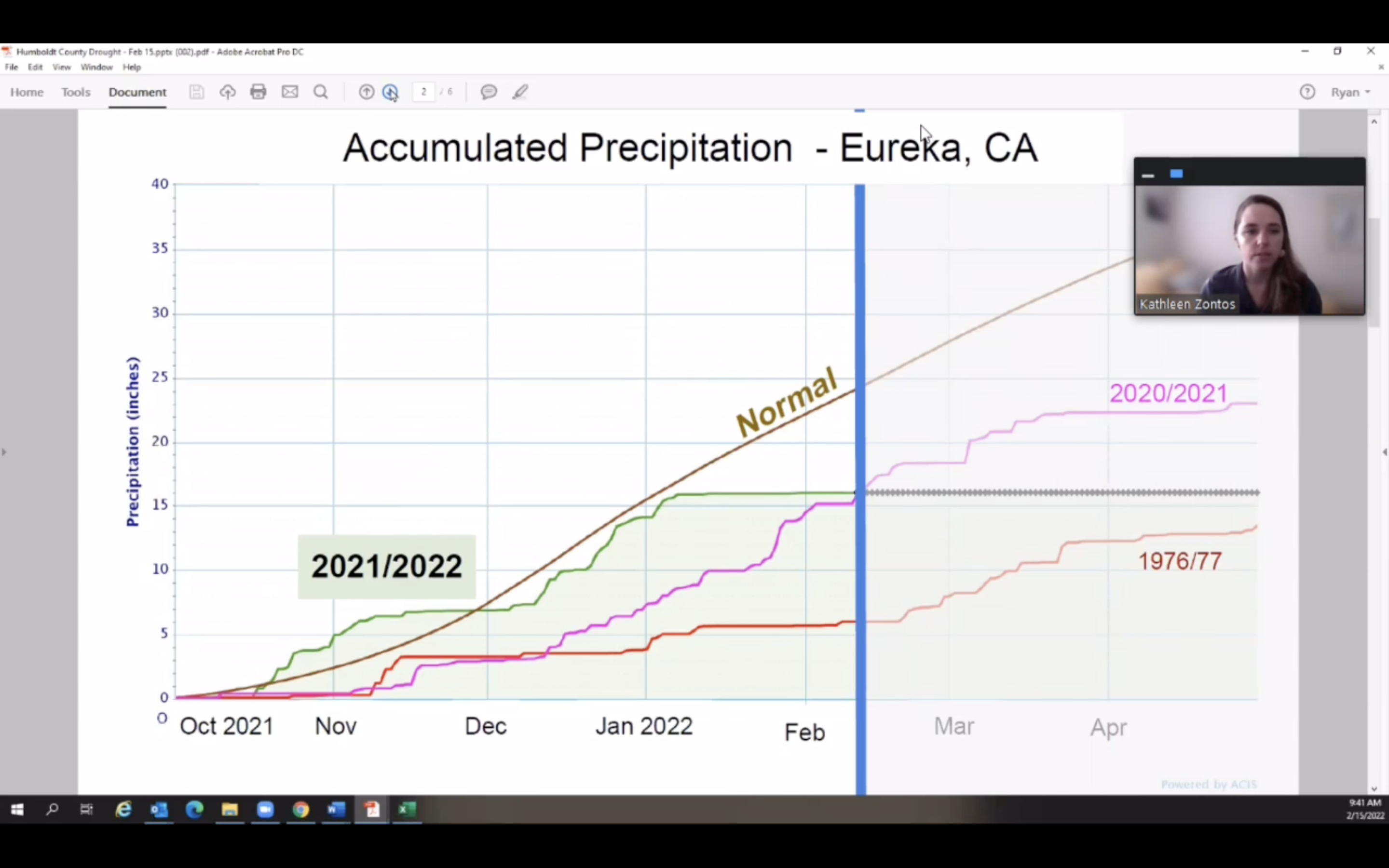
The green line represents the current water year, with pink showing last year’s rainfall and red showing the driest year on record. | Screenshot.
###
Much of the meeting’s drought discussion wound up focusing on cannabis. Staff asked the board to decide whether irrigation water for permitted weed grows, including the permitting of wells, should be curtailed. The board also considered creating a new position of resiliency coordinator for the Drought Task Force.
Planning and Building Director John Ford said staff wasn’t recommending curtailment action just yet, in part because the outlook for summer will grow clearer in the coming months. Staff in his department has been working with consultants to analyze the cumulative impacts of permitted wells on surface water, though at the moment permit applications are still being considered on a case-by-case basis in consultation with hydrogeologists.
Second District Supervisor Michelle Bushnell noted that there’s talk in the community about wells running dry but little in the way of confirmation.
“When we’re processing applications, nobody really wants to admit that a well has run dry,” Ford said.
Third District Supervisor Mike Wilson later noted that local residents are reporting dry wells to their well drillers, if not to county permitting authorities.
During the public comment period, a number of cannabis folks argued that the industry is being unfairly singled out, and they urged the board not to enact any irrigation curtailment measures.
“Cannabis water use is more regulated, measured and tracked than any other agricultural industry and uses significantly less water than any other industry,” said Natalynne DeLapp, executive director of the Humboldt County Growers Alliance (HCGA), a cannabis industry group. Her organization supports increased water storage capacity but is waiting for the state to release funds for that endeavor, she said.
Ross Gordon, the HCGA’s policy director, said the state needs to allow for fallowing of cannabis farms during dry years, letting cultivators cut back on their production without permanently forfeiting their license. He urged the board to advocate for that at the state level.
After the public spoke, Ford said the focused discussion on cannabis operations was not so much about singling the industry out for extra scrutiny; rather, it’s about clearly communicating regulatory issues.
“We are in a place where we need to know, what is the effect of wells? Are they hydrologically connected to surface water,” Ford said. “There’s been a lot of struggle with questions as to whether adequate investigation has been done. Really, it’s a prudent approach to make sure we’re not approving things without adequate information.”
As for the proposed resiliency coordinator position, Mario Kalson, supervising environmental health specialist with the county, said staff and the board need to consider both the scope of the role and potential sources of funding. Locating the job within the Office of Emergency Services could open up emergency mitigation funding and grant opportunities, Kalson explained. Staff plans to bring the matter forward for more discussion next month.
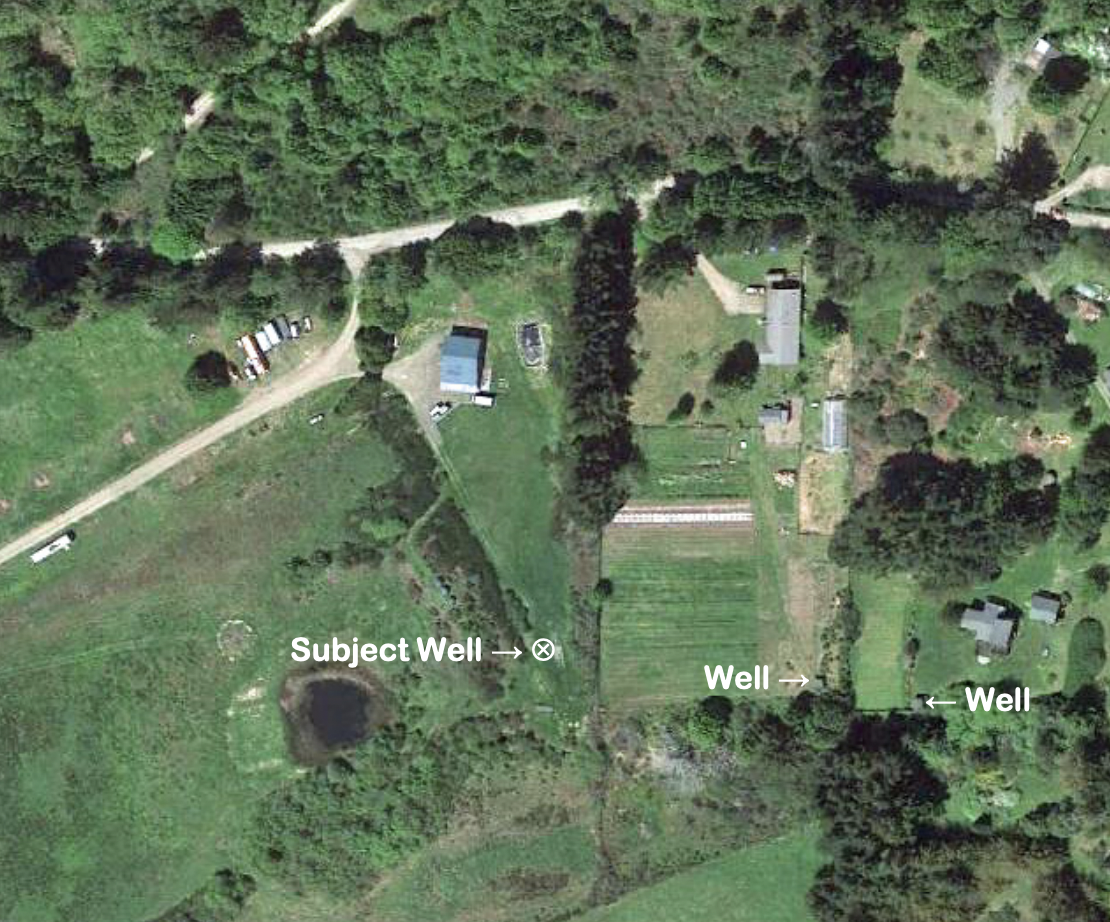
Modified Google Earth imagery of property near Petrolia where Humboldt’s Own, LLC, plans nearly 65,000 square feet of cannabis cultivation. | Via a county staff report.
###
The real drama in Tuesday’s meeting came later in the morning as the board considered an appeal of a Planning Commission decision to require a second water source as a condition of approving 64,800 square feet of commercial cannabis cultivation near Petrolia by Humboldt’s Own, LLC.
Ford explained that the question at hand was whether the existing well on the property might be hydrologically connected to nearby wells, wetlands or surface waters including Mill Creek.
Certified Engineering Geologist David Lindberg had assessed the well and submitted a letter with his conclusion:
“In our opinion, the subject well is not hydrologically connected to, or influencing surface water flows or nearby wells, Mill Creek tributaries, or ephemeral wetlands,” the letter states. He submitted a follow-up letter to county staff last week, reasserting his finding that the well is “hydrologically isolated” from surface waters and wetlands.
Lindberg was on hand via Zoom to answer questions from the board, and Madrone certainly did.
The exchange started politely enough, with Madrone asking Lindberg about his credentials, including whether or not he’d obtained his master’s degree, as Madrone himself did. But the Fifth District supervisor quickly transitioned to a more confrontational approach, like an attorney cross-examining a witness on the stand.
Referring to Lindberg’s recent letter to the county, Madrone said, “You’ve got a statement in there that says — it’s in the first paragraph and it says, ‘Note the water surface of the river is approximately equivalent to the depth of the well.’ Do you still stand by that statement?”
Lindberg confirmed that he did. Madrone then proceeded to challenge that conclusion, running through measurements and geological descriptions from in the letter and saying that, based on Lindberg’s own information, the bottom of the well must be 20 feet deeper than the surface of the Mattole River, some 3,200 feet to the south.
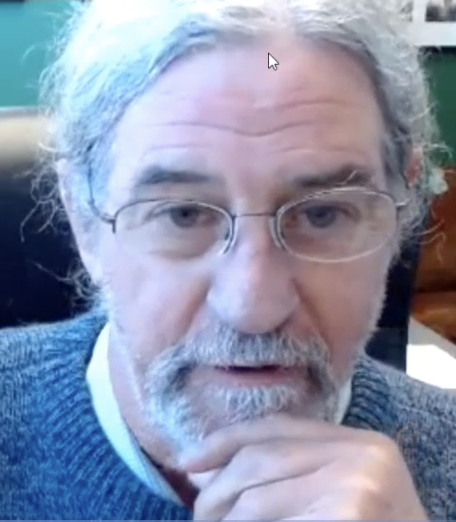
Madrone | Screenshot
“So I find it very difficult to understand how, number one, you can make a false statement … ,” Madrone said. “I don’t see any evidence in this report that can substantiate that this bottom 20 feet of this well is not tapping into the aquifer of the river. I realize it’s 3000 feet away, but these aquifers can be extremely expansive, as we’ve seen in all of our books that we studied when we went to school. The water in the river doesn’t just end at the banks of the river.”
Board Chair Virginia Bass asked Madrone if he’d reached out to Lindberg ahead of the meeting to address these issues, “because it feels like we’ve got a game of ‘gotcha’ going here, and it bothers me.”
Madrone said he had not reached out to Lindberg earlier because he wanted to have an unbiased opinion when he considered the matter.
“And so, no, I didn’t reach out,” Madrone said, “and there’s nothing wrong with that. In fact, that’s really the appropriate way to behave in these situations. And Mr. Lindberg has every opportunity here, today, to respond to this. And he had an opportunity with the letter that he submitted, and his letter simply has false information in it.”
Bass said Lindberg should be given a chance to respond to the accusations, and Madrone bristled.
“They’re not — Madam Chair, they’re not accusations,” he said.
“There were some comments made,” she countered.
“I don’t appreciate you couching my input as accusations,” Madrone said. “I presented information that is based on factual information presented by Mr. Lindberg. They’re not accusations, please.”
Lindberg said he didn’t know where to even begin responding. He went on to describe the area’s geology, saying the Mattole river is eroded into a channel of Franciscan bedrock while the well to the north taps into sandstone. He sounded flustered as his telephone rang in the background and an answering machine message played.
Finally he said, “It’s hard for me to visualize any way that the drawdown of the well expands the cone of depression from which it draws 3,200 feet away to the river. It just seems like quite a stretch of the imagination.”
“Well, my question didn’t get answered,” Madrone said. He ran through his analysis of the figures again. “The facts suggest that the well is drilled 20 to 40 feet below the surface of the river, not equal to it. And you didn’t answer that question.”
“I said it was approximately equivalent to [the river level],” Lindberg said.
“Yes, but it’s not,” Madrone said. “It’s 20 to 40 feet deeper than. That’s not ‘approximately equivalent to.’”
“We have a difference of opinion, I guess, on what ‘approximately equivalent’ means at this scale,” Lindberg said.
Bushnell then cut in, asking Ford to reiterate what exactly the board was supposed to be considering. She said applicants are required to conduct due diligence on matters such as this hydrology question, and that’s exactly what this letter represents.
“If you accept the report, yes,” Ford said. He went on to ask Lindberg to corroborate his understanding of the science — namely, that the water that flows into the Mattole goes along the top of the Franciscan layer while the well likely pulls from a deeper, isolated aquifer in a more permeable layer of fractured sandstone.
Lindberg said that was indeed his conclusion, but Madrone was not appeased. He said there’s still “zero information” about the geologic layers between the well’s location and the banks of the river. The board should not approve this project without substantial evidence that the well is not pulling from river’s aquifer, he argued, because the salmon and steelhead populations there are threatened and endangered.
“The river goes low, these fish need this water,” he said. “We as a board are supposed to look to the larger issues within our community and not just special interests.”
Bohn asked Ford whether the county has ever required an applicant to have test wells dug between their well and a river to study the underlying geology. Ford said no.
Senior Planner Cliff Johnson said the applicant, Jason Goforth, has 75,000 gallons of water storage onsite and is willing to provide more if he can get the necessary funding. Goforth, via phone, said he just can’t afford it right now.
Bushnell asked a few questions of staff and the applicant, and then she offered an apology “for the hostility on this board,” an apparent reference to Madrone’s interrogation. “It made me super uncomfortable. I just have to say that. I understand everybody wants to make their point, but I am not very comfortable with it.”
Bass said she had tried to steer away from the hostility but it wasn’t working so well.
During the public comment period, cannabis project consultant Steve Breitenstein said that while he appreciates the value of healthy debate, “the implications of this discussion extend well beyond the specific appeal… .” Many of his clients have been frustrated by the county’s lack of clarity on water sourcing requirements.
“Most of my clients are not hydrologists or engineering geologists; they’re farmers,” he said. “They rely on — and pay substantial amounts of money to — qualified professionals for assessments and have no choice but to trust their findings.” The Planning Commission seemed to base its approval on those findings as well, he said, but now Madrone had offered a second opinion. The county should have clear guidelines, Breitenstein argued.
“That’s the only way to avoid the repetition of this exercise for dozens and dozens of future projects. I alone have at least 10 different clients who are awaiting hearings on wells, and I have no idea what to tell them. Should we hire a geologist? Should we hire two? Should we consult with Supervisor Madrone?”
When the matter came back to the board, Madrone defended himself, noting that he’s a subject matter expert, not only in regards to hydrology and water but also fisheries in the Mattole.
“And, you know, calling it ‘hostile’ or ‘accusations’ I find to be really disrespectful,” he said. “You can call it ‘passionate.’ I would accept that. I am very passionate about protecting our fisheries and our fishing industry on the Mattole River. Yes, very passionate. But I was not hostile.”
He said his initial questions still hadn’t been answered to his satisfaction. “And it would seem to me that my other supervisors don’t seem to think that’s important, you know, and they’re willing to just write that off,” he said. “I find that to be really just amazing to me, and frankly a violation of our code of conduct that says we’re supposed to look out for the greater community interest, not just for a special interest. I think that’s really what’s going on here. And that’s not meant to be an accusation or be hostile. I’m just making my statements.”
He went on to suggest that applicants would be better off spending their money on rainwater catchment systems, which the Planning Commission readily approves, rather than expensive consultants.
While the discussion had been tense, that latter comment served to illuminate a path forward. Bushnell noted that the applicant had already stated a desire to provide more storage. She did take issue with Madrone’s suggestion that she and the other supervisors were catering to a special interest at the expense of greater community interests. She said she was merely trying to follow the rules of the county’s cannabis ordinances.
Wilson said he appreciated where the Planning Commission was coming from by encouraging water storage.
Eventually, the board landed on common ground, opting to approve the applicant’s appeal while requiring them to get the Planning Commission’s additional water storage in place by 2025.
Madrone commended the board in the end, saying they’d landed on a good compromise.
BOOKED
Today: 12 felonies, 16 misdemeanors, 0 infractions
JUDGED
Humboldt County Superior Court Calendar: Friday, Sept. 4
CHP REPORTS
1718 Mm36 E Hum 17.20 (HM office): Trfc Collision-Unkn Inj
ELSEWHERE
RHBB: CDPH Issues Immunization Recommendations for 2026-27 Respiratory Virus Season
RHBB: Redway Transfer Station to Close an Extra Day for Construction
RHBB: Dows Prairie Road to Close for Two Months for Culvert Repair
MASKS ON IN COURT! The State Mandate Has Ended But That Doesn’t Mean You Can Just Unmask Anywhere, and Court is One of Those Places You Cannot
LoCO Staff / Tuesday, Feb. 15, 2022 @ 3:11 p.m. / COVID-19 and Humboldt
Press release from the Superior Court of California:
The California Department of Public Health (CDPH) has provided updated guidance for the use of face masks effective February 16, 2022.
In accordance with the updated guidance from CDPH, Humboldt Superior Court issues the following mask requirements effective February 16, 2022:
Masks are required while in courtrooms, while in Jury Deliberation Rooms, while in the Jury Assembly Room on the Ground Floor of the courthouse and when conducting business at the Clerk’s Office public counters.
Judges will have full discretion during courtroom proceedings to allow individuals addressing the court to remove their masks if individuals cannot be clearly heard. Any individual experiencing symptoms of COVID-19 or other illness should not come to court.
The Humboldt Superior Court Clerk’s Office Lobby located at 421 “I” Street in Eureka is open to the public for walk-in service from 9:00 a.m. to 2:00 p.m. Clerk’s Office staff continues to be available by phone at (707) 445-7256.
Newsom Nominates First Latina to California Supreme Court
Byrhonda Lyons / Tuesday, Feb. 15, 2022 @ 1 p.m. / Sacramento

State Associate Justice Patricia Guerrero is Gov. Gavin Newsom’s new pick for the California Supreme Court. Illustration by CalMatters. Photo via California Courts.
###
Gov. Gavin Newsom today nominated to the state Supreme Court Patricia Guerrero, a San Diego appeals court justice who, if confirmed, would be the first Latina to serve on California’s highest court.
Colleagues have praised Guerrero for her on-the-job dedication — so much so that she once finished a criminal hearing brief while enroute to the hospital in labor.
“I am deeply honored by this incredible opportunity to uphold the rule of law and make a positive impact on the lives of Californians across the state,” said Justice Guerrero in a news release. “If confirmed, I look forward to helping instill confidence in the equality and integrity of our judicial system while honoring the sacrifices of my immigrant parents and demonstrating to young people that anything is possible in our wonderful and diverse country.”
A native of the Imperial Valley, Guerrero graduated from University of California, Berkeley and Stanford Law School before starting her legal career. She served as an attorney in the U.S. Attorney’s Office and as a law firm partner before being appointed to the San Diego Superior Court bench in 2013.
She has served on the Fourth District Court of Appeal since 2017. At her confirmation hearing that year, former colleague Robert Howard recalled how Guerrero finished a brief on her way to give birth to her son, and coordinated filing the brief hours later.
In nominating for the high court today, Newsom said her “wide-ranging experience, integrity, deep respect for the rule of law and lifelong commitment to public service make her a phenomenal candidate to serve as our next California Supreme Court Justice.”
State Supreme Court justices are nominated by the governor and must then be confirmed by the Commission on Judicial Appointments, which consists of California’s chief justice, the state attorney general and the senior presiding justice of the Court of Appeal.
Guerrero would replace former Justice Mariano-Florentino Cuéllar, who stepped down to run the Carnegie Endowment for International Peace. Cuéllar’s resignation left no Latino representation on the state’s most diverse bench. Since then, Newsom has been under increasing pressure to appoint the state’s first Latina member.
“Newsom has a chance to make history and give a Latina her rightful place in the California Supreme Court, making the judicial system stronger and fairer,” wrote Paul Barragan-Monge, director of mobilization for the University of California, Los Angeles, in November.
Across the state, there’s a significant shortage of Latinos attorneys and judges. In four majority-Latino California counties — Colusa, Kings, Madera, and Merced — there are no Latino judges in any superior courtrooms.
And such disparities can have effects that ripple through individual lives and entire communities. Research indicates that racially diverse judges and women judges tend to assess certain cases differently, on average, from their white and male counterparts.
And while roughly 60% of white and Asian Americans said they felt California county courts were fair over half the time, only about 40% of Latinos reported feeling the same, according to a study commissioned by the California Judicial Council.
After CalMatters reported last year on the gap and the state’s struggles to get more Latino attorneys to transition into judgeships, Gov. Newsom launched the California Judicial Mentor Program to help more diverse candidates apply to serve on the bench.
###
CALmatters.org is a nonprofit, nonpartisan media venture explaining California policies and politics.
BAY TRAIL GETTING CLOSER! County Acquires Easement Through Brainard Mill Site, the Last Big Right-of-Way Obstacle to the Eureka/Arcata Trail
LoCO Staff / Tuesday, Feb. 15, 2022 @ 11:44 a.m. / Trails
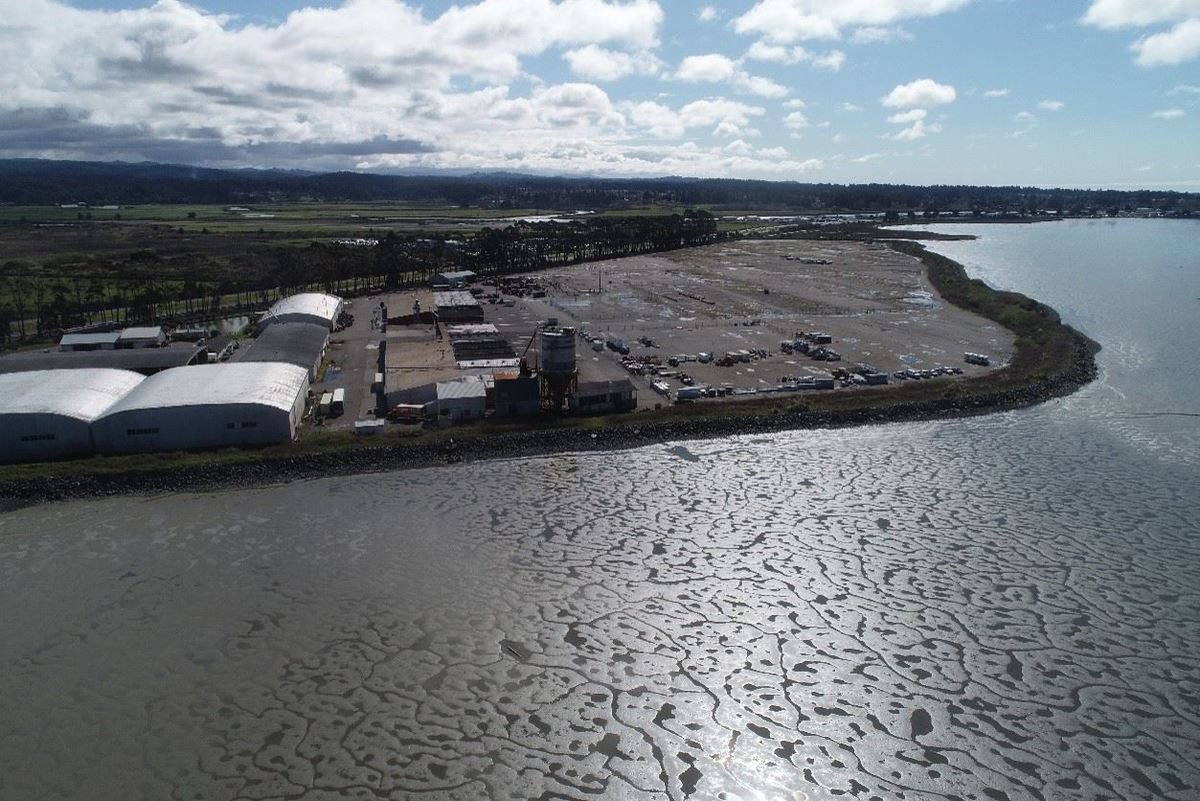
Brainard! Photo: County of Humboldt.
###
Press release from the County of Humboldt:
The County of Humboldt has acquired an easement from California Redwood Company, a subsidiary of Green Diamond Resource Company, to develop approximately 1 mile of the Humboldt Bay Trail on the levee surrounding the Brainard mill site. The easement provides the County of Humboldt the legal right to construct the trail while California Redwood Company retains ownership of the property. Funding to acquire the easement was provided through the State Transportation Improvement Program and administered by the California Department of Transportation.
The County of Humboldt is developing the Humboldt Bay Trail South project to expand the Humboldt Bay Trail by 4.25 miles and complete the connection between Eureka and Arcata along the Highway 101 corridor. The purpose of the project is to create opportunities for active transportation and to enhance access to Humboldt Bay. The easement at the Brainard mill site is one of the last remaining elements in the right-of-way phase of the project. The County of Humboldt expects to close escrow on a separate property acquisition by the end of February. The Coastal Commission is expected to consider issuance of a coastal development permit at its meeting scheduled for April 6-8.
“The Humboldt Bay Trail is an incredible destination for residents and visitors to be physically active while enjoying the scenic beauty of Humboldt Bay,” said Virginia Bass, Humboldt County Fourth District Supervisor. “Many residents visit the Eureka Waterfront Trail and the existing Humboldt Bay Trail segment through Arcata for walking, running, biking, skating, and traveling with mobility devices. Completion of the trail connection between Eureka and Arcata will be a major step forward for enabling non-motorized transportation options in the Humboldt Bay region. And the easement provided by California Redwood Company is especially valuable because it will enable the public to view and experience a beautiful corner of Humboldt Bay that was previously inaccessible. The County of Humboldt appreciates that California Redwood Company recognizes the many benefits of the Humboldt Bay Trail and was willing to incorporate the trail into its future plans for the Brainard property.”
“The Humboldt Bay Trail, when completed, will be a beautiful scenic link between Arcata and Eureka,” said Green Diamond Vice President and General Manager Jason Carlson. “We would like to thank the Humboldt County Public Works staff for their dedication to see this project through to completion and the County Board of Supervisors for their leadership and vision to support this project.”
Deputy Finds Broken-Down Vehicle on 299 to be Stolen, Actually; Two Arrested at Scene
LoCO Staff / Tuesday, Feb. 15, 2022 @ 9:16 a.m. / Crime
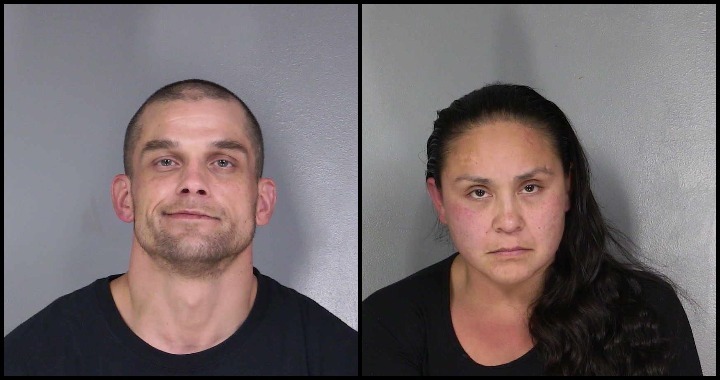
Coffer, Tello. Photos: HCSO.
###
Press release from the Humboldt County Sheriff’s Office:
On Feb. 14, 2022, at about 8:50 a.m., Humboldt County Sheriff’s deputies on patrol in the Willow Creek area observed a disabled vehicle and two individuals possibly in need of assistance parked at a turnout along Highway 299.
Deputies contacted the individuals, 36-year-old Melvin Louis Coffer and 29-year-old Rosamarie Ellen Louise Tello, and during the interaction observed evidence indicating the vehicle had possibly been stolen. Additionally, deputies found that Coffer had an outstanding warrant for his arrest. Coffer was taken into custody on his warrant. During a search of Coffer incident to arrest, deputies located approximately .38 grams of methamphetamine.
Upon further investigation into the status of the vehicle, deputies learned that the vehicle had false plates and was reported stolen out of the McKinleyville area. During a search of Tello and her belongings incident to arrest, deputies located drug paraphernalia.
Tello was arrested and booked into the Humboldt County Correctional Facility on charges of possession of a controlled substance paraphernalia (HS 11364(a)) and possession of a stolen vehicle (PC 496d(a)).
Coffer was booked into the Humboldt County Correctional Facility on fresh charges of possession of a controlled substance (HS 11377(a)), in addition to warrant charges of carrying a concealed dirk or dagger (PC 21310) and possession of a controlled substance (HS 11377(a)).
Anyone with information about this case or related criminal activity is encouraged to call the Humboldt County Sheriff’s Office at (707) 445-7251 or the Sheriff’s Office Crime Tip line at (707) 268-2539.
With Just Days Left for Public Comment, Enviro Groups Seek More Detail, Assurances in Nordic Aquafarms’ EIR
Ryan Burns / Tuesday, Feb. 15, 2022 @ 7:15 a.m. / Business , Environment
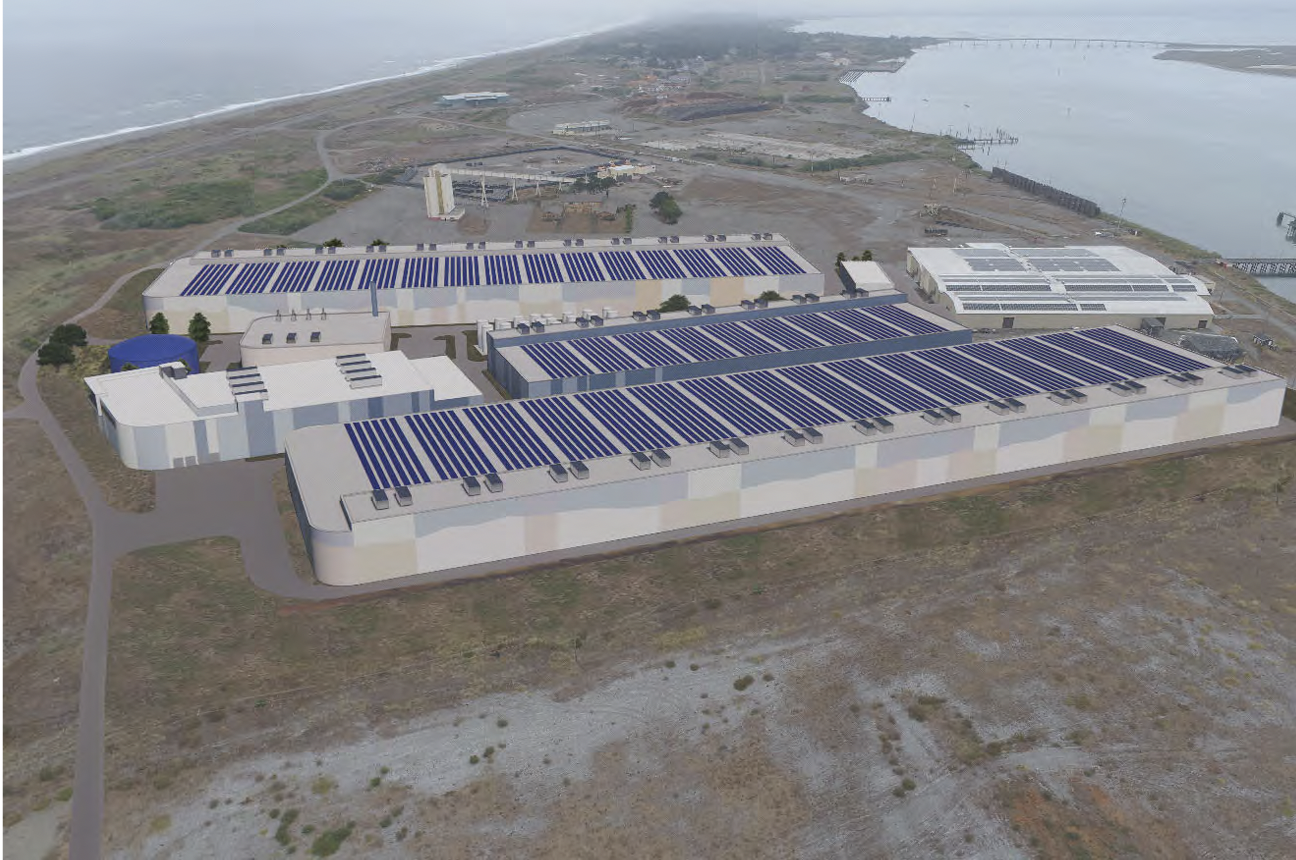
Visual simulation of Nordic Aquafarms’ planned land-based fish farm, a recirculating aquaculture system (RAS) facility planned for the Samoa Peninsula. | Image via Humboldt County’s Draft Environmental Impact Report.
###
The public has until Friday to review and comment on the county’s draft environmental impact report (DEIR) on the big land-based fish farm that Nordic Aquafarms plans to build on the Samoa Peninsula. The report is about 1,800 pages long, so if you’re planning to read the whole thing and haven’t yet started, best of luck!
Fortunately, local leaders of nonprofit environmental organizations have been poring over the voluminous document since it dropped on December 20, and in interviews they say they appreciate how open the Norway-based company has been to feedback and project revisions — including the decision to conduct a full environmental impact report — but they have a number of serious concerns, including the project’s massive energy demands, the effects of effluent discharged offshore, impacts to wildlife from water intakes in Humboldt Bay and more.
The DEIR, prepared for the county by engineering firm GHD, concludes that, with mitigation measures, the project will have no significant environmental impacts. That’s the same conclusion reached in the initial study released last April. But environmental stakeholders argue that this finding is based on insufficient baseline data and analysis.
None we spoke to said they’re outright opposed to the project, for which Nordic plans to spend millions of dollars further remediating the Humboldt Bay Harbor District’s blighted former pulp mill property on the peninsula. But they’re asking for some modifications and commitments in hopes of lessening the fish farm’s environmental impacts.
To review, Nordic has proposed building the world’s largest land-based recirculating aquaculture system (RAS), a state-of-the-art facility with a 17.6-acre footprint producing tons and tons of Atlantic salmon. They’d be raised from eggs to the juvenile stage in a hatchery facility at the center of the five-building campus, then transported via underground pipes to two massive grow-out modules, where they’d swim against a steady current while growing to market size.
Simulation of a Recirculating Aquaculture System from a Nordic Aquafarms video. | via GIPHY
###
With a projected annual production capacity of up to 27,000 metric tons of fish, the plant is designed to supply West Coast markets from Seattle to Los Angeles. (The company wants to build a similar facility in Belfast, Maine, to supply East Coast markets.) The Samoa facility, which would operate 24/7, is projected to employ 90-100 employees during Phase 1 of the two-phased buildout and up to 150 under Phase 2.
Two existing sea chests on Harbor District docks would pull in 10 million gallons of Humboldt Bay saltwater per day, and two million daily gallons of freshwater would be supplied by the Humboldt Bay Municipal Water District. Twelve and a half million gallons of effluent would be discharged daily through an existing mile-and-a-half-long ocean outfall pipe, which pulp mill owners were forced to install after being sued by the Surfrider Foundation and the EPA in the late 1980s.
According to the DEIR, onsite water treatment plants “will subject all inlet and wastewater to a stringent treatment process, including fine filtration, biological treatment and ultraviolet sterilization.”
If anyone was looking for a reason to doubt the strict veracity of the DEIR, the authors seem to have inadvertently provided one: Deep in the report, on page 53 of Appendix D (Marine Resources), former GHD senior scientist Ken Mierzwa is listed as one of four preparers. Trouble is, he says he was not involved.
In a Feb. 3 email commenting on the DEIR, Mierzwa says he did not contribute to Appendix D or any other part of the report.
“Without going into detail, I wish to make it clear that I disagree with a number of the statements made in the results and conclusions of Appendix D and carried forward into the EIR,” he writes. “Many items require additional analysis and/or additional mitigation, and I would have refused to put my name on the document as written had I known that it existed.”
Asked to respond, Nordic’s executive vice president of commercial operations, Marianne Naess, forwarded a statement from GHD:
Ken Mierzwa did not contribute to the Marine Resources Biological Evaluation Report associated with the Nordic Aquafarms EIR. Including Ken’s name as an author was an administrative oversight. Mr. Mierzwa’s name will be removed from the report and documented through the California Environmental Quality Act process.
We reached out to Mierzwa and asked him to elaborate on his perspective on the DEIR’s shortcomings. Below is a rundown of some of the major concerns raised by Mierzwa and others, including a local fisherman and a variety of environmental stakeholders.
Energy usage and greenhouse gas emissions
The DEIR says the project’s anticipated annual electricity usage at full build-out is 195 gigawatt hours (GWh). That’s a difficult statistic for most laypeople to comprehend, but a pie chart in the report’s energy chapter puts the figure into perspective. It shows that the facility would use roughly as much energy as the cities of Eureka and Fortuna combined:
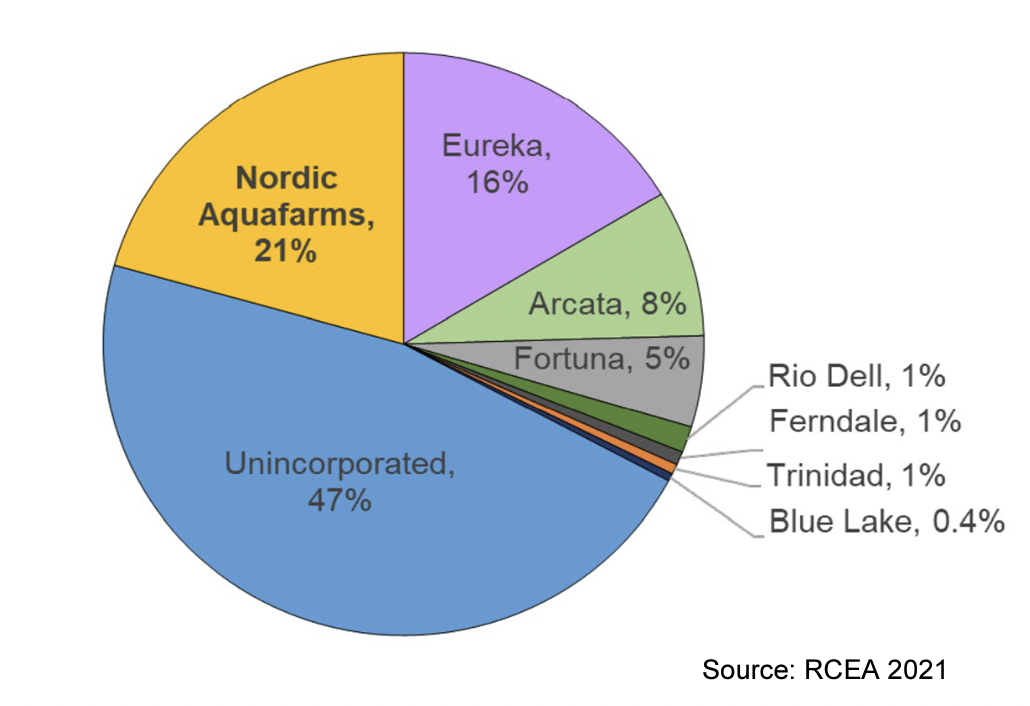
Annual electricity usage at full build-out (circa 2030) as a fraction of current total county load. | From the DEIR.
“It is a shocking amount of electricity,” said Tom Wheeler, executive director of the Environmental Protection Information Center (EPIC).
Caroline Griffith, executive director of the Northcoast Environmental Center (NEC), agreed, calling this energy demand “pretty mind-blowing.”
“It gives an indication of just how impactful this project could be and how important it is that the county accurately analyzes and assesses those impacts,” she said in an email.
EPIC, NEC and others have asked Nordic to commit to using 100 percent renewable energy from Day One. The company hasn’t gone quite that far, but it has committed to using “non-carbon” energy by following the procurement policies of Redwood Coast Energy Authority (RCEA), the joint powers authority that administers Humboldt County’s Community Choice Energy program.
Nordic also plans to incorporate roughly 15 acres of rooftop solar panels, enough to produce about 4.8 megawatts of electricity. The company says it would like to tap into any “larger or more beneficial carbon-neutral energy project [that] becomes available … such as the 4.6 gigawatt offshore wind project proposed approximately 21 miles offshore of Humboldt Bay.”
That project is still in the planning stages, and Wheeler said that while he appreciates Nordic’s stated desire to run as cleanly as possible, the county’s current energy infrastructure limits just how green the plant can be.
Humboldt County has limited import/export capacity, so while RCEA may purchase 100 percent renewable energy on the open market, most of the electricity Humboldt County customers actually use enters the grid via PG&E’s Humboldt Bay Generating Station, a 163-megawatt facility in King Salmon that runs on natural gas with propane backup.
“If we were to be connected to the grid in a different way I think that I could accept [Nordic’s projected] amount of electricity,” Wheeler said.
By purchasing the power through RCEA, Nordic will be “greening the larger grid,” he said, “but if we don’t have enough renewable energy [accessible locally] to serve this project, I think we are doing a disservice to our climate.”
EPIC plans to ask the company to commit to purchasing renewable power — locally, when it becomes available — as a means of driving investment. “I think that the way we’re most comfortable with this project moving forward is with offshore wind as well,” Wheeler said.
Nordic has argued that despite its eyebrow-raising energy requirements, their facility on the Samoa peninsula will actually reduce global greenhouse gas emissions. That’s because U.S. residents consume more than four times the amount of salmon we harvest, importing the vast majority of it from Europe and Latin America — a carbon-intensive journey.
Daniel Chandler, who sits on the steering committee of 350 Humboldt, a nonprofit dedicated to reducing emissions from fossil fuels, said he’s not sure exactly how well the comparison pencils out. For one thing, much of the fish currently being exported from Norway comes to the U.S. via ocean liner rather than airplane, though Nordic often uses the latter in its emissions analyses. For another, fish grown in Nordic’s Samoa facility would still need to be trucked to markets up and down the West Coast.
“That’s not analyzed in the EIR but it ought to be,” Mierzwa said.
Colin Fiske, executive director of the Coalition for Responsible Transportation Priorities, said he also has issues with the report’s greenhouse gas emissions analysis. The report bases its projections on PG&E’s self-reported 2019 figures for carbon dioxide emissions per megawatt hour, and he believes the data from 2019 was anomalously, maybe even absurdly low.
These data “allowed them to conclude — we still think erroneously — that they had a less-than-significant impact on climate emissions where, if they had used other data, it would have been clearly significant,” Fiske said.
He also believes the report’s authors used the wrong carbon emissions threshold from the Bay Area Air Quality Management District.
“There’s two different ones: a ‘stationary source threshold’ and a ‘land-use threshold,’” he said. The former is the one cited in the report, but Fiske said that’s supposed to apply only to facilities that produce their own emissions, like a factory or power plant.
Another potential source of emissions is the fish feed.
“It’s not discussed in the DEIR at all,” said Chandler. “There’s just no mention of greenhouse gas emissions from fish food.”
The environmental sustainability from fish food production has improved a lot in the past 20 years, he noted, explaining that is used to take about 10 pounds of other to produce one pound of salmon. That figure has dropped to a worldwide average of 1.87 pounds thanks to increased use of vegetable protein oil, insects and other ingredients, Chandler said.
Nordic has said it will source “the best available fish feed” with a goal of minimizing marine ingredients while meeting the health and welfare needs of the fish.
“We will only source our feed from accredited facilities that meet the criteria of ASC (Aquaculture Stewardship Council) or Global Gab certifications, just as we have done for our ASC- and Global Gab-certified facilities in Denmark and Norway,” Naess said in an emailed statement.
Still, Chandler would like the company to commit to buying food that has been tracked for greenhouse gas emissions and has the lowest level possible. Wheeler also identified the fish feed as an area of concern and said he’d like to see Nordic “lean in” and leverage their position as a market leader to drive innovation and further increase the amount of vegetable and insect content in fish feed.
Chandler is also worried about the use of chemical refrigerants, such as hydrofluorocarbons and hydrochlorofluorocarbons, which have thousands of times the global warming potential of carbon dioxide.
In responding to emailed questions from the Outpost, Naess referred more than once back to the analysis in the DEIR, saying full answers “might require much more detailed responses than would be possible to comment in a newspaper article.”
But she also noted that all comments submitted during this public review period will be addressed in detail, as required by the California Environmental Quality Act (CEQA), and the formal responses will be included in the Final Environmental Impact Report.
Regarding Fiske’s analysis of PG&E’s self-reported emissions she said, “Nordic used figures from 2016 in the first model in the IS/MND [Initial Study/Mitigated Negative Declaration]. This was updated in the analysis in the EIR, using the more recent 2019 calculation/figures,” which she said are “the latest available third party verified data.”
She continued:
Nordic shares the concern with regards to GHG [greenhouse gasses] and has therefore committed to follow RCEA´s goals with regards to non-carbon and renewable energy. This is clearly stated in the EIR and will be a binding condition in the Coastal Development Permit. The GHG levels in the EIR therefore reflects the actual emission levels.
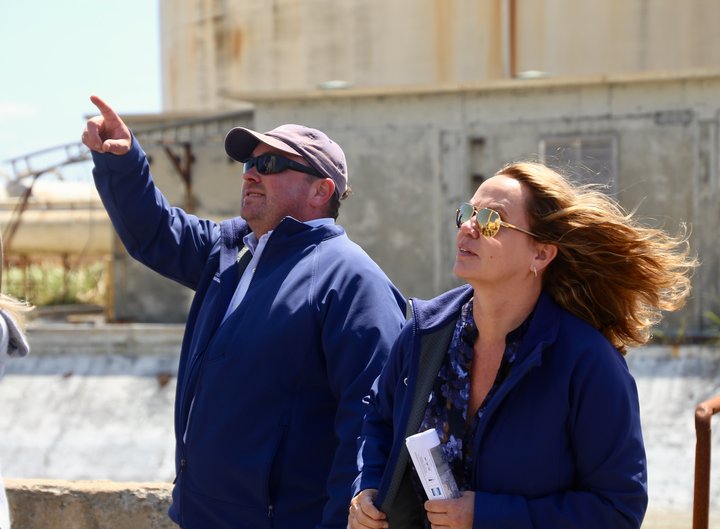
Nordic’s local project manager, Scott Thompson, and executive vice president of commercial operations, Marianne Naess. | File photo by Andrew Goff.
Outfall discharge
Like others who’ve examined Nordic’s plans, Humboldt Baykeeper Executive Director Jennifer Kalt was struck by the sheer size of the facility.
“It’s a huge project,” she said. “I mean, it’s massive, and it’s really got a lot of people worried that the nutrient levels — nitrogen in particular — could exacerbate the algae problems.”
She was referring to the effluent that will be pumped into the ocean via the 1.5-mile discharge pipe. This is the same pipe that Louisiana-Pacific once used to dump millions of gallons of untreated wastewater per day into the Pacific Ocean.
Nobody we spoke with thinks Nordic’s much-lower amount of treated discharge will be as harmful to marine life, but Kalt and others still worry that the effluent’s higher temperature and perennial discharge of nutrients such as nitrogen could stimulate algae growth, exacerbating the existing scourge of harmful algal blooms.
In response to feedback from environmental groups, Nordic last year agreed to independent monitoring of the effluent once the project is online, but Kalt and others take issue with GHD’s methods of collecting baseline data, saying the measurements used in the DEIR’s modeling were taken near the mouth of Humboldt Bay rather than offshore where the effluent will actually flow.
“They think the data they use from inside Humboldt Bay is just fine,” Kalt said. “They’re using logic and rationale that makes sense to someone that doesn’t know the science. They’re saying the bay flushes [into the ocean] so the it’s probably similar [conditions]. Well, it’s not.”
Delia Bense-Kang, Northern California coordinator for the Surfrider Foundation, agreed, saying the two locations have potentially different temperatures, salinity and other conditions.
The DEIR concludes that the environmental effects of the discharge will be less than significant. This was the area of the study for which Mierzwa was erroneously listed as a preparer, and he told the Outpost that he finds the level of analysis insufficient.
“I don’t think there’s enough information to make those sweeping [conclusions] that there’s no need to mitigate,” he said.
Asked about these issues, Naess replied, “Before we make any further comments, we would need to see the specific concerns in detail to be able to address them sufficiently. This will be addressed in detail in the reply to comments in the CEQA process.”
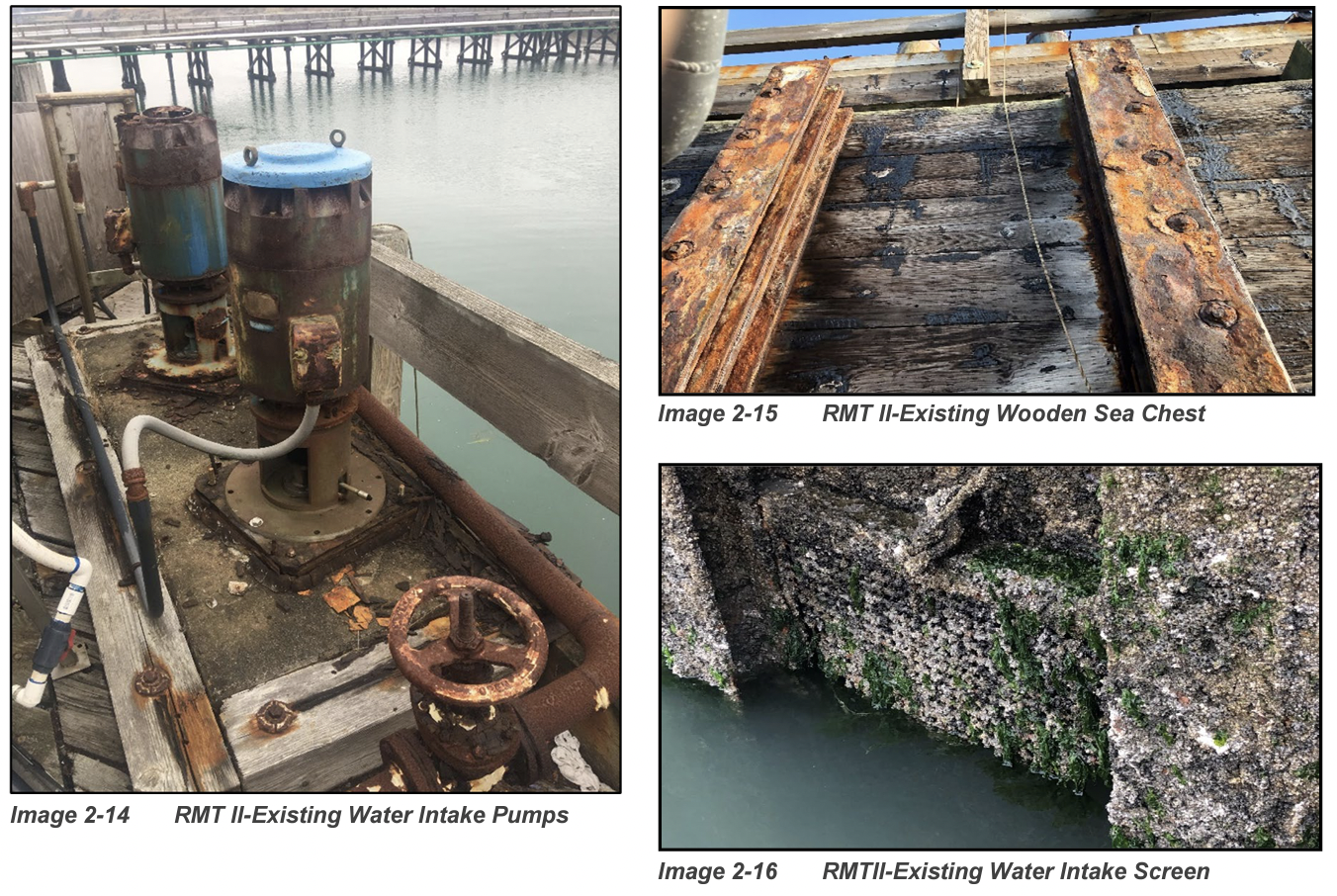
Photos of the Harbor District’s existing infrastructure via the DEIR.
Bay intakes
Jake McMaster, a local commercial fisherman, said he’s also worried that the outfall pipe may cause harmful algal blooms, and he’s also concerned about the sea chests sucking up millions of gallons of water from the bay.
“Humboldt Bay is a giant estuary with all sorts of juvenile everything — juvenile smelt, salmon, crab. Have you ever seen a juvenile crab?” he asked. “They’re tiny, like tadpoles.” McMaster is worried about the potential for these little critters to get sucked up into or against the intake screens.
The permit for the bay intakes is being pursued not by Nordic but rather by the Humboldt Bay Harbor, Recreation and Conservation District. The local government agency owns the sea chests along with the rest of Redwood Marine Terminal II, having acquired the former pulp mill property in 2013 for a single dollar.
The California Coastal Commission and California Department of Fish and Wildlife will have their say on that permit, but Nordic’s DEIR addresses the infrastructure, too, noting that the sea chests will be retrofitted and modernized to meet applicable design criteria. This includes the installation of fine-mesh screens to prevent impingement and entrainment of sea life.
Mierzwa said this is another area where he feels the analysis falls short. Specifically, he brought up Section 316(b) of the Clean Water Act, which requires the EPA to issue regulations on the design and operation of intake structures.
This particular section of law has been litigated extensively, Mierzwa said, adding that it’s taken very seriously. “There’s essentially no mention of it in Appendix D in this EIR,” he said. “It needed more analysis than it was given.”
The Harbor District has begun conducting studies to analyze the impacts of these intakes.
Naess said in an email, “This is addressed in detail in the EIR and the permit application from the Harbor District.” She noted that the screens will have a mesh size of one millimeter.
Transportation
At full production, the Nordic facility is expected to add 205 daily automobile trips, according to the DEIR. It would also add 32 outgoing trucks each week carrying waste to secondary use processing sites. Deliveries, including fish feed, shipping materials and process chemicals, would add another 20 truck trips per week.
The DEIR concludes that the increased traffic will have no significant environmental impact, but Fiske takes issue with the baseline figures, noting that the report compares its projections to the county’s per capita driving habits.
“And when you look at the entire county, of course, the average is way high because of people who live way out in the rural areas,” Fiske said. “And so that leads them to consistently conclude that there is no significant impact.”
Naess responded to this by saying, “Nordic believes we used the appropriate data and methodology for this study. Specific comments will be addressed as part of the CEQA process.”

Nordic executives led a group made up primarily of representatives from local environmental groups on a tour of the former pulp mill property last July. | File photo by Andrew Goff.
‘It’s just humongous’
Several of the people we interviewed kept returning to the project’s size.
“This is one of the biggest projects we’ve seen in the county for a long time,” Griffith observed. “There is a need to have the right information to make a correct assessment about the impacts, and I don’t know that we necessarily have all the right information.”
That said, she added that it would be great to see the site cleaned up. “That is part of what is in people’s minds: This site will eventually be used for something. We’d like to see it used in the best possible way.”
Kalt said she and others have encouraged Nordic to start smaller and then scale up when conditions warrant. “It’s just humongous,” she said of the existing plans. “We keep telling them, ‘If you make it smaller to start with, then we can see what the impacts are.’ The company has no track record of doing anything like this.”
Naess took issue with this allegation.
“The technology is NOT untested,” she wrote in her email. A company acquired by Nordic has spent decades designing RAS facilities that are currently in operation, and Nordic has such farms of its own, “which is more than any other RAS company,” Naess said.
“As stated before, the facility consists of several ‘independent units,’ none of which are larger than the farms that we are currently operating and it will be the same size as our fully permitted Maine facility,” she continued. “The facility will also be built in two phases, which allows for Nordic to commission, operate and adjust the facility to local conditions (if necessary) before building the second half of the facility.”
Like Griffith, Kalt said she’s not necessarily opposed to it going forward. “It’s not a project that I think can’t be mitigated,” she said. “But they need to do a better analysis.”
Wheeler said this project is up there with the rejected Terra-Gen wind farm as the biggest developments proposed during his time in Humboldt.
“I think that our approach for this project has been different, because in many respects [Nordic] has been open to criticism,” he said. “They’ve been willing to listen, propose changes to the project and work with the community. I hope this continues. We’re at a really important stage here, and they’ve done well by us so far.”
The company has listened to stakeholder concerns and, in some cases, altered the project to accommodate them — “the completion of the full EIR being one of those examples,” Wheeler said. “I think the benefit of the full EIR is being shown in the kind of concerns we are now raising. We’ve been able to present more nuanced issues and drive a conversation that is better for all of us in the county.”
Naess expressed a similar sentiment:
Nordic appreciates the good dialog we have had with the environmental groups during the permitting process. They play an important role as watchdogs to protect the environment in Humboldt and have rightfully challenged the project to make it better.
Nordic listened to the environmental groups and the community and did an EIR. Nordic listened to the concerns voiced by the environmental groups and included additional monitoring. Mutual respect and collaboration is always the way to create win-win solutions and improve the outcome. Nordic wants to thank the environmental groups for their willingness to be a constructive player in this process.
Once again, you have until Friday to submit your own comments on the project. They can be sent to the Humboldt County Planning and Building Department at 3015 H Street in Eureka or via email: CEQAResponses@co.humboldt.ca.us.
###
CORRECTION: This post has been corrected to reflect that Griffith works for the NEC rather than Friends of the Eel River. The Outpost regrets the error.
PREVIOUSLY:
- Nordic Aquafarms Plans to Grow Atlantic Salmon in Land-Based Fish Farm on Former Pulp Mill Property
- County Declares No Significant Environmental Impact for Proposed Samoa Fish Farm; Will Receive Comments, Critiques Through May 24
- In a Surprise Move, Nordic Aquafarms Agrees to Conduct Full Environmental Impact Report for Its Land-Based Fish Farm on the Samoa Peninsula
- Local Environmental Groups Laud Nordic Aquafarms’ Decision to Complete a Full Environmental Impact Report
- (PHOTOS) Nordic Aquafarms Execs Lead Tour of the Corroding Remains of the Pulp Mill Property Where They Plan to Build a Big Land-Based Fish Farm
- PENINSULA RISING: County Creating a Financing District to Supercharge Development in and Around Samoa
- (VIDEO) Take a Virtual Tour, With a Brief History, of Nordic Aquafarm’ Proposed Peninsula Project Site
- County Releases Draft Environmental Impact Report for Nordic Aquafarms’ Fish Factory Project on the Samoa Peninsula
Do-Over: Cal State Resubmits Application, Increasing Affordable Student Housing Projection by 800 Beds
Mikhail Zinshteyn / Tuesday, Feb. 15, 2022 @ 7:12 a.m. / Sacramento

Students walk through the Fresno State campus in Fresno, on Feb. 9, 2022. Photo by Larry Valenzuela for CalMatters
###
PREVIOUSLY:
###
After the California State University system realized it misread the fine print for a new state grant to build affordable student housing, officials went back to the drawing board, ran new numbers, and told lawmakers they have a plan to develop more discounted student homes.
The application do-over means as many as 800 more Cal State students — for a total of nearly 3,400 — may soon see heavily subsidized housing slots at a time when tens of thousands of California students are facing a dire housing crunch. The proposed housing projects would also cost the state less than what the Cal States put forth last fall — a rare instance of spending less to gain more in higher education.
The Cal State system submitted its revised plans to the governor’s office for approval in late January, two months after a 2021 CalMatters report found that the system needlessly proposed fewer affordable beds.
In its initial application to claim a portion of the $2 billion Gov. Gavin Newsom set aside for student housing, Cal State incorrectly assumed that it could use that money — and only that money — to build affordable units for low-income students.
As CalMatters reported and Cal State officials later acknowledged, rules governing the grant program allowed Cal State to combine state money with outside funds. Typically, campuses build housing by borrowing money. The state grant can serve as a large down payment on that student housing mortgage. Using a mix of funds allows campuses to build more units and take out less debt than they would have otherwise, savings that are then passed onto students. It’s an approach that several University of California campuses originally sought.
Cal State’s revised plans call for $823 million in total funding for housing projects across 10 campuses — with $535 million of that money coming from the new state housing grant and the rest from outside funds.
That $535 million amount is important. By the rules of the grant, the Cal States get $600 million over the three-year life of the grant program — assuming lawmakers and the governor follow through with their promise to fully fund the program.
The Cal State system’s original proposal sought $773 million in proposals — all from the grant. So even though that original slate of plans had more affordable beds listed, not all could have been built.
The math includes a lot of moving parts but it rests on the average cost to build a bed — a whopping $225,000 for Cal States and $240,000 for the UCs, based on grant project data the systems submitted.
How the grant language defines an “affordable” bed varies by campus, but the rents can’t exceed 33% of a county’s typical wage for a low-income person. In Los Angeles and San Diego, that means rents of roughly $700 to $800 a month. At UC Berkeley, it’s closer to $1,100 a month.
However the math works out, the state needs more affordable beds for students. Numerous California public universities report long waiting lists of students seeking campus housing. San Francisco State writes in its grant application that it has space for 4,000 student beds but in recent years has had a waitlist of 2,000 students seeking housing. Other research suggests tens of thousands of college students struggle with unstable housing situations and experience homelessness.
At the same time, campuses are in the midst of a building spree, though student housing rents can still be high. Meanwhile, lawmakers are pressuring the UC and Cal State systems to expand their enrollments, which will require more student housing. Several UC campuses technically house more students than they have beds for those students.
While the Cal States stretched their grant money further, they’re still proposing to pay for most of the affordable housing units with state grant money. Had the university system proposed using an equal amount of money from the state grant and from outside resources, campuses could build another 1,100 affordable beds, said Cal State trustee Jack McGrory,a San Diego-based developer. He crunched the numbers for CalMatters with a formula other developers use.
But a financing model that uses less state grant money would have been too expensive for the campuses, wrote Toni Molle, a spokesperson for the system. “Projects would not have been financially viable at higher levels of debt co-funding,” she wrote in an email.
“I’m not going to second-guess that,” said McGrory, who shared his calculations with CalMatters after Molle’s reply. He added that as a private developer, he tries to spend no more than half of his own funds for projects, but that affordable housing requires a different calculus because there’s less rental revenue to pay back the debt.
Still, one University of California campus seeking this grant money did propose using a lot more debt to build affordable beds. As one option, UC San Diego wants to use $100 million in new state grant funding to develop 1,100 ultra-affordable units for students as part of a $365 million project. No other campus at either public university system in California comes anywhere close to building that many beds. An alternative UC San Diego plan would create just 390 affordable beds but charge incredibly low rents of $418 a month.
Other UC projects hover around 300 affordable beds, on average. The same goes for Cal State’s 10 projects, with San Francisco State proposing the most in that system — 750 affordable beds.
That makes sense given how much experience UC San Diego has with student housing construction, said Paavo Monkkonen, an urban planning professor at UCLA.
The UC’s house roughly a third of their students while the Cal State system houses less than 15% of theirs, according to a 2021 Legislative Analyst’s Office report.
There’s no obligation for campuses to use a certain percentage of debt to finance their affordable housing projects, said Rebecca Kirk, an official within the governor’s Department of Finance, which is the office responsible for reviewing the campus housing grant proposals. It’s supposed to submit its recommendations to lawmakers March 1. Construction on these projects could start as early as Dec. 31, 2022.
Looking ahead, Monkkonen said the state should better coordinate the student housing construction efforts of California’s public colleges and universities to share financing and other ideas.
“This is a very obvious place for knowledge sharing,” he said. “We’re all on the same team.”
###
CALmatters.org is a nonprofit, nonpartisan media venture explaining California policies and politics.


