

OBITUARY: Larry Jean Beattie, 1947-2021
LoCO Staff / Thursday, Sept. 16, 2021 @ 6:56 a.m. / Obits

Our beloved father, Larry Jean Beattie, born June 6, 1947, passed away on August 24, 2021 after battling with COVID pneumonia for nearly a month.
At the age of 13, Larry started working for Fresh Freeze Enterprises, until he graduated from Eureka High School in 1965.
Just two days after graduating, Larry went on to join the United States Air Force where he was assigned to the 4392 Civil Engineering Squadron as an electrician in airfield lighting, base dispatch, and housing. He was later assigned to the 555 or Triple Nickel Combat Control Center Operations assigned as a Prime BEEF (Base Engineer Emergency Force) Member; he was to be shipped out anywhere in the world within a 24 hour notice; one of these stations included the Spy Ship Pueblo in North Korea.
Larry was also assigned to the 394th S.M.S (Minuteman) ICBM (Intercontinental Ballistic Missile) as an electrician in the Silo’s.
Larry attained the rank of sergeant at the age of 19, the youngest of 38,000 troops. He became a ground safety non commissioned officer the last six months of service and was awarded the Outstanding Unit Citation from President Johnson and a while later was honorably discharged. Upon his return from the service, he worked for Wolverton Mobil in Eureka and Wallace Security in Samoa. While attending college, he worked for Simpson Plywood, eventually building a career with the Georgia Pacific Pulp Mill (later turned into Louisiana Pacific Corporation). In those 25 years, he worked at the power plant and was trained for 14 different positions.
Larry was diagnosed with Alpha One Antitrypsin Deficiency, a genetic form of emphysema in 1994 and had to retire from Louisiana Pacific. At that time, he was given a prognosis of just a year to live. He went on to defy the odds and lived an additional 25 years. Before his diagnosis, he loved to hunt and fish with his sons. Some of his other hobbies included building black powder guns, clocks, and model airplanes that he would fly out at Table Bluff with his children.
Larry loved to garden. He had a green thumb and grew a multitude of vegetables that he handed out to all of his family, friends, and staff at Home Infusion. He was famous for his jams and homemade applesauce.
Larry was a member of the Eureka Elks Lodge and enjoyed dancing with his wife Rose and cooking his own steaks on ‘cook your own steak night’. When his illness limited him and he was not able to get out to dance, he would go and just enjoy visiting with good friends and watch others dance. He also enjoyed going to The Redding Air Show and admiring all the planes.
He loved family get-togethers with his kids and grandkids and was always telling jokes or tickling the kids until they squealed. One of his favorite things to do was going out to Petrolia for their annual barbecues at the Matol, a family tradition since he was a child that he carried on with his children and grandchildren.
Larry is survived by his wife Rose Beattie and step children William, Jennifer, James and Melanie, his three children; Troy Beattie, Aaron Beattie, and Emily Manfredonia; as well as grandchildren Mason and Madilynn Beattie, Austin and Connor Beattie, and Nicholas and Breauna Manfredonia; and Justin Benton, followed by great grandchildren Daniel Jr. Maxwell, Matthew Maxwell, Blaike Prigmore, and Bryleigh Prigmore, of whom he absolutely cherished; as well as his dog Dex and many other friends and family.
He is preceded in death by his parents Simon L. Beattie and Lucille L. Werts (Bishop), Grandparents Mr. and Mrs. Simon Lewis Beattie Sr. and Mr. and Mrs. Leonard Werts, as well as brothers Dennis M. Beattie, Jim L. Beattie, and Kim L Beattie.
The family would like to thank all of the staff at St, Joe’s Home Infusion for not only caring for our father over the years during his treatments, but also the friendship and compassion that they showed him.
We would also like to thank the staff at St Joseph Hospital and Stanford Hospital for caring for dad during his many stays; he truly loved the visits from all the nurses and Doctors that cared for him.
In lieu of flowers donations can be made to the Alpha Association.
We will be having a celebration of life on September 26, from 2-4 p.m., at the Elks Lodge in Eureka for anyone that would like to come share your memories. In accordance with local laws, facemasks will be required.
###
The obituary above was submitted on behalf of Larry Beattie’s loved ones. The Lost Coast Outpost runs obituaries of Humboldt County residents at no charge. See guidelines here.
BOOKED
Today: 3 felonies, 8 misdemeanors, 0 infractions
JUDGED
Humboldt County Superior Court Calendar: Today
CHP REPORTS
No current incidents
ELSEWHERE
RHBB: Magnitude 3.7 Earthquake Centered East of Hydesville
RHBB: Motorcyclist Injured in Solo Crash at 14th and California in Eureka
RHBB: Southbound Highway 101 Traffic Backs Up From Richardson Grove to Benbow
RHBB: Woman Suffers Possible Leg Fracture in Dyerville Loop Road Motorcycle Crash
OBITUARY: Rhonda May Grace Olufsen Lebon, 1963-2021
LoCO Staff / Thursday, Sept. 16, 2021 @ 6:56 a.m. / Obits
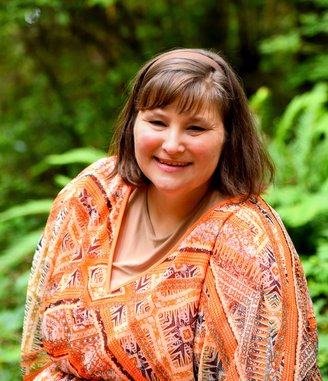
Rhonda
May Grace Olufsen Lebon
Born in Eureka on December 12, 1963, entered into rest September 8, 2021.
Parents, Mike Olufsen and Verna Mincks, both predeceased. She grew up in the Elk River area and attended South Bay Elementary, Alice Birney, Zane Jr. High and Eureka Senior High.
She married Lindsay Lebon and moved to Sydney, Australia where she gave birth her only child, Eric Craig Lebon.
Rhonda and Eric moved back to the United States and resettled in Eureka. She took various classes in College of the Redwoods with an emphasis in Early Childhood Development. She was employed at Diana’s Day Care for several years before changing employment to In-Home Supportive Services as a caregiver.
Rhonda became a born-again Christian in her early life and served many years with the Apostolic Faith Church as a Sunday School teacher and in the music ministry. In 2018 she began attending the Harvest Church - Eureka, where she was loved and valued.
Rhonda struggled with Type I diabetes and the related illnesses that come with that disease; however, that did not stop her from loving God, family and friends. She was known for her sense of humor and big smile.
Rhonda is survived by her son, Eric Lebon (Eureka), and siblings, Dan (Carol) Olufsen (Eureka), Brenda (Bob) Bishop (Richmond), Bonnie (Mark) Jones (Medford, OR), Judi Newbold (Moreno Valley) and a large number of relatives.
Final disposition was handled through Ayers Family Cremation. A celebration of life service will be held on Saturday, November 6, 2021, at 11 a.m. at the Harvest Church in Eureka.
###
The obituary above was submitted on behalf of Rhonda Lebon’s loved ones. The Lost Coast Outpost runs obituaries of Humboldt County residents at no charge. See guidelines here.
OBITUARY: Kenneth Dale Burns, 1954-2021
LoCO Staff / Thursday, Sept. 16, 2021 @ 6:56 a.m. / Obits
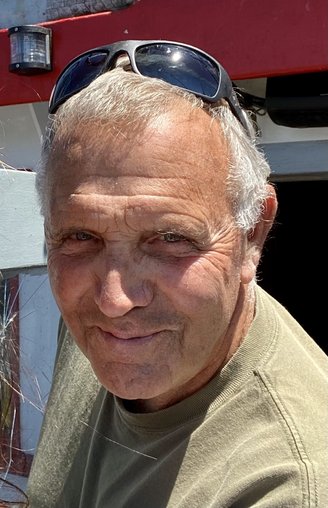
On September 6, four days after his 67th birthday, Kenneth Dale Burns passed in the night. He was the best of us. Whether donned in neoprene in the crashing waves, or atop of his fishing boat off Humboldt Bay, he was the best of us. He loved his wife with a sincerity and devotion that only a man with his capacity for love could achieve. He was the best of us. He had a quiet soul and a stoic presence that made us all feel safe. He was the best of us. His boys adored him and his grandchildren loved him because he was the best of us.
He was a captain, a husband, a father, and a grandfather. He was the rock on which his family leaned on. He was kind, generous and the bravest person we knew. He was hardworking and relentless in his purpose to take care of the ones he loved. His devotion to his family is something his wife and kids will carry with them forever. His legacy is as boundless as the sea he spent his life on. His absence will be felt among his friends and running mates who worked and fished by his side for all these many years.
Kenneth Dale Burns is survived by his loving wife Robin Burns, his three boys — Jeff, Kyle, and Roscoe — his stepchildren: Dylan, Steve, and Jennifer, and all of his lucky grandchildren who adored him: Kadence, Rowan, Axel, Saylor, Brantly, Trinity, Daisy, Gage, Ashlynn, Tommy, and Chaney.
We love you and we will miss you. We look now to the horizon and within ourselves to carry on your memory and honor your soul by becoming the best versions of ourselves. Because you were, and will always be, the best of us.
There will be a celebration of his life in early November, before crab season, for his family, friends, and any fishermen that would like to pay tribute to the wonderful person he was. A set date will be posted at a later time.
###
The obituary above was submitted on behalf of Kenneth Burns’s loved ones. The Lost Coast Outpost runs obituaries of Humboldt County residents at no charge. See guidelines here.
Two Arrested Today After Months-Long Fentanyl Trafficking Investigation, Drug Task Force Says
LoCO Staff / Wednesday, Sept. 15, 2021 @ 4:37 p.m. / Crime
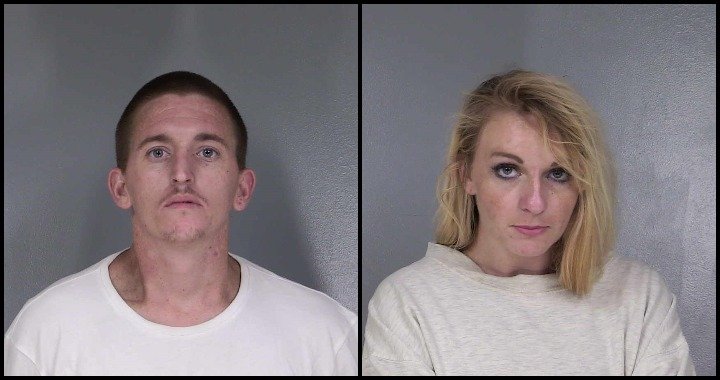
Calvert, Hermes-Lavasseur. Photos: HCDTF.
###
From the Humboldt County Drug Task Force:
On September 15th, 2021, agents with the Humboldt County Drug Task Force (HCDTF), with the assistance of Humboldt County Sheriff’s Office Special Services Deputies, served a search warrant in the 2300 block of Maple Lane in Eureka. HCDTF agents conducted a several months long investigation into Alexander Calvert (28 years old) and Kaira Hermes-Lavasseur (28 years old) for trafficking fentanyl out of the residence.
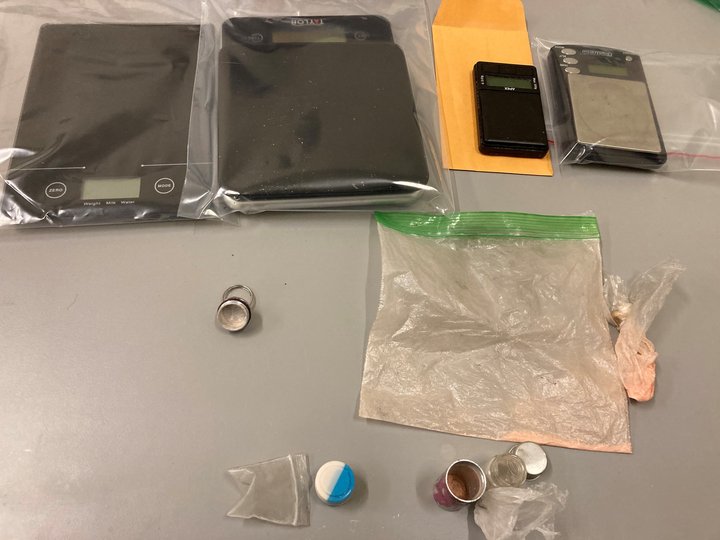
During the service of the search warrant, agents detained Calvert, Hermes-Lavasseur, and 7 additional people without incident. Agents conducted a search and located the following items of evidence: Hermes-Lavasseur was found to have fentanyl hidden on her person. Agents also located three separate packages of fentanyl inside of Calvert & Hermes-Lavasseur’s car along with approximately $1,700 in US currency. A fifth package of fentanyl was located inside a vehicle the suspects use. Inside of the residence, agents also located four digital scales.
The total quantity of fentanyl seized was approximately 17 grams. This fentanyl was unique in that it was bright orange in color. It is common for fentanyl to be disguised in many different fashions to avoid detection from law enforcement. The DEA reports that fentanyl is estimated to be 100 times stronger than morphine and poses a great danger for overdose deaths.
Calvert and Hermes-Lavasseur were both arrested and booked at the Humboldt County Jail for the following charges:
H&S 11351 Possession of a controlled substance for sale
H&S 11366.5 Maintaining or operating a drug house
Anyone with information related to this investigation or other narcotics related crimes are encouraged to call the Humboldt County Drug Task Force at 707-267-9976.
Arcata City Council to Consider Launching Rental Inspection Program to Protect Tenants, Community Ambassador Program to Improve Downtown Area
Stephanie McGeary / Wednesday, Sept. 15, 2021 @ 11:45 a.m. / Local Government
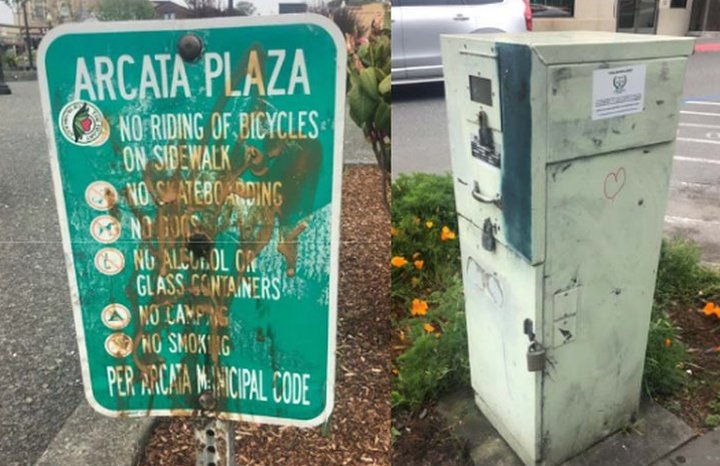
A community ambassador could help with things like graffiti removal in downtown Arcata | File images from the City of Arcata
###
Out of more than 4,000 residential properties in Arcata, city staff estimates that at least half are rentals and is concerned that some of those rentals are aging, deteriorating and possibly even illegal. That’s why the City is looking to improve its protections for tenants’ health and safety through the Residential Unit Inspection Program, which would require inspections of rental properties every three years. The council will consider adopting the program during tonight’s meeting.
If passed by the council, the program would apply only to long-term rentals — meaning properties that are rented for more than 30 days —and would not include vacation rentals or or Airbnbs. Single rooms in owner-occupied residences, mobile home parks and properties less than five years old would also be exempt from the inspection requirements.
Owners of rentals that meet the criteria would need to register with the City (registration fees would vary based on the number of units) and choose to either have the City inspect their property every three years, or to apply for a self-certification program, which would allow the owner to hire their own inspector or inspect the property themselves. The owner would have to “certify under penalty of perjury that the conditions at the property achieve the minimum standards listed on the Self-Certification Program checklist,” the city staff report states. In order to be eligible for self-certification, the property can’t have had any building, housing sanitation code violations within the past three years. Owners would also need to pay an inspection fee of $70 per inspection, or $40 for self-inspection.
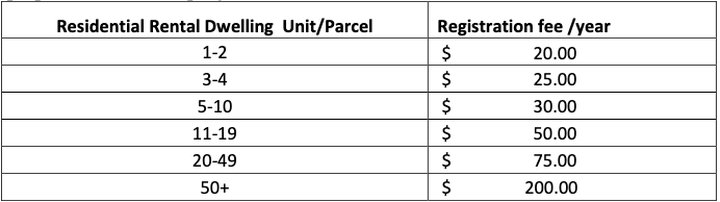
Proposed registration fees for the inspection program, from the City staff report
Not surprisingly, city staff anticipates that most owners will opt for the self-certification, which has caused some concerns for the council. During a meeting earlier this year, the council mostly supported the idea, especially since it could save the city a considerable amount of money on paying their own inspector. But some councilmembers were worried about how reliable the inspections would be.
“We have some really wonderful landlords in Arcata,” Councilmember Emily Goldstein said during the March 17 meeting. “We also have some really terrible landlords in Arcata. Many don’t even live here and aren’t a part of our community.” Goldstein added that she wanted “assurance that there is accountability for landlords who aren’t taking this seriously and aren’t providing safe and healthy places for people to live.”
According to the staff report, the City would be authorized to periodically conduct inspections of all rental properties to ensure compliance. During the March meeting, City Manager Karen Diemer said that the city could also conduct inspections based on complaints and encouraged anyone who suspects a property of not being up to code should call the city.
If a property is found to have a code violation, the owner will have 30 days (possibly more, depending on the nature of the problem) to fix the issue. If a violation is hazardous for the tenants, owners are required to provide them with a hotel or motel until the issue is resolved.
###
In other business, the council will consider launching a pilot Community Ambassador Program and provide direction to staff on how they would like to see the program operate.
The idea of starting a community ambassador program has come up in several council meetings before as a way to promote safety in the community without the need for more police officers and has been suggested as a part of the city’s police reform efforts. Several other cities, including San Francisco and Oakland, now have community ambassadors to serve as a helpful presence in their communities.
Community ambassador duties vary in different cities, but generally include things like engaging with the public and business owners, providing people access to services and assisting with minor maintenance issues, such as trash, graffiti and weed removal. Community ambassadors are also generally trained in de-escalation and can assist deterring criminal activity as well.
“The proposed program would partner with Arcata Main Street starting in the downtown and if successful could branch out to other districts such as Valley West, the Creamery, Northtown and the Marsh District,” the staff report states.
###
The Arcata City Council meets tonight, Wednesday, Sep.15, at 6 p.m. You can view the full agenda and directions on how to participate here.
‘IT STARTS TO HURT YOUR SOUL’: Two St. Joe’s Nurses Talk About Life Inside the ICU During COVID
Jacquelyn Opalach / Wednesday, Sept. 15, 2021 @ 10:42 a.m. / COVID-19 and Humboldt
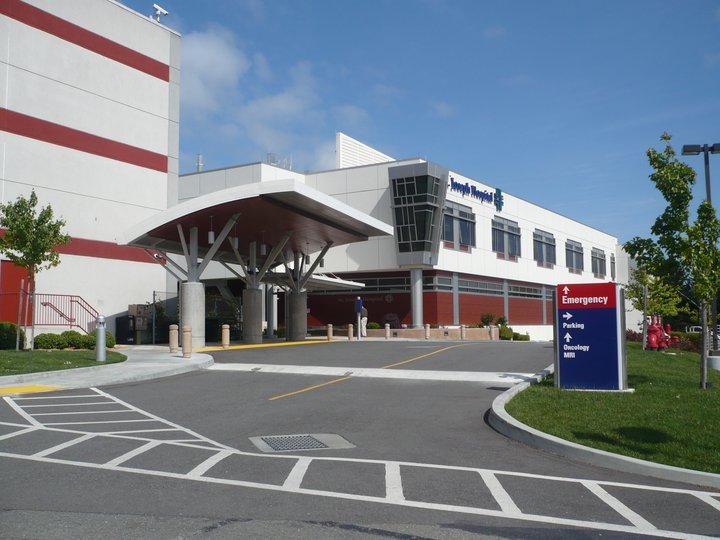
St. Joseph Hospital | Photo: Ellin Beltz, via Wikimedia. Public domain.
###
Humboldt’s daily COVID reports are a heavy weeknight ritual.
First come statistics: How many community members died today? How old were they? We learn new hospital admittance numbers, and their ages, too, then confirmed case counts. We get news and survival tips: No more communitywide contact tracing; additional shots now available to the immunocompromised; please don’t take ivermectin. And finally, in every report, Public Health tries to persuade vaccine-hesitant locals toward a potentially lifesaving choice, with a promise that vaccination is the best way to protect yourself and your community from more days like these, and more reports like this.
One recent evening, after a particularly grim report, a nurse emailed the Outpost.
“I am an ICU nurse at Joe’s,” she wrote. “I would love to talk anonymously about my experience when it is applicable.”
It’s applicable now, we think.
“What I’ve seen over the last — I don’t even know how many months we’re into this — 18 months or so has changed me as a person,” the nurse, who we’ll call Iris, told the Outpost in a phone interview.
“I just wish people could understand what we see every day and what it is actually like to be a patient in the ICU, because it’s brutal, and if it’s one thing I hear time and time again from patients who are not intubated is that they have regret. And that’s, I guess, what led me to reaching out.”
Soon after, we reached a second nurse who works in the intensive care unit at St. Joseph Hospital, and she was also willing to anonymously share her experience. She’ll be called Teresa.
“It’s hard to even talk about this. It’s just so stressful. It’s easier to just shove it down and not talk about it,” Teresa said. “But at the same time, I do want to because I do think there are so many misconceptions about what’s actually happening and whether it’s even happening within our community.”
Staff at St. Joe’s aren’t allowed to speak to media about what it’s like inside. Iris and Teresa both emphasized that the conditions at St. Joe’s ICU are not unique. By sharing their experiences, they are not trying to expose any flaws with the hospital. They want Humboldt to understand the context behind those nightly numbers. They hope to help people avoid regret.
Here is Humboldt’s COVID, as told by St. Joe’s ICU nurses Iris and Teresa.
A virus evolved
Over COVID’s first year in Humboldt County, St. Joe’s ICU saw just a few COVID-positive patients at a time. At St. Joe’s and across the nation, healthcare workers stressed over PPE (personal protective equipment) shortages, ever-shifting Centers for Disease Control and Prevention guidelines, and the unknown threats of the novel virus.
Teresa: Obviously, in the beginning, everybody was scared. We didn’t know what was coming our way. We were kind of bracing for impact.
We had just kind of a slow and steady flow of patients that came in. And at that point in time, we were worried about PPE, but we had it. Our hospital actually has done a good job at providing that. We have really not been without it the entire time.
Everybody was concerned and careful, but there was a lot of fear.
Last year, the pandemic really hit our older folks. 80s, 90s. That was really hard because there were a lot of people that would write off these people that were in their 90s as if their lives didn’t matter anymore. And they did.
People said: “Oh, you know, it’s the end of life.”
I would argue that whether you’re 50 or you’re 99, those individuals still deserved to be given a chance. They still deserved their life and they still deserved to die with their family members.
Then things kind of settled down a little bit, and everybody was very hopeful with the vaccine that it might end altogether.
This year’s COVID is different than last year’s COVID.
Now the situation is we know that people with a vaccine are still getting sick, but they’re not ending up in the ICU, for the most part.
This time around, they’re younger people. They’re people with children, families. They’re not 80 and 90 — I mean, obviously, we have 80- and 90-year-olds that pass — but we have many that are middle-aged or younger.
Now we’re seeing death of people that shouldn’t be dying on almost a daily basis. And that starts to hurt your soul — especially when you know that they could get a vaccination and it wouldn’t have to be this way, that we could prevent some of these deaths.
Inside the ICU
Inside the ICU are twelve single-bed patient rooms with glass doors. A main nurses’ station and several smaller nurses’ stations are scattered throughout the unit, and there’s a workspace for a physician and another for a pharmacist.
There’s also the IMCU, a separate “mild” ICU unit the hospital added because of COVID. It has six beds and is staffed with two nurses, and is separated from the ICU.
The ICU is a closed unit, meaning its staff doesn’t venture into other parts of the hospital. Its rooms are filled with intensive-specific equipment, like ventilators. Because of COVID, each room has been converted into an isolation room. To do that, the hospital installed negative flow units — which prevent air from entering and circulating the hospital by directing it outside — in every room that didn’t already have one, sometimes removing windows to accommodate the equipment. Isolation carts stocked with PPE — like gowns, masks, gloves and face shields — are parked in the hallway outside each room.
Teresa: If you were to walk in the unit, you would see carts and people gowning up to go inside of rooms. You would see lots of engineering staff — they go around and test to make sure that the rooms are, in fact, negative flow and that there’s no flow coming out of the door into the main hallway.
Iris: All of the rooms are telemetry rooms. So they have a monitor that’s monitoring all sorts of data, but the basics are heart rate, respiratory rate, oxygen level, blood pressure — those are the main ones.
And that’s in the room, and that’s at all the other nurses’ stations, it’s hanging from the ceiling, so that we’re always — that’s why I try to reassure people — we’re always watching you. Even if it [feels] like you haven’t seen someone for a little while, we’re always keeping a close eye.
In ICU, you have a doctor (specifically, an intensivist, which is a physician who works solely in the ICU), you have a respiratory therapist, you have a pharmacist, and you have charge nurses (“in charge” nurses who manage the ICU), break nurses (nurses who tend to patients while staff nurses are on their breaks), staff nurses.
Teresa: [Intensivists] usually have a specialty of pulmonology or anesthesiology. They’re usually kind of the cream-of-the-crop physicians, and they have a ton on their plate. A ton on their plate.
Iris: While we each have our own patient assignments, we’re all working together to care for those patients.
Every bed is full.
A shift
Iris: We do 12-hour shifts. We do work from 6:00 to 6:30, plus or minus a little bit of time. Sometimes it’s extra.
We get our assignment. At this point, most of us are taking one, if not two, COVID patients.
We are rounding with our physician. We do that every day, where we talk about each patient on an individual level and kind of go over their body systems. And then [we discuss] what could we be doing next, what’s our plan of care? So that’s evaluated every single day, sometimes more often than just once.
Throughout their shift, nurses manage their patients.
Teresa: Typically that means that we are gowning up, going into these rooms — we have tons of PPE, so that’s not an issue — then gowning down and going into another one.
Several patients are sedated. Those on ventilators can’t easily speak.
Teresa: Many of them require flipping them over on their bellies, and that’s called proning.
Proning helps patients experiencing respiratory difficulties breathe and protects them from developing bedsores.
Teresa: There are a lot of things that come with proning, but it requires a huge amount of people to flip these patients back and forth between their belly to their back because they have breathing tubes and lines and all sorts of things. Many of them [are] on many, many, many drugs, from sedation to pressors to antibiotics.
Iris: We’re assessing. We’re passing meds. And we’re cleaning patients up…We’re doing all sorts of personal care to help keep someone at the best that we can, with whatever they’ve got going on.
Teresa: These patients are really, really intensive. That’s all I can say: They’re critically ill right now. Many of them are kind of holding on by their pinky.
The patients
Most people who become extremely sick with COVID develop hospitalization-worthy symptoms — probably not being able to breathe — between days 6 and 11, Iris said. Once they’re admitted, patients are first put on a BiPAP (short for Bilevel Positive Airway Pressure) machine, and then a ventilator if need be.
Iris: I think what strikes me the most about specifically non-intubated COVID patients — because those are the ones you can really interact with, they’re not receiving sedation or anything else — is how scary it feels to be that short of breath.
I can’t count the number of patients who, for whatever reason, they take off their BiPAP mask or their high flow falls out of their nose, and their saturation starts to drop. And what we see with most of these people — I mean, if you’re this sick to be admitted, specifically to the ICU — is their saturations on just room air, like you and I are breathing, are in the 80s or lower. In a normal healthy person, you should see them in the mid-90s to 100.
So that feeling of being hypoxic — without enough oxygen — and that feeling of not being able to catch your breath, like the hardest workout you’ve ever done and you just can’t catch your breath afterward, is frightening. And to just keep feeling that way — that’s a terrible way to feel. And the anxiety that people feel in conjunction with that? It doesn’t surprise me, because being short of breath or feeling like you can’t catch your breath is a very unnerving and unnatural feeling.
I can’t tell you the number of patients who then have regrets.
After four days in the ICU, one of Iris’s patients asked her a question: “Where do I go from here?”
Iris: I explained the settings that they’re on. They’re on a BiPAP, which is the face mask that’s delivering breaths for them. It’s loud, it’s noisy and it’s uncomfortable, it breaks down the skin around your nose, and it’s at its maximum setting. So the only place to go after this is intubation.
And they asked me: “What percentage of people are we seeing coming off the ventilators?”
Honestly, I didn’t know. I know it’s not great odds, but I had to go ask somebody else.
She learned that less than 20 percent of patients successfully come off ventilators.
Iris: Those are really scary odds.
And this particular patient told me that that is consistent with what they had researched, and they didn’t want that.
So that’s really hard. I mean, they made this choice that they felt like was in good faith, based on information that was false: to not get vaccinated. And now they themselves are kind of facing their own mortality.
As a nurse, I can be frustrated that they made that choice, but on a human level, I’m still caring for someone who’s really sick and is scared. And that’s hard. And it’s like that day after day after day.
Teresa: Many [patients], when they get to the point where they know that they’re going to go on a ventilator, have a breathing tube put in (same thing) — they’re scared. A lot of them regret not getting a vaccine. We have people that ask us for the vaccine at that point, which of course is too late.
But I see on social media people wonder about this.
She sees people speculate that unvaccinated people hospitalized with COVID-19 maintain pride in their choice.
Teresa: I would strongly disagree with this.
There’s nobody, that before you put the breathing tube in, says, ‘Well, I fought the good fight against the government.’ For whatever reason, many people on social media think that this is the case, and I can surely tell you that it is not the case. They’re sad. They’re scared. Many of them regret not being vaccinated in the first place.
And very few — not even very few — nobody sits there and says, ‘Fought the good fight against the government,’ like so many people seem to think.
Patients and their families
In this COVID age, visitors are not usually permitted inside the ICU. Recently, the hospital instituted an exception.
Teresa: When a person is passing, if [their family member] is fully vaccinated and has a COVID test, I think within 72 hours, they can sit at the door, outside of the glass, to view their loved one, which is terrible.
In that situation, or when family members are not able to come in person, they can talk to their loved one through a phone.
Teresa: Mostly these people have breathing tubes. Often the nurses will get the phone, and they’ll put the phone up to the patient’s ear, so that their loved ones can talk to them.
We do that all the time.
That’s heartbreaking. It’s really heartbreaking to listen to people say goodbye to their loved ones on a phone. It’s awful. It really wears you down.
The nurses watch their patients’ sickness progress, and hopefully regress, and communicate changes to families.
Teresa: We’re talking to families, day in and day out, all through the day, about their loved ones.
Iris: Everyone’s different, but on average, a family calls two or three times a shift maybe, probably more so on a day shift than a night shift. And then, of course, if something changes, we would reach out to them.
You’ve got families who can’t come in, and they’re scared at home — either sick or healthy — wanting updates. And so often it’s like, ‘No change, no change.’ It’s the long haul. We’re waiting ‘til something does change, hopefully for the better. But it’s scary.
Teresa: Families are often just bewildered how this could be.
They’re so bewildered that their loved one even has it, or that this is happening. You get a lot of: “I can’t believe this is happening”, “Why is this happening?”, “My loved one is healthy, I don’t understand.”
And we continue to try and educate them.
Iris: For the most part, people are really understanding, are grateful, really thankful. I’d say 95-plus percent of people are that way.
We have had a few instances of family members playing Dr. Google — where they’ve read something online, or they saw something on Facebook, or a cousin told them about something — and they get frustrated that we don’t practice Google medicine. We practice evidence-based medicine.
Teresa: Some [families] wonder if [their loved ones] even have COVID. A lot of them are very angry and upset. A lot of them have heard of all these viral ideas and medications that have kind of come down through Facebook and other avenues of social media; what their loved ones should take. So we often get requests for experimental drugs that have no studies done supporting their use. They often are very upset at us because they believe that we’re withholding these medications from their loved ones.
It makes for a very, very tricky situation.
It’s hard on us nurses to have these patients and families that are unwilling to take what they call an experimental vaccine, but they demand experimental medications, it seems.
I think that’s really hard on the staff because it doesn’t make sense to us.
Difficulties
As more patients seek help and the pandemic wears on indefinitely, St. Joe’s is facing challenges. They’re losing staff, and the beds are full.
Iris: We were busy before COVID was like this. I mean, a year ago, we had one or two or three COVID patients, but we still had 12 total patients [in the ICU].
It makes me wonder: Where are all those patients? What is happening to them? They’re not all elective surgeries. They’re people who are getting sick and needing intensive care for other reasons…various different disease processes or illnesses that require the same level of care. We’re full of mostly COVID, so we can’t offer those services. Just makes me wonder, where did all these other patients go? They’re out there somewhere.
Teresa: [If a new patient is] ICU status, and they need a bed, and we don’t have a bed? Well, if we have a patient that can be downgraded, we would downgrade another patient. Otherwise, we look for a place to transfer them to, which is very, very difficult right now, too, because every hospital is full.
Iris: I know there’s all this talk about ‘Oh, there’s so many available other beds!’ But you have to understand what that really means. In the actual ICU we have 12 rooms. There are other beds we can convert ICU beds, but that’s not ideal for so many reasons.
Remember that the ICU is a closed unit filled with specific equipment and staffed with physicians and nurses who specialize in intensive care.
Iris: Now, say they’re opening up beds in another part of the hospital. You don’t have those same resources, you don’t have people at your disposal to help care for the sickest of the sick. And that’s scary.
St. Joe’s is low on staff, too. Two of their three resident intensivists recently left the hospital, and nurses aren’t staying, either.
Teresa: Now we’re relying on what is called locums, and those are traveling physicians. We have kind of a revolving door of traveling intensivists that are coming on.
Our manager in the hospitals [is] actively recruiting, but it’s an incredibly hard time to recruit new nurses. We do have a lot of them coming on board, but that involves a lot of training, so the nurses that are already there are still having to pick up shifts to make up for the ones that left, until the new ones are ready to be on their own.
We’re all picking up shifts when we can. Because of the burnout, people are making different decisions. Possibly they don’t want to work as a bedside nurse anymore.
I’ve heard, throughout the hospital, a lot of people [are moving] back to where their family is. I think people have reprioritized what they care about through this whole thing. I think that’s not only happening here, within the hospital, but it’s happening across the board.
There is a lot of sadness because we have so many of these critically ill patients. We’re working harder, and so there’s more burnout. People are tired. At this point, it’s been kind of a long haul. And it doesn’t feel like there’s an end in sight, because there are so many people that choose not to be vaccinated for whatever the reason is.
It starts to feel a little hopeless when you see so many people dying, and still people [are] refuting that it’s even happening.
I think we (nurses) all talk with each other like, “If only people could see what’s actually happening, if only they could understand what’s happening here, they might change their mind.”
Outside the ICU
The messages that lead some to doubt COVID are everywhere, from Facebook to the sidewalk in front of St. Joe’s. It’s hard to avoid and it weighs on healthcare workers.
Iris: I’m frustrated with the amount of misinformation that gets disseminated amongst people, specifically on social media.
Teresa: We all felt repulsed by whoever decided to do that demonstration outside of the hospital. I think that that really hit a lot of the caregivers hard. And it hurt pretty badly, not only for the caregivers. I would imagine patients’ families might be hit by that as well.
That protest was advertised by an organization called America’s Healthcare Workers for Medical Freedom. Teresa heard from others that some protesters were wearing fake stethoscopes, though she didn’t see that herself. None of her coworkers she’s spoken with since recognized any demonstrators as local healthcare workers.
It just felt like a huge slap in the face, when there are people dying inside the hospital.
Iris: I think people forget that as nurses and practitioners and providers, we’re just people too. People you live with, in some cases, or your neighbors or friends of friends. We’re all one degree separated here in Humboldt.
I know there was an article in the Times-Standard, a month or so ago, about a gentleman who was in the ICU who has since changed his mind and convinced others to get vaxxed, and I applaud him. I wish more patients or their family members would speak up who’ve had that same experience.
I can say it all I want, and doctors can say it all they want, and things like that, but when we hear it from somebody and they describe their experience, I think it hits kind of a different tone with people.
We’ll keep doing what we’re doing. But it’s hard.
Teresa: I would like people to know that these are real people. These are your neighbors, the person that works at the restaurant, or businesses that you frequent. These are real Humboldt families, individuals, that are in the hospital and are dying unnecessarily. If it wasn’t for COVID, they would not be dying. And they are.
I think we lose touch and we think if it’s not happening to one of your loved ones — friends, family members — you think that it’s not happening.
Until it’s your family member, it’s unreal. But I assure everybody: these are real people — that we live with, that we live next to, that we know — that are in there, dying, or fighting for their lives.
The easiest way we could turn things around is by vaccinating.
I’m not pretending that you won’t get COVID [after] being vaccinated, but the likelihood of being in the ICU is drastically reduced. These people — or 99 percent of them — are unvaccinated. It’s the easiest thing people could do to protect their loved ones and their family.
If not doing it for yourself, do it for your family members. Humboldt needs to come together and support each other and fight for each other and unify in that we all love each other.
We can do this as a community.
I think that’s about it.
OBITUARY: Barbara Ann Tomascheski, 1961-2021
LoCO Staff / Wednesday, Sept. 15, 2021 @ 6:56 a.m. / Obits
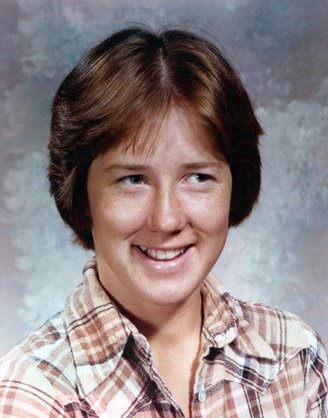
It
is with heavy hearts that we announce the passing of Ann Tomascheski.
Barbara Ann Tomascheski was born April 27, 1961 in Sparks, Nevada to Bud and Norma Tomascheski. The youngest of six, she was a striking child, with her blue-green eyes and chestnut hair. The family moved many times in her youth, but Ann, as she preferred to be called, always took it in stride. She attended schools in Reno, Boise and Reno again before finishing her highschool education at Eureka High School.
Ann would go on to Humboldt State University and then Chico State, where she graduated with a B.A. in child development in 1984. She would later return to Humboldt State and graduated with a masters in Speech/Language Pathology in 1992.
After
completing her studies, Ann became a speech and hearing specialist
for Eureka City Schools where she worked until her retirement in
2019. She certainly enjoyed helping children overcome their
difficulties with language.
Ann
enjoyed shopping for shoes and purses, traveling and a good brunch.
She always looked forward to planning another cruise or a trip to
Europe with her sister Liz.
She
is preceded in death by her parents Bud and Norma, and her sister
Patricia. She is survived by her brothers Dan Tomascheski (Jeanne),
and John Tomascheski (Christine), and sisters Dolores Blanc (Victor),
and Liz Tomascheski-Adams (Michael) as well as many nieces and
nephews.
A celebration of life will be held on the 25 of September, from 2 to 5 p.m., at Old Growth Cellars in Eureka. The family would like to thank Ayres Family Cremation, all of her friends at Eureka City Schools and Lafayette Elementary School, as well as her caring neighbors. We would especially like to thank her good friends Jodi and Vanessa for all they did for Ann.
###
The obituary above was submitted on behalf of Ann Tomascheski’s loved ones. The Lost Coast Outpost runs obituaries of Humboldt County residents at no charge. See guidelines here.


