Flora Egidia O’Donald was born September 16, 1930, and passed away June 10, 2021.
She was 90 years old, born at Scotia hospital to Giovanni and Emma Mela. She was the
youngest of three. After attending grammar school in Rio Dell and then graduating from Fortuna
High school in 1948, she moved to San Francisco to study Fashion Design. At age 21 she
contracted polio and spent weeks in the hospital. The polio had weakened her legs and stomach
muscles for the rest of her life.
In 1956 she married Robert (Buster) O’Donald and had two children, Dana and Kelly.
Flora was a devout Catholic. She also was a talented artist, painting murals for St. Patrick’s
Church and nature scenes or portraits for family and friends. She was also exceptionally good
at sculpting and sewing.
When her daughter Dana was diagnosed with leukemia, Flora dropped everything and
rushed up to Oregon to help Dana’s husband Rod take care of their two young sons Ross and
Ryan for a year. Flora was the most unselfish and giving person. Her concerns were always for
others. Flora was a true cancer survivor. In 1980 she was diagnosed with breast cancer. She went
through surgery, chemo and radiation treatments. And the cancer went into remission, only to
have it come back a year later. She went through the same treatments again, and the doctor told
her the prognosis was poor. But the cancer stayed in remission for the rest of her life.
Flora was preceded in death by her parents, Giovanni and Emma Mela, her husband Robert
(Buster) O’Donald, her daughter Dana Marie Wilson, sister and brother in law Alice and Pete
Silbernagel, sister in law Jackie Mela, nephews Ron and Paul Mela, nieces Danielle Saffell,
Janice Mela, good friends Wilma and Jack Thompson, Lillian Pasquini, and more.
Flora leaves behind her brother Albert Mela, her son Kelly and wife Sandy O’Donald,
granddaughters Hayli and Alli O’Donald, son in law Rod Wilson (Clare), grandsons Ross
Wilson (Lauren), Ryan Wilson (Katy), niece Denise Sweaney ( David), and nephews John Mela
and Jack Saffell, and good friends Gloria Grundman and Carol Richardson, and others.
Special thank you to the caring staff at Mad River Hospital, Dr. Kim Ervin, her
hospice care team, and Dr. Dittmer.
Services will be held June 24 at the Ferndale Catholic Church with the Rosary starting
at 10:15 a.m., followed by the Chaplet of Divine Mercy and Mass. Graveside service at 1:00 p.m. at
Oceanview Cemetery. Funeral arrangements by Gobles Mortuary. Donations may be made in
Flora’s name to Hospice of Humboldt.
###
The obituary above was submitted on behalf ofFlora Egidia O’Donald’s loved ones. The Lost Coast Outpost runs obituaries of Humboldt County residents at no charge. See guidelines here.
Is this a mockup for the proposed Saudi Arabian city of Neom? Or could it be Eureka in five years? Only attendees of tonight’s meeting can know for sure. | Image: Government of Saudi Arabia
###
If you live, work or spend any time in Eureka, then you likely care (or at least you should) about the city’s economy. And you probably have some ideas on what sectors you’d like to see Humboldt’s largest city prioritize when it comes to economic development, yes? Well, you can share your two cents with city staff and learn more about Eureka’s draft Economic Development Strategic Plan during a virtual public meeting tonight!
Here’s more information and directions on how to participate, from the City of Eureka :
The City of Eureka Economic Development Department is
currently updating its Economic Development Strategic Plan. The updated plan will outline
critical initiatives and highlight milestone projects and focus areas that will govern economic
development staff resourcing for the next five years.
An initial draft plan has is being developed with input from many critical community
stakeholders, but city staff wants to ensure every interested citizen has an opportunity to learn
about, fully consider, and help shape the final document.
On June 22nd at 5:00 p.m., the City of Eureka will host a virtual meeting to share the draft plan,
answer questions, and seek public input. All citizens and community stakeholders are
encouraged to attend. Pre-registration is not required, and interested participants can join via
Zoom using the link below.
Audio Access Phone Numbers: 1-669-900-6833 OR 1-408-638-0968
“I want to encourage everyone to join the virtual meeting on June 22. COVID-19 recovery is
underway, tourism is coming back, and essential momentum is building. Every citizen needs to
understand just where we are focused and why. And, of course, if we’ve missed anything along
the way, we want to hear about that too. Now is a great time to get involved,” City Manager
Miles Slattery said.
The Humboldt State University Police Department is aiming to create a new unarmed campus security position by January in response to recent requests from the campus community.
UPD Chief Anthony Morgan told the Outpost that the unarmed, non-sworn-in employee will patrol campus with little more than a uniform, radio and flashlight, and respond to non-urgent problems like noise complaints and vehicle lockouts.
“HSU’s sworn officers have an important role in campus safety,” Morgan said. “At the same time, members of the campus community wanted to see unarmed civilian responders to help students feel safer. In response to that, we’re updating an existing position as a Community Service Specialist position.”
Instead of requesting funds for an additional employee, Morgan said that UPD will replace its Clery Coordinator position — a job that is now handled by an HSU employee outside of UPD — with the new unarmed campus patrol position.
While other universities have taken more extreme measures — like Portland State University, which announced earlier this month that it will disarm all of its patrolling police officers by the fall semester — the California State University System told the Outpost that it has no plans to disarm its officers.
“During our May Board of Trustees meeting, CSU Chancellor Joseph I. Castro took the opportunity to confirm the important value that university police departments provide in maintaining the safety of CSU campuses,” CSU Director of Strategic Communications and Public Affairs Toni Molle said. “He shared that CSU will not defund, disarm or dissolve police departments, so we are not considering actions similar to those [at Portland State University].”
While HSU’s new unarmed patrol position will start with one employee, Chief Morgan said that he hopes to build upon the position by adding more employees and training them to handle additional duties like mental health responses.
“There are going to be times, as we get them training for mental health response, where they will be able to respond to calls for mental health concerns,” he said.
While Morgan plans to have the unarmed employee on duty by early next year, he said that UPD still has to advertise the position, go through the recruitment and background process and give students a say in the hiring before a candidate can be selected.
“I look forward to working with students, faculty, and staff representatives of our Campus Safety and Police Committee to strategize ways UPD can enhance the student experience,” he said.
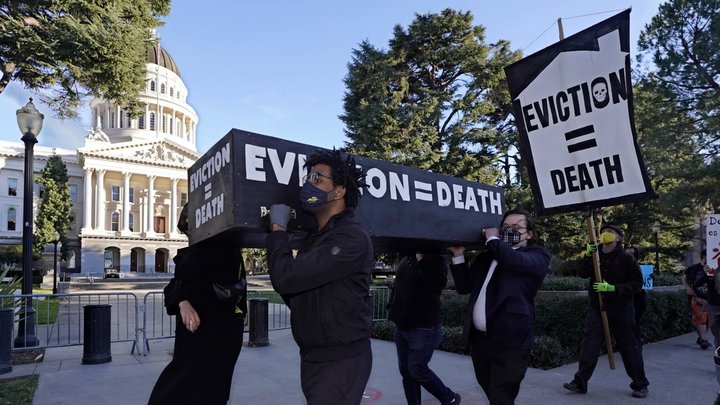
Demonstrators calling for lawmakers and Gov. Gavin Newsom to pass rent forgiveness and stronger eviction protections carry a mock casket past the state Capitol in Sacramento on Jan. 25, 2021. Photo by Rich Pedroncelli, AP Photo
For the third time during the pandemic, California legislators have pushed off a huge, looming question to the last minute: Will the state shield tenants from eviction?
The answer, most likely, is yes, but for how long and under what terms is still up in the air. Several lawmakers told CalMatters a decision could come late this week — only days before current protections are set to expire, after June 30.
Rental assistance is the key here: The state has been doling out $2.6 billion it’s sitting on at a snail’s pace, while figuring out what to do with an additional $2.6 billion from the federal government.
Since Gov. Gavin Newsom and the Legislature passed the last round of eviction protections in late January, the state has distributed only about $50 million of its $1.4 billion pot, and received applications for only about half of that money. While centralized data is unavailable for the cities’ and counties’ $1.2 billion share, there are similar reports of a slow rollout.
Key legislators are concerned about ending eviction protections before the bulk of those dollars have entered the pockets of the Californians who need it most, so they’re mostly hammering out new rules on eligibility and applications to make sure more rent relief gets out quicker.
“It doesn’t make sense to allow evictions, when there are still billions of dollars available that could prevent those very evictions,” said Assemblymember David Chiu, a Democrat from San Francisco who leads the Assembly Housing Committee and helped craft the original eviction moratorium last year.
But the deal-making to extend the eviction moratorium has been slow and secretive. Tenant and landlord groups told CalMatters they have been shut out of negotiations, which are taking place between Assembly and Senate leaders and the governor’s office — similar to the last two rounds of negotiations.
“Policymakers have been pulled in many directions, but I’m hopeful that the right conversations are happening, and we’re going to make progress before June 30,” Chiu said.
A deal could be unveiled as soon as today. Lawmakers will have to wait 72 hours from the time they get a bill on paper before taking a vote and getting something to the governor, which means Thursday is the earliest an extension could be finalized.
Here are some key decision points that will determine the fate of thousands and thousands of California renters:
How long will new protections last?
That question is at the heart of the debate. Tenant advocates want to extend protections for as long as possible, while landlord groups want the opposite.
Brian Augusta, legislative advocate for the California Rural Legal Assistance Foundation, said the tenant side has asked the state to tie the end date to distribution of all available rental relief funds — which at the current pace would take several months, at least.
“In my mind, it would be a travesty to end these eviction protections before we get every dollar out the door,” Augusta said.
Landlord advocates are concerned about the same issue, but want protections to end by September.
“We’d rather not have an extension at all, but we need to get the money out,” said Debra Carlton, executive vice president of the California Apartment Association. “That’s our number one focus. If that means a short, short-term extension, so be it. But the focus has to be on getting the money out.”
Another point of contention: The association wants the law to protect from eviction only those who have applied and are eligible for funds, while tenant advocates want blanket protections that also cover those who have struggled to learn about and apply for the program.
Augusta, on the tenants’ side, is fearful that sunsetting the protections while the Legislature is out of session — between Sept. 10 and Jan. 3 — would mean no one will be around to reassess and fix the rent relief program.
Another timeline tenant advocates are pushing is to link protections to an improved economy with lower unemployment.
“The concept is:Do people have their jobs back? Because if people don’t have their jobs back, they’re not going to be able to pay rent,” said Shanti Singh, communications and legislative director for Tenants Together, a statewide advocacy coalition. “It’s not rocket science.”
While the state has now reopened and life in California is returning to normal for many, many employees in lower-wage sectors are still out of work. Last month, CalMatters reported California still has the nation’s second-highest unemployment rate and has regained only 48% of jobs lost amid the pandemic.
“While the economy is coming back, there are still millions of struggling families, and we need to make sure that they’re not going to be evicted while there’s still money available to help them,” Chiu said.
How much will rent relief cover?
The most recent round of rent relief allowed landlords to collect aid totaling 80% of unpaid rent through March 2021, as long as they forgave the rest. If a landlord turned down that deal, the tenant could collect 25% of the rent owed and have the rest of the debt relegated to small claims court.
Tenants have argued that the formula gave them the short end of the stick, should landlords choose to turn down the money. The 25% payment guaranteed only that a renter wouldn’t be evicted, but could still saddle them with debt.
Rent strike signs are posted in the front window of an East Oakland home on May 6, 2021. Photo by Anne Wernikoff, CalMatters
In his May budget proposal, which legislators are now hashing out, Newsom called for state dollars to cover the full amount of missed rent — a proposal both the tenant and landlord groups have welcomed.
Newsom also suggested that money could go directly to tenants — as opposed to waiting until landlords accept the aid. That’s something the landlord groups are less than thrilled about.
“We think there will be huge abuse,” said Carlton, from the Apartments Association.
Chiu said the money could only be used to pay rental debt: “The two implications from that are: The landlord would not have to forgive any of that debt, and the tenant would receive coverage for everything that they owe.”
Under the current protections, tenants who had moved out to save on rent were ineligible for relief, because it was designed only to keep current tenants housed. Advocates are hopeful that will change in the new bill.
Another gaping loophole: Will people who took out loans from friends, banks, or payday lenders qualify for the money, as it isn’t a direct debt to the landlord? That remains to be seen.
Why has it taken so long to distribute rental assistance?
The existing moratorium laid out several ways the $2.6 billion would reach residents: The state would distribute it; cities or counties could do it themselves using the state’s rules; or the jurisdiction could distribute its share of federal dollars with its own rules, and let the state distribute the rest.
In all, the state was responsible for $1.4 billion. It has distributed a little more than $50 million to about 4,400 families, and received requests for about $616 million, according to data provided to CalMatters by the state’s Business, Consumer Services and Housing Agency.
By contrast, an analysis by PolicyLink, an Oakland-based research group, suggests that about 758,000 households in California are behind on rent, and owe a total of $3.5 billion. A newly released survey by the Terner Center at UC Berkeley — of 8,605 families renting from one of the state’s biggest nonprofit affordable housing developers — found that the number of tenants who couldn’t pay rent more than doubled during the pandemic, with Black and single-parent households hit hardest.
So why the disconnect between the need and the response? A recent survey of 177 tenant advocates found several culprits: trouble applying in languages other than English and Spanish, a lack of digital proficiency, and difficulty gathering documentation to prove eligibility for the relief.
Russ Heimerich, spokesman for the Business, Consumer Services and Housing Agency, said the daily average of people applying for rent relief skyrocketed by 70% the week of June 11, when his agency simplified the application.
“So it’s working,” he said.
But Singh identified another reason for the slow rollout: “A lot of the burden of the outreach basically is on structurally underfunded and understaffed community organizations, and so a lot of people just don’t know” that rent relief is available.
In cities that handled their own rent relief funds, including San Francisco, programs got underway less than a month ago, because they were working out who would be eligible for their limited funds.
Riverside County also came up with its own rules, but earlier in the process, and decided tenants and landlords would get 100% of the rent owed — as some lawmakers are hoping to replicate at the statewide level.
Compared to the $50 million in relief to 4,400 households in the state’s program, the county has sent more than $21 million to about 2,600 households, according to Mike Walsh, deputy director at the Riverside County Housing Authority, where applications exceed available dollars. He has a different ask for the Legislature: “Can you just please make this simple?”
Walsh said that he’s heard that landlords’ attorneys were not thrilled with the state’s 80% deal, so it took effort to get the word out that the Riverside County program was different. But as soon as the county runs out of funds, the state is supposed to step in with its own program. Walsh hopes for some streamlining to avoid the confusion of separate rent relief efforts with changing rules.
Why are evictions still happening?
Tenant advocates say that the current eviction protections aren’t really a moratorium because evictions have been ongoing. Singh, from Tenants Together, said her organization has been flooded with more calls this year than in the organization’s 13-year history. It brought on two more staff members just to handle calls.
The group’s staffers, volunteers and lawyerssay they have seen an uptick in informal evictions brought on by landlord harassment and legal cases over nuisances and renovations. That’s because the law only prevented landlords from kicking out tenants over missed rent.
“There should be additional protections to protect tenants from eviction, period, because we know that there’s lots and lots of other ways that people can be forced out,” Singh said.
For weeks, her organization has heard of pre-emptive threats of eviction: “Come July 1, you’re gone,” she said tenants have reported their landlords telling them. She hopes the Legislature will change that.
###
CALmatters.org is a nonprofit, nonpartisan media venture explaining California policies and politics.
A physician’s assistant listens to a patient’s heartbeat at a clinic in Bieber, California. The Legislature’s budget would expand Medi-Cal. Photo by Anne Wernikoff for CalMatters
Kming Rosenthal recently inherited $5,000 after her birth mother passed away last year. Rosenthal, 72, who lives off her social security disability benefits and doesn’t have much in savings, welcomed the extra cash.
She planned to deposit most of the new money in her savings account, but soon learned that if she wanted to keep her free Medi-Cal coverage, she couldn’t have more than $2,000 in the bank because it would disqualify her from Medi-Cal under what’s known as the “asset test.”
Rosenthal, who lives in Orange County, panicked. She needs Medi-Cal, the state’s insurance for low-income Californians, to help cover her pricey HIV medication and other costs not fully covered by Medicare, which covers seniors. She had to spend the money — she bought a new bed and a refrigerator — so that it wouldn’t affect her eligibility.
Now she wishes she’d waited. “I’ve recently run into some shortages and I think, ‘if only I could have kept more of that money,’” she said.
It’s too late to help Rosenthal, but the California Legislature is seeking to eliminate the Medi-Cal asset test once and for all.
In its budget approved earlier this month, the Legislature included an ongoing $105.7 million to cover the expected increase in Medi-Cal enrollment as a result of axing the asset limit. A final budget is still pending as negotiations with Gov. Gavin Newsom continue this week.
The governor’s May budget revision did not address the Medi-Cal asset test and he has not commented on it publicly.
The Legislature also is negotiating or awaiting final approval for other Medi-Cal changes, including:
Allowing older, undocumented Californians to sign up for Medi-Cal at either 50 or 60 years of age. Setting the minimum age at 60, as proposed by Newsom, would add an estimated 89,000 new people to the Medi-Cal rolls by 2024-25 and cost about $1 billion annually. The Legislature’s budget starts the expansion at age 50.
Extending how long women can stay on Medi-Cal post pregnancy from 60 days to a year. This expansion would be in place for five years.
Adding doula services for pregnant women as a benefit covered by Medi-Cal starting on Jan. 1, 2022.
Removing expiration dates for “optional benefits” — such as speech therapy, eyeglasses and podiatry services that states are not required to cover. These benefits were eliminated during the Great Recession and restored in 2019, but have expiration dates.
“This is a complete 180, from potential cuts and rationing to program expansions,” said Linda Nguy, a policy advocate with Western Center on Law and Poverty.
Last year, as the state planned for a budget deficit induced by the coronavirus pandemic, advocates feared losing some of the Medi-Cal gains achieved in the past years as the state recovered from the Great Recession. Although most programs stayed as is last year, planned program expansions were put on hold.
Now, with a $76 billion surplus, Newsom and lawmakers are discussing offering more benefits to more people for longer periods of time.
As of March, 13.7 million people — about a third of the state’s population — were enrolled in Medi-Cal. That’s about 1.2 million more people than were enrolled a year earlier because people lost jobs and wages during the pandemic. Nationally 10 million Americans enrolled in Medicaid, the federal insurance program for the poor, during the pandemic, according to a federal report.
Claire Ramsey, an attorney with Justice in Aging, said given the need and the state’s strong economic standing, now is the time to expand Medi-Cal to people who have been left out and eliminate outdated barriers.
For years, advocates and some lawmakers have been proposing to expand Medi-Cal benefits to unauthorized immigrants. They’ve succeeded through a piecemeal approach, first opening the program to undocumented children and then young audlts up to age 26. Older adults would be the latest addition.
A separate bill by Assemblymember Joaquin Arambula, a Fresno Democrat, seeks to expand Medi-Cal to all income-eligible undocumented immigrants, regardless of age.
People without legal status are barred from federal health coverage programs under the Affordable Care Act — commonly known as Obamacare — so health expansions for this population must be paid by state-only funds.
One thing Obamacare did do is eliminate Medicaid’s asset test for most people. It only applies to seniors and people with disabilities, driving financial instability among these already vulnerable groups, Ramsey said.
But, as Kming Rosenthal found out the hard way, besides needing a low enough income to qualify for Medi-Cal, a person cannot have more than $2,000 in certain types of assets; the limit for a couple is $3,000. These thresholds have not changed since 1989, when the average movie ticket cost $4.
The thinking is that if people have over a certain amount in resources, then that money could go toward paying for health care. “That means people can’t save for uncovered health expenses…or a move; a month’s rent and deposit are more than that,” Ramsey said.
And the rules can get complicated, leaving some people confused about what counts against their eligibility. Checking and savings accounts, cash on hand, a second car and life insurance count in the asset test, but a home and one car are exempt. Ramsey said that means low-income renters whose only assets may be in cash are at a disadvantage.
Close to 18,000 people could become newly eligible for Medi-Cal if the state eliminates the asset test, according to a March 2020 report from the Department of Health Care Services, which oversees the Medi-Cal program.
Assemblymember Wendy Carrillo, a Democrat from Los Angeles, introduced a bill that also seeks to repeal the asset test in case it doesn’t get done through the budget. AB 470 builds on legislation from 2019 that sought to increase the limit of countable assets from $2,000 to $10,000 for an individual. That two-year bill was shelved during the pandemic.
Ramsey said health advocates are not concerned that eliminating the asset test would allow rich people to get on Medi-Cal. “That’s a unicorn problem; we’re talking about a person who would have to be very low income but somehow rich in assets. If you could afford to get care anywhere, I don’t think you’d pick a Medi-Cal bed,” Ramsey said.
Many people on Medi-Cal may not even know about the asset rule until it comes time to renew their coverage.
“This state, of all states, needn’t look very far to see how many people are living in the streets,” Rosenthal said. “One misstep with my benefits and that could be me, and with my health conditions, that truly would be a death sentence.”
###
CALmatters.org is a nonprofit, nonpartisan media venture explaining California policies and politics.
Avelo, the California Redwood Coast’s newest and only low-fare airline, is celebrating the resilient Class of 2021 and the return to travel this summer by gifting 42 round-trip tickets to recent graduates residing in the Arcata / Eureka region.
In all, 21 Class of 2021 grads from Humboldt County will win two round-trip tickets [to Los Angeles] as part of the Avelo Grads-on-the-Go sweepstakes. Anyone 18 or older residing within 150 miles of the California Redwood Coast-Humboldt County Airport (ACV) graduating in 2021 from high school, college, university or technical/trade school is eligible to participate. Graduates can enter at aveloair.com/grads.
“This has been a challenging school year for students trying to remain academically engaged while often studying remotely,” said Avelo Chairman and CEO Andrew Levy. “The California Redwood Coast is home to dozens of schools. We are inspired by the perseverance of the Class of 2021 and we can’t imagine a better graduation gift than to help fuel their inspiration to travel and explore new places.”
Graduates can earn a second entry — increasing their chances of being selected — by posting a picture or video related to their graduation on Twitter or Instagram, and tagging @AveloAir and #AveloGradSweepstakes. The entry deadline is July 20, 2021 and winners will be selected at random by August 17, 2021. Travel must be completed by December 31, 2021.
Avelo is giving away more than 500 round trip tickets to graduates across the 12 communities it serves in the Western U.S.
Decision-time approaches for Sun Valley Floral Farm’s controversial proposal to develop an eight-acre cannabis farm in the Arcata Bottoms.
The Humboldt County Board of Supervisors on Tuesday will hear an appeal of the Planning Commission’s 5-2 approval vote, back in April. The project has drawn vociferous objections from a subset of Arcata residents and some cannabis industry folks.
As previously reported, the proposal — technically put forward by Arcata Land Company, LLC, which is controlled by Sun Valley — would include eight acres of cannabis cultivation, in both mixed-light greenhouses and light deprivation structures, along with 30,000 square feet of nursery. Water would be supplied by an existing well, and Sun Valley has agreed to purchase 100 percent renewable grid power through Redwood Coast Energy Authority.
The grow op would be located adjacent to Sun Valley’s existing flower cultivation operations and employ up to 80 full-time workers.
The eight-acre cultivation are would be significantly smaller than the original plans, which called for 36.87 acres. That was later reduced to just under 23 acres to meet the county’s property line setback requirements, then reduced again in an effort to appease critics. Still, if the approval stands as-is then this eight-acre farm would represent the largest legal weed grow in Humboldt County to date.
The appeal was filed by a group of 28 people, most if not all of whom are neighbors who take issue with Initial Study/Mitigated Negative Declaration (IS/MND) prepared by the county. These appellants say the environmental document includes false or misleading statements and inadequate analysis, and they’re calling on the Board of Supervisors to either reject the project or at least require a full Environmental Impact Report (EIR).
As for specifics, the appellants have articulated concerns about the project’s water and energy consumption, traffic impacts on Foster Avenue and the plant’s distinctive odor, among other issues. Sun Valley and county staff, meanwhile, say all environmental impacts will be mitigated to insignificant levels.
In a staff report prepared ahead of Tuesday’s meeting, the county says none of the appellants’ objections point to a procedural or factual failing in the environmental analysis and therefore the board should deny the appeal and approve the project. Importantly, though, this will be a de novo hearing, which means the board can consider new evidence, should any arise.
The hearing is scheduled for 10:30 a.m., and though California has mostly reopened the county is still holding its meetings virtually. If you’d like to submit public comments via Zoom, here’s what you do:
call 669-900-9128,
enter Meeting ID 947
1093 6411, and
press star (*) 9 on your phone to raise your hand.
Oh, and you should turn down the volume on your computer or TV because the audio can interfere with your call, and also because the video playback of the meeting typically runs behind realtime by a few seconds to several minutes.
Alternatively, you can email the board ahead of the meeting via cob@co.humboldt.ca.us. If you miss the meeting, check the Outpost afterwards for a report on the hearing along with other highlights from Tuesday’s meeting.





 Rent strike signs are posted in the front window of an East Oakland home on May 6, 2021. Photo by Anne Wernikoff, CalMatters