

BOOM: The Eureka Police Department Invites You to Narc on Your Illegal Fireworks-Shooting Neighbors Using This Handy Form
Andrew Goff / Thursday, June 10, 2021 @ 12:53 p.m. / Community
Eureka Police Department press release:
In response to the growing number of illegal firework complaints over the years (a 137% increase from 2019 to 2020), the City of Eureka has created a new form to report illegal fireworks. The form can be found on the Eureka Police Department website eurekapd.net or here. Completed forms can be submitted by email, mail, or in person and will be reviewed by both Eureka Police and Humboldt Bay Fire.
California Health and Safety Code HS 12677 makes it a crime to possess dangerous fireworks without a valid permit to do so. The use of illegal and dangerous fireworks can cause injury, death, fire, and stress and anxiety to humans and animals. It also causes added workload to our dispatchers and first responders fielding the complaints. The reporting form is intended to provide an easier way to report illegal fireworks in as much detail as possible.
Mayor Susan Seaman said, “Celebrating the Fourth of July by watching approved firework shows or safely using safe and sane fireworks are beloved traditions for many people. Shooting off illegal fireworks anytime, or any fireworks on days other than the Fourth, is far from beloved. It’s incredibly stressful for many residents and animals, and they’re extremely dangerous during fire season. This tool will provide an easier way to report illegal fireworks, giving our public safety officials better information to identify those who are breaking laws around the use of fireworks.”
When completing the Illegal Firework Report Form, please be as thorough as possible. In order to fully investigate a complaint, detailed location information is extremely important. The majority of our complaints are “heard only” and do not provide enough information to pinpoint a suspect location. Please also provide a call back number (make sure your voicemail is setup and not full) or email so that your can be contacted if further follow-up is needed.
We’re looking forward to a fun and safe summer and 4th of July season!
BOOKED
Today: 7 felonies, 9 misdemeanors, 0 infractions
JUDGED
Humboldt County Superior Court Calendar: Today
CHP REPORTS
1 Mm162 E Men R0.00 (HM office): Assist with Construction
ELSEWHERE
Governor’s Office: Governor Newsom signs first-in-the-nation AI safeguards to protect Californians, calls on the federal government to do its part
RHBB: Body Recovered from Humboldt Bay Near Foot of Commercial Street
KINS’s Talk Shop: Talkshop September 9th, 2026 – Michelle Bushnell
RHBB: HCSO Credits Jail Staff with Saving Inmate’s Life During Medical Emergency
Roofing Crew, Arcata Fire Stamped Out a Nascent Blaze at McKinleyville Shopping Center Before it Got Sketchy
LoCO Staff / Thursday, June 10, 2021 @ 11:14 a.m. / Fire
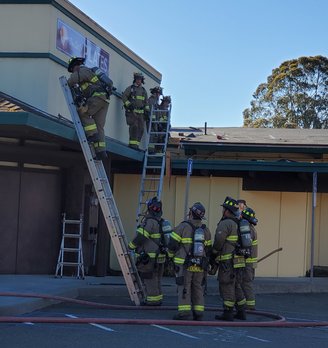
Photo: Arcata Fire.
From Arcata Fire District:
Just before 8 am this morning, Arcata Fire District along with CalFire, Westhaven Fire and Blue Lake Fire were dispatched to a commercial structure fire in the McKinleyville Shopping Center. Fire Chief Justin McDonald was first to arrive and confirmed smoke coming from the roof overhang area. The roofing crew confirmed that they had smoke in the area they were working and discharged fire extinguishers after calling 911.
Based on the building size with smoke visible, the Incident Commander requested the response be augmented to include the truck from Humboldt Bay Fire and additional engines from CalFire and Samoa Peninsula Fire.
Crews accessed the roof as well as the exterior attic area and found light smoke with no active fire. The firefighters used chainsaws on the roof to gain entry to where the smoke was found. The source of the smoke was contained to the structural portion of the interior attic where the roof and attic meet. Minimal damage was done to the building and a small amount of water was used. The businesses were able to maintain operational status.
Arcata Fire would like to thank our mutual aid providers for assisting us this morning and offer a thanks for the quick actions of the roofing team for early notification to 911 and deployment of their fire extinguishers.
California’s Big Reopening: What Changes — and What Doesn’t — on June 15?
Ben Christopher / Thursday, June 10, 2021 @ 7 a.m. / Sacramento
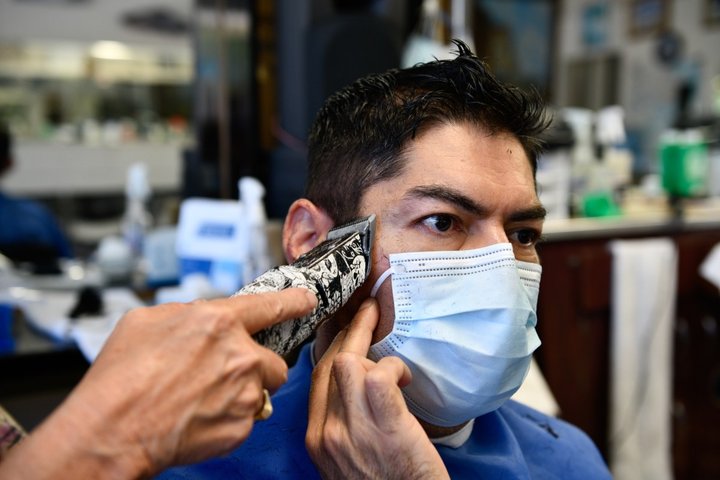
Carlos Hernandez holds his mask while getting a haircut by Sarah Cordiey at Spiros Barber Shop in Long Beach, on June 9, 2021. “During the pandemic, I got depression and anxiety,” said Hernandez, who saw his family for the first time last week in more than one year. “But then when I got [fully] vaccinated I felt a lot better.” Photo by Pablo Unzueta for CalMatters
###
California’s grand reopening day is almost here, but it comes with a few asterisks.
If all goes as expected and promised, on June 15 our 15-month-long ordeal of public health restrictions, mandates, bans and color-coded tiers to stem the COVID-19 pandemic will finally come to an end. As Gov. Gavin Newsom said in April and reaffirmed in May, next Tuesday is when “we can start to open up…business as usual.”
But as that much-touted date approaches, the governor’s promise of a sudden milestone is colliding with the loophole-ridden gradualism of California labor law, local control and the imperatives of fighting a diminishing — but not defeated — virus that has killed 62,500 Californians and counting.
Some mixed messages along the way have added to the confusion. So what will — and won’t — actually happen on Tuesday? Many of your questions, answered.
Will I be able to sit inside a bar, work out at a gym or go to the movies?
Probably.
The average Californian can expect things to look fairly back-to-normal in most of the ways that matter.
Moving “beyond the blueprint,” to use the state’s branding, and instead using federal health guidance for public places means that most businesses can dispense with social distancing requirements, capacity limits and forced closures.
But there’s a difference between “can” and “must.”
Counties will still be free to impose their own public health restrictions if they choose to — but only if they’re stricter than what the state is requiring. So far, no counties have said that they’ll part ways with the state’s rules, though a few, like San Francisco, say they’re still mulling over their options.
Even so, businesses aren’t taking any chances. On Tuesday, more than 35 business groups sent a letter to county governments across the state begging them to stick to the statewide rules.
Though business groups, who don’t relish the idea of getting sued, are hoping for consistent, cheap and easy-to-follow standards, your favorite restaurant, movie theater or hair salon is also free to impose its own public health restrictions.
That means you shouldn’t be surprised if you still spot a few “No Mask, No Service” signs after June 15.
“We are not requiring businesses to, for example, have somebody at the door checking for vaccine status as a way to comply.”
— Mark Ghaly, California Health and Human Services secretary
Can I go to a concert?
Depends. Are we talking open mic at the local bar or Beyonce at an arena?
The state has said it will impose additional restrictions on “mega events.” That’s defined as anything that draws more than 5,000 people indoors or 10,000 outside. (Sorry, nameless dude playing a melodica into a loop pedal, you are not a mega event).
According to the most recent state guidance, concerts, conventions and other indoor mega events will only be open to people who can prove that they’ve either been vaccinated (by showing a vaccination card, a photo of the card, or documentation from a doctor) or that they tested negative for the coronavirus in the last 72 hours. That kind of proof won’t necessarily be required at outdoor events such as baseball games, but the state is recommending that stadiums either impose such a rule or require masking.
Once I’m inside the bar, gym or movie theater, can I finally take this mask off?
Yes, if you’re vaccinated.
California’s public health officials confirmed Wednesday that along with relaxed social distancing, the state will also drop its mask mandate on June 15 and instead adopt the recommendations of the federal Centers for Disease Control and Prevention.
That means vaccinated adults should feel free to go mask-less in most public spaces. There are still exceptions for venues where the potential for many vulnerable people congregating in a confined place is high: hospitals and other health care settings, school classrooms, prisons and jails, public transit and nursing homes.
If you’re unvaccinated, you’ll still be required to wear a mask indoors in most public places, though it’s not entirely clear if or how that will be enforced. On Wednesday, health and human services secretary Mark Ghaly said that businesses can require masks of all customers, implement a vaccination verification system or simply go with the honor system.
“We are not requiring businesses to, for example, have somebody at the door checking for vaccine status as a way to comply with this,” he said.
What about when I’m at work?
For anyone who has a job, doesn’t work from home and spends their work hours with other human beings, this Q&A just got a lot more complicated.
Since last November, the state’s workplace safety regulator has been requiring most employees across the state to mask up and maintain six feet of distance from one another when possible. They’ve also required stores, restaurants and other employers to provide personal protective equipment to their staff, offer testing when necessary and, in some cases, set up pathogen-blocking furnishings such as plexiglass shields.
Those requirements seem to be on the way out, but not on June 15
Wednesday night, the state’s Occupational Safety and Health board agreed to take the new state public health mask guidance into account and vote on new workplace rules on June 17. If affirmed, they wouldn’t go into effect until June 28.
The board unanimously voted to revoke a vote last week to adopt new workplace rules that would let workers go maskless, but only so long as they and all their colleagues are vaccinated. Employers would also be required to provide N95 masks to staff.
“We can’t be the mask police. This totally contradicts the messaging that came out of the governor’s office, which was June 15, we’re opening up the economy.”
— Rachel Michelin, president of the California Retailers Association
That idea did not go over well with the state’s business interests. How, they asked, is an employer supposed to find out which workers are not vaccinated? What if vaccinated employees, chafing at their masks, begin harassing their unvaccinated colleagues? How expensive are all these masks going to be?
“We can’t be the mask police,” said Rachel Michelin, president of the California Retailers Association. “This totally contradicts the messaging that came out of the governor’s office, which was June 15, we’re opening up the economy.”
California’s business interests lobbied the governor directly, asking him to do an end run around the state’s workplace safety regulators and issue an executive order to “align” workplace guidelines with guidance from the state public health department and federal CDC. They renewed that request after the Cal/OSHA decision Wednesday night, urging Newsom to provide all employers with “consistency and certainty.”
Newsom declined on Friday to say whether he would act on that request. On Wednesday, Ghaly said the administration was “in no way predisposing or pushing for one outcome over the other” but for now was simply leaving it up to the workplace safety board.
Presumably state agencies will be abiding by the state public health guidelines?
You might think that. And that might very well be the case. But no one seems to know just yet, including the agencies, themselves.
Take the Department of Motor Vehicles. Californians participating in that most pedestrian of pre-pandemic activities — waiting in line at the DMV — may or may not be required to wear a mask, stay six feet apart from one another or have their temperatures checked before entry.
Those public health measures are in place now. Will they be relaxed come June 15?
State agencies are still waiting to find out.
“I’m in the same boat that the general public is in,” said DMV director Steve Gordon, whose agency is in the process of moving license renewals and other common customer service requests online.
A spokesperson for the governor’s office directed a question about state agency opening procedures to the California Department of Human Resources, where a spokesperson for CalHR did not respond to either emails or voice messages.
Is the state still going to be in a state of emergency?
Yes.
Does that mean the state isn’t actually going to reopen?
No.
When the governor was asked on Friday whether, come June 15, he would also rescind the state of emergency proclamation that he issued in the early days of the pandemic in March 2020, Newsom — to the surprise of many and dismay of some — said that he would not.
So how can the state possibly reopen for “business as usual” when it’s simultaneously under an emergency?
The answer might be that the definition of “state of emergency” under California law doesn’t necessarily mean “emergency” in the everyday “something is on fire” sense of the word.
While the California Emergency Services Act does give the governor exceptionally broad powers to govern by fiat during a period of crisis, in practice the governor has evoked that power during the pandemic to administer various public health and economic relief programs and to collect federal aid.
“Abruptly terminating the emergency would cancel all that wholesale,” said Brandon Stracener, research fellow at the California Constitution Center at UC Berkeley. “A gradual transition process that involves the Legislature is far better, and permits a rapid response to any unexpected surge in the pandemic.”
With executive orders empowered by the proclamation, Newsom has loosened regulations to allow more people to administer vaccines, banned water shut-offs on homes with delinquent utility bills, given cities the ability to freeze commercial evictions, allowed local governments and courts to conduct public hearings over Zoom and given businesses on state roads the freedom to set up parklets and other street-side services.
The governor is hoping to extend some of the programs long past June 15 — either as long as the effects of the pandemic coursing through the state, or until the Legislature can make it permanent by statute.
On June 2, for example, the governor’s office assured local governments that they would still be allowed to hold meetings remotely. “The Governor recognizes,” cabinet secretary Ana Matosantos wrote in an open letter, “the importance of an orderly return to the ordinary conduct of public meetings of state and local agencies and boards.”
Some local governments are deciding to return somewhat to normal; San Francisco Mayor London Breed presided over four weddings at City Hall to mark its reopening Monday.
Republicans in the Legislature have long bristled at the governor’s unprecedented use of executive power during the pandemic, and are now attacking him leading up to an all-but-certain recall election this fall. On Monday, Assemblymembers Kevin Kiley of Rocklin and James Gallagher of Yuba City and state Sen. Melissa Melendez from Riverside County demanded that the administration explain what justified the continued proclamation of the emergency.
Some emergencies from recent wildfires and past droughts are still active, Newsom’s office notes. State law does give the Legislature the ultimate check on the governor’s emergency powers. All they need to do is pass a resolution declaring the emergency to be over. But they haven’t. And with Democrats enjoying supermajorities in both the Assembly and Senate, they aren’t likely to anytime soon.
###
CALmatters.org is a nonprofit, nonpartisan media venture explaining California policies and politics.
Will Psychedelics Become Legal in California?
Marissa Garcia / Thursday, June 10, 2021 @ 7 a.m. / Sacramento

Illustration by Anne Wernikoff, CalMatters
###
Amid growing scientific research into therapeutic uses for psychedelic drugs and a progressive push to soften punishment for drug crimes, California lawmakers are considering a bill to legalize magic mushrooms, Ecstasy and several other hallucinogenic substances.
The proposal has set off an intense debate over how far California should go to embrace novel medical treatments and destigmatize drug use without compromising public safety. While research into the potential benefits of psychedelics to treat PTSD, depression and anxiety is becoming increasingly mainstream in academic settings, the bill goes beyond medical applications to allow recreational use of psychedelics.
Senate Bill 519 would decriminalize the possession and non-commercial sharing of psychedelics by people age 21 or older. It would not permit the sale of psychedelics in government-sanctioned shops the way cannabis is allowed under state law, but sets up the framework for California to move toward regulating psychedelic drugs in the future.
The measure passed a major hurdle last week, clearing the state Senate with the bare minimum of votes necessary, and now moves to the Assembly, where it will likely continue to divide Democrats who control the Legislature.
“We’ve addressed the issue of drug use by trying to arrest and incarcerate as many people as possible, and it hasn’t worked.”
— Sen. Scott Wiener, author of bill to decriminalize psychedelic drugs
The debate comes five years after California voters legalized cannabis and a year after Oregon voters legalized the use of psychedelic mushrooms in a therapeutic setting and decriminalized possession of small amounts of all drugs. Part of a growing movement to combat the War on Drugs, the California bill would mean that a psychedelic trip does not result in a trip to the police station.
“We’ve addressed the issue of drug use by trying to arrest and incarcerate as many people as possible, and it hasn’t worked,” said Democratic Sen. Scott Wiener of San Francisco, the bill’s author. “This War on Drugs hasn’t reduced drug use. It hasn’t reduced addiction. It hasn’t reduced overdoses. It’s made the problem worse.”
He’s pushing the measure as a way to expand treatment for mental illnesses and roll back criminal justice policies that he sees as discriminating against people of color.
However, some lawmakers say that Wiener’s approach goes too far. Among the drugs it would legalize is ketamine, which, according to law enforcement officials, is sometimes used to facilitate sexual assaults.
“I don’t know why in the world we would be contemplating legalizing a drug like ketamine, used to incapacitate young women and girls for the purposes of raping them,” GOP Sen. Melissa Melendez of Temecula said during a heated debate last week on the Senate floor.
Law enforcement groups also oppose the bill. The Peace Officers’ Research Association of California — a federation of police unions — argues that it would lead to more drug dealing and crime.
“We believe many of the penalties related to controlled substances work as a deterrent or a reason for individuals to get the treatment they need to turn their lives around,” the group wrote to the Senate Public Safety Committee. “As we have seen so many times, it is often the most vulnerable populations, and those who have the weakest support systems, that will be most susceptible to the increased access and use of drugs.”
“I don’t know why in the world we would be contemplating legalizing a drug like ketamine, used to incapacitate young women and girls for the purposes of raping them.”
— Sen. Melissa Melendez, opponent of bill to legalize psychedelic drugs
Democrats are divided over the proposal.
Sen. Bob Archuleta, a Pico Rivera Democrat, said he voted against the bill because it would legalize psychedelics before lawmakers have more information about their effects. The bill would set up a working group in the state Department of Public Health to research psychedelic substances in greater depth. Archuleta said he’d rather wait to receive definitive guidance from the group.
In Wiener’s eyes, there is no time to wait. Lives are on the line. Suicide rates of veterans were signficantly higher than the national suicide rate, according to 2016 data from the U.S. Department of Veterans Affairs.
Help for veterans?
In come psychedelics. The scientific research looks promising. Recent studies suggest that psychedelics such as MDMA — better known as molly or Ecstasy – could fill a gap in mental health care for veterans suffering from PTSD.
The UCLA Center for Health Policy Research found that nearly 55% of California veterans who sought medical help for mental health did not feel like they received the treatment they needed. It’s one reason several veterans groups support the bill.
“I had tried countless failed treatments and felt hopeless… With no other options left, I felt I had nothing to lose by pursuing psychedelic treatment outside the U.S.,” Marcus Capone, a former Navy SEAL, wrote in an op-ed urging lawmakers to pass the bill. “Practically overnight, I felt a huge weight had been lifted and my cognitive functioning returned. After years of frustration and hopelessness, I got my life back.”
Emerging scientific research shows that psychedelics can help people with PTSD learn new thinking patterns and overcome trauma.
“MDMA has a role to play in the extinction of fear-based memories, and fear-based memories are very well encoded in the brain there,” said Jennifer Mitchell, a neurologist at the University of California, San Francisco and a member of the UC Berkeley Center for the Science of Psychedelics. “It does appear to impact the consolidation and recollection of fear-based memories.”
The MDMA dose does not remove these fear-based memories. Mitchell says it helps patients revisit traumatic moments without the overhang of the usual fear or shame. Guided by a therapist, patients can work through their thoughts more deeply and eventually let them go.
Mitchell likens the effects of MDMA on memories to snow falling in a snow globe. Imagine skiing down a mountainside using the same trail every time. “Every time you take that trail, the snow gets a little bit more deeply packed and the trail gets a little bit more worn. And soon, that’s the only way up the mountain,” said Mitchell.
“The psychedelic allows you to shake the snow globe and for a fresh, smooth, new coat of snow to fall everywhere, such that that path is no longer apparent and you can find a new way off the mountain.”
Beyond PTSD, psychedelic drugs also offer promise for depression and anxiety treatments. A Johns Hopkins study from last year observed how adults with depression responded to two doses of psilocybin — and they thrived. More than 70% of participants saw an improvement in their mental health. The psychedelics outperformed other currently existing antidepressants four-fold. In another study, a participant who had taken many anti-anxiety medications that had never helped his depression finally got better after facilitated therapy sessions with psilocybin. He was stuck thinking the same negative thoughts over and over, and the psilocybin helped him cut that circuit short so he could heal.
Several research universities have invested in studying psychedelics’ medical potential, especially in the past two years. The Neuroscape Psychedelics Division at UC San Francisco formed in March 2021 with $6.4 million in private funding. The Johns Hopkins Center for Psychedelic and Consciousness Research, formed in September 2020, is supported by $17 million in private funding.
While many California lawmakers said they were persuaded that psychedelics could be beneficial in some medical settings, some were concerned about one phrase in Wiener’s bill: “social sharing.”
‘Social sharing’ debate
The legislation allows adults to exchange psychedelics with each other, so long as no money is involved. It would essentially sanction party drugs, argued Republican Sen. Pat Bates of Laguna Niguel.
“If we want to confine it, specify it for its therapeutic use with our veterans, I totally support that, but I do believe that this steps way over that,” she said, before voting “no.”
But Wiener argues that social sharing is an essential element of legalization.
“If people are going to use psychedelics, it’s better for them to use it with someone else because, even though people overwhelmingly use these drugs safely, anyone can have a bad reaction to any kind of drug, legal or illegal,” he said.
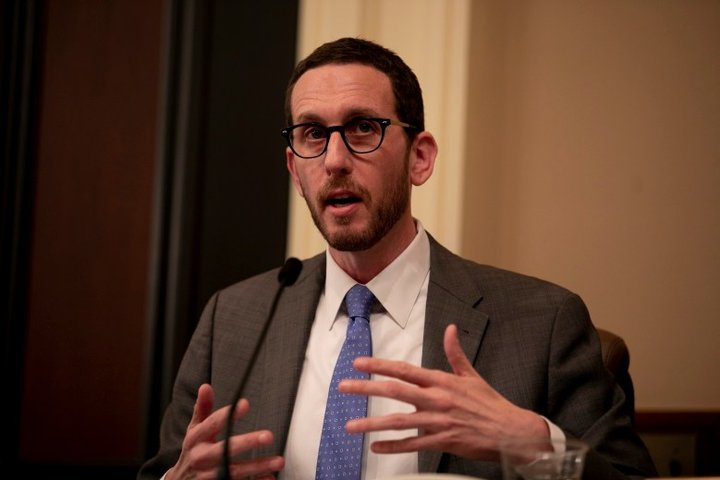
Sen. Scott Weiner, San Francisco Democrat.
But social sharing also opens up liability questions that concern Mitchell, the neuroscientist. “Unless there is regulation, who’s to say that somebody’s shrooms that they pick themselves in some field are the right thing? And if they share it, and it’s the wrong thing, and somebody dies… who’s to blame, and how do we fix that?” said Mitchell.
As decriminalization movements gain traction on the West Coast, some Native American groups in the Southwest remain concerned it could encroach on their traditional practices. The peyote cactus — a natural source of the psychedelic drug mescaline — is central to religious ceremonies for the Navajo Nation. The Los Angeles Times reported last year that some Navajo were upset by cities considering ordinances to decriminalize peyote. They fear it would diminish the natural supply of peyote, which is already a vulnerable species.
In response to this concern, Wiener’s bill would not decriminalize mescaline sourced from peyote. While it would still be illegal to possess a peyote cactus, the bill would allow mescaline from other types of cacti.
“We made this decision to honor the sovereign rights of Native Peyote practitioners, who point out that the peyote cactus is a sacrament and the peyote gardens in Texas have a dwindling supply of naturally-growing peyote,” Catie Stewart, Wiener’s spokesperson, wrote in an email to CalMatters.
In 2019, Oakland became the first city in California to decriminalize all psychedelic plants. Less than a year later, Santa Cruz passed a similar measure.
But those are some of the most progressive enclaves in California. Whether the whole state is ready to embrace psychedelics is a question that will be answered this summer, as the state Assembly considers Wiener’s bill. The Assembly has a bloc of moderate Democrats — some of whom represent swing districts — who sometimes side with Republicans to kill liberal legislation.
“If the bill doesn’t make it through the Assembly, we will try again,” Wiener said. “The issue is not going away, and sometimes it takes a few tries to get a bill through.”
###
CALmatters.org is a nonprofit, nonpartisan media venture explaining California policies and politics.
OBITUARY: Jeff Daniel, 1969-2021
LoCO Staff / Thursday, June 10, 2021 @ 6:56 a.m. / Obits
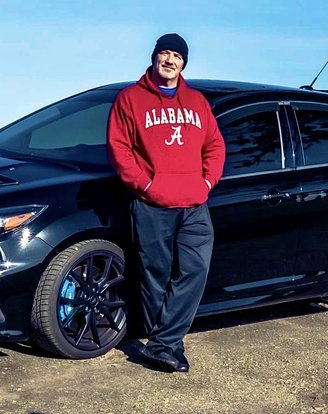
It is with great sadness we announce the passing of Jeffery Harmon Daniel on June 4, 2021.
Jeff was born on April 24, 1969 in Denver, Colorado to David and Cheryl Daniel, and was the youngest of five children. The family moved to Humboldt County in 1983, where much of the family has remained for nearly 40 years. Jeff graduated from Arcata High School in 1987. He was an amazing athlete, participating in many sports, with a particular passion and incredible talent for football, which he continued to play through college.
Jeff attended the police academy through College of the Redwoods, graduating in August of 1990. He served as an undercover narcotics agent with Glenn County Sheriff’s Department for a brief period. He was hired as a police officer for the Eureka Police Dept on September 28, 1991. He had an amazing and successful career, serving in many facets of EPD, including patrol officer, field evidence officer, SWAT, field evidence technician and detective, receiving his promotion to sergeant in January of 2003. Jeff retired from EPD on August 16, 2004.
He had a love and passion for anything fast, especially motorcycles. Whether out on the street riding his ZX14, or racing at Thunderhill on his GSXR 1000 at 180 m.p.h. with his closest friends, it was where he found his inner peace. Jeff also had his own business fabricating custom motorcycles and custom paint work for a few years. His love for bikes and cars started in childhood from his father, who taught Jeff and his brothers everything he knew about building fast cars, fast bikes and faster engines. Jeff and his brother Sean carried that knowledge into their current lives, with Jeff currently working at Humboldt Motorsports for nearly 10 years.
Jeff was a talented, skilled, motivated, selfless, honest and intelligent man. Whether being a police officer, master welder, master mechanic, skilled fabricator or builder, there was nothing he couldn’t do or accomplish, always striving for more of himself. He took pride in everything he did, whether building a deck, getting a customer’s bike fixed and working, or milling custom components.
Jeff made friends with everyone he met. He was very personable, humorous and friendly. He appreciated and cherished the friendships he made, especially those with his friends closest to him.
His greatest love was the love he had for his family. He was an amazing, supportive husband and best friend to his wife. He strived to be the best father and stepfather he could be to his son and his stepchildren, and loved them with all of his heart. He adored and loved his grandsons.
He is preceded in death by his mother and family matriarch Cheryl Daniel (Dave), his brother Lorne Daniel and his stepson Dalton Gutierrez. He is survived by his wife Tanya Fulton, father and family patriarch David Daniel (Cheryl), sister Christina Daniel, brother Sean Daniel, son Joss Daniel, stepson Bryce Wheelock, stepdaughter Dakotah Gutierrez Brennan(Andrew), stepdaughter Ashley Gutierrez, grandsons Jackson and Ronan Brennan, and many nieces and nephews, and great-nieces and nephews.
There will be a memorial and celebration of life for Jeff on June 19 at 4 p.m. at Humboldt Motorsports in Eureka.
###
The obituary above was submitted on behalf of Jeff Daniel’s loved ones. The Lost Coast Outpost runs obituaries of Humboldt County residents at no charge. See guidelines here.
(VIDEO) Anti-Vax Protesters Disrupt Huffman Town Hall
Ryan Burns / Wednesday, June 9, 2021 @ 12:16 p.m. / News , Politics
A group of angry protesters on Tuesday stormed into a town hall meeting being hosted by Rep. Jared Huffman to wave signs and shout chants such as “Medical freedom now!” “Shame on you!” and “Fauci lied!”
In a Facebook post published after the event, the North Coast congressman said the “mob” forced its way into the meeting, in defiance of health and safety protocols, and proceeded to be rude and aggressive.
“Outside of the January 6th insurrection, this might be the ugliest, most disgraceful spectacle I’ve ever seen,” Huffman wrote.
Video footage from the event, which was held in San Rafael, shows protesters waving American flags and protest signs, including one that says, “All the ferrets died.” That’s apparently a reference to a viral and debunked Facebook post claiming that animals involved in COVID-19 studies all croaked shortly after getting the shot. Again, malarkey.
Other signs compared the alleged discrimination faced by unvaccinated people to racial segregation and apartheid. Yet another invoked the Black Lives Matter movement by stating, in all-caps, “UNVACCINATED LIVES MATTER.” Those signs were held by white people, naturally.
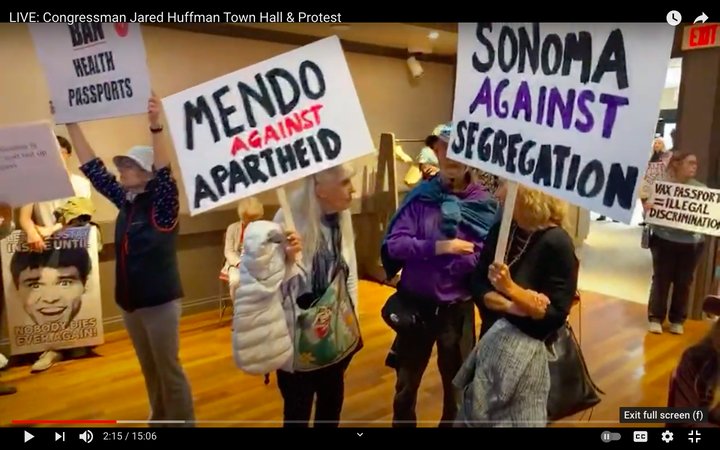
Screenshot from YouTube.
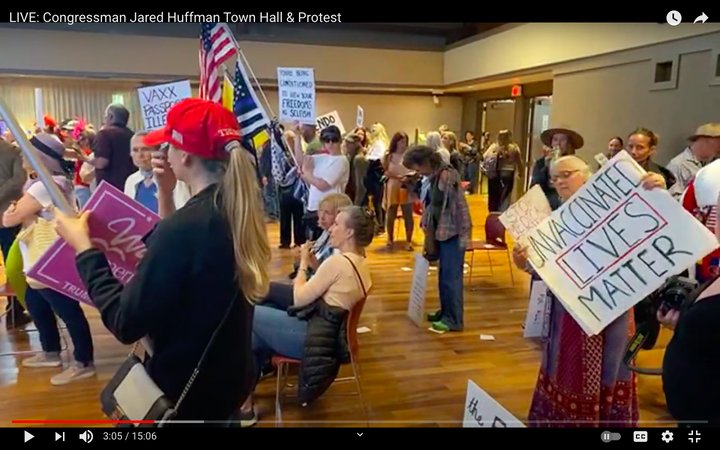
Screenshot from YouTube.
The protesters were apparently upset that proof of vaccination was initially required for admission and capacity was limited for physical distancing. (The vaccination requirement was later dropped.)
Amidst the shouting, Huffman addressed the protesters from the stage, saying, “We have always had capacity rules for gatherings. We’ve always had common sense limits on gatherings, and I’m sorry that some of it rubs you the wrong way. But it is not a civil right. It is not apartheid. It is not the Holocaust.”
Here’s what Huffman had to say afterward:
Tonight an angry COVID-denying mob tried to turn my town hall meeting into a MAGA circus. Outside of the January 6th insurrection, this might be the ugliest, most disgraceful spectacle I’ve ever seen.
I feel badly for the many constituents who wanted to join me in the kind of productive, respectful community dialogue we always have at my town hall meetings. The mob forced its way in, flouting public health rules on room capacity, masking and distancing. They defied our request that the limited room space be reserved for vaccinated constituents who had RSVP’d to attend (everyone else could join online). The mob was rude, aggressive, and determined to verbally and physically prevent us from proceeding, essentially daring us and/or the police to try and remove them, which we declined to do.
Thankfully, other than pushing, shoving and screaming, they stopped short of violence. To my poor staff and dozens of constituents who showed amazing grace and patience in weathering this spectacle with me, thank you. We were disrupted and disrespected, but not intimidated or deterred. We did our best to push forward with some semblance of a town hall.
I’ve had dozens upon dozens of town halls over the years and this has never happened before. Hopefully it will never happen again. To my knowledge, I’m the first Democratic politician in our area to try to resume in-person town hall meetings, and we wanted to do so in careful compliance with public health rules. We will find a way to get back to functional, respectful town hall meetings — they are such a wonderful exercise in democracy when people respect each other and express themselves with a modicum of civility.
But this is a cautionary tale regarding an issue I tried to discuss tonight. As strong and resilient as our democratic republic has been for over 230 years, as much as we think of American democracy and the rule of law as unshakable, the survival and continuation of this experiment is not preordained. We could lose it all. We came damn close to losing it over the past year, and those threats are still with us. Those of us who care about American values and institutions are going to have to do the hard work of maintaining and defending them against some very ugly, very serious threats in the months ahead.
(VIDEO) A Humboldt Inmate Spent Four Months Painting a Mural Inside the Jail’s Medical Facility
Andrew Goff / Wednesday, June 9, 2021 @ 11:11 a.m. / Art
Eureka’s ever-expanding mural inventory now includes an entry inside the walls of the Humboldt County Correctional Facility. Earlier today, the Humboldt County Sheriff’s Office shared a heartwarming clip celebrating the artwork of inmate Jackson Parrott who recently completed an ambitious nautical-themed piece inside the facility’s medical unit. The mural is Parrott’s first.
“It was a big learning process,” Parrott notes in the clip. While he’d been an avid drawer prior to tackling the project, he’d never before painted anything. But when correctional facility staff asked inmates to submit art samples to be considered for the mural gig, Parrott pursued the chance to hone a new skill. After being selected for the job, he took four months to complete the work.
“It’s awesome,” Parrot said. “It’s the opposite of how I usually do my time. I think there’s a lot more people in here could probably do some cool stuff too if given the opportunity.”
Sheriff’s Office staff say they’re open to inmates beautifying other blank walls inside the facility.
Check out Parrott’s work in the clip above.


