On Wednesday, June 9, 2021, at about 4:38 a.m., deputies from the Humboldt County Sheriff’s Office North Area Command responded to the Tri Counties Bank branch on the 1600 block of Central Avenue in McKinleyville for a report of an alarm.
When deputies arrived on scene, they discovered that an attempt to break into the ATM had been made. Deputies searched the area but were unable to locate any suspects. There was extensive damage to the ATM, but it did not appear the suspects were able to obtain any money from inside.
At this time, the identities of any suspects are unknown. Anyone with information regarding this case is asked to contact the Sheriff’s Office at 707-445-7251.
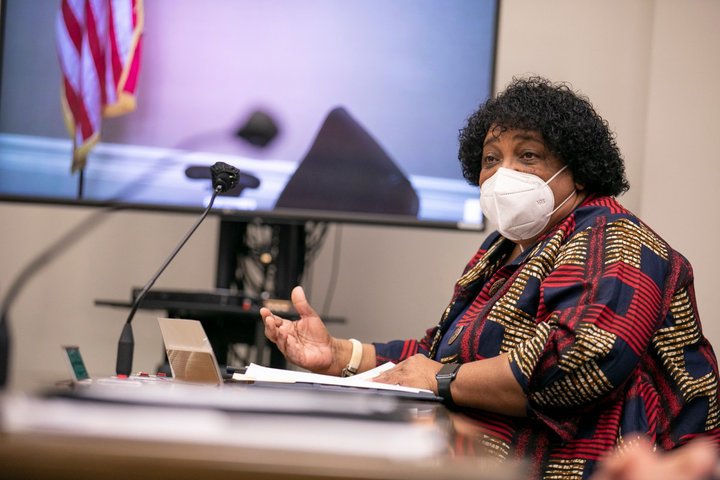
Dr. Shirley Weber testifies during her confirmation hearing as Secretary of State on Jan. 26, 2021 in Sacramento. Photo by Anne Wernikoff, CalMatters
###
For more than three decades, Black members of Congress have introduced legislation to study the lasting harms of slavery on African Americans, and propose remedies. Year after year, the federal proposal languished.
Now, California is going it alone.
This month, California’s first-in-the-nation task force to study reparations met for the first time, kicking off a two-year process to study the consequences of slavery and systemic racism against African Americans in California.
“You are here today not just to seek an answer to say was there harm, but your task is to determine the depth of the harm and the ways in which we are to repair that harm,” Secretary of State Shirley Weber, a former state Assembly member who introduced the legislation last year, told the reparations committee at the start of the six-hour meeting.
Against that somber backdrop, task force members alluded to controversial questions, long circulating in Black communities, that will for the first time get hashed out by state appointees in a public forum. How can a single state, which never formally sanctioned slavery, make amends for centuries of slavery practiced by Southern states and the federal government? How can California accurately quantify and repair centuries of racism on its own soil? Will the state seriously consider direct payments?
“Some asked us, ‘Why in California? Why not somewhere else? Why did we not do it in the South?,’” said Weber. “If not us, then who?”
Some asked us, “Why in California? Why not somewhere else? Why did we not do it in the South? If not us, then who? — Secretary of State Shirley Weber
Here’s a look into the key themes the task force will grapple with:
What will the task force do?
The reparations committee, appointed by the governor and legislative leaders, will meet at least 10 times, though members discussed adding more meetings. Kamilah Moore, an intellectual property attorney and activist from Los Angeles, was voted in as chairperson. They’ll release a report of their findings after the first year and a second report on recommendations for reparations the following year. The Legislature would need to pass more laws to implement them.
During an hour-long virtual public comment session, callers from across California urged the task force to make its meetings more accessible. One person asked for meetings to be streamed on YouTube, TikTok and other platforms. Another asked for them to happen on weekends — the first was on a Tuesday — and called for 12 additional public comment sessions. Multiple callers urged a media campaign to educate Black Californians about the task force.
Digging into a dark past
The reparations committee is likely to dig up chapters of the state’s history unknown to many. Reginald Jones-Sawyer, a Democratic state Assemblymember representing South Los Angeles who serves on the task force, likened the “truth-telling” process to recent viral videos of police violence. Staff of the California Department of Justice’s new racial justice bureau set the stage by presenting archival photos.
While California joined the Union as a “free state” in 1850, the state soon enacted a fugitive slave law that allowed slaves as long as they were eventually sent back to the South. A question facing the task force is how culpable the state California was in supporting slavery.
“When you’ve been gaslighted for 400 years, truth is critical,” said Lisa Holder, a Los Angeles civil rights attorney on the task force.
DOJ staff presented evidence of post-slavery discrimination with lasting health and education consequences. They showed how a 1937 redlining map of Oakland mirrored a recent map of areas vulnerable to public health disasters, such as COVID-19. They also referenced continuing racial segregation in education, such as the Sausalito Marin City School District, which a court ordered to desegregate in 2019.
The reparations committee must also consider institutions that benefitted from slavery. DOJ staff offered the example of Penn Mutual Life Insurance Company, which wrote policies to insure slaves for slaveholders. Operating today in California, Penn Mutual had $3.7 billion in revenue in 2019, according to the DOJ.
A focus on mental health and housing
The mental health and housing consequences of slavery emerged as priorities for the task force.
“We’re all suffering to this day of PTSD from slavery — post traumatic slavery disorder,” said Jones-Sawyer. “It’s really important that we don’t forget the trauma that is still in us, hundreds and hundreds of years of us being abused, of us dying, being lynched.”
We’re all suffering to this day of PTSD from slavery — post traumatic slavery disorder. — Assemblymember Reginald Jones-Sawyer
Another member urged the task force to pay attention to the other side: why people and institutions supported slavery and racism throughout history, and why some continue to oppose reparations.
“If we don’t go to the root cause, in terms of the human psyche and the human condition, we’ll only be doing window dressing,” said Dr. Cheryl Grills, a clinical psychologist on the task force who focuses on community healing.
Amos Brown, a civil rights leader and president of the San Francisco NAACP, pointed to more recent “urban renewal” programs that displaced thriving Black neighborhoods, like the Fillmore District in San Francisco, which “now only represents one block.” Brown, who is also a pastor, will serve as co-chairperson of the task force.
More than 2.5 million people who identify as Black or African American live in the Golden State, representing about 6.5% of the population in 2019. But they accounted for more than 40% of California’s homeless population.
Will California consider direct payments?
One of the most controversial decisions ahead of the panel is whether to recommend that California send direct payments to any African American residents.
A growing number of U.S. cities — Asheville in North Carolina, Evanston in Illinois and Providence in Rhode Island, among them — have begun reparations processes, emphasizing remedies that reinvest in African-American communities. But all have shied away from sending direct payments, with leaders arguing that that’s the federal government’s responsibility.
Scholars split over the right approach.
Duke University economistWilliam Darity Jr. and folklorist writer Kirsten Mullen testified at the meeting, arguing that true reparations require both apology and direct payments. The two experts, who recently co-authored the book “From Here to Equality: Reparations for Black Americans in the Twenty-First Century,” argued that social programs, affirmative action and reversing harmful policies — though important — don’t count.
Darity and Mullen said that in the international history of reparations — spanning post-Holocaust Germany to post-apartheid South Africa — only the U.S.’s formal apology and payments of $20,000 each to Japanese Americans interned during World War II counts as true reparations. (A Japanese American lawyer who helped lay the legal foundations for that process, Don Tamaki, also serves on the task force.)
Bradford suggested free education to descendants of slaves at Cal State and UC systems and first-time homebuyer’s assistance, as examples of what “reparations can look like without bankrupting the state.”
Still, Jovan Scott Lewis, a Berkeley geographer on the task force, said he’ll push for cash payments. Direct payments on the order of those given to Japanese Americans — or much larger, as many scholars have called for — could figure in the billions for California.
However, cash reparations may face fierce opposition from the public. A recent Reuters/Ipsos poll found that only one in 10 white respondents across the country supported cash reparations, while half of Black respondents endorsed it. Those who oppose reparations, including many Republicans in the U.S. Congress, often argue that it would take money from a group of people who never contributed to slavery and give it to another group who never experienced slavery.
Setting an example for the nation
California reparations committee members made clear that they hope their work will boost federal efforts to pursue slavery reparations.
“As our country reckons with our painful legacy of racial injustice,” Gov. Gavin Newsom said at last week’s meeting, “California again is poised to lead the way.”
###
This article is part of the California Divide, a collaboration among newsrooms examining income inequality and economic survival in California.
CALmatters.org is a nonprofit, nonpartisan media venture explaining California policies and politics.
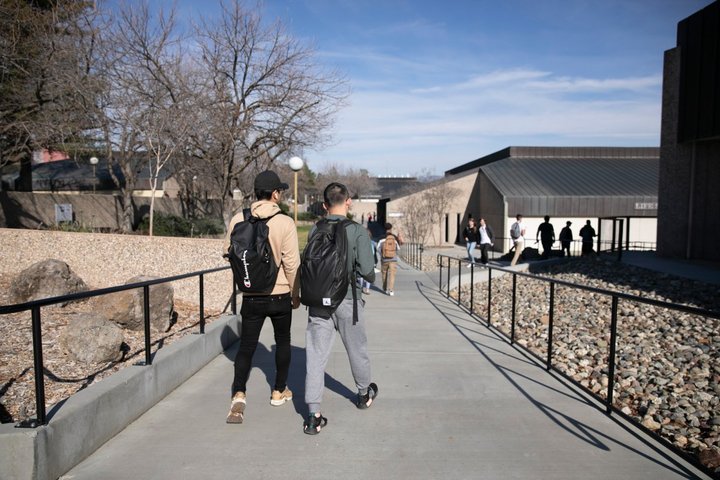
Butte College campus bustles between classes on February 12, 2020. Photo by Anne Wernikoff for CalMatters
###
Rarely are college bean-counters skeptical of receiving more money, but a plan to give California’s community college system hundreds of millions of dollars for faculty is dividing finance officials and professors.
For college financial officials, the new money would come at an inopportune time: Enrollment plunged across the 116-college system by 11% last fall as a result of the coronavirus pandemic. With fewer students to teach, financial officers worry that committing $170 million to hire 2,000 more full-time faculty now, per a budget blueprint approved by key legislative panels in late May, will lead to problems later.
“Excessive hiring in a declining enrollment environment can lead to painful budget reductions, layoffs, furloughs,” the association of community college financial officers wrote last week in a letter to top lawmakers in the Legislature’s budget committees. The financial officers would instead like the money to come with more flexibility.
Faculty grouse at that skepticism. They point to the college system’s decades-long inability to meet a quasi-mandate of having full-time faculty teach at least 75% of classes. Today that figure sits at 59% and has barely budged in three decades. The legislative largesse of $170 million is meant to drive the college system closer to that 75% goal, an aspirational benchmark that’s been on the community college system’s books since the 1970s.
“The fact that we have money proposed for the first time in a long time of the magnitude that is required to really be significant and we’re going to turn that down? That doesn’t make any sense to me,” said Evan Hawkins, executive director of the Faculty Association of California Community Colleges, the chief advocacy group representing community college faculty.
The drive for more full-time faculty
The leadership of the community college system supports more full-time faculty, in part because more instructors mean more personal relationships with students, something that research indicates is a crucial step in helping students complete college.
Colleges “balance the budget on the backs of part-time faculty,” said Wendy Brill-Wynkoop, a photography professor at College of the Canyons and incoming president of the faculty advocacy group.
This concern about part-time faculty isn’t new: When the 75% goal was put into California law in 1988, the bill’s language warned of a “proper concern about the effect of an overreliance upon part-time faculty.”
This year’s proposed legislative blueprint also calls for $75 million in ongoing funding for part-time instructors. The Legislature has until June 15 to approve this and other funding for the coming year’s state budget.
Funding flexibility
It’s not that community college finance officers reject more money outright. They want flexibility with any dollars they get, leaving them free to hire more financial aid advisors, academic counselors or other employees.
Though the community college system receives more overall total dollars from the state than the University of California or Cal State systems, the money comes out to a lot less per student given that community colleges have more than twice as many students as the UC and CSU combined. That leaves community colleges feeling perpetually squeezed financially.
From the perspective of community college budget officers, going on a state-mandated hiring spree ties the hands of campuses. The full-time faculty “may be teaching half empty courses. In the meantime, since you’re funding that, you’d have to reduce funding in other areas,” said Dan Troy, a board member of the Association of Chief Business Officials who also oversees financial planning at Cuesta College in San Luis Obispo.
Faculty think more instructors is a net win for colleges financially, not just academically. The more faculty a college has, the likelier students can find classes they need. Because the majority of the state funding that goes to colleges is based on student enrollment, finding slots for more students is a fiscal win, Brill-Wynkoop said. “You would think that investing in faculty should be the number one goal of an institution, because the thing that’s closest to students are faculty,” she said.
Other fiscal headwinds
Adding to the financial uncertainty is a perpetually looming budget reckoning that fiscal watchers say will only further squeeze colleges. In 2018 lawmakers and then-Gov. Jerry Brown overhauled how individual community colleges are funded — basing it not on the number of enrolled students but on a new formula that also takes into account student completion rates and how many students qualify for financial aid.
The Legislature wants to push back the start date a few more years into the future.
Another point of contention between faculty and college financial officers: a little-noticed but crucial calculation the community college system uses that can determine whether campuses spend millions of dollars more on faculty.
Each year the chancellor’s office uses a complex formula to calculate how many full-time instructors a college must have. The California community college faculty group wants to raise that minimum.
A higher floor means the system comes closer to reaching the 75% full-time faculty goal. But doing so also means that no college can dip below that threshold without enduring fines – adding to the fiscal anxieties of community college finance officers. The association of college finance officers begged lawmakers not to go down that route in their letter last week, clearly fearing such an outcome is possible as a condition of more funding.
Pushing a full-time faculty requirement is to “micromanage the money we get,” Troy said. “We think there are better ways to spend the state money.”
###
CALmatters.org is a nonprofit, nonpartisan media venture explaining California policies and politics.
Family
and friends are mourning the loss of “Curt,” since he passed away
in Eureka in the presence of his family. Curt was born in Lincoln,
Nebraska, but moved to Humboldt County at a young age, where he lived
for most of his life. After graduating Arcata High School in 1964, he
married Eloise (Henriksen) of Fortuna. Together they had four
children.
Curt
followed in his father’s footsteps to become a commercial
fisherman, and when his father retired, he and Eloise also took over
the family business of Henry’s Crab Traps. Curt continued to fish
for Dungeness crab, salmon and tuna along the entire West
Coast
from as far as Tahiti to Alaska. Over the many years of his career,
he owned and operated the Cavalier,
Early Dawn,
Compass Rose
and The Jewel.
He taught his older sons, Rodney and Jeffrey, along with his nephew,
Raymond, to fish when they were in their teenage years. In 1991 Curt
met his second wife, Carolyn. Together they ran a successful bed and
breakfast at East Brother Light station in Point Richmond, Calif.
After some time, he returned to fishing, and they also divorced.
Curt
was a man of adventure and he loved being on the ocean, but his
favorite thing to do in life was hunting. Many of his family
vacations centered around hunting. He shared stories of his exploits
with anyone who would listen.
Curt
enjoyed meeting new people and helping others. He had a great sense
of humor, was extremely generous, and could talk to anyone. He took
great pleasure in a good card game with much laughter and being in
the company of those he loved.
He
is preceded in death by his parents Elda C. (Pink) and Jewel Henry,
and his brother Raymond Henry. Curt is survived by his aunt, Joyce
Dowers; his two sisters:,Sandra D’Haem (Michael) and Donna Lyon
(Stephen). He also leaves behind his four children from his marriage
with Eloise — Rod Henry (Charlotte), Jeff Henry, Julene Saunders
(Michael), and Monte Henry (Nicole); his eight grandchildren, Cameron
Henry (Shauna), Brandon Henry, Riley Lowder (Greg), Hannah Henry,
Reagan Saunders, Avary Henry, Evan Saunders, and Grace Henry; and his
two great-grandchildren: Rowan Lowder and Bodhi Henry. He is also
survived by many cousins, nieces and nephews.
Curt
lived his life to the fullest and he is extremely missed. Family and
friends are invited to an open house on June 19, 2021, from 1 p.m. –
5 p.m. at Bayside Community Hall, 2297 Jacoby Creek Rd, Arcata.
Snacks will be provided.
###
The obituary above was submitted on behalf of Elda Henry’s loved ones. The Lost Coast Outpost runs obituaries of Humboldt County residents at no charge. See guidelines here.
Screenshots from Tuesday’s Board of Supervisors meeting (clockwise from top left): First District Supervisor Rex Bohn, Second District Supervisor Michelle Bushnell, Third District Supervisor Mike Wilson, Fourth District Supervisor Virginia Bass, Health Officer Dr. Ian Hoffman and Fifth District Supervisor Steve Madrone.
###
Tuesday’s meeting of the Humboldt County Board of Supervisors was certainly shorter than many a recent meeting, but not for lack of substantive issues. On the docket were the State of Covid post-reopening, a half-billion-dollar proposed budget for the upcoming fiscal year, the controversial mental health initiative known as Laura’s Law and more.
Let’s get right into it.
COVID-19
A week from today, California will do away with its color-coded blueprint metrics along with most of the mandatory protective health measures that have gone along with the tiered system. In his latest update on local pandemic conditions, Humboldt County Health Officer Dr. Ian Hoffman said it’s still not entirely clear what comes next.
Recently updated guidance from the state says that fully vaccinated people can go maskless in most settings — indoors and out — while the unvaccinated should still mask up in any indoor settings besides the home and in crowded outdoor settings where physical distancing isn’t possible.
As for going back to the office, Cal/OSHA, the state’s Division of Occupational Safety and Health, says that if anyone in your workspace is unvaccinated then all employees must wear their masks.
And since kids under age 12 aren’t eligible for vaccination, people will still be required to wear those lower-face coverings in settings such as schools, camps, daycare and youth sports — likely into the fall when students return from summer break.
Oh, and businesses can still require customers to wear masks “since it will not be possible to know who is vaccinated or unvaccinated,” Hoffman said. Surely no one will have a problem with that.
“There are also settings in which everyone will be required to mask regardless of vaccination status like on public transportation, health care settings, schools and other congregate settings,” he added. But all the capacity limits — those that have applied to retail stores, restaurants, movie theaters, etc. — will go away come June 15, though businesses can still apply them voluntarily, if the owners so choose.
Is Humboldt County ready for these protective measures to fall by the wayside? Well, Hoffman said we’re “rounding the corner” on a recent surge in COVID-19 cases, adding, “We’re hopeful the end is in sight.”
The county’s case rate and its test positivity rate are both half what they were just a few weeks ago, and more than 70,000 residents — about 62 percent of the eligible population — have received at least one dose of vaccine. “This is great news,” Hoffman said.
It could be greater, though. Northern California residents have the lowest level of COVID-19 antibodies, aka seroprevalence, of any region in the state — 46.9 percent compared to a statewide level of 72.1 percent.
“While this is not a perfect measure, it does reflect a combination of both vaccination and natural immunity from infection,” Hoffman explained. In other words, our community remains vulnerable to COVID-19.
“We still have work to do,” Hoffman said. There will be fewer restrictions starting next week, but it will remain important to increase our vaccination rate, keep testing and keep wearing masks in select settings to reduce our risk, he said.
Following this update, First District Supervisor Rex Bohn asked whether the county can rescind its local emergency proclamation as a means of maybe cutting back on some of the extra staff hours that have proliferated throughout the pandemic.
Ryan Derby, the Humboldt County Sheriff’s Emergency Operations Center director, said that rescinding the state of emergency would prevent the county from getting reimbursed from the state and federal governments for certain operations. Michele Stephens, the county’s public health director, echoed that point, saying extra positions and overtime costs are largely getting reimbursed via state and federal grants.
Bohn countered that state grants are still taxpayer money, “not pixie dust,” and if we keep spending it we’ll run out of funds for roads, the elderly and other worthy causes.
Hoffman assured him that many emergency operations are starting to wind down.
Third District Supervisor Mike Wilson voiced concern about those who continue to downplay the seriousness of the virus by suggesting that unless you catch it and die it’s really not a big deal. Maybe the county should continue to report hospitalization rates, he said, because COVID-19 is “a serious, deadly and preventable disease, and the best prevention is vaccination, by far.”
Bohn asked Hoffman to respond to some of the questions and claims he gets from constituents, including the unfounded theory that everyone who happens to test positive for COVID upon their demise gets added to the COVID death toll.
Hoffman said that’s not the case. “If the death is not related directly to COVID then we would not report that as a COVID death,” he said.
Regarding concerns about the speed at which the vaccines were developed, Hoffman acknowledged that it was fast but said “the science for [mRNA vaccines] goes back decades,” and they do not have the power to alter your DNA. Like foods, they’re made up of fats, sugars and acids that get broken down and leave the body quickly. “[T]he only thing that sticks around is your long-term immunity,” Hoffman said.
He closed by rattling off some statistics: more than 4,300 cases in the county, resulting in 46 deaths and nearly 200 hospitalizations. Meanwhile, among the 70,000-plus who’ve received at least one shot of vaccine, none have gone to the hospital or died.
Bohn said the county should be repeating that last part over and over, the way corporations repeat their catchphrases to imprint them on the brain.
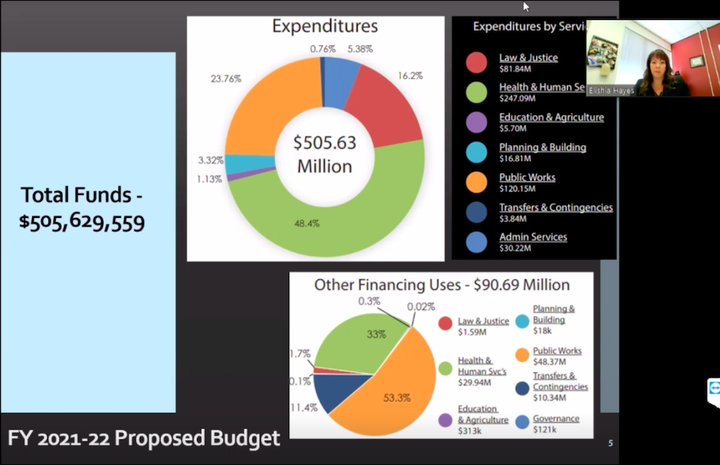
Screenshot of a PowerPoint presentation from Assistant County Administrative Officer/Chief Operating Officer Elishia Hayes.
The proposed budget
The county’s proposed spending plan for fiscal year 2021-22 tops out at $505.63 million, a nine percent ($40.1 million) increase over the budget that the board adopted for the current year. However, the county’s handy Open Budget website reflects a current operating budget of $547.84 million, making this the first fiscal year that the county has breached the half-a-bil mark.
In her presentation of this proposed budget, Assistant County Administrative Officer/Chief Operating Officer Elishia Hayes said much of the extra moolah in this year’s budget will go toward large projects, including storm-damage repairs and planning and construction of the Manila and Humboldt Bay trail.
As per usual, the largest portion of the budget will be allocated to the Department of Health and Human Services, with Public Works and Law & Justice coming in second and third, respectively. (See the pie chart above.)
Fortunately, projected revenues are climbing alongside this jump in spending — if not by quite the same margin. Hayes said general fund revenues are expected to hit $148.6 million this upcoming fiscal year, a roughly one percent increase that comes mostly via higher building permit fees and increased property and sales tax revenues. The general fund will use another $6.9 million in additional funding sources to create a balanced budget, Hayes said.
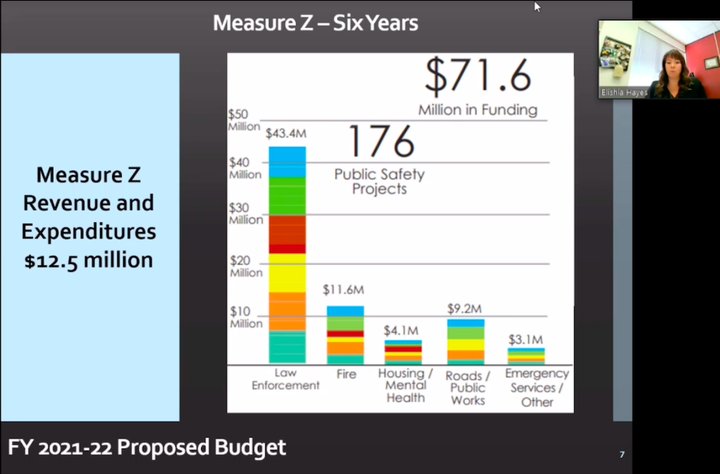
Measure Z, the voter-approved half-percent sales tax assessment, is expected to bring in $12.5 million this next fiscal year. Hayes presented a slide that shows how $71.6 million in Measure Z revenues have been spent in the six years since implementation, with the vast majority going to law enforcement, fire and roads/public works.
Defying economists’ projections, revenues actually increased during the pandemic thanks to increased online sales, lower interest rates, federal stimulus and unemployment benefits, Hayes said. That means the board can allocate an extra $1.3 million to Measure Z applicants this year.
The American Rescue Plan Act, a $1.7 trillion federal stimulus package passed in March, provided $350 billion in fiscal relief to local governments, with $65.1 billion of that set aside for counties. Humboldt can expect to get $13.16 million out of the deal, Hayes said. That money can be used to recoup losses from the pandemic and invest in water, sewer and broadband infrastructure.
Each year, county departments and outside agencies get a chance to request extra money, and this year the biggest ask comes from the Humboldt County Harbor, Recreation and Conservation District, which has requested $6 million in financial assistance to develop a new multi-purpose marine terminal.
That’s definitely a chunk of change, but Wilson, who for years served on the Harbor District’s board of commissioners, noted that it comes in response to requests from state and federal governments for Humboldt to prepare for potentially developing our port as a hub for wind energy development.
Larry Oetker, the Harbor District’s executive director, called in to make a case for the $6 million request, noting that it’s being driven by such esteemed authorities as the U.S. president, the state governor, the California Energy Commission and the Paris Climate Accord.
“They’re the ones asking Humboldt County to develop the port to prepare for the offshore wind industry,” Oetker said, and he argued that the Harbor District can’t undertake such an ambitious project on its own. He asked for an opportunity to give a presentation to the board at a future date.
Mary Ann Hanson, executive director of First Five Humboldt, also called in to advocate for increased child care funding, and several board members expressed support for the cause.
A follow-up budget presentations will take place June 21 at 1:30 and 5:30 p.m. with final adoption of the budget anticipated for June 29. You can get a more detailed look at the proposed budget via this link.
Laura’s Law
Following up on an issue they discussed in April, the board next considered whether to implement an assisted outpatient treatment (AOT) pilot program, which would allow for court-ordered treatment of certain people suffering from serious mental illness. Despite an absence of state funding, such programs have been implemented in a patchwork of counties as a result of Laura’s Law, state legislation named after a woman who was killed by a man who refused psychiatric treatment.
Back in April, county staff recommended that the county opt out of Laura’s Law, reasoning that the it already offers similar services and that few patients would actually qualify for the program. However, many members of the local psychiatric care community, including the local branch of the National Alliance on Mental Illness (NAMI), strongly urged the county to opt in.
After much discussion, the board in April directed staff to come back with a plan to implement Laura’s Law or similar type of program and to request an extension from the state on the deadline to opt out of Laura’s Law.
Today the board reconsidered the matter, and it again proved a somewhat divisive issue. Bohn talked about the intense community pressure to do something about homeless folks who clearly suffer from mental illness and wander the streets.
“I feel like a broken record; how do we address this?” he asked.
Emi Botzler-Rodgers, the county’s behavioral health director, said these challenges are “complex and multi-faceted,” with people often suffering from a range of interconnected issues, including homelessness, substance abuse and mental illness.
Fifth District Supervisor Steve Madrone said he fully supports a pilot program, though he said it’s time for the state to step up and fund such initiatives.
Speakers during the public comment period were divided. Some folks involved with the Humboldt County Transition-Age Youth Collaboration expressed opposition to Laura’s Law, suggesting that court-ordered treatment and increased interactions with law enforcement can be counterproductive.
Others disagreed. Tim Ash, from the local branch of NAMI, sad there are many misconceptions about Laura’s Law, including that notion that it leads to physically forced medication. “The facts are, putting people in front of a judge does work,” he said. “It doesn’t work for everybody, but it’s the only thing that works for some people.”
In the end, the board voted unanimously to implement the Laura’s Law - Assisted Outpatient Treatment pilot program and authorize the Department of Health and Human Services to issue a request for proposals for outside agencies to operate the program.
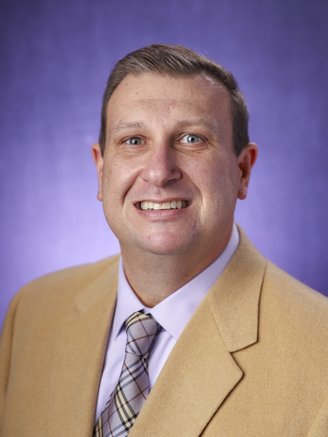
Cooper Jones has been appointed Humboldt State University’s new Executive Director of Intercollegiate Athletics. He begins July 19.
Cooper Jones. | HSU
Jones has more than two decades of experience in athletics and higher education, serving in administrative and revenue generating roles. His expertise includes strategy, planning, implementation, and budgeting for athletics programs; increasing philanthropy through sponsorship and major gift programs; and marketing and promotions. Jones has experience working with innovative executive teams and has proven his leadership skills in many programs in higher education and other organizations.
Throughout the course of his career, he has worked at institutions that place a high value on competitive success. At each institution, the men’s basketball team has advanced to at least one NCAA Tournament appearance. On four separate occasions those men’s teams advanced to the NCAA’s Sweet Sixteen round, with the 2002 Maryland men’s basketball team winning the NCAA National Championship.
Women’s basketball programs have been just as successful at each school he has served. Highlighting those successes are the 2006 NCAA National Championship (Maryland) and the 2008 NCAA National runner-up (Louisville). WNBA first-round draft picks, conference and national Players of the Year, and NCAA #1 and #2 seeds were an important part of the success achieved at each of the schools he served.
The baseball programs at each school have also enjoyed tremendous success. Regular season and conference titles, as well as NCAA Regional and Super Regional appearances are a regular occurrence at each school in his background. Highlighting this success was Louisville’s first-ever appearance in the College World Series in 2007, along with NCAA National Coach of the Year award and first-round selections as a part of the MLB Draft.
During his career, he has been intentional in building diverse and inclusive teams, has been a part of three University Advancement capital campaigns in excess of $1 billion dollars and annual fund drives in excess of $935 million, with direct responsibility for $505.5 million in new gifts and commitments.
“As a former student-athlete I understand the importance of a strong athletic department that supports our young student-athletes in the classroom and on the field,” says Jones. “One of my priorities will be to provide all the assets—tangible and intangible—that every student-athlete deserves and will need to be successful at Humboldt State University. And more importantly, for them to be successful once they leave campus and find their place in the world.”
“I am committed to developing a strong infrastructure that supports student-athletes, coaches, and staff to enable them to elevate Humboldt State to an unprecedented new level,” says Jones. “We have some exciting plans for the future of Lumberjack Athletics, and I will wake up every morning energized and enthusiastic about executing on those plans while aligning our department goals with the University’s objectives to create an athletic program that attracts national distinction. I am equally committed to evolving the club and recreational experience for our students and the university.”
“This is an incredible opportunity and I have worked for more than 20 years to prepare for this day,” he says. “I appreciate the encouragement I have received along the way from family, friends, and colleagues. I look forward to working hard each day to earn the trust and respect of the Lumberjack community, and building the type of intercollegiate athletics and recreation sports program our student athletes, staff, coaches, and entire University will be proud of.”
“I would be remiss if I didn’t thank James Hurley, President of Tarleton State University, and Gabriel Cagwin, Vice President of Tarleton State University, for the tremendous opportunity they extended to be part of their team. I truly enjoyed being a Texan, and the leadership and guidance from both Dr. Hurley and Dr. Cagwin has been vital to my career growth. I am indebted to both men for their unwavering friendship and support.”
Jones was most recently Assistant Vice President & Chief of Staff in Institutional Advancement at Tarleton State University, following a five-year stint as President of the Texas Sports Hall of Fame, where he implemented a $50 million capital campaign. He has also served as Executive Associate Athletic Director at Arizona State University and Senior Associate Athletic Director at the University of North Texas.
Prior to those roles, he was a fundraiser and major gift officer at three different institutions, primarily focused on raising funds for athletics programs.
Jones, a native of Conyers, Georgia, earned a Bachelor’s degree in Journalism and Public Relations with a Minor in History and Health Care Communications from Ohio University. He was a three-year letter winner and senior captain for the Bobcats football program and also made the Dean’s List.
Jones is married to the former Tiffany Goodman, who was born and raised in the East Bay region of San Francisco. She was a member of Georgia Tech’s first-ever ACC champion softball team in addition to being an Academic All-Conference selection. The couple are proud parents to a son, Jack, and twin daughters, Annie and Janie.
“We are excited to welcome Cooper and his family to the Humboldt State University community, says President Tom Jackson, Jr. “He brings extensive experience and a strong record of success, along with great enthusiasm. It’s a great time to be a Lumberjack, and getting Cooper on this team is just one more reason.”
Dr. Debbie Yow, former Director of Athletics for Saint Louis University, North Carolina State University, and the University of Maryland, says, “Cooper has an unparalleled work ethic. He understands what intercollegiate athletics adds to an institution of higher education and will be in lockstep with the senior leadership team of the University. His experience in athletics will bring a fresh perspective to problem solving, a trait every successful athletics director possesses. Congratulations on a terrific hire.”
Kids Ocean Day art contest second place winner: Liana S., 7th grade, McKinleyville Middle School | Images from the California Coastal Commission
This year, in order to maintain proper social distancing, Kids Ocean Day has taken a different approach by holding an online art contest. The winners were announced this morning and one of our own local students, Liana S. — a Seventh-grader at McKinleyville Middle School — took second place, with a creative embroidery piece.
“I embroidered this to show the amazing diversity of ocean life that we need to appreciate, respect, and protect,” Liana says of her work on the Kids Ocean Day website. “I included a shark, ray, octopus, seahorse, turtle, dolphin, eel, seal, and a school of fish. My favorite ocean animal is a dolphin.”
All of the submissions were assembled into an online mosaic in the shape of the painting by first place winner (Tracy N. of Garden Grove.) You can view the a video of the mosaic animation and photos of the other winning entries below.