

OBITUARY: Antonio DeAnda Sand, 1975-2021
LoCO Staff / Thursday, May 13, 2021 @ 6:56 a.m. / Obits

Antonio
DeAnda Sand
September 6,
1975
to May 7,
2021
He
was 45
Tony left this world peacefully with his family by his side. He went to be with his grandmother Lucy, whom he had a great love for. Tony had health complications which contributed to his passing. He will be greatly missed by his loving mother, family and friends. He could light the room up with his eyes, laughter and beautiful smile.
Many who knew Tony would say what a good heart he had. He was loved by many and will be missed by all. He was a wonderful young man who touch many lives, and was the pride and joy of his mother’s heart.
Tony enjoyed spending time with his family at the ocean and was an avid San Francisco Giants fan.
Tony was born in Eureka at the old General Hospital. He came in the world a fighter. Tony moved to Orland, Calif. with his mother, where he attended grade school and Orland High School. Tony played football in high school, which kept his mother on her toes. In his later years he moved back to Humboldt County, residing in Eureka. Tony had a love for his mother and wanted to be near her.
Over the years Tony had a variety of jobs. He was a hard worker and dedicated.
Married to his love Jessica Couch-Sand for 23 years, they had three children together and a stepchild he raised as his own. Tony was close to his father-in-law, William “Billy Goat, Wild Bill” Couch, and his brother-in-law, Billy Couch.
Tony was a proud member of the Bear River Band of Rohnerville Rancheria and especially proud of his heritage, passed to him by his Grandmother Lucy.
Preceded in death by his father, Alex DeAnda, grandfather Calvin L Sand I, grandmother Lucy Walker Sand, step-grandfather Rodney Seth Walker, uncle William (Billy) Sand, his cousin Casey Ryan Sand and his mother-in-law Marina Couch.
Survived by his mother, Sheila Sand Alcantar, wife Jessica Couch Sand, children Mercedes Frey and Husband Coleman, Isaac Couch-Sand, Zelia Couch-Sand , Izaiah Couch-Sand, sister Sarah Sand Orr and husband Dylan, his nieces and nephew – Adia, Ace and Abbey – aunts and uncles Shay and Wendell Freeman Sr., Bubby Sand, Marly and Russ Barrow, Dennis and Norma Sand, Conde Reeves and wife Stacey, who Tony introduced when they were 16, and his good friend Chon Reeves, and many other cousins and lifetime friends.
Our family would like to give a special thank you to the ICU staff and doctors at St. Joseph Hospital for their compassionate care.
There will be no service at this time. A celebration of his life will be later this year.
###
The obituary above was submitted on behalf of Antonio Sand’s loved ones. The Lost Coast Outpost runs obituaries of Humboldt County residents at no charge. See guidelines here.
BOOKED
Today: 7 felonies, 9 misdemeanors, 0 infractions
JUDGED
Humboldt County Superior Court Calendar: Today
CHP REPORTS
No current incidents
ELSEWHERE
RHBB: Magnitude 3.6 Earthquake Strikes West of Petrolia
Governor’s Office: Governor Newsom signs first-in-the-nation AI safeguards to protect Californians, calls on the federal government to do its part
RHBB: Body Recovered from Humboldt Bay Near Foot of Commercial Street
KINS’s Talk Shop: Talkshop September 9th, 2026 – Michelle Bushnell
Kneeland Glen Farm Stand Owner Evicted After Dog-Bite Incident, Repeat Warnings About Bringing Her Dog Onto the Property; Community Organizes Peaceful Protest
John Ross Ferrara / Wednesday, May 12, 2021 @ 3:20 p.m. / Business , Community , Dogs

The Kneeland Glen Farm Stand. | Photos provided by Kathy Mullen
The Kneeland Glen Farm Stand, a beloved community resource for fresh produce and other locally made goods, located just west of Three Corners Market, may close permanently at the end of the month after the stand’s owner received an eviction letter from the Northcoast Regional Land Trust yesterday.
Northcoast Regional Land Trust Executive Director Dan Ehresman told the Outpost that the non-profit’s board of directors unanimously agreed to evict the stand’s owner and operator, Kathy Mullen, after she repeatedly violated her lease agreement. The decision was announced this morning in a statement issued by the NRLT.
As some of you know, the Northcoast Regional Land Trust has made the difficult decision to end the lease relationship with the current tenant of the farm stand at our Freshwater Farms Reserve property. After repeated lease violations involving public safety, several serious incidents, and numerous disregarded warnings, the Land Trust Board of Directors felt it had no choice but to sever this longstanding relationship. We take very seriously the safety of those who visit our Freshwater Farms Reserve and could not continue to put visitors or the Reserve itself at risk. Failing to take measures to prevent serious injury could have resulted in tragedy, and subsequent liability could have caused the Land Trust to incur significant damages or even to lose the Reserve. This is certainly an unfortunate situation and one the Land Trust did not take lightly. We appreciate your support of the Land Trust and Freshwater Farms Reserve, and we wish the tenant well in their future endeavors.
The “lease violations” refer to issues stemming from a dog-bite incident that took place on the Freshwater Farms property earlier this year involving Mullen’s 14-year-old corgi-mix, Tootsie. Mullen said that one bicyclist needed medical care after the dog nipped their leg while they were leaving the stand. The NCRLT also received a separate complaint after the dog gave chase to a pair of joggers on the property.
“This is the first time she’s ever done anything. She doesn’t attack people, she chases people,” Mullen said. “She’s a herding dog used to manage goats and has a tendency to chase. She was not viciously attacking. She loves people and just wants her belly rubbed.”

Tootsie the dog.
While Mullen repeatedly ignored warnings from the NRLT to keep her dog off the property, she took responsibility for her actions in a statement put out on her Instagram this morning.
“I feel that I have let the community down,” Mullen said. “I love you all so much. My decisions regarding my dog have caused all this. I am sorry. My love for this little 25-pound, 14-year-old dog blinded my decisions. She has been at the store with me since we opened. I was letting her run about.”
The open-air community grocery stand has also been a valuable resource for local farmers such as Amy Diekmeyer of Luna Farm in Redcrest, who relies on Mullen’s stand to purchase wholesale produce and to distribute seasonal farm-share boxes to her customers.

“We needed a place to drop those boxes off and [the Kneeland Glen stand] was perfect,” Diekmeyer said. “She was doing this for free. It was a real kindness on her part. She also buys about $7,000 of produce from us every year. My community-supported agriculture deliveries start in two weeks. Without the farm stand, I’ll have to drive from Redcrest to deliver boxes to 50 different individuals on a Tuesday.”
College of the Redwoods Sustainable Agriculture Farm Manager Silas Sarvinski said that CR also utilized the Kneeland Glen Farm Stand to sell seasonal produce that supported the program.
“Kathy was extremely generous and let us do our community-supported agriculture drop-off there last season,” Sarvinski said. “We were planning on doing it there again this season. It was really helpful for our program. She has always been very kind to me and I’m disappointed to hear this.”
The potential loss of the stand has local farmers like Diekmeyer wondering if there’s a less-dramatic solution to the problem.
“The decision seems too petty and not solution-based,” she said. “Let’s find a real solution. Maybe Kathy is willing to step down. This farm stand is amazing. She helps out about 50 different vendors, like little old ladies that can’t leave the house but need to make a living so they sell jams and bake bread. It’s so unique to our area. It just doesn’t make sense that there’s not another solution. It’s such a stab to the heart.”

While Mullen said she’d be willing to step down as the owner, she said losing the stand would put her in serious financial trouble.
“If I lose my farm stand, I lose my income,” she said. “If I lose my income, it’s over for me and I will be homeless. I don’t just support myself. I also have a young lady who’s worked for me since she was 16. She’s 22 years old now. What will she do?”
A recent break-in at the stand has already put her in financial straits. Mullen said her computer was stolen from the stand two months ago, which led to identity theft and a loss of $14,000 that she’s still trying to recoup.
“We just planted the garden and all the flowers,” she said. We put a lot of money into that. It’s planting time and if we walk away, we’re going to lose everything. I wish they would be patient and give us a little more time, maybe until November when we’re all harvested.”
While Mullen has sworn to never bring her dog onto the property again, she said she’s been cut off from speaking with NRLT Executive Director Dan Ehresman and that her pleas have gone unanswered.
Vehement community members have organized a peaceful protest in support of Mullen and the Kneeland Glen Farm Stand. The protest will be held on Friday at 1 p.m. outside the Northcoast Regional Land Trust building at 901 Samoa Blvd. in Arcata.
“I hope and pray that they will give me a second chance,” Mullen said. “That’s my prayer, especially since we just planted everything. I don’t know what more I can do other than say sorry and that I won’t do it again, because I won’t.”
Can Newsom Build on Pandemic Lessons to End Homelessness?
Manuela Tobias / Wednesday, May 12, 2021 @ 7 a.m. / Sacramento
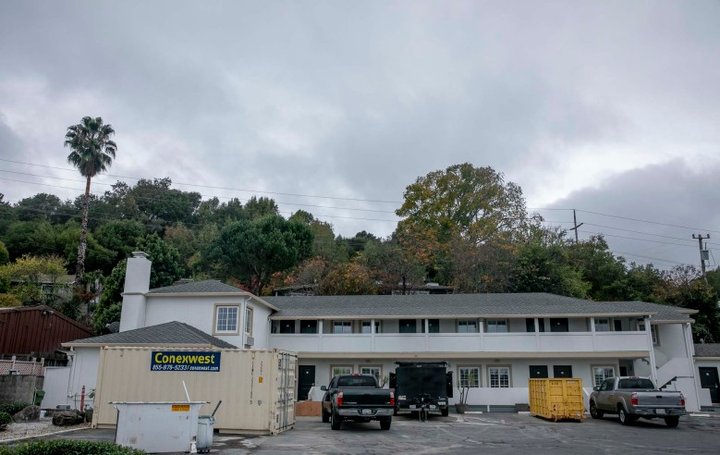
A motel in Marin County was scheduled to be converted into housing for the homeless under Project Homekey. Photo by Anne Wernikoff, CalMatters
###
From the lobby of a former extended-stay motel in San Diego, Gov. Gavin Newsom announced what he called a historic proposal to end a California crisis by converting thousands more hotel rooms into housing for people who are homeless.
In all, he proposed spending $12 billion over two years, about 10 times what he proposed spending on homelessness in January, thanks to a budget windfall pegged at more than $100 billion.
“What we’re doing here today is multiples of what any state in American history has committed to address this crisis of homelessness,” Newsom said Tuesday in calling for a massive expansion of Project Homekey, an emergency program launched during the COVID-19 pandemic that is regarded as one of his administration’s biggest victories tackling homelessness.
The program streamlines local zoning and environmental laws that make building in California so difficult, at a fraction of the cost, to convert mostly rundown hotels and motels into shelters and, eventually, affordable housing. The state spent $846 million on 94 Project Homekey conversions last year, including the San Diego motel that now houses 177 formerly unsheltered people.
Newsom called on one of them to speak: Lindsey Grace, a mother whose toddler was taken into foster care while she was living on the street last year.
“Because of this opportunity, and because the Housing Commission let us live here, I got my daughter back,” she said. “I’m 18 months sober; she’ll be 19 months old on the 22nd of this month.”
It was day two of Newsom’s statewide tour to promote his $100 billion “California Comeback Plan,” leading up to submitting his revised proposed budget to the Legislature at the end of the week. He’s able to propose such expensive initiatives thanks to a historic $76 billion state budget surplus, plus $27 billion in federal aid. He pointed out that his homelessness plan is a financial commitment equal to the tax rebate plan he outlined Monday.
Newsom is also ramping up to fight an almost certain recall election late this year. A new UC Berkeley Institute of Governmental Studies poll showed growing support for the governor: 49% of voters surveyed opposed the recall while 36% supported it. But of the various issues asked about, Newsom’s weakest spot was his handling of homelessness, with 57% of voters rating his job performance as poor or very poor and only 13% labeling it good or excellent.
“We can solve homelessness once and for all,” Newsom said in unveiling his new plan.
The plan includes a whopping $7 billion for the conversion of old buildings into shelters and affordable housing, plus $1.75 billion for shovel-ready projects, $1.6 billion toward homeless prevention and rental support, $447 million to address student homelessness at state colleges and universities and $150 million to rehouse people who benefitted from the state’s temporary COVID-19 shelters.
The governor’s office said this package would provide housing for 65,000 people, offer housing stability for more than 300,000 people and create 28,000 new beds and housing placements for those with behavioral health issues and seniors.
Even if those estimates prove true, they would not cover the state’s entire homeless population, which experts say will only grow in the coming months as low-income families reel from the effects of the pandemic and the statewide eviction moratorium ends June 30.
Nearly 250,000 people accessed homeless services in California last year, according to the state. By another count, last conducted in January 2020, more than 161,000 people experience homelessness on any given night in California. That one-night count was before COVID-19 ravaged the economy and just before Newsom made homelessness the focus of his State of the State speech.
State and local officials as well as advocates agree: The spending Newsom is now proposing is unprecedented. And it aims to address what residents up and down California have repeatedly named as the biggest issue facing the state.
But some worry that the governor’s plan fails to address the need for long-term solutions, or to provide flexible, long-term funding for cities and counties.
“This is bold. It’s historic,” San Jose Mayor Sam Liccardo, chairperson of a coalition of mayors from California’s 13 largest cities, told CalMatters. But, he added: “It’s not a secret we asked for more.”
Both the state Senate and Assembly budget blueprints call for $20 billion to address homelessness over the next five years. While Newsom is proposing more money per year, it’s not the long-term investment Liccardo and other mayors were hoping to see.
“We are concerned about future years and ongoing operations as we get past this moment where federal money is falling from the sky,” Liccardo said.
Assemblymember Phil Ting, a San Francisco Democrat who leads the Assembly Budget Committee, said the exact allocations of the $20 billion proposed by his committee hadn’t yet been hammered out. But he worries there isn’t enough in the governor’s budget proposal for flexible local spending.
The biggest programs to provide flexible local dollars: the Homeless Housing, Assistance and Prevention Grant Program and a similar local funding source introduced by Gov. Jerry Brown. It’s unclear whether the program has any allocations in the governor’s budget.
“One of the biggest areas of concern is the lack of flexible funding to cities and counties and continuums of care,” Ting said. “We’ll want to make sure there continues to be some level of flexible funding for those government agencies that are on the front lines of this crisis.”
Programs like this one, however, have raised significant concerns at the state level. A February report by the California state auditor found little accountability for the flexible dollars given to local jurisdictions over the past few years. And in his announcement, Newsom stressed the need for greater accountability in homeless spending.
“We definitely agree with him that there needs to be greater accountability,” Ting said. “We’re looking at trying to make a huge dent in homelessness, and the governor is as well. We just need to get our heads together and figure out how we can do that together.”
Margot Kushel, director of the UC San Francisco Center for Vulnerable Populations and the UCSF Benioff Homelessness and Housing Initiative, said the governor’s proposal is “a really good start, but it can’t be the end.”
Kushel said that Project Homekey was remarkable because of how it got around red tape. Normally, projects can take years to even get approved. Homekey was up and running months after it was announced.
But solving homelessness is not possible without addressing housing affordability, which is pushing thousands of Californians onto the street each year. According to estimates by the California Housing Partnership, California faces a shortfall of 1.3 million affordable rental homes.
“That’s fundamentally at the heart of the problem,” Kushel said. “There’s no way around that.”
Newsom is expected to make more announcements on funding for affordable housing in the coming days.
###
CALmatters.org is a nonprofit, nonpartisan media venture explaining California policies and politics.
OBITUARY: Jerry Nelson, 1931-2021
LoCO Staff / Wednesday, May 12, 2021 @ 6:56 a.m. / Obits

Garnett Gerald Nelson, known in the community as Jerry, was born on November 29, 1931 in Bristol Virginia where he lived until 1943 when he moved to Eureka. He passed away at 89 surrounded by family on May 10, 2021 in Eureka.
As the founder of California Real Estate, Jerry was a pillar in the community, and he dedicated his life to helping people buy and sell homes for over forty-five years. Over the course of his career, he got in the habit of passing out pens as advertisement. He got such joy out of giving away pens that he started doing it anywhere he could and soon became known as the pen man.
Jerry was an active member of Eureka The Pentecostal Church where he embraced God with a childlike faith. His love for God was matched only by his love for his family. Jerry’s kind spirit touched the lives of many, and it is that kindness that will be remembered most.
Jerry is preceded in death by his father, Garnet Lee Nelson, his mother, Ethel Batchelder, and his sister Jane L. Smith.
He leaves behind his loving wife, Jovina Nelson; sons Gary Nelson and Larry Nelson; sister, Pat Paul; stepchildren Brice, Kelly, Cristie, Jeffrey, Yvonne, and Aaron; eleven grandchildren, three great grandchildren, and numerous nieces and nephews.
A memorial service will be held at Eureka The Pentecostal Church (1060 Hoover St.), on Saturday, May 22, 2021 at 11 a.m. Due to capacity restrictions, those wishing to attend the memorial are asked to register at this link. In lieu of flowers, donations can be made to the American Cancer Society.
###
The obituary above was submitted on behalf of Jerry Nelson’s loved ones. The Lost Coast Outpost runs obituaries of Humboldt County residents at no charge. See guidelines here.
TODAY in SUPES: Board Agrees to Spend Another Half-Million Dollars Trying to Fix Its Ongoing Fiscal Shitshow
Ryan Burns / Tuesday, May 11, 2021 @ 6:13 p.m. / Local Government
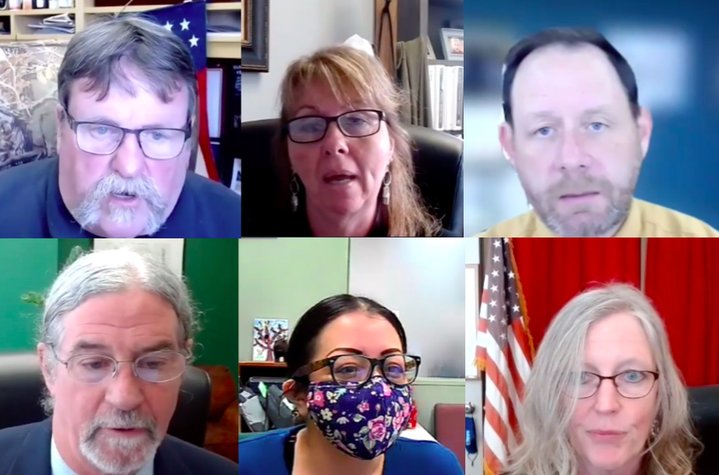
Screenshot from Tuesday’s Board of Supervisors meeting (clockwise from top left): First District Supervisor Rex Bohn, Second District Supervisor Michelle Bushnell, Third District Supervisor Mike Wilson, Fourth District Supervisor Virginia Bass, Auditor-Controller Karen Paz Dominguez and Fifth District Supervisor Steve Madrone.
###
The Humboldt County Board of Supervisors had a relatively short agenda on Tuesday, but they wound up engaged in some lengthy conversations on topics ranging from the county’s finances to its post-pandemic work routines and The Great Redwood Trail. You’ll find our weekly roundup in the paragraphs below.
The bulk of the morning session was occupied by urgent deliberations over the county’s ongoing fiscal management problems, which, over the past two years or so, have been the source of bitter infighting and the subject of countless meetings.
Today, the County Administrative Office was asking the board to approve spending up to $500,000 on a contract extension with Sacramento firm Macias, Gini & O’Connell, LLP (MGO). Back in March the county hired the firm to provide an array of financial management services. The original agreement with the firm was for half that amount, but in its staff report the County Administrative Office said more help is needed.
After consulting with various county departments, the staff report concluded that “the good of the organization would benefit from a contract amendment to extend the term of the agreement to June 30, 2022 and increase the amount by $500,000 in order to increase the scope of services.”
Those expanded services, enumerated in a long, bullet-pointed list, amount to hiring the firm to serve as the county’s chief financial officer (CFO), under the direction of County Administrative Officer Amy Nilsen. MGO would agree to provide improvements to internal controls and efficiency, offer assistance with the county’s new payroll system and give help to various departments, including the Auditor-Controller’s Office, the Treasurer-Tax Collector’s Office.
The item was on the agenda under the consent calendar, meaning it was set to be approved alongside a range of other matters in one cumulative vote, with very little discussion. However, Fifth District Supervisor Steve Madrone pulled the item for a more thorough look, saying it seemed like a lot of money.
After a brief presentation by Nilsen, First District Supervisor Rex Bohn voiced frustration with the ongoing issues, particularly the fact that the Auditor-Controller’s Office has yet to fully close the books on Fiscal Year 2019-20, with the next fiscal year set to begin in just eight weeks.
“I don’t know whose fault this is, but I’ve been getting phone calls from school districts [and] special districts … saying they can’t do their year-end audits because our books aren’t closed,” Bohn said. He referred to an allegation from the county’s Public Works Department, whose director, Tom Mattson, has said his department lost out on roughly $600,000 in state and federal reimbursements last year because the books weren’t closed in time for him to submit claims. “This has got to end somewhere,” Bohn said.
Multiple department heads appeared via Zoom and urged the county to approve the contract with MGO. Human Resources Director Linda Le said the firm’s staff would serve “as a nexus to the Auditor-Controller’s Office to help this organization move forward” in a fiscally responsible way.
Treasurer-Tax Collector John Bartholomew said he has grown concerned about potential blind spots in financial transactions that involve both his office and that of Auditor-Controller Karen Paz Dominguez. “On the Treasury side, [we] feel like we’re operating in the dark,” he said. “I’m not throwing aspersions to the Auditor-Controller’s Office, but we really need to have a comfort level that checks and balances do in fact exist, and that transactions are done in accordance with government code.”
Sheriff Billy Honsal agreed that matters have grown urgent and said that without knowing what his department’s fund balances are, it’s difficult to plan for offering services into the future. “This is something the county needs to put a lot of effort into, to try to fix this issue … because things are not working good right now,” he said. “I think you all need to hear that.”
“It’s very important that we close our books and get our audits done,” Public Works Director Tom Mattson said. “Any resources we can get to solve this problem would be greatly appreciated.”
Planning and Building Director John Ford said he supports the proposal, and he recounted an issue in which a grant given to Open Door Community Health Centers back in 2007 recently got mistaken for a loan due to a bookkeeping mixup. “So any ability to help clarify these things would be extremely helpful,” Ford said.
Connie Beck, director of the county’s Department of Health and Human Services, noted that MGO has been very helpful in getting documents together in a way that allowed the Auditor-Controller’s Office to get her department’s claims approved.
Eventually, Paz Dominguez had a chance to give her take on the situation. Speaking from her county office she said she didn’t know the meeting would include discussions about her office, and while she agreed with the call for transparency she disputed some of the allegations made by department heads. For example, she said the Treasurer-Tax Collector’s Office has been given full access to the Finance Enterprise software used in her own department and thus shouldn’t have concerns about blind spots.
Paz Dominguez also said some county departments have been forgiving loans without proper authority, which has caused confusion about ending account balances, and she insisted that all funds for special districts and schools have already been closed. She also questioned how much access to the county’s fiscal management software she should give to independent special districts.
“I want us all to be on the same page,” Paz Dominguez said. As for hiring MGO, she said that’s the purview of the CAO’s office and its head, Amy Nilsen. “What she intends to have them do I’m not sure,” Paz Dominguez said.
Regarding her own department, Paz Dominguez said that as soon as she’s able to fill the recently approved new positions for accountants and fiscal assistants, things will only get better.
Board Chair Virginia Bass said the conversation had gotten a bit off-topic, but the contentious back-and-forth continued. Bohn said the Fortuna School District and others have yet to receive their apportionments, and, recalling Paz Dominguez’s recent absence from the inaugural Audit Committee meeting, he said she’s clearly too busy to offer training to outside entities.
“I don’t care how we get there,” he said. “How do we get the people their money? … We’re spending so much time on this. We’ve spent more time on the Auditor-Controller’s Office in the last 18 months than I have in my previous seven years here.”
Third District Supervisor Mike Wilson said this proposal to pay for more services from MGO is “not perfect,” but he pointed out that the county may not use the entire half-a-million dollars, and he expressed hope that the funds would be used efficiently. With that, he made a motion to approve the contract agreement.
Fifth District Supervisor Steve Madrone seconded the motion, saying, “I too hope that this large expenditure actually provides assistance to Auditor-Controller’s office and all departments.” He added that he believes every county department shares some degree of blame for these ongoing fiscal issues.
The board wound up approving the $500,000 agreement with MGO unanimously.
###
Later, the board consulted with public health staff regarding California Governor Gavin Newsom’s plan to fully reopen the state’s economy on June 15, as long as there’s sufficient vaccine supply and hospitalization rates remain stable and low.
Humboldt County Health Officer Dr. Ian Hoffman said a number of key regulatory decisions have yet to be made, so it’s hard to say what Board of Supervisors meetings and other county business might look like come summer.
The board members offered differing viewpoints about how to return to in-person meetings, if at all. Madrone said that as long as there’s COVID circulating in the community, he has no intention of returning to congregate settings such as public meetings, “even though I’ve been vaccinated.”
He also suggested that shaking hands might be ill-advised, from a public health standpoint, saying “Oriental families” have a better approach with clasping their hands and bowing. (A quick aside on that: The term “Oriental” is widely considered an outdated and offensive means of referring to human beings. Five years ago, former President Barack Obama banned its usage — along with “negro” — in federal laws.)
Second District Supervisor Michelle Bushnell questioned Madrone’s stance on public gatherings, saying we’re not likely to see COVID disappear anytime soon. Hoffman agreed with that assessment, saying, “I think COVID is here to stay. It will become endemic.” He also vouched for the efficacy of vaccines in preventing serious illness and hospitalizations, even in the rare cases when someone who’s gotten their shots contracts the virus.
Eventually, the supervisors directed staff to develop recommendations for a permanent tele-work policy. They also approved the state’s supplemental paid sick leave and directed Human Resources to establish a new bank of leave hours for each county employee. After June 15, the board will consider whether to direct employees to return to in-person work activities, and whether to return to in-person board meetings themselves.
###

Humboldt County Deputy Director of Environmental Services Hank Seemann delivers a presentation on the NCRA and the proposed Great Redwood Trail. | Screenshot.
###
Toward the end of the public session Tuesday, the board considered whether to send a letter of support for the North Coast Railroad Authority’s proposal to railbank the northern section of its right-of-way.
Hank Seemann, the county’s deputy director of environmental services, explained that this would preserve the public resource for possible future rail use while allowing development of The Great Redwood Trail, an ambitious and expensive project that, if completed, would result in a multi-use pathway stretching 316 miles from San Francisco Bay to Humboldt Bay.
Seemann said this proposal would facilitate more near-term development of trails between cities along the coast, including the completion of the Humboldt Bay Trail South, from Eureka to Bracut. Developing the trail through the rural, interior regions would be a longer-term process, he added.
Bohn questioned whether the Timber Heritage Association, a volunteer group with dreams of an excursion train around the bay, had been adequately consulted.
Bushnell said landowners in her district had reached out to her with concerns about the impact of the proposed trail on their properties and cattle. She said there hasn’t been enough public outreach, and Bohn agreed.
Seemann said that sending the letter would allow the county to express its concerns, including concerns about engaging rural landowners, and said that in the absence of railbanking, portions of the right-of-way could revert to private ownership, which would break up the corridor.
Wilson said that while the railbanking proposal may have flaws, it’s “unequivocally” better than the alternative because it would preserve the corridor for future use. Madrone agreed.
The public comment period saw people from both sides of this debate speak up, with some saying there hasn’t been enough analysis and consultation with landowners while others lauded the proposal as a means of connecting communities and cleaning up the mess left in the Eel River Canyon by private rail operators.
Bass proved to be the swing voter, as she often is, and though she expressed some reservations she said, “I think sending the letter may be some of the best ways to get our concerns on the record. … I’m really not thrilled with this but I will likely support the recommendation.”
Indeed she did, and with Wilson and Madrone joining her, the board narrowly approved sending the letter with a 3-2 vote. You can read the full letter by clicking this link.
Local Schools and Local Sculptor Adorn Jolly Giant Creek With Art That Celebrates It
Jacquelyn Opalach / Tuesday, May 11, 2021 @ 2:32 p.m. / Environment

Photos: Jacquelyn Opalach.
##
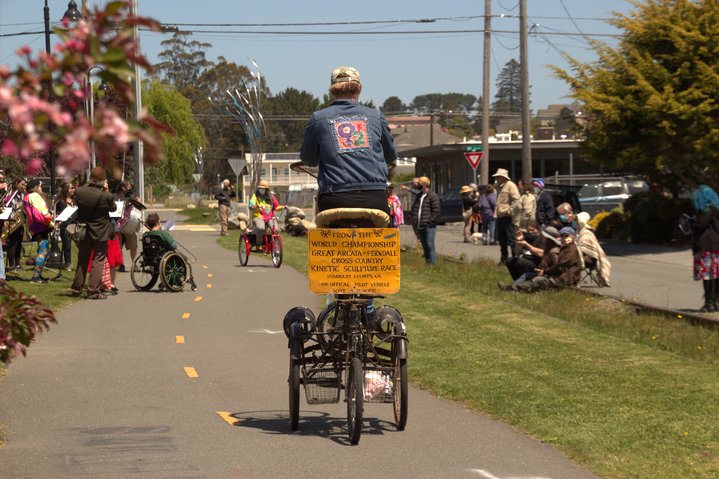
Arcata’s newest art installations in the Creamery District have specific, locational importance: they celebrate the Jolly Giant Creek and its ecosystem, and mark where its waters flow beneath our feet.
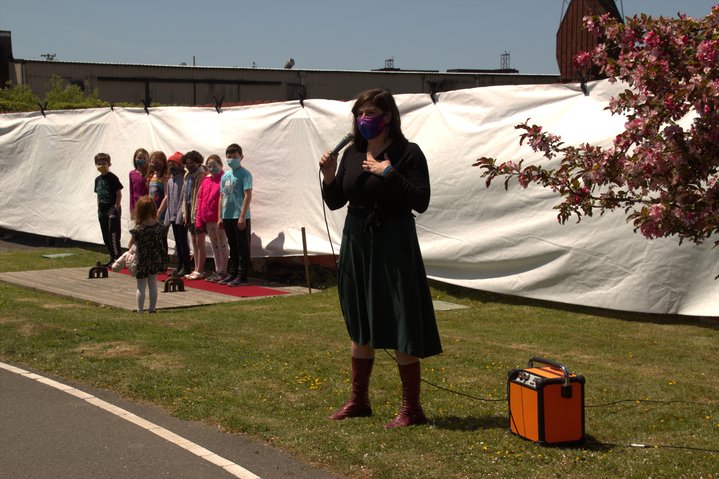
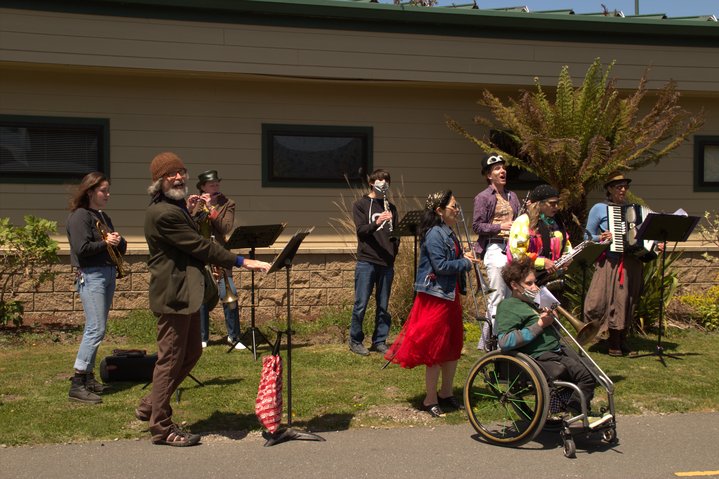
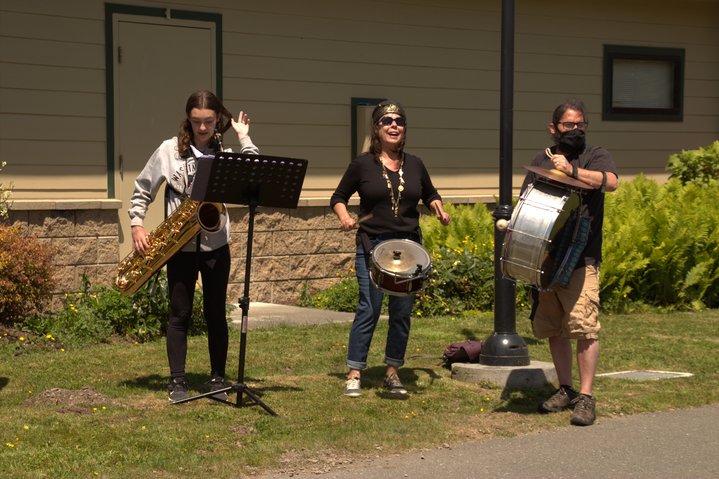
The new works include two permanent 14-foot sculptures created by James Hildebrandt and a mural painted by third- and fourth-grade students from Redwood Coast Montessori and Fieldbrook Elementary School via the Playhouse’s Artists in Schools program. Located along the L Street bike path at Eighth and Ninth streets, the pieces were unveiled on Saturday at an outdoor event hosted by the Arcata Playhouse. A group of student artists presented their mural in its full form for the first time and attendees were serenaded by Bandemonium.
On close inspection, viewers see that the “Art and the Environment: Keeping the Giant Jolly” mural, mounted to the red fence along the bike path on L, is a collection of two-by-two slabs of wood, painted by individual students and pieced together to create one four-by-72-foot Jolly-Giant-and-its-inhabitants artistic experience.
The eight-week mural project was completed entirely over Zoom with direction from the Playhouse’s Sarah McKinney, MacKenzie Ridgwood and Haley Davis. McKinney, who is education director at the Arcata Playhouse, told us on Saturday that her team consulted local experts to develop lessons about the creek and its inhabitants. “We spent the first two or three weeks just looking at pictures, talking about the stream, talking about where it goes through the town, how it dips beneath our feet, and that sometimes when we’re walking around places we might not know that there’s a stream underneath us,” McKinney said.
After that, the team marked a general outline on the wood panels before distributing them to the young artists, who painted sections of their pieces lesson-by-lesson, with guidance from Artists in Schools. Students were invited to add local animals to their art, which they sure did. “It was really fun to watch the whole process and see the kids pick animals that would live in the different habitats,” said MacKenzie Ridgwood, education assistant at the Playhouse.
Usually, Artists in Schools brings shadow puppetry and mask making and performing to K-8 students in a few participating local schools, but doing those projects over Zoom quickly proved to be too tricky a challenge. The team pivoted to bringing Arcata this project instead, and we are happy they did. Now, the fence on L’s bike path — which has never been bestowed with art before — is adorned with young, environmentalist energy. Whoot!
A short ways down the path are Hildebrandt’s two sculptures, named “Homeward Leaping!” Constructed primarily from stainless steel and copper — 65 percent of which was upcycled — the two sculptures stand directly over the creek and bend fluidly with the wind.
“A friend of mine and I were walking down the street one day and we’re going, “you know, there’s a creek under this road, and no one knows about it, really,” Hildebrandt said of his inspiration for the pair of sculptures. A year and a half later, we can all see now where the Jolly Giant flows.
“So many people would be walking by while I was working and they would tell me, ‘We used to drink water from this creek! We used to catch fish and eel in it!’ You know, back in the ‘60s and ‘70s,” Hildebrandt said. “The community’s been wonderful.”





Unpermitted Weed Operation Taken Down Near Dinsmore, Sheriff’s Office Says; 5,200 Plants Eradicated
LoCO Staff / Tuesday, May 11, 2021 @ 10:20 a.m. / Crime
Press release from the Humboldt County Sheriff’s Office:
On May 10, 2021, deputies with the Humboldt County Sheriff’s Office Marijuana Enforcement Team (MET) served one search warrant to investigate illegal cannabis cultivation in the Burr Valley area. The California Department of Fish and Wildlife and Humboldt County Code Enforcement assisted in the service of the warrant.
One parcel was investigated during the service of the warrant. The parcel did not possess the required county permit and state license to cultivate cannabis commercially.
During the service of the warrant, deputies eradicated approximately 5,207 growing cannabis plants.
Assisting agencies found the following violations:
- Four water pollution violations (up to $20,000 fine per day, per violation)
- Two depositing trash in or near a waterway violations (up to $20,000 fine per day, per violation)
Additional violations with civil fines are expected to be filed by the assisting agencies.
No arrests were made during the service of the warrant. The case will be forwarded to the District Attorney’s Office for review.
Anyone with information about this case or related criminal activity is encouraged to call the Humboldt County Sheriff’s Office at (707) 445-7251 or the Sheriff’s Office Crime Tip line at (707) 268-2539.

Photos: HCSO.


