

OBITUARY: Debra Elaine Sherman Albers, 1966-2021
LoCO Staff / Thursday, March 11, 2021 @ 6:56 a.m. / Obits
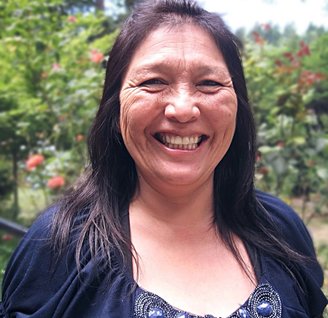
Debra Elaine Sherman Albers more commonly known as “Debbie” crossed over on March 2, 2021 at her home in Loleta. She was born on July 25, 1966 in. She was a proud member of the Bear River Band of Rhonerville Rancheria.
Debbie had a heart of gold and a smile to reflect that. She was a caring mother, grandmother, and friend to all. She greeted everybody with her open arms no matter who you were. Debbie loved spending time in the kitchen, creating delicious meals and baked goods for her family and friends. She was especially known for cooking the best Spanish rice and peanut butter cookies. One of her proudest moments was conquering and remastering another recipe. When it came to cooking up a storm in the kitchen there was no doubt that she was truly uncontested.
Debbie was not a hard person to find matter of fact, you would find her more times than not. She was notorious for walking with multiple bags flung over her shoulders. For if she has somewhere to be, she would get there regardless if she had to walk ten miles and catch four different busses to get there. She was a determined, goofy, free spirited soul and would walk as far as her little feet could carry her, and then some.
Debbie will be remembered for attending council meetings, cultural ceremonies, and sporting events. She truly lived for social interactions and self development. She loved her watching her children at sporting events. Debbie would fill the sporting arenas with her loud laughter and loud cheers, as that was her in her element.
In Debbies younger years she attended beauty school in Eureka, where she learned skills that she generously provided to anybody in need of some beauty. Debbie was an avid competitor on the daily quiz radio channel “Cool 105”. She would listen to that station every morning no matter how loud or who was asleep.
Debbie did not have a lazy bone in her body, for if you needed help she would be there at the drop of a dime, regardless of who you were and the situation you were in. Debbie made it her life destiny to make sure all was loved, and for that she will truly be missed by many.
Debra Elaina Sherman Albers is survived by her children Delmar Donahue, Edwin Donahue Jr (Zance), Derek Donahue, Clifford Albers jr, Shannon Albers, Elaina Albers and Dentillia Albers. Grandchildren Kidiwische Donahue, Naomi Donahue, Raymee Donahue, Neisha Donahue, Marissa Donahue, Tyler Donahue, Quintin Donahue Jr, Shirley Anne Donahue, Damian Ike Donahue, Eliza Albers, Numikoy Albers, Abalone Albers, Adalina Arias and many many cousins aunties and uncles.
She is preceded in death by her father and mother Duane and Elaine Sherman, Grandma (mom) Beverly James, Grandpa Cecil Sherman Sr, Her husband Clifford Albers Sr, and Former Partner Gus Donahue.
Paul Bearers - Denny Sherman, Gusto Bowie, Rick Moorhead, Richard Moorhead, Art Moon, Wayne Moon, Joe Sherman, Darrell Sherman, Jess Sherman, Douglas James, Melvin F Farmer III, Zanz Donahue, Delmar Donahue, Quintin Donahue Sr, Derek Ike Donahue, Clifford Albers, Shannon Albers, Jim Bowie, Rhys Arias.
There will be a wake Thursday, March 11, 2021 at her residence in Loleta at 5:30 p.m.
Her services will be held Friday, March 12, 2021 at the Bear River Recreation Center at 11 am. She will then be laid to rest at Sunset Memorial in Eureka. A Reception will follow at the Bear River Recreation Center.
###
The obituary above was submitted on behalf of Debbie Albers’ loved ones. The Lost Coast Outpost runs obituaries of Humboldt County residents at no charge. See guidelines here.
BOOKED
Today: 11 felonies, 7 misdemeanors, 0 infractions
JUDGED
Humboldt County Superior Court Calendar: Today
CHP REPORTS
Meyers Ave / Eureka St (HM office): Trfc Collision-No Inj
Us101 N / Trinidad Ofr (HM office): Assist with Construction
ELSEWHERE
KINS’s Talk Shop: Talkshop September 15th, 2026 – Matt Eberhardt
Governor’s Office: California honored for nation-leading efficiency and data-driven improvements in state services and programs
KINS’s Talk Shop: Talkshop September 15th, 2026 – Matt Eberhardt
OBITUARY: Betty Maciel, 1929-2021
LoCO Staff / Thursday, March 11, 2021 @ 6:56 a.m. / Obits
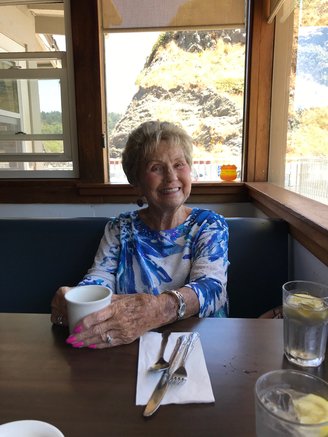
Betty Maciel
November 11, 1929- February 22, 2021
Betty was born in Crawford County, Arkansas on November 11, 1929 to Clarence and Ellen Hand. At the age of five her family moved to California. While attending school in Bayside she met Joe Maciel. She went on to marry Joe and enjoyed 71 years of marriage before his death in 2017.
Betty had four wonderful children — Larry, Shirley, George, and Terri. Not only was she a great mom, she was a loving sister, aunt, grandma, great grandma, great great grandma, and friend. She was the matriarch of something special that very few experience. Throughout her life, Betty made many great memories. She and Joe traveled to Alaska, Hawaii, and Mexico as well as extensively throughout the continental U.S. in their travel trailer. She enjoyed entertaining and very often was also the entertainment. She organized many fun family gatherings and was a great hostess. One would always leave her house with great memories and a full stomach. On any given day. you could find her adorned with jewelry and dressed to impress.
Betty is survived by her sister Bonnie, brother Gary, children Larry (Norma), Shirley Bugenig, and Terri (Bob) Wallis, 10 grandchildren, 13 great-grandchildren, and two-great-great grandchildren.
She also leaves behind Juan, the caretaker that took excellent care of her throughout the twilight of her life. Many thanks to hospice and Katina as they made her final days comfortable. Betty was loved by all and will be deeply missed.
FYI. She loved her #1 grandson David (Dustin) the most…
###
The obituary above was submitted on behalf of Betty Maciel’s loved ones. The Lost Coast Outpost runs obituaries of Humboldt County residents at no charge. See guidelines here.
OBITUARY: Sigrid Kathe Kinyoun, 1930-2021
LoCO Staff / Thursday, March 11, 2021 @ 6:56 a.m. / Obits
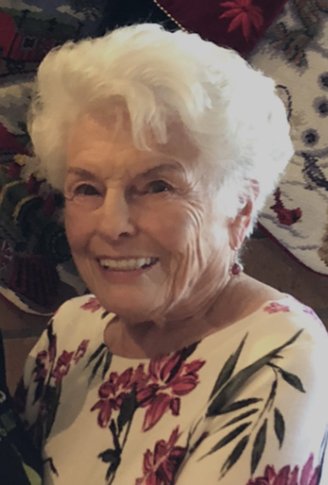
Sigrid Kathe Kinyoun went to be with her Heavenly Father on March 1st, 2021. She was two weeks shy of the young age of 91. She was born to Julius Heiss and Johanna Treiber in Santa Monica, CA in 1930. She enjoyed being involved in the Pacific Telephone Pioneers and attending St. Mark’s Lutheran Church in Ferndale. Her favorite pastime was sitting by her window in her blue recliner knitting for numerous friends and family members. She was a strong Christian woman with a stubborn German flare. Her family was the joy of her life.
She is preceeded in death by her late husband John Kinyoun. Daughters Mona Lisa Kinyoun, Monica Gribben and Jennifer Kinyoun. Son Michael Kinyoun. Grandchild Jamika Newman. Great grandchildren Mylie Kirk and Asher Kinyoun. Sisters Tina Frejlach (Ken Frejlach), Elizabeth Kutschinski (Clancy Kutschinski), and brother Martin Heiss (Anne Heiss). Dear friends Kline Purcell and Joe Johansen.
She is survived by sister Karin Hubby (Skip Hubby), son Matt Kinyoun (Nichole Piland) and Daughter Staci Lopez (Mike Lopez). Grandchildren Wes & Lane Kinyoun (Lakesha Kinyoun), Danielle Maestas, Zach Bircham, Ethan & Eli Lopez, Russ Newman (Teresa Newman), Michelle Kirk (Adam Kirk), Jason Kinyoun, Tania Gilliam (Damani Gilliam), Camille Drayton. Great grandchildren Rusty & Shelby Newman, Nacalah, Jaquez, Javon and Nyla Gilliam, Paris and Ariyah Seymore, Bryce, Chance, Dakota and Makayla Kirk, Alaina and Kaitlyn Kinyoun. She is survived by many nieces and nephews with whom she kept close to her heart.
She had a loving and caring support group in her neighborhood (Karen, Brenda, Mark, Cena, Tim & Taffy), a very long list of close friends (best friends Joyce Craig and Howard Penn). She had the deepest admiration for her Pastor and friend in Christ, Tyrel Bramwell.
She touched so many lives, her loss will be felt by many.
Private services will be held at a later date. In lieu of flowers, donations can be made to Hospice of Humboldt.
###
The obituary above was submitted on behalf of Sigrid Kinyoun’s loved ones. The Lost Coast Outpost runs obituaries of Humboldt County residents at no charge. See guidelines here.
‘Revolutionary’ Federal Stimulus Bill Could Cut California Child Poverty by Half
Jackie Botts / Wednesday, March 10, 2021 @ 5:11 p.m. / Sacramento

Photo by Blogging Guide on Unsplash.
###
As President Joe Biden’s $1.9 trillion virus relief package heads to the Oval Office for his signature, the mammoth spending bill has the potential to reduce child poverty in the Golden State by half.
That would be a turning point for a state that is an economic powerhouse vexed by the highest poverty rate in the nation when accounting for the cost of living.
Economists and progressives are hailing as “revolutionary” a provision to send periodic cash to most families with children through a one-year expansion of the existing child tax credit. When combined with the state’s new stimulus aid, the payments could lift millions of Californians out of poverty this year, particularly immigrant households that have borne the brunt of the pandemic’s health and economic effects.
The expanded child tax credit will go a long way for Alma Jimenez, an undocumented single mother of 8-year-old Abraham, who is a citizen. Abraham has been in virtual school for nearly a year, forcing Jimenez to take occasional house-cleaning jobs and make artisanal soaps from home.
“I haven’t paid the light bill, PG&E” and several months of rent, said Jimenez in Spanish from the one-bedroom they share in Concord. “It would help me pay them. Maybe my car insurance. I’d distribute it.”
As logistics of the child tax credit are still being worked out by the IRS, the federal package passed by Democrats in Washington, D.C., achieves something California progressives have dreamed of, but had not yet achieved: sending monthly cash aid to families in poverty with no application process, work requirements or restrictions on how to spend the money. In recent years, Gov. Gavin Newsom and fellow Democratic lawmakers have made strides on various proposals, such as a $1,000 tax credit to low-income working families with children under 6, but failed to pass a bill intended to lift all children out of deep poverty.
California experts say this one-year policy will be a political test for a permanent child allowance in the United States, and they hope it passes with flying colors.
“If it were to be made permanent, it would be the most important anti-poverty program for children in our history,” said UC Berkeley economist Hilary Hoynes, one of a committee of experts who recommended this policy in a 2019 National Academies of Sciences, Engineering, and Medicine report on reducing child poverty.
Cut child poverty rate by half
Biden is expected to sign the stimulus bill on Friday. It also includes $1,400 stimulus checks for individuals making less than $80,000 and couples earning $160,000 or less annually, extra $300-a-week unemployment payments extended through Sept. 6, and a cash infusion for state and local governments.
Through the expanded child tax credit, the federal government will send regular payments that add up to $3,600 per year for each child under the age of 6 and $3,000 for each child under 18. Single parents making up to 75,000 and couples earning up to $150,000 per year are eligible, covering over 60% of California households with children, according to a CalMatters analysis of Census data.
At stake for California is the chance to slash its child poverty rate in half, from 17.4% to 8.7%, according to researchers at Columbia University’s Center on Poverty and Social Policy, who crunched the state’s poverty estimates for CalMatters. An estimated 7.9 million California children would benefit from the expansion.
The stimulus package faced unanimous opposition among Republicans, but the child tax credit expansion garnered less criticism. Some critics warn it could disincentivize parents from working or getting married.
“This isn’t a rescue bill, it isn’t a relief bill, it is a laundry list of left-wing priorities that predate the pandemic and do not meet the needs of American families,” said House Minority Leader Kevin McCarthy, a Bakersfield Republican.
The IRS could start providing advances on the tax credit as soon as July 1, likely on a monthly basis. That means that families will likely receive nearly half of their total 2021 child tax credit this calendar year, and claim the rest when they file their 2021 tax returns next spring.
Why are experts calling this revolutionary?
Public policy experts say the child tax credit expansion is significant in three ways. For one, Congress expanded the annual dollar amount substantially, up from the current maximum of $2,000 for each child. Second, it will now be universally available to all families with children who make under $75,000 per parent. Currently families with no income don’t qualify and the lowest-income families qualify for less.
Finally, it will be available on a monthly basis. That will greatly reduce financial anxiety, said UC Santa Cruz sociologist Chris Benner, who directs the Institute for Social Transformation. This gives parents the stability they need to seek new economic opportunities as the country recovers from the pandemic, Benner said, like paying for child care so they can go back to work or returning to school to get a better job.
And that the cash will be unconditional is both “revolutionary” and “still weirdly controversial,” said Alexandra Cawthorne Gaines, vice president at the Center for American Progress, who previously advised governors across the country on social policy.
“There are still people who fully believe that low-income people of color, in particular, are not capable of making wise decisions with their money, so they want to put conditions on how they spend their cash,” Cawthorne Gaines said.
Taken together with California’s new $600 Golden State Stimulus payments for an estimated 5.7 million low-income households, the expansion could mark a financial turning point in the pandemic for hundreds of thousands of California families with undocumented parents, who have been excluded from most other pandemic relief efforts like stimulus checks and unemployment benefits.
That’s because the Golden State Stimulus provides extra aid totalling $1,200 for low-income undocumented workers. And the federal child tax credit is available for all citizen children regardless of their parents’ immigration status — including the one in eight school age children in California estimated to have an undocumented parent.
Where’s the evidence this will work?
The idea of sending regular cash to families is not novel. The United Kingdom halved child poverty in less than a decade with a bundle of policies including a child allowance. Canada is on track to do the same.
In fact, not having a child allowance sets the United States apart from other peer nations and leaves us with a much higher child poverty rate, said Clare Pastore, a professor at the USC Gould School of Law who specializes in poverty and civil rights.
“This benefit is a step towards a child allowance, which has been proven over time and in many nations to be one of the most significant steps, if not the most significant step, in reducing child poverty,” Pastore said.
California’s $1,000 young child tax credit, passed in 2019, is actually the “closest relative” to what Congress has now done, said Hoynes. That’s because the amount doesn’t decrease for lower earners.
California has set the stage for this policy in other ways. The city of Stockton ran a two-year universal basic income pilot program to give $500 each month to 125 residents, and reported promising results last week. After one year, 40% of participants had a full-time job — up from 28% — and reported that the cash had allowed them to reduce gig work, complete internships and get training needed to find better jobs. Anxiety and depression fell. Participants were better prepared to handle unexpected expenses. The most common use for the cash was food.
Think of this as a “down payment” on reducing child poverty, said Cawthorne Gaines, but more needs to be done to make sure that hard-to-reach children — like those in immigrants families, foster families or the juvenile justice system — get the benefit. And other social safety net programs still need strengthening, she said.
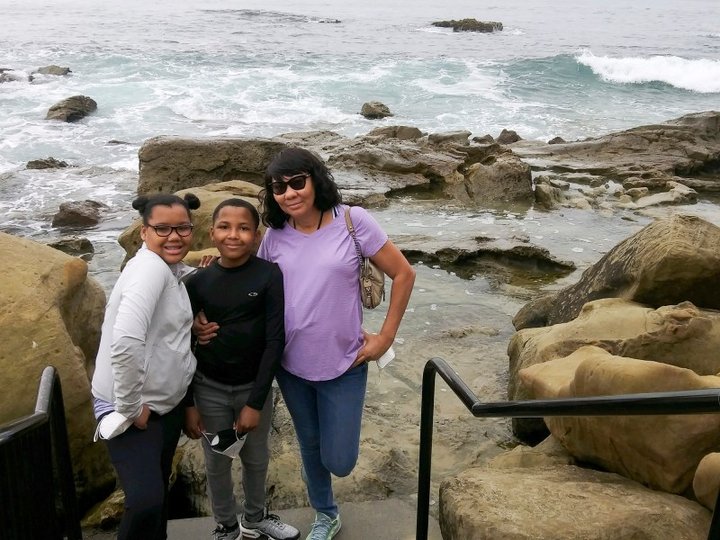
Carol Taylor, right, with twins Taylor and Tyler. Photo courtesy of Carol Taylor
That’s clear to Carol Taylor, a South Los Angeles single mom of sixth-grade twins.
The child tax credit will make a welcome dent in her monthly meal budget and distance learning expenses: the internet bill that doubled when Taylor upgraded to higher speed for Zoom classes, a 24-inch touchscreen computer for the kids, a large tent for Taylor to take her own work calls as a disability advocate in the backyard, and the $70 an hour she’s paying for a private tutor, due to concerns about her daughter’s charter school and the Los Angeles Unified School District failing to deliver adequate support for her documented learning challenges.
“They don’t care,” Taylor said. “That’s what COVID’s revealed. It’s up to us as parents.”
“For sure, the funds will help,” Taylor said, but she said it will take more than monthly checks to account for faltering public schools and costs of living that have skyrocketed since Taylor moved to Los Angeles in the early 1990s.
###
CalMatters economy reporter Lauren Hepler and The Mercury News reporter Laurence Du Sault contributed to this report. This article is part of the California Divide, a collaboration among newsrooms examining income inequality and economic survival in California.
CALmatters.org is a nonprofit, nonpartisan media venture explaining California policies and politics.
U.S. Coast Guard Sector Humboldt Bay Patrol Boat Decommissioned After 21 Years of Service
John Ross Ferrara / Wednesday, March 10, 2021 @ 2:50 p.m. / Local Government

U.S. Coast Guard Cutter Dorado. | U.S. Coast Guard Sector Humboldt Bay
U.S. Coast guard patrol boat “Dorado” was decommissioned today during a ceremony in Crescent City after 21 years of service along the North Coast.
The Dorado was the sixth of 74 vessels built in its fleet, and passed through the Panama Canal in 1999 on its maiden voyage from New Orleans to Crescent City.
Sector Humboldt Bay Commander Capt. Mark Hiigel honored the Marine Protector Class Cutter during the ceremony with stories of past rescues carried out on the boat by U.S. Coast Guard service members.
“While in transit during its inaugural trip before making it to home port here in Crescent City, Dorado scored [its] first operational mission by rescuing two teenage boys whose boat had capsized at the mouth of the Mississippi river,” Capt. Hiigel said.
In 2001 the Dorado spent three weeks in San Francisco following the 9/11 terrorist attacks to provide security and carry out anti-terrorism missions. In 2011 its crew also helped raise 15 sunken vessels and remove more than 2,000 cubic yards of oily debris from sensitive wildlife areas following Japan’s magnitude 9 earthquake and subsequent tsunami.
“These are only a few of the events and only begin to scratch the surface of a long and exceptional number of events that have been completed by coast guard cutter Dorado over [its] two decades of service,” Capt. Hiigel said.
Now that the Dorado is decommissioned, U.S. Coast Guard Lt. Commander Gabriel Vigil told the Outpost that its crew will undergo a quarantining process for several weeks before making the long journey back through the Panama Canal and up to Baltimore. There, the ship will be handled by the Department of Defense’s Foreign Military Sales program and transferred to an allied country for future coast guard, law enforcement and defense operations overseas.
“In short, it gives [the Dorado] a second career,” Vigil said.
Watch the Dorado’s full sendoff in the video shared on Sector Humboldt Bay’s Facebook page here.
County Officially Opens Up Local Vaccination Eligibility to Residents 65 and Older
LoCO Staff / Wednesday, March 10, 2021 @ 1:24 p.m. / COVID-19 and Humboldt
From the Humboldt County Joint Information Center:
Vaccination priority is expanding to include county residents age 65 and over, effective immediately.
Groups now prioritized for vaccination include:
- Age 65 and over – All county residents in this age group qualify.
- Emergency services – All law enforcement, fire and medical first responders, including volunteer and paid personnel.
- K-12 and early education, child care – All staff, paid and volunteer, who work in a K-12 or early childhood education setting as educators or support staff. This includes aides and office staff as well as transportation, custodial, cafeteria and maintenance workers.
- Higher education – All educators and support staff.
- Phase 1A health care – All workers in this sector.
Depending on vaccine availability, Public Health expects to open vaccination appointments to the food and agriculture sector in the coming weeks.
At this time, vaccination appointments are offered by invitation only. To sign up to be notified of available appointments:
- Fill out the online “COVID-19 Vaccine Interest Form for Individuals:”
- To complete the interest form in English, go to humboldtgov.org/InterestForm. For assistance in completing the form, call the Humboldt County Joint Information Center (JIC) at 707-441-5000.
- Para completar el formulario de interés de vacunas en español, visite humboldtgov.org/formulariadeinteres. Para obtener ayuda para completar el formulario, llame al Centro de Información Conjunta del Condado de Humboldt al 707-441-5000.
- You should receive a confirmation email from forms-receipts-noreply@google.com. (Remember to check your junk folder.) If you do not receive a confirmation email, call the JIC at 707-441-5000.
To register for an appointment when your age group or industry sector is open for vaccination:
- Public Health or another local approved vaccinator will contact you using information you submitted through the Interest Form.
- Check your email regularly for an appointment invitation from covidvaccineinfo-noreply@co.humboldt.ca.us or from your health care provider. (Remember to check your junk folder.)
- Follow the link in the email to register for an appointment online. It’s recommended that you sign up for the first appointment available. After registering, you’ll receive a confirmation email from no-reply@multistatep4p.com. If you need to cancel, please use the link in the confirmation email.
- If the clinic is full or you need to reschedule your appointment, please use the “Additional Appointment Request Form” link included in the invitation email from covidvaccineinfo-noreply@co.humboldt.ca.us.
If you don’t have access to the internet or a computer, call the JIC at 707-441-5000.
Some Safeway and CVS Pharmacy locations are offering COVID-19 vaccination appointments in partnership with the federal government. Learn who is eligible for vaccination and sign up for an appointment at one of these locations by clicking on the links below.
- Safeway: https://www.mhealthappointments.com/covidappt
- CVS Pharmacy: https://www.cvs.com/immunizations/covid-19-vaccine?icid=cvs-home-hero1-link2-coronavirus-vaccine.
For the most recent COVID-19 information, visit cdc.gov or cdph.ca.gov. Local information is available at humboldtgov.org or during business hours by contacting covidinfo@co.humboldt.ca.us or calling 707-441-5000.
Supervisors Add Conditions But Narrowly Deny Appeal of Rolling Meadow Ranch Cannabis Project in Remote SoHum
Ryan Burns / Wednesday, March 10, 2021 @ 11:34 a.m. / Cannabis

Senior Planner Meghan Ryan presents an overview of the Rolling Meadow Ranch project. | Screenshot from Tuesday’s Board of Supervisors meeting.
###
PREVIOUSLY: Appeal of 8.5-Acre Cannabis Project Along the Eel River Triggers Debate About Weed Grows in Remote Humboldt
###
At the end of a lengthy public hearing on Tuesday, the Humboldt County Board of Supervisors voted 3-2, narrowly denying an appeal of the Planning Commission’s Jan. 21 approval of a controversial cannabis cultivation and processing project near the remote Southern Humboldt community of McCann.
The project, developed by Rolling Meadow Ranch, LLC, calls for 5.73 acres of mixed-light cultivation and processing facilities located in four distinct cultivation areas in up to 16 greenhouses, with a total project footprint of 8.5 acres.
In a story last week we described how the proposal was met with significant community opposition, fueling an ongoing debate about whether industrial-scale commercial cannabis operations belong in the remote, rural corners of the county.
On Tuesday, the board took up that debate, with Fifth District Supervisor Steve Madrone and Third District Supervisor Mike Wilson voicing concerns about fire response challenges and potential environmental impacts. Both wound up voting against denial of the appeal (and thus against the project).
Their fellow supervisors said they shared some of those concerns — particularly about the project’s location outside of all nearby fire districts — but after crafting a list of five new conditions of approval, the three-person majority voted to deny the appeal, clearing the way for the project to commence.
The appeal, which was filed by three neighboring property owners, argued that the applicant should be required to complete a full environmental impact report (EIR) to more fully analyze a range of potential impacts. For example, the appellants questioned whether the project’s three wells could provide the projected annual demand of 4,628,200 gallons of water without impacting the nearby Eel River. They also questioned the adequacy of access roads and biological surveys and argued that fire mitigation measures were insufficient.
At yesterday’s meeting, Senior Planner Meghan Ryan laid out the details of the appeal and defended county staff’s work in preparing an initial study and mitigated negative declaration (MND), a document that says all potential environmental impacts from the project can be mitigated to less-than-significant levels. Public Works had deemed the access roads sufficient, she said, and evidence strongly indicates that the deep groundwater wells are not connected to to the Eel.
In short, she said, the project meets all the requirements of the county’s Commercial Medical Marijuana Land Use Ordinance, aka Ordinance 1.0, which governs this application.
Jason Holder, the attorney hired by the appellants, argued otherwise, saying the environmental review for the project “does not pass muster” under the California Environmental Quality Act due to errors and omissions in the MND.
During the public comment period, more than 20 people called or Zoomed in, with all but one urging the board to uphold the appeal and deny the project.
Debra Lake, representing the Fruitland Ridge Volunteer Fire Protection District, said that while the project is located outside of her district’s response area, no other first-responder agency is any closer. With long response times, the fire risk is “definitely a danger” to nearby residents, she said.
Tom Wheeler, executive director of the Environmental Protection Information Center (EPIC), said, “What’s obvious and at the heart of this is the desire of this county to discourage cannabis production in the hills. …This project is too big and too impactful for the location where it’s being proposed.”
Others reiterated concerns about the fire risk, roads, water supply and cumulative impacts.
After the public comment period, Planning and Building Director John Ford said that public opposition alone can’t be the basis for denying a project. There must be fact-based evidence of a significant adverse impact, and he said the appellants had failed to provide that.
The board then embarked on a lengthy Q-and-A with staff. Second District Supervisor Michelle Bushnell, in her first public hearing since taking office a few months ago, agreed with Wilson and others about the fire risk and asked whether the applicant would be willing to put a first-responder on staff. Ford said he’d spoken with Andrew Machata, the owner of Rolling Meadow Ranch, LLC, and he had expressed a willingness to do just that.
Bushnell said she’d feel better if that were added as a condition of approval, along with a provision calling for more rainwater catchment.
Madrone, on the other hand, said he had “a lot of heartburn over these large industrial grows out in the middle of nowhere,” adding, “I strongly feel an EIR is probably required on this project.”
First District Supervisor Rex Bohn suggested that the appellant should be required to provide a deposit to the Fruitland Ridge Fire District as collateral for the expense of responding to a fire. Machata has agreed to purchase a water tender so his workers can respond to any onsite fires themselves.
Ultimately the board directed staff to add new five conditions of approval, three of which will bolster fire preparedness. Another will require additional rain catchment while the fifth requires a plan to prevent spread of sudden oak death.
Bushnell thanked her constituents for their feedback and said that while she shares some of their concerns, she believes Machata followed county regulations with this project. Any change in approach to industrial cannabis projects like this one should be made at the policy level, she said.
Bohn made the motion to reject the appeal and approve the conditional use permits for the project. Bushnell seconded the motion, and in the roll-call vote they were joined by Fourth District Supervisor Virginia Bass.


