
G and 17th streets could one day look like this, if the Reconnect Arcata project begins construction. Screenshot from meeting.
The Arcata City Council laid waste to a smorgasbord of an agenda last night, doing everything from learning about a potential funding method for the Arcata Fire District, to considering adopting a policy regulating city employees’ use of artificial intelligence, to improving the Redwood Park basketball court, plus a few other items. (They’re also interesting.)
Potential Fees for the Fire District
The council heard a report from Blair Aas, from consulting firm SCI, on levying new fees on developments in and around the city — not for the city’s benefit, but for the Arcata Fire District’s. AFD only has so many ways to earn revenue, Aas and fire chief Chris Emmons explained, and Arcata’s growing population necessitates an expansion of their services they don’t have the funding for.
The scheme would work like this: the city would charge developers constructing new property a fee, a set amount of money per square foot. The exact charge would vary depending on the kind of development; ones with fewer people on-site, like warehouses and agricultural land, would be the cheapest, and multi-family housing the most expensive. Under state law, accessory dwelling units under 750 square feet would be exempt. After taking some of the revenue to compensate its staff, the city would then give the fees to AFD, because it has no power to levy fees on its own.
It might be a necessary step to support a beleaguered, crucial service in a growing town, Emmons and Aas said. To keep their services the same across an expanding community, AFD would have to keep up with new development. “Growth should pay for growth,” as Aas put it.
The fine points haven’t been hammered out, Aas said, but it’d be ideal if the fees were automatically adjusted to keep pace with inflation.
Aas said he’s also going to attempt to sway the county to implement the fee as well, across the unincorporated area AFD serves. He’ll present a report to the board of supervisors in September.
The council members seemed interested in the idea, but there’s no firm plans yet to put the fee into law.
AI Policy
PREVIOUSLY
###
How — if at all — should city employees be allowed to take advantage of the productivity-optimizing power of artificial intelligence? The council, faced with a resolution that would answer some of that question, decided they’d wait until the next meeting to pass it.
Merritt Perry, Arcata’s city manager, said the resolution was a “baseline;” easily adjustable and widely applicable, with few specific “dos” or “don’ts.” He said he expected to update it regularly.
Perry said the city had been behind on regulating its employees’ AI use. Some of them had purchased their own subscriptions to an AI service, and the city needed to get everyone on the same boat. They haven’t selected a specific artificial intelligence every city employee will use, but because they paid for the Microsoft suite, Copilot could end up being the one.
Council members Meredith Matthews and Sarah Schaefer both said they were wary of the harm AI can inflict on the environment and on artists, whose online work is regularly scraped and used for training the bots. They said they didn’t want any AI-generated material to be used for external, public-facing purposes.
“It’s so fast and so convenient, and then it’s hard sometimes to remember — you could be grabbing art from somebody else who produced it,” Perry said. “Some of our staff are very cognizant and on top of that. I think there are a number of folks who are very focused on ‘Let’s try to not take advantage of others’ artwork.’”
Schaefer and Matthews asked that staff tighten the resolution up to replace the “may”s in the resolution with “shall” or “will” so there’s no wiggle room. It’ll come back for a vote in two weeks.
Tax Incentives!
The city sent an application to the state asking that an Arcata census tract that includes some of the downtown and the Gateway Area be turned into an “Opportunity Zone,” a lower-income area where private investors and business owners are subject to lower capital-gains taxes. The program is meant to spur development in areas that need it the most. Jennifer Dart, a city planner, said they chose that census tract because it’s likely to be the most competitive out of all of the tracts in the city, with the most undeveloped land and commercial space that could entice people into building more housing or founding new businesses.
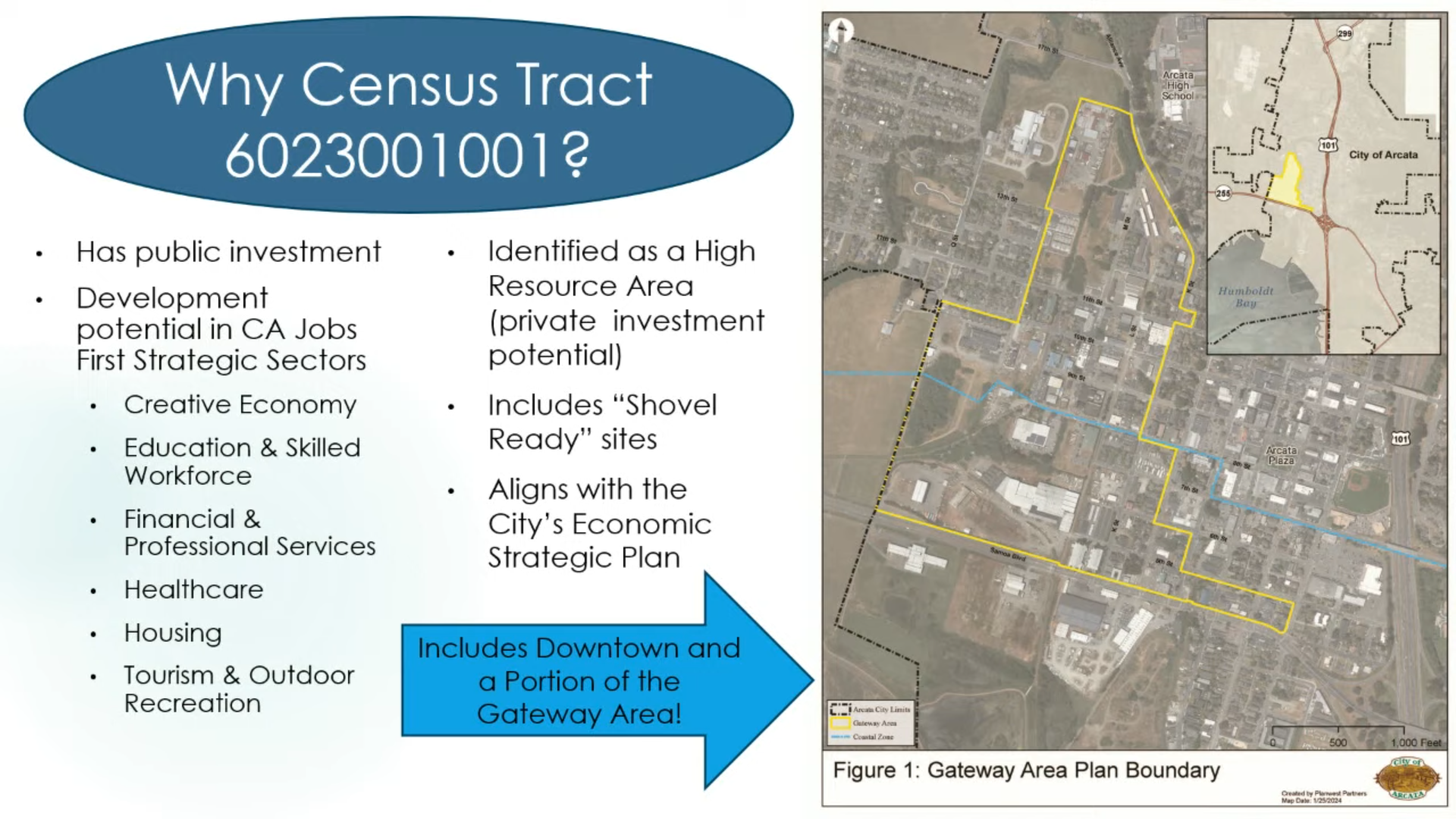
The census tract. Screenshot from meeting.
Reconnect Arcata
The engineering department snagged itself another $75,000 to pursue the dream of one day enabling seamless car-free transport from one half of the city to the other.
The Reconnect Arcata project has been on the ropes. Because of city-wide funding issues, its budget was slashed from $300,000 down to $150,000 when the city’s budget was being drawn up, which, according to the staff report, would have prevented the engineering department and the consulting firm it hired to “deliver a meaningful final project.”
Arcata has long been working to reconnect the eastern and the western halves long divided by Highway 299 and Highway 101, City Engineer Netra Khatri asserted. The Bay Trail down to Eureka, the Annie and Mary Trail, the pedestrian bridge on G Street, the overpass on Giuntoli — all of these were designed to allow residents to get around easier on foot. It’s time to continue the process, he said, and kick in more funding to cap off the project.
The council agreed, voting unanimously to allocate $75,000 from the General Fund on the project. “While I’m not super thrilled that we’re changing a budget that we just so recently passed,” Councilmember Meredith Matthews said, “I really can’t think of a better thing to spend that money on.”
The engineering department will use the funds to complete detailed maps of the proposed projects and hold a community meeting to solicit the public’s wishes.
Basketball court
The basketball court in Redwood Park is in rough shape, about 30 years after its construction. It’s being split and deformed by redwood tree roots, and a lackluster drainage system allows water to pool on the court. It is the only publicly accessible full court in Arcata.
It’s a worthy cause, the council said, deciding to award local asphalt company Hooven and Co. $115,319 to spruce up the court and ensure its health for the next few decades. The court will be resurfaced, the hoops and nets will be replaced, and the drainage system will be juiced up.
Councilmember Alex Stillman, somewhere around 87 years old, said she’d probably sit out any 5x5 council vs. staff hooping session. She is willing to be a cheerleader.
CLICK TO MANAGE