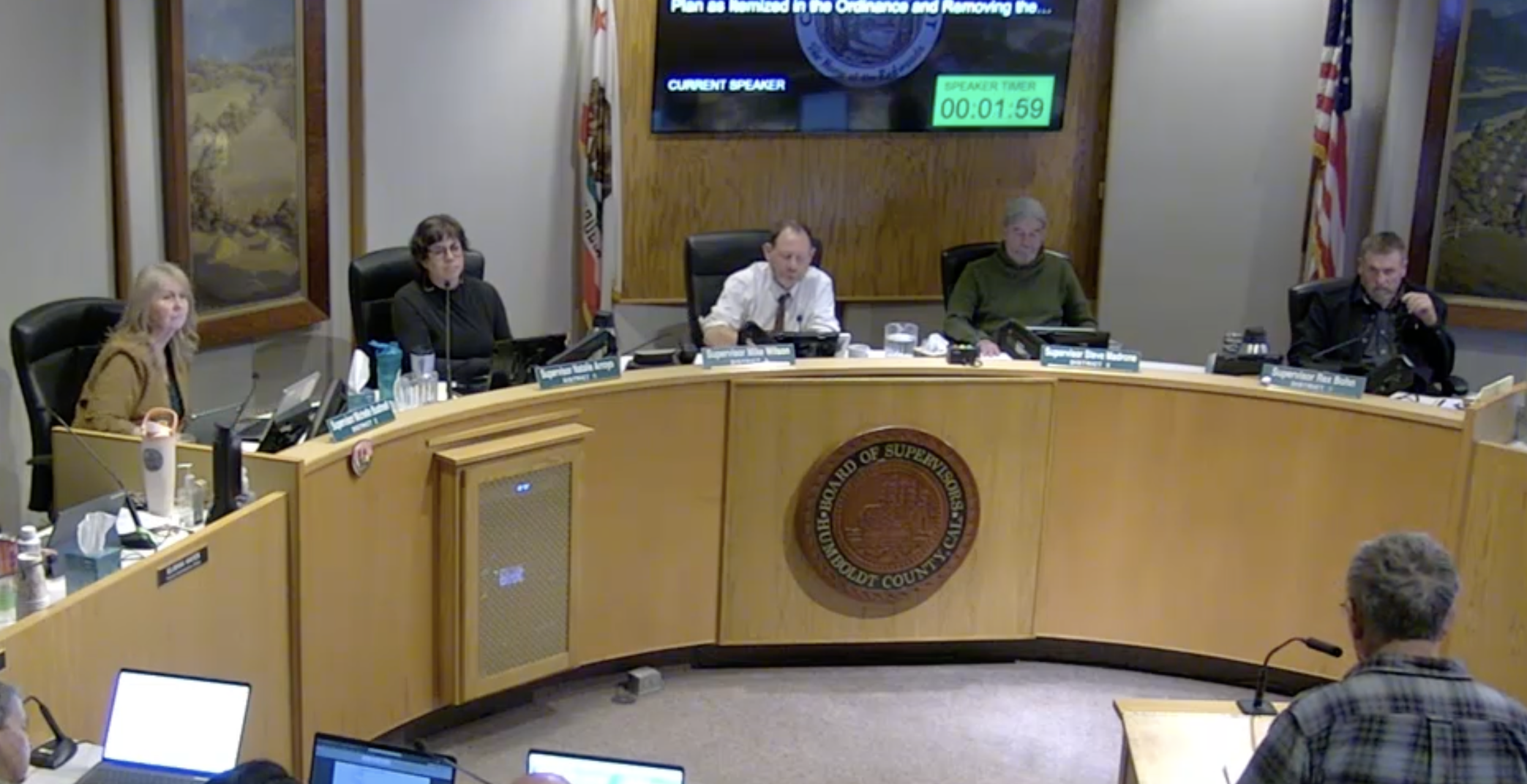
Screenshot of Tuesday’s Humboldt County Board of Supervisors meeting.
###
Today’s Humboldt County Board of Supervisors meeting got off to a rocky start after staff spent the first hour and a half of this morning’s session sorting out technical difficulties with Zoom. (Details here.)
Given that California law requires county administrators to spend at least an hour troubleshooting such issues before continuing without remote participation via Zoom, the meeting didn’t start til a little after 10:30 a.m. If you had planned on sharing your comments via Zoom, you can send them via email to COB@co.humboldt.ca.us, and they will be placed in the official record when the meeting minutes are published.
Ok! Let’s get into it!
Modernizing the Humboldt Bay Area Plan
The board kicked off the meeting with an update to the Humboldt Bay Area Plan (HBAP), which governs the use of 21,500 acres of unincorporated land surrounding Humboldt Bay and 20-plus miles of coastline.
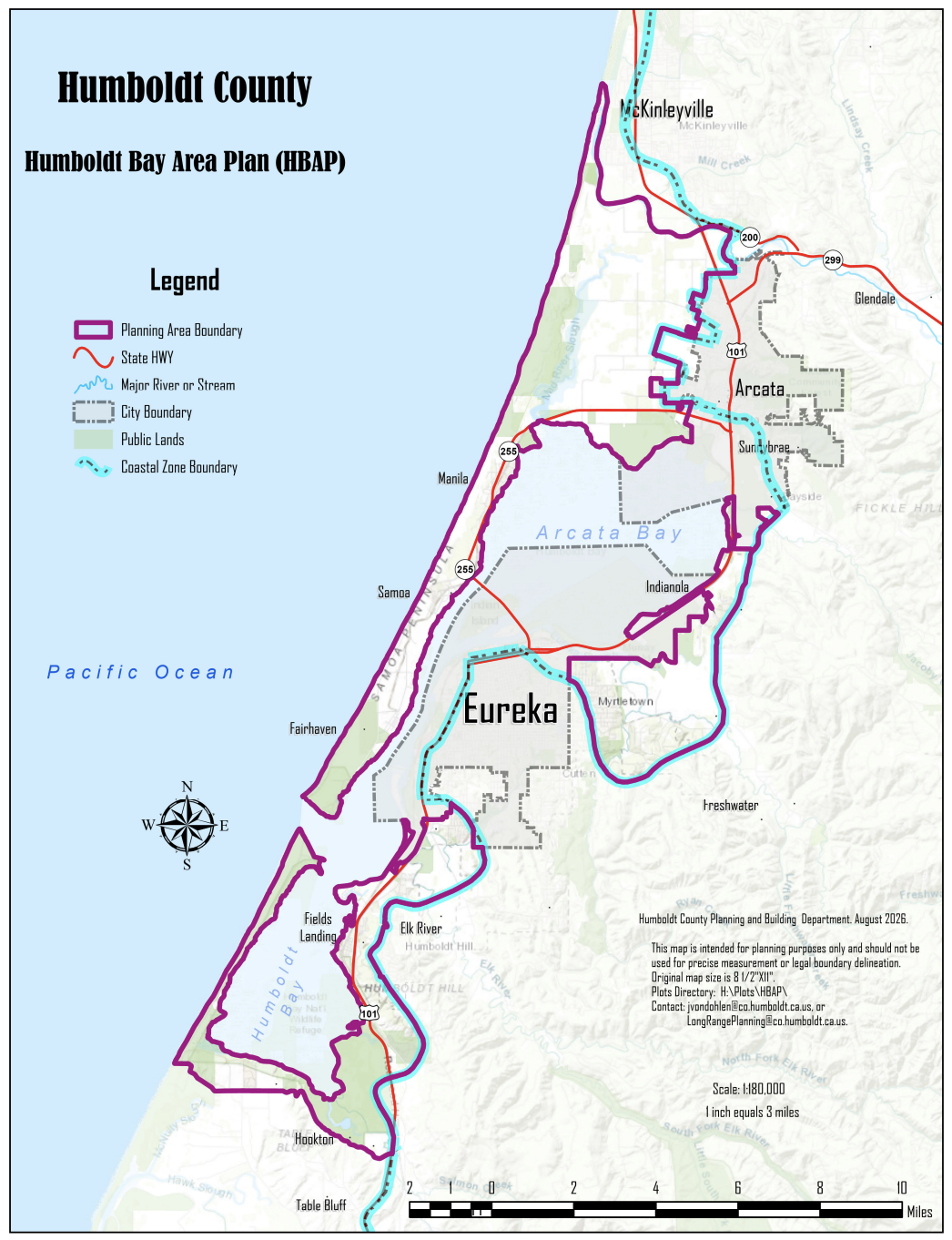
A map of the Humboldt Bay Area Plan (HBAP) area. | (Click to enlarge.)
Most of the amendments approved at today’s meeting were focused on modernizing archaic land use and zoning designations. For example, staff added new chapters to the HBAP that focus on protecting natural resources and adapting to coastal hazards, such as sea level rise, tsunami and flooding. The amended document also includes new sections that detail the tribal history of the region and integrate environmental justice principles into the county’s planning and regulatory framework.
The board’s discussion and public commentary, however, largely focused on the creation of a “port overlay zone” that would amend the county’s zoning code to allow for the development of the proposed Offshore Wind Heavy Lift Marine Terminal Project slated for the Samoa Peninsula.
Reanne Meighan, an associate planner with the county, explained that the Coastal-Dependent Development section of the document needed to be updated for port development to move forward. However, she emphasized that the port overlay zone was not being implemented through the HBAP.
“This [amendment] would allow the property owner to request the modification to zoning standards to accommodate development of a heavy lift marine terminal,” Meighan said. “We are not proposing the port overlay zone today. This would simply provide the first step in an avenue for a property owner to start that process.”
During public comment, several residents expressed concern about the proposed port overlay on the Samoa Peninsula, which some speakers saw as an attempt by the Humboldt Bay Harbor, Recreation and Conservation District to expedite the proposed port development project. Others felt the county should be doing more to adopt standards that protect residents and the environment from the proposed development.
“In my estimation of this, I think that the tail is kind of wagging the dog,” said Tina Manos, a member of the Samoa Steering Committee and the Community Advisory Committee for the port development project. “We’ve seen it before … where a developer will come in and call the shots, and when the county is not in a position to be super vigilant and doing oversight, we end up being hurt. … Shouldn’t the county be the dog that protects humans? Personally, I want a guard dog.”
Rachael Smith, a representative of the Redwood Region Climate and Community Resilience (CORE) Hub, noted that the Harbor District has already begun environmental review for the proposed project, but reminded the board that it will one day be tasked with defining “what responsible offshore wind development looks like on the West Coast.”
“The county will eventually be in the position to consider expanded industrial standards for structure height, lighting, noise, vibration, air quality and emissions, cumulative impacts on disadvantaged communities, compatibility with nearby neighborhoods and affordable housing, and protection of tribal cultural resources and culturally significant areas,” Smith said. “If the county and the Harbor District want to pursue a tribal co-management approach, that needs to happen now. … We encourage you to keep those future implications in mind as you consider the plan today.”
Following public comment, Planning and Building Director John Ford noted that most speakers were concerned about the heavy lift marine terminal project rather than the proposed updates to the HBAP. Still, he acknowledged that the port overlay may seem like it “allows a developer to do anything they want to do,” but said its intent is to create a process to address specific issues in specific locations.
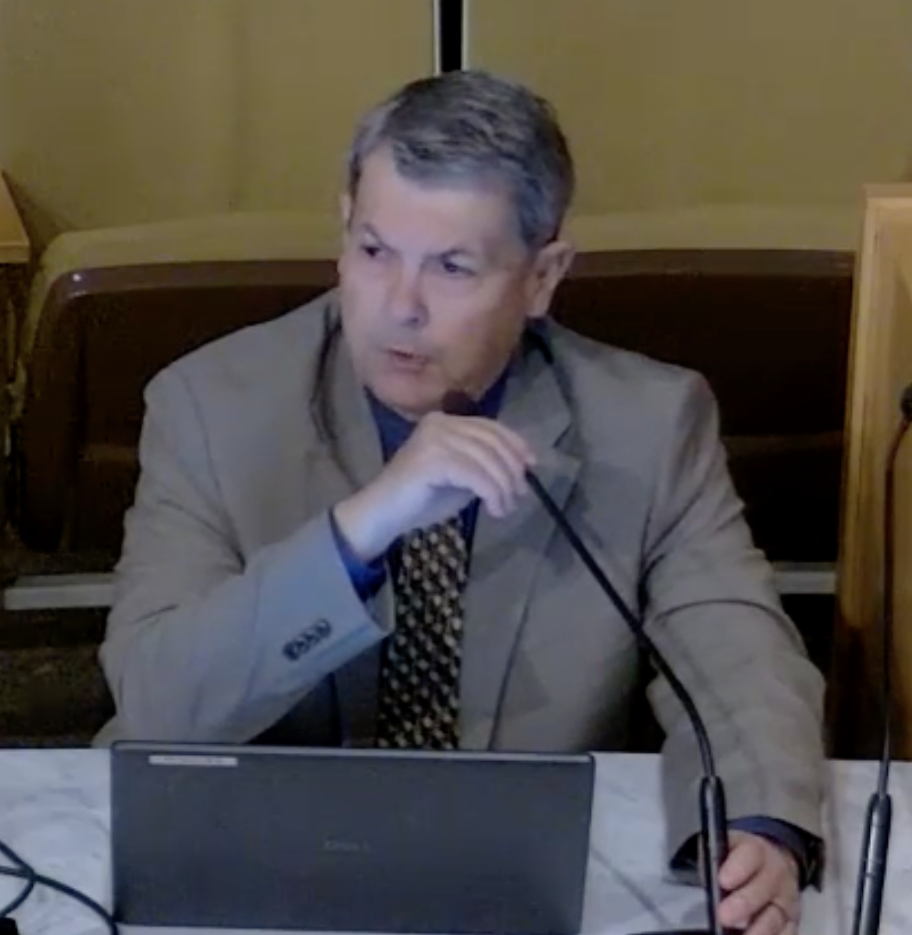
Ford | Screenshot
“Rather than trying to create a one-size-fits-all set of regulations, it allows a property owner to come in and identify what it is that they want to have done,” Ford said. “The creation of a port overlay … does not guarantee that the county, the Planning Commission or the Board of Supervisors is going to grant everything that is being asked [by the developer in an application].”
Seeking clarification from Ford, Fourth District Supervisor Natalie Arroyo reiterated that the port overlay doesn’t serve as a “blank check for development” on the peninsula. Rather, it establishes an area where a port terminal could be built. “Is that correct?” she asked.
“That is absolutely correct,” Ford said, adding that the overlay would affect several other areas around the bay. “Rather than change the zone and the standards within the zone and having those then become ubiquitous standards across the entire Humboldt Bay, [this] allows the county to consider the needs for a particular location, and also consider the constraints at a particular location.”
Arroyo also brought up the possibility of creating an overlay to provide a path for low-lying coastal communities like Fields Landing and King Salmon to bolster flood protections.
“That’s still in process, but I think that … we may need to start looking at longer term plans at this point,” Ford said.
“One of the things the Planning Commission talked about, and staff wants to be sensitive to, is that there’s a fine line between helping people and imposing regulations that actually reduce property values or make things more difficult,” he continued. “Maybe this is too personal, but I certainly don’t want to see people struggle. I don’t think anybody saw this coming 10 years ago or 20 years ago. Maybe they should have, but that’s in the past now.”
Going back to port development, First District Supervisor Rex Bohn described the scene at a recent public scoping meeting for the proposed heavy lift marine terminal project where all but two speakers were fiercely opposed to the project. He admitted that he had mixed feelings about the proposal and was worried that Humboldt would serve as the “canary in the coal mine” for offshore wind development on the West Coast.
“At the meeting the other night, they were talking about the design, and [it] scared the hell out of me,” he said. “We don’t know if we’re going to make them out of concrete or steel yet. We don’t know! We’ve never been this far offshore [and] we’ve never gone this deep. … I hope we’re looking at this both for the residents [and] as a county. … I think the concept is great, but is the delivery going to be great? And what are we going to leave in the wake?”
Still, Bohn acknowledged that when the Board of Supervisors voted in 2019 to deny the onshore Terra-Gen wind farm, there was hope that offshore wind would fulfill Humboldt County’s renewable energy needs in the decades to come. “If we want to electrify the world, if we want to build trails for people everywhere and things like that, we’re going to have to support some sort of industry,” he said.
He suggested that staff omit the bit about the heavy lift marine terminal from the HBAP update until the Harbor District wraps up environmental review.
Second District Supervisor Michelle Bushnell asked a few clarifying questions about the document, one of which was how the document would change if the proposed port overlay were omitted from the HBAP.
“Keeping the overlay or not keeping the overlay [in the document] doesn’t allow or disallow the Harbor District to apply for a heavy lift terminal?” Bushnell asked.
“That is correct,” Ford said.
“So this wouldn’t stop anything if it’s taken out?”
“That is correct. … The purpose of this … is to target where the application is being focused [and] where the changes are being made.”
After some additional discussion, Arroyo made a motion to approve the plan with a minor amendment to ensure the document complies with the Regional Climate Action Plan, which was seconded by Third District Supervisor and Board Chair Mike Wilson. The motion passed 4-1, with Bohn dissenting.
Humboldt is Keeping Its Membership With RCRC
During its afternoon session, the board returned to last week’s debate over whether or not the county should maintain its membership with the Rural County Representatives of California (RCRC), a statewide organization that advocates for rural issues at all levels of government.
After a half hour of at-times tense debate among supervisors, the board unanimously agreed to keep its membership with RCRC. Bohn will continue to serve as the county’s delegate, and Wilson will continue to serve as alternate.
The proposal to ditch RCRC came about at last week’s meeting when Fifth District Supervisor Steve Madrone asserted that he had been treated “very rudely” by RCRC members in the past and felt the organization only represents a minority of the county’s interests. Given that Wilson was absent, the board decided to table the discussion to ensure the full board was able to weigh in.
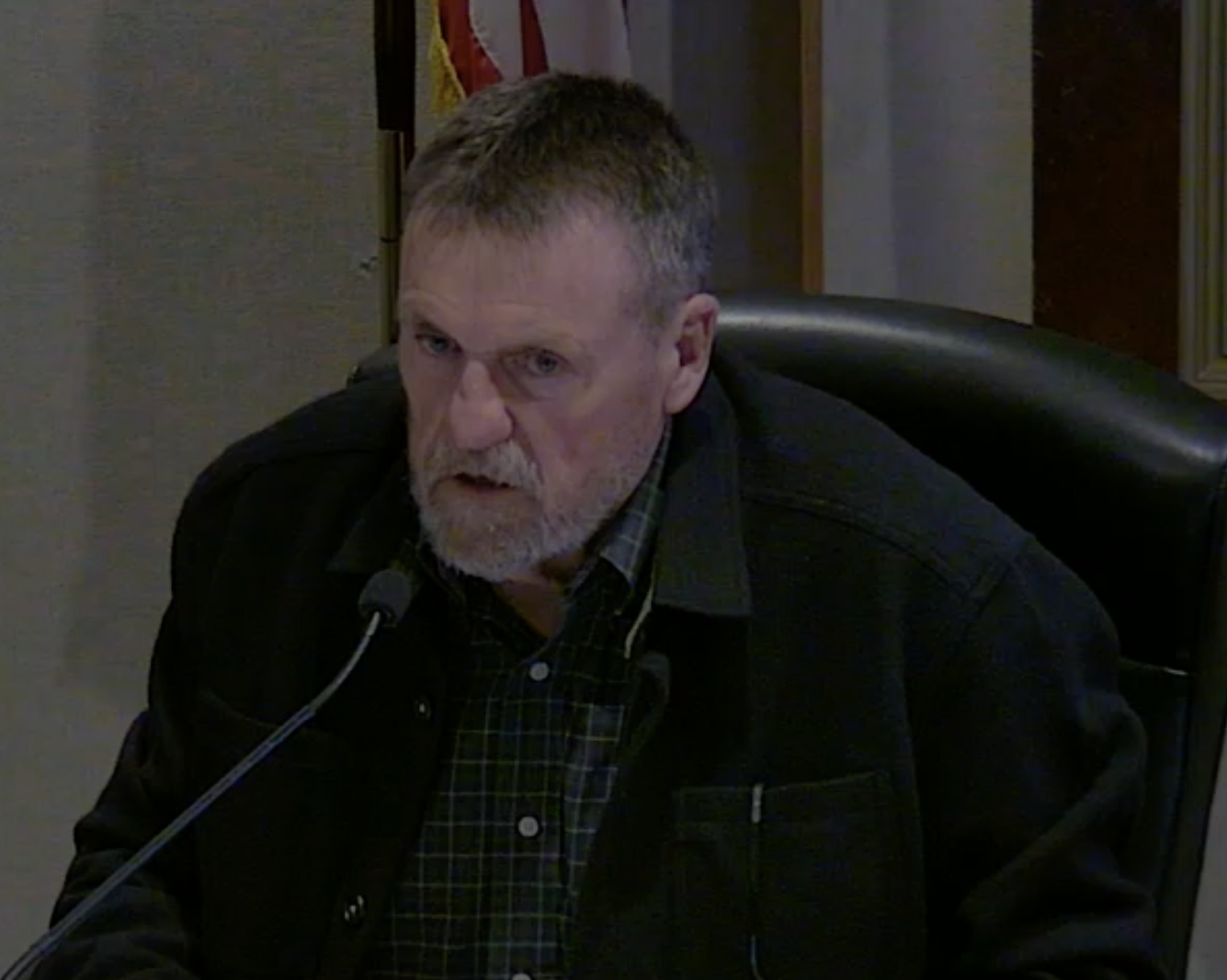
Bohn | Screenshot
Speaking at today’s meeting, Bohn emphasized that he is always advocating for Humboldt’s interests at RCRC membership meetings, as well as various other functions he attends.
“I will represent Humboldt County and my constituency, even though sometimes it may be in conflict because not everybody agrees on everything that goes on,” he said. “There are still people that need to be represented in the county that may not agree with what you have to say.”
A few times during the discussion, Arroyo, Wilson and Madrone underscored that the code of conduct requires board members to represent the county’s official position on matters, even if they don’t agree.
“We’re not going to things and representing positions that aren’t the majority board position,” Arroyo said. “The code of conduct is really clear about when we’re appointed by this board as delegates for the Board of Supervisors, even if we don’t personally agree, we’re expressing the board’s official position. And if we’re not doing that, then we’re explicitly stating that we don’t represent the County of Humboldt.”
“I don’t always agree with the positions we take as a full board, but I’m still responsible for representing those,” Arroyo added.
Madrone’s position seemed to soften a bit from last week. His primary issue was that RCRC generally has more conservative views on environmental issues. Still, he acknowledged that RCRC plays a valuable role in advocating for access to health care in rural communities.
“It’s never been a question of that,” he said. “I think they do a great job in those arenas of health and human services or public health. … A lot of other rural issues, no doubt about it.”
A few people spoke during public comment to urge the county to continue its membership with RCRC. Speaking on behalf of Humboldt Redwood Company, Community Engagement Manager Eileen Russell said RCRC “provides a strong voice in Sacramento for rural communities and the issues that uniquely affect us.”
“As a company that manages working forest lands here on the North Coast, we see firsthand how decisions made at the state level impact our communities,” Russell said. “The realities of managing forests, supporting local jobs and maintaining a viable natural resource economy are not always fully understood in Sacramento. It’s important that policymakers hear directly from rural counties so that legislation is practical and reflects the communities it will affect.”
Planning and Building Director John Ford also spoke in favor of the county continuing its membership because he often seeks help from RCRC.
“One of the things I’ve noticed is that they have been able to do something for me that I don’t get very often: they give me both sides of the issue,” he said. “They help me to understand both sides of the argument, and then when I come back and present information to you to help you make decisions, it’s informed by the information that they provided me.”
After some additional discussion, the board unanimously voted to continue its membership with RCRC and keep Bohn as the board delegate.
###
Check back on Wednesday for coverage from today’s meeting!