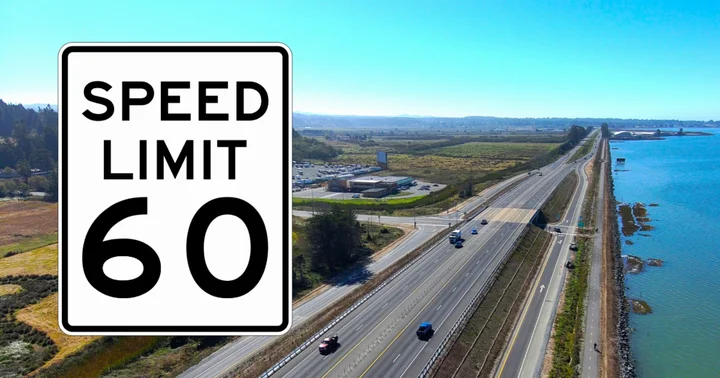
Caltrans graphic celebrating the return to 60 m.p.h.
###
In 2002, Caltrans lowered the speed limit on US 101 between Eureka and Arcata to 50 mph following a series of horrific crashes. That change alone produced significant safety gains over the 24 years since, during which time Caltrans spent $46 million on the massive new Indianola overpass, closed most gaps in the median, and made a few other tweaks to the corridor. These changes eliminate the most severe conflict points and will no doubt reduce serious crashes further.
Or they would have, if Caltrans hadn’t just announced the inexplicable decision to raise the speed limit in the corridor to 60 mph. With that change, the agency has undone much of the safety progress it spent so many years and so many dollars pursuing.
For drivers following the speed limit, the new limit increases the stopping distance by 114 feet on wet asphalt. It increases the kinetic energy of a vehicle - the factor which determines the extent of damage in a crash - by 44%. In other words, the new speed limit dramatically increases the chances of a crash, and the chances that crash will be deadly.
Increased speeds will likely bleed over onto adjoining stretches of 4th and 5th Streets, which are already among the most dangerous streets in the county. Rainy or foggy conditions will make these high speeds even more dangerous. In many parts of the corridor, if a driver loses control, there are no barriers preventing the vehicle from leaving the highway, or even crossing the ditch and landing on the new Humboldt Bay Trail. And the new signal at Airport Road requires traffic to occasionally come to a full stop, which will inevitably catch some drivers unaware.
So why is Caltrans raising the speed limit? Despite hailing the new limit as a “major milestone,” they have offered no explanation. Perhaps they recognized that sacrificing safety just to shave off 50 seconds or so from a commute between Eureka and Arcata wouldn’t sound very good in a press release.
One thing is clear: they kept this decision from the public as long as they possibly could. As a traffic safety advocate, I reached out to Caltrans multiple times going back to at least 2023 to ask if they planned to raise the speed limit, and to urge them not to. I was never given a straight answer. Instead, they announced the change to the public on a Friday afternoon with plans to put up new signs on Monday.
More important than the secrecy, though, is the fact that this speed limit increase may be illegal. Under California law, most speed limit changes must be justified by an “engineering and traffic survey.” By default, the limit is then set at a speed which is exceeded by only 15% of drivers in free flowing traffic under current conditions (the “85th percentile rule”). But Caltrans is also required to consider the road’s crash history as part of the study, and can lower the limit to ensure safer conditions.
In announcing the new speed limit, Caltrans declared that an engineering and traffic survey will be done “by the end of 2027 to evaluate conditions and the posted speed limit.” In other words, they increased the speed limit without having yet completed the required study. Given the 85th percentile rule, the higher speed limit now will make it much harder to lower the limit again after a future study.
The engineering and traffic survey process is itself deeply flawed, and gives speeders an outsized role in setting the speed limit. It was designed, ironically, to prevent the state from unreasonably lowering the limit to create “speed traps.” But there’s nothing in the law that says speed limits can be increased without a study, either. This other kind of speed trap, which ensnares road users in the deadly net of higher speeds, may not be what legislators were thinking of when they wrote the speed limit laws decades ago. But it is a more dangerous kind of trap by far.
It is particularly ironic for this move to come at a time when the region is getting ready to adopt a Vision Zero Action Plan which, among many other actions, calls for reducing speed limits to help prevent traffic deaths. Caltrans should reverse its reckless, foolhardy decision and return the speed limit to the level that allowed the name “safety corridor” to be applied in the first place.
###
Colin Fiske is executive of the Coalition for Responsible Transportation Priorities.