The blood bank needs you, O- types! | Image: Northern California Community Blood Bank
###
Facebook post from the Northern California Community Blood Bank:
A slowdown in donations at the end of December and into the new year has left us in need of Type O donors, especially Type O-. We are now entering the third week of January with no O- blood available at the blood bank. While local hospitals still have limited supplies on their shelves, once those units are used, we have nothing available to replenish them. If you are Type O-negative, please donate as soon as possible.
O-negative donors are universal donors, meaning your blood can be given to any blood type and is especially vital in emergency situations when a patient’s blood type is unknown.
Donate today:
Bloodmobile at Wildberries Marketplace in Arcata: 12:00–6:00 PM
Blood Bank on Harrison: Open until 6:00 PM
If you’re unable to donate today, please visit nccbb.org to view our bloodmobile schedule and blood bank hours. Please spread the word.
Ed. note: On Friday, a caller asked us if there was a protest planned for the Courthouse the next day. We couldn’t immediately find evidence of it. But then your correspondent drove by on Saturday and there the protesters were. Apologies to our caller.
Fortunately, Friends o’ the LoCO Ted Pease and Jamie Blatter sent us dispatches from actions in Arcata and Trinidad over the weekend.
###
Trinidad Indivisible Trinidad Protest:
‘Few, But Fierce’
By Ted Pease
More
than 75 people (and six dogs) turned out for Trinidad Indivisible’s
protest on Sunday against the killing of a 37-year-old Minneapolis
woman by a masked ICE agent,
“ICE Out for
Good” was the theme of nationwide weekend protests decrying the
death of Renee Nicole Good, who was shot three times in the head by
ICE agent Jonathan Ross on Wednesday as she tried to drive away from
a confrontation.
Photo: Pease.
At Trinidad’s
rally and in other marches from Seattle to Miami, protesters called
for abolishment of ICE — the federal Immigration and Customs
Enforcement agency that has been scouring communities for suspected
illegal immigrants on orders from the Trump White House.
Trinidad
protesters waved signs at passing motorists, the vast majority of
whom honked and waved back in support. Spirits were high, but the
demonstrators’ purpose and determination were deadly serious,
participants said. “Trump is evil,” one woman said. “He has to
go.”
Singing
and chanting, the group marched through Trinidad to the Harbor
overlook and back, waving signs against President Donald Trump’s
“Evil, Authoritarian Agenda” and “Keep Us Safe and Free from
the Dictator DT.”
Trinidad
Indivisible founder Tina Freeland said she was gratified by the
turnout, especially at short notice. “We want to send a message to
Renee’s family, to the Portland couple shot on Thursday by federal
agents, to all those who have been targeted/terrorized by ICE and
especially to our elected lawmakers that this cannot continue!”
Indivisible Trinidad said online. When Freeland created the group
last fall, she was told it was the smallest Indivisible chapter in
the country.
The group grew out
of efforts by Barbara Snell, 94, who flew the American flag upside
down — a signal of distress — outside her Main Street home, and
held a solo anti-Trump rally on Main Street in April 2025. That grew
to a dozen or so for a first “No Kings” rally last summer to
nearly 50 in October.
Among the signs at
Sunday’s “ICE Out for Good” rally:
“Fight Fascism”
“Remember Renee”
“This is What a Domestic Terrorist Looks Like”
“No Tax Cut for Billionaires”
“Melt Ice”
“Hate Will Not Make Us Great”
“When Masked Goons Rule Our Streets, We Have Domestic Terrorism by
Secret Police”
“Make America Sane Again”
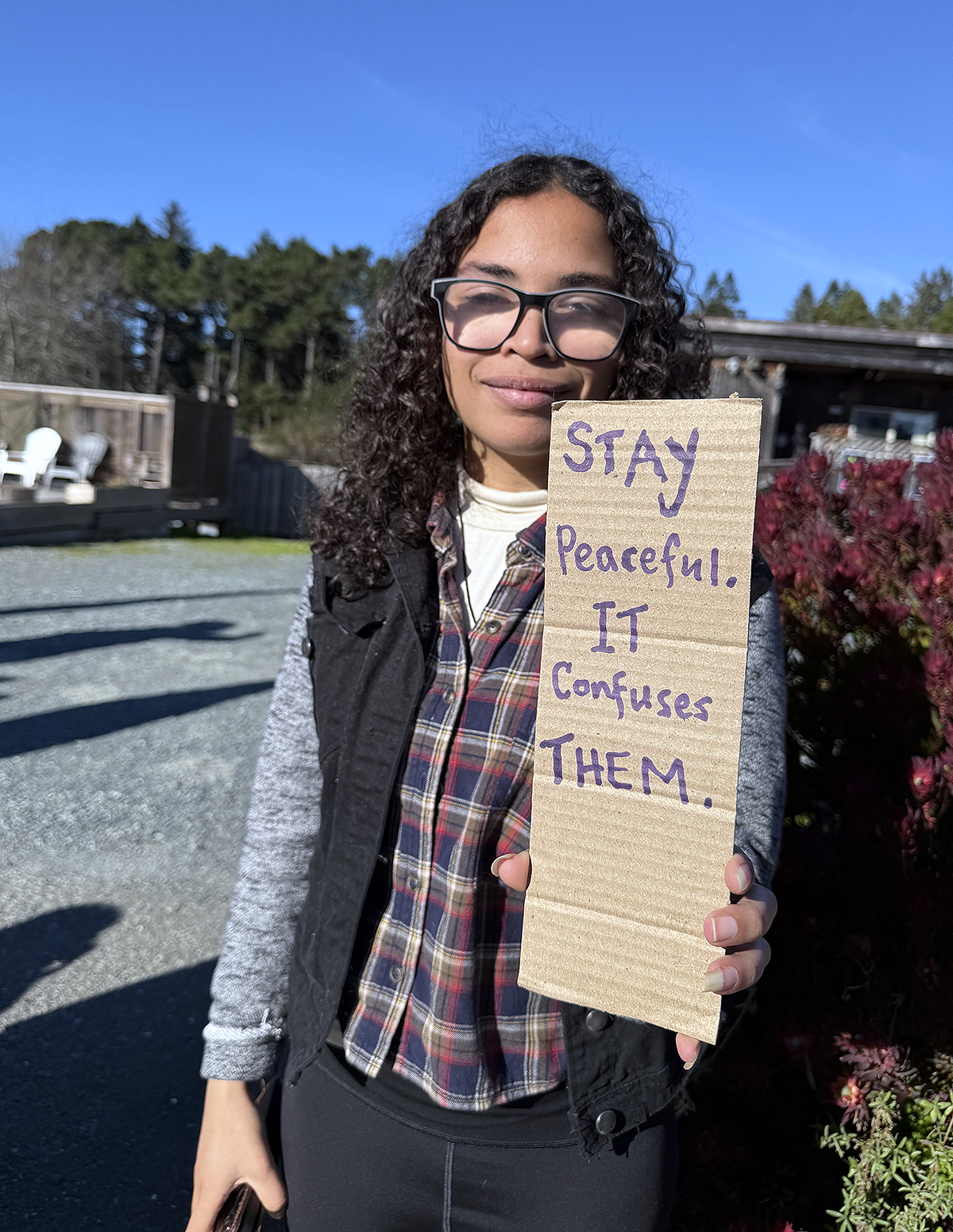
“Stay Peaceful. It Confuses Them”
As
the demonstrators broke up, one man commented: “I didn’t see any
ICE thugs. I think it worked.”
###
Photo: Blatter.
From Jamie Blatter, in Arcata:
Dozens of protesters gathered to protest the increase of ICE presence
and violence across the country, voicing their outrage over the
killing of Renee Good by an ICE agent in Minneapolis, Minnesota
earlier this week. Protestors had homemade signs and upside-down US
flags. Signs read messages such as “melt ice,” “do you
not see the suffering?”, and ” we are allowing murder.”
Protestors gathered on the corner of 8th and G and did several laps
around the Plaza, waving signs and chanting phrases such as “no
hate, no fear, immigrants are welcome here.”
This protest is one
of many happening all across the country this week. The event was
organized by community member Jacob Sonye, a first-time organizer who
felt called to action.
“We felt
compelled to gather, reinforce, and stand up for rights afforded by
the U.S. Constitution and by law. We feel that ICE’s actions not only
violate constitutional and human freedoms, but also diminishes trust
and cohesion within our communities and our government. Our aim is to
help people realize that they can be a part of rebuilding and
reinvigorating for change” said Sonye.
Does thinking about the climate crisis get you down? Do you feel guilty about your consumption? Do you feel overwhelmed thinking about all that dooms our planet? Your emotional response to the state of the environment is understandable — good, even! — but if it is impacting your capacity to live a full and vibrant life, maybe it’s time to take action. Ecochaplain Hanna Nielsen joins the show to discuss how to become a more resilient (and more impactful) person. Hanna, together with the Good Grief Network, is also hosting a 10-week program this spring on building community and personal resilience. Details at the bottom of this post.
Seely Bros photos of the Great Blue Lake Fire of 1911.
###
Editor’s note: This account of the Blue
Lake fire of 1911 is from a booklet, “Blue
Lake is Burning, ” compiled by Isabelle
Evans, president of the Blue Lake Museum Society. What follows are excerpts of
news accounts included in the booklet.
###
From the Blue Lake Advocate, Dec.
7, 1911:
The business district of Blue Lake was
partially swept by fire beginning a few
minutes after 12 o’clock noon Tuesday,
December 5, 1911, and which originated
in August Brand’s clothing store and
tailor shop. In a very few minutes after
Brand left his shop to go to dinner the
building was a mass of flames, with a
stiff breeze blowing directly across the
street on which was situated the Odd
Fellows Hall, Walter Ingham’s Saloon,
Henry Laverty’s Barber Shop and the
Blue Lake Drug Store occupied by George L. Sackville.
To these buildings the flames were
quickly communicated and within two
hours all the buildings in the block were
burned, including M.J. Kelly’s fine residence and the Jones buildings, the last of
which on the corner was the two story
structure occupied by Lon Edwards as a
confectionery store, express office and
Sunset Telephone headquarters.
Here a heroic fight was made to check
the further spread of the fire which was
crowned with success. To this success
everything conspired — the heroism of
individuals, the splendid services of our
neighboring towns, a veering of the
wind and a drizzle of rain. Not a single
element of these could have been
spared.
In answer to frenzied telephone calls,
special engines came from both directions. From Glendale came their chemical engine trailing behind the Minor
Company’s delivery wagon, from Arcata came their big chemical engine and
from Korbel their fire fighting apparatus and two immense tanks full of
water built upon flat cars. Louis Everding and Thomas Fox came with the
help from Korbel, bringing a bucket
brigade fully equipped for service.
The fire line had previously been successfully held from the Palace Saloon to
the Forester’s building at a great personal effort, and the fiercest battle was
yet to be fought at the latter place. The
Forester’s building and the one burning
were two of the highest in town and were
directly opposite with only a 50-foot
street between. Into this intolerable
heat the Glendale chemical wheeled into
play and got first water, directing the
stream against the high walls of the now
smoking building. When it was exhausted the Arcata chemical engine began
action and kept up the good work, assisted by Joe Tabor holding the nozzle of
a line of hose, while others kept him
from catching fire by throwing buckets
of water over him while he was fighting.
A HEROIC FIGHT
A great battle was also going on at the
opposite corner owned by Mrs. Douarin
and occupied by Dr. C.N. Mooney. The
chief hero of this fight was George Perham. Mounted on the peak of the gable
next to the street, he defied the fierce
blasts of flames that kept jumping at
him and dashed water against the building from buckets as they were handed
up to him. Perham had previously been
laid out in another battle earlier, but
revived consciousness in time to lead the
important fight at the Mooney corner.
When the walls of the building fell,
falling outward, a sheet of flame fairly
enveloped the heroic fighter for an instant and all who were watching fully
expected him to roll from the roof like a
dead fly. But Perham merely ducked his
head, bending low and holding his
breath and just then he was drenched
with a life-giving bucket of cold water.
John Arnold of the Blue Lake Hotel
was another fire fighter overcome during the battle, but responding again
with renewed vigor. It is impossible to
record the name of all who did valiant
service at some point in the battle. No
one saw it all but a few others who came
within the observance of the writer deserving special mention were Jack
Fletcher, John Arnold, Robert Barr,
Len Higgins, Bert Clark, Charles Beauchamp, Robert Poulton, Wiley Hanson,
E.A. Spring, A. Welsh, J. Baldwin, J.
Pollow, O.E. Bradford, Mrs. Peterson,
Mr. Robertson, Cale Hickox, J. Kuhlmann, W.F. Hemphill, B. Pido and
Charles Crowden.
A splendid supply of water was luckily available from Mrs. Douarin’s tank
and there was a continuous line of water
carriers at this point. The charred wall
of the Douarin buildings and the Forester’s building after the danger had
passed showed how narrowly the spread
of the conflagration had been averted.
In places the outside walls were completely burned through.
Notwithstanding the combined efforts of our neighbors and our own
townspeople, the fire would have even
then gained the mastery except for the
aid of nature. Just when the flames were
hottest the wind changed for about 15
minutes, blowing the flames back upon
themselves. In the path of the fire the
wind was blowing thousands of burning
brands which fell among old shed roofs
and walks, which would have caught
and started new fire but for the friendly
rain. As it was, several small fires were
started but luckily were observed in
time to extinguish them. One brand was
observed to alight still flaming at Glendale, two miles away.
The only losses sustained outside of
the block mentioned were A.J. McPherson’s Livery Stable containing about
$2,000 worth of hay and his blacksmith
shop adjoining and the buildings adjoining that in which the fire originated.
These were the Elite Saloon and Giuntoli’s Saloon and Restaurant, owned by
Mrs. M. Rankin.
The only lives lost were animals.
Adam Kemp and Henry Laverty were
the owners of some good bird dogs, who,
like Casablanca, refused to leave the
“burning deck” and were consumed. A
luckless cat and several chickens completed the toll of death in the great Blue
Lake fire.
ORIGIN OF THE FIRE
The fire originated in August Brand’s,
but just where and how is yet shrouded
in mystery. He had left the place but
about five minutes when it was observed, but with the means at hand the
fire was then uncontrollable. If a sufficient supply of water had been promptly
applied from the rear, it is believed the
fire could have been easily subdued.
The total lack of fire fighting facilities
is accountable for the great fire that
followed. A single hydrant with the ordinary pressure of water would have
been sufficient to quench the flames if
applied to the one story building where
the fire started. The great value of
chemical engines was demonstrated by
those who so promptly came to our rescue from Arcata and Glendale. Fred
Stouder was the hero of the Arcata contingent. An engine was already steamed
up and a car was standing on the track.
Within five minutes Stouder got the consent of the Arcata & Mad River Rail road
officials and just 14 minutes from the
time it started on its race, landed in Blue
Lake. The little car on which was loaded
the chemical engine and several ladders
bobbed around the curves like the tail of
a kite, part of the time traveling on two
wheels. Stouder did all that was possible
to assist it in keeping the rails by jumping over to the high side each time it
threatened to leap from the track. Engineer Liscom kept a firm hold on the
throttle but there were times when he
held his breath, fearing that his engine
might be derailed at any time.
GRATITUDE TO NEIGHBORS
The City of Blue Lake also feels a deep
sense of gratitude to Korbel and its people for their timely and generous aid.
This is the first time in our experience
when water was known to be transported from one community to another with
which to fight fire. The Korbel people
showed a thoughtfulness in this act that
is fully as commendable as their heroic
efforts after arrival. To Louis Everding,
Joseph Tabor, Thomas Fox, ex-fire chief
of Eureka, Andrew Skiro, and many
others is due the profound respect and
gratitude of all Blue Lakers.
Fire Chief Cochrane of Eureka was
only a little later to get to Blue Lake than
those from less distant points. In an inconceivably short time he gathered up a
load of picks and axes and three small
fire extinguishers and reached the scene
in a little over half an hour.
Our remaining nearest neighbor,
Glendale, replied to our call for help
instantly, and reached here just in time
to prevent a spread of the flames which
but for their assistance would have been
beyond control.
WOMEN AND CHILDREN
Not by any means does all the credit
for valuable and efficient work belong to
the men. Many women worked with
wonderful persistence and energy in
saving movables of all kinds, and it is
due to two lady friends of the Kelly’s that
practically everything within their
house was saved, including the carpets
and curtains. Many children also performed their part in helping distracted
chattel owners to save their effects. Two
ten-year-old boys carried Mr. Laverty’s
heavy barber chair a distance of two
blocks to a place of safety and assisted in
wheeling out the vehicles in McPherson’s livery stable. In fact many children
performed miracles of service with
their nimble feet and cheerful readiness
to be of use.
When finally the flames first began to
be subdued, a great sense of relief was
experienced by all, but many were still
vigilant to prevent a relapse and were
not satisfied as long as there was a spark
of fire to be seen. The town trustees put
on a patrol of six men during the night
and with the dawning of another day all
possibility of disaster was at an end,
truly but a deplorable sight met the
view. Where before had existed a lot of
occupied business buildings was now a
mass of charred ruins, twisted pipes and
wires and relics of useful machinery.
AS TO REBUILDING
But the ashes were not yet cold when
plans of rebuilding were discussed. The
Odd Fellows have determined to put in
a finer hall than ever, and the disposition of many belonging to the order is to
make it fire proof. James Worthington
will soon have another business structure underway and the drug store will
be rebuilt. Others will promptly follow,
if not by the present owner, than by
those who are prompt to see the advantages of locations and who will buy the
sites. Although Hugh Kelly was hard hit
in losing his fine residence, he was
cheerful under misfortune and displayed his genuine Irish wit when asked if he
would rebuild by replying between
puffs of his meerschaum: “Well, not tonight…”
Regarding the rebuilding of the business block destroyed, some of the owners may sell their vacant sites to some energetic businessmen who themselves will
erect some substantial business buildings. Not a better location in Blue Lake
for any kind of business can be found.
Owing to its beautiful location. Blue
Lake is bound to grow gradually and
nothing will help it along better than an
infusion of new business blood in its present inactivity. Our people are too sanguine over the future of our little city to
let it lay inactive, because progress is
now as it always has been their motto.
Let us do all we can to help our new city
and improve its appearance a hundred
percent.
FIRE LOSSES AND INSURANCE
As far as can possibly be ascertained a
list of the destroyed property is as follows:
James Worthington’s Saloon - $1,250 -
insurance $900.
Stock in Stock and
Kemp’s - $900 - no insurance.
George
and Mattie Rankin - hotel - $1,250 -
insurance $600.
Giuntoli Bros. - stock in
said hotel - $1,200 - insurance $1,000.
A.
Brand - stock and store - $2,000 - insurance $1,850.
IOOF Hall - $6,000 - insurance $3,000.
C. Deschartres’ Drug Store
- $2,500 - insurance $2,000.
Allard and
Matthews Saloon - $1,000 - insurance
$1,000.
Henry Laverty - stock in Allard
and Matthews Barber Shop - $200 - no
insurance.
J.A. McPherson Livery Stable - $5,000 - no insurance.
Margaret
Jones - residence, store and jewelry
store - $4,250 - insurance $3,100.
Lon
Edwards - stock in candy store $1,000 -
insurance $800.
Hugh Kelly’s residence
and small store - $3,000 - no insurance.
Dr. Woods’ stock in Jones’ building -
$700 - insurance $500.
Renner’s stock in
Jones’ building - $500 - no insurance.
And fences, poles, wire and minor damages - $5,000 - insurance $2,500 …
NOTES
Hugh Kelly and family moved to the
house recently occupied by the McLeods. Walter Ingham, whose place of
business burned last Tuesday, has decided to retire from the saloon business
in Blue Lake. Just what he will do in the
future is yet undecided.
Lon Edwards has moved his central
telephone office and Wells Fargo and
Co. Express in the Blue Lake depot, to a
room adjoining the waiting room, where
everything is attended to as nicely and
promptly as before.
H.J. Laverty, Blue Lake’s well-known
barber, is now nicely located in the Blue
Lake barbershop, where he expects to
see all of his former customers and
friends. He was one of the unfortunate
fire victims of Tuesday.
The Odd Fellows are now holding
their regular meeting in the Presbyterian Church. Rev. Baesler kindly donated the use of the edifice until better arrangements can be made. Other
lodges that have been offered the same
hospitality are the Rebekahs, K. of P.,
and Fraternal Brotherhood. All were
glad to avail themselves to the minister’s
kindness.
The Seely Bros, of Arcata showed
their enterprise by coming to the scene
quickly enough to get many fine negatives of the fire while in progress and
these are selling at the post office faster
than proverbial hot cakes.
The safes of Giuntoli, Ingham and
Brand were opened Thursday afternoon
and in the former two everything was
found in perfect condition. Brand’s safe
went into the fire with the outer door
partly open and the papers within were
found somewhat charred. The safe contained no cash.
The Brizard company, in appreciation of the efforts of their employees at
the fire, presented each of them with a
$10 gold piece Thursday.
Kemp and Stover saved the greatest
part of their liquors and opened up at 8
o’clock the next morning next to Dr.
Fountain’s dental office.
Charles McLean was not as fortunate.
Though getting out a lot of goods, when
he tried to recover them again, a big
share was missing.
The various lodges saved all of the
effects from the Odd Fellows’ building
except the Rebekahs. Even the piano
was successfully landed from the second
floor. This was not accomplished without great personal effort and risk. Mrs.
Crowden and Ed Lewis saved the records, the latter being almost overcome
by the smoke in making his escape.
Among the tenants of the burned
structures. Dr. Wood was hard hit in
losing all of his valuable heirlooms and
keepsakes gathered through a long and
busy life, as well as nearly all of his
valuable library. He saved a portion of
his instruments and with great cheerfulness and alacrity established himself
again in business the following morning, his office now being in the Perigot
building adjoining the Advocate office.
An important lesson of this fire, apart
from revealing the necessity of an adequate water system is that of an organized volunteer fire department, and to
have a competent leader, clothed with
sufficient authority to act and direct the
work or rescue. If either Joe Tabor or
Thos. Fox could have felt free to do what
they liked upon reaching the fire, it
might not have been nearly so disastrous.
From the Daily Humboldt Standard, Dec. 7, 1911:
As a starter for a municipal water
system and for a fire department for
Blue Lake, this evening the City Board
of Trustees purchased from Will Warren his water system for a consideration
of $850 while the clerk of the board was
directed to immediately communicate
with companies manufacturing chemical fire apparatus for the purpose of
securing estimates of the cost of a suitable engine for the town of Blue Lake.
That the fire of yesterday shall be the
last disastrous conflagration in the history of Blue Lake is the announced determination of the City Trustees.
Before anything else was taken up
Trustee McPherson, who had been one
of the heavy losers in the fire, introduced
a resolution thanking each and every
person who has assisted in fighting and
ultimately checking the flames. Special
thanks were extended to the crews from
Korbel, Glendale, Arcata and Eureka,
that gave valuable assistance in saving
what of the business section of the town
that still stands. The resolution was
unanimously adopted.
Trustee Geer presented to the Board
an option on the water system belonging
to Will Warren which furnished water
to a number of families in Blue Lake and
which furnishes an excellent foundation
for a larger system to be built later,
urging that it be immediately accepted.
After prolonged discussion of the water
company, it was decided that the option
should be taken up and the City of Blue
Lake will soon supply itself with water.
It was then brought out that a fire
department was needed as badly as water, and it was decided that fire fighting
apparatus should be provided. The clerk
will proceed immediately to secure figures and data regarding chemical extinguishers and before long it is expected
Blue Lake will possess its own chemical
fire fighting apparatus.
Steps have been taken by the City
Trustees as well as by the private property owners to clear up the debris
caused by the fire and to put Blue Lake
into a more orderly shape. The street
and alley committee was directed to
clear out the obstruction from Power
Creek which runs through the burned
area, and it was voted to recall the order
heretofore given out that all property
owners may lay sidewalks within thirty
days hence. This is done owing to the
heavy financial drain which has been
caused by the fire and to other reasons
which would make it impractical to
commence a campaign of sidewalk
building at this time…
From the Blue Lake Advocate, Dec. 16, 1911
Since the big conflagration of December 5th, Blue Lake people interested in the burned district
have been planning to rebuild as soon as
possible.
Last Saturday evening and Sunday
three special insurance agents and adjusters were kept busy adjusting the
losses of those who were fortunate
enough to carry insurance on their respective buildings and stock of goods
and as far as we know everything has
been adjusted satisfactorily to all concerned.
Already preparations are being made
to erect a new saloon building and barber-shop on the site of the old Elite saloon formerly occupied by Kemp and
Stock which property belongs to James
Worthington. August Brand is figuring
on rebuilding his tailor shop and clothing store as soon as possible, and so is
Mrs. Mattie Rankin, who owns the property at the corner of that block opposite
the site of the Odd Fellows’ Hall. Mrs.
Rankin will erect a two-story building
measuring 24x24 feet. The first will consist of a barroom, a kitchen and a dining
room, while five rooms will comprise the
upstairs. It is understood the Ole C. Anderson of this place will have charge of
this new structure, which will be up-to-date in every respect. Giuntoli Bros, will
most likely occupy the new structure.
It is learned that the Blue Lake Lodge
of Odd Fellows may not rebuild their
hall on their own lot, and may form a
partnership with Mad River Lodge K. of
P. and the two orders will erect a large
and handsome two-story structure on
either the Jones’ site or the old drug
store site facing H Street.
###
The piece above was printed in the July-August 1989 issue of the Humboldt Historian, a journal of the Humboldt County Historical Society. It is reprinted here with permission. The Humboldt County Historical Society is a nonprofit organization devoted to archiving, preserving and sharing Humboldt County’s rich history. You can become a member and receive a year’s worth of new issues of The Humboldt Historianat this link.
Some people leave an imprint that extends far beyond their own lifetime. Sonny Tripp was one of those people.
Leroy “Sonny” Tripp was born on August 5, 1969, to Leroy and Sue Tripp. He and his sister, Melissa (Tripp) Defenbaugh, were raised in Crescent City and later Redding, where Sonny formed lifelong friendships and deep community ties that remained with him throughout his life.
From an early age, Sonny found joy and belonging through athletics. Growing up in Crescent City, he developed a love for football, basketball, and track. Sports became a natural way for him to connect with others and begin building the leadership and discipline that would shape much of his life.
Sonny attended Redwood Elementary School in Crescent City, following in the footsteps of his mother and her siblings. One of his favorite teachers was Mr. Goodgame, who inspired Sonny’s interest in history. During these years, his love for football and basketball continued to grow. In eighth grade, Sonny had the special opportunity to be coached by his father, who later presented diplomas to Sonny and his classmates, making the milestone especially meaningful.
During his freshman year of high school, Sonny moved to Redding, where he continued to excel in athletics and form lasting friendships. He was crowned Homecoming King during his senior year football season, reflecting the friendship, respect, and admiration held by his peers.
Sonny went on to attend Sacramento State, Santa Barbara City College, and Humboldt State University where he received his Bachelor of Arts in Native American Studies. He would later earn a Master’s in Education while student teaching at Chief Sealth High School and also taking care of his young family in Seattle, Washington. Sonny was always grateful for his education and would often remark how it helped him provide for his family.
Sonny had three children with Sawar Young. Being a father was Sonny’s greatest pride and source of strength. Above all, Sonny cherished his family, which he called “his basket”. He loved his kids, Mateek, Imya, and Imnihva unconditionally and the time he spent raising them was filled with laughter, love, and joy. His greatest wish for them was their happiness.
Fatherhood came naturally to Sonny. He led with humor, guidance, wisdom, and compassion, and he listened with care and intention, always doing his best to support his children. Sonny sacrificed much to raise his children and support his basket far from home. He was grateful to return home with his family and to serve his community.
Gratitude shaped the way Sonny saw the world, and grounded him in love and positivity. That spirit was reflected in his parenting, where he treated every moment with his children as a blessing and never missed an opportunity to remind them how deeply they were loved. They were the center of his world.
In his final moments, Sonny was surrounded by his two sons, his daughter and close friends. Through tears, there was comfort in knowing how much love he had given and in the love that surrounded him in return.
Sonny was a proud Karuk tribal member and a descendant of the villages of Katimiîn, Ameekyáaraam, and Asamnaamkaruk. He deeply valued his Native heritage and honored his family’s traditions in every part of his life. He was a jump dancer, brush dancer, and sun dancer with his Ho-Chunk and Lakota brothers.
As a coach, Sonny brought a winning culture to every team he led. He guided students who were often overlooked and helped them recognize their own strength and voice. Coaching basketball was one of his greatest joys and one he got to share. During his tenure as the McKinleyville High School Varsity Head Coach, he had the privilege to coach with one of his best friends Larrin McConnell and to coach his two sons. He would teach his players that the court was a sacred place, where you play to win; and leave everything you have on the court. To give anything less than your best is to sacrifice the gift.
To his players, and to students, he was a positive influence who truly took the time to listen and care. Working with the schools was a very rewarding time for Sonny. He formed lasting connections and cared for his students with genuine concern, supporting them not only in sports and education, but in life. To some of his players, he was far more than a coach. He was a role model who believed in them long before they believed in themselves.
Sonny’s work as an Indigenous Education Advocate for the Northern California Indian Development Council (NCIDC) brought him great pride. During this time, he was able to unapologetically be himself while working to bring leaders together from across the West Coast. Though the work was serious and deeply important, Sonny never let it become too heavy. He carried it with humility, balance, and a sense of humanity that made others feel welcome and connected.
Alongside his NCIDC family, he built bridges between cultures, generations, and communities. He believed deeply in the potential of every young person and in the importance of education grounded in identity, respect, and belonging. Through partnerships with tribal nations, schools, the ACLU and many other organizations, Sonny helped create lasting change that continues to shape the lives of students and families. Those who worked beside him remember his integrity, compassion, and courage. His legacy lives on in the students he uplifted, the conversations he started, and the movement he helped advance toward equity, healing, and cultural understanding.
One of the most meaningful chapters of Sonny’s life was the time he spent caring for his uncle, Brian D. Tripp with the assistance of his son Imya. Those years were filled with adventure, laughter, and music at Karuk Man’s House. During this time he had a chance to reconnect with old friends while also making new ones. Sonny stepped up and filled a huge gap for his entire family and extended community. NCIDC provided unwavering support during this time, making it possible for Sonny to balance caregiving with his professional responsibilities.
To those who knew him, Sonny was unforgettable. Though his absence is deeply felt, his spirit continues through the lives he touched, the songs he carried, and the lessons he shared. Sonny’s energy lifted every space he entered, and he had a rare gift for making others feel seen, heard, and valued. His presence, influence, and care will continue to guide and inspire the North Coast for generations to come.
The Tripp family extends their heartfelt thanks to Imya Tripp, Chris Carmona, and Larrin “Coach” McConnell for their unwavering care, presence, and compassion they showed Sonny throughout his lymphoma diagnosis and cancer treatment. They are also deeply grateful to the doctors, nurses, and staff at UIHS, Providence Santa Rosa, and UCSF, whose dedication and kindness provided comfort and support during an incredibly difficult time. To the many friends and loved ones who contributed to Sonny’s GoFundMe, your support brought comfort during his final months and reminded Sonny, again and again, how deeply he was loved. Thank you.
The family also offers sincere and lasting gratitude to the Northern California Indian Development Council and Eureka City Schools for their continued support and the many ways they showed care for Sonny throughout his work. Your understanding, flexibility, and compassion made a meaningful difference in his life and in the lives of those he served.
Sonny was preceded in death by his great aunt Georgie, his uncles Amos Tripp, Brian D. Tripp, and Phillip Tripp. And mother’s side of family; uncles Mike Hutsell, Clayton Hutsell and aunties Paula Lotti and Jaxie Snider. Heart brothers Phil Ford, Charles “Chaz” Marshall, Tim Brown, JP Morgan, and Darrell Emerson.
He is survived by his parents, Leroy and Sue Tripp; his children, Mateek Tripp, Imya Tripp, and Imnihva Tripp; his sister & brother-in-law, Melissa & Bill Defenbaugh; his nephew, Yutimiin Defenbaugh; aunts & uncles, Maria Tripp, David & Jan Tripp, Rose Tripp, Helen & Pat Suri, Karen Noble and numerous cousins.
To the many people, students, players, families, and community members we were unable to list, please know that Sonny considered you his own.
On Sunday, January 18, 2026, family and friends will gather in rememb
In Loving Memory of Leroy ‘Sonny’ Tripp
August 5, 1969 – October 31, 2025
Some people leave an imprint that extends far beyond their own lifetime. Sonny Tripp was one of those people.
Leroy “Sonny” Tripp was born on August 5, 1969, to Leroy and Sue Tripp. He and his sister, Melissa (Tripp) Defenbaugh, were raised in Crescent City and later Redding, where Sonny formed lifelong friendships and deep community ties that remained with him throughout his life.
From an early age, Sonny found joy and belonging through athletics. Growing up in Crescent City, he developed a love for football, basketball, and track. Sports became a natural way for him to connect with others and begin building the leadership and discipline that would shape much of his life.
Sonny attended Redwood Elementary School in Crescent City, following in the footsteps of his mother and her siblings. One of his favorite teachers was Mr. Goodgame, who inspired Sonny’s interest in history. During these years, his love for football and basketball continued to grow. In eighth grade, Sonny had the special opportunity to be coached by his father, who later presented diplomas to Sonny and his classmates, making the milestone especially meaningful.
During his freshman year of high school, Sonny moved to Redding, where he continued to excel in athletics and form lasting friendships. He was crowned Homecoming King during his senior year football season, reflecting the friendship, respect, and admiration held by his peers.
Sonny went on to attend Sacramento State, Santa Barbara City College, and Humboldt State University where he received his Bachelor of Arts in Native American Studies. He would later earn a Master’s in Education while also taking care of his young family in Seattle, Washington.
Being a father was Sonny’s greatest pride and source of strength. Above all, Sonny cherished his family, which he called “his basket”. He loved his three kids, Mateek, Imya, and Imnihva unconditionally and the time he spent raising them was filled with laughter, love, and joy. His greatest wish for them was their happiness.
Fatherhood came naturally to Sonny. He led with humor, guidance, wisdom, and compassion, and he listened with care and intention, always doing his best to support his children. Sonny sacrificed much to raise his children and support his basket far from home. He was grateful to return home with his family and to serve his community.
Gratitude shaped the way Sonny saw the world, and grounded him in love and positivity. That spirit was reflected in his parenting, where he treated every moment with his children as a blessing and never missed an opportunity to remind them how deeply they were loved. They were the center of his world.
In his final moments, Sonny was surrounded by his two sons, his daughter and close friends. Through tears, there was comfort in knowing how much love he had given and in the love that surrounded him in return.
Sonny was a proud Karuk Tribal member and a descendant of the villages of Katimiîn, Ameekyáaraam, and Asamnaamkaruk. He deeply valued his Native heritage and honored his family’s traditions in every part of his life. He was a jump dancer, brush dancer, and sun dancer with his Lakota brothers.
As a coach, Sonny brought a winning culture to every team he led. He guided students who were often overlooked and helped them recognize their own strength and voice. Coaching basketball was one of his greatest joys and one he got to share. During his tenure as the McKinleyville High School Varsity Head Coach, he had the privilege to coach with one of his best friends Larrin McConnell and to coach his two sons. He would teach his players that the court was a sacred place, where you play to win; and leave everything you have on the court. To give anything less than your best is to sacrifice the gift.
To his players, and to students, he was a positive influence who truly took the time to listen and care. Working with the schools was a very rewarding time for Sonny. He formed lasting connections and cared for his students with genuine concern, supporting them not only in sports and education, but in life. To some of his players, he was far more than a coach. He was a role model who believed in them long before they believed in themselves.
Sonny’s work as an Indigenous Education Advocate for the Northern California Indian Development Council (NCIDC) brought him great pride. During this time, he was able to unapologetically be himself while working to bring leaders together from across the West Coast. Though the work was serious and deeply important, Sonny never let it become too heavy. He carried it with humility, balance, and a sense of humanity that made others feel welcome and connected.
Alongside his NCIDC family, he built bridges between cultures, generations, and communities. He believed deeply in the potential of every young person and in the importance of education grounded in identity, respect, and belonging. Through partnerships with tribal nations, schools, the ACLU and many other organizations, Sonny helped create lasting change that continues to shape the lives of students and families. Those who worked beside him remember his integrity, compassion, and courage. His legacy lives on in the students he uplifted, the conversations he started, and the movement he helped advance toward equity, healing, and cultural understanding.
One of the most meaningful chapters of Sonny’s life was the time he spent caring for his uncle, Brian D. Tripp with the assistance of his son Imya. Those years were filled with adventure, laughter, and music at the Karuk Man’s House. During this time he had a chance to reconnect with old friends while also making new ones. Sonny stepped in and filled a huge gap for his entire family and extended community. NCIDC provided unwavering support during this time, making it possible for Sonny to balance caregiving with his professional responsibilities.
To those who knew him, Sonny was unforgettable. Though his absence is deeply felt, his spirit continues through the lives he touched, the songs he carried, and the lessons he shared. Sonny’s energy lifted every space he entered, and he had a rare gift for making others feel seen, heard, and valued. His presence, influence, and care will continue to guide and inspire the North Coast for generations to come.
The Tripp family extends their heartfelt thanks to Imya Tripp, Chris Carmona, and Larrin “Coach” McConnell for their unwavering care, presence, and compassion they showed Sonny throughout his lymphoma diagnosis and cancer treatment. They are also deeply grateful to the doctors, nurses, and staff at UIHS, Providence Santa Rosa, and UCSF, whose dedication and kindness provided comfort and support during an incredibly difficult time. To the many friends and loved ones who contributed to Sonny’s GoFundMe, you brought comfort during his final months and reminded Sonny, again and again, how deeply he was loved. Thank you.
The family also offers sincere and lasting gratitude to the Northern California Indian Development Council and Eureka City Schools for their continued support and the many ways they showed care for Sonny throughout his work. Your understanding, flexibility, and compassion made a meaningful difference in his life and in the lives of those he served.
Sonny was preceded in death by his great aunt Georgie, his uncles Amos Tripp, Brian D. Tripp, and Phillip Tripp. And mother’s side of family; uncles Mike Hutsell, Clayton Hutsell and aunties Paula Lotti and Jaxie Snider. Heart brothers Phil Ford, Charles “Chaz” Marshall, Tim Brown, JP Morgan, and Darrell Emerson.
He is survived by his parents, Leroy and Sue Tripp; his children, Mateek Tripp, Imya Tripp, and Imnihva Tripp; his sister, Melissa (Bill) Defenbaugh; and his nephew, Yutimiin; aunts & uncles, Maria Tripp, David & Jan Tripp, Rose Tripp, Helen & Pat Suri, Karen Noble and numerous cousins.
Honorary Pallbearers
Cousins
Levi Tripp
Hector Tripp
Paloma Pole
Monica Tripp
Analisa Tripp
Frankie Tripp
Emilo Tripp
Justin Tripp
Angelica Tripp
Phil Tripp
Jasper Tripp
Pimm Allen
Kapoon James
Sandi Colivas
Wiyaka Bennett
Tammy Wakefield
Friends that were family
Larrin McConnell
Chris Carmona
Rick Garcia
Donny Koopman
Jeff Garrett
Dennis Salyers
John Riddle
Mike Spangle
Gary Storts
Bubba Riggins
Vincent Feliz
Sam Jones
Rob Butler
Bronson Koenig
Dustin Dutra
Shawna Gallagher
Toni Ramos
Marva Jones
Roman Rain Tree
Gerald Spannaus
Antonio Padilla
Charli “C Murph” Murphy
Ron Griffin
Tyler Conrad
Nikwe Hostler
To the many people, students, players, families, and community members we were unable to list, please know that Sonny considered you his own.
On Sunday, January 18, 2026, family and friends will gather in remembrance of Sonny. Please join us at 11 a.m. in the Jay Willard Gymnasium at Eureka High School for a celebration of life and a potluck, as we honor the memories and spirit he leaves with us.
rance of Sonny. Please join us at 11 a.m. in the Jay Willard Gymnasium at Eureka High School for a time of shared reflection and a potluck, as we honor the memories and spirit he leaves with us.
###
The obituary above was submitted on behalf of Sonny Tripp’s family. The Lost Coast Outpost runs obituaries of Humboldt County residents at no charge. See guidelines here. Email news@lostcoastoutpost.com.
Eight years after descending upon the Victorian Village of Ferndale, thereupon to lead what he deemed the “one faithful church in Humboldt County,” Lutheran Reverend Tyrel Bramwell received and accepted a Divine Call to GTFO.
His incendiary views even prompted local right-wing radio station KINS to disinvite him as a contributor to its regular “Community Comment” segment.
Bramwell is now scheduled to be installed as the new pastor of St. John’s Lutheran Church in Lovell, Wyoming (pop. 2,243), according to the website for the Wyoming District of the Lutheran Church — Missouri Synod.
In addition to leaving Ferndale — a city he once compared to Sodom, and whose Chamber of Commerce he accused of sponsoring Satanism — Bramwell has announced plans to forsake the internet.
“Mine will be a year lived offline,” he recently announced on his YouTube channel. “This channel will sit dormant and the videos are going private. If I come back online in the future, I will be focused on the present and the future, but not on the past.”
When it comes to Pastor Bramwell, let’s hope Humboldt does the same.
Press release from the Humboldt County Sheriff’s Office:
On Jan. 8, 2026, at approximately 10:08 p.m., Humboldt County Sheriff deputies were dispatched to the Hoopa-Willow Creek Ambulance base, located at 63 Willow Way in Willow Creek, to meet with a reported stabbing victim.
While deputies were en route, they were advised the ambulance was transporting the victim to a local hospital. One of the responding deputies met with the ambulance and spoke to the 40-year-old female victim.
The victim reported she was refueling her truck along side of Highway 299 at Panther Rd., in Willow Creek when she was stabbed by a known suspect. The suspect was identified as 45-year-old Cody Benjamin Sides of Willow Creek.
Due to the nature and potential severity of her injuries, the victim was transported to a local hospital for treatment.
Deputies conducted a search of the surrounding area for Sides, and he was not located. As a result, a Ramey arrest warrant was obtained for Sides’ arrest.
This investigation is ongoing.
Anyone with information regarding the whereabouts of Cody Benjamin Sides or information related to this incident are urged to contact the Humboldt County Sheriff’s Office at (707) 445-7251 or the Sheriff’s Office Crime Tip line at (707) 268-2539.