

Humboldt Planning Commission Denies Permit for Old-Growth Tree Removal in Lower Redway, Finding No Evidence of ‘Imminent’ Hazard
Isabella Vanderheiden / Friday, June 19 @ 3:43 p.m. / Environment , Local Government

Screenshot of Thursday’s Humboldt County Planning Commission meeting.
###
At last night’s meeting, the Humboldt County Planning Commission voted unanimously to deny a special permit for the removal of a 252-foot old-growth redwood in Lower Redway, citing insufficient evidence that the tree posed an “imminent” hazard to nearby structures.
The long-awaited decision came after an hour of fervent public comment in which more than two dozen community members criticized the county for allowing four old-growth redwoods to be removed from the residential lot at the corner of Briceland Road and Oakridge Drive without county approval. Many speakers argued that the trees, estimated to be more than 350 years old, should have been protected by the county-designated Q Zone, which provides specific protections for old-growth redwoods near the John B. DeWitt State Natural Reserve in Lower Redway.

The redwood in question is the tree on the right with the scar at its base. | Screenshot via Google Streetview.
Senior Planner Cliff Johnson provided an overview of the special permit request at the outset of last night’s meeting, detailing the history of the property and the surrounding Q Zone. Johnson explained that the property’s owner, Robert Scarlett, obtained a hazardous tree exemption from CalFire, which is also his employer, last year to cut down five old-growth trees on a property he had recently bought for his mother to live on.
The trees were inspected by a Lucas Titus, a CalFire professional forester, who identified “approximately five trees/clumps” that posed a “safety hazard” to the house below, and Scarlett went ahead with cutting down four of the five trees. (That assessment is linked here.)
But as the logging crew prepared to cut down the final tree slated for removal last month, county officials informed Scarlett that cutting the tree — even topping it — posed a safety risk to people traveling on Briceland Road and said he would need an encroachment permit to move forward. Days later, the county said he would actually need a special permit.
Why wasn’t a special permit required before the first four trees were removed? Planning and Building Director John Ford said Scarlett contacted the county last year to see if he needed a special permit, but was told he wouldn’t need one, since he had already secured a hazard tree exemption from CalFire.

Ford | Screenshot
“At the time, we had a different understanding of what the county could do with the Q Zone,” Ford explained, adding that staff was under the impression that CalFire’s jurisdiction superseded the county’s. “Those [four trees] were removed … with a process, but it wasn’t the appropriate process.”
Tonya Farmer, a local attorney representing Scarlett, emphasized that her client had gone through the process that was available to him and “acted reasonably in seeking permission” to remove the trees. She urged the commission to approve his permit.
“The evidence before the [commission] establishes that the tree is within striking distance of residences, roadways, utilities, infrastructure and public areas,” Farmer said. “Both the registered professional forester and the ISA [International Society of Arboriculture] certified arborist concluded the tree contains significant structural defects and presents a hazard under those circumstances. Mr. Scarlett faces potential civil liability if he fails to take reasonable steps to address the hazard condition on his property.”
“The question before the commission is not whether anyone values old-growth redwoods; it is whether the property owner, faced with professional opinions identifying a hazardous tree, acted reasonably in seeking permission to remove it, and he did,” she added.
Of the two dozen-plus residents who spoke during the public comment, all but one were opposed to tree removal. Many speakers sharply criticized the county for failing to enforce Q Zone protections, with one speaker calling the process a “complete embarrassment” and another accusing the planning commission of acting “in complete contempt for the Southern Humboldt community.”
Some speakers, including registered professional forester (RFP) Patrick Mulligan, claimed that Scarlett had “gone expert shopping” to find an arborist who would “give him a desired outcome.” He asserted that Titus’ initial assessment of the trees can’t be trusted because “he is a biased coworker of Scarlett.”
“These reports should not be trusted,” Mulligan said, noting that he used to live in the Briceland area and has seen the trees up close. “Steve Hohman’s report is not a separate assessment; it is a regurgitation of the arborist report, so it holds no value except by itself, except for his authority as an RPF, because the arborist could not meet the required level of authority.”
Mulligan also disputed Hohman’s claim that the tree “has a significant cavity with rot,” and said claims of root damage are “exaggerated.”
“Caltrans has repeatedly said during Richardson Grove litigation that moderate damage to redwood roots does not affect long-term stability, and the scar is not a threat either. Redwood trees heal,” he said. “There is no actual emergency. It is a lie for profit, and the county should not let itself be fooled again.”
Similarly, Tom Wheeler, executive director for the Environmental Protection Information Center (EPIC), noted that none of the inspection reports actually identified the trees as posing an “imminent” threat to nearby structures. He argued that the “supposed defects” to the tree, including the large scar at the base where a smaller tree was removed, were “created by the property owner himself or his agents.”

Wheeler | Screenshot
“That is supposedly a pathway to rot, again, that was caused by the property owner,” Wheeler said. “The arborist report also identifies changes to wind on the tree, and this notion that it could function as a sail and increase the risk of blowdown. That change in wind was caused by the removal of those four other trees. … There is no existing rot as a consequence of that cut. There may be rot in the future because of the property owner’s actions, [but] there is no rot at present.”
“This is an imminent hazard, and so we should not try to find that there is one when one does not exist,” he added.
Other speakers raised alarm over the precedent that would be set if the permit were approved.
“There’s plenty of trees out there with fire scars that are hundreds of years old … and they’re still living,” said Redway resident Kathy Glass. “It’s got cavities, it’s got scars, it’s got hazards; I mean, you could say it about every tree in the county.”
The only person who spoke in favor of the special permit was Thomas Mulder, the former Southern Humboldt representative on the Planning Commission. He warned commissioners that they would be liable if the tree “comes down and kills someone.”

Tonya Farmer and Robert Scarlett address the commission at last night’s meeting. | Screenshot
After public comment, Scarlett joined his attorney at the podium to answer questions from the commission. Before taking questions, Farmer called out several commenters by name to dispute their claims against her client. She refuted the assertion that Scarlett was granted the hazard tree exemption by CalFire because of his employment at the agency. She also disputed the claim that he had made a “substantial monetary windfall” from the logged trees.
“The total amount of money that he received for all the trees [was] not one million dollars, [it was] $70,000,” she said. “That’s it. And that’s not even net; he had to pay for the services to fell the trees, so this lie must stop today.”
Commissioner Todd Fulton asked Scarlett if he knew how the property was zoned when he bought it. “I’m unsure to this question,” Scarlett responded.
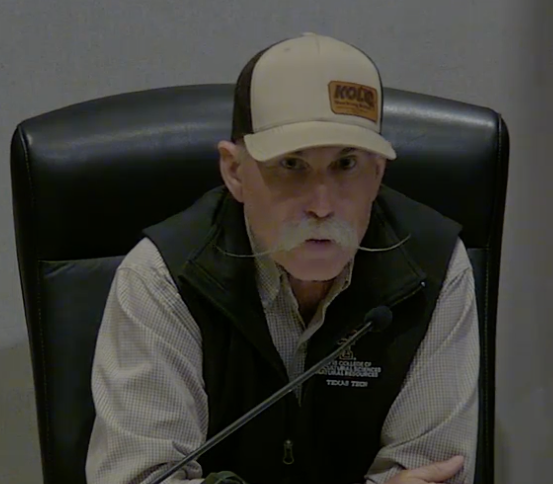
Fulton | Screenshot
“Was it ag exclusive?” Fulton asked. “Was it timber production zone? What was the zoning on the property when you purchased it?”
Scarlett’s attorney leaned over and said something in Scarlett’s ear. “Residential,” he replied.
Fulton said he had asked the question because he was trying to understand if Scarlett was aware of the Q Zone when he purchased the property.
“I’ve grown up across the street for 25 years, [and] I’ve been told about the Q Zone my whole life,” Scarlett said. “I think we’re getting into the weeds and everything like that with other individuals here. I acquired this property for my mother … because she is of aging and I live currently across the street.”
Scarlett emphasized his concern about limbs falling from the tree, noting that he had seen limbs fall from the tree in question and crush a vehicle.
Commission Chair Sarah West asked about drone footage of the crown of the tree and why it wasn’t submitted to the commission ahead of the meeting. Scarlett said he was led to believe that the forester he hired had sent the video to the county staff.
Ford said he had received the forester’s reports, but not the video. “I had discussed with Mr. Scarlett some things that he could do to make those reports stronger, including the video, and but none of that was done.”
Commissioner Noah Levy asked if Scarlett had girdled the four trees that were cut last year, referring to a logging practice where a complete ring is cut through the bark and cambium layer to kill a tree without cutting it down. “And if so, why would you have done that?”
“That was not me,” Scarlett said. “That was the company that I hired to do the job.”
“You should ask the company who did the job why they did that, not my client,” his attorney interjected.

Levy | Screenshot
“Well, did you ask them why they did that?” Levy asked. “I mean, you hired them.”
“They told me [they did it] so they can get a clean cut on the tree,” Scarlett said.
Levy said he could understand why Scarlett would want to remove hazardous limbs from the tree, but felt that people who “choose to live in the redwoods assume a certain risk.” Levy added he’s had to limb trees around his home before, but emphasized that he did so carefully “because living with the trees was the point of purchasing that property.”
“[W]ithout getting into your motivations or your character, I feel that the evidence that … your experts provided for why removal of these trees was the best or necessary course was very thin,” Levy continued. “I don’t find the evidence that you’ve submitted persuasive. At most, I think there might be a need to remove certain limbs, but that’s just where I stand on this.”
Farmer pushed back, reiterating that her client had followed the law. “Yeah, it needs to be improved, but … start with who was responsible for the Q Zone in the first damn place,” she said. “Then my client wouldn’t have had to go through any of this.”
Fulton emphasized that the commission’s role was not to judge the applicant’s motive for cutting down the trees — “the cat is out of the bag” — but to determine whether the remaining tree poses an “imminent” threat to nearby structures and infrastructure.
Commissioners Jerome Qiriazi and Peggy O’Neill both felt as though there wasn’t substantial evidence to prove the hazard was imminent. Commissioner Lorna McFarlane agreed, and made a motion to deny the special permit, which was seconded by O’Neill.
Commissioner Iver Skavdal expressed frustration at the commission having to deal with the issue in the first place. “This situation is a mess, which may be the understatement of the day,” he said. “I am disappointed in the steps taken — or not taken — that resulted in us being here tonight.”
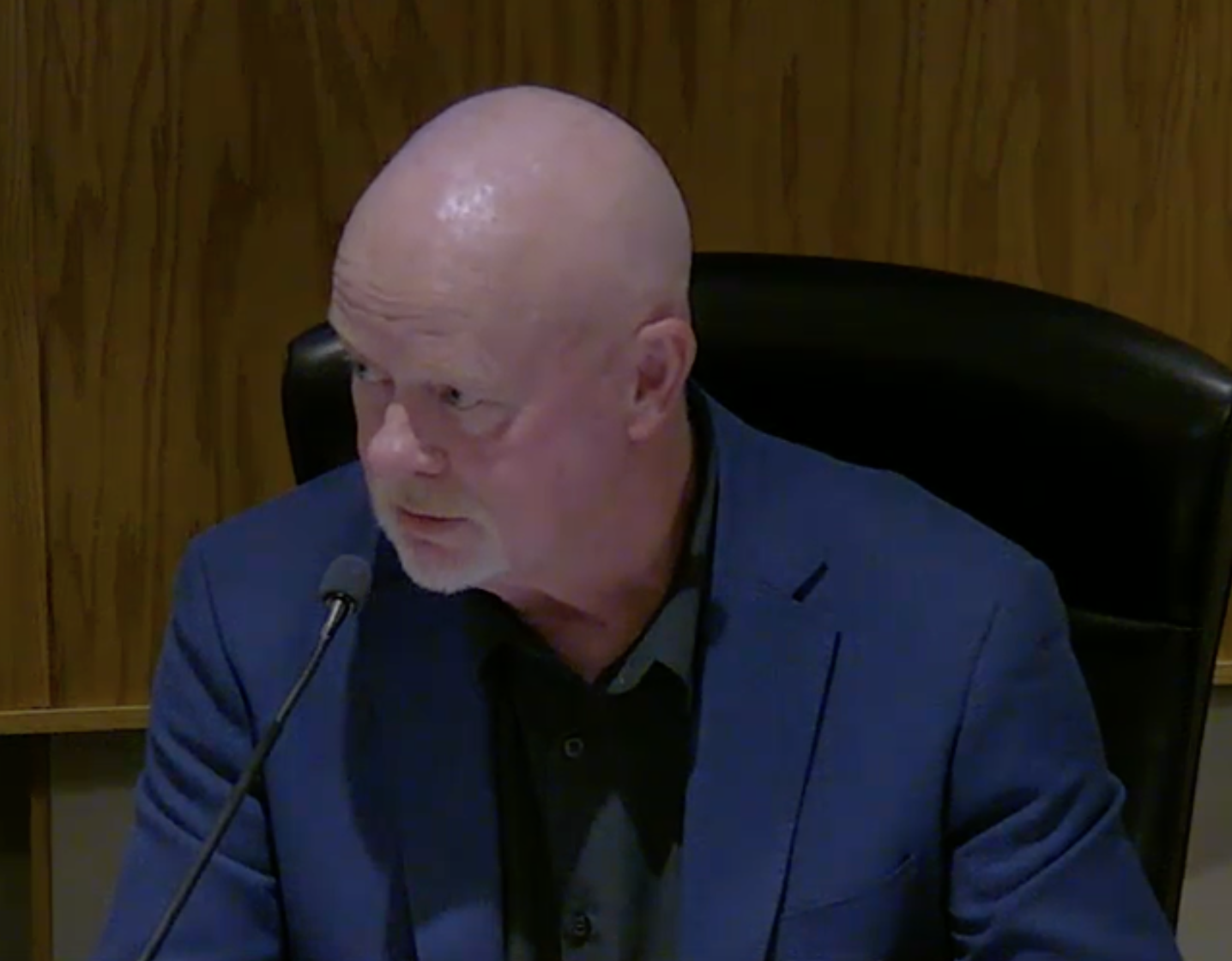
Skavdal | Screenshot
Skavdal said he was hesitant to support the motion, given the potential liability to the county if the tree were to fall and injure someone. However, he agreed with Levy that residents take on a certain level of risk when living among the redwoods.
“I don’t see that as any different from people who choose to have a house by the beach in a tsunami zone or next to the river in a flood zone,” he said. “Each of us weighs that risk with the opportunities and benefits that come from living in those areas. We’re talking about degrees of risk, and who participates in that risk, and that’s where I’m starting to be troubled. … If we decide the tree stays, who’s at risk if a limb falls on the applicant’s property or on the applicant’s mother?”
McFarlane said she would be happy to include an amendment to her motion that would allow Scarlett to limb the tree as he sees fit, but Ford noted that he can already do that.
O’Neill added that Scarlett could always resubmit his special permit request if the tree started showing signs of rot. This seemed to ease Skavdal’s concerns. Still, he urged staff to return to the commission or the Board of Supervisors with a report on the Q Zone to bolster it’s protections.
After some additional discussion, the commission denied the special permit request in a 7-0 vote.
BOOKED
Today: 11 felonies, 14 misdemeanors, 0 infractions
JUDGED
Humboldt County Superior Court Calendar: Yesterday
CHP REPORTS
No current incidents
ELSEWHERE
Governor’s Office: Governor Newsom statement on compromise to address wildfire risk, support fire survivors, and create stronger accountability
RHBB: CDFW Announces Angling Closure at Mouth of the Klamath River
RHBB: Humboldt Bay Area Plan Planning Commission Workshop on Thursday, Sept. 3
Save the Redwoods League Says Caltrans’ Last Chance Grade Mitigation Plan is ‘Deeply Flawed,’ Urges Stronger Protections for Old-Growth Redwoods
LoCO Staff / Friday, June 19 @ 8:45 a.m. / Environment , Traffic

Old-growth coast redwoods in Prairie Creek Redwoods State Park, part of Redwood National and State Parks. | Photo by Max Forster via Save the Redwoods League.
###
###
Press release from Save the Redwoods League:
San Francisco, Calif. (June 17, 2026) – Save the Redwoods League objects to the inadequate mitigation package recently proposed by the California Department of Transportation (Caltrans) for Last Chance Grade. This critical project would construct a 6,000-foot tunnel that will directly impact old-growth coast redwood forests in Del Norte County to realign US-101 and bypass a geologically unstable 3.5-mile stretch of the highway along coastal cliffs.
On May 29, 2026, Caltrans released their Final Environmental Impact Report and Statement for Last Chance Grade, which included a mitigation proposal to compensate for damages created by the project in portions of Redwood National and State Parks (RNSP) including old-growth redwoods. This mitigation is designed to ‘balance the scales’ for negative environmental impacts caused by tunnel construction in this UNESCO World Heritage Site by providing sufficient funding to accelerate second-growth forests toward old-growth status.
Only 5% of California’s original old-growth coast redwoods remain today, and this project will require the removal of up to 144 mature trees in RNSP, including 16 protected, centuries-old redwoods up to 8.9 feet in diameter. Mitigation funding would be directed to restoration work at Redwoods Rising, a partnership in which Save the Redwoods proudly participates alongside California State Parks and the National Park Service in RNSP.
Caltrans offered two potential mitigation strategies: a combination of funding for land acquisition of at least 335 acres and restoration work in RNSP totaling 335 acres, or alternatively, funding solely for restoration work that would cover 670 acres. Unfortunately, the scale of restoration that the proposed mitigation package would enable is not commensurate with the loss that the removal of these old-growth redwoods represents. The total value of this current mitigation proposal amounts to less than half of 1% of the projected $2.7 billion budget for Last Chance Grade, an insufficient attempt at restitution for cutting down some of the world’s last remaining ancient redwoods.
“While Save the Redwoods supports the overall intention of Caltrans’ mitigation strategy, including providing funding for Redwoods Rising, the proposed scale of the package is deeply flawed and fails to address the significant environmental impact that the Last Chance Grade project will incur,” said Ben Friedman, director of government affairs and public funding at Save the Redwoods League. “Old-growth redwoods are among Earth’s oldest living organisms, represent vast potential as natural climate allies and are iconic fixtures of California. If select old-growth redwoods must be casualties of this project, then Caltrans must offer a robust, meaningful mitigation package to recognize the value of these invaluable trees and help fund activities that promote the old growth of the future. We look forward to working with Caltrans to advance a suitable mitigation package.”
When old-growth redwoods are cut down, more than the trees themselves are lost. These forests provide critical habitat for vulnerable wildlife, like the marbled murrelet and the northern spotted owl, and store more carbon per acre than any other forest type in the world. It takes hundreds of years to cultivate successful, mature coast redwood habitat, making the removal of any old-growth redwoods truly devastating.
Save the Redwoods laments the loss of these ancient trees while acknowledging the difficult reality that there is no way to safely address Last Chance Grade without removing some of these redwoods. For decades, this 3.5-mile section of Highway 101 between Eureka and Crescent City has been plagued by landslides and frequent closures, with no viable alternate routes for local communities, commerce or tourism. Completing this project will improve safety for travelers, support the regional economy and preserve vital Tribal and community connectivity.
Since 2015, Save the Redwoods has worked closely with Caltrans and Congressman Huffman’s Stakeholder Working Group to assess Last Chance Grade, limit the project’s environmental impact to the least harmful option and explore mitigation opportunities that reflect the substantial nature of that impact. These past conversations have been productive and transparent, but Caltrans’ existing mitigation proposal is simply not acceptable.
In recent engagements, Caltrans has indicated their willingness to revisit the project’s mitigation package with Save the Redwoods and fellow stakeholders. We urge Caltrans to continue these discussions in good faith to ensure more appropriate mitigation for Last Chance Grade. Old-growth redwood forests are irreplaceable, and far more work is needed to properly calculate equitable compensation for these ancient trees than is reflected in Caltrans’ current proposal.
This Lawmaker’s Proposal Could Make California ‘The Most Secretive State in the Country’
Yue Stella Yu / Friday, June 19 @ 7:43 a.m. / Sacramento

Assemblymember Blanca Pacheco speaks with a fellow lawmaker during session at the state Capitol in Sacramento on June 13, 2024. Photo by Cristian Gonzalez for CalMatters
###
This story was originally published by CalMatters. Sign up for their newsletters.
###
In March, Assemblymember Blanca Pacheco introduced a measure that would have made it more expensive for Californians to obtain government records.
Amid opposition from transparency advocates and public access concerns from her own Assembly colleagues, though, the Downey Democrat diluted her proposal to simply give governments more time to respond to records requests, a change that allowed the measure to sail through the Assembly in May.
Now, she’s brought the controversial elements back — and they are even more restrictive than before, drawing fierce opposition from transparency advocates.
The latest version of her proposal, Assembly Bill 1821, would allow government agencies to delay responding to certain requests and to charge at least $88 an hour to search for and review the records they deem are for “commercial use.”
Government agencies could also take requests to court if they believe someone is asking for the records for a malicious reason.
Pacheco told CalMatters her measure aims to prevent frivolous records requests from inundating local governments, especially requests generated by artificial intelligence.
For years, local agencies have argued that fulfilling extensive records requests burdens public workers and allows bad actors to overwhelm governments. In 2023, someone requested Bay Area city officials’ emails to train an AI service they wanted to sell to local governments, said Donald Larkin, an attorney representing the League of California Cities, which supports the legislation.
“Transparency is important to me,” Pacheco said in an interview. “We just want it to run efficiently, and these are just minor amendments or minor tweaks to the Public Records Act.”
But First Amendment advocates say state law already allows agencies to decline frivolous records requests by arguing that they are “unduly burdensome.” Even when requests are legitimate, agencies routinely delay fulfilling them or withhold records for months or years, drawing legal challenges.
Pacheco’s measure would create barriers that would chill the public from filing requests, effectively gutting the state’s open records act and violating the spirit of Californians’ constitutional right to government information, transparency advocates argue.
“The only way that there’s any government accountability is that people know what the government is doing,” said David Snyder, a former journalist and now the executive director of the First Amendment Coalition.
“This looks a lot like an effort to evade accountability.”
The proposed changes would “make California stand out as the most secretive state in the country,” said David Cuillier, a University of Florida journalism professor who sits on the federal Freedom of Information Act advisory committee.
The whiplash of amendments angered many transparency advocates, who criticized Pacheco for overhauling her proposal only after it was approved by the Assembly.
The move, prevalent in the Legislature, “often leads to badly written bills with dangerous side effects and AB 1821 now fits squarely into that category,” said Tracy Rosenberg, advocacy director at local watchdog group Oakland Privacy, who called the proposal “a virtual horror show of governmental non-transparency.”
Authority to sue for ‘malicious’ requests
While many local governments across the nation have sued — and largely lost — over what they consider “vexatious” requests, California would be the first state to explicitly allow agencies to sue for “malicious intent.” Requesters the court deems malicious would have to pay $88 an hour to obtain records.
Public agencies already use the courts to target requests they don’t like, and rubber-stamping that authority by writing it into law would embolden them to deny more requests, First Amendment advocates say.
“It would be easily weaponized by agencies seeking to thwart transparency and accountability, as has already happened elsewhere in the country,” Snyder said.
The threat of a lawsuit alone would “chill requesters from submitting public requests,” said Shaila Nathu, a senior attorney with ACLU of Northern California, which also opposes the bill.
Pacheco dismissed the concerns, stating that she doubts that cities would sue very often because it’d require them to go to court just to recover a limited amount of fees. But the provision would offer a tool just in case, she said.
“Hopefully this will curb the bad actors,” she said. “I don’t anticipate that this would slow down legitimate requests.”
‘Outrageous’ fees risk chilling public engagement
Advocates also criticized Pacheco’s fee proposal, arguing it would discriminate against requesters based on their use for the records. State law bars agencies from limiting access to public records based on purpose.
The measure would allow agencies to charge more for requests they deem to further someone’s “commercial, trade, or profit interests.” It would exempt just a small group of people, such as academics, journalists and government agencies. Under current law, agencies can only charge for making copies of the records, usually at between 10 to 50 cents a page.
For the rest of the public, agencies could ask them to submit information “promptly” to prove their intent and automatically treat those who don’t as commercial requesters. The bill includes no standard for what is “prompt.”
“It’s so fact-specific that it’s kind of hard to say what’s reasonable, what’s prompt,” Pacheco said. “Most people will reply if a city asks, and then the city can then obtain the records for the individual.”
 Assemblymember Blanca Pacheco during a floor session at the state Capitol in Sacramento on March 23, 2026. Photo by Fred Greaves for CalMatters
In an email, Pacheco spokesperson Alina Evans told CalMatters that the assemblymember wants to prevent taxpayers from subsidizing “the cost of building or improving a private company’s commercial product.” But, she said, Pacheco will amend the measure to prevent forcing every requester to justify their request.
Snyder said that language would give governments broad authority to play favorites — “to see why it is somebody’s requesting records and then to potentially make decisions based on that.”
Those deemed commercial would have to pay $22 an hour in “administrative fees” and $66 an hour in “professional fees” for the search, review and redaction of the records, although the California Supreme Court already ruled in 2020 that such charges threaten Californians’ right to access.
That hourly rate would be “outrageous” and could easily become so burdensome that low-income Californians stop filing requests altogether, Cuillier warned.
Critics also slammed the measure for empowering agencies to decide how quickly they need to respond to requests based on how people file them.
Under current law, government agencies must respond to a request within 10 calendar days and extend the deadline for providing the records by no more than 14 calendar days. The law does not mandate a specific format for submission, although many local and state agencies allow requests through an online portal.
Pacheco’s bill would extend the timeline to 10 and 14 business days respectively, but only if the requests are filed in person or by email during normal business hours.
Those requesting records by fax, by mail or through an online portal would be at the agencies’ mercy.
The initiative originated from one of Pacheco’s many trips sponsored by special interest groups last year, her spokesperson, Alina Evans, told CalMatters in March. Last year, Pacheco reported receiving more than $45,000 in sponsored travel — the most of any California lawmaker — including a study tour in Spain, a golf tournament in Pebble Beach and a conference in Maui. When asked Wednesday, however, Pacheco said she did not remember which one inspired her measure and said the idea came from multiple conversations with local governments.
The latest amendment reflects talks Pacheco had with the League of California Cities, the California State Association of Counties, the city of Downey, municipal clerks and several lawmakers on the Assembly Judiciary Committee, which approved a much narrower version of her proposal, Evans said.
Cal State Faculty Push to Prevent AI Tools From Replacing Them as Schools and Staff Experiment
Mikhail Zinshteyn / Friday, June 19 @ 7:41 a.m. / Sacramento

A student walks up the stairs at the Innovation and Instruction building at Cal State Dominguez Hills in Carson on Feb. 19, 2026. Photo by Zin Chiang for CalMatters
###
This story was originally published by CalMatters. Sign up for their newsletters.
###
The nation’s largest public four-year university may soon be barred from replacing faculty with generative AI as a bill backed by a union of professors comes nearer to reaching the governor’s desk.
Few examples exist of the California State University’s attempting to replace faculty labor with generative AI tools, but the faculty union wants to prevent such efforts from ever getting off the ground. The bill so far has garnered no opposition from lawmakers and may clear the Legislature as soon as Monday.
“We do have some cases of the potential replacement of faculty work by AI, and so I personally am very concerned about closing the barn door after the horse has already gotten out,” said Kevin Wehr, a professor of sociology at Sacramento State, which is part of the Cal State system. Wehr leads the bargaining team for the faculty union, the California Faculty Association.
“We’re trying to keep ahead of a rapidly changing set of technologies,” he said in an interview.
Wehr and other faculty and union representatives Calmatters spoke with are especially alarmed about Cal State because of the system’s growing embrace of generative AI tools. Cal State signed a $17 million contract with ChatGPT last year to provide all students and faculty access to the company’s suite of education offerings.A survey released by Cal State in the spring found that just over half of faculty reported AI affecting their teaching negatively. Just one-third of students indicated that their professors teach them how to use AI effectively, CalMatters reported. Cal State has since renewed its contract with ChatGPT, paying the company $13 million annually for the next three years, according to LAist.
Cal State is one of several state agencies flagged in a government report that uses “high risk” AI tools, CalMatters reported. Those include cheating detection software for students taking exams remotely.
Already, the system’s use of AI is creating tension between faculty and administrators.
Next month, the state labor relations board will hold a meeting over the system’s purchasing of AI tools such as ChatGPT. The union filed an unfair labor practice charge last year when the system rolled out its new pivot toward AI.
In 2025 the faculty union filed a separate complaint with the labor board that Sacramento State was considering deploying AI chatbots that fed off the course material professors voluntarily submitted, a claim Cal State refuted. The union also contested an administrator’s proposed written recommendation that students seek out mental health support through AI tools in the event campus counselors weren’t available.
Cal State and the union settled the matter in March and the union withdrew its complaint. Sacramento State agreed that it wouldn’t “implement autonomous programs or bots with the primary purpose of performing bargaining unit work or evaluating faculty” without meeting and conferring with the union first.
“Many institutions of higher education are exploring options to integrate AI into their courses and curriculum,” said the bill’s author Sen. Sabrina Cervantes, a Democrat from Riverside, at a bill hearing in June. “In many instances, this has been done without any boundaries or guardrails.”California Faculty Association represents coaches and mental health counselors in addition to professors. It has donated at least $3.4 million to state legislators and other candidates for state office since 2020. Cervantes has gotten at least $64,650 from the union since 2016, according to Digital Democracy, a CalMatters government disclosure tool.
Cal State has no position on the bill, but the role of AI broadly is a sticking point in ongoing labor contract negotiations between the union and the university system.
A dispute over bots at Sacramento State
The California Faculty Association filed unfair labor practice charges against Sacramento State with the California Public Employment Relations Board last winter over what it said were campus efforts to replace some of the work of faculty, which the union maintained violated state labor law.CalMatters obtained these records through a California Public Records Act request.
The union alleged that Alexander “Sasha” Sidorkin, the campus’s then chief AI officer, created a mental health chatbot for students and included a link to it in a resources webpage for students. The complaint indicates that the link was accompanied by the statement, “AI is better than nothing, when a counselor isn’t available.”In a response, Cal State’s chancellor’s office wrote to the labor board that the union’s claims of unfair labor practices were bogus. Sidorkin didn’t develop any such bots and “there was no implementation of any AI bots to do any counseling work.”
CalMatters spoke with Sidorkin by phone this week. Prior to the call, he had no knowledge that he was named in the complaint. Sidorkin called the union’s allegation “a misstatement of the fact.” He never created a bot, he said, but merely recommended that students use ChatGPT if they cannot find a counselor.
Sidorkin, who has a new book out on using AI to teach in universities, said Sacramento State terminated the position of chief AI officer last April during a wave of systemwide layoffs and the campus took down the website affiliated with that role.
He remains at the university as a professor of education and is a union member. Sidorkin shared a copy of the proposed syllabus language that he archived. He still stands by his recommendation that students are informed in their course syllabus that an AI tool during a mental health episode is better than nothing.
 The Hornet Commons student housing complex at California State University, Sacramento, in Sacramento on July 13, 2022. Photo by Rahul Lal, CalMatters
Patrick Oberle, an associate professor of geography at Sacramento State and a union member, said the faculty association took up the issue because it represents counselors who the university could attempt to outsource. CalMatters spoke with him before speaking with Sidorkin.
The union filing also alleges that Sidorkin created an AI-powered tool to interpret the faculty union’s contract with the university system. The union argued this too violated state labor relations law and that the tool itself produced incorrect information. “When the union objected, the CSU ceased use of the contract interpretation bot,” the complaint read.
And Sidorkin solicited faculty for their course syllabi and materials “to receive a customized AI tutoring bot for their classes.” The complaint included an email from Sidorkin to faculty that Sac State leaders told him to retract the request, though he seemingly opposed the move.“This technology is available on the open market through multiple platforms; however, you will not be able to build them through my office at this time,” he wrote then. He told CalMatters that some 18 professors sent their course material to him the first day he invited submissions.
A human resources director at Sacramento State wrote to a faculty member reassuring her that any bots by administrators need to be bargained over between the union and Cal State “before being used, posted, published, shared, or distributed,” according to a copy of the email.
Sidorkin told CalMatters that the union’s filing the charges was a mistake.“It’s not a good PR move also on the union’s side because they look like they’re Luddites, and this is not true,” he said, adding that dozens of faculty at Sacramento State alone have developed AI chatbots in support of their courses for students after Cal State purchased ChatGPT accounts for faculty and students last year.“I am disappointed in my union,” he added.
Faculty fears of AI mission creep
Oberle, the professor, fears that without guardrails, a university could chip away the work of instructors in ways that hurt student learning and diminish the joy of teaching.
One concern? That a campus may encourage professors to shift more of their grading to AI to then grow the number of students per class. That hasn’t happened in a formal way, yet.
That would mean less human engagement with instructors for students. And it could reduce the need to hire additional professors as others retire, which would limit the power of the faculty union.“We’re trying to accommodate the folks who are deeply opposed to AI’s very existence, and also accommodate the folks that are very excited about all of its possibilities,” Oberle said.
The point of the unfair labor practice charge, he said, wasn’t to tie the hands of Cal State administrators, but to underscore that using AI to potentially replace labor requires a conversation with faculty.
More battles over AI in the workplace
Cervantes’ bill is one of several in California aimed at curbing the role of artificial intelligence in the workplace, but others are far more divisive. Senate Bill 947, would prevent employers from relying solely on AI tools to discipline or dismiss employees. That legislation has the support of labor unions and some nonprofits skeptical of generative AI. Business groups oppose it, including the California Chamber of Commerce as well as ride-hail company Lyft. Gov. Gavin Newsom vetoed a similar bill last year.Another, Senate Bill 903, would ban psychotherapists from offering therapy through chatbots and place other limits on the use of AI tools in transcribing patient sessions or communicating with patients. It would also ban bots from making independent therapeutic decisions. The California Chamber of Commerce and California Medical Association oppose it.
“We know technology can augment humans, but it should never replace humans,” said Assemblymember Mike Fong, a Democrat from Alhambra and chair of the Assembly’s committee on higher education, when speaking about Cervantes’ Cal State faculty bill.
Moments later, the committee voted 10-0 to pass the measure.
OBITUARY: Chris Laurentz Spoerle, 1959-2026
LoCO Staff / Friday, June 19 @ 6:56 a.m. / Obits

Chris Laurentz Spoerle, 66, of Fortuna, passed away on June 2, 2026.
Born on August 26, 1959, in Huntington Park, Calif., Chris grew up in Norwalk, Calif., and graduated from John Glenn High School in 1977. Following graduation, he entered the United States Army, where his final duty station was in Germany. During his time there, he was introduced to the ministry of Overseas Christian Servicemen’s Centers (OCSC), an experience that had a profound and lasting influence on his life and faith.
After returning to the United States, Chris worked for Campus Crusade for Christ before beginning a career in the trucking industry. After moving to Humboldt County in 1989, he worked for Dutra Trucking, Don Nolan Trucking, and Steve Wills Trucking, where he became known as a highly skilled engine mechanic. Later in life, he returned to school and worked for local communications companies including Cal Autofone, Masterson Communications, and Carlson Wireless. His final employment was with Grundman’s Sporting Goods, where he became a familiar face to many in the community.
After retirement, Chris enjoyed camping, fishing, and spending time at Ruth Lake with family and friends. He loved being outdoors and could often be found sitting on the patio listening to the waterfall in the pond or wandering through the vegetable garden.
Chris’s Christian faith was the foundation of his life. Through his health challenges he remained steadfast, drawing strength from the Lord and sharing that strength with those around him. He will be remembered for his smile during adversity and his kindness.
Chris is survived by his wife of 43 years, Hope Spoerle; his children, Justin (Ariel) Spoerle, Sarah (Eric) Jones, Aaron (Isabella) Spoerle, and Matthew Spoerle; and his grandsons, Stetson and Branson Spoerle. He is also survived by extended family members and many friends.
Uncle Chris was greatly admired by his many nieces and nephews. His love for family and friends was evident throughout his life, and he will be greatly missed.
A memorial service will be held at 2 p.m. on July 25, 2026, at Campton Heights Baptist Church in Fortuna, California. A potluck meal will follow the service. Family and friends are warmly invited to bring a favorite dish to share.
The family would like to thank Dr. Allen Mathew and his team at Redwood Renal for their excellent care and compassion over the past two years.
In lieu of flowers, donations may be made to the National Kidney Foundation in Chris’s memory.
“I have fought the good fight, I have finished the race, I have kept the faith.”
— 2 Timothy 4:7
###
The obituary above was submitted on behalf of Chris Spoerle’s family. The Lost Coast Outpost runs obituaries of Humboldt County residents at no charge. See guidelines here. Email news@lostcoastoutpost.com.
City of Eureka Takes Over Management of Bayside Village Transitional Housing Project
Sage Alexander / Thursday, June 18 @ 5 p.m. / Homelessness , Housing

The garden at Bayside Village Transitional Housing. Photo: Sage Alexander.
About a year after the first tenants moved into the Bayside Village, a 32-unit transitional housing project on Hilfiker Lane in Eureka, the Betty Kwan Chinn Homeless Foundation ended its agreement to operate the facility.
Chinn said she feels guilty about this, but the setup just didn’t work out for the organization. Now, the project is operated by the City of Eureka’s UPLIFT program. The city took over the site May 15.
The transition was “nearly seamless, as far as just changing over the site management,” said Jeff Davis, project manager for UPLIFT Eureka in an interview.
The village is the first project of its kind the city has run. But Davis said operations are so far so good, about a month in.
He said UPLIFT is used to taking on new projects.
“A lot of the things that we’re doing, diving into the social services realm, it’s something that cities traditionally do not do,” he said.
The 25 or so residents there now formerly lived in encampments along the Waterfront Trail, a requirement for entry tied to grant funding the city obtained to construct the project.

Photo: Sage Alexander.
People moved there summer of last year into a smattering of residential pod units, which stand alongside shared showers, a kitchen, laundry facilities and group meeting areas. The site’s been conceptualized since 2017, and finally opened through a collaboration of multiple agencies with Chinn’s foundation operating it.
When asked about ending the agreement, Chinn said the tenant/landlord dynamic was all new to her.
At the village, residents would pay $200 a month in rent (mostly fundraised by the larger community). This aimed to establish rental history, and the residents were paid back the amount at the end of their year lease, $2,400.
But that also meant they have tenant’s rights, said Chinn.
“I should study more before I get myself in there. I’ve never been a landlord, so I don’t know that kind of law,” she said.
That meant staff couldn’t take steps that she said helps people detach from the homeless lifestyle, such as room inspections for cleanliness, requiring people participate in case management or preventing visitors from coming to visit overnight.
“I found out I’m unable to provide the service for them, it’s not my ability to help them,” she said.
She said she wanted to help the people because they are some of the most vulnerable, and emphasized she feels guilty she couldn’t continue running the site, but learned a lot in the process.
Davis said in retrospect, the initial model that centered around a one-year timeline on the leases may not have been the best fit for the population.
Davis said the average length of time a resident of the village had been homeless was between ten to fifteen years, with one current resident homeless for 35 years.
“For someone that had been experiencing homelessness for three and a half decades to have 12 months to kind of turn everything around, stabilize and secure permanent housing, was pretty unrealistic,” he said.
Plus, he said, getting people into programs that provide permanent housing can take years, with long waitlists. Another issue in the model was that residents lost their “chronically homeless” designation, which gives people priority on certain waitlists, because they were in transitional housing.
The transitional housing model works with some populations, Davis said, but for this one, not so much.
Now, the city is operating the village in a new model as basically emergency housing. This allows the current residents to stay as long as they need to, with the ultimate goal to move people into permanent housing. (Some already have moved into permanent housing, noted Davis). According to Davis, at this time, the city doesn’t have plans to hand off the project to another agency.
He said most of the operating costs come through California Advancing and Innovating Medi-Cal (CalAIM) which funds social services through Medi-Cal.
The city will honor the leases the tenants originally signed and help support them, he said.
At the site Thursday, near an art class and people grilling dinner, Aerora Fonlupt, social service manager with UPLIFT, said the program allows for an appropriate amount of time for people to acclimate being out of camps, find their footing and find placement.
As for the transition of the city taking over, “I don’t think we could have asked for it to go any more smoothly than it has,” she said.

Photo: Sage Alexander
She noted there’s people on the program’s waitlist, and staff is working to stabilize before admitting more people. She said guests often visit their friends and have expressed interest in having a spot there, kind of a natural bridge from the encampments.
Lisa Hilliard, a resident of the Bayside Village, spoke in support of the city taking over.
Hilliard, who has spearheaded adding a vegetable garden at the site, said it’s important to give people a bar to reach for — reasonable responsibilities to slowly move forward.
“People can’t flip a coin and go from not having any responsibilities to, oh my God, here’s a $1,700, $1,800, $1,900 a month house payment, and everything that goes along with it,” she said.
Lost Coast Brewery is For Sale
Ryan Burns / Thursday, June 18 @ 1 p.m. / Business

The Lost Coast Brewery brewing facility at 1600 Sunset on the south end of Eureka. | Photos by Ryan Burns.
###

A sign on Hwy. 101 beckons travelers to visit the main brewing facility.
Lost Coast Brewery, the 36-year-old Humboldt County suds-maker that grew into one of the nation’s top 50 craft breweries, is up for sale.
Owner Barbara Groom, who co-founded the brewery with Wendy Pound after touring English and Welsh pubs in the late ‘80s, told the Outpost on Thursday that she’s ready to retire.
“I’m 80 years old; I can’t do this forever,” she said.
Industry website ProBrewer.com quietly broke the news late last week, touting Lost Coast’s trajectory from the original brewery and restaurant in downtown Eureka through its 2014 expansion to a $27 million, 75,000-square-foot brewing facility at the south end of the city. But Groom said she’s not expecting a quick sale.
“We’re looking around, seeing if we can find somebody, but there are not a lot of people buying breweries right now,” she said.
After years of explosive growth, the craft brewing industry has fallen on hard times amid rising costs, excess competition and fading demand. The COVID pandemic and a shift away from alcohol consumption among young people have both contributed to declining sales. More than half of the microbreweries in the country in 2018 had closed by 2024, according to a recent story in The Guardian. In October, ProBrewer reported a continuing “cascade of breweries filing for bankruptcy and closing.”

A Flatmo-inspired shark hangs outside the main brewing facility.
“In this atmosphere, there’s too many breweries,” Groom said. “Nobody’s really drinking. … Eight, 10 years ago, breweries were selling like hotcakes. Not anymore.”
When the brewery and cafe opened in 1990, Lost Coast Brewery was among the first women-owned breweries in the country. The company’s aesthetic, and most of its distinctive labels, were created by local artist Duane Flatmo, who later beefed with Groom over royalties and look-alike artwork. The company’s award-winning brews include Downtown Brown, Great White, Alleycat Amber, 8-Ball Stout and Tangerine Wheat, and its beer has been distributed to at least 21 states and 11 countries.
Groom said she doesn’t have a specific asking price in mind, and she’s open to selling each piece of the business separately, whether someone wants the downtown restaurant, the brewing facility, the brand or the whole shebang. She added that she doesn’t want her employees or customers to worry; the sale could take years. But she’s ready to kick back with a cold one.
“I just want to retire,” she said. “I want to go traveling. I’ve got a nice little camper. I just want to get in that baby and travel across the United States.”

The restaurant, at 617 Fourth Street in Eureka.


