It’s that time again, folks! Organizers of the sixth annual Eureka Street Art Festival are gearing up to bring a much-needed dose of color to the drab walls of Broadway.
There are 20 murals planned for this year’s festival. Where is all the art happening, you ask? Keep scrolling for a map of the mural locations along the southern Highway 101 corridor and more information about the painters who will be spreading art and color throughout our fair city.
###
Click to enlarge.
###
Press release from the Eureka Street Art Festival:
This July 31st - August 5th, the Eureka Street Art Festival will be bringing 20 new murals to South Broadway and the 101!
2023 Mural Artists
This year we are welcoming artists from around the corner and around the world. The 2023 Artists include:
Laci Dane - Weott, CA
Blake Reagan - Loleta, CA
CALANGOSS (Eder Muniz) - Rochester, NY
Ripe Mind (Tony Diaz) - Arcata, CA
ORLUarts - Oakland, CA
Fasm - Modesto, CA
REBOUND - Arcata, CA
Caitlin McDonagh - Victoria, BC, Canada
Ekosaurio - Santurce, Puerto Rico
Josh Overington - Arcata, CA
Edin + Ben Goulart - Bayside, CA
Ladi Ladines - Humboldt County, CA
Tamzen Fox - Humboldt County, CA
Aerosol Kingdom - Rochester, NY
Miles Toland - Nevada City, CA
LEHO - Tainan City, Taiwan
Kay Lopez - Eureka, CA
Mark Worst - Los Angeles, CA
Zoë Gelfant - Montreal, QC, Canada
For the week of the Festival, these artists will be painting murals along the 101 and South Broadway, from D Street all the way to the Herrick Overpass. As always, we are featuring a strong group of local artists, including a number of painters who participated in the ESAF Mural Apprentice Program in past years. And this year we are excited to be welcoming international artists again, with muralists coming from as far as Canada, Puerto Rico, and Taiwan to spread some color in Eureka. You can find examples of all of the artists work on our social media (@EurekaStreetArtFestival) and our website (www.EurekaStreetArtFestival.com).
How to Enjoy the Festival
Drive + walk around the Festival area during the week – Grab a map from our website, the Eureka Visitor Center, Humboldt Cider Company or Festival HQ (located at Papa + Barkley).
Daily Art Talks – at 5:30pm This year we will be organizing more in-depth Art Talks each day. Check our website and social media for the schedule and locations.
Support the Broadway businesses while you’re out!– Let’s show some love to our local businesses throughout the week.
Attend the Block Party on Saturday, August 5th from 12-6, under the Samoa Bridge – Enjoy the huge beer garden, listen to live music, eat tons of good food, watch artists work, shop from local vendors, and meet the mural artists!
The Eureka Street Art Festival’s mission is to create intentional, accessible art that enlivens public spaces, stimulates community revitalization, and attracts visitors to Eureka. ESAF is a Dreammaker Project of the Ink People Center for the Arts.
An offshore wind turbine’s floating platform, measuring 100 feet tall and 425 feet long per side. File photo.
Offshore wind energy can be thought of as three distinct projects: the construction of offshore wind turbines, the actual operation and generation of electricity, and the transmission of that electricity across California. The Humboldt Harbor District is poised to play a major role in offshore wind turbine construction and is planning improvements to create a port designed specifically to build these large floating turbines.
The Harbor District has released a “Notice of Preparation”—the initial step in the CEQA process for analyzing environmental impacts from the port redevelopment. Luis Neuner of EPIC, Jen Kalt of Humboldt Baykeeper, and Caroline Griffith of the Northcoast Environmental Center join the show to discuss their thoughts on the initial designs.
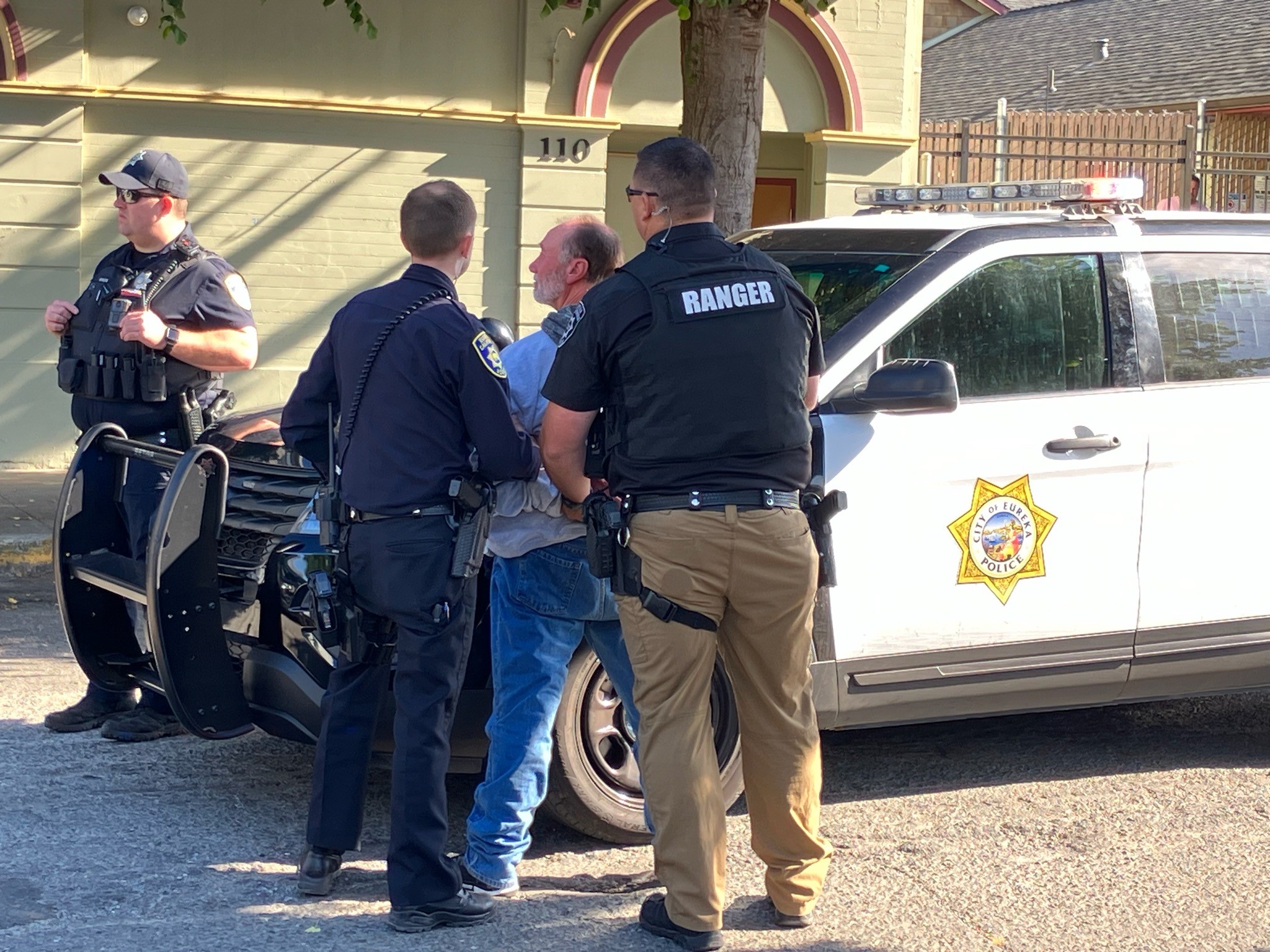
On July 12, 2023, a 43-year-old man was lit on fire near the 400 block of A Street in
Eureka. The man received critical burns and was transported out of the area for
treatment.
Through extensive investigation, Eureka Police Detectives identified 60-year-old Vaughn
Pernell Jones as the suspect. On July 14, 2023, a Ramey Warrant was obtained and
Jones was taken into custody near the 100 block of 2nd Street. Jones was booked into
the Humboldt County Correctional Facility for attempted murder and mayhem.
Swimming in the Mattole, near the Mattole Bridge at A. W. Way County Park. All photos courtesy Gerald Beck via The Humboldt Historian, unless otherwise noted.
There had been casual discussions
over the past few years about the
possibility of a visit to the Mattole
valley, but the talk never seemed to
evolve into a plan of action. At a recent dinner party, though, that barrier was broken and my friends rather
unexpectedly said, “Let’s go!” As we
climbed the “Wildcat” out of Ferndale
on our way to my family’s camp on
Conklin Creek Road, the suggestion
was repeatedly made that my information about that part of the county
ought to be recorded before it fades
into the unrecoverable past.
And so I am charging forth on the
wings of family history, on the stories
of earlier times told by my mother
and father until their passing in 1963,
and on my own personal visits to the
Mattole commencing around 1939.
My mother, Cora Farnsworth, was
born in Ettersburg on the Upper
Mattole in 1901. She had nine siblings. She graduated from the Petrolia School around 1912, and I have
a photo from that time. It shows her
standing on the school porch with
the other students and the teacher.
The author’s mother, Cora Farnsworth, is in the back row, second from left. Circa 1912.
She often spoke fondly of a little
black mare that she and her sisters
rode to school. There must have been
a one-room school in Ettersburg at
that time. Her father had apparently
come into the Upper Mattole with
one of the earliest wagon trains to
reach that area. He is buried in tbe
old Mattole cemetery on the knob
just south of tbe Petrolia Store. His
name, Farnswortb, persists among
some of the old-timers who use it to
identify a ridge to the north of the
table that one crosses traveling the
Mattole Road to and from Petrolia.
Learning responsibilities in homemaking very early, my mother occasionally traveled to nearby Briceland, where she worked as a domestic
servant. It wasn’t long before she had
made the two-day journey by horse
and wagon to Eureka, where she
had gained employment as a clerk at
Hink’s department store, which later
became Daly’s.
It was, however, the Mattole Valley
that always remained in her heart, and
when the opportunity occurred to
purchase a few acres with a cabin on
the lower river near Petrolia around
1956, my dad threw economic caution to the winds and purchased the
property as a family retreat. To my
mother it was like coming home. My
parents were acquainted with many
of the original ranch families of the
area: Roscoe, Clark, Hindley, Lindley, Oeschger, Etter, Lloyd Roberts,
Ear] Schortgen, etc. (Ken Roscoe’s Heydays in Humboldt is a fascinating
collection of humorous anecdotes,
mostly from the Mattole). Both my
mom and dad loved going there, often inviting friends to share in what
they considered their good fortune.
In 1958 my dad paid $25 for a unit
of “farmer’s lumber” from the mill
in Carlotta to build an additional
shelter. He pieced the components of
the structure together in our horse
barn at Hydesville, loaded them on
the old 1947 International, hauled
them down to the valley, and assembled what has survived to this day as
“the sleeping cabin.” Their vision for
the future of the property was that
it serve as a special meeting place
for the extended families of my two
sisters and myself, a purpose it has
served well for over fifty years.
The Beck family cabin on the Mattole. The wrap-around porch was added together with a new foundation after the 1992 earthquake, which neatly deposited the house ten feet from its original location.
Some of my earliest experiences on
the Mattole took place in the forties at another beautiful cabin on the
little flat, up a gulch and just slightly downstream from the mouth of
Conklin Creek. Tbe cabin belonged
to two older ladies named Williams
and Graham, one a widow, the other
a “spinster.” At that time these women
owned the ranch in Hydesville that
was later purchased by the Fearrien
family when Les first came there. My
dad had entered a business arrangement with Williams and Graham
involving their ranch property: he
would seed the large front fields on
the Hydesville table to subterranean
clover in return for the use of the entire ranch for livestock pasture. The
older ladies insisted that our family make use of the cabin on Conklin Creek Road anytime we might
choose during those years. There
were at least three other cabins on
this little flat. One belonged to Adrian and Sue Chapin, who ran a dairy
farm in Ferndale, and Marge and Rae
Wright utilized another. The Wright
family bistory is associated with the
earliest valley settlements. It was at
this cabin tbat I first slept on Mattole
ground, went trout fishing and first
encountered water snakes and pinch
bugs in my swimming trunks at the
close-by pools.
My dad spoke of his experiences
as a young man driving livestock from the Mattole to markets in Eel River Valley. During our family’s
trips to Petrolia he always identified
the various ranches that the road
passed through from Bunker Hill to
Bear River, over Cape Mendocino
and down the coast to Davis Creek.
Many of these properties were initially developed by the Russ family
and acquired names from legends
and myths like Mazeppa and What
Cheer, to comments on the prevailing weather such as Spicy Breezes
and Windy Nip. These titles always
called forth my father’s memories of
trailing cattle over the ridges in wind
that made it difficult to sit a saddle.
The perpetual ocean wind along the
coastal ridges was often a distinct
actor in these stories.
Curtis and Olive Walker were close friends of my
parents. They lived on the Walker
Ranch, which was situated on an exposed ridge above the Zanoni Ranch.
For many years, access into the Mattole was directly up Domingo Creek
from the ocean, tbrough Zanoni’s
and past the Walker gate over into
McNutt Creek. The transition from
the coastal environment, where all
the trees branched to the southeast
from the perpetual ocean winds,
over the ridge into the more protected valley climate, always seemed
like pure magic to me, symbolic of
suddenly arriving instantaneously
in a true “heaven on earth” for a boy. Mixed with that magic is a story my
dad told repeatedly about Grandma
Walker, arriving at the gate from a
daylong stage journey. According to
accounts, it bad been so windy that
the elderly lady bad been thrown off her feet and had crawled hand over hand clinging to the fence about a
quarter of a mile to make it home.
Thoughts of the Walker ranch
bring forth my lifelong friendship with Curtis and Olive’s son Lowell. Redheaded Lowell was a couple
of years older and a seasoned mountain ranch boy. One of my earliest
encounters with Lowell was during
a family visit to the ranch when he
introduced me to archery. I think it
must have been around 1939. Using
Lowell’s bow and arrows out behind
the barn, we took turns shooting
straight up until the arrows disappeared into the wind and we ran for
the barn to avoid being brained by
the returning missiles. I was hooked
and began begging my parents for a
bow and arrows. Lowell had gotten
his bow from the Cape Mendocino
lighthouse keeper, who had fashioned yew wood bows for several
years as a hobby to pass the solitary
time. Finally, tired of listening to the
begging, my parents took me out to
the lighthouse to get me a yew wood
bow.
The Cape Mendocino Lighthouse as it appeared in 1915. Photo: Humboldt County Historical Society.
What I recall about that day
may be one of those little episodes
that has expanded with time but it
frightened me enough to stick with
me for seventy years. The lighthouse
keeper had suspended a ship’s hawser the short distance from his living
quarters to the light so that he might
go back and forth hand over hand to
perform maintenance in all weathers. It was fair with a rather regular
northwest wind over the cape that
day as we got out of the car to walk
down to the keeper’s quarters, but it
kept me clutching the door handle of
our little Ford. My father took one of
my hands and my mother the other
as they leaned into the wind to get
down the trail. What I distinctly recall is a sensation of flying between
and behind my parents because the
wind kept me airborne behind them,
my weight inadequate to allow my
feet to touch the ground. I still
the treasured bow acquired out on
the cape that day, a reminder of a
world of experiences.
The Walkers eventually moved to
town where Curtis became a dairyman. He passed away as the result
of a heart condition aggravated by
a night spent attempting to save his
milk cows from the rising waters of
the Eel River during the 1964 flood.
Lowell became a veterinarian and
returned to purchase a ranch in the
Mattole valley upon his retirement.
The manned light house on Cape
Mendocino was eventually replaced
by an automated navigation light
coded for identification by navigators. Over the years Blunt’s Reef
was marked by an audible bell buoy
and also by a manned light ship anchored on the reef, both now passed
into history.
The author’s father, Everett Beck, with his horse and dog.
During our journeys to and
from the cabin on the Mattole,
my dad always had a string of tales
concerning various points of interest along the way. Some came from
have his personal experiences as a young
cowboy in the twenties. Others related to the location and naming
of stop on the early journeys from the
various ranches and places. I learned
of the early history of Bear River
Valley and the original ranch families that first settled this tiny isolated
community. It was interesting to realize that the old hotel at Capetown
on Bear River was the primary stage stop on the journeys from Mattole country. It was a necessary
facility because the trip took two
days, at first by horse-drawn wagon
that involved some segments of travel
along the ocean beaches at low tides
and required fording the Eel River.
When the Mattole Road was developed, the stage always stopped overnight at Capetown. There were stories of waiting for low tides to herd
cattle up the coast past the promontory that old timers refer to as Devil’s
Gate, in order to avoid driving the
stock up over the ridges at that point.
The changing perspective of Steamboat Rock was always fascinating to
watch as we traveled past the cape.
It was the stuff of seafaring fantasies
for a ten-year-old, as were stories
of a mounted cavalry detachment
that was maintained on the beach
between Devil’s Gate and Davis
Creek during the years of the Second
World War. Dad always pointed out
the location of the corrals and barracks that had housed a small team
of horsemen who patrolled the coast
from the mouth of the Mattole to the
cape. Their mission was to look out
for Japanese submarines and foreign
ships.
To remember the Mattole is to
remember the joys of swimming and fishing. Early visits to the
valley, before the acquisition of our
cabin property, always meant daily
swimming adventures in the nearby
pools and a regular opportunity for
trout fishing in virtually untouched
streams. To a ten-year-old it was the
best of all worlds. What could surpass sleeping out under the stars,
awakening with a blacktail doe peering down at you, promenading to the
river to swim, lunching on all your
mother’s favorite dishes, and going
fishing in the afternoon with trout
for breakfast next morning. Heaven
on earth!
The Mattole has been one of the
very best streams on the entire
North Coast for salmon and steelhead fishing. When I became interested in the larger fish, I often fished
the river and learned of questionable
harvesting procedures carried out at
the river’s mouth. In a normal rainfall year the mouth would dry up,
leaving a narrow spit separating the
river estuary from the ocean. When
it was determined that the runs were
waiting offshore to travel upstream
for spawning, it became common
practice for a team of locals to open
the mouth of the river by digging a
narrow channel across the spit with
shovels, to fork the numerous salmon out of the narrow channel with
pitchforks and to haul away wagon
loads of salmon. This was likely one
of the factors contributing to the decline in fish populations. Another
factor is probably the erosion and
silting of the stream resulting from
the years of unregulated logging.
Modern efforts aim at preventing the
anadromous fishes, particularly the
Coho, from becoming extinct.
Looking down from Bear River Ridge into the Bear River Valley. The Petrolia Road is seen going past the Capetown Hotel and up the hill to Cape Mendocino.
The Mattole Valley has always
struck me as a raw uncontrolled
landscape of amazing wildness and
excesses, such as the earthquake activity, the torrential rainfalls, rapid
floods, wildfires, and lawless pioneering. Historically, there are areas
of the drainage that have experienced
frequent downpours in excess of ten
inches in single twenty-four-hour
periods, resulting in annual precipitation totals well over one hundred inches and rapid river flooding. Some of the original ranchers
repeatedly set fire to their land with
the dual purpose of eventually making the land produce more forage
and exercising seasonal control of
the noxious species and poison oak.
The younger generations currently
residing in this area have accomplished clear changes in the social,
economic, and cultural structure of
the Mattole drainage. Laura Walker’s Mattolia gives a view of current
residents’ perspectives about the
valley. Current policies of fire control have changed the landowner’s
management procedures. Seasonal
uncontrolled wildfire is no longer a
forage management option. A great
deal more attention is directed at
preserving the various aspects of the
environment, including timber management, water utilization and restoration of the fisheries. The valley
now sports day camps for kids and
a high school. In earlier times, many
valley youngsters were boarded out
in Ferndale during the school year
because of the time and uncertainty
of travel in and out of the area.
Such symptoms of civilization,
however, cannot erase the early history, the indelible string of boyhood
adventures, and the later years of
country experiences that feed my
love for the Mattole River Valley. To
this day I get up in the morning, go
to the sink and splash cold water in
my face, pretending it is water from
the Mattole.
A Beck family reunion, circa 1985, with the author’s children, grandchildren, sisters, and nieces and nephews. The family continues to gather when they can at the Mattole cabin.
###
The story above was originally printed in the Summer 2011 issue of The Humboldt Historian, a journal of the Humboldt County Historical Society, and is reprinted here with permission. The Humboldt County Historical Society is a nonprofit organization devoted to archiving, preserving and sharing Humboldt County’s rich history. You can become a member and receive a year’s worth of new issues of The Humboldt Historianat this link.
Carl Meyers, 87, of McKinleyville, passed away peacefully in the
sanctuary of his home on July 11, with his beloved wife, Rhonda, and
daughter, Emily, holding his hands.
Carl
was born in the Bronx in 1936, but raised in the East Bay area of
Northern California. There he developed a love of nature, learning
new things, playing tennis, and figuring out how to take apart and
fix almost anything. In his 40’s he moved up to Arcata to study
biology and botany and he found the place where he felt truly at
home. Carl always had an enthusiastic joy sharing his knowledge of
native plants and birds with anyone and everyone. Working at the
Arcata Co-op he met the love of his life, Rhonda. They were married
for 42 years. Together they experienced the joy of raising their
daughter Emily and later welcoming their son in law Jerrod into the
family. When granddaughters Sadie and Simone arrived, Carl was
overwhelmed with love for these two precious young girls. Through his
final days, he still couldn’t believe how lucky he was to be their
grandpa
Community
activism and volunteer work were always important to Carl. He was a
docent at the Arcata Marsh, and worked for Friends of the Dunes,
California Native Plant Society, Redwood Alliance, The Environmental
Center, Food for People and many more fine organizations. Later in
his life he discovered a talent for drawing and shared his beautiful
pictures of birds on notecards and prints. Drawing gave him another
connection with nature and with his many artist friends.
As
well as being a beloved husband, father and grandfather, Carl was a
dear brother, uncle, friend to many and a dedicated cat dad.
A
memorial service and celebration of Carl’s life will take place on
Wednesday, August 2, at 11 a.m., at the Humboldt Unitarian
Fellowship, at 24 Fellowship Way, Bayside, CA. Reception to follow.
Carl
and his family would be honored for any donations to be made in his
memory to the local organization Food for People.
###
The obituary above was submitted on behalf of Carl Meyers’ loved ones. The Lost Coast Outpost runs obituaries of Humboldt County residents at no charge. See guidelines here. Email news@lostcoastoutpost.com.
One of the city-owned parking lots — Fifth and D — that could be awarded to a housing developer at this Tuesday’s Eureka City Council meeting. Google Earth screenshot. (The Lloyd Building is no longer there, obviously.)
Local opponents of the City of Eureka’s plans to build housing on underutilized downtown parking lots say that they’ll be taking their fight to the voters.
Just recently, they filed a “notice of intent” to circulate a petition to put an initiative on the ballot — one that they say would amend the city’s General Plan to stop the parking lot conversions.
The notice of intent was signed by former mayoral candidate and “Take Back Eureka” leader Michelle Costantine, and by local financial planner Mike Munson. Both are also members of “Citizens for a Better Eureka,” a Security National-led coalition that has filed lawsuits against the city in an attempt to achieve the same end.
Recognizing the need — and indeed, the state-mandate — for new housing, including below-market-rate housing, within city limits, the proponents are offering a different vision: Put all the new apartments out by Winco. The ordinance’s proponents believe that the 14-acre Jacobs Campus, an abandoned school in the Highland Park neighborhood, has more than enough space to accommodate all the new development the city needs for many years.
But it’s unclear whether rezoning the Jacobs Campus for housing would actually result in new housing development there. The City of Eureka has been trying for some time to purchase the Jacobs Campus for just such a purpose, but so far the district has been unwilling to sell the land. Most recently, it rejected a bid from both city government and the California Highway Patrol, which is looking to build a new headquarters locally. The Outpost’s recent emails to school district leadership to inquire about the status of the Jacobs Campus have not been returned.
A press release from Costantine and Munson, sent by the Tennessee-based public relations consultant Gail Rymer, who has recently been representing Arkley in Eureka housing-development matters — others‘ and his own — is below.
Two local citizens are spearheading a ballot initiative designed to provide
badly needed housing in Eureka. The “Eureka Housing for All and Downtown Vitality” initiative is the focus of
A Notice of Intent filed today with the City Clerk’s office. The petition, signed by Mike Munson and Michelle
Costantine, seeks to put a measure on the City ballot amending portions of the City’s 2040 General Plan.
One of the key features of the initiative is rezoning the 14-acre site of the former Jacobs Middle School for
single and multi-family housing. Located adjacent to bus lines and close to stores and services, this planned
development would provide several hundred housing units, bringing badly needed funds to the local schools
and fixing the poorly planned efforts by the City to build on several downtown parking lots, which would result
in the loss of 640 parking spaces that are critical for downtown businesses, restaurants, and shops.
“This initiative addresses a problem in the City’s General Plan,” Munson said. “Re-zoning the school property
and several other properties throughout the city will lift development restraints, paving the way for hundreds of
housing units for all income levels in Eureka without impacting downtown vitality.”
The Jacobs site could accommodate almost all the City’s housing needs, including low, medium, and market-
rate housing. Located adjacent to an existing bus line and close to stores and services, the development of
the Jacobs site would help the City of Eureka to provide urgently needed housing that would reduce reliance
on automobiles, increase the use of transit, include state-of-the-art technology to conserve energy and
minimize the carbon footprint that new housing ordinarily entails.
In a recent poll conducted by FM3 Research, 57% of the 365 respondents (Eureka registered voters) said they
would vote yes if such a measure were on a future Eureka ballot. Eight percent were undecided. The poll also
asked how they would vote if the now vacant 14-acre Jacobs Middle School site were proposed for the several
hundred units of subsidized affordable housing in place of the parking lot developments. 77% were in favor of
the alternative location over the parking lots. Seven percent were undecided. The polling results can be found
here. [Ed. note: Link not provided.]
The ballot measure would allow voters to determine the approach to developing low, very-low-income,
medium, and market-rate housing in the City while requiring the City to maintain current levels of public
parking on downtown City-owned, off-street parking lots.
According to Munson and Costantine, building housing without parking severely harms the economic vitality of
small businesses downtown and ensures parking for businesses and potential residents. This initiative will
require any housing built on those lots to retain the existing parking spaces and provide an appropriate
amount of parking to accommodate the needs of residents in the new units.
“This is about housing for all – working, middle-income families, along with low and very-low-income
households, who are finding no place to rent or buy that they can afford,” said Costantine. “This initiative is a
small but important step towards addressing this problem in the City of Eureka.” The initiative can be found
here.
The City has 15 days to prepare a title and summary for the ballot measure, followed by a required legal
notice published in a local paper. Around August 1, the petition will begin circulating to collect registered
voters’ signatures.
When the Humboldt Patient Resource Center Inc. (HPRC) announced its unexpected closure on June 1, bringing an abrupt end to 24 years in business, the statement posted to social media explained, “The untimely and unexpected passing of the owner has presented us with unavoidable challenges concerning our state cannabis license.”
What it didn’t mention is that the corporation had been accumulating tax liens over the past year, and by the time it closed the company owed $973,064.95 in state taxes, enough to earn a place in the top half of the “Top 500 Sales & Use Tax Delinquencies in California.”
Documents on file with the California Secretary of State include 11 active notices of sales tax liens levied against HPRC since February of 2022.
The oldest active lien on record, which covered the tax period from April 1 — June 30, 2020, was filed on Feb. 18, 2022, in the amount of $105,435.96. The most recent delinquent tax bill on file is nearly $32,000 assessed this past Valentine’s Day.
The registered agent for HPRC’s business license, which has been suspended by the Franchise Tax Board, is Connor T. Hawkins, who died on February 28, three months before the business closed, at the age of 58, according to an obituary posted online.
Mariellen Jurkovich, the longtime director of HPRC, was, for many, the face of the operation, a staunch advocate for the medicinal value of cannabis. Reached by phone on Friday, she said she retired from the business about a year to a year and a half ago, though she was aware of its accumulating tax debt.
“There just wasn’t a lot of money to pay the taxes,” she said. “They were trying to pay it off but it got out of control. I know [Hawkins] was trying to take care of it.”
Jukovich said Hawkins had put someone else in charge of the day-to-day business operations and wasn’t working in the Arcata dispensary much in the months before his death. He had been sick for some time with liver problems, she added, though she’s not sure what his cause of death was.
Launched in 1999, HPRC operated solely as a medical cannabis dispensary for most of its years in operation. In 2019 it opened a Eureka dispensary and associated wellness center, both of which closed during the COVID-19 pandemic.