
(VIDEO) Two More Deaths Reported In Connection to McKinney Fire, Bringing Death Toll to Four
John Ross Ferrara / Tuesday, Aug. 2, 2022 @ 2:30 p.m. / Fire
Today’s McKinney Fire update.
MCKINNEY FIRE: Two People Found Dead as the Siskiyou County Blaze Surpasses 55,000 Acres; Highway 96 Remains Closed
###
Two additional bodies were located in the McKinney Fire zone today, raising the fire’s death toll to four.
The state’s largest active wildfire, burning west of the Highway-96, I-5 interchange in central Siskiyou County, also claimed the lives of two unidentified people found inside a burned-out car over the weekend.

Redding Police neighborhood patrol observe the advancing fire. | Siskiyou County Sheriff’s Office.
“Search teams located two additional deceased individuals in the McKinneyFire perimeter,” the Siskiyou County Sheriff’s Office stated today. “Both individuals were located at separate residences along State Route 96. There will be no additional information pending positive identification and notifications to next-of-kin.”
As of this morning, the fire is reported to be 56,165 acres in size and 0 percent contained. Despite today’s tragic news, firefighters say they were able to make progress on the blaze yesterday with the help of lower temperatures, higher humidity levels and some rain.
Fire Integrated Real-time Intelligence System flight video of the McKinneyFire.
“In the absence of the explosive fire behavior observed previously, firefighters were able to take a more direct posture and engage directly on the McKinney, China 2, and Alex Fires,” the McKinney Fire’s incident management team stated.
The adjacent China 2 Fire, Alex Fire and surrounding lightning fires have officially been named the Yeti Complex, which is 2,430 acres in size and also 0 percent contained.
The McKinney Fire incident management team, made up of Calfire’s Siskiyou Unit and Klamath National Forest firefighters, reports that 1,363 firefighters are actively assigned to the McKinney Fire. Approximately 450 firefighters are assigned to the Yeti Complex.
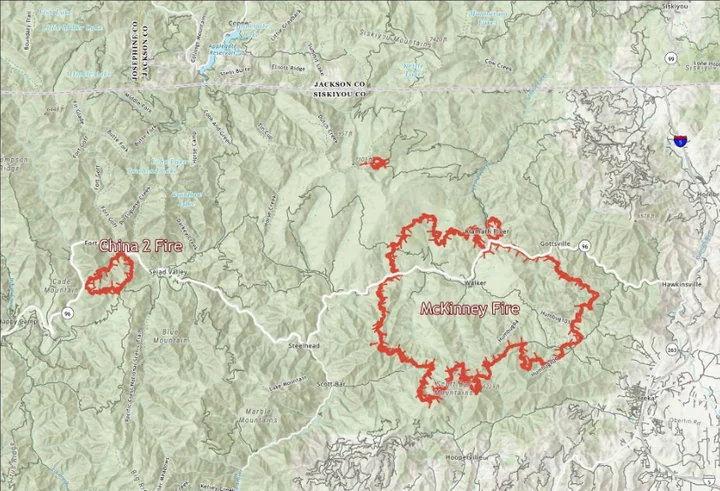
Latest McKinney Fire and Yeti Complex map. | InciWeb
Numerous evacuation orders and warnings remain in effect today. The latest evacuation information can be found on the Siskiyou County Sheriff’s Office and Siskiyou County Office of Emergency Services Facebook pages. A map of the evacuated zones is viewable on the website Zonehaven. A shelter for evacuees is set up at the Weed Community Center at 161 E. Lincoln Ave. in Weed.
Highway 96 remains closed between Scott River Road and Highway 263.
BOOKED
Today: 6 felonies, 12 misdemeanors, 0 infractions
JUDGED
Humboldt County Superior Court Calendar: Today
CHP REPORTS
Poppy Dr / Sherwood Rd (HM office): Closure of a Road
ELSEWHERE
County of Humboldt Meetings: CAT (Committee for Active Transportation) Meeting Agenda
Governor’s Office: California and the Australian state of Queensland ink new partnership to accelerate climate resilience, agricultural technology, and innovation
County of Humboldt Meetings: Human Rights Commission Agenda- Hybrid Meeting
Fishing the North Coast : Cool Water, Rain Spark Klamath Salmon Push
Food Hub Pilot Program to Enhance Access to Local Produce, Build Better Connections Between Farmers and Buyers
Isabella Vanderheiden / Tuesday, Aug. 2, 2022 @ 12:11 p.m. / Food

The food hub will make it easier for wholesale buyers to access delicious carrots like these! | Photos by the North Coast Growers’ Association
###
The COVID-19 pandemic has wreaked havoc on international trade networks, and it’s had an unprecedented impact on global food supply chain dynamics. It’s made it more difficult for rural communities like ours to access healthy and affordable food. The North Coast Growers’ Association (NCGA) is trying to enhance food access by establishing better connections between local farmers and buyers.
“One of the best things that COVID did for us was provide a shift to Zoom and the ability to have all of the players in one room and have conversations about food access,” Megan Kenney, NCGA’s director of cooperative distribution, told the Outpost in a recent interview. “We were all talking about these local issues as well as global trends with the food supply chain and the creation of a food hub seemed like a natural next step in addressing shortcomings in our infrastructure.”
The idea for a local food hub came about shortly after the NCGA initiated its Harvest Box program, which provides community members of all income levels with locally grown produce. The program’s success inspired local stakeholders to look for new ways to support local food producers and make it easier for farms and wholesale buyers to do business together.
“At the onset of the pandemic, the Humboldt Food Policy Council and UC Cooperative Extension had many phone conversations with local agencies and tribes that feed our community,” Dorina Espinoza, an advisor with the UC Cooperative Extension for Humboldt and Del Norte counties, told the Outpost. “What we learned added energy to what many people in our community have known for some time, we need a food hub to help fill a gap in and strengthen our food system here on the North Coast.”
The food hub will connect local food producers with restaurants and agencies that feed our community, such as Food for People and the Humboldt County Office of Education (HCOE).
“By connecting food producers with food businesses, food serving agencies, and consumers we can better match how much local food we produce with how much local food we consume, help expand local food sales and mitigate the risk a food producer would take by increasing food production,” Espinoza added.
Erin Derden-Little is the farm-to-school coordinator for the HCOE. Her job is to find local food to incorporate into high-quality meals for students.

Yum!
“Local sourcing is a challenge in our rural area, especially for our smaller, outlying districts,” Derden-Little wrote in an email to the Outpost. “It is financially infeasible for local farmers to drive long distances to deliver small volumes to individual sites. And of course, the few distributors that serve our schools do not carry local produce either. [We’ve] experimented with different ways to solve the local procurement puzzle. Our greatest success has come from taking a more active role in purchasing and distribution.”
Her team has essentially created a mini food hub for local schools by serving as the go-between for local farmers and school districts. The NCGA’s food hub will serve as a larger version of what HCOE has implemented in local schools for the past year, she said.
The food hub will also streamline the payment process between farmers and buyers. Currently, if a restaurant owner wants to order local produce, they have to contact their farmer each week to find out what is available, make the order and pay each invoice individually. This process can take a lot of time and energy, Kenney said, so only a handful of local chefs are able to source local produce this way.
“I used to work for Christine Silvers at the Humboldt Soup Company and every Saturday she walks around the Arcata Plaza farmer’s market and gets seasonal produce from local farms,” she said. “She has spent a really long time developing those relationships and figuring out who will have certain products at different points in the season and has been able to create almost all of her menus around a seasonal concept.”
On top of that, farmers do not necessarily operate on the same clock as the restaurants they serve. Several deliveries may come in shortly after opening whereas another might come in during the middle of a lunch rush.
“There are eight cars in the drive-thru, we’re going a mile a minute and a farmer will come in with, like, 10 cabbages. Someone will have to step off of the line to receive it and take the invoice,” Kenney said. “All of those invoices have to be entered into QuickBooks and paid individually. …A lot of business owners don’t have the flexibility in their schedule to do something like that.”
That’s where the food hub comes in. The NCGA plans to simplify the entire process by coordinating orders, deliveries and payments for each farm and wholesale buyer. This means both parties will have one point of contact, one delivery to make or receive and only one invoice to pay.
“Basically, they will be able to visit an online store where they can find out what is available from multiple farms,” Kenney said. “We would receive that order and once ordering closes for the week, we would let each farm how many cases of each item was ordered from them. At that point, the farmer writes one invoice to us that we pay instead of having them write 10 or 15 invoices. Then we would write one invoice to the recipient for exactly what they ordered so they don’t have to pay 10 or 15 invoices. They just pay the food hub.”
The food hub is currently in its pilot phase. One of the program’s participants, Nicholas Kohl, owner of the Oberon Grill in Eureka, said increased access to local food will give him the opportunity to tailor his menu to the local calendar.
“I am excited about the program because, from a restaurant owner’s point of view, it’s difficult to know what we’ll need from the market,” Kohl told the Outpost in a recent interview. “I can give them a wish list of what we’re looking for and they will get it for me. The NCGA has a much better idea of who has what and what can be utilized on a commercial scale. …If developing this relationship can help me get a better view of the growing cycles, I can have a locally sourced menu and be reliant on local farms rather than national and international producers. For me, that’s really important moving forward.”
The NCGA is currently looking for a brick-and-mortar location. Kenney said they have their eye on a space in Eureka that has a warehouse, a commercial kitchen and a retail space. Ideally, they would like to rent out the commercial kitchen to local producers.
“A lot of our farmers need a large kitchen to process all their pickles or their jam, things that need to be done in a commercial kitchen, but they don’t need access year-round,” she said. “If we are able to secure funding for this space, we would have commercial kitchen space and we would build out the rest with some dry storage and cold storage, and an area that could be a staging area for our Harvest Boxes as well.”
The NCGA is seeking $350,000 to launch operations. Kenney said they’ve has applied for several grants and is looking to launch a donation campaign to get things started. She anticipates $400,000 in gross income in the first year of operations. Within five years, she projects $1,400,000 in gross income, which will be reinvested in the local food system.
Kaiser Mental Health Workers Signal Open-Ended Strike in Northern California
Jocelyn Wiener / Tuesday, Aug. 2, 2022 @ 12:10 p.m. / Sacramento
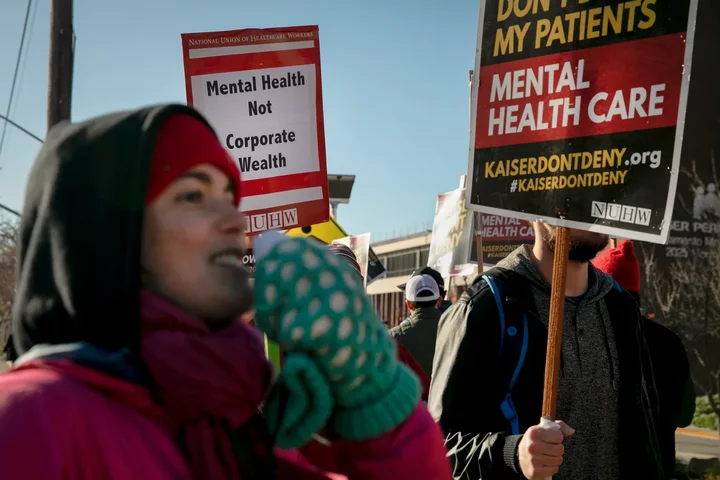
Mental health care workers picket outside of Sacramento Medical Center in protest of long wait times for patients and overwhelming caseloads at Kaiser Permanente facilities. Dec. 16, 2019. Photo by Anne Wernikoff for CalMatters
###
A union representing 2,000 Kaiser Northern California mental health workers this morning announced plans for an open-ended strike beginning Aug. 15.
Among the reasons union representatives outlined: high clinician workloads and patients waiting weeks or even months for mental health care. Even as demand for care has surged, frustrated therapists are abandoning the health giant, said union spokesperson Matt Artz.
“We don’t take striking lightly,” Sal Rosselli, president of the National Union of Healthcare Workers, which represents the clinicians, said in a prepared statement, “but it’s time to take a stand and make Kaiser spend some of its billions on mental health care.”
CalMatters has reached out to Kaiser for comment. In the past, the health plan has pointed to a shortage of clinicians as an ongoing challenge.
The company has drawn increased scrutiny from lawmakers for its mental health services in recent years. In May, the Department of Managed Health Care announced that it would be conducting a non-routine audit of Kaiser’s mental health services.
The union and Kaiser have one more bargaining session planned for Friday, Artz said. He said Kaiser Northern California’s mental health workers, including psychologists, social workers, therapists and addiction counselors, have gone on strike for short amounts of times six times in the past 4 years. This would be their first open-ended strike, which means the union is not establishing an end date.
Kaiser has 4.6 million enrollees in Northern California, Artz said, though that figure does not reflect how many currently access their mental health benefits.
In a letter sent Sunday to the Department of Managed Health Care, which regulates health plans, the union asked the department to ensure that Kaiser continues providing mental health care to patients during the strike, rather than canceling appointments.
Amanda Levy, deputy director for health policy and stakeholder relations for the Department of Managed Health Care, said the department is continuing to monitor access to services for patients impacted by the strike.
“The law requires health plans provide enrollees with medically necessary care within timely access and clinical standards at all times, which includes during an employee strike,” she said.
Despite growing efforts at the state level to enforce mental health parity laws, Kaiser mental health practitioners say they still struggle to provide adequate and timely care for patients.
Sarah Soroken, who has worked as a therapist at Kaiser Fairfield for six years, said access to treatment has worsened during her time there. She said the pandemic has aggravated the situation, with more patients seeking care, even as more therapists are leaving.
“Right now we’re at a crisis point,” she said. “Things are worse than ever.”
Kaiser is not the only provider facing a shortage of mental health practitioners. Complaints of shortages also have been raised by counties, school districts and non-profit organizations around the state. Artz said some Kaiser providers are being recruited to work at telehealth start-ups, where money is good and work-from-home options abound. Others are entering private practice.
“Right now we’re at a crisis point. Things are worse than ever.”
— Sarah Soroken, Kaiser Fairfield therapist
The union says the rate at which mental health clinicians are leaving Kaiser nearly doubled in the past year, with 668 clinicians leaving between June 2021 and May 2022, compared to 335 clinicians the previous year. In a union survey of 200 of those departing clinicians, 85 percent said they were leaving because their workload was unsustainable or they felt they did not have enough time to complete the work, and 76 percent said they were unable to “treat patients in line with standards of care and medical necessity.”
Some of these concerns are not new, although the pandemic has exacerbated them.
In 2013, the Department of Managed Health Care fined Kaiser $4 million for failure to provide adequate mental health treatment.
In a hearing this spring, lawmakers raised concerns about the state’s plans to move an additional 200,000 Medi-Cal members onto Kaiser, given problems with mental health treatment. Democratic Sen. Scott Wiener of San Francisco has introduced a bill to significantly increase fines for health plans that fail to comply with state laws.
Another bill of Wiener’s, SB 221, which took effect July 1, is intended to ensure patients don’t face long delays for follow-up treatment through commercial providers like Kaiser. Specifically, the new law, which was sponsored by the union, requires that patients receive follow-up mental health care within 10 business days unless a provider determines that a longer wait will not be detrimental to the patient.
At a virtual press conference in late June, Kaiser mental health practitioners said the health giant wasn’t close to meeting those requirements.
###
CalMatters.org is a nonprofit, nonpartisan media venture explaining California policies and politics.
Can Californians Afford Electric Cars? Wait Lists for Rebates Are Long and Some Programs Have Shut Down
Nadia Lopez / Tuesday, Aug. 2, 2022 @ 7 a.m. / Sacramento
Photo by CHUTTERSNAP on Unsplash
###
When Tulare resident Quentin Nelms heard California was offering a hefty state subsidy to help lower-income residents buy electric cars, he applied right away.
But it wasn’t as easy as he thought it would be.
Nelms spent four months on a waitlist before he was accepted into one of the state’s clean-car incentive programs in January. He qualified for $9,500 that he planned to use to buy a 2022 Ford Mustang Mach-E. But after discovering that several dealerships had raised the car’s price by more than $10,000 during the time it took to get the grant, he could no longer afford the roughly $53,000 cost.
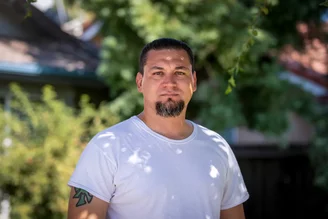
Quentin Nelms, who lives in Tulare, qualified for a state subsidy but the electric car’s cost rose too fast. Photo by Larry Valenzuela, CalMatters/CatchLight Local
“We got into this program and it’s not helping like it’s supposed to,” Nelms said. “It’s useless at this time because there’s nothing out there and the cars that you do find, everything’s gone up in price.”
Affordable and efficient electric vehicles are critical to California’s efforts to tackle climate change and clean up its polluted air — by 2035, the state plans to ban all new sales of gas-powered cars.
But the state’s incentives and rebates for lower-income people who purchase electric cars have suffered from inconsistent and inadequate funding.
This year’s funding for some of the programs ran out in April — the waitlists have been shut down because of the backlogs. And even for the rebates that are still available, the obstacles are substantial: Program administrators are inundated with requests for the money, resulting in months-long waits — at the same time that prices are surging and electric cars are in short supply.
The troubled state subsidy programs raise a crucial question: Can California enact a mandate that requires 100% of all new cars to be zero emissions when a large portion of the population can’t buy them?
If most Californians can’t afford to replace their old, higher-polluting gas-powered cars, many of Gov. Gavin Newsom’s climate goals are in jeopardy, along with statewide efforts to clean up the nation’s worst air pollution.
New electric cars range in price from $25,000 to $180,000. Many models, including Ford’s popular Mustang and F150 Lightning electric truck, are sold out, with long waiting lists.
“As California transitions to an electric future, these vehicle markups are definitely pricing our clients out,” said Maria Ruiz, a supervisor at the EV Equity Program, which was launched by a Central Valley coalition of clean-air advocacy organizations. “We’ve seen markups as high as $15,000. So that sadly has been a big challenge.”
So far, it’s unclear how successful the state’s subsidy programs have been in cutting greenhouse gases because the Air Resources Board has failed to adequately measure it, according to an audit by the state’s Legislative Analyst’s Office.
“As California transitions to an electric future, these vehicle markups are definitely pricing our clients out. We’ve seen markups as high as $15,000.”
— Maria Ruiz, the EV Equity Program
Since 2010, California has allocated more than $1.84 billion to a hodgepodge of three programs: the Clean Cars 4 All Program, the Clean Vehicle Rebate Project and the Clean Vehicle Assistance Program, according to Air Resources Board data. In exchange, over those 12 years, about half a million Californians have received grants or rebates for buying cleaner cars or replacing older cars.
The Clean Vehicle Rebate Project, which receives the bulk of the state’s funding, has distributed 478,364 rebates since its launch in 2010, while the Clean Vehicle Assistance program has assisted buyers in purchasing 4,438 clean vehicles since 2018. Clean Cars 4 All, which only serves residents in the state’s most polluted regions, has taken 12,800 pre-2007 model year cars off the road since its launch in 2015.
All of the programs, which award up to $7,000 or $9,500 toward the purchase of an electric car, have income limits. The rebate project is for residents with incomes up to $135,000. Clean Vehicle Assistance and most Clean Cars 4 All programs accept applications from residents with incomes at or below 400% of the federal poverty level — equivalent to $54,360 for an individual. (The U.S. Senate also appears poised to enact a $7,500 federal tax credit for individuals with incomes less than $150,000.)
“Before the pandemic and the rise in prices, we do have evidence that these (state) programs were sort of effective and encouraged people to buy electric vehicles,” said Erich Muehlegger, an associate professor of economics at University of California, Davis. “But the challenge right now is that these programs are facing really, really strong headwinds because of the high prices of electric vehicles.”
Muehlegger said supply chain delays and high demand have triggered a widespread shortage of new and used cars.
While pandemic-induced price hikes have hit both gas-powered and electric cars, he said the sticker shock is likely most extreme in the electric vehicle market due to higher demand and shortages of components, like microchips. Fewer electric cars are in supply, straining the market, creating long wait lists for new models and driving up prices for the new and used vehicles that remain on dealers’ lots.
“We have to make sure there’s a whole range of vehicles that are zero emission, and we’ve essentially got just a little over a decade to try to get there,” said Ethan Elkind, an attorney who directs the climate program at the Center for Law, Energy and the Environment at UC Berkeley Law.
The lack of inventory and high prices have forced some program participants like Nelms to give up the state money they qualified for. Nelms is no longer planning to buy a car anytime soon; he will keep using his 2016 Honda Civic for now — which means California lost the opportunity to replace a higher-polluting car with a zero-emission one.
Since 2010, California has allocated more than $1.84 billion to three programs. In exchange, about half a million Californians have received subsidies for cleaner cars.
“This program is what I was hoping to count on, but once all the prices were going up, that hope just kind of disappeared,” Nelms said. “Right now I’m not able to do anything, so I just had to let the grant go.”
In addition to the $9,500 in state money that would have gone to a dealer, Nelms knew he needed to scrape together other funds to afford the roughly $800 in monthly payments for a Mach-E. He was approved for a loan and planned on applying for another federal rebate program. His 20-year old son also picked up a part-time job to help with the payments.
But the dealership markups quickly changed Nelms’ mind. He didn’t want to risk having negative equity – when the amount of money owed on a car is more than the amount that it’s worth.
Though he had to forfeit the grant, he said he’d consider applying to the Clean Vehicle Assistance program again when the car market stabilizes.
For now, he said, he’ll have to pay high gas prices.
“Inflation, it’s never been this bad,” Nelms said. “There’s always things that happen in life that can hold you back, but that’s what growth is, having to work harder and push yourself and get through these tough things.”
Programs run out of funding
Following a 2020 executive order from Newsom, the Air Resources Board has drafted a proposed regulation that would phase out gas cars, beginning with 35% of 2026 models. The aim is to put 5 million zero-emission cars on California’s roads by 2030 and slash tailpipe emissions, California’s largest source of planet-warming pollutants.
But one of the biggest challenges with the transition to electrification is the financial obstacles faced by lower-income households.
The state’s programs designed to help them have been plagued with inconsistent and inadequate funding ever since they were launched years ago.
Most of the funding — $1.27 billion of the total $1.84 billion over the past decade — has come from the state’s cap-and-trade program, a market for buying and selling greenhouse gas credits that fluctuates in quarterly earnings. The rest is supplied in the state budget, which is approved by the Legislature and governor.
Lisa Macumber, an Air Resources Board official who oversees vehicle incentive programs, said insufficient funding has shut down the programs several times throughout the years. Some years, there are so many applicants that there’s barely enough money to keep the programs open for six months, let alone an entire year, she said.
While applications for the Clean Vehicle Rebate Project, the biggest of the programs, are still being accepted, the volumes are high and the delays substantial: People must wait on average more than two months to be notified if they’re selected or rejected, and then they must wait longer to receive the money.
Last fall and winter, it was even worse because of the pandemic. People were waiting an average of eight months before their requests were processed, Macumber said.
Another program, Clean Vehicle Assistance, closed in April because funds ran out; the waitlist is closed to new applicants due to backlogs. The San Joaquin Valley’s and San Diego’s Clean Cars 4 All programs also are shut down due to depleted funds, although those programs in the Los Angeles basin, Bay Area and Sacramento recently reopened for applications.
Macumber said more funding from a $10 billion zero-emission vehicle investment in the state budget is on the way, but it’s unclear when that money will come through.
“It’s a very challenging landscape,” Macumber said. “Our programs have to be able to adjust based on the funding we receive each year.” That leads to confusion for residents, she said.
Californians who need the funds the most — those with incomes below 225% of the federal poverty level — are not accessing the program as quickly as other income groups. (The federal poverty level is $13,590 for an individual.)
“Higher income groups were able to go through the process and purchase new zero emission vehicles faster, resulting in depleting funds quickly,” Macumber said. “The majority of very low-income consumers need help through the application process and need more time to find proper, mostly used, vehicles. By the time they’re at the point to purchase their vehicles, funds were not available.”
Efforts to streamline subsidies
Some lawmakers worry that these problems are standing in the way of making cars accessible to those who would benefit the most because they live in regions with some of the poorest air quality.
State Sen. Monique Limón, a Democrat from Santa Barbara, said a bureaucratic application process is creating obstacles for the state’s neediest residents.
This year, Limón introduced a bill, SB 1230, that would streamline the application process and expand Clean Cars 4 All to residents who don’t live in the participating regional air districts. An online portal would allow people to submit one application for all of the programs.
The bill will be heard by the Assembly Appropriations Committee on Aug. 3.
“Often people will have an urgent need for a new vehicle and it can take up to several weeks to months to get approved through some of these programs,” Limón said. “We are trying to speed up that application process. Getting more zero emission vehicles on the road will help us equitably reach our climate goals while also correcting systemic problems that have allowed communities of color to bear the brunt of the climate crisis.”
The air board also is working on combining the Clean Vehicle Assistance and Clean Cars 4 All programs and expanding them statewide to provide access to 4 million more residents in or near low-income communities outside of the regions that already participate.
Eligibility criteria also will change. They currently operate on a first-come, first-served basis for income-eligible residents in ZIP codes considered disadvantaged. The board plans to change to a “needs-based” approach that also prioritizes applicants who qualify for public assistance programs, such as Medicaid, Supplemental Security Income, CalWorks or Section 8 housing.
“There are so many low-income consumers that don’t reside in a disadvantaged community,” Turner said. “If you live in a disadvantaged community, you’re immediately prioritized. It’s also important to ensure that low-income consumers that reside right outside still have opportunities to access these funds.”
The statewide program will not replace the regional Clean Cars 4 All programs and instead work in tandem with them, Turner said.
“We know now that when you move really fast….there’s a lot of opportunity for people to slip through the cracks or for certain populations to get left behind.”
— Jessica James, General Motors
However, environmentalists and community grassroots organizations worry it could harm their efforts to assist people in disadvantaged areas and create more confusion.
“The number one priority for us is making sure that we’re not disrupting and not overriding the community partnerships that are currently in place,” said Chris Chavez, deputy policy director at the Coalition for Clean Air, an environmental advocacy group. “What we want to make sure is, as we’re expanding throughout the state, that we don’t lose sight and don’t lose focus on disadvantaged communities because those are the ones with the greatest burdens, the greatest vulnerabilities and greatest barriers to clean transportation.”
Chavez worries that the statewide program could “compete” with regional incentive programs. If that happens, he said the regional programs could potentially lose funding and no longer be able to operate in the areas that they’re currently serving.
Charging is a big obstacle, too
The lack of rebates and long waitlists aren’t the only obstacles in getting Californians to universally buy electric vehicles. For many, a lack of charging infrastructure in their homes and communities is a big hurdle.
Most public charging stations are clustered in urban, coastal areas. About 1.2 million chargers will be needed for the 8 million zero-emission cars expected by 2030. State data shows that currently there are only about 80,000 with another 123,000 on the way – falling far short.
Elkind, of UC Berkeley Law, said the lack of available charging stations is particularly tough for renters and people in rural areas.
“It’s a huge advantage to have an electric vehicle, especially with the rising gas prices,” he said. “It’s just a question of what public charging infrastructure is out there.”
Many renters don’t have a dedicated place to park their vehicle and plug it in, especially if they’re in an apartment building without a parking garage, Elkind said. He said more chargers at workplaces and more superchargers in communities could be a good alternative for people who lack home chargers.
Building more charging infrastructure in rural areas is especially important because residents tend to drive many more miles than people in suburban or urban areas. They need longer-range vehicles with powerful chargers.
Lack of inventory at dealerships
Jessica James, General Motors’ program manager of its climate equity fund, said the automaker has made it a priority to eliminate gas cars in the next decade, but acknowledged that the rapid move towards electrification could leave many vulnerable communities behind. Though General Motors is trying to expand its fleet of new vehicles, supply chain problems are making it difficult.
“We know now that when you move really fast — or take an entire industry and kind of rebuild it — that there’s a lot of opportunity for people to slip through the cracks or for certain populations to get left behind,” James said. “We’re doing everything we can to bring new EV products to market as fast as we possibly can, but those product development timelines are a little longer than we all wish they were.”
Tom Knox, executive director of Valley Clean Air Now, works with the region’s air district to help low-income and disadvantaged residents like Nelms apply for state rebates. Some nonprofit organizations are negotiating with dealers to lower used car prices for people who qualify for state incentives. But dealerships struggled during the pandemic and their supplies of electric cars are low.
“Solving the inventory problem is the single most valuable thing that could happen within the equity programs,” he said, adding that he’s optimistic that the market will improve in 12 to 18 months. “It’s starting to head in the right direction, but it’s still an enormous challenge for our customers.”
###
CalMatters.org is a nonprofit, nonpartisan media venture explaining California policies and politics.
OBITUARY: Jeri Lorraine Colby Garza, 1952-2022
LoCO Staff / Tuesday, Aug. 2, 2022 @ 6:56 a.m. / Obits
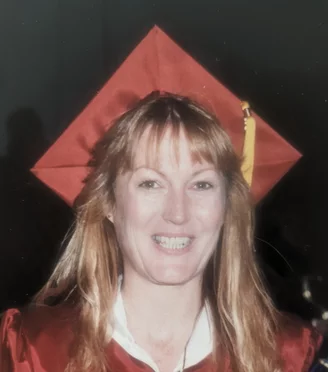
It is with great sadness that we announce the passing of our beloved Jeri Lorraine Colby Garza. Jeri was a wonderful daughter, sister, wife and mother.
She was a happy partner to Chuck Freeman for over 40 years. A proud grandmother and new great-grandmother, also a friend of so many people, she will be remembered and greatly missed.
Born to Gerald Arley and Sylvia Lorraine Colby on December 7, 1952 in Oxnard, Calif., Jeri made an impact from day one. Growing up in Southern California with three sisters, Jeri was an active child. Making friends and organizing the “front yard games,” Jeri attended Girl Scouts, ballet classes, guitar lessons (which she was very good at) and also loved fishing with Grandpa.
She will be remembered as an active member of Channel Islands High School, class of 1971 in Oxnard, Calif.
Jeri married Fred Garza and they had two sons, Jason and Christopher. The family moved to Hopkinsville, Kentucky, where Fred was in the U.S. Army, 101st Airborne Division, 1st Brigade.
After the marriage ended Jeri returned to Eureka to rejoin family. Rebuilding her life with her children, Jeri decided to follow the path into the nursing field. She was proud to continue a tradition started by a grandmother in the 1940s.
Jeri attended College of the Redwoods and raised her children as a single mother.
Jeri’s drive and passion for nursing never waned, earning her LVN, RN, RRN and Pediatric RN degrees. Starting at Sea View Convelescent Hospital, Jeri also worked at General Hospital, Mad River Community Hospital, General Hospital Acute Rehabilitation Facility and the Blood Bank.
Her time working at the General Hospital Acute Rehabilitation Facility with her friend Gay Waterman was one of the most rewarding experiences of her long career. Jeri took great pride in providing her patients with the absolutely best care and attention.
Jeri earned many pins of recognition and awards during her nursing career and proudly purchased a home in Eureka.
Some of her favorite passions were her growing family, gardening — her flowers! — cats and music.
Winning dozens of blue ribbons at the Humboldt County Fair for her floral and vegetable entries, one year entering and participating with her sister Ann, Jeri was especially thrilled with her five “Best of Show” ribbons in florals. Taking her young children to view the Kinetic Race in Ferndale was a family affair. Whether Jeri was fishing with Grandpa, winning turkeys and dining room sets on the radio or dancing in the living room to the “oldies,” she knew how to enjoy life.
Preceded in death by beloved grandparents Jesse and Edith Ebert, parents Gerald Arley Colby and Sylvia Lorraine Scott, and Fred Garza.
Jeri leaves behind her loved 40-year partner Chuck Freeman, who cared, loved and built a life with Jeri in Eureka. Also survived by sisters Lynn Niekrasz (spouse Michael Niekrasz), Ann Colby, and youngest sister Carol Colby; sons Jason Lee Garza (spouse Julie J. Garza) and Christopher Allen Garza; great-grandchildren Jason, Jacob, (mother Tracy M. Thrash) Cameron and Cyle (mother Julie J. Garza). Also Felicia Marie and Katelyn Rose Garza, mother Holly Ainsworth. Jeri just celebrated the birth of her first great-grandchild, Leo Garza.
Nephews and nieces include Joshua D. and Keith R. Mann, Jesse D. Alora and Rachael A. Ruud and Jerry L. Colby.
Very special lifelong friends include Laura Lee-Cessna-Redwine (the 5th Colby sister) and Debbie Knuppel (Hixson). Escapades ensued when these three were together, meeting in elementary school and maintaining a 6O-year friendship.
Also Gay Waterman, who met Jeri 42 years ago at “Basic Patient Care” class. Studying and working together in the Health Field was a shared and memorable experience.
Family and friends are welcome to share memories of a life well lived in honor of our dearly loved Jeri Lorraine Garza. A celebration of life will be held at the Eureka Elks Lodge, Herrick Ave, Eureka on September 22 from 2-4 p.m.
###
The obituary above was submitted by Jeri Garza’s loved ones. The Lost Coast Outpost runs obituaries of Humboldt County residents at no charge. See guidelines here. Email news@lostcoastoutpost.com.
Gov. Newsom Declares State of Emergency Over Monkeypox Outbreak
LoCO Staff / Monday, Aug. 1, 2022 @ 5:19 p.m. / Sacramento

Graphic: CDC.
From the office of Gov. Gavin Newsom:
As part of the state’s ongoing response to the monkeypox outbreak, Governor Gavin Newsom today declared a State of Emergency to bolster the state’s vaccination efforts. The proclamation supports the work underway by the California Department of Public Health and others in the administration to coordinate a whole-of-government response to monkeypox, seek additional vaccines and lead outreach and education efforts on accessing vaccines and treatment.
“California is working urgently across all levels of government to slow the spread of monkeypox, leveraging our robust testing, contact tracing and community partnerships strengthened during the pandemic to ensure that those most at risk are our focus for vaccines, treatment and outreach,” said Governor Newsom. “We’ll continue to work with the federal government to secure more vaccines, raise awareness about reducing risk, and stand with the LGBTQ community fighting stigmatization.”
To expand vaccination efforts, the proclamation enables Emergency Medical Services (EMS) personnel to administer monkeypox vaccines that are approved by the FDA, similar to the statutory authorization recently enacted for pharmacists to administer vaccines. The state’s response to monkeypox builds on the infrastructure developed during the COVID-19 pandemic to deploy vaccine clinics and ensure inclusive and targeted outreach in partnership with local and community-based organizations.
A copy of the emergency proclamation can be found here.
Last month, California public health leaders urged federal partners to make more vaccine doses available to the state as quickly as possible so that the state can expand eligibility to both confirmed and probable exposures, as well as to individuals who are at high-risk of contracting the virus. To date, the state has distributed more than 25,000 vaccine doses and will make additional allocations in the coming days and weeks. Los Angeles County has received a separate allocation of vaccine. In all, the state has received more than 61,000 doses. The state is also supporting overall vaccination efforts in collaboration with locals, including helping provide staffing and mobile clinics. The state allocates doses to local health departments based on a number of factors, including the number of reported monkeypox cases in an area and estimate of at-risk populations.
As of July 28, the state had expanded its testing capacity to process more than 1,000 tests a week. The state’s public health laboratory leaders have been working with local public health, academic, and commercial laboratories to ensure testing capacity is increasingly available and coordinated with the public health response. CDPH is also expanding treatment options. Access to the antiviral prescription drug tecovirimat (TPOXX) used to treat monkeypox is limited, but the treatment can now be administered at more than 30 facilities and providers across the state.
The state continues outreach and education efforts to inform Californians about monkeypox and ways to limit its spread. The state has hosted multiple webinars for local health departments, community-based organizations, and other health care providers and has attended various town halls and community meetings to speak with and hear from the public and local leaders. CDPH is also scheduling listening sessions with the LGBTQ community. CDPH is currently running paid ad campaigns on various digital media platforms to promote awareness and engage communities at higher risk of contracting monkeypox.
Redwood National Park Closes ‘Hyperion,’ World’s Tallest Tree, to the Public While Officials Determine How to Prevent Environmental Degradation in the Area
John Ross Ferrara / Monday, Aug. 1, 2022 @ 4:40 p.m. / Environment , Local Government
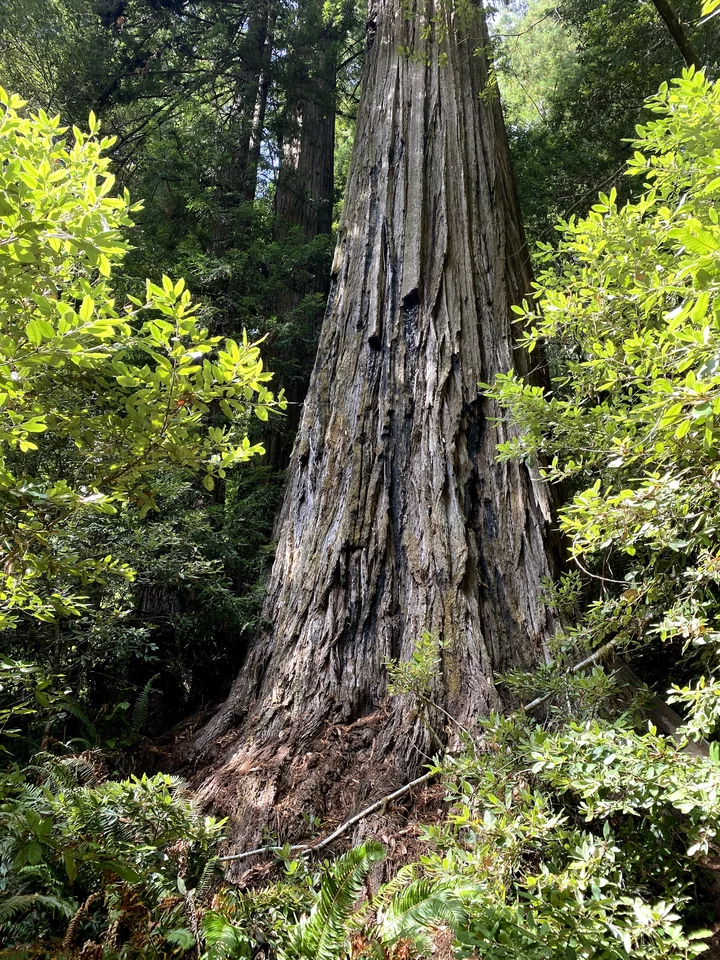
Hyperion as seen from the base of the tree. | Redwood National and State Parks
In order to preserve the not-so-well-kept secret location of “Hyperion,” the world’s tallest living tree, the National Park Service was discreet when it closed a general area of Redwood National and State Parks in March.
The decision went mostly unnoticed until Saturday, when SFGate reported that the closure was put in place to prohibit public access to the 380-foot tree in order to prevent further environmental degradation. Since then, the head of the park’s Natural Resources Management program, Leonel Arguello, has been fielding media questions from national news outlets like NPR, the New York Times, the LA Times and CNN.
The undeveloped region of the park, Arguello said, has seen an increasing number of visitors since Hyperion was confirmed to be the world’s tallest by Humboldt State University Professors Stephen Sillett and Kenneth L. Fisher in 2006. This resulting influx of people has caused unwanted environmental problems, including litter, human waste and reduced plant life caused by human footsteps.

“Visitors stepping on Hyperion has resulted in the degradation of the tree’s base,” the NPS states on its website. “The area around the tree no longer has ferns due to trampling.” | Photo by A. Gran
“In recent years, we’ve started to notice more degradation out there — people creating side trails, leaving human waste behind and garbage,” Arguello told the Outpost. “It’s disturbing and damaging to the resources. There are no trails. It’s a wildland setting. There’s no cell service. It’s really remote. If someone were injured, it would be a while before we could respond and extract them. Those factors really conspired in the park’s decision to enact a closure until we can figure out the best thing to do. Currently the closure is the best option.”
In addition to degrading the environment, the added trash could also affect the park’s newly re-introduced endangered condors.

Redwood National and State Parks’s four new condors. | U.S. Fish and Wildlife Service
“If they see something shiny, they may peck at it and take it back to the nest,” Arguello said. “A big problem with condors is that they eat a lot of microtrash. That’s a concern. It could be something down the road that becomes a problem as they begin to nest in our area.”
While some of these issues could be minimized by building an official trail to the tree, Arguello said that there are a number of issues to consider. For starters, the NPS would require additional funding to build and maintain the trail.
“It’s a pretty wild, un-mechanized portion of the park,” he said. “We are trying to minimize the number of trails we have. Building a trail to NPS standards is costly, and maintaining the trails requires a lot of continued effort.”
There’s also no way of knowing how long Hyperion will remain the tallest tree, or if visitors will still use the trail when the tree is ultimately surpassed.
“There could be another tree in the park or elsewhere in the redwood range that suprases the height of this tree for whatever reason,” Arguello said. “It could happen at any time. If history is any indication, [the record for the world’s tallest tree has changed] at least four times since 1963. There’s no reason to believe this tree will be the champion 20 years from now. We have to be careful not to make a rushed decision when building a new trail, but also want to protect our resources and visitors.”
The view of Hyperion, Arguello said, is also fairly unremarkable due to its relatively slim trunk and an obstructed view of its upper canopy from the tree’s base. Popular images of Hyperion towering above the redwood forest, he added, were likely taken by drones — an illegal activity without the proper permits — and don’t reflect the viewing experience had by hikers.
“The only time you can see it from a distance is on the trail to the Tall Trees Grove,” he said. “If you look across, you can see the top of the tree buried under a forest of old growth redwoods.”
To dissuade people from violating the closure, Redwood National and State Parks is adding signs to nearby trails, and has put out a frightening statement on its website, warning that trespassers could receive $5,000 fines and six months in jail. While these penalties are examples of the most extreme outcomes, Arguello said that park employees are keeping an eye on the area, and that trespassers will be cited and asked to leave. Physical signs will also be added to nearby trails in the coming months to keep people away.
As long as there is no designated trail in the area, Arguello said that potential Hyperion-seekers are better off enjoying the park’s many other existing trails instead.
“We have lots of trails for people to go see,” he said. “There’s Tall Tree Grove, Ladybird Johnson Grove, Trillium Falls, Lost Man Creek Trail, Grove of the Titans. These are amazing trails that are all spectacular in their own way. Going to this one tree that’s off the beaten path is dangerous and impacts the forest. We want visitors to stay safe and enjoy park for its purpose of preserving old-growth redwoods.”


