

Arson Deemed Possible as Second Wildfire Sparks in Downtown Hoopa in Three Days; Hoopa Valley Temperatures Expected to Hit 106 Today
John Ross Ferrara / Thursday, July 28, 2022 @ 12:25 p.m. / Fire
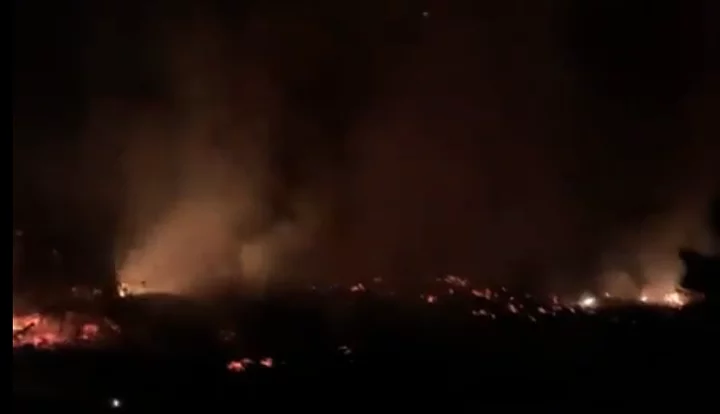
Hoopa’s latest wildfire was brought under control this morning. | Still from Hoopa Fire Department and Office of Emergency Services Facebook video.
PREVIOUSLY: (VIDEO) Two Fires Illegally Ignited Hours Apart In Hoopa, Hawkins Bar; Authorities Investigating
###
A new wildfire less than an acre in size is under control in Hoopa after firefighters responded to a reported vegetation fire near the Hoopa Valley Food Distribution building along Highway 96 at 1:15 a.m. today.
Hoopa Fire Chief Greg Moon told the Outpost that arson is a possible cause, as the fire started approximately 100 yards away from a previous vegetation fire that was extinguished on Monday morning.
Moon confirmed that arson is suspected to be the cause of Monday’s fire, and said that there is no possibility that embers from Monday’s fire ignited the new fire today.
“This is unacceptable,” Moon said. “We’re going to catch the people who are doing this. We’re going to prosecute them.”
A third wildfire was also brought under control in Hawkins Bar just after midnight on Monday. However, this fire is believed to have been caused by an illegal burn pile, and has no suspected connection to the recent fires in Hoopa.
No evacuation orders are in place as a result of these fires.
The National Weather Service forecasts that temperatures will hit 106 degrees in Hoopa this afternoon. Tomorrow is expected to be even hotter, with a high of 107.
Temperatures will dip back into the high 90s over the weekend, when scattered thunderstorms will be possible across Trinity County.
“Hot conditions will persist across the interior through the end of the work week,” the NWS forecast states. “Persistent marine clouds and fog will keep coastal areas seasonably mild, with at least some afternoon sunshine. There may be a few thunderstorms over northern Trinity County each afternoon through the weekend.”
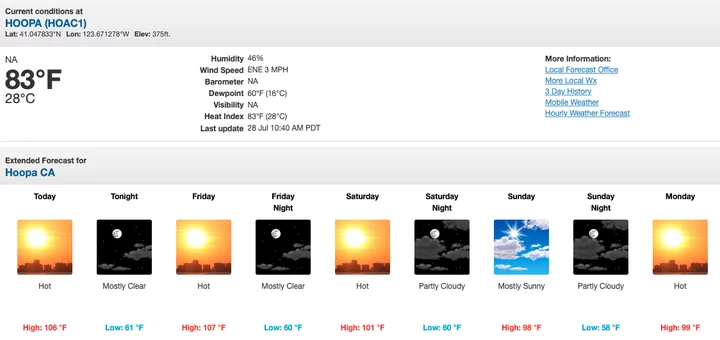
Hoopa 7-day forecast. | NWS
BOOKED
Today: 6 felonies, 12 misdemeanors, 0 infractions
JUDGED
Humboldt County Superior Court Calendar: Today
CHP REPORTS
Poppy Dr / Sherwood Rd (HM office): Closure of a Road
ELSEWHERE
County of Humboldt Meetings: CAT (Committee for Active Transportation) Meeting Agenda
Governor’s Office: California and the Australian state of Queensland ink new partnership to accelerate climate resilience, agricultural technology, and innovation
County of Humboldt Meetings: Human Rights Commission Agenda- Hybrid Meeting
Fishing the North Coast : Cool Water, Rain Spark Klamath Salmon Push
Eureka’s Revamped Police Oversight Board Reviews Bylaws, Staffing Levels at EPD, Newly Approved City-Owned Security Camera Policy
Isabella Vanderheiden / Thursday, July 28, 2022 @ 11:15 a.m. / Local Government , Public Safety
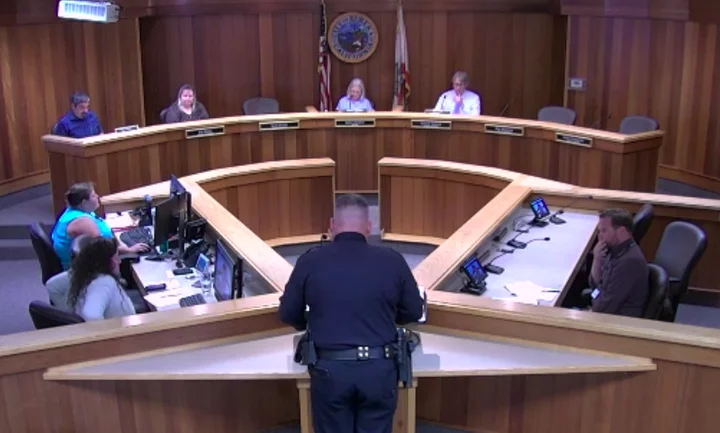
Screenshot of Tuesday’s Citizen Oversight of Police Practices board meeting.
###
Does Eureka have enough cops?
Not at all, according to information presented at the City of Eureka’s Citizen Oversight of Police Practices (COPP) board, which convened for its second quarterly meeting on Tuesday afternoon to discuss staffing and recruitment efforts at the Eureka Police Department.
Also discussed at the meeting of the city’s new police watchdog: How its members will be notified in the event an officer employs lethal force and what its role will be when that inevitably happens, and what is the city going to be doing with the security camera footage it will soon be collecting?
The COPP was formed earlier this year in response to the City Council’s request to beef up the Eureka Police Chief’s Citizen Advisory Board and enhance transparency and accountability within the department in the wake of the texting scandal. The City also hired Los Angeles-based consulting firm OIR Group to serve as the City’s Independent Police Auditor (IPA) and act as a conduit between the board and the department.
Police shootings and oversight
While reviewing the board’s draft bylaws during this week’s meeting, board member Mark Pardoe asked Michael Gennaco, founding principal of OIR Group, how he plans to communicate with the board in the event of a critical incident, such as an officer-involved shooting. Gennaco said his team would spring into action as soon as they became aware of the incident and would immediately notify the COPP board via text message.
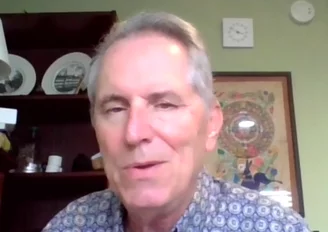
Gennaco | Screenshot
“For example, in Anaheim, we are immediately notified of an in-custody death, officer-involved shooting or another critical incident, and then we work with the officer and the city manager to provide some preliminary information to the community-based review board about what has occurred,” he said. “We want you all to be informed of what is happening in your city regarding police involvement in a critical incident.”
OIR Group would continue to keep the board informed throughout the internal investigation process, but Gennaco emphasized that “these investigations are not completed overnight.”
“There are a lot of reasons for that,” he said. “…For example, if it’s an officer-involved shooting and it’s a fatality, the autopsy report that’s conducted, the toxicological report that’s conducted by the coroner’s office, all that information needs to be gathered by the detectives who are conducting the investigation. Eventually, that investigation is submitted to the district attorney for review and then there’s an internal review that’s conducted by [EPD] with regard to adherence to policy.”
Board Chair Melinda Ciarabellini asked whether any information would be made available to the public during the investigation process. It depends on the nature of the investigation, Gennaco said, but the matter would probably be taken up with the COPP board before any information went out to the public.
“That could vary and could depend a lot on what the initial information is, but there is certainly the ability to have special [or closed session] meetings, although I’m not sure that will be necessary in every case,” he added.
Following a brief exchange on the public notification process, the board unanimously agreed to adopt the draft bylaws in a 5-0 vote.
Staffing woes
Standing in for interim Police Chief Todd Jarvis, EPD Captain Brian Stephens provided the board with an update on staffing and recruitment efforts at the department. While staffing has improved over the last few months, nine of the 47 positions allotted under the 2022-23 budget year – minus the position of chief – remain vacant, he said.
“Of those positions, we have 32 working officers that are solo officers in the field or detectives. That breaks down to 22 sergeants and officers covering patrol, one of whom is currently on light duty,” he said. “In our detective bureau, [there is] one acting captain, one [Community Services and Engagement Team] sergeant [and] a waterfront ranger position that is funded by Measure Z.”
Stephens added that an officer position on the Mobile Intervention & Services Team (MIST), which is also funded by Measure Z, is in the process of being filled. There are also three police academy graduates going through EPD’s field training program who are expected to go solo by the end of October. Another three recruits are expected to graduate from the basic police academy in December. They could be solo officers on the street by next spring, he said.
There are three vacant positions in dispatch, one vacancy in community services and two vacancies in the records section. Both of the department’s animal control control officer positions are vacant as well, putting “quite a strain” on both the community and patrol officers.
“[There is] some good news,” Stephens said. “We purchased a new, dual purpose K9 that will go to Officer Jeremy Sollom. …His training will be completed by the first week of October and the dog has been named Yeti. …We’re currently fundraising for a second K9 that we hope to purchase in January. Our total goal would be to have…three patrol K9s and then we have a specialized narcotics, weapons and ammunition canine that does detection of those items.”
City Manager Miles Slattery jumped in to shed “a little positive light” on the City’s recruitment and retainment efforts. “A few months ago we were at about 13 officers down and we were looking at approximately two or three officers looking to go to another agency,” he said. “We worked really hard together as a team to retain and try to prevent people from leaving. …We’ve always had issues with maintaining staffing levels at EPD. We’re moving in the right direction.”
Gennaco added that police departments across the country have battled staffing shortages over the last few years.
“There are a lot of reasons for that,” he said. “The murder of George Floyd, subsequent protests and the defund policing movement. …The increased attention to policing has certainly created some pressure points with regard to those who are in the profession or those who may have otherwise wanted to get into the profession.”
Gennaco added that traditional incentives and long-term benefits offered to police officers aren’t as attractive to young people as they were in the past.
“[They’re] thinking, ‘I’m gonna try this for three or four years then I’m gonna try something else.’ They’re not interested in getting locked into a position and getting stuck,” he said. “That sort of runs contrary to the incentives that are traditionally provided police officers, which is the generous retirement and other other benefits that they accrue at the end of the career.”
The board accepted the staffing report but did not take a vote on the matter.
Those security cameras
The board also discussed the City’s new security camera use policy. The policy, which seeks to define the ways in which City-owned security cameras can be used, was adopted by the City Council earlier this month.
If you recall, the policy proposal came about after City staff erected an unsightly surveillance pole, popularly known as a “Lot Cop,” directly in front of Eureka’s Old Town gazebo without the council’s knowledge or approval. After a day of public outcry, staff agreed to move the pole behind the gazebo.
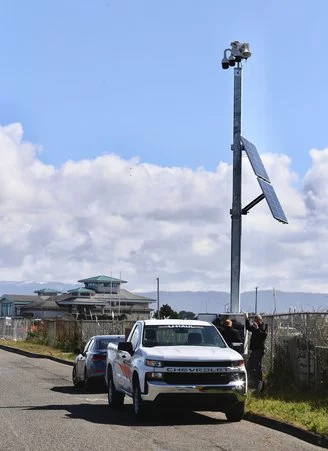
Mobile Lot Cop parked near the Wharfinger Building. | Photo: Andrew Goff
Before the thwarted attempt to install the security device at the Old Town gazebo, City staff parked mobile Lot Cops at various problem locations around town – near the Wharfinger Building and the Carter House, on Fifth Street downtown, along the Hikshari Trail corridor and elsewhere, and it proved successful in combating crime and undesirable behavior around town.
“Because of some of the staffing issues that we were seeing at EPD, we were looking at alternative ways to reduce calls for service and address problem areas,” Slattery explained told the board. “…We saw really good results [during our six month trial] with the mobile Lot Cops, especially in some of our problem areas, as well as some private locations that were having issues with vandalism and break ins.”
One of the main concerns brought up during the public process was the issue of constant surveillance, Slattery explained. He emphasized that the cameras will not be monitored 24/7, but will be used “for security purposes and oversight purposes to follow up on vandalism and crime” and could actually “exonerate people.”
Pardoe asked how much the Lot Cops would cost the City annually. The one-time cost for the polls and associated equipment was $20,000, Slattery said. The annual cost to keep the devices up and running is about $60,000.
Pardoe also asked who would have access to the security camera footage.
“It’ll be a limited number of folks that are designated by the city manager to view it,” Slattery said. “It won’t be open to all staff in any way, shape or form. There may be some exceptions but, for the most part, it will be the Public Works director, the EPD Community Services Director, and the police chief and captain.”
The board agreed to accept the report after a few additional questions but did not take a vote on the matter.
A recording of the meeting can be found here.
WATER SMASH: Southbound Highway 101 All Screwed Up at the Entrance to Eureka
LoCO Staff / Thursday, July 28, 2022 @ 9:27 a.m. / Traffic
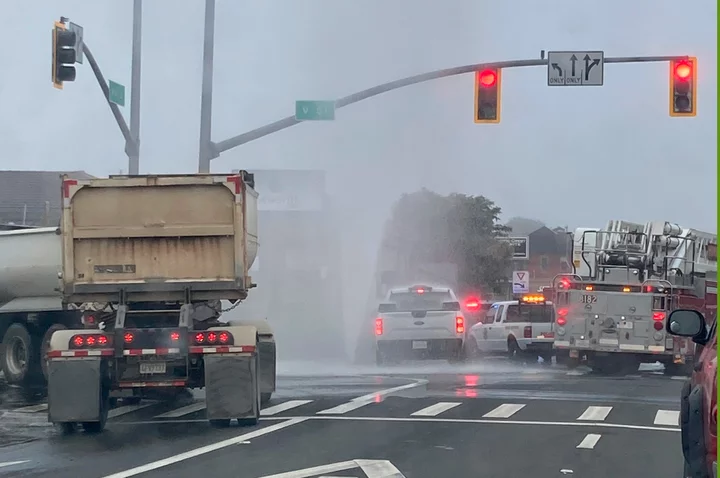
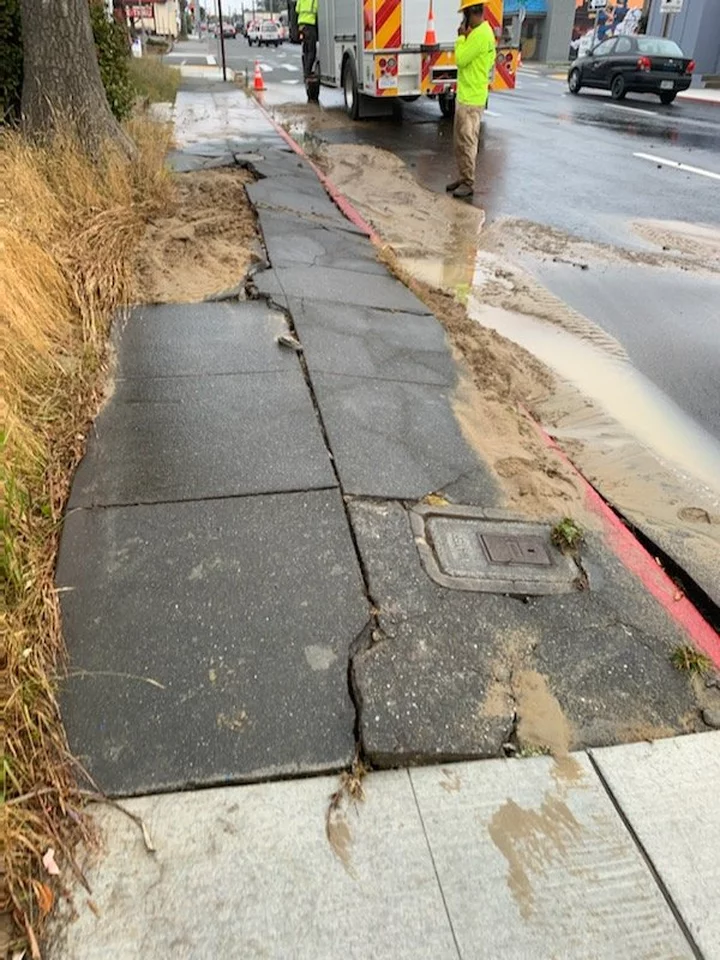
The car crash briefly occasioned a road geyser. Reader-submitted photo.
A car crash on the Highway 101 corridor near the east end of Eureka this morning has snarled up traffic and smashed the roadway something good this morning.
Andrew Goff, at the scene, says Fourth Street — that’s southbound 101 — is down to one lane, as of this writing. Fifth Street — northbound 101 — is unimpaired. You’ll want to avoid the area, if possible. That might mean heading down the peninsula if you’re coming from Arcata.
Here’s what Caltrans had to say about it on its Facebook page earlier this mogning.
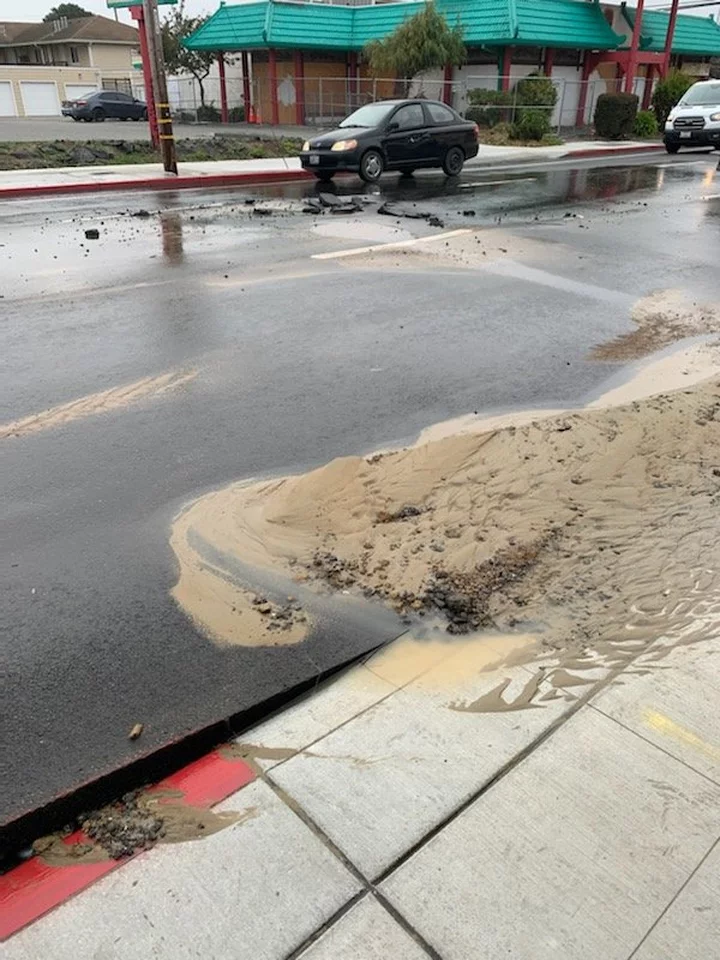
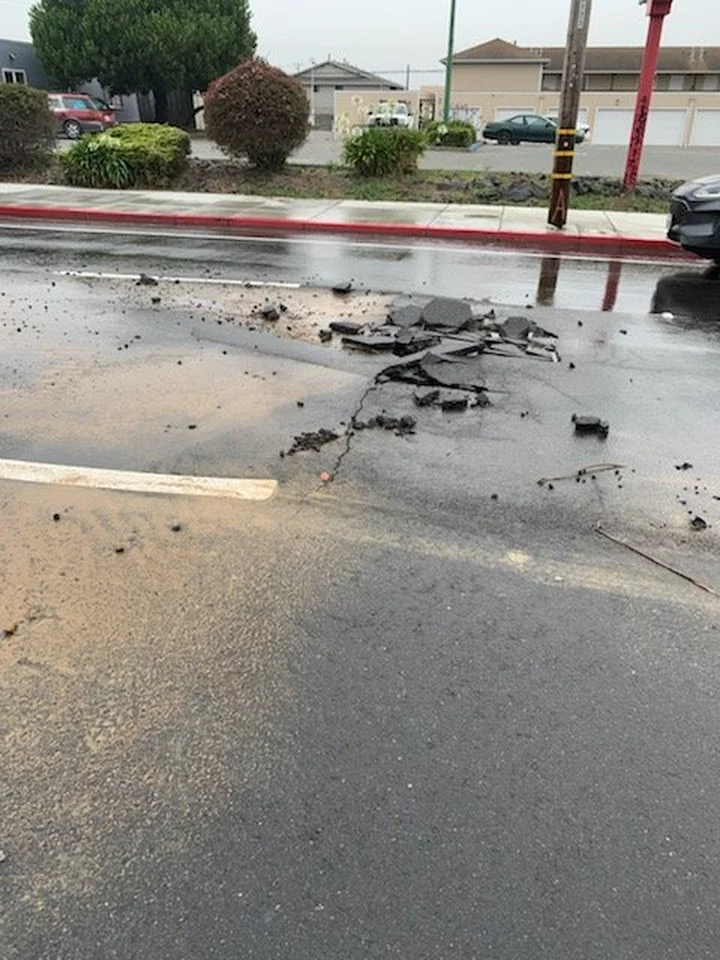
Heads up! There’s been a collision in Eureka on U.S. 101. Traffic is impacted at (Fourth Street) between T and S Streets. A fire hydrant was hit and the roadway suffered damage. Please expect slowdowns and find an alternate route around. We’ll update this post when things are cleared up.
Photos below from Caltrans social media earlier this morning:
Is It Too Easy for Write-In Candidates in California Elections?
Sameea Kamal / Thursday, July 28, 2022 @ 7:14 a.m. / Sacramento
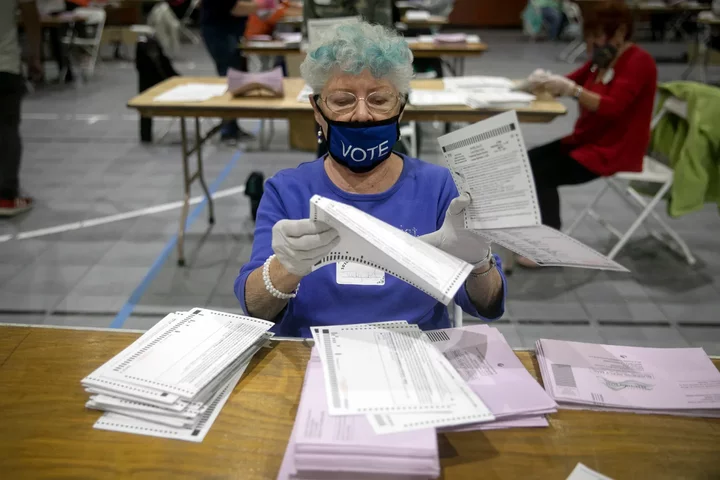
Elections volunteer Judy Moon extracts ballots from mail-in envelopes in Martinez on Oct. 31, 2020. Photo by Anne Wernikoff for CalMatters.
Rich Kinney readily concedes: Making it onto California’s November election ballot is a miracle.
The 66-year-old associate pastor and former mayor of San Pablo in the Bay Area is running to unseat Democratic Assemblymember Buffy Wicks out of staunch opposition to her support for abortion rights.
What did it take for him to make the Nov. 8 ballot? Only about 60 signatures to qualify as a Republican write-in candidate for the June 7 primary, and a mere 37 votes to finish in the top two.
Wicks won 85,180.
Kinney, the only other official candidate in the Assembly District 14 primary, said the write-in process allows newcomers a chance to move forward without the challenges of fundraising against an incumbent.
“Going around my district and trying to get funding was ridiculous. No one wants to give funding to a campaign that’s not going to get out the gate,” he told CalMatters.
While some candidates might spend millions of dollars or months campaigning, California’s top-two primary system means that in races with only one other candidate, it’s possible for a write-in candidate to sneak into second place with very little support.
For the June 7 primary, state Assembly and state Senate candidates needed as few as 40 people to sign nomination papers to qualify as write-in candidates. And no matter how few votes they won, as long as they finished in second, they advanced to the November election.
This year, Kinney wasn’t the only one to win fewer than 50 votes and make it onto the ballot. Thomas Edward Nichols, a Libertarian running against Republican incumbent Jim Patterson of Fresno in Assembly District 8, made it with just 15 votes. Mindy Pechenuk, a Republican in Assembly District 18, advanced to a matchup with Oakland Democrat Mia Bonta with just 31.
In total, nine write-in candidates moved on to the general election in state Assembly races, and two for state Senate seats.
But while getting onto the ballot is one feat, winning the race is another. It’s a reality that Kinney acknowledges.
“I really understand that it’s next to impossible to be able to unseat a sitting Democrat in the Legislature,” said Kinney, who ran unsuccessfully for state Assembly in 2014 and for state Senate in 2016. “But we’ve got to put up a good fight anyway. It’s important that voters who care about the decency of life have an opportunity to rally together and say so.”
Christian Grose, academic director of the USC Schwarzenegger Institute for State and Global Policy, said while it’s a quirk of the election system that write-in candidates can make it to the ballot with so little support, it’s not necessarily a problem caused by the top-two primary system or by the write-in process.
“It’s the lack of serious competition from formal Republican and Libertarian candidates,” he said. “Basically, it’s the lack of organized challengers that’s the problem.”
Because of the write-ins, only two candidates for 100 legislative seats have a free pass on the Nov. 8 ballot: Republican Assemblymember Vince Fong of Bakersfield and Democratic Assemblymember Reggie Jones-Sawyer of Los Angeles. (Democrat Giselle Hale, mayor of Redwood City, withdrew last week for the open Assembly District 21 seat in Silicon Valley, but her name will still appear on the ballot with Diane Papan, a San Mateo City Council member and now the only active candidate.)
Fair or futile?
The write-in process was established in California in 1911 as part of the Progressive Era political reforms, according to Alex Vassar, communications manager at the California State Library.
Prior to that, political parties would hand out “tickets” to voters — essentially filled-out ballots.
“One of the major goals was to empower individual voters and weaken the ‘political machines,’ and give voters the ability to make separate decisions in each election contest. California adopted what was called ‘the Australian ballot,’ which was essentially the modern secret ballot that we know and love today,” Vassar said.
Only a handful of write-in candidates have won either legislative or congressional seats in the last century. Vassar said it was “beyond rare” — in 1930, 1936, 1944, 1958 and 1982.
When U.S. Rep. C. F. Curry died in office in October 1930, his son, C. F. Curry Jr., won the seat the next month as a write-in, defeating a Republican, a Democrat, and two independents. When Assemblymember Lee Bashore died in September 1944, he had already won both the Republican and Democratic nominations. Three write-in candidates ran, and Ernest R. Geddes was elected with 45.9% of the vote, according to Vassar.
“It lets people onto the playing field, but not onto one of the teams,” said Thad Kousser, a professor of political science at the University of California, San Diego. “It allows candidates entry, but then places a mountain to climb still for write-in candidates.”
Even if the write-in candidates are political unknowns, it creates more competition for the general election, Grose said.
“It’s probably a nuisance for these incumbents who will probably win,” he said. “They’re going to do a little more work, and that’s not so bad.”
In an April meeting of the Santa Monica Democratic Club, state Sen. Ben Allen acknowledged that to keep his seat, he had to beat a write-in candidate — Kristina Irwin.
“She seems like a very nice person who watches way too much Fox News, and she’s just kind of, like, adopted all the crazy Republican conspiracy theories,” Allen said at the event, according to the Santa Monica Daily Press. He added that being pushed to campaign more aggressively would be a good thing.
Irwin won 6,260 votes in the primary — far more than the 213 earned by another write-in candidate in that race, but 159,000 votes fewer than Allen.
In Orange County, write-in candidate Leon Sit, a 19-year-old engineering student at UCLA, advanced to the general election with 551 votes from Orange and San Bernardino counties.
That result “reinforces that the voice of each and every voter matters, that every vote counts,” Orange County Registrar of Voters Bob Page said in an email. From an election operations standpoint, Page said the write-in process does not create any additional work or challenges.
Sen. Ben Allen has taken at least $583,000 from the Finance, Insurance & Real Estate sector since he was elected to the legislature. That represents 14% of his total campaign contributions.
Sit said he used social media to gather support, and was also interviewed by local reporters, which increased his name recognition.
Still, he said, “statistically the political winds are not in the favor of a challenger like me.” And if he somehow beats Republican Phillip Chen, he might have to cut back on his course load or even take a break from school.
“I didn’t come into this to be a legislator,” Sit said. “I did it to give the district a choice between two candidates, even if one of those candidates was a 19-year-old college student.”
Nichols, who is up against Patterson, won a spot on the November ballot with even fewer votes, just 15. Like Sit, he knows unseating the incumbent is a long shot.
Patterson has been in the Legislature since 2012, The district, which encompasses the Central Valley and parts of the Sierra Nevada, is largely Republican.
Still, Nichols said he was motivated to run to get the Libertarian Party’s message before voters and to raise the issues he sees in his local community, especially the increased cost of living due to fire threats – specifically, homeowner and property insurance.
Nichols says he’s glad the write-in process exists — and that it could give voters a way to think “outside of the duopoly that dominates our political culture.”“I’ve got to say, I really appreciate the fact that an engineer up here in the foothills could wind up on the ballot going after an incumbent,” he said. “I’m satisfied with the democratic process in that respect.”
###
CalMatters.org is a nonprofit, nonpartisan media venture explaining California policies and politics.
COVID Outbreak Hits Humboldt County Planning and Building Department
Ryan Burns / Wednesday, July 27, 2022 @ 4:07 p.m. / COVID-19 and Humboldt
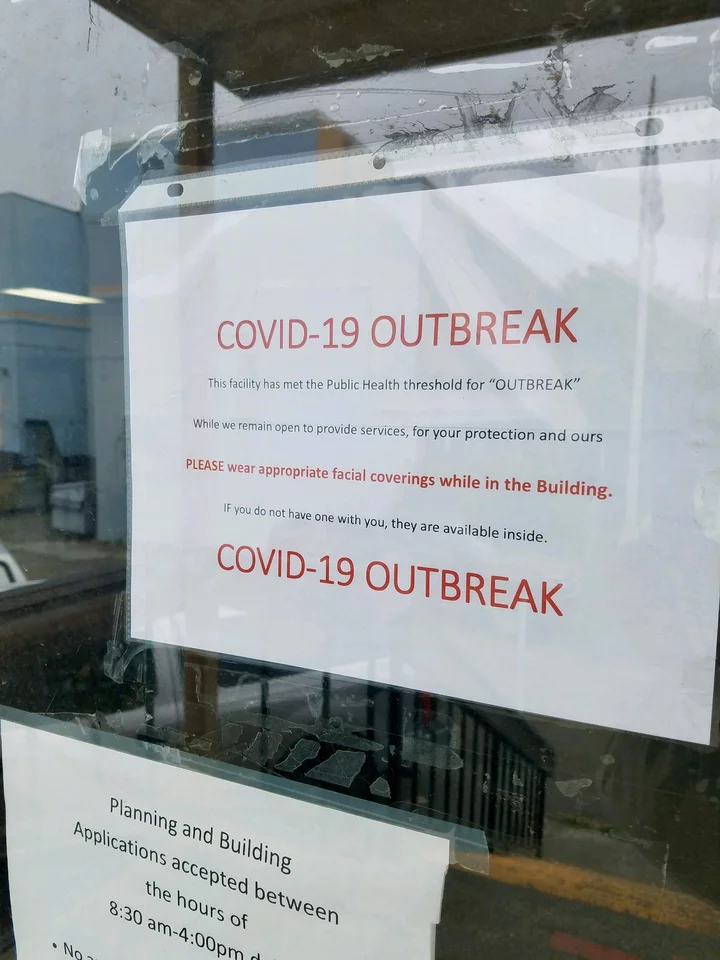
A sign posted in the window to the entrance of the Humboldt County Planning and Building Department. | Submitted
###
The Humboldt County Planning and Building Department is in the midst of a COVID-19 outbreak that has lasted nearly five weeks.
The office at 3015 H Street in Eureka remains open, though a sign posted on the door warns members of the public in bright red letters that the facility has met the Public Health branch’s threshold for an outbreak.
In accordance with Cal/OSHA guidelines, COVID-19 outbreaks are declared when a cluster of employees tests positive within a 14-day period, said Cati Gallardo, a public information specialist with the county. An employee in the department, who asked to remain anonymous, said the outbreak was declared on June 23 and extended after yet more employees tested positive.
In order for the outbreak to be declared over, the department must go 14 days without any additional positive diagnoses, according to Gallardo, who said that a dozen Planning and Building workers have tested positive since the fourth week of June.
As protective measures, employees have been masking and practicing physical distancing, and the department has had both routine and targeted cleanings, Gallardo said.
“Employees have been directed to stay home if they aren’t feeling well,” she added. “Employees are also being informed of positive cases and being provided with free COVID-19 testing and instructions on how to self-monitor for symptoms. Staff has been provided with information on what employee benefits are available to them should they test positive.”
The sign on the front door asks members of the public to wear “appropriate facial coverings when entering the building,” with a note that masks are available inside. But Gallardo said masking remains optional for the general public.
While the number of PCR tests being administered countywide has dropped significantly in recent months, the percent testing positive has skyrocketed since the beginning of April, according to information on the county’s COVID dashboard.
The anonymous Planning and Building employee said the earliest date that the outbreak can now be declared over is a week from today, August 3. [UPDATE: After three more positive tests, including one just this morning, that date has been moved back to August 10, the employee says.]
Return of the Sea Otters? Fish & Wildlife Study Finds Reintroduction of the Species Is Feasible on West Coast
LoCO Staff / Wednesday, July 27, 2022 @ 1:08 p.m. / Wildlife

Southern sea otter settling in for a nap. | Lilian Carswell/USFWS
###
Press release from the U.S. Fish & Wildlife Service:
Under a directive from Congress, the U.S. Fish and Wildlife Service evaluated the feasibility of reintroducing sea otters to their historical range along the West Coast of the contiguous United States. The Service focused the assessment on northern California and Oregon, where potential sea otter reintroduction would have the greatest conservation value.
The Service’s assessment indicates reintroduction is feasible, but it does not provide a recommendation as to whether sea otter reintroduction should take place. Additional information and stakeholder input would be needed to help inform any future reintroduction proposal if the initiative moves forward.
Sea otters once lived across the north Pacific Rim from the northern islands of Japan to Baja California. By 1911, this heavily hunted species was nearly extinct and survived in only a few small disjunct populations. After slow population recovery and past reintroduction efforts, sea otters now again inhabit portions of their historical range. However, sea otters remain absent from the contiguous Pacific Coast, with the exception of central California, one island in southern California, and the northern coast of Washington. Sea otters in California are listed as threatened under the Endangered Species Act.
As a keystone species, sea otters play a fundamental role in the ecological health of nearshore ecosystems. Sea otters eat sea urchins and other marine grazers, which helps keep kelp forests and seagrass beds in balance. Their presence in the ocean enhances biodiversity, increases carbon sequestration by kelp and seagrass, and makes the ecosystem more resilient to the effects of climate change. Additionally, reintroduction could increase the genetic diversity of recovering sea otter populations and contribute to the conservation of the threatened southern sea otter.
“If sea otters are reintroduced to northern California and Oregon, it would benefit both otters and the nearshore marine ecosystem,” said Craig Rowland, acting state supervisor for the Service’s Oregon office. “Additional work is needed to evaluate the possible impacts of a potential reintroduction as well as measures to offset these impacts. While we anticipate an overall socioeconomic benefit to coastal communities, we also recognize that some local shellfish fisheries could be affected.”
In the consideration of sea otter reintroduction, the Service’s assessment recommends stakeholder engagement in the identification of potential reintroduction sites and small-scale experimental reintroductions as next steps. If there is a move to formally propose the reintroduction of sea otters, the Service would initiate a public review process under the National Environmental Policy Act.
The Elakha Alliance, an Oregon nonprofit group, separately evaluated the feasibility of bringing sea otters back to the Oregon Coast. The Service partly funded this study. The feasibility assessment by the Service is intended to be read as a companion to the Elakha Alliance study, but it expands the geographic area under consideration in response to the request from Congress.
For more information and a copy of our report, please visit: https://www.fws.gov/project/sea-otter-feasibility-assessment###
The mission of the U.S. Fish and Wildlife Service is working with others to conserve, protect, and enhance fish, wildlife, plants, and their habitats for the continuing benefit of the American people. For more information on our work and the people who make it happen, visit www.fws.gov. Connect with our Facebook page at www.facebook.com/usfws, follow our tweets at www.twitter.com/usfwshq , our YouTube Channel at http://www.youtube.com/usfws and download photos from our Flickr page at http://www.flickr.com/photos/usfwshq

A female adult sea otter carries her pup in the water. | Lilian Carswell/USFWS
Delta Tunnel: Salmon at Risk From Massive Water Project, State Report Says
Rachel Becker / Wednesday, July 27, 2022 @ 12:15 p.m. / Sacramento
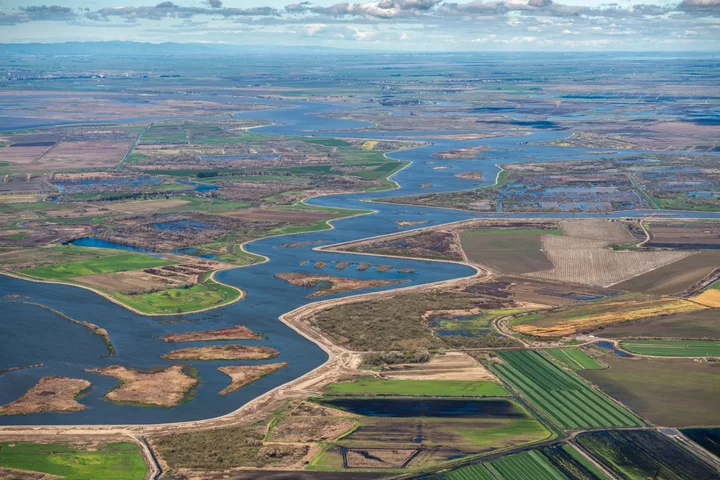
An aerial view of the Middle River in the Sacramento-San Joaquin River Delta on Mar. 8, 2019. Photo by Ken James, California Department of Water Resources.
###
California’s water agency today released a long-awaited environmental report outlining the details and impacts of a controversial proposal to replumb the Sacramento-San Joaquin Delta and pump more water south.
In the report, state officials said the tunnel project could harm endangered and threatened species, including the Delta smelt, winter-run chinook salmon and steelhead trout. To offset the “potentially significant impacts” on the rare fish, the Department of Water Resources says thousands of acres of other wetlands would have to be restored — which critics say is a slow and inefficient way to provide new habitat.
The draft environmental impact report is a major step in planning a tunnel that would fundamentally reshape California’s massive water management system.
The report outlines the proposed path of a 45-mile tunnel that would pipe water from the Sacramento River, bypassing the Delta, and funnel it into Bethany Reservoir, the “first stop” on a state aqueduct that funnels water south.
The goal of the project, which has been planned in various forms since the 1960s, is to shore up water supplies against environmental catastrophes such as earthquakes and the weather whiplash and sea level rise of climate change, according to California Natural Resources Secretary Wade Crowfoot.
Water agencies that can eventually sign on to receive the tunnel project’s water stretch from the Bay Area and Central Coast to the Central Valley and Southern California.
“It is a conundrum to be able to manage the Delta in a way that protects the environment, respects the communities that live there, and provides for the water supplies of a large portion of the state,” Crowfoot said.
The state’s companion explainer for the report, also released today, says changes in flow at and downstream of the tunnel’s intakes “have the potential to decrease migration rates, alter migration routing, reduce availability of rearing habitat, and increase exposure to predation for winter-run Chinook salmon, Central Valley spring-run Chinook salmon, and Central Valley steelhead.”
“It is a conundrum to be able to manage the Delta in a way that protects the environment, respects the communities… and provides for the water supplies of a large portion of the state.”
— California Resources Secretary Wade Crowfoot
Carrie Buckman, environmental program manager for the state’s Delta Conveyance Office, said the department’s analysis found that 4% fewer juvenile winter-run chinook would survive during their peak times in the Delta in below-normal water years.
The summary also notes “potentially significant impacts to delta smelt and longfin smelt” because changes in Delta flow “could affect the species directly or indirectly through changes in factors such as food availability.”
Environmentalists said the project would endanger salmon and other fish that already are in poor shape.
“We know that the status quo is really bad for fish and wildlife, but their own (environmental impact) document shows that the Delta tunnel will make things even worse,” said Doug Obegi, senior attorney at the Natural Resources Defense Council. “You could have a delta tunnel that was environmentally protective, at least in theory, but none of the ones that were proposed or analyzed in here even seem to pass that basic test.”
Buckman said approximately 1,500-3,500 acres of wetlands would be restored to offset the environmental damage.
“The restored habitat would be designed to look and function like tidal wetland habitats currently in the Delta, such as those on Liberty Island,” she said in an email. She added that habitat restoration deadlines will be tied to the project schedule and include provisions requiring restoration ahead of the impacts.
Water experts and environmentalists question, however, whether restoring other wetlands would protect salmon and other fish.
“The state has a bad track record of getting habitat mitigation completed,” said Greg Gartrell, a consultant and retired water manager from the Contra Costa Water District. “They’re very slow, and they’re very meticulous. But they get in their own way.”
A priority of Gov. Gavin Newsom, the effort has also drawn opposition from environmental groups and Delta residents, who worry that drawing freshwater away from the Delta coupled with years of construction will leave the region salty, stagnant and barren.
“I fear that the Delta would eventually just become basically ghost towns,” Kathy Bunton, a Delta resident who owns Delta Kayak Adventures, told CalMatters last month. “It’s just heartbreaking.”
The 3,000 page draft lays out the potential operations of the tunnel routes and their environmental consequences. Alternate routes that were also considered would connect to an existing pumping plant in the south Delta.
“This project is critical to ensuring Californians have access to high-quality, affordable and reliable water supplies amidst the growing impacts of climate change,” Jennifer Pierre, general manager of the State Water Contractors, an association of public water agencies, said in a statement.
The draft “clearly shows that the project has been downsized, refined and redesigned to avoid and reduce local impacts and address environmental concerns,” she said.
The long-awaited tunnel project has been at this point before: Another environmental impact report was finalized in 2016. Yet that project, a pair of tunnels, stumbled because of the high costs and eventually died when Newsom withdrew the administration’s support.
Among other impacts of the tunnel are the removal of 71 structures, including 15 residences; the conversion of more than 2,300 acres of farmland considered to be of “statewide importance”; disruption to cultural and historic sites and resources; and construction noise.
Planning, building tunnel could take until 2040
The price tag hasn’t yet been updated but the cost would be in the billions. In 2020, one of the alternate paths was estimated to cost just under $16 billion. The state plans to issue bonds to fund the final design and construction process. Water agencies receiving the water will be required to pay the state back.
Plans to replumb the Delta have been decades in the making, changing shape over time from a canal to twin tunnels to, eventually, a single tunnel that Newsom promoted when he took office.
If eventually approved, the project would take decades more to complete. Californians will have 90 days to comment on the draft environmental impact report, one of the first steps in a permitting process that could last years. Construction, which is not expected to start before 2028, could take another 12 to 13 years to complete.
Crowfoot said the state is moving as quickly as it can. But he said the state must be cautious because it’s likely it will face lawsuits.
“The governor is committed to getting this project essentially in a place where it’s getting built by the end of this administration,” Crowfoot said. “It’s got any number of potential environmental litigants. We have to do what’s required under the law.”
The State Water Project supplies 27 million people and 750,000 acres of farmland — transporting water through the Delta south with pumps so powerful, they can make rivers run backward.
“This project is critical to ensuring Californians have access to high-quality, affordable and reliable water supplies amidst…climate change.”
— Jennifer Pierre, general manager of the State Water Contractors
Piping water from north of the Delta during wet spells while continuing to pump from the south would allow state water managers to send 540,000 more acre-feet of water south during an average year, or 316,000 in a dry year, compared to existing conditions, according to the documents released today. It’s enough water to supply between 1.1 and 1.9 million households for a year.
Buckman stressed that these numbers are under 2020 conditions, and “do not capture anticipated supply shortages” in the future, when supplies are expected to decline because of climate change and sea level rise.
This year, due to prolonged drought, water providers relying on the State Water Project are receiving 5% of their total 4.1 million acre-foot allocation — less than 220,000 acre-feet.
“With significant water shortages on the horizon, it is mind boggling that the Delta Conveyance Project is the first priority of the Department of Water Resources and the Newsom administration,” Barbara Barrigan-Parrilla, executive director of the advocacy group Restore the Delta.
The analysis also “identified the potential for small increase in salinity in the western Delta,” Buckman said in an email, that “would not exceed water quality objectives.”
Gartrell expects more disputes over the potential risks and benefits of the proposal to play out now that the report’s been released — a continuation of what he has called “the epicenter of the California water wars for almost 60 years.”
“It’s something that a lot of people will dig into and give them things to argue about,” he said. “As if they needed it.”
###
CalMatters.org is a nonprofit, nonpartisan media venture explaining California policies and politics.


