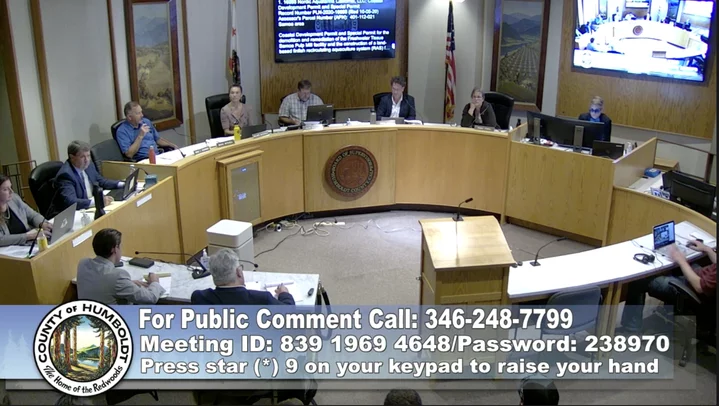
The Humboldt County Planning Commission last night heard a series of informational reports followed by nearly two hours’ worth of public comment, which didn’t leave the deliberative body any time to deliberate and vote on the $650 million land-based fish farm that’s been proposed for the Samoa Peninsula. Thus, the hearing to consider certifying the project’s Environmental Impact Report (EIR) and the approving two key permits was continued to next week’s meeting on Thursday, Aug. 4.
As a quick refresher, Norway-based Nordic Aquafarms has proposed a major development that would include the demolition and remediation of the long-defunct Samoa Pulp Mill facility followed by two-phase construction of a 766,530-square-foot recirculating aquaculture system (RAS) facility, which would produce up to 27,000 pounds metric tons of Atlantic salmon per year for distribution across the West Coast.
Thursday’s hearing began with a lengthy informational report led by the assigned county planner, Cade McNamara, and Byron Turner, a senior planner with LACO Associates, who helped prepare the environmental document. The pair outlined the project details and offered an overview of the various permitting agencies that musts sign off on various aspects of the endeavor. (See yesterday’s post and its links to previous Outpost coverage for more details.)
McNamara noted that Nordic’s project would be located on a high-priority site, a brownfield zoned for coastal-dependent industrial activity, and the company plans to conduct further abatement and cleanup before starting construction.
He then ran through a series of “master responses” to some of the 242 comments the county received about the project’s Environmental Impact Report. That collection of comments included 12 from local, state and federal agencies, 19 from non-governmental organizations and 79 from individuals, plus 132 letters of support.
Some of the major areas of concern include greenhouse gas emissions, the discharge of treated effluent from an existing mile-and-a-half-long outfall pipe, impacts to Humboldt Bay from water intake infrastructure and the carbon footprint of the project’s fish feed.
McNamara and Turner explained the analysis and mitigation measures that allowed the county to conclude that this project will have no significant environmental impacts.
A few Planning Commissioners had questions. Peggy O’Neill asked about earthquake safety for employees, for example, and Planning and Building Director John Ford explained that a large recirculating aquaculture system (RAS) building onsite has been designed as a refuge that can withstand a once-in-2,500-years seismic event.
Fellow commissioner Noah Levy asked about checkpoints between the first and second phases of construction and was assured that there are some. And Commissioner Melanie McCavour grilled Nordic staff about measures that will be taken to prevent the proliferation of naturally occurring estrogen from the fish feed into the ocean and bay.
Levy applauded Nordic staff, saying, “They have worked really hard to create a project that would set a new standard, in a lot of ways.” He also observed that the county has put “a lot of robust conditions” on it, adding, “I just see our job up here as trying to make sure those conditions are adequate, within the bounds of what’s feasible, to make this the best project it can be.”
In a separate presentation, Humboldt Bay Harbor, Recreation and Conservation District Executive Director Larry Oetker described Nordic’s plans as an ideal fit for the coastal dependent former mill property owned by the Harbor District, and he raved about Humboldt Bay’s valuable infrastructure assets, including its ample supply of both fresh and saltwater, its underutilized industrial properties and its ocean outfall pipe.
“We were able to work and attract Nordic Aquafarms to come here because they recognize that this is the premier site on the entire west coast of the United States for aquaculture operations,” Oetker said. “I do not say that lightly. The infrastructure that you are evaluating here is the dream of almost any coastal community that you see.”
Brenda Chandler, Nordic’s interim CEO, gave her own presentation, saying company heard the public feedback and has “gone above and beyond, in some cases, and tried where we can to include your requests in our commitments to you where feasible.”
She cited the company’s commitment to using 100 percent renewable and non-carbon energy as an example and said, “We want to be the employer in the neighborhood [that] everyone is proud of.” The company expects to hire an estimated 150 full-time employees, not counting construction jobs, Chandler said.
“Our team hopes you agree that Nordic Aquafarms is the best fit for Humboldt County, from our strong foundation to our commitment to sustainable, balanced environmental and social values and delivery of fresh, sustainably produced food to the west,” she concluded.
The earliest batch of public comments was dominated by members of the Operating Engineers Local 3 union, who showed up to the meeting in force to advocate for the project, saying it would create much-needed living-wage jobs and allow them to show their kids something they’re proud to have helped build.
“Nordic has come in and gone above and beyond … ,” said union member Harry Herkert. “They’re taking a dilapidated, contaminated pulp mill and they’re going to turn it into a viable industry.”
He added that he’s not Nordic’s target market, since he goes out and catches his own salmon in the ocean, but he believes the company has done its due dilligence and will be a good neighbor for years to come.
“And it’s good to see that we’re attracting that kind of industry,” he continued. “We need it. The port’s falling apart. We need sustainable industry. We need jobs back, and they’re gonna supply 300 construction jobs — living-wage jobs — and then, going forward, 150 full-time jobs that are also going to be [paying] living, sustainable wages. … So I implore you, please pass this project. Do it tonight. Let’s get the ball rolling.”
Others voiced support, too. Colby Smart, assistant superintendent at the Humboldt County Office of Education, said county schools have a number of aquaponics programs that are languishing “in their infancy” because students don’t see a lot of career opportunities. “This changes that,” Smart said.
“This project represents a critical piece in that school-to-career pipeline, and I really, really endorse it,” he added.
Rafael Cuevas-Uribe, a fisheries biology professor and aquaculture expert at Cal Poly Humboldt, said he’d examined the plans for the project and was impressed by its state-of-the-art technology, including an advanced fine-mesh filtration system for effluent.
“I’ve never seen a recirculating system with this type of cutting-edge technology,” Cuevas-Uribe said. He noted the vast deficit between the amount of fish consumed in the United States and the amount produced and said the aquaculture industry has struggled because it’s been defined by its critics rather than its proponents. He included himself in the latter category and encouraged the county to approve the project.
John Friedenbach, general manager of the Humboldt Bay Municipal Water District, reminded folks that the district’s “abundant” water, sourced from the Mad River, used to provide65 million gallons per day to the two pulp mills that operated on the peninsula for decades. Nordic, by comparison, needs less than three million gallons per day, less than five percent of that previous demand. He too urged the Planning Commission to approve the project.
But plenty of people offered criticism and opposition, too, and as the public comment shifted from in-person to call-in, the balance gradually shifted toward members of local environmental groups who advocated either additional conditions of approval or outright denial of the project.
Several people said the fish farm’s saltwater intake infrastructure should be located offshore, rather than in the bay. Others faulted the Environmental Impact Report for making assumptions in its modeling and omitting analysis of key project components, such as the greenhouse gas impacts of its fish feed and egg supplies.
Eight separate members of the climate action group 350 Humboldt took a turn speaking, each voicing concerns about the project’s carbon dioxide emissions and the impacts on climate change.
“If this project goes forward, I would ask that you require a performance bond from Nordic in the amount of $500 million to protect Humboldt County taxpayers,” 350 Humboldt member Laura Simpson said.
Jessie Misha, chair of the Surfrider Foundation’s Humboldt County chapter, said permit conditions need to be improved to ensure minimal climate impacts. She said the county should require Nordic to transition to zero-emission electric trucks and require fish feed with a low carbon footprint, re-evaluated annually.
Caroline Griffith, executive director of the Northcoast Environmental Center, voiced appreciation for Nordic leadership’s accessibility to this point, but she added that the project is “really massive” and said her organization has some serious concerns.
The main one is the ocean discharge, and Griffith said the county should amend the conditions of approval to requiring monitoring the effluent as soon as it begins. It’s important to ensure, before phase two construction begins, that this discharge is not affecting biological resources or contributing to harmful algal blooms, she said.
Griffith also voiced concerns about emissions from transportation and fish feed as well as the sheer size of the proposed factory.
“The scale of the project is really concerning,” Griffith said. “And we suggest starting with a smaller project, or that the planning commission consider issuing a [coastal development permit] that expires within a set amount of time, maybe five or 10 years.”
Jennifer Kalt, executive director of Humboldt Baykeeper, echoed that last point, saying that if Nordic was willing to start with a smaller project and meet “clear benchmarks” before scaling up, it would “go a long way” toward addressing her organization’s various concerns.
Eventually, the list of public speakers reached it end, and while some members of the Planning Commission expressed interest in moving on to deliberations and possibly a decision, others spoke in favor of waiting until next week to wrap things up. Commissioner Brian Mitchell, for example, noted that he was calling in to the meeting from the East Coast, where it was well after midnight.
And so, with a motion, a second and unanimous approval, the Planning Commission agreed to come back next Thursday to consider everything its members have seen and heard thus far.
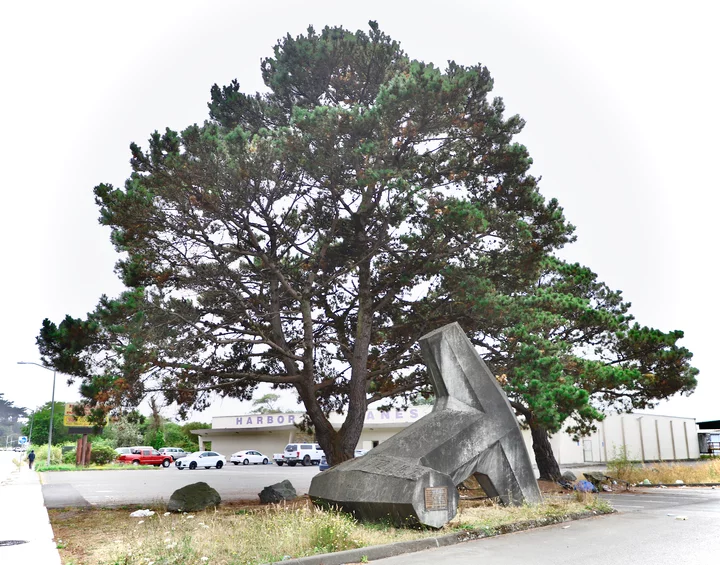
This dolos has to be moved from its Broadway home, but where should it go? | Photos by Andrew Goff
###
A group of Humboldt Bay history-loving folks are trying their darndest to save the Broadway dolos from demolition. If the City of Eureka does not approve a financially viable plan to relocate the iconic hunk of concrete in the next two weeks, the dolos will be destroyed.
(To be clear, we’re only talking about one dolos. The plural version is “Dolosse.” They are those gigantic wave-dissipating concrete structures piled out on the jetty.)
The effort to relocate the beloved dolos from its existing location at the former Chamber of Commerce site came about last week after the Eureka City Council voted 3-1, with Councilmember Kati Moulton dissenting and Councilmember Kim Bergel absent, to move forward with the demolition of the dolos to make way for a new hotel.
Can’t the City just move the dolos somewhere else, you ask?
Yes, but it’s really, really expensive. Moving the 42-ton dolos to Coast Guard Park at the intersection of Broadway, Fairfield and Del Norte streets, as staff previously suggested, would set the City back at least $50,000 and involve large equipment and significant traffic control measures along U.S. Highway 101. In contrast, demolition and debris removal costs would run closer to $10,000.
The City is working with Leroy Zerlang, chair of the Humboldt Harbor Safety Committee, and several local business owners to find a cheaper method of moving the dolos.
“North Coast Fabricators has a 110-ton crane that could pick the dolos up and Figas Construction and a couple of other companies might have a lowboy available that could move it,” Zerlang told the Outpost in a recent interview. “Now, I’m not saying that these guys would do it for nothing, but it will be far from $50,000. …A lot of people will be very upset if it is destroyed. It’s historic.”
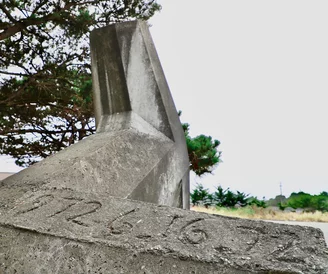
The dolos was donated to the City in 1972 by the U.S. Army Corps of Engineers during the reconstruction of the Humboldt Bay jetties, according to the Oct. 18, 1972 edition of the Times-Standard.
Dolos no. 1,972
The 1,972nd dolos produced by the Umpqua River Navigation Company and donated by the U. S. Army Corps of Engineers, found a safe and sound display on the Eureka Chamber of Commerce parking space on Broadway, Tuesday. The huge concrete form, weighing 42 tons, is usually used in jetty construction on Humboldt Bay. The chamber requested one for display purposes, and the heavy jack-like dolos was brought from the North Jetty across Samoa Bridge, down Fourth Street to its Broadway location.
The single dolos on Broadway is representative of the entirety of Humboldt Bay, Zerlang said. “Without the dolos, we wouldn’t have an entrance bar. We wouldn’t have commercial fishing. We wouldn’t have sports fishing. We wouldn’t have ship traffic. We wouldn’t have any of that. That’s how important these [dolosse] are.”
There are a few possible locations up for consideration: Coast Guard Park (as previously mentioned), Madaket Plaza, the site of the Wharfinger Building or somewhere on Woodley Island.
“We’re trying to finalize a new location but we need to make sure that the foundation can accommodate the weight of the dolos,” City Manager Miles Slattery told the Outpost this morning. “It’s likely to go somewhere near the Wharfinger or somewhere down on Madaket Plaza, but we need to finalize a location and then have the engineer make sure it will be viable in that location.”
Slattery emphasized that there is “no time” to return to the city council with a new proposal, so the City is counting on folks like Zerlang to find a cheaper way to move the dolos.
“We need to match the cost of demolition. That is the direction that was provided by the council,” he said. “…We are not going anywhere near $50,000. [The cost to relocate] needs to be somewhere in the vicinity of what it costs to demolish. It can change by 10 percent or something like that, but it sure as heck is not going to double or triple.”
Councilmember Kim Bergel said she would be in favor of moving the dolos to Madaket Plaza where it could be displayed for tourists and community members alike.
“I mean, it could sit at Coast Guard Plaza with a plaque, but who’s gonna stop and read that?” she said in recent interview with the Outpost. “Whereas when you’re out on Madaket or down in Old Town you’re more likely to stop by and look at it. We’re just looking at whatever we can do to maintain this piece of history and to move forward in a way that gives people the opportunity for people to learn about it.”
Councilmember Natalie Arroyo agreed and said she will keep working with Zerlang and Operating Engineers Local Union No. 3 to find a new home for the dolos. “…Ultimately I just want to be sure that this cool piece of history is saved,” she said. “…Given my love of Humboldt Bay and our maritime sector, this has a special place in my heart!”
What do you think the dolos should go? Take the LoCO poll here!
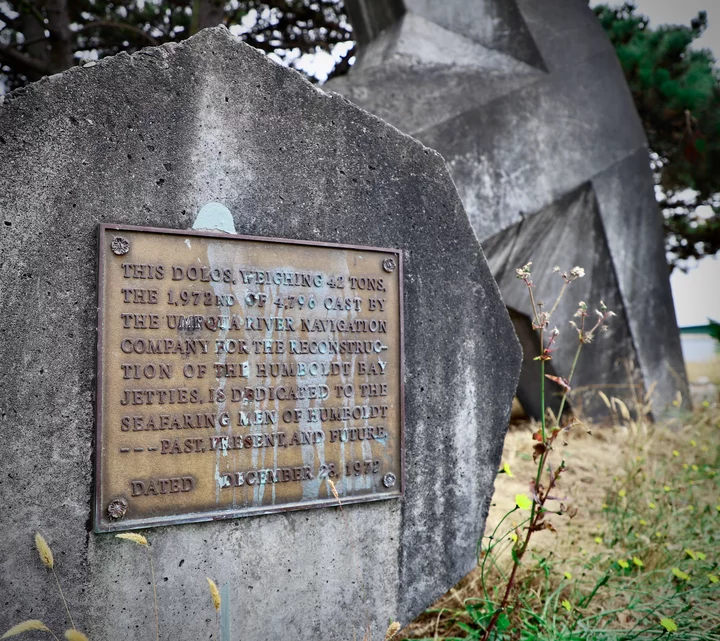
“This dolos, weighing 42 tons, the 1,972nd of 4,796 cast by the Umpqua River Navigation Company for the reconstruction of the Humboldt Bay Jetties, is dedicated to the seafaring men of Humboldt — past, present, and future.”
Press release from the Humboldt County Sheriff’s Office:
On July 28, 2022, at about 2:52 p.m., Humboldt County Sheriff’s deputies were dispatched to a Hoopa residence for the report of a domestic violence victim with serious injuries.
Deputies arrived at the residence and located an adult female victim. The victim was transported to a local hospital for treatment of her injuries. Through their investigation, deputies determined the suspect to be 21-year-old Nicoma Redman Sanderson. Sanderson was located and taken into custody at a residence on Hospital Road in Hoopa.
Sanderson was booked into the Humboldt County Correctional Facility on charges of assault with a deadly weapon other than a firearm (PC 245(a)(1)), battery with serious bodily injury (PC 243(d)) and inflicting corporal injury (PC 273.5(a)).
In the United States, more than 10 million adults experience domestic violence annually. Domestic violence is prevalent in every community, and affects all people regardless of age, socioeconomic status, sexual orientation, gender, race, religion, or nationality. Physical violence is often accompanied by emotionally abusive and controlling behavior as part of a much larger, systematic pattern of dominance and control. Domestic violence can result in physical injury, psychological trauma, and even death.
If you or a loved one is experiencing domestic violence or abuse, there are resources available to help. To speak with an advocate or be connected with services, contact the Humboldt Domestic Violence Services 24/7 Support Line at (707) 443-6042 or the National Domestic Violence Hotline at (800) 799-7233. If you are experiencing a life-threatening emergency, call or text 9-1-1.
Jack R. Thompson passed away at the age of 84 years old on July 20, 2022 in his home surrounded by his loving family. Jack passed away shortly after being diagnosed with pancreatic cancer. He fought hard until the end listening to the hymn, Standing on The Promises of God. Which is how he lived his life.
Jack was born on May 31, 1938, in Ogallala, Nebraska. He was the second of five children born to Herbert and Mary Virginia Thompson. He was raised on an active cattle ranch in Arthur, Nebraska. On November 5, 1960, at the age of 22, Jack married his devoted and loving wife, Mary Ann McMurtry in Ogallala, Nebraska. To this union was born three daughters: Pamela, Lisa, and Sheila. Jack was a patriot of his country. Amidst the Cuban Missile Crisis, Jack joined the National Guard, where he served for 8 years.
After the 1964 Humboldt Flood, Jack moved his family to California to support and rebuild the community of Rio Dell with his uncle, Charlie Thompson. Shortly after moving to Rio Dell, Jacked began working and later managing 101 Auto Parts. Jack was a devoted Christian and in the ‘70s helped build his church, The Fortuna Church of the Nazarene, where he was an active and longtime member.
In 1973, Jack went to work as a machinist at Pacific Lumber Company until his retirement in 2000. After retiring, Jack became active in Rio Dell City Government. Jack was elected Mayor of Rio Dell, and served on both the City Council and Planning Commission. Additionally, Jack was President of the Humboldt Waste Management board.
Jack and his wife enjoyed traveling and visited nearly all 50 states spending time recognizing national historic sites across the county. Jack and Mary Ann never missed an opportunity to celebrate their grandchildrens’ many accomplishments attending sporting events and activities all across the state. Jack and Mary Ann were immensely proud of their children and grandchildren.
Jack was preceded in death by his father and mother, Herbert and Mary Virginia Thompson, infant sister, Corina, and his brother, Don Thompson.
Jack is survived by his loving wife, Mary Ann Thompson, daughters, Pamela (Michael) Bishop, Lisa (Tom) Cook, and Sheila (Brian Eilers); Grandsons Teigan (Kate) Eilers, Austin Cook, and Joseph Bishop; Granddaughters, Macie (Travis) Mohorovich, and McKenzie Bishop. Jack is survived by his sister, Phyllis (Jerry) Sullaway, and his brother, Terry Thompson, who passed away only one hour after Jack on July 20. Jack is also survived by numerous nieces and nephews. Jack is survived by his lifelong friend Ken Teasley whom he always admired and was proud of his engineering career at Boeing.
There will be a graveside service at the Sunrise Cemetery on Saturday, July 30, 2022 at 3 p.m. In lieu of flowers the family is asking for donations to Hospice of Humboldt.
The family would like to give special thanks to Pastor Mark Seitz, Michael Gibbs, Jack’s cousin, Linda Samuelson, Kimberly Petersen, Dr. Kennedy, and to the caring nurses from Hospice of Humboldt.
###
The obituary above was submitted by Jack Thompsons’ loved ones. The Lost Coast Outpost runs obituaries of Humboldt County residents at no charge. See guidelines here. Email news@lostcoastoutpost.com.
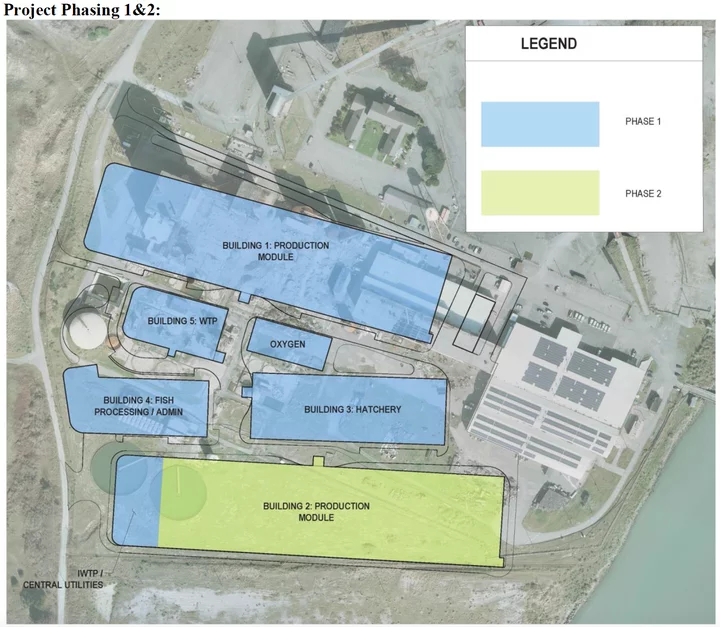
Diagram via the Planning Commission’s executive summary.
###
Three and a half years after Nordic Aquafarms announced plans to build a massive land-based fish farm on the Samoa Peninsula, the project is finally coming before the Humboldt County Planning Commission tonight. Backers are seeking certification of the Environmental Impact Report (EIR) and the approval of two key permits.
The Norway-based aquaculture company, which underwent an abrupt change in leadership earlier this month, needs both a Coastal Development Permit and a Special Permit to move forward with the development, which involves the demolition and remediation of the defunct Samoa Pulp Mill facility followed by construction of a 766,530-square-foot recirculating aquaculture system (RAS) facility.
The project will also require separate permits from the California Coastal Commission and the Northcoast Regional Water Quality Control Board for bay intake and ocean outfall infrastructure.
The Humboldt Bay Harbor, Recreation and Conservation District will apply for a permit to draw approximately 10 million gallons per day of saltwater out of Humboldt Bay via modernized intake infrastructure called sea chests. The regional water board must issue the permit for the daily discharge of 12.5 million gallons of treated wastewater via an existing ocean outfall pipe that extends a mile and a half offshore.
Meanwhile, the Humboldt Bay Municipal Water District has agreed to provide 2.5 million gallons of freshwater and industrial water per day, sourced from the Mad River.
The Coastal Commission must sign off on both the intake and outfall aspects of the project’s infrastructure, and the California Department of Fish and Wildlife must approve the production of Atlantic salmon.
Jacqueline Cassida, a community liaison for Nordic based in Maine, where Nordic is pursuing a similar facility, told the Outpost via email Thursday that “both the Coastal Commission and the Regional Water Board are waiting until the EIR is certified before they move forward in their process.”
Still, tonight’s hearing represents a monumental step for the ambitious fish farm project, which is expected to produce up to 27,000 metric tons of gutted, head-on Atlantic salmon and fillets each year for distribution to markets up and down the West Coast.
Since the endeavor was first announced in early 2019, Harbor District commissioners, county supervisors and the business community have all been bullish on the economic development potential. The company’s latest estimates put the project cost at roughly $650 million, and it’s expected to create up to 130 jobs by the time Phase 2 buildout is completed in 2030.
And virtually everyone is excited about the prospect of seeing further cleanup and remediation of the crumbling pulp mill property.
But plenty of folks in the community still have reservations. Perhaps foremost among them are environmental concerns over the project’s water intake impacts, its nutrient-rich wastewater discharge and its massive projected energy consumption. At full build-out, the fish farm is expected to have an electricity demand of 22.3 megawatts (averaged out over a year), or 195 gigawatt hours of energy per year, which would account for roughly 21 percent of the county’s total electricity usage.
Under pressure from environmental groups, Nordic officials committed to using 100 percent renewable electricity, though the details of acquiring that clean energy have yet to be hashed out. Facility plans include a 4.8 megawatt solar array mounted on
building rooftops, covering about 657,000 square feet.
Other concerns expressed in public comments include the sourcing and ingredients of fish feed as well as the source of Atlantic salmon eggs. Nordic has agreed to implement a mitigation monitoring and reporting plan.
The Final Environmental Impact Report, prepared for the county by local engineering firm GHD and released to the public about a month ago, finds that there are no significant unavoidable environmental
impacts that can’t be mitigated to a less-than-significant level.
The Planning Commission meeting is scheduled to begin at 6 p.m. in board chambers at the Humboldt County courthouse. The only other item on the meeting agenda is a discussion about whether or not to send a letter to the Board of Supervisors regarding water storage requirements
for cannabis projects.
Still, it’s quite possible the commission won’t wrap up its decision-making process at tonight’s meeting. If that’s the case, the hearing will be continued to a meeting one week hence, on August 4.
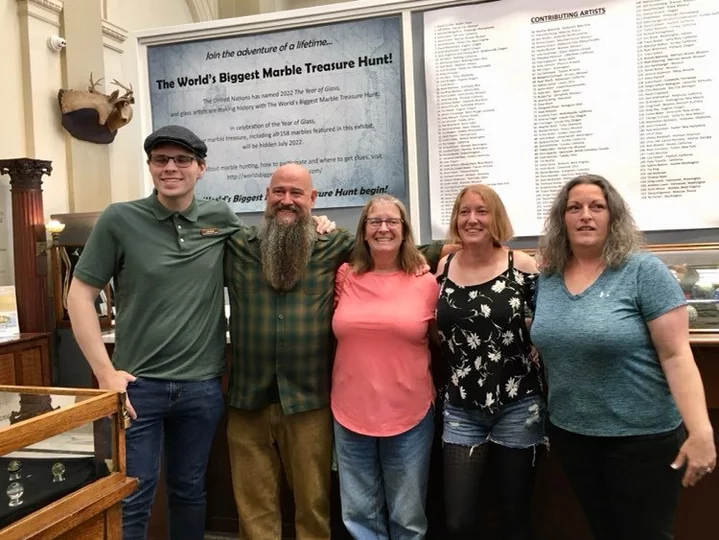
(left to right) Josh Buck, Topher Reynolds and winning team members Donna Mitchell, Collien Aten and Cecilia Patton | Photo: Stephanie McGeary
###
After four straight days of driving across six states, hiking through dunes and canyons, braving storms and desert heat, Collien Aten, Donna Mitchell and Cecilia Patton of Crescent City arrived at a celebration at the Clarke Museum on Wednesday afternoon to be declared the winners of an extravagant treasure hunt and to claim their prize of $45,000 … worth of marbles.
That might sound a little crazy, but for members of the World’s Biggest Marble Hunt – a huge network of marble enthusiasts who hide and hunt marbles around the world – this days-long treasure hunt was the adventure of a lifetime.
“The awesome thing about marble hunting is you make yourself go places and go further to seek this treasure, to find this thing that someone else hid,” Patton told the Outpost during the treasure hunt celebration at the Clarke Museum. “You push yourself to go places you would normally never go.”
Patton, Aten and Mitchell during the journey | Facebook
Patton, Aten and Mitchell’s team, called “Done Deal” was one of six teams competing in the treasure hunt, which started in Colorado Springs on Saturday morning. Will Stuckenberg – a glass artist in Branson, Missouri and one of the founders of World’s Biggest Marble Hunt – orchestrated the event, posting “tasks” on social media for the teams to complete in various locations across the route. Each time a team completed a task and posted photo proof, Stuckenberg would post the next location and task the teams needed to complete. There were 17 total checkpoints throughout the approximately 1,750-mile route, which took the teams through various national parks, hiking destinations and interesting towns.
Seventy teams had initially signed up for the hunt, Stuckenberg said, none of them knowing where in the world it would begin. Three days before the official start of the treasure hunt, Stuckenberg posted a map on the Facebook group, showing the general area of the starting location, giving teams a chance to travel to the area. On Saturday morning, the first location – Colorado Springs – was revealed, and once the first team arrived, the other teams were given a 17-hour window to arrive, rest and prepare for the remainder of their journey. Of the 70 teams signed up, only six actually made it to participate in the treasure hunt.
Stuckenberg had planned out the route by embarking on a three-week road trip with his kids, visiting various towns and parks that he thought might make good locations and identifying whether they could work for the hunt. Stuckenberg wanted the treasure hunt to be challenging, so that only the real diehards would stick with it, but he also wanted to make sure it was not dangerous. He also needed to find locations that would be accessible any time of the day, since he knew the teams would arrive at different times.
Stuckenberg’s intense treasure hunt planning process (left) and map showing general start location for the hunt | Facebook
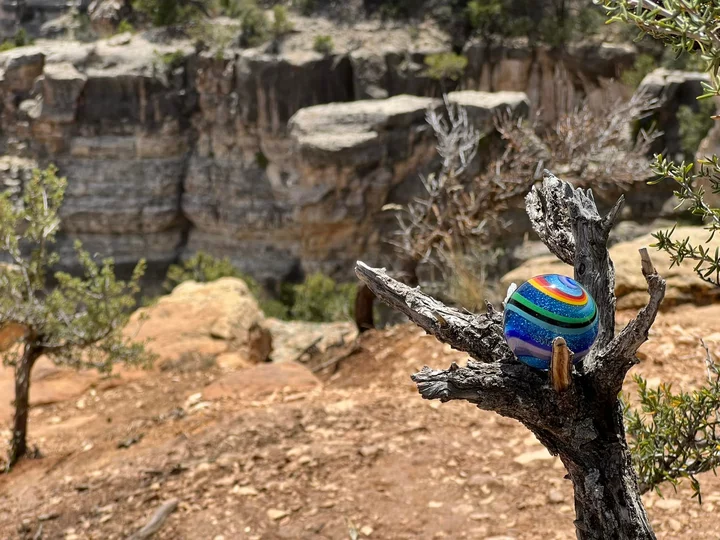
A marble Stuckenberg hid at the Grand Canyon | Facebook
The challenges Stuckenberg chose included a three-mile hike down the Grand Canyon, a hike through Garden of the Gods in Colorado, a long drive through Death Valley, a stop at the Golden Gate Bridge in San Francisco, and – oddly – a stop to feed donkeys carrots in the town of Beatty, Nevada. Of course, he hid some marbles along the way for the treasure hunters to find.
One of the most challenging legs of the hunt was the hike through Great Sand Dunes National park in Colorado. “That is really hard – to hike on the sand, Stuckenberg told the Outpost in a phone interview earlier this week. “We had a lot of teams that had to do it in the middle of the night during a sandstorm.”
Aten, of the winning team, agreed that hiking the dunes was the most challenging part of the treasure hunt. Aten had been selected by her teammates to complete that hike on her own, so that they could finish more quickly. This was the only time during the journey that Aten almost gave up.
“It was brutal,” Aten told the Outpost at the Clarke Museum on Wednesday. “It was one of those things where you’d be like, ‘Oh good, I’m almost to the top of this sand dune,” and then you’d get to the top and be like “Damn it! There’s another one that’s even taller.’”
Aten in Great Sand Dunes Park, CO | Facebook
Aten and her mother, Mitchell, often go marble hunting together in Humboldt and Del Norte Counties. When Aten heard about the treasure hunt, she knew that this would be a perfect adventure to take with her mom. Needing a third member for their team, they asked Patton – who is Mitchell’s chiropractor – to join them. Amazingly, Patton was completely on board.
“I’ve always wanted to do an Amazing Race-like challenge,” Patton told the Outpost. “I wanted to see new places. So I thought ‘Yeah, OK. Let’s do this.”
The team flew all the way out to Colorado to start the hunt, and rented a car for the rest of the journey. Stopping at a hotel only once to take showers, the three took turns sleeping in the back seat of the car during their trip. They crossed the finish line at the Clarke Museum on Tuesday evening, only about 30 minutes before the second-place team. For most of the race, team “Done Deal” was just barely behind another team. But when they realized that the final leg was taking them through Humboldt County – where cell service and GPS can be a little unreliable – these gals knew they had the home-team advantage.
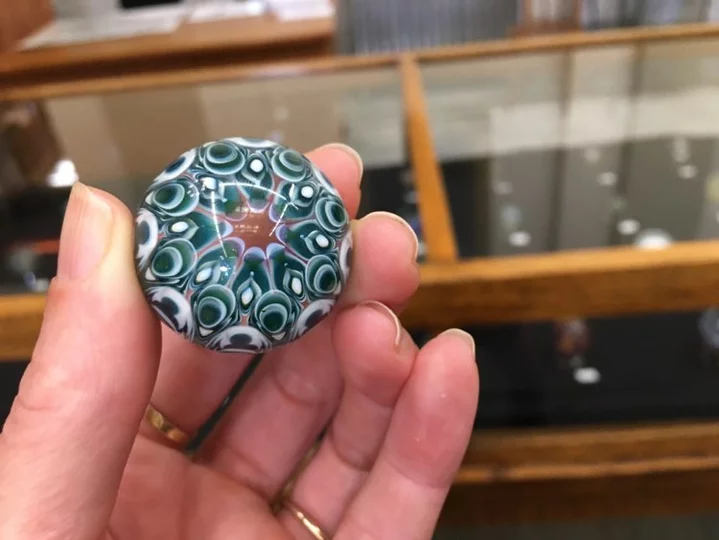
After a couple of checkpoints in San Francisco, the last leg took them through the Avenue of the Giants and the Drive-Thru Tree near Leggett. After hitting the final stop at Eureka’s Clarke Museum on Tuesday, the team drove back to Crescent City to get some much-needed sleep. They then drove all the way back to Eureka on Wednesday, to join the celebration and claim their prize – 158 marbles, each donated by a different artist, collectively worth $45,000.
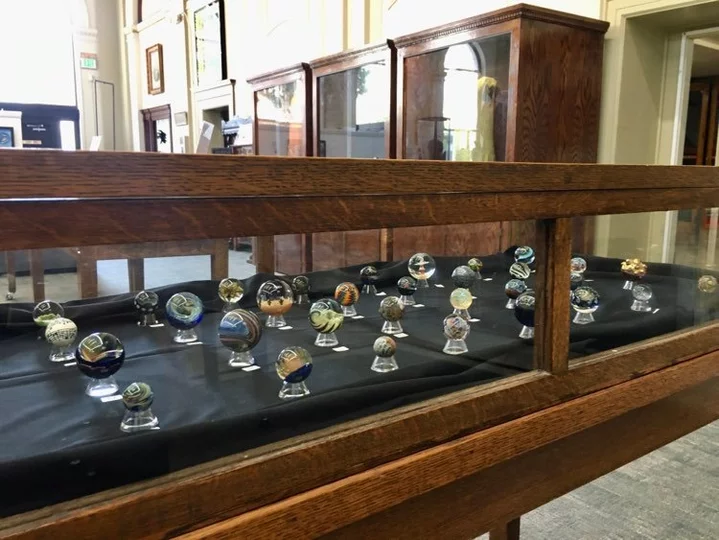
Some of the prize marbles at the Clarke Museum | Stephanie McGeary
The collection, which has been on display all month at the Clarke, includes pieces from at least 20 famous artists, Stuckenberg told the Outpost. Some of these artists – including Mark Matthews, Josh Simpson and Yoshinori Kondo – are revered in the glass world and create pieces worth thousands of dollars. So it’s not surprising that some marble fans were willing to go to extreme lengths to win this collection.
Aten, Mitchell and Patton plan to send some of the marbles to one of the other teams that had to drop out of the race because one of the members had a leg injury. They are also giving some to another treasure hunter, named Tammy, who was competing alone. As of Wednesday, Tammy still hadn’t finished the hunt, but the winners said she is planning to complete the whole thing. The winners were so impressed that anyone would attempt this journey alone that they felt she deserved a prize too.
The remaining marbles they plan to split evenly among the three of them. “I will have the most epic marble collection in all of Del Norte County now,” Aten said.
Among the folks gathered at the museum on Wednesday to greet the competitors was Eureka Mayor Susan Seaman, Josh Buck (the new executive director of the Clarke Museum) and Topher Reynolds – local marble-maker and one of the hosts of World’s Biggest Marble Hunt.
After congratulating the winning team on their impressive feat, Reynolds thanked the museum, the contributing artists and the City of Eureka for their help with the treasure hunt, and helping to bring attention to the growing community of people who create, collect, hide and find marbles.
“This is just further proof that Eureka is the center of the marble universe and that the community here appreciates niche things,” Reynolds said to the crowd gathered at the museum on Wednesday. “Marbles are a very niche market and when you tell people you’re into marbles, you get a little bit of that look. But when you see what we’ve been able to put together here and you see what the community has done and you see what people are willing to do, it all starts making sense.”
Check out some much better photos of the entire marble collection posted by Brian Bowden.
Security National’s Tim Callison (left) and Smokehouse owner Laura Bringhust.
UPDATE, 12:58 p.m .:
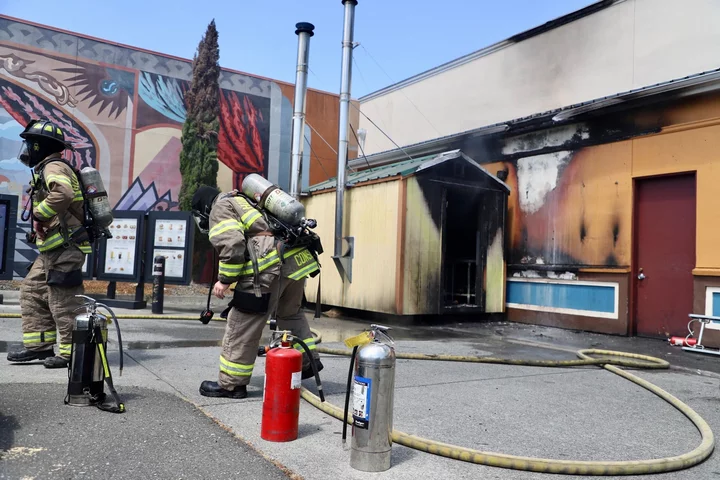
Humboldt Smokehouse owner Laura Bringhurst confirmed to the Outpost that no one was injured in the blaze. The fire started in her smoker, which is located in a small outbuilding to the rear of the restaurant.
“I was finishing up my pork,” she said. “The day is ruined. The week is ruined. This is basically my worst day ever.”
Bringhurst said obviously her business would need to close for the foreseeable future. Her first thoughts were for the clients who’d already placed orders that she’d be forced to disappoint, but she said she plans to rebuild.
“We’re gonna keep on keepin’ on,” she said. “As soon as possible I’m going to get a new smokehouse shack and new smokers. As soon as I can.”
— Andrew Goff
###
Photos: Andrew Goff.
Just after 12 p.m. this afternoon, the smokehouse attached to Humboldt Smokehouse — a popular downtown BBQ joint — went up in flames.
Humboldt Bay Fire responded quickly to the scene and was able to knock down the fire, but the outbuilding that houses the smoker was very visibly damaged. There appeared to be some damage to the main building as well.
As of this writing, firefighters are up on the roof of the business, presumably checking for any spread.
North Coast News’ Austin Castro was at the scene and filed to Facebook Live. More photos below.
Humboldt Smokehouse owner Laura Bringhurst (right) looks on at the damage.