

Former HSU Student Doug Thron Travels to Ukraine to Rescue Lost Pets in War-Torn Areas Outside of Kyiv
John Ross Ferrara / Friday, June 10, 2022 @ 7:21 a.m. / Animals , Cal Poly Humboldt
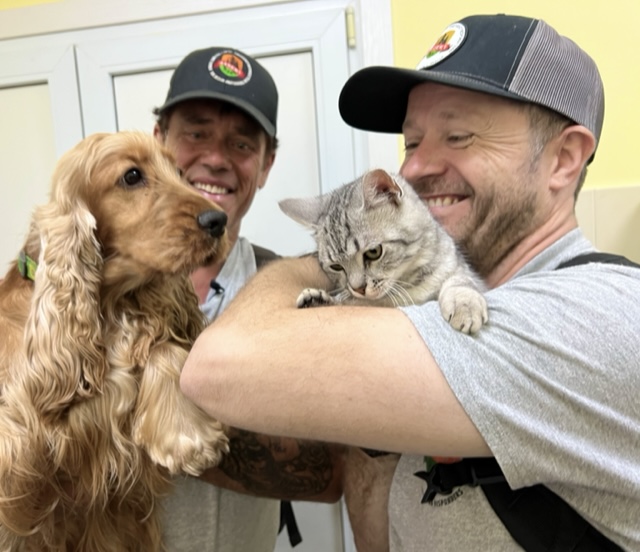
Thron and Okrant hold up two rescued animals.
Humboldt State University alumnus Douglas Thron has dedicated the past few years of his life to rescuing animals strayed in the wake of natural disasters: The 2018 Camp Fire, Hurricane Dorian, the Australian bush fires, the 2021 Western Kentucky tornado. While Thron’s passion project has taken him to some hazardous locations, it’s hard to believe his latest mission: Three weeks in war-torn Ukraine, searching bombed-out buildings for lost pets that need a home.
The 52-year-old cinematographer, who uses a drone fitted with an infrared camera to locate and ultimately rescue stranded animals for his Curiosity Stream TV show “Doug to the Rescue,” arrived in Kyiv last week.
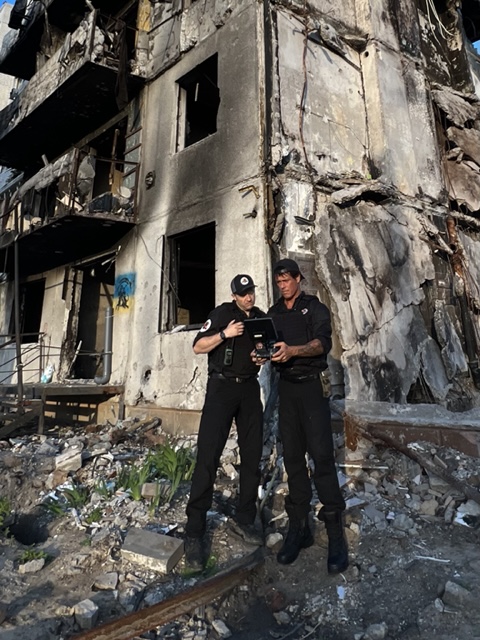
Thron has told the Outpost that he’s currently living in a hotel room about 10 minutes away from a heavily shelled town on the outskirts of Kyiv — an area he and fellow rescuer Ryan Okrant travel to daily to scour the wreckage for stray cats and dogs.
“We hear the [air raid] sirens go off every night, and that’s when the missiles are shot at Kyiv,” Thron said. “Missiles hit some buildings about two miles away from our hotel a few days ago, but we were far enough away that we couldn’t hear it.”
Despite the ongoing war with Russia, Thron said that entering Ukraine was easier than he imagined.
“It’s surprisingly easy to get in,” he said. “It took about three days, several flights and a bus to get here: Miami to London, London to Warsaw, then a 16-hour bus ride right into Kyiv.”
Once Thron and Okrant arrived in Kyiv, they were paired up with mandatory military security and a translator that they lucked into finding on their bus to Kyiv.
“To get the permits to fly in, we had to get permission from the government for military security that protects us,” Thron said. “We have two Ukrainian soldiers that travel with us continually. It gives you a certain level of comfort. We found our own translator. We were on the bus and some college guy who was applying to Stanford was sitting next to us. He spoke pretty good English and we asked him if he knew any translators. He told us about his friend who’s studying to be a lawyer. We figured a guy smart enough to be a lawyer would be a good translator.”
With his team assembled, Thron said that he’s managed to rescue as many as 15 animals in the first week of the trip.
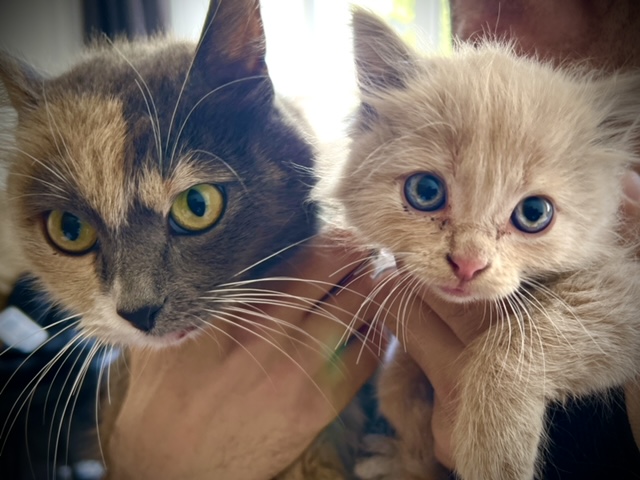
The rescued mother and one kitten.
“We rescued a mamma cat and kitten three nights ago, and had a feeling that there may be more kittens,” Thron said Wednesday. “We left an infrared trail cam set up over night. Upon reviewing the footage the following morning, we discovered three additional kittens living in the kitchen.”
Leaving fresh food and water for the remaining cats, Thron and Okrant returned on Wednesday with the mother cat to capture the remaining kittens.
“We sat silent for nearly 15 minutes before we saw one kitten emerge from the kitchen, followed by another, and then the last,” he said. “We’ve now rescued an entire family of 4 kittens and their mother from the eighth floor of a bombed-out building.”
The rescued cats were deemed to be malnourished, but Thron said that they are in good health considering the circumstances.

The three remaining kittens.
“They had to have been in this apartment complex during the bombing and somehow survived,” he said. “The whole area was heavily bombed. The cats must have gotten scared and crawled in cabinets, behind the fridge or scurried underneath stuff. Half the complex was turned to ash and the other half is completely blown out.”
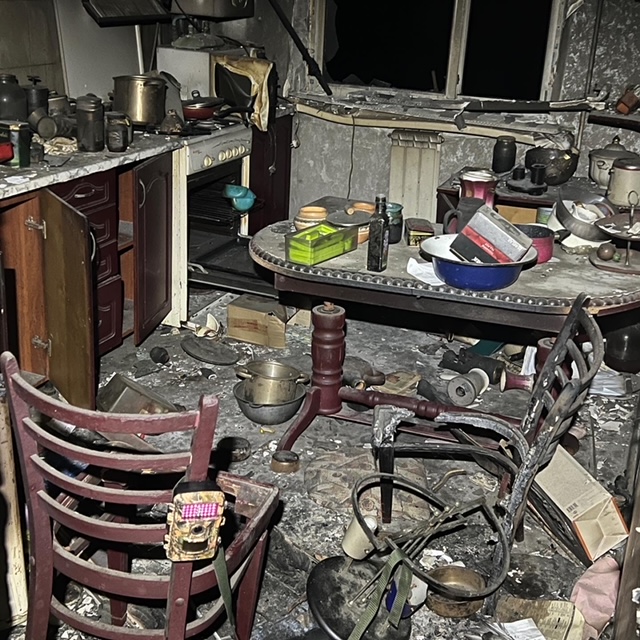
The inside of a bombed building.
Thron said that 15 rescued animals is already enough to consider the trip a success. But with two weeks left, he plans to save as many animals as possible and take in all the Ukrainian culture he can.
“Most of our friends think we’re batshit nuts,” he said. “Kyiv is an unbelievably beautiful city. I don’t know if it’s the TV news that makes it look dreary, but it’s got these really colorful buildings and magnificent, giant cathedrals. It reminds me a lot of Humboldt, with its rolling hills, mountains, trees and a big beautiful river on the side of the city. It’s much more beautiful than I was expecting.”

While he’s enjoyed his time in Kyiv, Thron said that living in a war zone does weigh on his mind at night as he lies listening to the air raid sirens.
“You think about it more times than not,” he said. “I’m not so much afraid of dying as I am stepping on landmines or being held captive. At certain times, when we’re climbing into buildings, the soldiers tell us to be careful of trip wires connected to grenades. I’m hopeful that that won’t happen, but I will probably kiss the ground when I land back in the U.S.”
Aside from his health, Thron is also taking financial risks with his current project. In the past, Curiosity Stream has funded many of his rescues. However, he said that the Ukraine trip is so dangerous that no company was willing to accept the risks involved with bankrolling the trip. Instead, he and Okrant have paid for the rescue by crowdsourcing and spending thousands of dollars of their own money. While he hopes to make it home safely and eventually sell his footage to recoup his losses, Thron said that rescuing the animals is his biggest concern.
“It’s not hard to do something that you love for a living,” he said. “You have to live pretty frugally, like sleeping out in sheep pastures in Poland while you wait for the bus. Our hotel is a small, shared room that was donated to us. But I like to travel and meet people, and I certainly love saving animals and being outdoors.”
Over the years, Thron has successfully reunited many animals with their families. In Kyiv, he and Okrant are working with local vets and pounds to document the rescues in hopes that someone is out there looking for their lost pet. However, he said that a reunion in the Ukraine seems unlikely.
“I think this is going to be different from hurricanes, fires and tornadoes,” he said. “Thousands of people have passed away. I think a lot of owners won’t be coming back.”
Given the deadly nature of the war, Thron is actively organizing adoption plans for all of the rescued animals.
“All are spoken for,” he said. “There are multiple sanctuaries willing to take them: Places outside of Kyiv, in France, Canada, Puerto Rico. I have a list of people who want to adopt from Canada, California, Michigan, Georgia. The one thing that is nice about animals rescued from [disaster areas], is that people want to help out and have an animal with a fascinating story. It certainly helps place them in a good home.”

BOOKED
Yesterday: 6 felonies, 12 misdemeanors, 0 infractions
JUDGED
Humboldt County Superior Court Calendar: Today
CHP REPORTS
No current incidents
ELSEWHERE
RHBB: HAF+WRCF Opens Fall Grant Round for Artists, Seniors and Holiday Programs
RHBB: State Parks Urges Safety Precautions Ahead of Labor Day Weekend
Electric Car Mandate: California Air Board Questions Cost, Practicality
Nadia Lopez / Friday, June 10, 2022 @ 7 a.m. / Sacramento
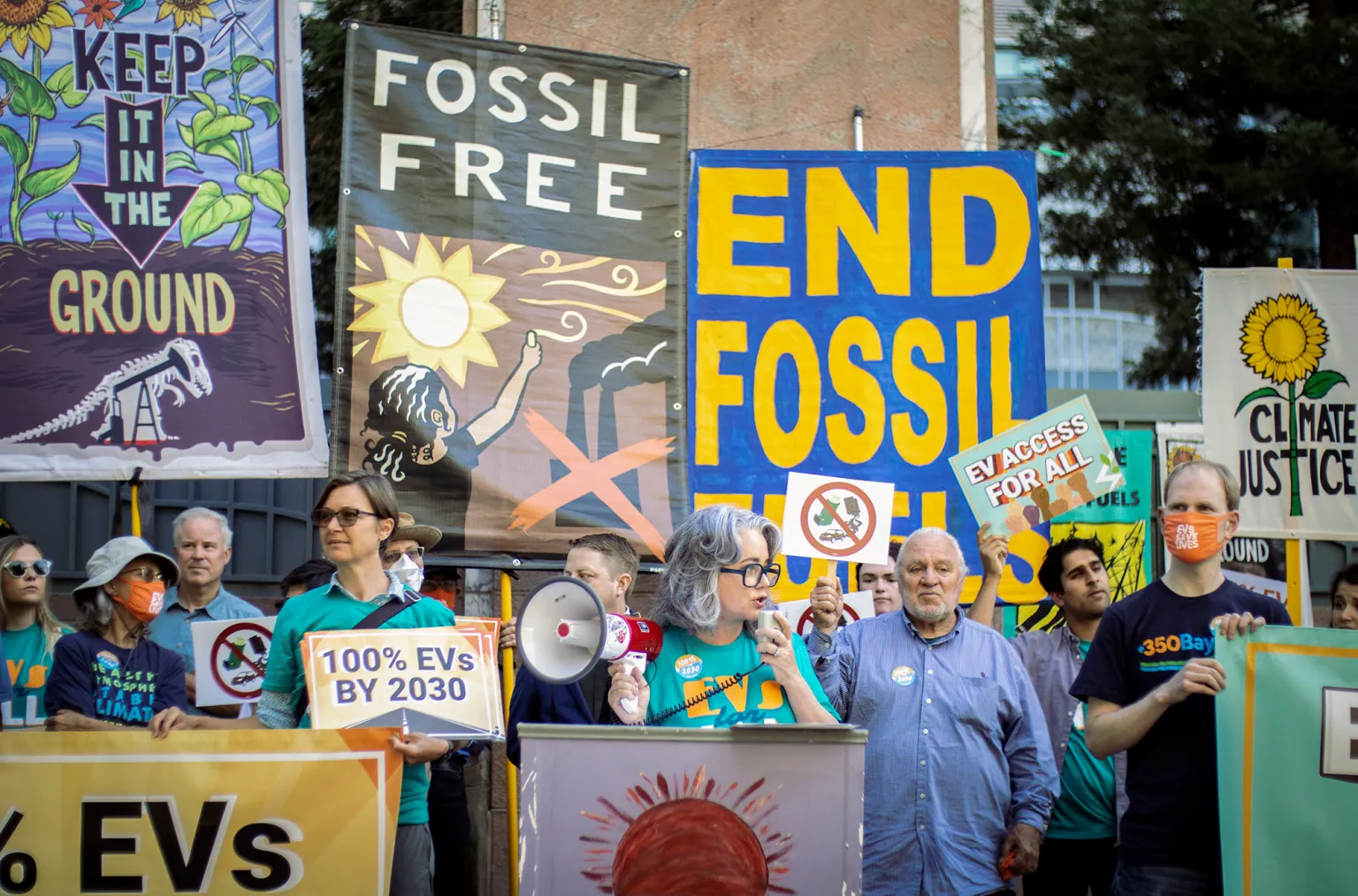
Environmental activists call on the California Air Resources Board to push harder in its proposed mandate to ramp up electric car sales at a rally at the agency’s headquarters in Sacramento on June 9, 2022. Photo by Rahul Lal, CalMatters
Members of California’s Air Resources Board today questioned the practicalities of their staff’s proposal to ban gas-powered vehicles, raising concerns over challenges in buying and charging electric cars.
Air Board Chair Liane Randolph asked staff to find more strategies to ensure that the state’s proposed mandate includes strong equity measures so that low-income residents face fewer barriers buying electric cars.
At a public hearing that stretched on for nine hours in Sacramento, auto company representatives, environmentalists and car owners showed up in droves to voice their concerns. Some said the rapid transition could harm the disadvantaged communities it aims to help, while others said the air board needs to take bolder action to address air pollution.
The rules would mandate increased sales of electric or other zero-emission vehicles in California, beginning with 35% of 2026 models. In 2035 sales of all new gas-powered cars would be banned. Currently only about 12% of new car sales in California are zero-emission vehicles.
The standards would be among the most aggressive actions that state regulators have ever taken to address climate change and poor air quality. They could transform the cars Californians drive, revolutionize the auto and power industries, and could eventually drive stronger nationwide standards.
“This is arguably the most important action the California Resources Board will ever take,” said Daniel Sperling, a member of the Air Resources Board and founding director of the University of California, Davis Institute of Transportation Studies. “What we’re doing here is by far the most important strategy for decarbonizing transportation. There’s nothing even close to it.”
Air board member Diane Takvorian, who is executive director of an environmental justice group, said there is “a lack of clarity” about what the regulation can do, adding that it needs to address the availability of electric cars in the used car market. She said a steady and reliable supply of used electric vehicles is a necessity for low and middle-income residents.
She said the proposal needs stronger equity measures.
“If we don’t create a market that is creating affordability, we’re going to end up in the same situation that we’re in now with housing, where there are many homes on the market that are just out of reach for most of California,” Takvorian said. “I don’t think that the equity provisions that we’re talking about are necessarily that everybody in the state should be able to buy a new zero-emission vehicle. We need to figure out what the entire system looks like.”
The board is expected to vote on the mandate in August.
Environmentalists voiced concern that the board’s proposal doesn’t go far enough to get gas-powered cars off the road, urging the board to set a more stringent goal of 75% zero-emission sales in 2030.
Several city and county elected officials from around the state, including from car-centric cities like Long Beach, Santa Clara and Los Angeles, also expressed support for more stringent measures.
‘Very real challenges,’ auto industry says
Representatives of automakers, including Ford and Subaru, said the industry is committed to electrifying its fleet, but raised questions about the timeline.
“Subaru fully supports an electric net carbon net zero carbon future, but today’s advanced clean cars proposal aims to set a very challenging path for the U.S. auto industry,” said David Barker, environmental activities manager for North American Subaru. “There are very real challenges in meeting consumer demand while at the same time overcoming supply chain disruptions and limited access to critical help. These challenges are amplified for small manufacturers like Subaru.”
Dr. John Balmes, a longtime member of the air board and proponent of clean air, expressed concern about whether car manufacturers would be able to comply with the mandate.
“Do we have enough knowledge? I think the answer is probably no,” he said. “I’m worried that we’re not going to get the new zero-emission vehicles that we would like to have.”
Costs of the mandate could run $289 billion over the lifetime of the rule. But the economic benefits could reach $338 billion — a net benefit of $48 billion, according to air board staff.
While electric cars currently cost more than a gas-powered car, savings on gas and maintenance could end up saving car owners an estimated $3,200 over ten years for a 2026 car compared to a gas-powered car and $7,500 for a 2035 car, according to the air board’s estimates.
Air board staff say the new standards will boost interest in electric vehicles and bring the cost down over time.
But they said challenges with the transition remain.
Air board officials said consumer reluctance remains a concern, citing challenges that could hinder the pace of switching over to electric vehicles.
Also, the need for more public charging infrastructure and home chargers is already a barrier that is frustrating for some electric car owners. About 1.2 million chargers will be needed for the 8 million electric cars expected in California by 2030, according to staff’s calculations.
Car buyers are also concerned about battery life, higher purchase price and the limited number of models.
To address some car owner concerns, the proposed measure requires automakers to set strong performance, warranty and durability requirements. Electric cars must be able to drive at least 150 miles on a single charge. Batteries would need to be more durable and carry a manufacturer’s warranty. At least 80% of the original range must be maintained over 10 years. To ease the strain on automakers, that requirement would be reduced to around 75% during the first five years.
Air board staffers said they would grant automakers incentives to sell some vehicles at a lower cost in an effort to help low–income residents afford electric cars.
Under the proposed rule, automakers could get credits toward meeting their sales targets through 2031 if they sell cars at a 25% discount through community-based programs, or if they offer passenger cars for less than $20,000 and light trucks for under $27,000. Air board officials said provisions would prevent companies from stockpiling credits that would be a disincentive from meeting future requirements.
But some residents told the board that they’re already feeling financially strapped and can’t see ever affording an electric car. While the proposal offers financial incentives for automakers, they doubted they would gain access to programs meant to help low-income car owners.
“I am lower class. I am under the poverty level,” said Sherry Chavarria, a Dinuba resident. “How can I afford a Tesla? The people that get the incentives are the upper class.”
The rules would not apply to the used car market, and it wouldn’t eliminate the millions of gas-powered cars already spewing planet-warming emissions and smog-causing gases on the road.
The proposal would also drive a wide-ranging transition of the workforce, causing some industries to gain jobs while others lose them as the state shifts to pollution-free cars.
Throughout the economy, an estimated 64,700 jobs will be lost because of the mandate, according to the California Air Resources Board’s calculations. On the other hand, an estimated 24,900 jobs would be gained in other sectors, mostly in the power industry, so the estimated net loss by 2040 is 39,800 jobs, a minimal amount across the state’s entire economy.
Mechanics would be among the most affected — more than half of their current number of jobs would be lost over the next two decades if the mandate goes into effect, the air board estimated.
“I am sensitive to the fact that this rapid transformation will be disruptive across many industries, not just the auto industry, not just the oil industry, you’ve got the parts suppliers, you’ve got the mechanics, you’ve got the electric utilities, you’ve got the local governments,” air board member Sperling said at the hearing. “And it’s going to be even more disruptive in the other states who lag behind California in every way.”
Sperling said it’s important that California sets a strong precedent and reduces the challenges because other states will follow suit.
“My biggest concern by far is dealing with the other states, and we need them to be successful because what we’re doing here is not just for California,” he added. “If you look at it from a climate perspective, actually, this is much more important.”
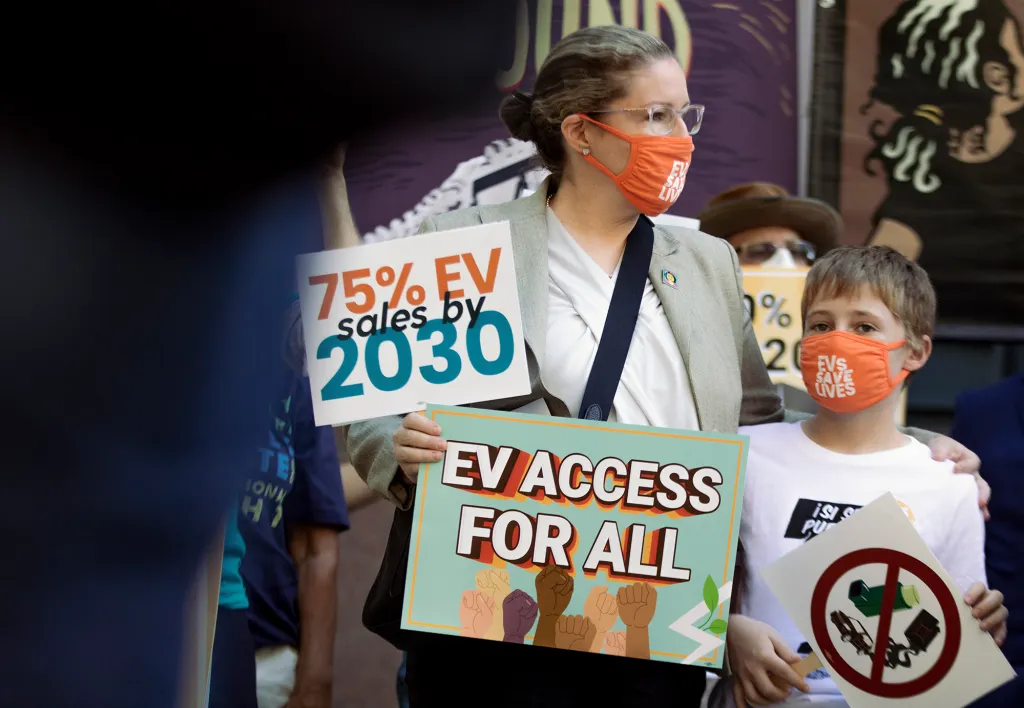
Community organizer Lori B. Pesante of the Dolores Huerta Foundation and her son Dorius attend a rally at the Air Resources Board’s headquarters. Photo by Rahul Lal, CalMatters.
At a rally at the air board’s headquarters in Sacramento before the hearing, environmental justice advocates called on the board to take bolder action on the mandate.
Meg Whitman, 42, a Sacramento-based physician at the rally, moved to the area five years ago from Massachusetts. She said her seven-year-old son was diagnosed with asthma last year, which she thinks could be from exposure to wildfire smoke and exhaust from highly-congested freeways.
“He really didn’t have any symptoms of asthma as a baby and during his toddler years,” she said. “We are going to keep a close eye on it, but we have considered moving out of the area for his sake. The question is, where is that and where will it be safe?”
Whitman’s three-year old son also came down with bronchitis as a six-week old baby. While he has been healthy since, she said she’s now worried he could also develop asthma.
“The faster we can curb tailpipe emissions, the faster we can help prevent some of these diseases and excess deaths,” she said. “It’s just something I think about with my boys all the time. I’m frightened for their future. My boys, they’re just my whole world.”
Years in the making
The air board’s move toward zero-emission vehicles has been decades in the making. But many of those efforts have also faced hurdles.
California first adopted zero-emission standards in 1990, which at the time required that 2% of new car sales between 1998 and 2000 be emission-free, and increase to 5% in 2001 and 2002. In a stunning reversal, the air board rescinded those rules in 1996 following immense pressure from automakers and oil companies. At the time, concerns over the technology and battery lifespan of electric cars fueled much of the debate.
Today auto companies like Tesla and Ford have transformed the state’s electric vehicle market, with more than 80 models now available.
Only about 2% of the state’s 26 million cars on California’s roads were zero emissions in 2020, but electric vehicle sales have been steadily increasing since. The state had formerly enacted standards that required about 8% of new cars sold in the state to be zero emission in 2025, according to air board staff. That goal was already met in 2021, when electric vehicles made up 12% of all new car sales.
The state has long been a pioneer in setting tough climate change policies and the federal government usually follows. At least 15 other states have pledged to follow California’s lead on bold auto emission rules.
Many representatives from several states, including New York, Massachusetts, New Jersey and Oregon, showed up at today’s hearing in support of the proposal, vowing to implement similar rules in their states.
The transportation sector is one of the largest sources of pollution across the state, accounting for about 40% of the state’s greenhouse gas emissions.
The state’s authority to independently set stronger tailpipe emissions standards and mandate zero-emission sales was granted half a century ago, when Congress passed the Clean Air Act in 1970. The law included special conditions for California to help the state address its severe smog.
Under President Donald Trump, the state’s authority was revoked by the Environmental Protection Agency. The state then filed lawsuit after lawsuit to overturn the decision. California and four major automakers also made their own deal to continue cutting greenhouse gases.
The Biden administration in March restored the state’s power to set emission standards stricter than the federal government’s. That decision is now being challenged by 17 Republican state attorneys general, who are suing the administration for what they say is “favoritism” that “violates the states’ equal sovereignty.”
###
CalMatters.org is a nonprofit, nonpartisan media venture explaining California policies and politics.
Prison Rehab: Can California Learn Anything From Norway?
Nigel Duara / Friday, June 10, 2022 @ 6:59 a.m. / Sacramento
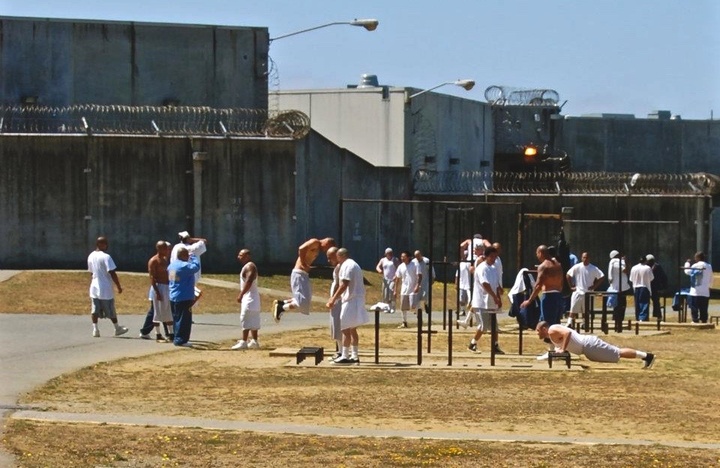
Inside Pelican Bay. File photo: Andrew Goff.
California has a recidivism problem.
Two-thirds of people incarcerated in the state will return to prison within three years, either through new offenses or parole violations, according to California Department of Corrections and Rehabilitation data.
In Norway, by contrast, recidivism is down from 60%-70% in the 1980s to about 20% today. The country credits the change to reforms that prioritize rehabilitation over punishment — and to its guiding question on prison policy: When prisoners are released, what kind of neighbor does society want them to be?
Prisons in Norway and parts of Western Europe deemphasize the institutional aspects of incarcerated life. Prisoners get to wear their own clothes, cook their own food and have relative freedom of movement within the prison walls.
Democratic Assemblymember Carlos Villapudua of Stockton read about the Norwegian model last year and offered up a scaled-down version this year for California.
The bill, AB 2730, passed unanimously and now heads to the Senate, with the support of both prison reform advocates and the union representing prison guards.
The idea is that prisoners with two years or less left on their sentences would be chosen by the warden and moved into a campus on prison grounds where they would cook their own food, do their own laundry and make their own beds. And most importantly to Villapudua, they would get job training in areas that need more workers.
For Villapudua’s district, that means training truck drivers to combat a shortage of truckers willing to take on long-haul routes. For some inmates, that means getting a Class A driver’s license to drive big rigs before they are released.
“That way, by the time they get out, they already have their Class A license and they know who their bosses are,” Villapudua said. “That’s how much a desperate need this field has.
“Their first week, maybe even before they get out, they may have a paycheck because (trucking companies) now have signing bonuses.”
Villapudua said he’s helped four formerly incarcerated people get Class A licenses and connected them with employers, for jobs he said pay more than $80,000. But the process, he said, is backward.
Instead of waiting for people to be released, facing their first days outside a prison trying to find employment, Villapudua said it makes more sense to use their last two years inside for job training.
The idea of a more communal model for U.S. prisons has started to take hold in several states, part of a long-running effort by the California-based Prison Law Project to fly legislators to Norway where they can see the model firsthand.
In North Dakota, about a dozen incarcerated people live in a trailer called the Transitional Housing Unit, living in their own rooms with locking doors. In Connecticut, they’re able to take a manufacturing course at a local community college. In Idaho, the Marshall Project reported, a prisoner, a guard and their families went fishing together.
“Can we snap our fingers and turn California prisons into Norway? No,” said Sharon Dolovich, director of the UCLA Prison Law and Policy Program. “But this is an urgently needed step to transform the experience of incarceration into what it’s actually supposed to represent.”
Despite Norway’s success around recidivism, the prison system there came to international attention in the last decade for a different reason: Anders Breivik, the man who killed 77 people in bomb and gun attacks in 2011, alleged in a 2016 lawsuit that he was being mistreated.
That’s when most people learned about his accommodations: Three separate cells, access to video games and the freedom to cook his own food. According to the BBC, he built a gingerbread house as part of a prison competition.
That’s not quite what Villapudua said he envisions in California.
“People always think reform is a bad word,” Villapudua said. “The key is to separate folks who know they made a mistake and know they’re going to be normal citizens again, not being in there faking it. If you fake it, you go back to general population.”
The bill passed unanimously in the Assembly public safety and appropriations committees, and again on the Assembly floor in May.
It doesn’t come with money attached, so if passed and signed by the governor, the California prison system would have to pay for it within its own budget, which is $14.2 billion in 2022-2023.
No specific conviction would disqualify inmates from participation, something Dolovich said is an important aspect of the bill that allows for a much wider spectrum of inmates to participate.
Villapudua said he deliberately left the program open to everyone, not just the “non-non-nons,” a colloquial phrase indicating inmate with sentences that are non-violent, non-serious, and non-sexual.
“Everybody’s so ready to exclude the very people we’re trying to help,” Dolovich said. “Who are these elusive non-non-nons?”
Not all the details are hammered out, Villapudua said, and questions remain. Would inmates leave the prison to work in the outside world? Can they get jobs as dockworkers at ports, which require background checks?
In a letter of support to the Legislature, California Correctional Peace Officers Association lobbyist Matthew Easley wrote that the bill would be an improvement over vocational programs offered today. In his letter, he derided existing programs as often having “no correlation to the needs of the communities to which inmates will be released” and failing to prepare them for employment.
And, he said, the community setting would help prisoners who want rehabilitation by separating them from prisoners who don’t.
“Even with the appropriate motivations and intentions, the pressures found from fellow inmates can be too great to keep to the straight and narrow,” Easley wrote on May 23. “Prison politics can often be inescapable when programs and housing are delivered in the same environment as those who have no intention of improving themselves.”
###
CalMatters.org is a nonprofit, nonpartisan media venture explaining California policies and politics.
OBITUARY: Brittany Marie Eusted, 1987-2022
LoCO Staff / Friday, June 10, 2022 @ 6:56 a.m. / Obits

Brittany
Marie Eusted passed away unexpectedly
in her hometown of Rio Dell on May 5, 2022, from a pulmonary
embolism. She was 35 years old at the time of her passing.
Brittany was born to Tina Marie Moore and Anthony John Eusted on February 26, 1987, in Fortuna. Brittany was part Native American, of the Mi-due tribe. She attended Rio Dell Elementary and graduated from Fortuna High School in 2004. After high school, she attended Frederick and Charles Beauty College while exploring career paths.
She loved braiding hair for friends and family, drawing, riding the four- wheeler, camping, swimming and hanging out with friends at the river. She also liked to cook — fajitas were her specialty. Most of all she loved being a mother. Brittany was a first-time mom, giving birth just weeks before her passing to a beautiful baby girl on April 16, 2022. She was smitten from the moment her daughter Xya entered this world.
Brittany will be remembered for her big heart, great sense of humor, and infectious laugh. She was a loving mother, partner, daughter and friend. She is greatly missed by her daughter Xya Marie Eusted-Taylor, her significant other of 19 years, Lewis Taylor, her mother Tina Moore, her father Anthony Eusted, her grandfather Phillip Moore, her aunts Johnette Chairez, Angelia Sondergard, Diana Sears, and Misty Moore as well as her extended family, numerous cousins and friends.
She is preceded in death by her grandparents John and Noreen Eusted, her grandmother Marilyn Moore, her aunt Pam Marrow, her uncle Lige Sears, and cousin Melissa Sears.
Friends and family are invited to attend a graveside service at Sunrise Cemetery located at 3315 Newburg Road, in Fortuna on Saturday, June 18, 2022, at 11 a.m. A reception honoring Brittany will immediately follow at 656 S. Scotia Rd, Scotia, CA 95565 (Take the Stafford Exit). A bank account has been set up at Coast Central Credit Union for Brittany’s daughter if you would like to make a donation in lieu of flowers (Account # 370599-0700). If you have any questions about the service, please call Tony at 707-845-5428. The family would like to thank everyone for their love and support during this very difficult time.
###
The obituary above was submitted by Brittany Eusted’s loved ones. The Lost Coast Outpost runs obituaries of Humboldt County residents at no charge. See guidelines here. Email news@lostcoastoutpost.com.
OBITUARY: Joseph Angelo Musone, 1933-2022
LoCO Staff / Friday, June 10, 2022 @ 6:56 a.m. / Obits

You
could say he walked with a bit of a swagger as he entered a room, his
eyes told a story, and his smile warmed your heart. There was
something about him, a craisma, a light, a feeling of calm in his
presence. He was our voice of reason, our rock. The world as we knew
it, has changed for ever, and is that less bright.
It is with deep sorrow and broken hearts that we announce the passing of our beloved husband, father, grandfather, great-grandfather and friend, Joseph Angelo Musone. On May 3rd, with his loving wife by his side, Joe received his wings and was reunited with his family in Heaven.
Joe, also known as “Sonny” by family and friends growing up, was born in Meadville, Pennsylvania on October 13, 1933. He grew up in a big, loving, Italian family in Hornell, New York where family time and gatherings were a normal occurrence. At a young age, Joe worked delivering newspapers, and helping neighbors shovel snow. When he was a bit older, he worked as a lifeguard at the local pool and set pins at the bowling alley. After High School, in 1952, he joined and served in the United States Air Force. He was stationed in Korea during the Korean Conflict and served as a Hydraulics specialist until 1956. Joe studied at the University of Houston, Louisiana College, Auburn University, and Louisiana State University, taking courses in accounting and engineering. He later worked for the U.S. Forest Service for 30 years. He started out in research administration in Montgomery, Alabama and then in 1975 worked as contracting officer for Six Rivers National Forest in Eureka. In 1982, he was awarded a certificate of Merit for providing high quality service and work during a period of fiscal constraints and personnel reductions. He retired from the U.S. Forest Service in 1982. Joe worked along with planning developers as a program specialist for the city of Eureka for a short time before going on to work for Humboldt County Public Guardian’s Office as a deputy.
In Joe’s free time he enjoyed taking his wife out dancing, playing racketball, pool, ping pong and golf. Two of his favorite things to do were watching Notre Dame football and spending time laughing and celebrating with family and friends. He loved visiting his family back East when he could. He missed his family that was not near and would talk of them often by telling stories of the good old days. He always held them close to his heart. If you knew Joe, you knew that besides being a great guy, he loved to tease, joke and even pull pranks. He especially got kicks out of his adventures and the fun he shared with longtime friend, Craig Miller, “two wild and crazy guys!” Joe always looked forward to creating fun and loving memories by taking his family camping in the summer and skiing in the winter. He liked volunteering, coaching youth football, and took pride in coaching his daughters in softball for years. He supported them at all their sporting events and extra curricular activities. Joe loved watching his grandchildren grow and spending time with them. He always said how they kept him young and on his toes. He was an amazing Nonne (Grandfather) to them all. He was their dancing partner, their snuggle buddy, jokester and Hero. Joe also looked after and cared for his younger brother Gary (who was born with Cerebral Palsy) after their parents had passed. He volunteered his time at Eureka HCAR Center, where his brother attended classes. Joe spent several years on the Humboldt County Grand Jury where he found interest in the courts and the cases. He was a proud member of St. Joseph’s Parish and the Knights of Columbus in Fortuna, as well as the “Blues Brothers” Baseball team, Redwood Empire Golf, and the Elks Club.
He is survived by his loving wife of 44 years, Deanna Musone, and their two daughters, Meghan Musone Heald (Josh), and Nicole Musone Miller (Shaun) as well as daughters Karen Musone Hill, and Lisa Musone, along with his nine grandchildren (Chrystal, Carmen, Ashley, Brody, Hannah, Lilly, Jordyn, Briar Rose and Gianna) and seven great-grandchildren (Cody, Lakyn Caylee, Asher, Casyn, Haidyn and Emma); niece Kim Drepensted Bossard (David); sisters-in-law Karen Sanderson and Dixie Morris (Gary) and Brother in Law Michael Nothem. He also leaves behind many special cousins and friends that were a lot like siblings to him growing up and in his later years. He is preceded in death by his mother, Rose Galle Musone, his father, Joseph Musone, sisters Marie Musone Drepensted, Jeannie Musone Shutz, brother Gary Musone, son-in-law Charlie Hill and brother-in-law Dan Sanderson.
Joe loved any reason to get together with family and friends. Good food, wine, and music were always a must. These gatherings will not be the same without him. He enjoyed life, never complained, had a kind heart and a beautiful smile.
We
hope you are at rest, or better yet, dancing and laughing with loved
ones within the pearly gates. Please know that your stories, your
love and your spirit will live on through all who loved you!
A celebration of life will be held for family and friends at the Historic Scotia Lodge on August 27th. We urge all who knew and loved Joe to come celebrate his life and share a story or two. Reach out with any questions to mmusone@aol.com.
In lieu of flowers, donations in his name can be made to Eureka HCAR, Hospice of Humboldt, St. Joseph’s Parish Knights of Columbus (Fortuna) and/or the Italian Civic Club in Meadville, PA.
###
The obituary above was submitted by Joe Musone’s loved ones. The Lost Coast Outpost runs obituaries of Humboldt County residents at no charge. See guidelines here. Email news@lostcoastoutpost.com.
Supes Advance Climate Action Plan Despite Bushnell’s Skepticism About Its Compatibility With ‘Rural Living’
Ryan Burns / Thursday, June 9, 2022 @ 4:32 p.m. / Environment , Local Government
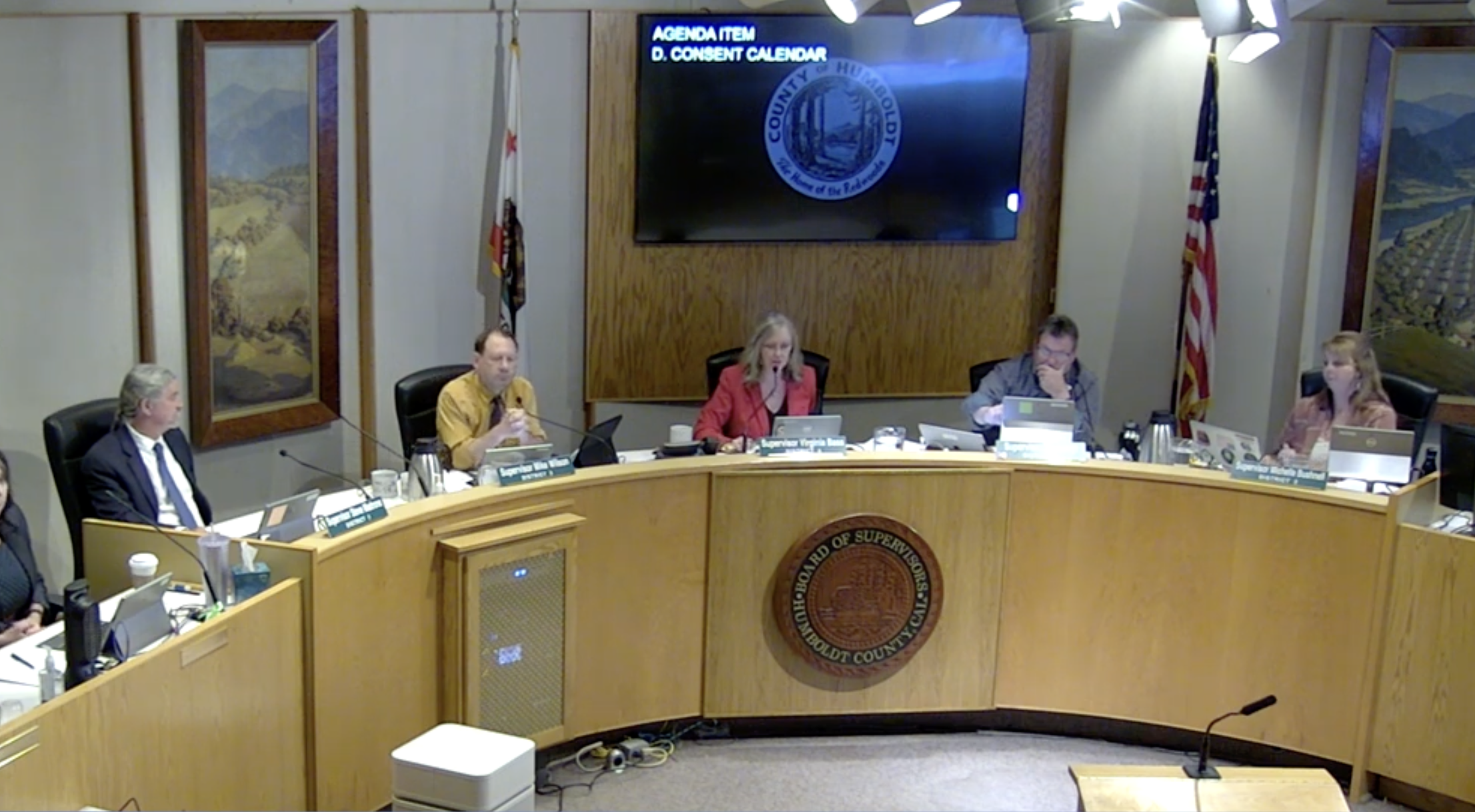
The Humboldt County Board of Supervisors. | Screenshot.
PREVIOUSLY:
- Got Ideas About How Humboldt Can Reduce Its Carbon Footprint? City of Eureka, County Government to Hold ‘Climate Action Plan Public Workshop’ Later This Month
- As the Planet Heats Up, the County Plans to Address Rising Sea Levels With an Emissions Reduction Plan and a Slow Retreat Strategy
- TODAY in SUPES: An Apology, Some Vaccine Hesitancy, a Climate Action Plan and a Code of Ethics, Oh My!
###
Earlier this week the Humboldt County Board of Supervisors accepted the public review draft of the Regional Climate Action Plan, an ambitious environmental document being drafted in collaboration with local cities in an effort to reduce greenhouse gas emissions in the coming decades.
The unanimous vote, which was taken with Third District Supervisor Mike Wilson absent, served to advance the Climate Action Plan to the stage where planning staff can begin working on an environmental impact report (EIR). Planning and Building Director John Ford stressed that the document is still very much a work in progress.
At the outset of the board’s discussion, Ford said, “We recognize that there are still some things that need to be worked out … [and] that there are still people commenting on things and working on things, so it doesn’t have to be perfect at this point.”

That caveat provided some minor relief for Second District Supervisor Michelle Bushnell, who described the draft plan as “more of an urban document,” one that may have “missed the mark a little bit for rural living” by failing to accommodate locals whose homes are in remote locations, sometimes off the grid.
Senior Planner Michael Richardson explained that the goal of the plan, broadly, is to reduce greenhouse gas emissions countywide. In doing so, the county hopes to meet reduction targets established by the state, which would simplify and streamline environmental review for future development.
The first target is to reduce greenhouse gas emissions to 40 percent of the county’s 1990 levels by 2030. The longer-term goal is to achieve net neutrality by 2045, effectively zeroing out the region’s net greenhouse gas emissions. Richardson said staff has already identified measures to reach that goal.

The largest reduction of GHG emissions will come from electrifying local infrastructure, followed by zero-emission passenger vehicles, according to the Regional Climate Action Plan.
First District Supervisor Rex Bohn asked about the level of public outreach thus far and was informed that there was a series of public workshops held throughout the county, and once the EIR is complete, public hearings will be held in all participating jurisdictions, including the county and all seven of its incorporated cities.
Bushnell peppered planning staff with a series of questions. She asked whether a region so rich with trees will be able to take advantage of carbon credits, to which Richardson and Ford replied that it’s possible, though such an endeavor would be “intensive,” likely requiring an outside consultant to develop a sequestration strategy.
Noting that her own district is very rural, Bushnell said she wasn’t quite comfortable with the plan’s call for a 20 percent reduction in water usage across the board.
“I don’t know if it’s appropriate in this document to say that when it’s conditional on climate — you know, drought or not drought,” she said.
Ford explained that the 20 percent reduction is a reference to green building standards in the state’s existing regulations, and there’s no way to adopt a qualified Climate Action Plan without complying with those standards.
“You might ask, ‘What’s the importance of that? Is that just a political thing that we’re trying to do, or are there really benefits to the county?’” Ford said. He explained that as the county moves forward with any kind of development, environmental impacts will soon be part of the discussion for every single project. And if the county doesn’t have a qualified Climate Action Plan, every project will be subject to extensive additional review.
“I know some of this is shocking,” Ford said. “But the reality is [that] this is where our legislative process is going at the state level, and if we aren’t moving with that, we’re going to be increasingly in a more and more difficult position to see development approved.”
Bushnell continued to questions the plan’s compatibility with rural living, noting that full electrification might not be achievable for people who get power and heat from generators and propane.
“That’s how people live off the grid,” she said.
“I think we have a little bit more work to do, frankly,” Richardson acknowledged. “And that will be a focus of the public engagement through the EIR process.”
Before leaving the meeting for another obligation, Third District Supervisor Mike Wilson said the draft plan is not perfect by his standards, nor by those of his constituents, but he thinks it’s good enough to start the environmental review process. And he said it’s reasonable to address the environmental challenges inherent in remote living styles because “the impacts of climate change are pretty extreme in those same spaces.”
During the public comment period, local environmental leaders including Matt Simmons, a staff attorney with the Environmental Protection Information Center (EPIC), and Caroline Griffith, executive director of the Northcoast Environmental Center (NEC), voiced support for adopting the plan, and they urged the board to exclude industrial point sources from the greenhouse gas emissions baseline. Simmons said that’s important because local governments have little control or influence over such emissions sources, which are regulated at the state and federal level.
Thomas Mulder, a SoHum cannabis grower and Bushnell’s appointee to the Humboldt County Planning Commission, disagreed, saying industrial point sources should be included, and like Bushnell, he argued that the plan should make more accommodations for rural living.
“Leaving those industrial heat sources [out] and excluding rural living actually drives the forces of Agenda 21, and that’s something I don’t really support,” Mulder said, referring to an extremist conspiracy theory about a secret plot to impose a totalitarian world government in the name of environmentalism.
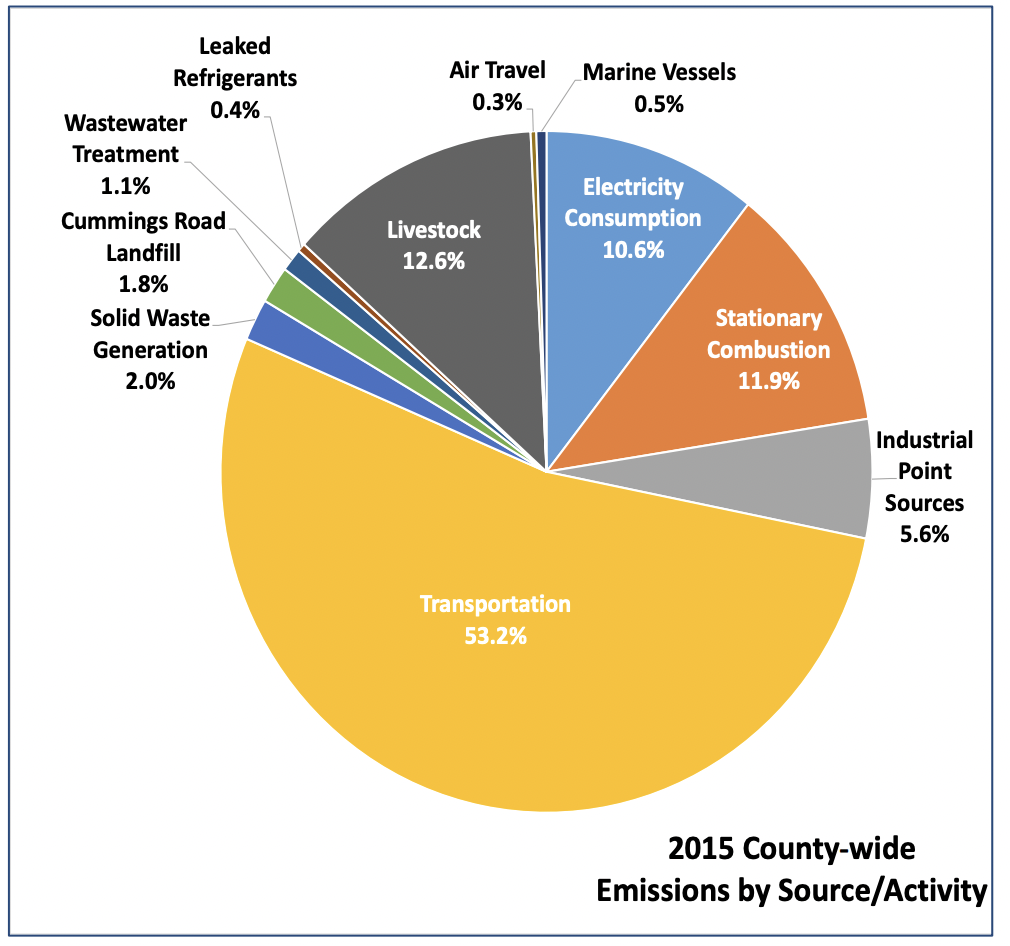
More than half of countywide emissions in 2015 came from transportation. County staff is currently working on updating this information with 2020 data. | Image via the County of Humboldt.
###
Fifth District Supervisor Steve Madrone said he’d like to see the plan incorporate incentives to reward landowners and businesses “that boldly go forth and implement these things that are going to help our planet, help our communities, etc.”
He proceeded to make a motion to direct staff to proceed with the environmental review of the plan, but Bushnell still wasn’t ready to support it. She asked staff to address the concerns she’d raised, and Bohn raised a couple of his own. He said that references to building new housing only within a certain distance from a downtown could stifle growth.
“You guys, we’ve got to build probably 500 homes if you really want to do this [offshore] wind project, if you really want to do the [Nordic Aquafarms] fish project, and if we really want to accept what Cal Poly is doing,” Bohn said. “And we’re not going to put them all in eight-story apartment buildings.”
He also noted the limited electrical transmission capacity of PG&E’s local infrastructure. “Do we want to financially curtail ourselves and everything else?” he asked. “Or can we gradually keep going the way we’re going and and set up some more, you know, realistic goals?”
In the end, Ford, who will be heading to a new job in Fort Bragg before long, helped the board craft a motion incorporating their feedback and concerns expressed by local community members. The motion directs staff to further refine the Climate Action Plan and use the EIR addresses the following:
- the complexities of rural living, making sure not to preclude development or maintenance of property
- the benefits of carbon credits and carbon offsets
- an evaluation of industrial point source emissions, including an explanation of why it should or should not be included within the plan
- the inadequacies of the PG&E electrical grid, with contingencies in case the grid cannot be improved or improvement is delayed.
- the importance of coordinating the Climate Action Plan with other regional plans, and
- the goal of incentivizing means of exceeding the expectations of the plan.
Once Ford enumerated those provisions, Bushnell said, “Thank you. That would be my motion.”
Madrone seconded the motion, and the four board members present all voted in favor. Ford said staff will continue to provide updates as the environmental review process continues.
For more on the draft Regional Climate Action Plan, including links to the document and appendices, click here.
(VIDEO) An Orca Pod Cruised Humboldt Bay on This Blessed Day
Hank Sims / Thursday, June 9, 2022 @ 4 p.m. / Wildlife
Just when you thought this day could not get any more gorgeous, Friend o’ the LoCO John Summers sends along the above video of a pod of orcas checking out the scene near the old pulp mill.
WELCOME, ORCAS!
This isn’t the first time that our tuxedo’d friends have frolicked in our bay waters. Just about exactly two years ago, our pals on the M/V Madaket caught footage of a pod goofing around just downwater of this spot.
It’s currently unknown whether this pod is the same pod featured in the 2019 video at that link — whether, in other words, they are regular tourists charmed by our Victorian Seaport — or whether it is a group of their countrymen who heard about Humboldt through word-of-blowhole.


